This Wheel Offset Calculator compares your current and new wheel widths and offsets to estimate how far the new wheels will sit inward or outward on your vehicle. Enter the width and offset of both wheels to calculate changes in outer wheel position, inner suspension-side clearance, and approximate backspacing.
Wheel offset is an important measurement when replacing factory wheels with aftermarket rims, choosing wider wheels, or adjusting vehicle stance. Even a small difference in offset can change the position of a wheel relative to the fender, suspension, and brake components. A wider wheel can also affect both sides of the wheel well, even when the offset stays the same.
My calculator uses wheel width in inches and offset in millimeters. It compares the geometry of the two wheels without requiring a vehicle make or model. However, it cannot determine whether a wheel will physically fit your vehicle.
Below the calculator, I explain how to enter your measurements, understand the inner and outer position changes, calculate offset and backspacing, measure wheel dimensions, and evaluate important fitment considerations before purchasing or installing new wheels.
AUTO GEAR LAB TOOLS FREE CALCULATOR
Wheel Offset Calculator
Compare wheel widths and offsets to estimate inner clearance and outer poke.
Enter your details
Your results
Calculations compare wheels only: tire bulge, brake clearance and suspension movement are not included.
How to Use My Wheel Offset Calculator
My Wheel Offset Calculator helps compare the position of two wheels mounted on the same vehicle hub.
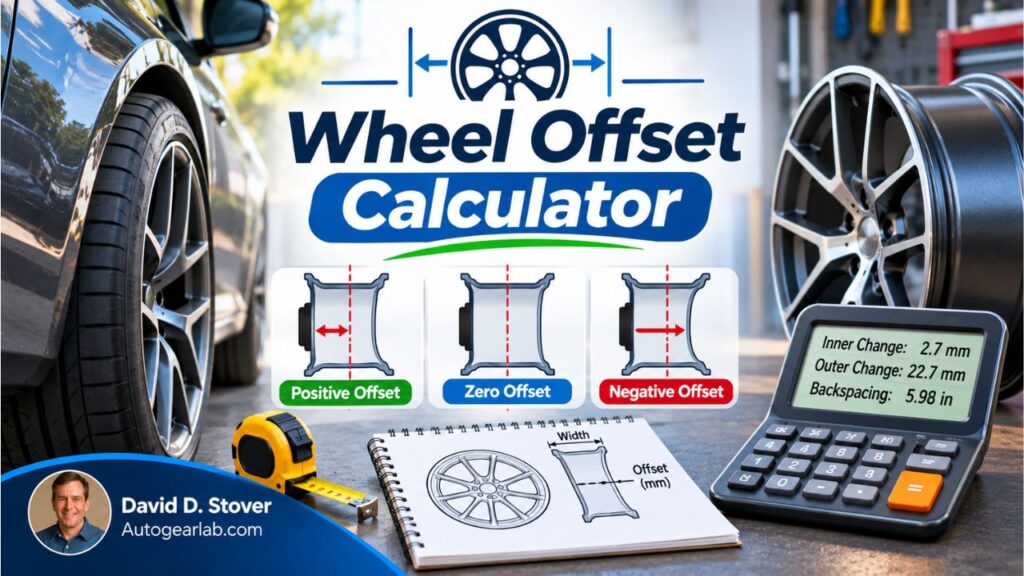
It uses four measurements:
- Current wheel width
- Current wheel offset
- New wheel width
- New wheel offset
The calculator then estimates how the wheel’s inner and outer edges move relative to their original positions.
Step 1: Enter Your Current Wheel Width
Find the Current Wheel section.
In the Wheel Width field, enter your existing wheel width in inches.
For example, enter 8 if your factory wheel is 8 inches wide.
The calculator initially uses 8 inches as its example.
Wheel width is measured between the tire bead seats, not across the outermost edges of the wheel lips.
Common wheel widths include:
- 6.5 inches
- 7 inches
- 7.5 inches
- 8 inches
- 8.5 inches
- 9 inches
- 9.5 inches
- 10 inches
- 10.5 inches
- 11 inches
- 12 inches
The calculator supports widths from 4 to 16 inches, with 0.5-inch increments in its input controls.
Check the actual specifications of your wheels rather than estimating width by appearance.
Step 2: Enter Your Current Wheel Offset
In the Wheel Offset field under Current Wheel, enter your existing wheel offset in millimeters.
For example, if your factory wheel has a positive 35 mm offset, enter:
35
If it has a negative 12 mm offset, enter:
-12
The calculator supports offsets between -100 mm and +100 mm.
It uses +35 mm as its default example.
Wheel offset may be marked on the back of the wheel using the letters ET, followed by a number.
For example, ET35 commonly indicates a positive 35 mm offset.
If you’re unsure about the offset, check the manufacturer’s wheel specifications or have the wheel measured.
Step 3: Enter Your New Wheel Width
Move to the New Wheel section.
Enter the width of the aftermarket wheel you’re considering.
For example, suppose you’re replacing an 8-inch-wide wheel with a 9-inch-wide wheel.
Enter:
9
The calculator uses this difference to determine how much extra wheel width extends toward the suspension and fender.
Step 4: Enter Your New Wheel Offset
In the New Wheel Offset field, enter the offset of the replacement wheel.
For example:
25
This represents a positive 25 mm offset.
Your comparison now looks like this:
| Measurement | Current Wheel | New Wheel |
|---|---|---|
| Wheel width | 8 inches | 9 inches |
| Wheel offset | +35 mm | +25 mm |
Step 5: Click Calculate
After entering the four values, click Calculate.
The calculator estimates the differences in wheel position.
For the example above, the results are:
| Result | Calculated Value |
|---|---|
| Outer wheel position | 22.7 mm farther outward |
| Inner wheel position | 2.7 mm closer to suspension |
| Wheel width difference | +25.4 mm |
| Offset difference | -10 mm |
| Current wheel backspacing | Approximately 5.88 inches |
| New wheel backspacing | Approximately 5.98 inches |
These results describe wheel geometry, not guaranteed physical clearance.
Step 6: Understand the Inner Position Change
The Inner Position result describes how the inner rim edge moves relative to the original wheel.
A positive value means the new inner rim edge moves farther toward the suspension.
A negative value means it moves away from the suspension.
For example:
+2.7 mm inner position change
This means the inner rim edge extends approximately 2.7 mm farther toward the suspension than the previous wheel.
If everything else remains geometrically identical, the change reduces the available rim-edge clearance by approximately that amount.
However, actual suspension clearance also depends on wheel construction, tire dimensions, and vehicle components.
Step 7: Understand the Outer Position Change
The Outer Position result estimates how far the outer rim edge moves relative to the original wheel.
A positive value means the new outer edge moves outward toward the fender.
A negative value means it moves inward.
For example:
+22.7 mm outer position change
This means the replacement wheel extends approximately 22.7 mm farther outward than the original wheel.
This outward movement is commonly described as increased wheel poke.
It does not mean the tire itself will extend exactly 22.7 mm farther outward.
Step 8: Review the Backspacing Results
The calculator displays approximate backspacing for both wheels.
These estimates include a standard 1-inch total allowance for the wheel flanges.
Actual backspacing may vary because wheel-lip dimensions and designs are not identical across all products.
For precise measurements, use the manufacturer’s specifications or measure the physical wheel.
How Does My Wheel Offset Calculator Work?
The calculator uses wheel width and offset to determine the position of the wheel edges relative to the mounting surface.
It converts wheel width from inches to millimeters, calculates each wheel’s inner and outer positions, and subtracts the original values from the new values.
Formula 1: Convert Wheel Width to Millimeters
Wheel width is normally specified in inches, while offset is specified in millimeters.
Both measurements must use the same unit for position calculations.
Wheel Width (mm) = Wheel Width (inches) × 25.4
For an 8-inch wheel:
8 × 25.4 = 203.2 mm
For a 9-inch wheel:
9 × 25.4 = 228.6 mm
The difference is:
228.6 − 203.2 = 25.4 mm
Formula 2: Calculate Inner Wheel Position
The calculator determines the inner bead-seat edge position using:
Inner Position (mm) = (Wheel Width in mm ÷ 2) + Wheel Offset
A larger positive result means the inner rim edge extends farther inward from the wheel mounting surface.
For the current 8-inch wheel with +35 mm offset:
Inner Position = (203.2 ÷ 2) + 35
Inner Position = 101.6 + 35
Current Inner Position = 136.6 mm
For the new 9-inch wheel with +25 mm offset:
Inner Position = (228.6 ÷ 2) + 25
Inner Position = 114.3 + 25
New Inner Position = 139.3 mm
The change is:
139.3 − 136.6 = +2.7 mm
The new inner rim edge sits 2.7 mm farther inward.
Formula 3: Calculate Outer Wheel Position
The calculator determines the outer rim-edge position using:
Outer Position (mm) = (Wheel Width in mm ÷ 2) − Wheel Offset
For the current wheel:
Outer Position = 101.6 − 35
Current Outer Position = 66.6 mm
For the new wheel:
Outer Position = 114.3 − 25
New Outer Position = 89.3 mm
The difference is:
89.3 − 66.6 = +22.7 mm
The new wheel extends 22.7 mm farther outward.
Formula 4: Calculate Inner Clearance Change
Inner Position Change = New Inner Position − Current Inner Position
You can also calculate the same result directly:
Inner Change (mm) = [(New Width − Old Width) × 25.4 ÷ 2] + (New Offset − Old Offset)
A positive value means the inner rim edge moves closer to the suspension.
A negative value means it moves away.
Formula 5: Calculate Outer Wheel Poke
Outer Position Change = New Outer Position − Current Outer Position
An equivalent formula is:
Outer Change (mm) = [(New Width − Old Width) × 25.4 ÷ 2] − (New Offset − Old Offset)
A positive value indicates more outward rim position.
A negative value indicates a more tucked-in rim position.
Formula 6: Calculate Approximate Wheel Backspacing
The calculator also estimates backspacing using:
Backspacing (inches) = [(Wheel Width + 1) ÷ 2] + (Offset ÷ 25.4)
The additional 1 inch represents an approximate total flange allowance.
This is necessary because backspacing is normally measured to the inner wheel lip, while nominal wheel width is measured between the bead seats.
For an 8-inch wheel with +35 mm offset:
Backspacing = (8 + 1) ÷ 2 + 35 ÷ 25.4
Backspacing = 4.5 + 1.378
Approximate Backspacing = 5.88 inches
For a 9-inch wheel with +25 mm offset:
Backspacing = (9 + 1) ÷ 2 + 25 ÷ 25.4
Approximate Backspacing = 5.98 inches
These figures should be treated as estimates because actual flange dimensions can vary.
What Is Wheel Offset?
Wheel offset is the distance between a wheel’s centerline and its hub mounting surface, measured in millimeters.
The hub mounting surface is the part of the wheel that contacts the vehicle’s wheel hub.
The centerline is the midpoint of the wheel’s nominal width.
Offset describes how those two reference points are positioned relative to each other.
Wheel offset can be positive, zero, or negative.
The correct offset is important for positioning the tire-and-wheel assembly within the available wheel well.
Positive Wheel Offset
A wheel has positive offset when its mounting surface is positioned toward the outward-facing side of the wheel relative to its centerline.
For example:
ET+35 means positive 35 mm offset.
With wheel width unchanged, increasing positive offset moves the entire wheel inward toward the suspension.
Many modern passenger cars and crossovers use positive-offset wheels.
However, the correct value depends on the vehicle’s particular suspension, brakes, and wheel specifications.
Zero Wheel Offset
A zero-offset wheel has its hub mounting surface aligned with the wheel centerline.
For example:
ET0 = 0 mm offset
For a given wheel width, equal portions of the nominal rim width extend inward and outward from the centerline.
Zero-offset wheels are found in some specialty, truck, and aftermarket applications.
Negative Wheel Offset
A wheel has negative offset when its mounting surface is positioned toward the inner side of the wheel relative to the centerline.
For example:
ET-12 means negative 12 mm offset.
With wheel width unchanged, moving toward a more negative offset pushes the wheel farther outward.
Negative-offset wheels are often associated with deep-dish designs and some off-road applications.
However, not every vehicle can safely accommodate negative-offset wheels.
For a visual explanation of positive, zero, and negative offset, see Tire Rack’s wheel offset guide, which describes how mounting-surface position influences wheel placement and clearance.
Positive vs. Negative Wheel Offset
The main difference between positive and negative offset is the position of the mounting surface relative to the wheel centerline.
| Offset Type | Mounting Surface Position | General Wheel Position |
|---|---|---|
| Positive | Toward outward-facing side | More inward at the same width |
| Zero | Aligned with centerline | Centered |
| Negative | Toward inner side | More outward at the same width |
These descriptions assume wheel width remains unchanged.
If you change wheel width at the same time, the inner and outer edge positions must be calculated separately.
Does More Positive Offset Mean More Clearance?
Not necessarily.
Increasing positive offset moves a wheel inward when its width remains the same.
This may create more room near the outer fender but reduce clearance around suspension components.
Does Negative Offset Always Mean Better Fitment?
No.
Negative offset may increase inner clearance, but it also moves the wheel farther outward.
This can increase the risk of contact with the fender, wheel arch, or bodywork during steering and suspension movement.
The correct offset is determined by the complete vehicle and wheel combination.
Wheel Offset vs. Backspacing: What’s the Difference?
Wheel offset and backspacing are closely related, but they are different measurements.
Wheel Offset
Wheel offset measures the distance from the nominal wheel centerline to the hub mounting surface.
It is normally measured in millimeters.
Examples include:
- +45 mm
- +35 mm
- +20 mm
- 0 mm
- -12 mm
Wheel Backspacing
Backspacing measures the distance from the wheel’s hub mounting surface to the innermost wheel lip.
It is commonly measured in inches.
For example:
- 4.5 inches
- 5 inches
- 5.5 inches
- 6 inches
Wheel Offset and Backspacing Comparison
| Feature | Offset | Backspacing |
|---|---|---|
| Main measurement | Centerline to mounting surface | Mounting surface to inner lip |
| Common unit | Millimeters | Inches |
| Uses nominal wheel width | Yes | Physical rim dimensions |
| Indicates inner wheel position | Indirectly | Direct physical measurement |
| Can be positive or negative | Yes | Normally a positive distance |
Backspacing is particularly useful when checking how close the wheel barrel may sit to suspension components.
Offset is useful for comparing wheel specifications and understanding wheel position relative to the hub.
Why the Calculator Uses a Flange Allowance
Nominal rim width is measured between the bead seats, not from the outside of one lip to the outside of the other.
The physical wheel is generally wider than its advertised nominal width.
My calculator assumes an additional 1 inch of total wheel width to estimate backspacing.
That approximation is useful for planning, but actual backspacing should be verified using product specifications or a physical measurement.
How to Measure Wheel Width Correctly
Accurate width measurements are essential when comparing wheel offset.
A common mistake is measuring across the outer edges of the wheel and treating that number as nominal rim width.
Bead-Seat Width vs. Overall Width
Nominal wheel width is measured from bead seat to bead seat.
The bead seats are the locations where the tire beads rest against the wheel.
Overall width includes the outer wheel flanges.
For example, an 8-inch nominal wheel might measure approximately 9 inches across its outer lips.
Actual dimensions vary by wheel design.
How to Find Your Wheel Width
You can check:
- The wheel’s manufacturer specifications
- Size markings cast or stamped on the wheel
- Original equipment specifications
- Documentation from the wheel supplier
- A direct measurement between the bead seats
If the tire is mounted, the bead seats generally cannot be measured directly.
A wheel specialist can confirm the correct width when necessary.
Discount Tire’s wheel width measurement guide explains why bead-seat width differs from outside-to-outside wheel width and how to avoid measurement errors.
What Does 18×8.5 Mean?
A wheel marked 18×8.5 generally has:
- 18-inch nominal diameter
- 8.5-inch nominal width
The diameter determines the required tire bead-seat diameter.
The width helps determine compatible tire sizes and wheel position.
The calculator uses the 8.5-inch width, not the 18-inch diameter, for its inner and outer position calculations.
How to Find or Measure Wheel Offset
You need the correct offset measurement before comparing wheels.
Check the Wheel Markings
Many wheels have their specifications cast, stamped, or engraved on the rear.
For example:
18×8.5J ET35
This may indicate:
- 18-inch nominal wheel diameter
- 8.5-inch nominal width
- J-type rim flange contour
- +35 mm offset
Marking formats vary by manufacturer.
Check the Manufacturer’s Specifications
If you know the exact wheel brand, model, diameter, and width, the manufacturer may provide the offset in its product specifications.
Make sure you select the correct wheel variant.
The same wheel design may be available in several widths and offsets.
How to Calculate Offset From Backspacing
When you know actual backspacing and overall wheel width, you can calculate offset.
Offset (mm) = [Backspacing − (Overall Wheel Width ÷ 2)] × 25.4
For example:
- Measured overall width: 9 inches
- Backspacing: 5.5 inches
Offset = (5.5 − 4.5) × 25.4
Offset = +25.4 mm
If you only know the nominal width, you must first estimate or measure the overall width.
Measuring Backspacing on a Wheel
For a wheel removed from the vehicle and prepared safely for measurement:
- Place the wheel with its mounting surface accessible and the inner side facing upward.
- Lay a straightedge across the inner wheel lip.
- Measure the perpendicular distance from the mounting surface to the straightedge.
- Record the measurement in inches.
- Confirm it against the manufacturer’s specification when possible.
The straightedge must contact the appropriate rim edge rather than resting on a tire or protruding feature.
Wheel Offset Comparison Examples
The following examples show how wheel width and offset work together.
Example 1: Changing From 18×8 +35 to 18×9 +25
Original Wheel
- Diameter: 18 inches
- Width: 8 inches
- Offset: +35 mm
New Wheel
- Diameter: 18 inches
- Width: 9 inches
- Offset: +25 mm
Calculated results:
| Measurement | Difference |
|---|---|
| Wheel width | +25.4 mm |
| Offset | -10 mm |
| Inner wheel edge | 2.7 mm inward |
| Outer wheel edge | 22.7 mm outward |
This combination increases outward wheel position while also slightly reducing inner rim-edge clearance.
Whether it fits depends on the actual available clearances and the selected tire.
Example 2: Same Width, Lower Offset
Suppose both wheels are 8 inches wide.
Current offset: +35 mm
New offset: +20 mm
Offset difference:
20 − 35 = -15 mm
With the wheel width unchanged:
- Inner rim edge moves 15 mm away from the suspension.
- Outer rim edge moves 15 mm outward.
Reducing offset by 15 mm moves the entire wheel approximately 15 mm outward.
Example 3: Same Offset, Wider Wheel
Suppose you change from an 8-inch wheel to an 8.5-inch wheel while keeping +35 mm offset.
Width difference:
0.5 × 25.4 = 12.7 mm
Half the width difference:
12.7 ÷ 2 = 6.35 mm
The result is:
- Inner rim edge moves 6.35 mm inward.
- Outer rim edge moves 6.35 mm outward.
Increasing width without changing offset distributes the extra width equally between the inner and outer sides.
Example 4: Wider Wheel With Higher Offset
Current wheel: 8 inches wide, +35 mm
New wheel: 9 inches wide, +45 mm
Results:
- Inner rim edge moves 22.7 mm closer to the suspension.
- Outer rim edge moves 2.7 mm outward.
This combination demonstrates why choosing a wider wheel with a higher positive offset can create substantial inward clearance concerns.
Wheel Offset Change Comparison Chart
The following chart assumes both the original and replacement wheels have exactly the same width.
| Original Offset | New Offset | Inner Edge Movement | Outer Edge Movement |
|---|---|---|---|
| +35 mm | +45 mm | 10 mm inward | 10 mm inward |
| +35 mm | +25 mm | 10 mm outward | 10 mm outward |
| +35 mm | +15 mm | 20 mm outward | 20 mm outward |
| +35 mm | 0 mm | 35 mm outward | 35 mm outward |
| +20 mm | +35 mm | 15 mm inward | 15 mm inward |
| 0 mm | -12 mm | 12 mm outward | 12 mm outward |
When only offset changes, the entire wheel moves by the difference between the two offset values.
When width also changes, the extra width must be included in the calculation.
What Is Wheel Poke?
Wheel poke describes how far a wheel or tire extends outward relative to a reference position, often the vehicle’s fender.
Drivers sometimes use the term to describe a wheel that sits farther outside the wheel arch.
My calculator estimates the change in the outer rim position.
It does not measure actual distance beyond the vehicle’s fender.
Does More Wheel Poke Mean the Tire Will Stick Out?
Not necessarily.
A wheel can move outward without extending beyond the fender.
Whether the tire protrudes depends on the original fender clearance, tire section width, sidewall shape, and the new wheel geometry.
For example, a new rim extending 15 mm farther outward may still fit beneath the fender if there is sufficient available space.
Wheel Poke vs. Flush Fitment
A flush fitment generally describes a wheel-and-tire combination that visually aligns closely with the outer fender.
However, a static flush appearance does not guarantee sufficient clearance during steering or suspension compression.
Actual clearance should be checked throughout the required range of movement.
Can Negative Offset Create More Poke?
Yes.
For two wheels of equal width, moving from a positive offset to a lower or negative offset shifts the wheel outward.
However, the resulting stance must still be compatible with the vehicle’s suspension and steering geometry.
Wheel Offset and Inner Suspension Clearance
Inner clearance is the space available between the wheel-and-tire assembly and nearby suspension components.
Potential interference points include:
- Struts
- Springs
- Control arms
- Steering components
- Inner wheel-well liners
- Other vehicle-specific components
What Does Closer to Strut Mean?
If the calculator shows:
+5 mm closer to strut
It means the new inner rim edge is predicted to extend 5 mm farther inward than the original rim edge.
It does not mean the wheel will necessarily touch the strut.
The calculator does not know the original gap.
Estimating the Remaining Inner Clearance
If you have separately measured the actual rim-edge-to-component clearance, you can estimate the change.
Estimated New Inner Gap = Original Inner Gap − Calculated Inner Position Change
For example:
Original measured gap: 12 mm
Calculated inner change: +4 mm
Estimated new gap:
12 − 4 = 8 mm
This is only a simplified static estimate using the same reference point.
It does not account for tire bulge, wheel-barrel shape, component movement, or measurement uncertainty.
Do not treat the calculated gap as proof that the fitment is safe.
What If the Calculator Shows a Negative Inner Change?
A negative inner change means the new inner rim edge moves away from the suspension compared with the original wheel.
This generally increases inner rim-edge space under the same geometry.
However, other dimensions may still create interference.
How Wheel Offset Affects Fender Clearance
Fender clearance is the available space between the tire-and-wheel assembly and the vehicle body.
A wheel that extends farther outward may approach the fender edge or wheel-arch liner.
Potential Fender Contact
Possible interference may occur during:
- Suspension compression
- Sharp steering angles
- Driving over bumps
- Carrying heavy loads
- Cornering
- Changes in suspension height
The calculator predicts outer rim-edge movement but cannot determine actual dynamic clearance.
Does a Wider Wheel Always Rub the Fender?
No.
A wider wheel may fit if its width, offset, tire dimensions, and vehicle clearances are compatible.
However, increasing width can reduce available space on one or both sides.
A verified vehicle-specific wheel-and-tire fitment is more dependable than using wheel width alone.
Does Lowering a Car Change Wheel Offset?
Lowering a car does not physically change the wheel’s manufactured offset.
However, suspension changes can affect wheel alignment, camber, ride height, and available travel.
These changes may alter tire-to-fender clearance.
A wheel combination that clears at standard ride height may not clear after suspension modifications.
Wheel Offset and Tire Size Compatibility
Wheel offset affects the wheel’s position, while tire size affects the overall dimensions of the mounted tire.
Both must be considered together.
Why Tire Width Matters
Tires often extend beyond the outer edges of the wheel itself.
The amount of sidewall bulge depends on tire construction, nominal section width, and the width of the wheel used for mounting.
For example, two different tire models with the same nominal size may have different measured section widths.
Consequently, a wheel offset calculation alone cannot determine exact tire clearance.
Matching Tire Width to Wheel Width
Every tire has an approved rim width range established by its manufacturer or applicable industry standards.
Installing a tire on a wheel outside its approved range can create handling and safety problems.
Always check the specific tire’s technical specifications.
Wheel Diameter and Tire Diameter
The wheel’s nominal diameter must match the tire’s required rim diameter.
For example, a tire marked R18 requires a compatible 18-inch rim diameter.
A change in overall tire diameter can also affect speedometer readings, vehicle clearance, and drivetrain operation.
These factors require separate evaluation.
Why the Calculator Doesn’t Ask for Tire Size
My Wheel Offset Calculator is designed specifically to compare wheel geometry.
It does not include tire section width, aspect ratio, sidewall shape, or overall tire diameter in its calculations.
For that reason, its results should not be interpreted as a complete tire fitment assessment.
Does Wheel Offset Affect Steering and Handling?
It can.
Changing wheel offset changes the wheel’s position relative to the hub and suspension.
A substantial change may affect steering geometry and how forces act on suspension and wheel-bearing components.
Steering Scrub Radius
Scrub radius relates to the relationship between the steering axis and the tire contact patch at the road surface.
Changing wheel position can alter this relationship.
Depending on the suspension design, the change may affect steering feedback, road sensitivity, and the way the vehicle responds during braking.
Steering Effort and Feedback
A different wheel position can affect steering feel.
Changes may be particularly noticeable when combined with different tire widths, wheel weights, and tire constructions.
Wheel Bearings and Suspension Loads
Moving the wheel-and-tire assembly farther from its intended position can alter leverage and loading on wheel bearings and suspension components.
However, the effect depends on the overall vehicle geometry and operating conditions.
The calculator does not estimate wheel-bearing life or suspension loads.
Does Offset Change Wheel Alignment?
Wheel offset itself is not the same measurement as camber, caster, or toe.
Installing wheels with a different offset does not directly set those alignment angles.
However, changes in wheel position and accompanying suspension or tire modifications may affect handling and can warrant professional evaluation.
Wheel Offset for Trucks and Off-Road Vehicles
Wheel offset is especially important when selecting aftermarket wheels for trucks and SUVs.
Off-road wheels may use wider rims or more outward offsets to achieve a particular stance or accommodate certain tire combinations.
Positive Offset Truck Wheels
Some trucks use positive-offset factory wheels designed around their hubs, brakes, suspension, and body clearances.
A replacement wheel should be selected using vehicle-specific fitment requirements.
Zero-Offset Truck Wheels
A zero-offset wheel may sit farther outward than a positive-offset factory wheel of the same width.
The amount of outward movement depends on the original offset.
For example, replacing a +35 mm wheel with a 0 mm wheel of identical width moves the rim approximately 35 mm outward.
Negative-Offset Truck Wheels
Negative-offset wheels may create a more aggressive outward stance.
However, they may also increase the likelihood of fender interference or changes in steering behavior.
They are not automatically appropriate for lifted trucks or larger tires.
Does a Lift Kit Fix Wheel Offset Problems?
A suspension lift may change some available clearances, but it does not correct every fitment issue.
Wheel-to-brake clearance, steering geometry, suspension interference, and tire width must still be evaluated.
The correct wheel specifications should be verified for the actual suspension and tire configuration.
Wheel Spacers vs. Lower-Offset Wheels
Wheel spacers and lower-offset wheels can both change how far a wheel sits outward.
However, they are not mechanically identical.
How a Wheel Spacer Changes Position
A wheel spacer is installed between the vehicle hub and wheel mounting surface.
A properly installed spacer of a specified thickness moves the wheel outward by approximately that thickness.
For example, a 10 mm spacer moves the wheel outward by about 10 mm relative to the original hub mounting face.
Effective Offset Formula
For a basic geometric comparison:
Effective Offset = Wheel Offset − Spacer Thickness
Suppose a wheel has:
- Offset: +35 mm
- Spacer thickness: 10 mm
Effective offset = 35 − 10
Effective Offset = +25 mm
Geometrically, this produces approximately the same wheel-centerline position as a +25 mm wheel of equal width without the spacer.
Important Wheel Spacer Limitations
Wheel spacers affect more than the mathematical offset.
Safe compatibility depends on:
- Hub engagement
- Centering design
- Wheel fastener engagement
- Spacer construction
- Load capacity
- Vehicle manufacturer approval
- Proper installation
- Applicable local requirements
The calculator does not accept spacer thickness as a separate input.
You can use effective offset for a simple geometric comparison, but this does not establish that the spacer setup is safe.
Consult a qualified wheel specialist and follow the vehicle and component manufacturers’ requirements.
How to Choose the Correct Wheel Offset for Your Vehicle
There is no universal wheel offset that fits every car, SUV, or truck.
The correct specification depends on the vehicle and the complete wheel-and-tire assembly.
Start With Your Original Equipment Specifications
Find the original wheel width, diameter, and offset.
Check the owner’s manual, original equipment documentation, or reliable manufacturer specifications.
Use the exact vehicle year, make, model, trim, and brake package.
Confirm the Wheel Bolt Pattern
The wheel’s bolt pattern must match the vehicle hub’s required pattern.
For example, a 5×114.3 mm bolt pattern indicates five mounting holes on a 114.3 mm pitch circle.
The calculator does not check bolt patterns.
Check the Center Bore
The wheel’s center bore must be compatible with the vehicle’s hub.
Some aftermarket wheels use approved hub-centric rings for specific applications.
Always follow the wheel and vehicle manufacturers’ installation requirements.
Check Brake Caliper Clearance
Brake clearance depends on the wheel’s inner barrel diameter and spoke profile.
Two wheels with the same width and offset can provide different brake caliper clearance.
A wheel offset calculation cannot predict those differences.
Verify Wheel Load Rating
The wheel must have adequate load capacity for the intended vehicle and application.
This is especially important for trucks, towing vehicles, and heavily loaded SUVs.
Do not select wheels based solely on appearance or offset.
Confirm Tire Compatibility
Verify the chosen tire’s approved rim width range, load capacity, and speed rating.
The wheel and tire must be suitable for one another and for the vehicle.
Perform a Physical Fitment Check
When appropriate, have a qualified installer verify clearance under the relevant operating conditions.
Tire Rack’s vehicle-specific wheel fitment guidance explains why diameter, width, offset, bolt pattern, spoke design, brake clearance, and other measurements must all be considered before confirming wheel compatibility.
Important: A favorable calculator result does not mean the replacement wheel is guaranteed to fit.
Common Wheel Offset Calculator Mistakes
Confusing Wheel Width With Wheel Diameter
Wheel width and wheel diameter describe different measurements.
The calculator requires width, not diameter.
For an 18×8.5 wheel, enter 8.5 inches.
Measuring the Outside Width Instead of Bead-Seat Width
Wheel widths are specified between the bead seats.
Using overall width instead can produce incorrect position calculations.
Forgetting the Offset Sign
Positive and negative offsets have different meanings.
Entering +25 instead of -25 changes the result significantly.
Check the actual wheel specifications.
Assuming More Negative Offset Always Fits Better
Lower offset generally shifts a wheel outward at the same width.
This may increase inner clearance while reducing outer clearance.
Ignoring the Tire’s Actual Width
The calculator estimates rim-edge movement.
It does not calculate the mounted tire’s full section width or sidewall position.
Assuming Wheel Backspacing Is Exact
The backspacing result uses an approximate 1-inch total wheel-flange allowance.
Actual measured backspacing may differ.
Ignoring Brake Clearance
A wheel may have acceptable inner and outer rim positions but still interfere with brake calipers because of spoke or barrel design.
Assuming the Calculator Confirms Safe Fitment
The tool cannot evaluate vehicle-specific geometry, dynamic suspension movement, load rating, bolt pattern, or hardware compatibility.
Use it for initial comparison, not final installation approval.
Using Different Units
Wheel width is entered in inches.
Wheel offset is entered in millimeters.
Entering offset as inches or width as millimeters will produce incorrect results.
Forgetting About Modified Suspension
Lowering kits, lift kits, aftermarket control arms, and other modifications can change available space.
A wheel combination that fits a stock vehicle may not fit a modified version.
Wheel Offset and Fitment Safety Checklist
Before purchasing or installing replacement wheels, verify the following:
- Current wheel width and offset are correct.
- New wheel width and offset match the intended product.
- Inner rim-edge position change has been reviewed.
- Outer rim-edge movement has been reviewed.
- Tire section width and overall diameter are compatible.
- Wheel diameter matches the selected tire.
- Tire-approved rim width range is satisfied.
- Bolt pattern matches the vehicle.
- Center bore and hub engagement are correct.
- Wheel and tire load ratings are adequate.
- Brake caliper and wheel-barrel clearances are verified.
- Fender and suspension clearance are verified through the required movement.
- Correct wheel fasteners and installation procedures are used.
- Steering, handling, and manufacturer requirements have been considered.
If any of these requirements are uncertain, consult a qualified wheel-and-tire installer before driving on the replacement wheels.
Wheel Offset Calculator FAQs
What Is a Wheel Offset Calculator?
A Wheel Offset Calculator compares the width and offset of two wheels to estimate changes in their inner and outer positions. My calculator also provides approximate backspacing values.
How Do I Calculate Wheel Offset?
Wheel offset can be calculated from the wheel’s hub mounting surface and centerline position. If you know actual backspacing and overall wheel width, subtract half the overall width from backspacing and multiply by 25.4 to express the result in millimeters.
What Does ET35 Mean on a Wheel?
ET35 indicates a positive wheel offset of 35 mm. The mounting surface is positioned 35 mm toward the outward-facing side from the wheel’s nominal centerline.
Is a Higher Offset More Inward or Outward?
With wheel width unchanged, a higher positive offset moves the wheel inward toward the suspension. A lower offset moves it outward.
What Is the Difference Between +35 and +25 Offset?
For two wheels of equal width, changing from +35 mm to +25 mm moves the entire wheel approximately 10 mm outward.
What Happens When You Change From +35 to 0 Offset?
If wheel width stays the same, the wheel moves approximately 35 mm outward. Actual fender clearance and fitment still need to be checked.
Does a Wider Wheel Need a Different Offset?
Not always. However, increasing wheel width changes both inner and outer rim-edge positions. Adjusting offset may be necessary to maintain suitable clearance, depending on the vehicle.
Will 9-Inch Wheels Fit Instead of 8-Inch Wheels?
Possibly, but width alone is insufficient to confirm fitment. You must consider offset, wheel diameter, tire size, bolt pattern, center bore, brake clearance, suspension geometry, and load capacity.
How Much Does a 10 mm Offset Change Move a Wheel?
With wheel width unchanged, a 10 mm offset change shifts the wheel laterally by approximately 10 mm. The direction depends on whether offset increases or decreases.
What Is Wheel Poke?
Wheel poke describes how far the wheel or tire extends outward, often relative to the fender. My calculator estimates the change in outer rim-edge position rather than actual fender protrusion.
Does Lower Offset Increase Wheel Poke?
Generally, yes. When wheel width remains the same, reducing offset moves the wheel outward and can increase poke.
What Is the Difference Between Wheel Offset and Backspacing?
Offset measures the distance between the wheel centerline and mounting surface. Backspacing measures the distance from the mounting surface to the inner wheel lip.
Does Wheel Offset Affect Tire Rubbing?
It can. Changing offset may reduce clearance around suspension components or fenders. Actual rubbing also depends on tire dimensions and suspension movement.
Can I Use the Calculator for Trucks?
Yes. The geometry formulas apply to passenger cars, trucks, SUVs, and many other road vehicles. However, vehicle-specific fitment and load ratings must be verified separately.
Can I Use the Calculator With Negative Offset?
Yes. Enter a negative value, such as -12, in the offset field. The calculator supports offsets from -100 mm to +100 mm.
Does the Calculator Check Brake Clearance?
No. Brake clearance depends on wheel diameter, barrel shape, spoke design, and vehicle-specific brake components.
Does Wheel Diameter Affect Offset?
Wheel diameter and offset are separate measurements. Changing diameter does not automatically change the numerical offset, although it can affect physical brake clearance and tire compatibility.
Can I Calculate Wheel Backspacing From Offset?
Yes. The calculator estimates backspacing using wheel width and offset, with an additional 1-inch total flange allowance. Actual backspacing should be verified when precise measurements matter.
Does Wheel Offset Affect Steering?
It can. Substantial offset changes may affect scrub radius, steering behavior, and suspension loading. The effect depends on the vehicle’s steering and suspension geometry.
Is Zero Offset Better Than Positive Offset?
Not necessarily. The correct offset depends on vehicle design and the required wheel-and-tire fitment. Zero offset is not universally better or safer.
Can I Use Wheel Spacers to Change Effective Offset?
A spacer moves the wheel outward. For a basic geometric comparison, subtract spacer thickness from the wheel’s offset. However, safe spacer installation requires additional compatibility checks.
How Accurate Is My Wheel Offset Calculator?
The geometric calculations are accurate for the entered nominal wheel widths and offsets, subject to rounding. Backspacing is approximate because the calculator assumes a standard flange allowance. The tool does not confirm actual vehicle fitment or tire clearance.
Conclusion
My Wheel Offset Calculator provides a practical way to compare current and replacement wheel specifications before choosing aftermarket wheels.
By entering the width and offset of both wheels, you can estimate how far the inner rim edge moves toward or away from the suspension, how much the outer edge moves toward the fender, and how the approximate backspacing changes.
The calculations are especially useful when comparing wider wheels, different offsets, or alternative wheel designs.
However, wheel offset is only one part of proper fitment. Tire dimensions, brake caliper clearance, bolt pattern, center bore, load ratings, and suspension movement must also be considered.
Use the calculator to understand the geometry of a proposed wheel change, then verify the complete wheel-and-tire combination against your vehicle’s specifications and through an appropriate physical fitment check before installation.