This Car Battery Voltage Checker helps you understand whether a measured 12-volt car battery reading is within a common operating range, partially discharged, or potentially abnormal. Enter the voltage measured with a multimeter, select whether the engine is off or running, and the calculator will display an approximate voltage status, visual battery indicator, and suggested next step.
A healthy automotive battery supplies electrical power for starting the engine and operating vehicle electronics when the engine is off. Checking battery voltage can help identify a low state of charge, potential charging concerns, or situations that require additional testing. However, voltage alone cannot confirm battery health, remaining capacity, or cold cranking performance.
The checker is primarily intended for conventional 12V lead-acid automotive batteries. AGM batteries, smart charging systems, and other battery technologies may produce different readings.
Below the calculator, I explain how to measure battery voltage correctly, use each input, interpret resting and engine-running readings, understand the voltage ranges, recognize warning signs, and decide when charging, additional testing, or professional inspection may be necessary.
AUTO GEAR LAB TOOLS FREE CALCULATOR
Car Battery Voltage Checker
Interpret a 12-volt lead-acid battery reading with the engine off or running.
Enter your details
Your results
Resting voltage is only a rough condition indicator. Test a rested battery with the engine off; AGM, smart charging and lithium systems can differ.
How to Use My Car Battery Voltage Checker
My Car Battery Voltage Checker is designed to interpret a voltage reading that you have already measured from your vehicle’s 12V battery.
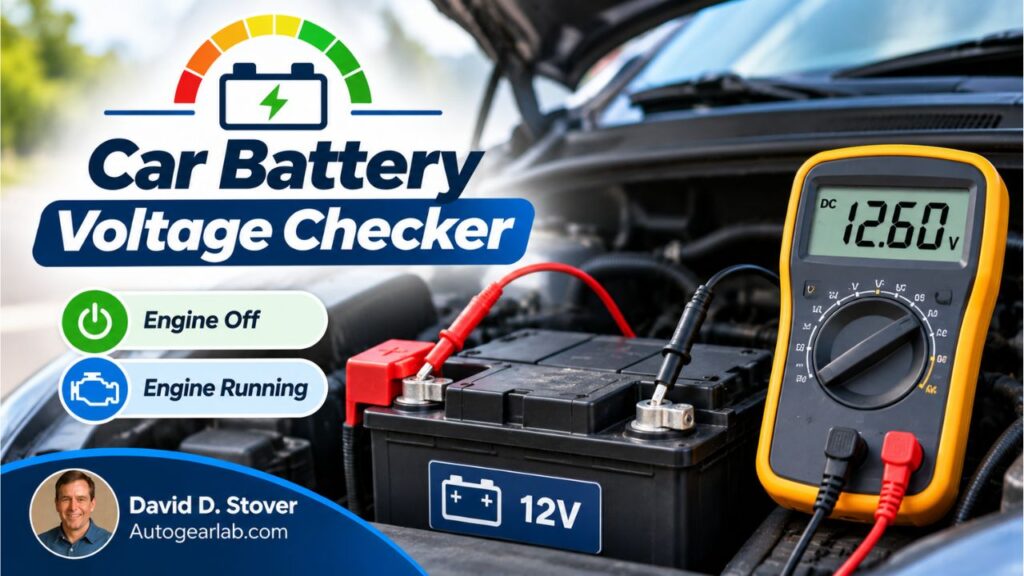
The calculator does not connect directly to your car or automatically measure voltage. You need a suitable digital multimeter or battery voltage tester to obtain the reading.
It has two main input fields:
- Measured Battery Voltage
- When Was the Voltage Measured?
Follow these steps to interpret your battery reading.
Step 1: Measure Your Car Battery Voltage
Start by measuring the voltage of your vehicle’s 12V battery using a suitable digital multimeter.
For a resting battery reading, the engine and electrical accessories should be switched off, and the battery should have had enough time to settle after charging or driving.
Set the multimeter to measure DC voltage and select a range suitable for a 12V automotive battery.
Connect the red probe to the positive (+) battery terminal and the black probe to the negative (-) terminal.
Read the voltage displayed on the meter.
For example, the multimeter might display:
12.48V
Record this measurement before using the calculator.
If you are unfamiliar with electrical testing or the battery is damaged, have the vehicle inspected by a qualified technician.
Step 2: Enter the Measured Battery Voltage
Find the Measured Battery Voltage field.
Enter your reading in volts.
For example:
- 12.60 for a resting reading of 12.60 volts
- 12.35 for a resting reading of 12.35 volts
- 14.20 for an engine-running reading of 14.20 volts
The calculator accepts measurements from 8.00V to 18.00V.
Its default example is 12.60V.
Use the actual number displayed on your multimeter rather than estimating the voltage from a dashboard battery icon.
Step 3: Select When the Voltage Was Measured
The calculator provides two measurement conditions.
Engine Off / Battery Rested
Choose this option when measuring a battery that has been allowed to settle with the engine and accessories off.
This mode estimates the battery’s charge condition based on its resting voltage.
Engine Running
Choose this option when measuring system voltage at the 12V battery terminals while the vehicle’s engine is operating.
This mode compares the reading with a common conventional charging-voltage range.
The two conditions use different thresholds, so choosing the correct mode is essential.
Step 4: Click Calculate
After entering your voltage and measurement condition, select Calculate.
The calculator displays:
- Measured voltage
- Voltage status
- Visual battery indicator
- Approximate interpretation
- Suggested next step
For example, if you enter 12.60V and select Engine Off / Battery Rested, the result will indicate Near fully charged.
If you enter 12.20V under the same condition, the result will indicate Moderately discharged.
Step 5: Review the Battery Voltage Status
Read the status message alongside the explanatory note.
For a resting measurement, the calculator may indicate that the battery is near fully charged, partially discharged, or at a lower charge level.
For an engine-running measurement, it indicates whether the reading falls below, within, or above a common charging range.
These are screening categories, not definitive battery or alternator diagnoses.
Step 6: Follow the Suggested Next Step
The calculator provides different general guidance depending on your selection.
For resting-voltage readings, it recommends charging and appropriate battery testing when the battery appears weak.
For engine-running readings, it recommends comparing the result with vehicle-specific charging specifications and inspecting the charging system if warning signs are present.
Important: A reading within the calculator’s normal category does not guarantee that your battery can reliably start the engine.
How Does My Car Battery Voltage Checker Work?
Unlike a fuel cost or MPG calculator, the Car Battery Voltage Checker does not calculate a result using a mathematical formula.
Instead, it uses voltage-range classification.
The calculator compares your measured voltage with predefined ranges associated with two different operating conditions.
How Resting Battery Voltage Is Evaluated
When you select Engine Off / Battery Rested, the checker compares the voltage with general reference ranges for 12V lead-acid batteries at moderate temperatures.
The categories include:
- Near fully charged
- Partially discharged
- Moderately discharged
- Low state of charge
- Very low voltage
- Unusually high resting reading
For example, a resting reading of 12.45V falls into the plugin’s partially discharged category.
A resting reading of 11.90V falls into its very low voltage category.
How Engine-Running Voltage Is Evaluated
When you select Engine Running, the calculator uses a different classification.
It checks whether the reading is:
- Below a common charging range
- Within a common charging range
- Above a common charging range
A reading of 14.20V falls inside its common charging range.
A reading of 13.20V falls below that range.
However, vehicle-specific charging strategies can make these readings appropriate under some conditions.
How the Visual Battery Indicator Works
The calculator includes a battery-shaped visual indicator.
This illustration changes according to the voltage category.
For resting readings, the visual uses approximate fill levels representing the selected category.
The displayed fill level is not a measured battery state-of-charge percentage.
For example, a full-looking indicator does not prove that the battery has 100% usable capacity or is in good health.
The battery graphic is designed to make the voltage category easier to understand.
Car Battery Voltage Chart: Engine Off
The following chart shows the exact general voltage categories used by my calculator for an engine-off, rested 12V lead-acid battery.
| Resting Battery Voltage | Calculator Status |
|---|---|
| Above 12.90V | Unusually high resting reading |
| 12.60V–12.90V | Near fully charged |
| 12.40V to below 12.60V | Partially discharged |
| 12.20V to below 12.40V | Moderately discharged |
| 12.00V to below 12.20V | Low state of charge |
| Below 12.00V | Very low voltage |
These classifications are approximate and primarily intended for conventional 12V lead-acid batteries.
They should not be treated as universal thresholds for every battery chemistry, temperature, or vehicle.
What Does 12.6V Mean on a Car Battery?
A resting voltage around 12.6V commonly indicates that a conventional 12V automotive lead-acid battery is near a fully charged condition.
My calculator classifies 12.60V as Near fully charged.
However, a battery can show satisfactory resting voltage and still be unable to deliver sufficient starting current.
If the vehicle cranks slowly despite a normal resting reading, additional battery testing is appropriate.
What Does 12.4V Mean?
A rested battery reading of 12.4V suggests a lower charge level than a reading near 12.6V or above.
The calculator classifies 12.40V as Partially discharged.
This does not automatically mean the battery needs replacement.
It may need to be recharged, particularly if the vehicle has been parked for an extended period or has experienced repeated short trips.
Is 12.2V a Low Battery Reading?
A rested 12.2V reading indicates substantial discharge relative to a fully charged conventional starting battery.
The calculator classifies this as Moderately discharged.
A battery at this voltage may still start some vehicles, but starting performance becomes less reliable under demanding conditions.
Cold temperatures and high engine-starting requirements can make the situation worse.
What Does 12.0V Mean?
The calculator classifies a resting reading of 12.0V as Low state of charge.
This indicates that the battery is considerably discharged.
A compatible battery charger and further testing may be appropriate.
Avoid assuming that a short drive will fully recover a significantly discharged battery.
What If the Battery Reads Below 12V?
A rested reading below 12.0V is classified as Very low voltage.
Possible explanations include:
- An extensively discharged battery
- Long periods without charging
- Excessive electrical draw while parked
- A battery that no longer holds charge properly
- A charging-system problem
- An internal battery fault
A very low reading warrants attention, but voltage alone cannot identify the exact cause.
If the battery is swollen, leaking, unusually hot, or otherwise damaged, do not attempt ordinary charging or jump-starting.
Why Would a Resting Battery Read Above 12.9V?
A resting voltage above 12.9V can result from surface charge after driving or charging.
Some AGM and specialized batteries also have higher normal open-circuit voltages than conventional flooded starting batteries.
The calculator flags these readings because additional context is needed, not because a reading above 12.9V automatically means the battery is defective.
For example, certain fully charged OPTIMA deep-cycle AGM batteries can have resting voltages around 13.0–13.2V.
OPTIMA explains battery-specific voltage ranges and surface-charge effects in its guide to measuring battery voltage.
Car Battery Voltage Chart: Engine Running
When the engine is running, the voltage measured at the battery terminals often reflects the operation of the vehicle’s charging system.
This differs from the battery’s resting voltage.
My calculator uses the following general ranges:
| Engine-Running Voltage | Calculator Status |
|---|---|
| Below 13.50V | Below common charging range |
| 13.50V–14.80V | Within a common charging range |
| Above 14.80V | Above common charging range |
These ranges are useful for initial screening of conventional charging systems.
They are not universal alternator specifications.
Is 13.5V Normal With the Engine Running?
A reading of 13.5V is at the lower end of the calculator’s common charging range.
Whether it is appropriate depends on vehicle design, battery condition, electrical load, temperature, and charging strategy.
A reading near this level does not prove the alternator is fully functional.
Is 14.2V a Good Charging Voltage?
For many conventional 12V charging systems, a battery-terminal reading around 14.2V with the engine running is common.
The calculator categorizes 14.2V as Within a common charging range.
However, the charging system still needs to meet the manufacturer’s specifications under the applicable operating conditions.
What Does 14.8V Mean?
A reading of 14.8V is the upper boundary of the calculator’s common charging range.
Some batteries and charging systems may operate around this voltage under particular temperature and charging conditions.
Do not automatically conclude that the alternator is faulty solely because its measured voltage is near the upper end.
Is 15V Too High for a Car Battery?
A reading of 15.0V is above the calculator’s common range and will trigger a warning.
However, some charging systems use higher voltages under particular conditions.
The correct interpretation depends on the vehicle’s charging strategy and battery technology.
If voltage remains above the vehicle manufacturer’s specified limit, professional inspection may be necessary to identify a possible voltage-regulation problem.
Why Does My Car Show Only 12.8V While Running?
Several possibilities exist.
A conventional charging system might not be providing the expected charging output.
However, a modern vehicle with computer-controlled charging may deliberately reduce alternator output during certain operating conditions.
A single 12.8V engine-running measurement is therefore not enough to diagnose alternator failure.
Check vehicle-specific service information and look for other symptoms.
How to Check Car Battery Voltage With a Multimeter
A digital multimeter is one of the most useful tools for measuring automotive battery voltage.
It can help determine whether a battery appears discharged and whether the charging system is producing a plausible voltage.
What You Need
For a basic measurement, prepare:
- A suitable digital multimeter
- Insulated test probes
- Safety glasses
- The vehicle owner’s manual
- A clean, accessible battery testing location
You do not need to disconnect the battery for an ordinary voltage measurement when the manufacturer permits testing at the installed battery terminals.
Step 1: Park Safely
Park on a stable, level surface.
Switch off the engine and electrical accessories.
Apply the parking brake.
Make sure the vehicle cannot move unexpectedly.
Step 2: Locate the 12V Battery
The battery may be located under the hood, in the trunk, beneath a seat, or in another compartment.
Some vehicles provide designated remote electrical testing points.
Use the locations specified in the owner’s manual.
Do not access orange high-voltage cables or traction-battery components in hybrid or electric vehicles.
Step 3: Allow the Battery to Rest
For a meaningful open-circuit voltage measurement, allow the battery to settle after driving or charging.
A recently charged battery can temporarily display an elevated voltage because of surface charge.
Where practical, letting the battery rest for several hours or overnight can improve the usefulness of the reading.
Follow battery-specific testing instructions when available.
Step 4: Set the Multimeter to DC Voltage
Turn the multimeter to the DC voltage setting.
On a manually ranging multimeter, a range around 20V DC is commonly appropriate for a conventional 12V battery.
For an auto-ranging meter, select DC voltage and follow the instrument instructions.
Do not use resistance or current-measurement modes for an ordinary battery-terminal voltage test.
Step 5: Connect the Test Probes
Connect the red probe to the positive (+) terminal.
Connect the black probe to the negative (-) terminal or an approved test point specified by the vehicle manufacturer.
Keep the metal probe tips from touching each other.
Avoid allowing tools or jewelry to bridge the battery terminals.
Step 6: Read the Voltage
Observe the number displayed on the multimeter.
For example:
12.54V
Record the result.
Enter this value into the calculator using Engine Off / Battery Rested.
Step 7: Interpret the Reading
A reading of 12.54V falls into the calculator’s Partially discharged category.
If the reading suggests a low charge level, use a compatible charging method and consider additional testing.
Step 8: Check Engine-Running Voltage if Appropriate
If you are qualified and comfortable working near a running engine, you can perform a separate charging-system voltage measurement following the vehicle and test-equipment instructions.
Keep test leads, clothing, hair, and hands away from belts, fans, pulleys, and moving parts.
Use secure approved test connections. Do not reposition loose probes near moving engine components.
Record the engine-running voltage and select Engine Running in the calculator.
Never disconnect the battery while the engine is running as a method of testing the alternator.
Why Does My Car Battery Voltage Change?
Battery voltage is not a permanently fixed number.
It changes in response to charge level, operating conditions, electrical demand, battery chemistry, and temperature.
State of Charge
A discharged lead-acid battery generally has a lower resting voltage than a fully charged battery of the same type under similar conditions.
This is why resting voltage can provide an approximate indication of charge condition.
Surface Charge
After charging, a battery may temporarily show a higher voltage than its settled open-circuit value.
This can make a recent charging session appear to have restored the battery more fully than it actually has.
Temperature
Battery temperature affects electrochemical behavior, available starting performance, and voltage interpretation.
Cold weather can reduce a battery’s ability to deliver high starting current.
Temperature also influences the voltage a charging system may use.
Electrical Accessories
Headlights, cabin fans, audio equipment, and other accessories consume electrical energy.
If the engine is off, they draw power from the battery.
With the engine running, the charging system must support electrical loads while maintaining battery charge.
Alternator Operation
In a conventional gasoline or diesel vehicle, the alternator supplies electrical energy while the engine runs.
Voltage can change as the charging system responds to demand.
Battery Age and Condition
An older battery may have reduced capacity or increased internal resistance.
It may appear charged at rest but struggle to deliver sufficient starting current.
This is why a voltage reading alone cannot confirm battery health.
Car Battery Voltage vs. State of Charge vs. Battery Health
These terms are related but describe different characteristics.
Battery Voltage
Voltage is the electrical potential difference measured across the battery terminals.
The calculator interprets this measured value.
State of Charge (SOC)
State of charge describes how much charge is available relative to the battery’s current full-charge reference.
A resting-voltage reading can provide a rough SOC indication for certain lead-acid batteries.
However, exact SOC cannot be reliably determined from a universal voltage chart.
State of Health (SOH)
State of health describes the battery’s condition relative to its performance when new.
It may involve remaining capacity, internal resistance, and starting ability.
A battery with a high resting voltage can still have poor state of health.
Cold Cranking Amps (CCA)
CCA is a standardized measure of a starting battery’s ability to deliver current at low temperature under specified test conditions.
CCA is particularly important for engine starting.
My Car Battery Voltage Checker does not measure CCA.
A suitable battery analyzer, conductance tester, or load tester is needed for a more complete battery assessment.
The automotive battery manufacturer Interstate Batteries explains the difference between voltage, charge level, and battery health, including why a battery may show adequate voltage but still fail to start a vehicle.
What Is the Difference Between a Battery Voltage Test and a Load Test?
A battery voltage test and a battery load test answer different questions.
Battery Voltage Test
A voltage test determines the electrical potential at the battery terminals under the measurement conditions.
It can indicate whether a conventional lead-acid battery appears substantially discharged.
It does not directly measure the battery’s ability to deliver large currents.
Battery Load Test
A load test evaluates how the battery performs while supplying a controlled electrical load.
A properly conducted test can help determine whether the battery can support starting-related demands.
Testing conditions and procedures depend on the battery type, temperature, and tester.
Conductance Battery Test
A conductance tester evaluates electrical characteristics associated with battery performance.
Many automotive service facilities use conductance testing equipment to help assess starting battery condition.
It can provide information beyond a simple static voltage measurement.
Which Test Should You Use?
A multimeter is useful for quick screening.
If the vehicle has starting problems or the battery repeatedly loses charge, a proper battery condition test is more informative.
Avoid replacing a battery solely because one voltage measurement falls slightly below a general reference range.
Why Is My Car Battery Voltage Low?
A low resting-voltage reading can have several causes.
Understanding the reason helps determine whether the battery needs charging, further testing, or replacement.
The Vehicle Has Been Parked for Too Long
Car batteries naturally lose charge over time.
Vehicles may also consume electricity while parked to support security systems, memory functions, and control modules.
Extended storage can leave a battery partially or heavily discharged.
Frequent Short Trips
Starting an engine consumes battery energy.
If you drive only short distances, the charging system may not have sufficient opportunity to replace all the energy used.
This is especially relevant when the vehicle has high electrical demands.
Lights or Accessories Were Left On
Interior lights, headlights, or other accessories can drain a battery when the engine is off.
Some vehicles automatically shut off accessories, while others may continue supplying power.
The Battery Is Aging
As a lead-acid battery ages, it can lose usable capacity and starting performance.
It may charge normally but lose voltage more quickly after sitting.
Excessive Parasitic Draw
Parasitic draw refers to electricity consumed while the vehicle is parked and switched off.
Some draw is normal.
An abnormal draw caused by a malfunctioning component, module, or accessory can repeatedly discharge the battery.
A parasitic draw diagnosis requires appropriate current-measurement procedures and vehicle-specific information.
Charging-System Problems
If the alternator or charging system is not adequately replenishing the battery, its state of charge may gradually decline.
Possible causes include electrical faults, charging-control problems, wiring issues, or mechanical problems affecting the alternator.
Car Battery vs. Alternator: How to Tell the Difference
Battery and alternator problems can produce similar symptoms.
These may include slow starting, dim lights, electrical warnings, and difficulty keeping the vehicle running.
Signs of a Weak Battery
Possible symptoms include:
- Slow engine cranking
- Clicking when attempting to start
- Repeated jump-start requirements
- Difficulty starting after the vehicle sits
- Low resting voltage
- Failure during a professional battery condition test
Signs of a Charging-System Problem
Possible symptoms include:
- Battery warning light while driving
- Repeated battery discharge after charging
- Unusual charging voltage
- Electrical accessories behaving unpredictably
- Loss of electrical power while driving
- Vehicle stalling associated with electrical failure
These symptoms are not exclusive to one component.
Can Battery Voltage Diagnose a Bad Alternator?
Not by itself.
The calculator’s engine-running mode provides a preliminary comparison with a common charging-voltage range.
However, alternator diagnosis may require testing output under different loads, checking voltage drop, evaluating charging commands, and inspecting relevant electrical components.
A vehicle with computer-controlled charging may intentionally operate outside older conventional charging ranges.
The AAA guide to bad alternators versus bad batteries describes common warning signs and explains why additional testing may be necessary.
Flooded, AGM, and EFB Battery Voltage Differences
Not all 12V lead-acid batteries behave identically.
The calculator’s voltage classifications are general estimates.
Flooded Lead-Acid Batteries
Flooded lead-acid batteries use liquid electrolyte and are common in conventional automotive applications.
A rested, fully charged conventional starting battery often measures around 12.6–12.8V, depending on product design and conditions.
The calculator is most directly suited to general screening of this type of battery.
AGM Batteries
AGM stands for Absorbent Glass Mat.
These batteries use a fiberglass separator system to retain electrolyte and are widely used in modern vehicles with higher electrical demands.
Some AGM batteries have higher fully charged resting voltages than conventional flooded batteries.
Consequently, an AGM battery showing more than 12.9V is not automatically faulty.
Use the battery manufacturer’s voltage specifications and testing instructions.
EFB Batteries
EFB stands for Enhanced Flooded Battery.
EFB batteries are used in various vehicles, including some with automatic start-stop systems.
Their electrical characteristics and charging requirements may differ from those of conventional flooded batteries.
The vehicle manufacturer may specify particular testing and replacement procedures.
Lithium Automotive Batteries
Lithium batteries can have substantially different voltage-versus-state-of-charge behavior.
The calculator’s conventional lead-acid reference ranges are not suitable for interpreting lithium battery condition.
Use a battery-specific management system or testing procedure.
Is This Checker Suitable for Electric and Hybrid Vehicles?
Some electric and hybrid vehicles contain a separate low-voltage auxiliary battery in addition to their high-voltage traction battery.
If the auxiliary system uses a conventional 12V lead-acid battery, resting voltage can offer limited information.
However, charging may be managed by a DC-DC converter rather than an engine-driven alternator.
Therefore, the calculator’s Engine Running mode and conventional charging thresholds may not apply.
Never use this calculator to interpret or test a high-voltage EV traction battery.
Follow the specific vehicle manufacturer’s instructions for auxiliary battery diagnosis.
How to Recharge a Low Car Battery Safely
If your resting voltage suggests substantial discharge, the next step may be charging rather than immediate replacement.
Use a Compatible Battery Charger
Select a charger approved for your battery type.
An AGM battery may require an AGM-compatible charging mode.
Follow the charger and battery manufacturer’s instructions.
Charge in a Suitable Location
Lead-acid batteries can release flammable gases during charging.
Use a properly ventilated location and keep ignition sources away from the battery.
Avoid charging visibly damaged, leaking, swollen, frozen, or overheating batteries.
Follow the Correct Connection Procedure
Use the designated charging terminals or connection points and follow the vehicle and charger manufacturer’s instructions.
Do not improvise connections.
Let the Battery Settle Before Retesting
After charging, surface charge can temporarily elevate terminal voltage.
Allow the battery to rest as instructed before comparing the result with the resting-voltage categories.
Perform Additional Testing if Necessary
If the battery repeatedly loses charge, fails to hold voltage, or struggles to start the vehicle, have it tested properly.
A voltage reading alone cannot determine whether its available starting capacity is sufficient.
When Should You Replace a Car Battery?
A battery should not automatically be replaced simply because its measured voltage is low.
A discharged battery may recover after proper charging.
However, replacement may be appropriate if testing confirms that the battery can no longer perform reliably.
Signs Replacement May Be Necessary
Examples include:
- Failure of an appropriate battery load or conductance test
- Inability to hold charge after proper charging
- Repeated starting failure despite a functioning charging system
- Severe physical damage
- Battery failure confirmed by a qualified technician
Battery age can also be a factor, but service life varies with temperature, operating conditions, maintenance, and battery design.
What If the Battery Is Fully Charged but the Car Won’t Start?
Normal resting voltage does not guarantee adequate starting performance.
Possible causes include:
- Weak battery under load
- Poor battery connections
- Starter motor problems
- Electrical circuit faults
- Security or control-system problems
- Other vehicle-specific faults
A qualified diagnostic inspection may be necessary.
How to Maintain Healthy Car Battery Voltage
Regular battery care can help reduce unexpected starting problems.
Drive the Vehicle Regularly
Long periods of inactivity can allow battery charge to decline.
Driving may help replenish battery energy when the charging system is working correctly, although short trips do not guarantee full charging.
Consider a Battery Maintainer for Storage
If your vehicle remains parked for extended periods, a compatible automatic battery maintainer may help preserve charge.
Follow the battery, vehicle, and maintainer manufacturer’s instructions.
Keep Battery Connections in Good Condition
Loose or corroded connections can interfere with electrical performance.
Inspect accessible connections for visible damage.
If cleaning or service is required, follow the appropriate procedures or have a technician perform the work.
Avoid Unnecessary Electrical Loads
Do not leave headlights or other accessories operating for extended periods with the engine off.
Check aftermarket electrical accessories if the battery repeatedly discharges.
Check the Charging System When Problems Appear
If the battery warning light illuminates or electrical performance changes, have the charging system inspected.
Test the Battery Before Seasonal Temperature Changes
Cold weather increases the demands of engine starting.
Hot weather can accelerate battery deterioration.
Checking battery condition before demanding seasonal conditions can reduce the risk of unexpected failure.
Common Car Battery Voltage Checker Mistakes
Measuring Immediately After Driving
A battery may retain surface charge after driving.
This can produce a higher reading than its settled resting voltage.
Selecting the Wrong Measurement Condition
Engine-off and engine-running readings are interpreted differently.
A 12.6V resting reading can be normal, while 12.6V during engine operation may require a different explanation.
Assuming the Battery Graphic Shows Exact Charge Percentage
The calculator’s visual indicator is illustrative.
It does not directly measure battery capacity or state of health.
Assuming 12.6V Guarantees a Healthy Battery
A weak battery can still show a normal open-circuit voltage.
Additional starting-performance testing may be necessary.
Assuming 14.8V Is Always an Overcharging Problem
Charging voltage varies with battery type, temperature, and vehicle control systems.
A single reading should be evaluated against manufacturer specifications.
Using the Calculator for Lithium or High-Voltage Batteries
The ranges are not universal across battery chemistries.
Do not use the tool as a lithium battery health checker or an EV high-voltage diagnostic tool.
Ignoring Battery Temperature
Battery temperature can change voltage interpretation and available starting performance.
The calculator does not include temperature compensation.
Confusing Battery Voltage With Alternator Output Current
Voltage and current are different electrical measurements.
The checker does not measure alternator current output, battery charging current, or charging capacity.
Ignoring Warning Lights
An apparently normal voltage reading does not override a battery or charging-system warning light.
Follow the vehicle manufacturer’s guidance when warnings appear.
Battery Testing Safety Precautions
Working around automotive batteries involves risks from electrical shorts, corrosive electrolyte, flammable gases, and moving engine components.
Follow these precautions:
- Wear appropriate eye protection.
- Remove metal jewelry that could contact electrical components.
- Keep flames, sparks, and smoking materials away from lead-acid batteries.
- Never bridge the positive and negative terminals with a metal tool.
- Do not test a visibly swollen, cracked, leaking, or frozen battery.
- Keep probes and cables away from engine belts and fans.
- Use the correct multimeter function and appropriately rated test leads.
- Never use a multimeter’s current-measurement mode directly across battery terminals.
- Do not disconnect the battery while the engine is operating to test the alternator.
- Follow vehicle-specific procedures for vehicles equipped with start-stop, hybrid, or other advanced electrical systems.
If you notice a strong sulfur-like odor, visible battery damage, smoke, overheating, or other hazardous conditions, stop testing and arrange professional assistance.
Car Battery Voltage Checker FAQs
What Should a Healthy Car Battery Read?
A fully charged conventional 12V lead-acid starting battery commonly reads around 12.6–12.8V after resting. The appropriate range can differ by battery type and temperature. Voltage alone cannot confirm battery health.
Is 12.6 Volts a Good Car Battery Reading?
Yes, 12.6V is generally a favorable resting reading for many conventional 12V starting batteries. My calculator classifies it as Near fully charged.
Is 12.4 Volts Too Low for a Car Battery?
A resting reading of 12.4V suggests the battery is below a typical full-charge condition. My calculator classifies it as Partially discharged. Recharging and retesting may be appropriate.
Is 12.2 Volts Enough to Start a Car?
Some vehicles may start at 12.2V, but reliable starting depends on battery condition, temperature, engine requirements, and available cranking current. A voltage reading alone cannot guarantee starting performance.
What Does 12.0 Volts Mean on a Car Battery?
A resting 12.0V reading indicates a low charge level under the calculator’s conventional lead-acid reference ranges. The battery may need charging and further evaluation.
Is 11.9 Volts a Dead Car Battery?
A resting 11.9V reading indicates substantial discharge. However, it does not by itself prove the battery is permanently unusable. A compatible charger and appropriate testing may help determine its condition.
What Should Car Battery Voltage Be While Running?
Many conventional 12V charging systems operate around 13.5–14.8V under common conditions. Actual specifications depend on vehicle design, temperature, charging strategy, and battery type.
Is 14.5 Volts Normal While Driving?
A reading of 14.5V falls within the calculator’s common charging range. Whether it is correct for your vehicle depends on its charging-system specifications and operating conditions.
Is 15 Volts Too High for a Car Battery?
The calculator flags 15V as above its common charging range. Some systems may operate at elevated voltage under particular conditions, so compare the reading with manufacturer specifications before diagnosing a fault.
Why Is My Battery Voltage 13.2V With the Engine Off?
Possible reasons include recent charging, residual surface charge, or a battery type with a higher normal resting voltage. Check the battery manufacturer’s specifications and repeat the measurement after appropriate resting time.
Can I Check Car Battery Voltage Without a Multimeter?
Some vehicles display battery or electrical-system voltage, and certain battery testers provide a voltage reading. However, a suitable multimeter or dedicated tester is preferable for a direct battery-terminal measurement.
Can This Calculator Tell if My Battery Is Bad?
No. It interprets measured voltage but cannot determine remaining capacity, internal resistance, or cold cranking performance. A complete battery test is required to assess condition more reliably.
Can This Calculator Check My Alternator?
It provides a basic comparison of engine-running voltage against a common charging range. It cannot independently diagnose alternator performance or identify specific charging-system faults.
Does a Fully Charged Battery Always Read 12.6V?
No. Fully charged resting voltage varies by battery chemistry, design, temperature, and manufacturer. Some batteries normally measure above 12.6V.
How Long Should I Let a Battery Rest Before Testing?
Follow the manufacturer’s instructions. Waiting several hours or overnight after charging can allow surface charge to dissipate and improve the usefulness of the resting-voltage measurement.
Does Cold Weather Lower Car Battery Voltage?
Cold temperatures affect battery chemistry and available starting power. Voltage interpretation and starting performance should be evaluated with battery temperature in mind.
Can a Battery Show 12.6V but Still Be Bad?
Yes. A battery may show normal resting voltage but fail to deliver sufficient starting current. Load or conductance testing can help identify this problem.
Does the Checker Work for AGM Batteries?
It can provide limited voltage context, but AGM batteries may have different fully charged resting voltages. The battery manufacturer’s specifications should be used for accurate interpretation.
Can I Use This Checker for a 24V Truck Battery System?
No. The calculator’s classifications are designed around conventional 12V automotive systems. They should not be used to diagnose a 24V system.
What Should I Do if My Battery Voltage Keeps Dropping?
Recharge the battery using a compatible charger, then arrange suitable battery and charging-system testing. Repeated voltage loss may be associated with battery deterioration, abnormal parasitic draw, or charging problems.
Conclusion
The Car Battery Voltage Checker provides a quick way to interpret measured voltage from a conventional 12V automotive lead-acid battery.
By entering the measured voltage and selecting whether the engine is off or running, you can compare your reading with general reference ranges and receive a suggested next step.
For many conventional starting batteries, a rested voltage near 12.6V indicates a relatively high state of charge, while significantly lower readings suggest discharge. Engine-running readings commonly fall within a higher charging-voltage range, although modern vehicle charging systems can behave differently.
Remember that voltage is only one part of battery diagnosis. It cannot confirm cold cranking performance, remaining battery capacity, or overall state of health.
Use the checker as an initial screening tool alongside reliable multimeter measurements, manufacturer specifications, and professional testing when necessary. Regular battery maintenance and attention to charging-system warning signs can help reduce unexpected starting problems.