This Online Tire Size Calculator calculates your tire’s overall diameter, section width, sidewall height, circumference, and estimated revolutions per mile using three basic measurements. Enter your tire’s width in millimeters, aspect ratio, and wheel diameter in inches to instantly see its nominal dimensions in both metric and imperial units.
Understanding tire dimensions is useful when researching replacement tires, checking wheel sizes, planning tire upgrades, or comparing the measurements of passenger-car, SUV, and light-truck tires. For example, a 225/65R17 tire has a nominal overall diameter of approximately 28.52 inches, but that measurement is not immediately obvious from its sidewall marking.
My calculator handles the conversions automatically and displays a visual tire illustration alongside the calculated measurements. It does not require a vehicle make, model, or year, and it works without a manufacturer-specific tire database.
Below the calculator, I explain how to enter each measurement, understand the results, calculate tire diameter and circumference, interpret tire-size markings, compare common dimensions, and identify important limitations and safety considerations before choosing replacement tires.
AUTO GEAR LAB TOOLS FREE CALCULATOR
Online Tire Size Calculator
Decode tire dimensions, overall diameter, circumference and revolutions per mile.
Enter your details
Your results
Calculated dimensions are nominal. Actual tire measurements and fitment vary by manufacturer and vehicle.
How to Use My Online Tire Size Calculator
My Online Tire Size Calculator is designed to calculate the basic dimensions of a metric tire from its section width, aspect ratio, and wheel diameter.
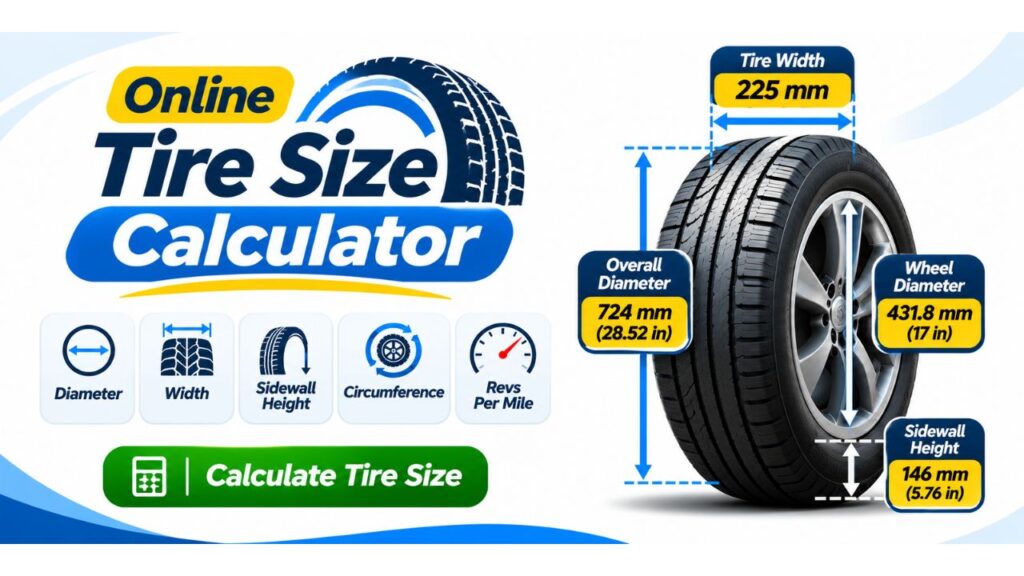
The calculator has three input fields:
- Tire Section Width
- Aspect Ratio
- Wheel Diameter
It uses these measurements to calculate six results automatically.
Step 1: Enter Your Tire Section Width
Find the Tire Section Width field.
Enter the first number from your tire’s metric size designation.
For example, if your tire is marked:
225/65R17
Enter:
225
This means the tire has a nominal section width of 225 millimeters.
Section width is measured across the widest part of the tire’s sidewall under standardized measurement conditions.
It is not necessarily the same as the width of the tread contacting the road.
The calculator uses 225 mm as its default example.
Supported section widths range from 125 mm to 445 mm, using 5 mm increments.
Step 2: Enter the Tire Aspect Ratio
Find the Aspect Ratio field.
Enter the second number from the tire-size designation.
For example:
225/65R17
Enter:
65
The aspect ratio represents the nominal sidewall height as a percentage of the tire’s section width.
A 65 aspect ratio means the sidewall height is approximately 65% of the nominal section width.
The calculator uses 65% as its default value.
Supported aspect ratios range from 20% to 90%, using 5% increments.
Step 3: Enter the Wheel Diameter
Find the Wheel Diameter field.
Enter the number appearing after the letter R in your tire-size designation.
For example:
225/65R17
Enter:
17
This indicates a tire designed for a compatible 17-inch-diameter wheel.
Wheel diameter is measured at the tire bead-seat location.
It is different from the overall diameter of the complete tire.
The calculator uses 17 inches as its default.
Supported wheel diameters range from 10 to 26 inches, using 0.5-inch increments.
Step 4: Click Calculate
After entering your measurements, click Calculate.
For the default inputs:
| Calculator Input | Value |
|---|---|
| Tire Section Width | 225 mm |
| Aspect Ratio | 65% |
| Wheel Diameter | 17 inches |
The calculator identifies the nominal tire size as:
225/65R17
It then calculates the tire’s dimensions using the standard geometric formulas.
Step 5: Review Your Tire Dimensions
The calculator displays six measurements.
| Calculator Result | Calculated Value |
|---|---|
| Overall Diameter | 28.52 inches / 724 mm |
| Sidewall Height | 5.76 inches / 146 mm |
| Tire Section Width | 8.86 inches / 225 mm |
| Tire Circumference | 89.58 inches / 2,275 mm |
| Revolutions Per Mile | 707.3 |
| Wheel Diameter | 17 inches / 431.8 mm |
The displayed values are rounded for readability. The underlying calculations use greater precision.
These dimensions describe the theoretical size of the tire.
Actual tire measurements may differ because of manufacturer specifications, tire construction, inflation pressure, and other factors.
Step 6: Understand the Visual Tire Illustration
The calculator includes a visual tire illustration displaying the entered size.
This helps you understand the general relationship between tire diameter and wheel diameter.
The illustration is useful for explaining nominal geometry, but it is not a scale-accurate rendering of a particular tire model.
It does not show exact tread design, tire shoulder shape, or physical vehicle clearance.
Step 7: Calculate Another Tire Size
To evaluate another tire, replace the input values.
For example, enter:
- Width: 285 mm
- Aspect Ratio: 70%
- Wheel Diameter: 17 inches
The calculator produces dimensions for:
285/70R17
You can repeat the calculation for different sizes.
However, this calculator does not display two tire sizes side by side. For simultaneous comparisons, use my separate Tire Size Comparison Calculator.
How Does My Online Tire Size Calculator Work?
The calculator uses geometric formulas based on the dimensional values contained in a metric tire designation.
A metric tire size provides three essential measurements:
- Nominal section width in millimeters
- Sidewall aspect ratio as a percentage
- Wheel diameter in inches
From these measurements, the calculator determines the theoretical sidewall height, overall diameter, circumference, and revolutions per mile.
Formula 1: Calculate Tire Sidewall Height
The first calculation determines the nominal height of one tire sidewall.
Sidewall Height (mm) = Tire Width (mm) × Aspect Ratio ÷ 100
For a 225/65R17 tire:
Sidewall Height = 225 × 65 ÷ 100
Sidewall Height = 146.25 mm
Convert the result to inches:
146.25 ÷ 25.4 = 5.7579 inches
Sidewall Height ≈ 5.76 inches
This is the theoretical height of one sidewall.
Formula 2: Calculate Overall Tire Diameter
The overall tire diameter includes the wheel diameter and two sidewall heights.
Overall Diameter (mm) = (Wheel Diameter in Inches × 25.4) + (2 × Sidewall Height in mm)
For a 225/65R17 tire:
Wheel diameter = 17 × 25.4 = 431.8 mm
Two sidewalls = 146.25 × 2 = 292.5 mm
Overall diameter = 431.8 + 292.5
Overall Diameter = 724.3 mm
Convert to inches:
724.3 ÷ 25.4 = 28.5157 inches
Overall Tire Diameter ≈ 28.52 inches
You can also calculate the diameter directly in inches:
Tire Diameter (inches) = Wheel Diameter + [(2 × Tire Width × Aspect Ratio) ÷ 2,540]
Both methods produce the same theoretical result.
Formula 3: Convert Tire Section Width to Inches
The first number of a metric tire size is stated in millimeters.
To convert it into inches:
Tire Width (inches) = Tire Width (mm) ÷ 25.4
For a 225 mm tire:
225 ÷ 25.4 = 8.8583
Tire Width ≈ 8.86 inches
This is the nominal section width, not the measured tread width.
Formula 4: Calculate Tire Circumference
The theoretical circumference is the distance around an ideal circular tire.
Tire Circumference = π × Overall Diameter
Where π is approximately 3.14159.
For a tire with a calculated diameter of 28.5157 inches:
Circumference = 3.14159 × 28.5157
Tire Circumference ≈ 89.58 inches
In millimeters:
724.3 × 3.14159
Circumference ≈ 2,275.46 mm
The calculator displays the circumference in both inches and millimeters.
Formula 5: Calculate Tire Revolutions Per Mile
There are 63,360 inches in one mile.
The theoretical revolutions-per-mile formula is:
Revolutions Per Mile = 63,360 ÷ Tire Circumference (inches)
For a 225/65R17 tire:
63,360 ÷ 89.5849
Estimated Revolutions Per Mile ≈ 707.3
This means an ideal tire with the calculated circumference would rotate approximately 707 times to travel one mile.
Actual tire revolutions per mile can differ because tires deform while supporting the vehicle’s weight.
Formula 6: Convert Wheel Diameter to Millimeters
Wheel diameter is commonly listed in inches.
To convert it into millimeters:
Wheel Diameter (mm) = Wheel Diameter (inches) × 25.4
For a 17-inch wheel:
17 × 25.4 = 431.8 mm
Wheel Diameter = 431.8 mm
This is the nominal bead-seat diameter, not the overall outside diameter of the wheel’s metal flanges.
Summary of All Tire Size Formulas
| Measurement | Formula |
|---|---|
| Sidewall height (mm) | Width × Aspect Ratio ÷ 100 |
| Overall diameter (mm) | Rim Diameter × 25.4 + 2 × Sidewall |
| Section width (in) | Width in mm ÷ 25.4 |
| Overall diameter (in) | Overall Diameter in mm ÷ 25.4 |
| Circumference (in) | π × Diameter in inches |
| Revolutions per mile | 63,360 ÷ Circumference in inches |
| Wheel diameter (mm) | Wheel Diameter in inches × 25.4 |
These formulas calculate nominal dimensions.
They do not account for actual tire deformation, construction differences, or manufacturer-specific measurements.
Online Tire Size Calculator Example: 225/65R17
The calculator’s default example is 225/65R17.
This size is useful for demonstrating how tire width, aspect ratio, and wheel diameter work together.
Input Measurements
- Section width: 225 mm
- Aspect ratio: 65%
- Wheel diameter: 17 inches
Calculated Measurements
| Tire Dimension | Result |
|---|---|
| Tire size | 225/65R17 |
| Section width | 225 mm |
| Section width in inches | 8.86 in |
| Sidewall height | 146.25 mm |
| Sidewall height in inches | 5.76 in |
| Overall diameter | 724.3 mm |
| Overall diameter in inches | 28.52 in |
| Circumference | 89.58 in |
| Revolutions per mile | 707.3 |
What These Measurements Mean
The nominal section width is approximately 8.86 inches.
Each theoretical sidewall is about 5.76 inches tall.
The complete tire measures approximately 28.52 inches in diameter.
Its ideal geometric circumference is approximately 89.58 inches.
The calculated revolutions per mile are approximately 707.3.
These results can help explain tire dimensions before shopping for replacements or researching alternative sizes.
They do not verify that a particular tire model will fit your vehicle.
What Is a Tire Size?
A tire size is a standardized designation describing important dimensional and construction characteristics of a tire.
It usually appears on the tire sidewall.
For example:
P225/65R17 102H
This marking includes information about:
- Tire application or type
- Nominal section width
- Aspect ratio
- Tire construction
- Wheel diameter
- Load index
- Speed rating
The dimensional portion is used by the calculator.
Additional markings help determine whether the tire is suitable for a particular vehicle.
How to Read a Tire Size
Consider the example:
P225/65R17 102H
Each part has a specific meaning.
P — Passenger Tire Designation
The letter P identifies a P-metric passenger tire designation.
P-metric tires are commonly used on passenger cars, crossovers, and some light-duty vehicles.
Not every metric tire size includes a P prefix.
225 — Tire Section Width
The number 225 represents the tire’s nominal section width in millimeters.
The width is measured between the sidewalls under standardized conditions.
It does not directly identify tread width or the size of the road-contact patch.
65 — Aspect Ratio
The number 65 describes sidewall height as 65% of the section width.
For a 225 mm section width:
225 × 0.65 = 146.25 mm
R — Radial Construction
The letter R identifies radial tire construction.
Most modern passenger-car tires use radial construction.
17 — Wheel Diameter
The number 17 indicates that the tire is designed for a compatible wheel with a nominal 17-inch bead-seat diameter.
The wheel diameter must match the tire’s required rim diameter.
102 — Load Index
The load index identifies a standardized load-capacity rating.
It does not directly represent pounds or kilograms without consulting the applicable load index chart.
The calculator does not evaluate load index.
H — Speed Rating
The speed-rating symbol identifies the tire’s assigned speed capability under specified conditions.
It is separate from the tire’s dimensional measurements.
The replacement tire must meet the vehicle manufacturer’s applicable speed-rating requirements.
For additional information about tire sidewall markings, see Michelin’s guide to reading tire markings, which explains the relationship between tire size, construction, load index, and speed rating.
Understanding Tire Section Width
Tire section width is one of the most commonly misunderstood tire measurements.
It describes the nominal width across the tire’s sidewalls when measured under specified conditions.
Is Tire Width the Same as Tread Width?
No.
Section width and tread width are different measurements.
Section width measures the nominal distance between the outermost sidewall surfaces.
Tread width describes the width of the tire’s tread area.
The two values are not necessarily identical.
A tire may have a nominal section width of 225 mm but a different tread width depending on its design.
Why Actual Tire Width Can Vary
The actual measured section width depends on several factors, including:
- Tire construction
- Manufacturer specifications
- Measuring rim width
- Inflation conditions
- Sidewall design
Two tire models with the same nominal size may have slightly different actual section widths.
Does a Wider Tire Always Have More Grip?
Not necessarily.
Tire grip depends on tread compound, construction, temperature, road conditions, tread design, loading, and other characteristics.
A wider nominal tire does not automatically provide better braking or handling performance in every situation.
Can Wider Tires Affect Vehicle Clearance?
Yes.
A wider tire may sit closer to suspension components or extend farther toward the fender.
However, actual clearance also depends on the wheel width, offset, tire profile, and vehicle geometry.
The calculator does not determine physical clearance.
What Is Tire Aspect Ratio?
The tire aspect ratio describes the nominal height of the sidewall as a percentage of the tire’s section width.
For example:
225/65R17
The aspect ratio is 65%.
This means the sidewall height is approximately 65% of 225 mm.
High-Profile vs. Low-Profile Tires
A tire with a higher aspect ratio generally has a taller sidewall relative to its section width.
A tire with a lower aspect ratio generally has a shorter sidewall relative to its section width.
Examples include:
- 225/70R17
- 225/65R17
- 225/55R17
- 225/45R17
If section width and wheel diameter remain unchanged, reducing the aspect ratio reduces the nominal overall diameter.
Tire Sidewall Height Comparison
For a 225 mm section width:
| Aspect Ratio | Sidewall Height |
|---|---|
| 40% | 90.00 mm |
| 45% | 101.25 mm |
| 50% | 112.50 mm |
| 55% | 123.75 mm |
| 60% | 135.00 mm |
| 65% | 146.25 mm |
| 70% | 157.50 mm |
| 75% | 168.75 mm |
These are calculated values.
The comparison assumes the tire section width remains 225 mm.
Does Aspect Ratio Affect Ride Comfort?
It can.
Sidewall height influences how a tire deforms under load and responds to road irregularities.
However, ride comfort also depends on tire construction, inflation pressure, tread design, suspension, and road conditions.
A higher aspect ratio does not guarantee a smoother ride in every vehicle.
Tire Diameter vs. Wheel Diameter
Tire diameter and wheel diameter are not interchangeable.
Wheel Diameter
Wheel diameter is the nominal diameter of the rim where the tire beads seat.
For example, an R17 tire is designed for a compatible 17-inch wheel.
Overall Tire Diameter
Overall tire diameter includes the wheel diameter plus the tire sidewall above and below the wheel.
For example, the theoretical overall diameter of 225/65R17 is 28.52 inches.
Why This Difference Matters
A 17-inch wheel does not mean the complete tire measures 17 inches tall.
Similarly, two tires installed on 17-inch wheels can have very different overall diameters.
The differences depend on tire width and aspect ratio.
Can Two Different Wheel Sizes Have Similar Tire Diameters?
Yes.
For example, a tire with a larger wheel diameter can use a shorter sidewall to maintain a similar overall tire diameter.
This relationship is important when researching plus-size wheel-and-tire packages.
However, a similar overall diameter does not automatically mean the replacement wheel and tire are compatible with the vehicle.
Tire Size Calculator Chart: Common Metric Tire Dimensions
The following table shows nominal dimensions calculated using the same formulas as my Online Tire Size Calculator.
| Tire Size | Overall Diameter | Section Width | Sidewall Height | Revs/Mile |
|---|---|---|---|---|
| 195/65R15 | 24.98 in | 7.68 in | 4.99 in | 807.4 |
| 205/55R16 | 24.88 in | 8.07 in | 4.44 in | 810.7 |
| 225/45R17 | 24.97 in | 8.86 in | 3.99 in | 807.6 |
| 225/65R17 | 28.52 in | 8.86 in | 5.76 in | 707.3 |
| 245/65R17 | 29.54 in | 9.65 in | 6.27 in | 682.8 |
| 265/70R17 | 31.61 in | 10.43 in | 7.30 in | 638.1 |
| 285/70R17 | 32.71 in | 11.22 in | 7.85 in | 616.6 |
| 275/60R20 | 32.99 in | 10.83 in | 6.50 in | 611.3 |
All values are theoretical and rounded.
They are not manufacturer-certified specifications or replacement recommendations.
Example: 265/70R17 Tire Size
Enter:
- Width: 265
- Aspect Ratio: 70
- Wheel Diameter: 17
The calculator produces approximately:
- Diameter: 31.61 inches
- Section width: 10.43 inches
- Sidewall height: 7.30 inches
- Circumference: 99.29 inches
- Revolutions per mile: 638.1
Example: 285/70R17 Tire Size
Enter:
- Width: 285
- Aspect Ratio: 70
- Wheel Diameter: 17
The calculator produces approximately:
- Diameter: 32.71 inches
- Section width: 11.22 inches
- Sidewall height: 7.85 inches
- Circumference: 102.76 inches
- Revolutions per mile: 616.6
This tire is often loosely described as being close to 33 inches in diameter.
However, its nominal width is not identical to that of a flotation tire marked 33×12.50R17.
How to Calculate Tire Size Manually
You can perform the same calculations without an online tool.
However, you must use the correct measurement units.
Manual Example: 235/55R18
Start with:
- Section width: 235 mm
- Aspect ratio: 55%
- Wheel diameter: 18 inches
Step 1: Calculate sidewall height
235 × 0.55 = 129.25 mm
Step 2: Convert sidewall height into inches
129.25 ÷ 25.4 = 5.09 inches
Step 3: Calculate overall diameter
18 + (2 × 5.0886) = 28.18 inches
Step 4: Calculate circumference
28.1772 × π = 88.52 inches
Step 5: Calculate revolutions per mile
63,360 ÷ 88.5212 = 715.8
The results are:
| Measurement | Value |
|---|---|
| Overall diameter | 28.18 in |
| Sidewall height | 5.09 in |
| Section width | 9.25 in |
| Circumference | 88.52 in |
| Revolutions per mile | 715.8 |
My calculator performs these calculations automatically.
What Is Tire Circumference?
Tire circumference is the distance around the outside of a tire.
For a theoretical circular tire, circumference is calculated using the overall diameter.
The formula is:
Circumference = π × Diameter
Circumference matters because it is related to the distance a tire travels during each rotation.
However, a real tire does not behave exactly like a rigid circle while supporting a vehicle.
Nominal Circumference vs. Rolling Circumference
Nominal circumference is the mathematical circumference of a circle with the calculated outside diameter.
Rolling circumference describes the effective distance traveled during one revolution under operating conditions.
These measurements can differ because a tire deforms at the road-contact area.
Why Rolling Circumference Matters
Rolling circumference is relevant to:
- Speedometer calibration
- Odometer measurements
- Effective gearing
- Tire revolutions per mile
- Certain drivetrain systems
- Replacement tire comparison
The Online Tire Size Calculator reports theoretical circumference, not measured rolling circumference.
What Are Tire Revolutions Per Mile?
Tire revolutions per mile describe how many times a tire rotates while traveling one mile.
The calculator estimates this value using nominal circumference.
Larger Tires vs. Smaller Tires
A larger tire generally has a greater circumference.
Therefore, it requires fewer revolutions to cover one mile.
A smaller tire generally has a shorter circumference.
It requires more revolutions over the same distance.
Example: Comparing Tire Revolutions
Consider two tire sizes.
205/55R16
Calculated revolutions per mile: 810.7
225/65R17
Calculated revolutions per mile: 707.3
The larger tire requires approximately 103 fewer theoretical revolutions per mile.
This relationship helps explain why changing tire size may affect speedometer readings and effective gearing.
Why Manufacturer Revolutions Per Mile May Differ
Actual revolutions per mile depend on:
- Tire construction
- Tire loading
- Inflation pressure
- Tread design
- Rolling deformation
- Test conditions
The nominal formula provides a useful estimate but does not replace manufacturer-measured data.
For a technical explanation of nominal tire dimensions and their limitations, see Tire Rack’s guide to calculating tire dimensions.
Why Calculated Tire Size May Differ From Actual Tire Measurements
The calculator uses mathematical relationships between the values in the tire-size designation.
Real tires are manufactured products whose measured dimensions may differ from nominal geometry.
Tire Manufacturer Differences
Two manufacturers may produce tires with the same nominal size but slightly different physical dimensions.
Differences can result from tread construction, casing design, and manufacturing specifications.
Tire Model Differences
Even within the same brand, different tire models can have different overall diameters or measured section widths.
For example, an all-terrain tire and a highway tire carrying the same nominal size may not have identical published dimensions.
Measuring Rim Width
Tire section width is measured using a specified measuring rim.
Mounting the tire on another approved rim width may affect its measured section width.
Tire Inflation Pressure
Inflation pressure affects the shape and operating behavior of a tire.
The calculator does not include tire pressure as an input.
Vehicle Weight
A tire deforms while supporting the weight of the vehicle.
This changes its loaded radius and effective rolling behavior.
Tire Tread Wear
As a tire wears, its effective outside dimensions can change.
A heavily worn tire may have a different rolling circumference from the same tire when new.
Why Actual Specifications Matter
If you are researching tire fitment where a few millimeters matter, use the exact tire manufacturer’s published dimensions.
Do not rely solely on nominal calculator results.
Metric Tire Sizes vs. Flotation Tire Sizes
Not all tires use the same size notation.
My Online Tire Size Calculator is designed for metric tire dimensions entered as separate width, aspect-ratio, and wheel-diameter values.
Metric Tire Sizes
An example is:
285/70R17
This describes:
- 285 mm nominal section width
- 70% sidewall aspect ratio
- 17-inch rim diameter
The overall tire diameter must be calculated.
Flotation Tire Sizes
An example is:
33×12.50R17
This describes:
- 33-inch nominal overall tire diameter
- 12.50-inch nominal section width
- 17-inch rim diameter
The aspect ratio is not stated directly.
Does My Calculator Accept Flotation Sizes?
Not directly as a flotation-size input.
The Online Tire Size Calculator requires metric-style section width, aspect ratio, and wheel diameter.
It does not include separate flotation diameter and width fields.
For metric-to-inch and flotation-to-metric calculations, use my separate Tire Size Conversion Calculator.
Is 285/70R17 the Same as 33×12.50R17?
No.
The two designations have similar nominal overall diameters, but their widths differ.
A 285/70R17 tire has a calculated nominal width of approximately 11.22 inches.
A 33×12.50R17 flotation designation specifies a nominal width of 12.50 inches.
Their load specifications, approved rims, and actual measurements may also differ.
They should not be treated as automatically interchangeable.
What Is the Difference Between P-Metric and LT-Metric Tires?
P-metric and LT-metric tires can use similar dimensional formats.
However, their intended applications and load-inflation requirements may differ.
P-Metric Tires
P-metric tires carry a passenger-tire designation.
An example is:
P225/65R17
The P prefix identifies the passenger-tire sizing category.
LT-Metric Tires
LT-metric tires are intended for applicable light-truck uses.
An example is:
LT285/70R17
Their construction, load range, and inflation requirements may differ from those of P-metric tires.
Does the Calculator Show P or LT?
The calculator uses the three numeric dimensional inputs.
It generates a metric size label such as:
285/70R17
It does not display or classify P-metric or LT-metric tire-service requirements.
A tire’s nominal dimensions alone cannot establish whether it has the appropriate load capacity for a particular vehicle.
Does Changing Tire Size Affect Speedometer Accuracy?
It can.
The speedometer uses information related to vehicle or wheel rotation to estimate road speed.
Changing the tire’s effective rolling circumference can affect the relationship between wheel rotation and actual road speed.
Larger Tire Diameter
A larger tire generally travels farther per revolution.
If the vehicle retains its original calibration, actual road speed may be higher than the dashboard indicates.
Smaller Tire Diameter
A smaller tire generally travels less distance per revolution.
Under unchanged calibration, actual speed may be lower than the dashboard reading.
Speedometer Correction Formula
A simplified formula is:
Estimated Actual Speed = Indicated Speed × (New Tire Diameter ÷ Original Tire Diameter)
For example, suppose the original tires have a diameter of 25 inches and the replacement tires have a diameter of 26 inches.
At an indicated 60 mph:
60 × 26 ÷ 25 = 62.4 mph
The actual speed would be approximately 62.4 mph under the simplified assumptions.
Does This Calculator Calculate Speedometer Error?
No.
My Online Tire Size Calculator calculates one tire’s nominal dimensions.
It does not compare two tire sizes or calculate actual road speed.
For that purpose, use my Tire Size Speedometer Calculator or Tire Size Comparison Calculator.
Does Tire Size Affect Ground Clearance?
Changing overall tire diameter can affect axle height.
If a replacement tire has a larger effective radius, it may raise the axle centerline.
Ground-Clearance Formula
Approximate Axle-Height Change = (New Tire Diameter − Original Tire Diameter) ÷ 2
For example:
Original diameter = 30 inches
New diameter = 32 inches
Axle-height change = (32 − 30) ÷ 2
Estimated Increase = 1 inch
This is a theoretical relationship.
Why Actual Ground Clearance Can Differ
Real-world clearance depends on:
- Tire deflection
- Vehicle weight
- Tire inflation
- Suspension configuration
- Tire wear
- Actual rolling radius
The calculator does not directly estimate ground clearance.
Does Tire Size Affect Fuel Economy and Performance?
Potentially.
Changing tire dimensions can affect several aspects of vehicle operation.
Fuel Economy
Larger or wider tires may change rolling resistance, rotating mass, and effective gearing.
The resulting effect on MPG depends on the complete tire and vehicle combination.
Tire size alone cannot determine how much fuel economy will change.
Acceleration
A larger effective rolling circumference changes the relationship between wheel rotations and road distance.
This can affect effective gearing and acceleration characteristics.
Tire weight and construction also matter.
Braking
Changes in tire dimensions, grip, weight, and construction can influence braking behavior.
Safe braking performance depends on much more than nominal diameter.
Steering Response
Tire section width, sidewall characteristics, construction, and wheel offset can affect steering response.
A wider tire is not automatically better for every vehicle or driving condition.
Ride Comfort
Sidewall height can influence the tire’s contribution to ride comfort.
However, inflation pressure, tread design, tire construction, and vehicle suspension also play important roles.
How to Choose the Correct Tire Size for Your Vehicle
The calculator helps you understand tire dimensions, but it does not determine which tire size is suitable for a particular vehicle.
Selecting replacement tires requires manufacturer-approved specifications.
Step 1: Check the Vehicle Tire Placard
Most passenger vehicles have a Tire and Loading Information Label near the driver’s door opening.
It commonly lists the original equipment tire size and recommended cold tire inflation pressure.
Step 2: Check the Owner’s Manual
The owner’s manual may provide approved tire sizes and specific requirements for different wheel packages.
Some models have different tire sizes depending on trim, engine, suspension, or brake configuration.
Step 3: Verify the Tire’s Load Capacity
The replacement tire must have suitable load capacity for the vehicle.
Do not choose a tire based solely on dimensional similarity.
Step 4: Check the Speed Rating
Confirm that the replacement meets the applicable vehicle manufacturer’s speed-rating requirements.
Step 5: Verify Wheel Compatibility
The wheel diameter must match the tire’s required rim diameter.
The wheel width must fall within the tire manufacturer’s approved rim width range.
Step 6: Check Physical Clearance
Verify sufficient clearance around:
- Fender openings
- Suspension components
- Steering components
- Brake components
- Inner wheel-well liners
Step 7: Consider Drivetrain Requirements
Some AWD and 4WD vehicles have strict requirements for matching rolling circumference between tires.
Check the manufacturer’s instructions before installing different tire dimensions.
The National Highway Traffic Safety Administration’s tire safety guidance recommends using the original tire size or another size approved by the vehicle manufacturer.
NHTSA also advises checking the vehicle’s tire placard for the recommended inflation pressure rather than using the maximum pressure printed on the tire sidewall as the normal setting.
How Much Tire Size Difference Is Acceptable?
You may encounter recommendations to keep replacement tire diameter within approximately 3% of the original.
That can be useful as an initial dimensional comparison.
However, 3% is not a universal tire-fitment safety rule.
Some vehicles require a much closer rolling-circumference match.
Other vehicles support manufacturer-approved alternatives with different dimensions.
Does a Matching Diameter Guarantee Fitment?
No.
Two tires can have nearly identical diameters but very different widths.
The replacement tire may also have an unsuitable load index, speed rating, or rim width requirement.
What If a Tire Is Taller but Narrower?
A taller, narrower tire may affect vehicle clearance differently from a shorter, wider tire.
Both diameter and section width must be considered.
What If the Replacement Tire Has a Different Wheel Diameter?
Changing wheel diameter may require a different tire profile to maintain an appropriate overall diameter.
The entire wheel-and-tire package must be verified.
Can the Calculator Find Tire Size by Vehicle?
No.
The current Online Tire Size Calculator is a dimension calculator, not a vehicle-fitment database.
It does not include:
- Year selection
- Vehicle make
- Vehicle model
- Trim selection
- OEM tire-size lookup
- Vehicle-specific wheel compatibility
- Manufacturer-approved replacement recommendations
You must enter the tire dimensions yourself.
If you do not know your tire size, look at the tire sidewall, vehicle tire placard, or owner’s manual.
Common Online Tire Size Calculator Mistakes
Entering Tire Width in Inches
The Tire Section Width field expects millimeters.
For example, enter 225 rather than 8.86.
Entering the Aspect Ratio as a Decimal
Enter 65 for a 65% aspect ratio.
Do not enter 0.65.
Confusing Tire Diameter With Wheel Diameter
The Wheel Diameter field requires the rim’s nominal diameter.
It does not ask for the complete outside diameter of the tire.
Entering the Entire Tire Code in a Numeric Field
The calculator has three separate numeric inputs.
For 225/65R17, enter:
- Width: 225
- Aspect Ratio: 65
- Wheel Diameter: 17
Do not paste the complete tire-size code into one numeric field.
Using Unsupported Input Values
The calculator supports specific numeric ranges.
Measurements outside those ranges may be rejected.
It is intended for common metric tire dimensions rather than every specialty or historical tire sizing system.
Assuming Tire Width Is Tread Width
Section width and tread width are different measurements.
The calculator reports nominal section width.
Treating Calculated Diameter as an Exact Manufacturer Measurement
Nominal tire geometry may differ from actual product dimensions.
Use published manufacturer specifications when precise fitment matters.
Assuming the Calculator Confirms Tire Fitment
The tool does not know your vehicle’s suspension, wheel offset, brake dimensions, or load requirements.
A valid mathematical result is not proof of safe compatibility.
Confusing Calculated and Actual Revolutions Per Mile
The calculator uses theoretical circumference.
Real tires deform while rolling, so actual revolutions per mile may differ.
Ignoring Tire Pressure and Load
Tire inflation and vehicle load affect real-world tire behavior.
Those factors are not included in the calculator.
Tire Size Calculator Limitations
The calculator is intended for dimensional calculations and educational planning.
It cannot determine every characteristic of a real tire.
What the Calculator Can Determine
- Nominal metric tire-size label
- Theoretical outside diameter
- Nominal section width in inches and millimeters
- Calculated sidewall height
- Geometric circumference
- Estimated revolutions per mile
- Wheel diameter conversion
What It Cannot Determine
- Actual measured tire diameter
- Loaded rolling circumference
- Exact manufacturer revolutions per mile
- Tread width
- Tire load index
- Load range
- Speed rating
- Approved rim width
- Tire pressure requirements
- Vehicle-specific fitment
- Suspension or brake clearance
- Tire weight
- Tire performance
- Legal installation approval
Understanding these limits helps prevent misinterpreting the results.
Tire Size and Replacement Safety Checklist
Before buying replacement tires, verify the following:
- Original tire size is correct.
- Tire section width is entered in millimeters.
- Aspect ratio is entered as a percentage.
- Wheel diameter is entered in inches.
- Calculated overall diameter has been reviewed.
- Actual manufacturer tire dimensions have been checked.
- Replacement tire size is suitable for the vehicle.
- Load capacity meets manufacturer requirements.
- Speed rating is appropriate.
- Wheel diameter is compatible.
- Rim width is approved for the tire.
- Brake and suspension clearance is sufficient.
- Fender clearance has been verified.
- Tire pressure follows the vehicle manufacturer’s instructions.
- AWD or 4WD tire-matching requirements are satisfied.
- Any necessary speedometer recalibration has been considered.
If you are uncertain about the replacement tire specifications, consult a qualified tire professional before installation.
Conclusion
My Online Tire Size Calculator provides a straightforward way to calculate nominal tire dimensions using section width, aspect ratio, and wheel diameter.
It automatically determines overall diameter, sidewall height, section width, circumference, estimated revolutions per mile, and wheel diameter conversions.
These measurements are useful when researching tire specifications, understanding tire-sidewall numbers, and preparing to compare alternative tire sizes.
For accurate results, enter the dimensions using the correct units and remember that the calculations describe theoretical geometry rather than exact physical tire measurements.
Before selecting a replacement tire, check the vehicle manufacturer’s requirements, actual tire specifications, load and speed ratings, wheel compatibility, and available clearances.
Used alongside those checks, the calculator can help you understand tire dimensions and make more informed decisions about tire and wheel options.
Online Tire Size Calculator FAQs
What Is an Online Tire Size Calculator?
An Online Tire Size Calculator uses tire section width, aspect ratio, and wheel diameter to calculate nominal dimensions such as overall diameter, sidewall height, circumference, and estimated revolutions per mile.
How Do I Calculate Tire Size?
Enter the section width in millimeters, aspect ratio as a percentage, and wheel diameter in inches. The calculator uses those measurements to determine the tire’s theoretical dimensions.
How Do I Calculate Overall Tire Diameter?
Multiply section width by the aspect ratio and divide by 100 to find sidewall height in millimeters. Multiply the sidewall height by two, add the wheel diameter converted to millimeters, and divide the total by 25.4 to obtain inches.
What Is 225/65R17 in Inches?
A 225/65R17 tire has a theoretical overall diameter of 28.52 inches, a nominal section width of 8.86 inches, and a sidewall height of 5.76 inches.
What Does 225/65R17 Mean?
It indicates a nominal 225 mm section width, a sidewall height equal to 65% of that width, radial construction, and a 17-inch wheel diameter.
What Is 285/70R17 in Inches?
A 285/70R17 tire has a calculated overall diameter of approximately 32.71 inches, a nominal section width of 11.22 inches, and a sidewall height of 7.85 inches.
How Do I Convert Tire Width From Millimeters to Inches?
Divide the width in millimeters by 25.4. For example, 225 mm divided by 25.4 equals approximately 8.86 inches.
How Do I Calculate Tire Sidewall Height?
Multiply the nominal section width by the aspect ratio, then divide by 100. For example, a 225/65 tire has a theoretical sidewall height of 146.25 mm.
What Is the Difference Between Tire Diameter and Wheel Diameter?
Tire diameter is the overall outside diameter of the complete tire. Wheel diameter is the nominal bead-seat diameter of the rim onto which the tire is mounted.
Does a Higher Aspect Ratio Mean a Taller Tire?
If section width and wheel diameter remain unchanged, a higher aspect ratio produces a taller theoretical sidewall and overall tire diameter.
Is Tire Width the Same as Tread Width?
No. Tire section width measures the nominal width across the sidewalls, while tread width describes the tread area.
How Do I Calculate Tire Circumference?
Multiply the calculated overall tire diameter by π, approximately 3.14159. The result is the theoretical circumference.
What Does Revolutions Per Mile Mean?
It describes how many times a tire rotates while traveling one mile. My calculator estimates this value from the tire’s nominal geometric circumference.
Do Larger Tires Have Fewer Revolutions Per Mile?
Generally, yes. Larger-diameter tires have greater nominal circumferences, so they require fewer rotations to cover one mile.
Can I Use the Calculator for Truck Tires?
Yes. It can calculate nominal dimensions for truck tires whose width, aspect ratio, and rim diameter fall within the supported metric input ranges. It does not verify load ratings or truck-specific fitment.
Does the Calculator Work for LT-Metric Tires?
It can calculate the dimensional portion of supported LT-metric sizes. However, it does not interpret LT load ranges, inflation requirements, or load index.
Can I Calculate 33-Inch or 35-Inch Tire Sizes?
You can calculate metric tires with theoretical diameters near those sizes. However, this calculator does not accept flotation dimensions such as 33×12.50R17 directly.
Does the Calculator Compare Two Tire Sizes?
No. It calculates the dimensions of one tire at a time. For a side-by-side comparison, use my Tire Size Comparison Calculator.
Does the Calculator Show Speedometer Error?
No. It calculates tire dimensions and estimated revolutions per mile. Speedometer correction requires comparing original and replacement tire rolling dimensions.
Does the Calculator Find Tires by Car Model?
No. The calculator uses dimensions entered manually. It does not include a vehicle year, make, model, or trim database.
Can a Tire With the Same Diameter Have a Different Width?
Yes. Different section widths and aspect ratios can produce similar nominal overall diameters.
Why Does the Actual Tire Diameter Differ From the Calculator?
Actual dimensions vary by tire manufacturer, construction, measuring rim, inflation conditions, and tire model. The calculator uses nominal geometric measurements.
Does Tire Size Affect Fuel Economy?
It can. Changes in tire diameter, width, weight, and rolling resistance may affect vehicle efficiency. The exact effect depends on the tire and vehicle.
Is a 3% Tire Diameter Difference Safe?
Not necessarily. Three percent is sometimes used as an initial comparison guideline, but it is not a universal fitment standard. The replacement must meet vehicle-specific requirements.
Can I Use a Different Tire Size Than the Manufacturer Recommends?
Only after confirming that the alternative size satisfies applicable vehicle, tire, wheel, and safety requirements. Consult the manufacturer or a qualified tire professional.
How Accurate Is My Online Tire Size Calculator?
The calculations are mathematically accurate for the entered nominal dimensions, subject to rounding. Actual tire measurements and loaded rolling circumference may differ from the calculated results.