Yes, a 4000A jump starter is very powerful and can be a good choice for large gasoline engines, diesel trucks, SUVs, RVs, and demanding cold-weather starts. For an ordinary small car, however, 4000 peak amps is often more capacity than you actually need.
The real value of a 4000A jump starter depends less on the impressive number printed on the case and more on its engine-size rating, 12V or 24V compatibility, actual starting current, battery capacity, clamps, cables, safety protections, and temperature performance.
The Quick Verdict on 4000A Jump Starters
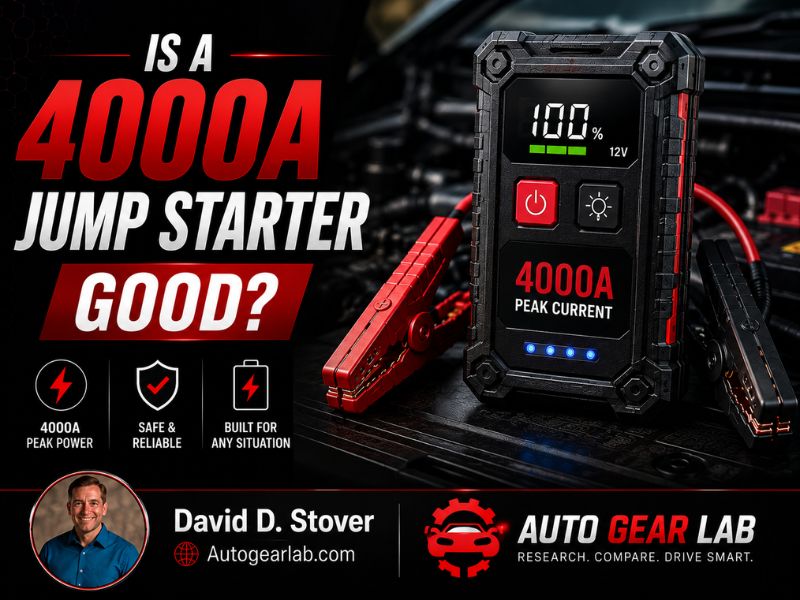
A 4000A unit belongs in the high-output portable jump starter category.
Current products show how capable this class can be. Westinghouse rates its current 4000A 12V model for gasoline engines up to 9.0L and diesel engines up to 7.0L, while other current 4000A units are advertised for gasoline engines around 10L and diesels around 8L.
That gives a 4000A unit enough potential capacity for far more than the typical four-cylinder commuter car.
A simple way to think about it is:
| Vehicle or Use | Is 4000A Sensible? |
| Small gasoline car | Usually more than necessary |
| Sedan or crossover | Plenty of reserve |
| Large SUV | Strong choice |
| Gasoline pickup | Strong choice |
| Large V8 | Well suited if properly rated |
| Diesel pickup | Often a very good fit |
| RV or large van | Useful depending on engine |
| Multiple family vehicles | Good one-unit solution |
| Fleet or roadside work | Potentially very useful |
| Heavy commercial equipment | Check voltage and professional rating carefully |
The table is only a practical guide. Always use the engine and voltage limits published for the specific product.
What Does 4000A Actually Mean?
On most compact lithium jump starters, 4000A means 4000 peak amps.
Peak amps represent a very brief maximum-current capability. They do not mean that the booster continuously sends 4,000 amps through your battery and starter motor.
That distinction matters because peak current is not standardized consistently across every jump starter manufacturer.
You can see the difference by looking beyond the headline rating. One current VEVOR 4000A model lists a 700A starting current, while Sealey lists its 4000A RS4000 at 2,000A cranking current.
Both products can carry “4000A” in their descriptions while having very different additional specifications.
So asking whether 4000A is good based entirely on peak current is a little like comparing engines only by their maximum horsepower while ignoring torque, gearing, displacement, and vehicle weight.
The complete design matters.
How Much Engine Can 4000A Handle?
This is where a quality 4000A jump starter becomes genuinely impressive.
Current 12V models commonly advertise support for very large gasoline and diesel engines. Westinghouse specifies 9.0L gas and 7.0L diesel, while VEVOR specifies 10L gas and 8L diesel for its current 4000A unit.
Another current product, the NAVITEL JS4000, is also rated for gasoline engines up to 10L and diesels up to 8L.
These examples show the general capability of the class, but they should not be turned into a universal rule that every 4000A jump pack can start an 8L diesel.
Manufacturer testing methods, internal batteries, electronics, and cable design differ.
If your truck has a 6.7L diesel, check whether the particular 4000A unit explicitly supports at least that displacement rather than assuming the amp number guarantees compatibility.
For a Small Car, 4000A Is Usually Overkill
Suppose you drive a 2.0L gasoline sedan.
A reputable 4000A booster can have several times the starting capacity necessary for that application.
That does not normally make it dangerous simply because more current is available.
The starter motor draws current based on the electrical conditions of the starting circuit. A properly designed 12V booster does not automatically force its entire advertised peak current through a small engine.
The bigger question is whether carrying a larger and potentially more expensive unit provides enough additional benefit.
For a small car in a mild climate, a good lower-output jump starter can usually be lighter, cheaper, and easier to store while still providing comfortable starting reserve.
The 4000A option becomes more attractive if you want one booster for several vehicles or expect to upgrade to a larger truck or SUV.
Large Gasoline Engines Are a Better Match
A big V8 gasoline engine is where the additional capacity begins to make more practical sense.
Large pickups, SUVs, RVs, and older high-displacement engines can place greater demands on the starting system, especially when the vehicle battery is substantially discharged.
A 4000A-class unit provides considerable headroom rather than operating near its advertised limit.
This can be especially useful if the same booster needs to serve a small car one day and a large truck the next.
For households with multiple vehicles, sizing the booster around the largest engine you realistically expect to start is generally more useful than sizing it around the smallest vehicle.
Diesel Trucks Are One of the Strongest Reasons to Buy 4000A
Diesel applications are where higher-output jump starters become particularly relevant.
A diesel engine typically requires more starting effort than a similarly sized gasoline engine because of its higher compression and cold-start requirements.
That is why jump starter manufacturers normally publish separate gasoline and diesel displacement ratings.
A 4000A model that supports a 10L gasoline engine may be rated for only an 8L diesel.
The difference is normal.
For a large diesel pickup, the additional reserve can be particularly helpful if the vehicle uses dual 12V batteries, has been sitting for an extended period, or must start in freezing temperatures.
Remember that two batteries do not automatically mean the truck uses a 24V starting system. Many diesel pickups have two 12V batteries connected in parallel while maintaining a 12V system.
Cold Weather Makes Extra Reserve More Valuable
A jump starter that seems oversized in summer may make much more sense during winter.
Cold temperatures reduce available battery performance while simultaneously making an engine more difficult to crank.
This affects both the vehicle starting battery and the internal lithium battery inside the jump starter.
A 4000A unit gives you more theoretical reserve, but you should still look at its actual temperature specifications.
For example, Westinghouse currently specifies an operating range of approximately -4°F to 140°F (-20°C to 60°C) for its 4000A model.
TOPDON’s professional V4000 HD is specified to operate from around 14°F to 122°F (-10°C to 50°C).
The important takeaway is that the biggest amp number does not automatically equal the best extreme-cold performance.
Operating temperature and battery chemistry matter too.
4000A Does Not Automatically Mean Better Battery Capacity
Another specification buyers often overlook is watt-hours (Wh).
Watt-hours describe stored energy.
Peak amps describe short-duration starting output.
Those are related characteristics, but they are not the same measurement.
Westinghouse’s current 4000A model, for example, has an 88.8Wh lithium battery, as does a current VEVOR 4000A model.
A larger internal battery can help provide more starting attempts, but battery capacity alone does not guarantee superior cranking performance either.
A good jump starter needs to combine sufficient stored energy with the ability to release very high current efficiently.
Why Cable and Clamp Quality Matters at 4000A
High starting current has to travel through the jumper cables and battery clamps before it reaches the vehicle.
If those components introduce too much electrical resistance, some of the available voltage is lost before it reaches the starter circuit.
This is why you should examine more than the jump pack itself.
A high-quality 4000A unit should have substantial clamps that grip firmly and conductive surfaces that make good contact with the battery terminal or designated jump point.
Cable length also deserves attention.
A compact unit with extremely short leads can be frustrating on a vehicle with recessed terminals or remote under-hood jump points.
A realistic buying principle is:
Good electrical connection beats a bigger marketing number.
Safety Features Matter More as Power Increases
A high-output jump starter contains enough energy that proper protection electronics are worth prioritizing.
Look for reverse-polarity protection, short-circuit protection, over-current protection, temperature protection, and spark-resistant connection logic where available.
Westinghouse specifies spark-proof and reverse-polarity protection on its current 4000A unit, while VEVOR lists multiple protections including reverse polarity, overcurrent, overvoltage, and short-circuit safeguards.
These features are especially useful for a product that may be used only occasionally and under stressful roadside conditions.
However, smart electronics are not a reason to ignore correct battery procedures.
Always verify positive and negative polarity, use the vehicle’s specified jump points, and never attempt to jump a battery that is visibly swollen, leaking, frozen, or severely damaged.
12V vs. 24V Can Matter More Than 4000A
Not every 4000A booster is designed for the same electrical system.
Many portable consumer jump starters are 12V only.
Professional units can support both 12V and 24V systems.
TOPDON’s current V4000 HD, for example, is designed for both 12V and 24V vehicles. It produces up to 4000A at 12V and 3000A at 24V and is intended for applications ranging from passenger vehicles to trucks, buses, and heavy equipment.
This highlights an important rule:
Correct voltage comes before amperage.
A 4000A 24V output is not a stronger alternative for an ordinary 12V passenger car.
Applying the wrong voltage can damage vehicle electrical components.
Is 4000A Better Than 3000A?
It offers additional potential output, but the practical difference depends on your vehicle.
If a reputable 3000A unit already comfortably exceeds your engine’s requirements, switching to 4000A may not noticeably improve a routine jump start.
The larger unit becomes more attractive when you have a large diesel, big gasoline engine, extreme winter conditions, multiple vehicles, or frequent starting work.
Across different brands, do not assume the 4000A model must outperform every 3000A unit.
One 4000A product can have a different starting-current rating, internal battery capacity, clamp design, and temperature limit than another product with a lower advertised peak figure.
Compare complete specifications rather than doing the math based only on peak amps.
What 4000A Cannot Fix
A more powerful jump starter does not solve every no-start condition.
If the vehicle battery has a shorted cell, severe internal damage, broken terminal, or other major failure, the jump pack may struggle regardless of its rating.
A 4000A unit also cannot repair:
A failed starter motor, bad starter relay, corroded ground cable, fuel-delivery failure, ignition problem, immobilizer fault, or mechanical engine issue.
One useful diagnostic clue is how the engine behaves.
If the 4000A booster makes the engine crank strongly but the engine never fires, additional jump-starting power is probably not the answer.
The starting circuit may already be doing its job.
Who Should Seriously Consider a 4000A Jump Starter?
A 4000A unit makes the strongest case for someone who owns a large gasoline pickup, V8 SUV, diesel truck, RV, boat, or several different vehicles.
It also makes sense for drivers who travel in areas where a battery failure could leave them far from immediate help.
Professional users may benefit from even more specialized 4000A products. TOPDON’s V4000 HD, for example, uses a large 204.8Wh LiFePO4 battery and supports both 12V and 24V applications, placing it in a very different category from compact consumer 12V boosters.
For a single compact gasoline car, that type of capability is generally unnecessary.
Frequently Asked Questions
Is 4000A Enough to Jump-Start a Car?
Yes. A quality 4000A jump starter provides considerably more starting capacity than most ordinary passenger cars require.
Can a 4000 Amp Jump Starter Start a Truck?
Yes, many 4000A models are intended for pickups and large SUVs. Check the specific gasoline or diesel engine displacement rating before buying.
Is 4000A Good for a V8?
Yes. Current 4000A products are available with gasoline-engine ratings around 9L to 10L, giving them substantial capacity for many V8 applications.
Can 4000A Start a Diesel Truck?
Often, yes. Current 4000A consumer models include ratings around 7L to 8L diesel, although capability varies by manufacturer.
Is 4000A Too Much for a Small Car?
It is usually more capacity than necessary, but a correctly designed 12V automotive jump starter does not damage a small vehicle merely because it has additional available current.
Is 4000A Better Than 2000A?
It provides greater potential reserve, but the larger number alone does not guarantee better real-world performance. Engine rating, cranking output, internal battery, clamps, cables, and temperature capability all matter.
Does 4000A Mean 4000 Cranking Amps?
No. Most portable units use 4000A as a peak-current rating. Published starting or cranking current can be much lower and varies significantly by product.
How Many Times Can a 4000A Jump Starter Start a Car?
It varies with the model and starting conditions. Westinghouse currently advertises up to 50 starts per charge for its 4000A unit, while actual results depend on engine size, temperature, battery condition, and cranking duration.
Is a 4000A Jump Starter Good for Winter?
It can be an excellent choice because the additional starting reserve is useful in cold conditions, but check the unit’s actual operating-temperature specification rather than relying solely on peak amps.
Should I Buy a 3000A or 4000A Jump Starter?
Choose 4000A when its additional engine capacity or starting reserve solves a real need, such as a large diesel or several vehicles. If a reputable 3000A unit already comfortably covers your largest engine, the extra capacity may be unnecessary.
Is a 4000A Jump Starter Good Overall?
Yes, a 4000A jump starter is very good when you need high starting capacity for large gasoline engines, diesel trucks, SUVs, RVs, cold-weather use, or multiple vehicles. Current quality products in this class can support gasoline engines around 9–10L and diesels around 7–8L, although the exact limits vary by model.
For a small passenger car, that much output is often unnecessary. A lower-capacity quality booster can be easier to carry and still provide plenty of emergency starting power.
More importantly, do not buy from 4000 peak amps alone. Evaluate the engine-size rating, actual starting or cranking current, system voltage, battery capacity, cable and clamp quality, temperature range, and smart safety protections.
A well-engineered 4000A jump starter offers substantial reserve and flexibility. But the real sign of a good jump starter is not the biggest amp number—it is whether the unit can reliably and safely start the vehicle you actually drive under the conditions where you are most likely to need it.