A good 4×4 tire inflator needs to do more than add a few PSI to a passenger-car tire. It should move enough air for larger all-terrain tires, reach every wheel easily, tolerate repeated air-ups, and run reliably from a vehicle’s 12V electrical system.
My first choice is the GSPSCN 12V Heavy Duty Double Cylinder Tire Inflator. Its dual-cylinder design, 70 L/min rated airflow, 150 PSI maximum pressure, and portable setup make it a practical choice for drivers who want strong inflation performance without carrying an oversized compressor.
For drivers running tires up to about 33 inches, the VIAIR 88P Portable Compressor Kit is another dependable option. I especially like its compact metal construction, direct battery connection, long hose, and straightforward design for trail and roadside use.
If you regularly air down larger tires before hitting trails, the Smittybilt 2781 High Performance Air Compressor deserves serious consideration. Its 5.6 CFM maximum airflow and long hose make it particularly useful for larger 4×4 tires where a small emergency inflator would take too long.
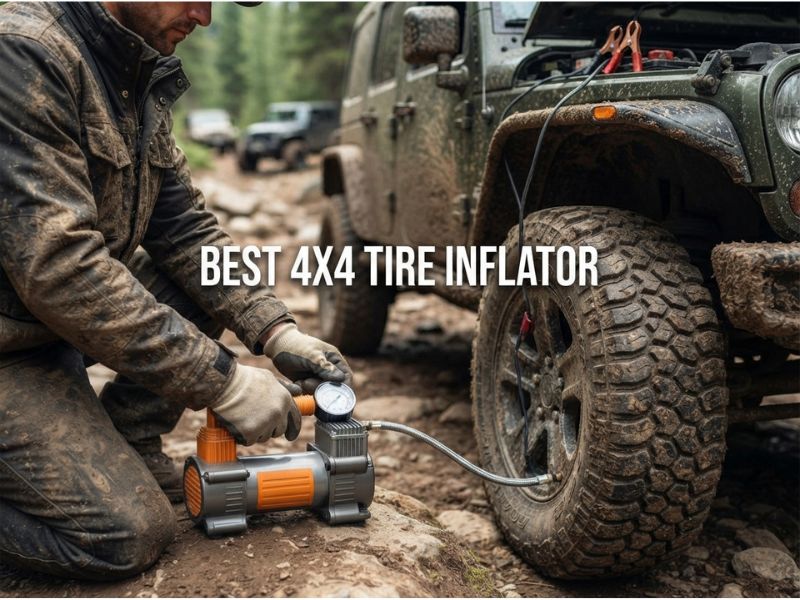
Best 4×4 Tire Inflators Heavy-Duty Picks for Off-Road Use
| Image | Product Name | Check Price |
|---|---|---|
Best Choice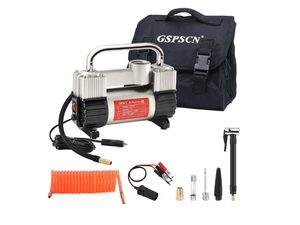 | GSPSCN 12V Heavy Duty Double Cylinder Tire Inflator | Check Price |
Second Best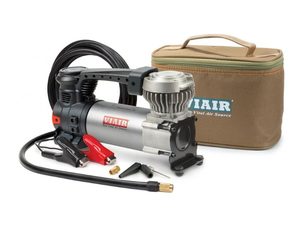 | VIAIR 88P Portable Compressor Kit | Check Price |
Third Choice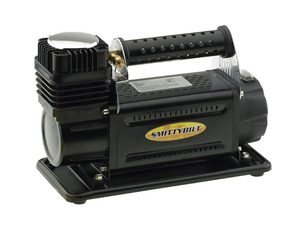 | Smittybilt 2781 High Performance Air Compressor | Check Price |
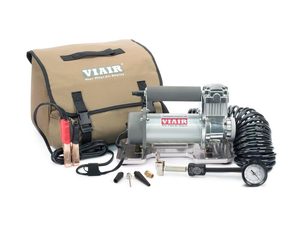 | VIAIR 400P Portable Compressor Kit | Check Price |
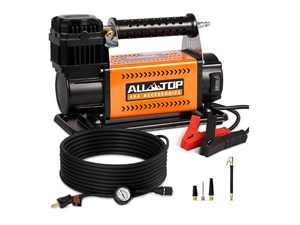 | ALL-TOP 12V Portable Air Compressor Kit | Check Price |
The right compressor depends heavily on tire size and how you use your 4WD.
Someone driving a stock crossover on gravel roads has very different requirements from a Jeep, Bronco, Tacoma, 4Runner, or full-size pickup running 33-, 35-, or 37-inch tires.
For this guide, I focused on the factors that matter most for genuine four-wheel-drive use: airflow, inflation speed, tire-size suitability, duty cycle, direct battery power, hose reach, construction, heat management, portability, and ease of storage.
1. GSPSCN 12V Heavy Duty Double Cylinder Tire Inflator – Best Overall 4×4 Tire Inflator
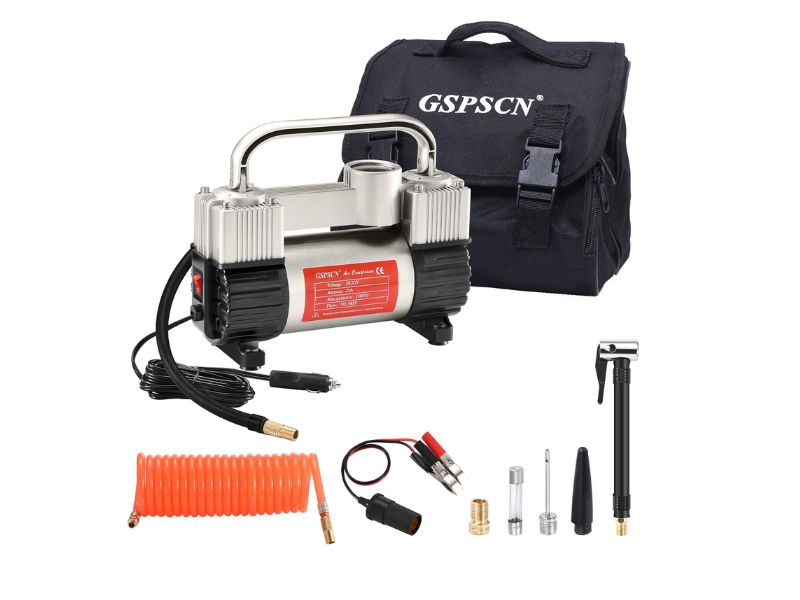
Key Features
- Dual-cylinder compressor
- 12V DC operation
- 150 PSI maximum pressure
- Approximately 70 L/min rated airflow
- Direct battery-clamp capability
- Extended air hose
- Metal compressor construction
- Rubber anti-vibration feet
- Carrying bag included
- Multiple inflation adapters
The GSPSCN Heavy Duty Double Cylinder Tire Inflator is my top recommendation because it strikes a useful balance between airflow, portability, and cost-conscious trail readiness.
Unlike the tiny compressors designed mainly for occasional passenger-car top-offs, this unit uses two cylinders to compress air. The practical benefit is greater air volume, which becomes important when you are filling larger 4×4 tires.
Airing up one tire by five PSI is not particularly demanding. Airing four large tires from trail pressure back to highway pressure is different.
When a 4×4 has been running at reduced tire pressure on sand, rocks, mud, or rough trails, each tire may need a substantial amount of air before returning to pavement. A higher-flow compressor reduces both waiting time and frustration.
The GSPSCN is rated at around 70 liters per minute, giving it considerably more air-moving ability than many compact emergency inflators.
Its direct-drive dual-cylinder design is another reason it works well in a four-wheel-drive environment. Two cylinders operate together rather than relying on a miniature single-cylinder pump.
The compressor also offers a maximum pressure rating of 150 PSI. That number is far higher than normal 4×4 tire pressure, but the important specification for off-road users is still airflow rather than maximum PSI.
Most 4×4 tires will operate somewhere well below 50 PSI depending on the vehicle, load, tire construction, and manufacturer’s recommendations.
What I find particularly useful is the included extended hose. Long wheelbases can expose one of the biggest weaknesses of cheap tire inflators: poor reach.
When your compressor is connected near the engine bay, the hose must comfortably reach the rear wheels. An extension hose makes that much easier on SUVs and pickups.
The compressor also includes battery clamps, which are preferable to a cigarette-lighter plug for higher-demand pumps.
A normal 12V accessory outlet is limited by its wiring and fuse. Direct connection to the vehicle battery provides a more appropriate electrical source for a compressor drawing higher current.
At roughly six pounds, this model remains relatively easy to pack. That is important because off-road recovery kits quickly become heavy.
Once you add recovery boards, tow straps, shackles, tools, a jack, tire plugs, first-aid equipment, water, and other essentials, a massive compressor can become an annoyance.
This one occupies a useful middle ground.
What I Like
The dual-cylinder layout is the standout feature. It gives the compressor enough airflow to be genuinely useful on SUV and pickup tires instead of simply looking good on a specification sheet.
I also like the direct battery connection. For a compressor intended to work hard, I prefer battery clamps over relying on an accessory socket.
The extended hose improves usability around longer vehicles, and the carrying bag helps keep the compressor and accessories together.
What I Do Not Like
There is no sophisticated automatic preset system. You need to monitor pressure while inflating and stop when the tire reaches the desired level.
The compressor can also become hot during extended operation, as virtually every portable piston compressor does.
Drivers running very large 37- or 40-inch tires may want an even higher-flow system designed specifically for repeated heavy-duty air-ups.
Verdict
For the average 4×4 owner running stock or moderately oversized tires, the GSPSCN offers an excellent combination of airflow, portability, simple battery-powered operation, and value.
It is the model I would choose first for general trail use, road trips, camping, and emergency tire inflation.
2. VIAIR 88P Portable Compressor Kit – Best for Up to 33-Inch Tires
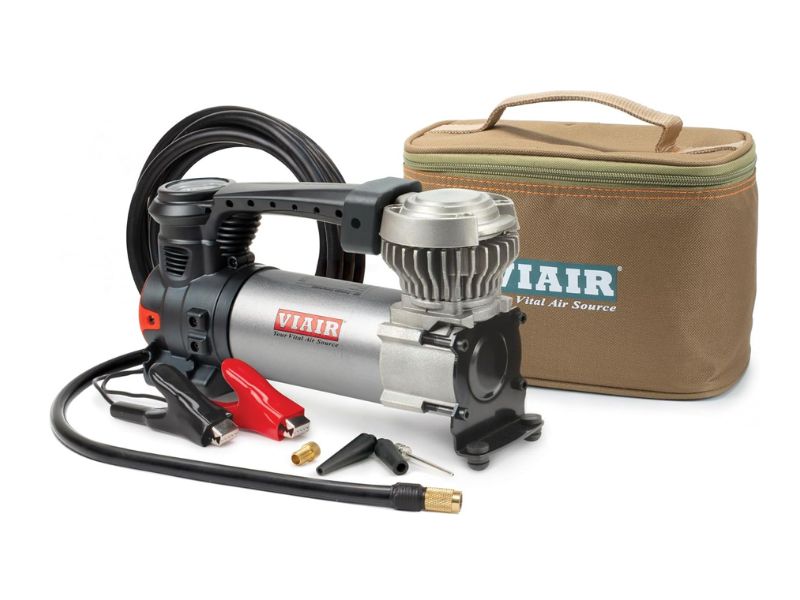
Key Features
- 12V portable compressor
- Approximately 1.47 CFM airflow
- 120 PSI working pressure
- Designed for tires up to about 33 inches
- Direct battery clamps
- Long air hose
- Brass twist-on tire chuck
- Integrated pressure gauge
- LED work light
- Carrying bag
The VIAIR 88P has earned a strong reputation among drivers who want a compact compressor that is more substantial than an inexpensive emergency pump.
Its biggest advantage is that the compressor has a clearly defined application: tires up to approximately 33 inches.
That makes buying easier.
Rather than trying to interpret exaggerated maximum-PSI numbers, you can compare the compressor directly with the tire size on your 4×4.
For vehicles such as a stock or lightly modified Jeep Wrangler, Toyota 4Runner, Ford Bronco, Nissan Frontier, Toyota Tacoma, or similar 4WD, 33 inches covers a large portion of common tire setups.
The 88P produces roughly 1.47 CFM and operates directly from the vehicle battery.
It is not the fastest compressor in this guide, but speed is only one part of the equation.
The VIAIR’s appeal lies in its relatively compact metal body, simple operation, dependable hose connection, and proven portable-compressor format.
Battery clamps provide power without relying on an interior 12V outlet. This is particularly useful because off-road compressors often draw more current than a small dashboard accessory socket is designed to provide.
The air hose provides enough reach for typical SUVs and pickups, and the solid brass twist-on chuck creates a secure connection to the tire valve.
Some drivers prefer quick-release chucks because they are faster. However, a threaded chuck has an important benefit when you are working on uneven terrain: once screwed onto the Schrader valve, it tends to stay securely attached.
The integrated pressure gauge allows you to monitor progress without carrying a separate gauge for every adjustment.
I still recommend having a dedicated tire-pressure gauge in a 4×4 recovery kit.
Built-in compressor gauges can be affected by vibration, temperature, and the difference between flowing and static air pressure. A separate gauge lets you verify final pressure once inflation has stopped.
The built-in LED is another small but worthwhile feature.
Off-road problems rarely happen at convenient times. If you are airing up after sunset, dealing with a puncture at a campsite, or stopping beside an unlit rural road, illumination around the compressor makes the process easier.
Its relatively light weight also makes the 88P easy to leave in the vehicle full time.
That matters because the best compressor is ultimately the one you actually have when a tire loses pressure.
What I Like
I appreciate the clear 33-inch tire suitability. It removes much of the guesswork for owners of stock and moderately modified 4x4s.
The battery clamps, brass chuck, metal housing, long hose, and carry bag all suit trail use.
The compressor is also considerably more compact than many high-output units, making it easier to fit into an already crowded cargo area.
What I Do Not Like
At 1.47 CFM, it will not air up large tires as quickly as the Smittybilt or ALL-TOP compressors later in this guide.
There is also no automatic shutoff. Pressure needs to be monitored manually.
If you regularly run 35-inch tires or larger, I would move up to a higher-output model.
Verdict
The VIAIR 88P is one of the easiest recommendations for 4x4s running tires up to about 33 inches.
It may not produce the biggest airflow number in this roundup, but its combination of compactness, direct battery power, reach, and straightforward operation makes it a strong trail companion.
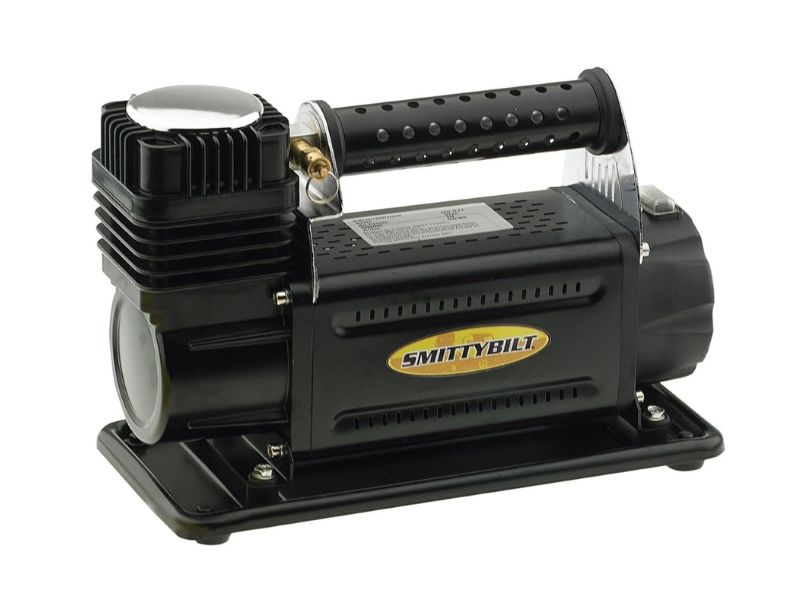
3. Smittybilt 2781 High Performance Air Compressor – Best High-Airflow Pick for Large Tires
Key Features
- 12V compressor
- Approximately 5.6 CFM maximum airflow
- Approximately 160 L/min output
- 150 PSI maximum pressure
- Long quick-release coil hose
- Heavy-duty battery clips
- Around 10-foot power cable
- Direct-drive motor
- Nylon carrying bag
- Designed with off-road tire adjustment in mind
The Smittybilt 2781 is where this list moves from general-purpose portable inflation into more serious off-road territory.
Its maximum airflow is around 5.6 CFM, or 160 liters per minute, which is substantially higher than many common compact tire inflators.
That extra airflow makes a noticeable difference when you are repeatedly inflating large tires.
Smittybilt specifically positions the 2781 as a trail-focused compressor and notes that it is commonly used with 35- and even 37-inch tires.
This is exactly the kind of use where compressor choice becomes important.
Imagine airing four 35-inch tires down from highway pressure to roughly 15–20 PSI for soft sand or trail traction.
When it is time to head home, you might need to add 15 PSI or more to every tire.
A low-output emergency compressor can theoretically do the job, but the process may take a long time and create a substantial amount of heat.
A compressor moving several cubic feet of air per minute is much better suited to that workload.
The Smittybilt’s long coil hose is another advantage.
The hose is approximately 24 feet long, which provides excellent reach around a pickup, Jeep, SUV, or other off-road rig.
That allows you to position the compressor near the vehicle battery and work around all four corners without constantly relocating it.
The unit uses a 12V motor and heavy-duty battery clips, avoiding the limitations of a standard cigarette-lighter outlet.
That is the arrangement I generally prefer on a serious trail compressor.
Airflow requires electrical power. Once you move beyond small emergency inflators, direct battery connections become increasingly common because the compressor can draw more current safely.
Construction also feels more oriented toward rough use than a plastic consumer inflator.
That does come with a penalty: size and weight.
A high-output 4×4 compressor will never disappear into a tiny glove-box-sized compartment.
However, for drivers who routinely change tire pressure, the reduced air-up time often makes the extra bulk worthwhile.
What I Like
The airflow is the biggest reason to buy the Smittybilt.
At roughly 5.6 CFM maximum output, it is much better suited to large tire volume than compact car-style pumps.
I also like the long hose and battery-clamp connection. Both make sense for real-world off-road use.
The compressor is particularly appealing for Jeep, truck, and full-size SUV owners running larger-than-stock tires.
What I Do Not Like
It is heavier and takes up more storage space than the VIAIR 88P.
This is also a relatively straightforward mechanical compressor rather than a feature-heavy digital inflator. Drivers looking for preset PSI control and automatic shutoff may prefer a different style.
Verdict
The Smittybilt 2781 is a strong choice when inflation speed for 35- or 37-inch tires matters more than compact dimensions.
For frequent off-road air-down and air-up cycles, its higher airflow can save considerable time.
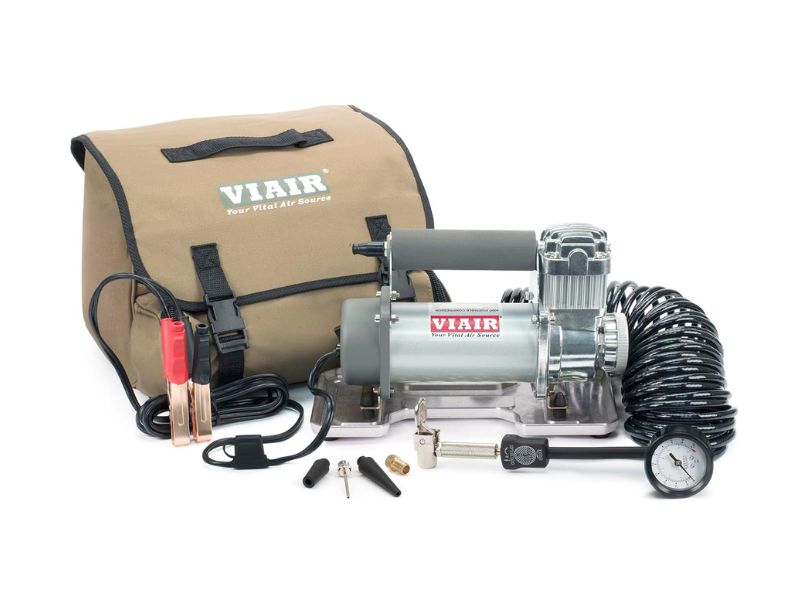
4. VIAIR 400P Portable Compressor Kit – Best Premium Pick for 35-Inch Tires
Key Features
- Designed for tires up to about 35 inches
- 2.30 CFM airflow at 0 PSI
- 150 PSI maximum working pressure
- 33% duty cycle at 100 PSI
- 30-amp maximum draw on 12V version
- IP54 environmental protection
- 25-foot air hose
- Dual battery clamps
- Thermal overload protection
- Carrying bag included
The VIAIR 400P is one of the more refined portable compressors for 4×4 owners who want a clearly documented performance envelope.
VIAIR rates the 400P for tires up to approximately 35 inches, with airflow of 2.30 CFM at zero pressure and a maximum working pressure of 150 PSI.
This puts it directly into the sweet spot for many modified 4WDs.
Thirty-five-inch tires are extremely popular in off-road builds because they provide additional ground clearance and a larger contact patch without requiring the extreme modifications often associated with 37s or 40s.
However, they contain a substantial amount of air.
A compressor that feels perfectly quick on a 28-inch passenger tire can seem painfully slow when asked to bring four 35s back up from trail pressure.
The 400P addresses that problem with a stronger compressor design and a clearly stated duty cycle.
Its 33% duty cycle at 100 PSI means VIAIR provides meaningful information about how the compressor is intended to operate under load.
Duty cycle is one of the most overlooked tire-inflator specifications.
A compressor’s motor and cylinder generate heat. If the unit is operated continuously beyond its design limits, thermal protection may engage or component life can be reduced.
Knowing the compressor’s intended operating cycle helps off-road users manage long air-up sessions more intelligently.
The 400P also uses direct battery clamps and draws up to 30 amps on the 12V version.
Again, this demonstrates why powerful 4×4 compressors normally bypass interior power outlets.
Its 25-foot hose is excellent for long-wheelbase vehicles.
Instead of dragging the compressor from tire to tire, you can position it near the battery and move primarily with the hose.
The included 5-in-1 inflator/deflator system is useful for drivers who regularly adjust pressure both downward and upward.
That is a key distinction between a normal roadside compressor and a trail air system.
An everyday driver may inflate tires a few times per year.
A serious 4×4 owner may alter tire pressure during almost every trail outing.
For that user, fast deflation, accurate checking, and convenient reinflation become part of the driving routine rather than emergency procedures.
The IP54 rating is another welcome specification for off-road equipment, providing a defined level of protection against dust ingress and splashing water.
You should still treat the compressor as an electrical tool rather than something designed to be submerged, but additional environmental protection makes sense around dusty trails and campsites.
What I Like
The 400P has one of the clearest specification packages in this roundup.
The combination of 35-inch tire compatibility, 2.30 CFM airflow, duty-cycle information, thermal protection, IP54 construction, and a 25-foot hose makes it easy to understand exactly what you are buying.
Build quality and accessory organization also suit drivers who expect to keep a compressor for years.
What I Do Not Like
The 400P is not the highest-airflow compressor here, despite being positioned for serious 4×4 use.
It also costs more than many general-purpose alternatives.
Drivers running 37-inch or larger tires should consider stepping up to an even more powerful compressor.
Verdict
The VIAIR 400P is an excellent choice for a 4×4 on tires up to about 35 inches, particularly when build quality, clearly documented specifications, hose reach, and trail-ready design matter more than finding the cheapest solution.
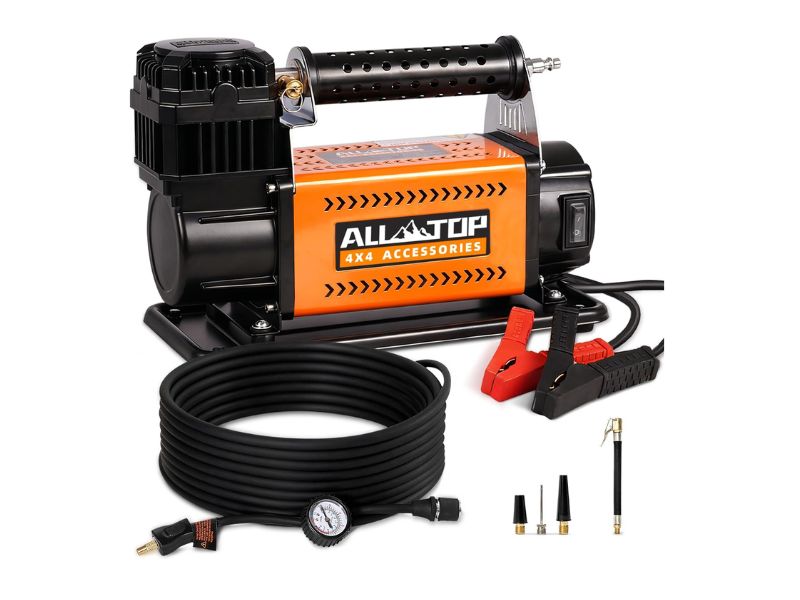
5. ALL-TOP 12V Portable Air Compressor Kit – Best High-Output Off-Road Compressor
Key Features
- 12V compressor
- Approximately 7.06 CFM maximum airflow
- Approximately 200 L/min output
- 150 PSI maximum pressure
- 26-foot air hose
- 6.5-foot power cable
- Direct battery power
- Thermal cutoff protection
- Pressure safety valve
- Metal housing
- Carry bag included
The ALL-TOP 12V Portable Air Compressor Kit offers the highest stated airflow of the five compressors in this guide.
The compressor is rated at approximately 7.06 CFM, or 200 liters per minute, with a 150 PSI maximum pressure.
That specification immediately makes it interesting for drivers with large-volume off-road tires.
The compressor is aimed specifically at vehicles such as SUVs, 4x4s, trucks, RVs, motorcycles, and other equipment where greater air delivery is useful.
A 26-foot air hose gives excellent reach around larger vehicles, while the 6.5-foot power cable keeps the compressor relatively close to the battery.
This setup makes sense electrically.
Rather than extending a high-current electrical cable unnecessarily, you place the compressor near the power source and use a long air hose to reach each wheel.
The metal housing and aluminum cylinder are designed to assist with heat dissipation.
That matters because heat is one of the major limiting factors in portable air compressors.
Every time the piston compresses air, heat builds inside the cylinder and head.
High-output operation makes heat management even more important.
ALL-TOP also includes an automatic thermal cutoff switch and pressure safety valve designed to protect the compressor.
Those protections are particularly valuable during repetitive four-tire inflation sessions.
The downside of high output is that the compressor is much less compact than the VIAIR 88P.
At roughly 16 pounds, it is something you deliberately make space for rather than casually tossing into a small storage compartment.
For overlanding, that may not be an issue.
Vehicles already carrying organized recovery equipment often have drawer systems, roof storage, cargo cases, or dedicated equipment compartments.
For a daily-driven compact 4×4, however, a smaller compressor may be easier to live with.
What I Like
The 200 L/min maximum airflow is the biggest attraction.
The long hose also suits full-size 4WDs, trucks, and overland vehicles.
I appreciate the thermal protection and safety valve because a compressor with this level of output may see demanding use.
What I Do Not Like
The 16-pound weight makes it significantly less convenient than smaller portable units.
Its size may be unnecessary for drivers who only occasionally add a few PSI to stock tires.
High current demand also means direct battery connection should be treated as part of normal operation.
Verdict
The ALL-TOP is a strong option for drivers who prioritize maximum airflow and large-tire inflation speed.
It makes the most sense in an overland vehicle, pickup, or heavily equipped 4×4 where storage space is available and fast air-ups justify carrying a larger compressor.
4×4 Tire Inflator Comparison
| Product | Power | Max Pressure | Rated Airflow | Tire-Size Focus | Hose Reach | Duty/Protection | Weight | Best For |
| GSPSCN Heavy Duty Double Cylinder | 12V battery | 150 PSI | 70 L/min | Stock to moderately oversized 4×4 tires | Extended hose | Dual-cylinder design | About 6 lb | Best overall balance |
| VIAIR 88P | 12V battery | 120 PSI | 1.47 CFM | Up to about 33 in. | Long hose | Portable compressor design | About 4.75 lb | Compact trail kit |
| Smittybilt 2781 | 12V battery | 150 PSI | 5.6 CFM / 160 L/min | 35–37 in. trail tires | 24-ft coil hose | Heavy-duty direct drive | About 20 lb | Large-tire air-ups |
| VIAIR 400P | 12V battery | 150 PSI | 2.30 CFM | Up to about 35 in. | 25-ft hose | 33% duty cycle at 100 PSI, thermal protection | About 10.4 lb | Premium off-road use |
| ALL-TOP Air Compressor Kit | 12V battery | 150 PSI | 7.06 CFM / 200 L/min | Large 4×4 and truck tires | 26-ft hose | Thermal cutoff and safety valve | About 16 lb | Maximum airflow |
The GSPSCN provides the best middle ground for most 4×4 owners. It is relatively compact while its dual-cylinder design supplies considerably more airflow than miniature roadside pumps.
The VIAIR 88P is the easiest model to carry full time and is particularly suitable for 4WDs running tires up to roughly 33 inches.
For more demanding builds, the Smittybilt 2781 and ALL-TOP prioritize high airflow. The VIAIR 400P sits between those extremes, combining moderate output with clear 35-inch tire compatibility and detailed duty-cycle specifications.
How to Choose the Best 4×4 Tire Inflator
Start With Your Tire Diameter
Tire size should be one of your first considerations.
A 4×4 running 265/70R17 factory tires places considerably less demand on a compressor than a Jeep running 37×12.50R17 mud-terrain tires.
Larger tires contain more air.
That means more air must be replaced every time pressure is increased.
For stock tires, a smaller compressor can be perfectly adequate.
For 33-inch tires, I prefer a compressor specifically rated for that range or one offering a healthy airflow figure.
For 35-inch tires, look toward higher-output compressors such as the Smittybilt, VIAIR 400P, or ALL-TOP.
Once you reach 37 inches and beyond, compressor output becomes even more important.
Prioritize Airflow Over Maximum PSI
One of the easiest ways to buy the wrong inflator is to focus only on PSI.
You will see compressors advertising 100 PSI, 120 PSI, 150 PSI, or even higher.
That does not tell you how quickly the compressor will inflate your tire.
A 4×4 tire may only need 35 PSI for normal road use.
What matters is how much air the compressor can deliver while pressure is building.
That is why CFM and L/min figures are important.
CFM means cubic feet per minute.
L/min means liters per minute.
Higher airflow generally means faster inflation, although comparisons should be made carefully because manufacturers may rate airflow at different pressures.
Understand Why 4×4 Tires Take Longer to Inflate
An off-road tire has a large internal volume.
When you air down, you intentionally release a significant amount of air to reduce pressure.
Lower pressure allows the tire carcass to flex more and increases the size of the contact patch.
That can improve traction and ride comfort on certain off-road surfaces.
The downside comes later.
Before sustained highway driving, the tires normally need to be restored to an appropriate road pressure.
You are no longer adding two or three PSI.
You may be replacing half the tire’s normal pressure across four large tires.
That is why off-road compressors need far greater capability than small emergency pumps.
Consider Your Typical Air-Down Pressure
How far you reduce pressure makes a major difference.
A driver going from 36 PSI to 28 PSI for a gravel road will not need nearly as much compressor capacity as someone dropping from 35 PSI to 15 PSI for sand.
Likewise, airing a set of 33-inch tires back up is easier than filling 37s.
Think about your actual usage rather than buying solely from a specification table.
Look Carefully at Duty Cycle
Duty cycle describes how long a compressor can operate during a given period under specified conditions.
For example, a 33% duty cycle does not mean a compressor is poor quality.
It simply indicates that operation and cooling time must be managed according to its rating.
This becomes important when airing four tires consecutively.
A compressor that handles one tire easily may become extremely hot after the third or fourth.
Higher-duty compressors are especially valuable for groups, large tires, overlanding, and repeated air-up sessions.
Battery Clamps Are Usually Better for Serious 4×4 Use
Small tire inflators often plug into the vehicle’s 12V accessory outlet.
That is convenient, but serious compressors frequently use alligator-style battery clamps instead.
There is a good reason.
High-flow compressors need substantial electrical current.
The wiring and fuse supporting an interior outlet may not be designed for that load.
Direct battery connection allows the compressor to draw power from a more appropriate source.
Follow the compressor manufacturer’s instructions carefully, including recommendations regarding whether the vehicle engine should be running.
Check Maximum Amp Draw
Airflow comes from mechanical work, and mechanical work requires electrical power.
High-output compressors may draw 30 amps, 40 amps, or considerably more depending on the design.
This is not inherently a problem, but your electrical system and connections need to be appropriate.
Never replace a fuse with a larger one simply to prevent it from blowing.
A fuse is there to protect wiring from excessive current.
Hose Length Matters More Than You Think
Long-wheelbase pickups and SUVs can be surprisingly difficult to reach with a short hose.
A compressor may sit near the front battery while the rear passenger-side tire is many feet away.
A long air hose is usually better than a very long power cable.
Keeping the compressor near the battery minimizes voltage drop through high-current wiring while the air hose handles the distance.
For large 4x4s, I like seeing roughly 20 feet or more of usable hose reach.
Check the Chuck Style
Two common designs are threaded chucks and clip-on chucks.
Threaded chucks screw onto the tire valve and create a secure seal.
Clip-on models are faster to attach and remove.
For trail use, either is acceptable if it seals well.
The important factor is avoiding air leakage while inflating.
Consider Heat Management
Portable compressors get hot.
That is normal.
Compressing air generates heat through both mechanical friction and thermodynamic compression.
Metal cylinder heads and fittings can become hot enough to cause burns.
Look for features such as:
- Thermal overload protection
- Aluminum cylinders
- Metal heat sinks
- Cooling fins
- Safety shutoff systems
- Stable mounting feet
More importantly, follow the manufacturer’s operating and cooling recommendations.
Think About Dust and Water Exposure
Off-road equipment lives in a harsh environment.
Dust gets everywhere.
Mud and water spray are common.
A compressor with a defined IP rating can provide additional confidence, although no portable electrical compressor should be treated as waterproof unless explicitly designed and rated for that exposure.
Keep the unit dry whenever practical and store it in its case after use.
Consider Storage Weight and Size
A compressor is only one part of your trail equipment.
A well-equipped 4×4 may already carry:
- Tire repair tools
- Recovery boards
- Tow straps
- Soft shackles
- Winch equipment
- First-aid supplies
- Tool kits
- Jack equipment
- Spare parts
- Water
- Camping equipment
A 20-pound compressor may be worthwhile for frequent trail use but unnecessary for occasional gravel-road driving.
Balance inflation performance against the storage space you are willing to sacrifice.
What Airflow Is Good for a 4×4 Tire Inflator?
There is no single perfect number, but higher airflow becomes increasingly valuable as tire diameter grows.
For stock-size tires and occasional use, roughly 1–2 CFM may be adequate.
Around 2–3 CFM can provide a useful balance for many 33- to 35-inch applications.
Compressors offering 5 CFM or more become particularly attractive for large tires and repeated air-ups.
However, airflow figures should not be considered in isolation.
A manufacturer’s 5 CFM specification measured at zero pressure cannot necessarily be compared directly with another manufacturer’s rating measured at 30 PSI.
Duty cycle, hose restrictions, electrical voltage, temperature, and compressor efficiency all affect real-world performance.
What Size Tire Inflator Do I Need for 33-Inch Tires?
For 33-inch tires, I recommend looking for a compressor specifically rated for that size or something producing at least respectable portable-compressor airflow.
The VIAIR 88P is a good example because its intended tire-size range extends to approximately 33 inches.
If you air down frequently, buying extra compressor capacity can reduce air-up time.
A more powerful unit may also run for less total time, potentially reducing heat accumulation during a four-tire session.
What Size Compressor Is Best for 35-Inch Tires?
Thirty-five-inch tires benefit significantly from a stronger compressor.
I would prioritize:
Good airflow: preferably several CFM where possible.
Long hose reach: especially on pickups and full-size SUVs.
Direct battery power: high-output compressors should generally avoid low-current accessory outlets.
Useful duty cycle: the compressor needs to handle four consecutive tires.
Thermal protection: valuable during demanding air-up sessions.
The Smittybilt 2781, VIAIR 400P, and ALL-TOP are better aligned with this type of usage than compact emergency pumps.
What About 37-Inch Tires?
Once tire diameter reaches 37 inches, air volume becomes substantial.
A small compressor can technically produce the necessary pressure, but inflation speed may become frustrating.
This is where compressors with around 5 CFM or greater output become much more attractive.
Drivers who regularly run 37s may also consider dual-compressor or permanently mounted onboard-air systems.
Portability is convenient, but permanent systems can provide exceptional airflow and eliminate the need to unpack a compressor every time.
Portable Compressor vs. Onboard Air for a 4×4
A portable compressor works well for most recreational drivers.
It can be moved between vehicles, requires no permanent installation, and can be stored when not needed.
An onboard-air system mounts permanently to the vehicle.
It can provide immediate access to compressed air and may be connected to an air tank, multiple tire hoses, lockers, or other pneumatic accessories.
The downside is complexity.
Installation can require wiring, relays, fuses, mounting brackets, air lines, fittings, and possibly a tank.
For occasional trail use, portable equipment is simpler.
For frequent off-roading, overlanding, or competitive use, onboard air can be worth the investment.
Single-Cylinder vs. Dual-Cylinder Tire Inflators
Dual-cylinder compressors often provide greater airflow because two pistons compress air simultaneously.
That does not automatically make every dual-cylinder model better than every single-cylinder compressor.
Motor quality, cylinder size, cooling, duty cycle, and internal efficiency also matter.
However, when comparing similarly designed portable inflators, a dual-cylinder layout can offer faster inflation of large tires.
This is one reason the GSPSCN works well as a balanced 4×4 option.
Why Fast Inflation Matters Off Road
Inflation speed is more than a convenience.
After several hours on a trail, drivers are often tired and ready to head home.
Spending 30 or 40 minutes kneeling beside tires beside a highway entrance is not ideal.
A faster compressor gets the vehicle back to appropriate road pressure sooner.
That can also make a difference when weather changes unexpectedly or when your group is trying to leave a remote location before dark.
Should You Carry a Separate Tire Pressure Gauge?
Yes.
Even when a compressor includes a built-in gauge, a separate quality gauge is useful.
Check pressure after airflow has stopped and the reading has stabilized.
For consistent handling, all tires on the same axle should normally be adjusted according to the vehicle or tire setup requirements.
Airing down should also be done systematically rather than guessing based on tire appearance.
Tire Pressure for Off-Road Driving
There is no universal off-road PSI.
Appropriate pressure depends on:
- Vehicle weight
- Tire construction
- Tire size
- Load
- Terrain
- Wheel width
- Driving speed
- Bead-retention system
- Driver experience
Sand may call for significantly lower pressure than a maintained gravel road.
Sharp rocks create different requirements.
Going too low can allow the tire bead to separate from the wheel or expose the sidewall and wheel to damage.
Always understand your tire and wheel setup before experimenting with extreme pressure reductions.
Tire Inflator vs. CO2 Tank for 4×4 Use
A portable CO2 tank can inflate large tires extremely quickly and requires no electrical power during use.
That makes it attractive for serious off-road driving.
However, the tank contains a finite amount of gas.
Once empty, it must be refilled.
An electric compressor is slower but essentially offers unlimited air as long as the vehicle can supply electrical power and the compressor remains within its operating limits.
For most recreational 4×4 owners, an electric compressor is the more practical long-term solution.
Important 4×4 Tire Inflation Safety Tips
Park the vehicle in a stable location before inflating tires.
Avoid working immediately beside fast-moving traffic whenever possible.
Follow the vehicle or tire manufacturer’s road-pressure recommendations after leaving the trail.
Do not inflate a visibly damaged tire.
A torn sidewall, damaged bead, exposed cord, or severely deformed tire may fail under pressure.
Wear eye protection when working with damaged wheels or tires.
Keep hands away from hot compressor components.
Never allow electrical clamps to touch each other while connected to the battery.
Confirm polarity before attaching battery leads.
Inspect cables, hoses, and fittings periodically.
Off-road vibration can damage equipment that has been bouncing in a storage compartment for months.
Common Mistakes When Buying a 4×4 Tire Inflator
Buying Based Only on PSI
Maximum PSI is easy to advertise but tells you little about large-tire inflation speed.
Focus more heavily on airflow and tire-size suitability.
Choosing a Car Inflator for 35-Inch Tires
A compact passenger-car inflator may eventually fill a large off-road tire, but the process can be painfully slow.
Choose equipment appropriate to tire volume.
Ignoring Duty Cycle
Four tires create a continuous workload.
Make sure your compressor can handle the operating time or follow the required cooling intervals.
Using an Underrated 12V Socket
Do not connect a high-current compressor to a low-current accessory socket simply because you have an adapter.
Use the power method specified by the compressor manufacturer.
Buying a Hose That Cannot Reach
Check the total distance from the battery area to the farthest wheel.
A short hose can make an otherwise excellent compressor frustrating to use.
Forgetting About Storage
Heavy compressors need secure storage.
Loose equipment can become dangerous during sudden braking or off-road impacts.
Ignoring Final Pressure Accuracy
Inflation speed is only part of the job.
Verify final pressure accurately before returning to highway speeds.
Frequently Asked Questions
What is the best 4×4 tire inflator?
The GSPSCN Heavy Duty Double Cylinder is the best overall choice for most 4×4 owners.
Its dual-cylinder design, approximately 70 L/min airflow, direct 12V battery operation, extended hose, and manageable size make it well suited to stock and moderately oversized 4×4 tires.
What is the best tire inflator for 35-inch tires?
A higher-output compressor such as the Smittybilt 2781 or VIAIR 400P is better suited to 35-inch tires.
Larger tires contain much more air than normal passenger tires. High airflow and an appropriate duty cycle reduce the time needed to restore road pressure after airing down.
Is the VIAIR 88P good for off-roading?
Yes, the VIAIR 88P is well suited to casual off-roading with tires up to about 33 inches.
It provides direct battery power, a compact metal design, useful hose reach, and a secure tire connection without requiring much cargo space.
How much CFM do I need for 4×4 tires?
Around 2 CFM or more is useful, while 5 CFM or higher is preferable for larger tires and faster air-ups.
Tire diameter, starting pressure, duty cycle, and how often you air down should all influence your choice.
Is 150 PSI necessary for a 4×4?
No, airflow is usually much more important than having a 150 PSI maximum rating.
Most 4×4 tires operate far below 150 PSI. The higher rating shows compressor capability, but it does not tell you how quickly a large tire will inflate.
Should I connect a 4×4 compressor directly to the battery?
Direct battery connection is generally preferred for higher-output portable compressors.
Large compressors may draw more current than a standard accessory outlet can safely provide. Always follow the manufacturer’s specified power method.
Can I inflate 37-inch tires with a portable compressor?
Yes, but choose a high-airflow compressor designed for large off-road tires.
Low-output compressors may take a long time and build excessive heat. Drivers who regularly use 37s should prioritize airflow and duty cycle.
How long does it take to air up four 4×4 tires?
Inflation time varies dramatically with tire size, airflow, starting PSI, and target pressure.
A high-output compressor can make the process considerably faster than a compact emergency inflator. Airing four 35-inch tires from trail pressure is much more demanding than adding three PSI to stock tires.
Do I need automatic shutoff?
Automatic shutoff is convenient but not essential for a serious 4×4 compressor.
Many high-output off-road models prioritize airflow and durability instead. Using a separate pressure gauge provides good control when automatic presets are unavailable.
Can a 4×4 compressor reseat a tire bead?
Some high-output compressors may help reseat certain beads, but results depend heavily on tire, wheel, airflow, and the nature of the separation.
Bead seating can be hazardous. If you are not experienced with the procedure, professional assistance is the safer option.
Should I run the engine while using a 12V compressor?
Follow the compressor manufacturer’s instructions for your specific model.
Many high-output compressors are designed to work while the vehicle’s charging system is supplying power, helping reduce battery drain and voltage drop.
Is a dual-cylinder inflator better for off-road tires?
Dual-cylinder designs can provide strong airflow and are often well suited to larger tires.
However, cylinder count alone does not determine performance. Motor quality, cylinder size, cooling, duty cycle, and actual airflow remain important.
Final Verdict
For most drivers searching for the best 4×4 tire inflator, the GSPSCN 12V Heavy Duty Double Cylinder Tire Inflator is my first choice. Its combination of dual-cylinder airflow, direct 12V power, extended reach, manageable weight, and straightforward construction makes it practical for everyday 4WD ownership and recreational trail use.
The VIAIR 88P Portable Compressor Kit is better if compact size is a priority and your tires are approximately 33 inches or smaller.
For larger tires, the Smittybilt 2781 High Performance Air Compressor delivers significantly greater airflow and is more appropriate for repeated off-road air-ups.
The VIAIR 400P Portable Compressor Kit is a strong premium option for rigs running tires up to about 35 inches, particularly for drivers who value clearly documented duty-cycle and environmental-protection specifications.
Finally, the ALL-TOP 12V Portable Air Compressor Kit stands out for maximum stated airflow and makes sense for larger 4x4s, pickups, and overland vehicles where fast inflation is worth the additional storage space and weight.
The key is to match your compressor to your tire diameter, air-down habits, electrical system, and frequency of off-road use. A small inflator can be fine for occasional pressure corrections, but a real trail vehicle deserves a compressor capable of restoring four large tires without turning every air-up into a long wait.