A flat or severely underinflated tire can turn an ordinary drive into an unexpected roadside problem, especially when there is no service station or air pump nearby. Carrying the best flat tire inflator gives you a convenient way to restore tire pressure when the tire is still capable of holding air.
The most useful models combine strong airflow, accurate pressure monitoring, sufficient hose and power-cord reach, and dependable construction in a package that can stay in your vehicle.
My first choice is the FORTEM Tire Inflator Portable Air Compressor. Its 150 PSI capability, digital pressure gauge, automatic shutoff, long power reach, LED light, and AC/DC flexibility make it particularly practical for drivers who want one inflator for both roadside emergencies and routine tire-pressure maintenance at home.
For buyers who want more power flexibility and already use cordless power tools, the DEWALT DCC020IB 20V MAX Corded/Cordless Inflator is an excellent upgrade. It can operate from several compatible power sources, includes automatic high-pressure inflation, and is built for more frequent use than many inexpensive emergency pumps.
If compact cordless convenience matters most, I also like the AstroAI L7 Tire Inflator Portable Air Compressor. Its rechargeable battery, lightweight body, 150 PSI maximum pressure, automatic shutoff, and digital controls make it particularly convenient for topping up car, motorcycle, and bicycle tires without routing a long power cord around the vehicle.
The five inflators below cover different needs, from small emergency pumps to higher-output compressors suitable for larger passenger and light-truck tires. I compared them based on inflation capability, power source, portability, pressure control, hose design, durability, and real-world roadside usefulness.
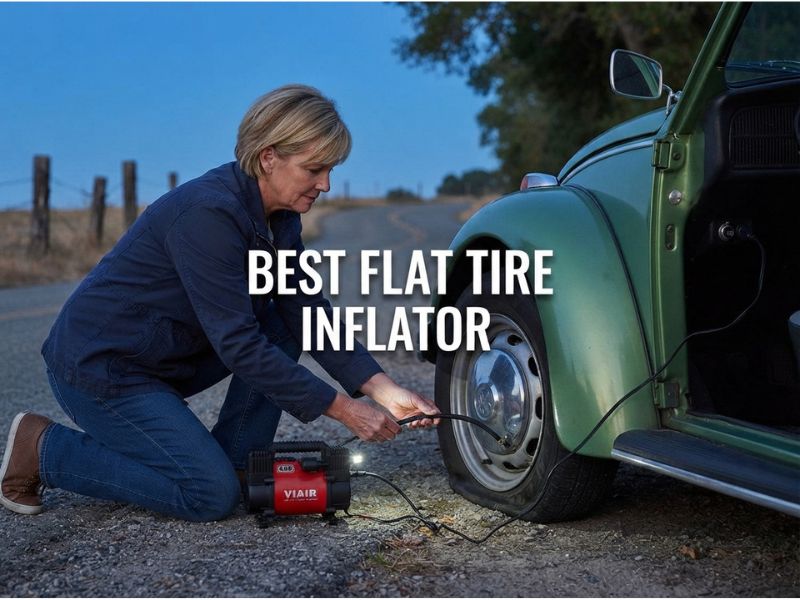
5 Best Flat Tire Inflator
| Image | Product Name | Check Price |
|---|---|---|
Best Choice | FORTEM Tire Inflator Portable Air Compressor – Best Overall | Check Price |
Second Best | DEWALT 20V MAX Corded/Cordless Inflator | Check Price |
Third Choice | AstroAI L7 Tire Inflator Portable Air Compressor | Check Price |
 | VIAIR 88P Portable Compressor Kit | Check Price |
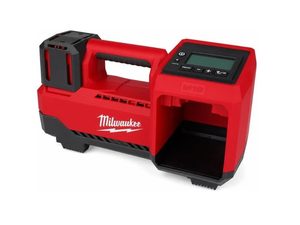 | Milwaukee M18 2848-20 Cordless Tire Inflator | Check Price |
1. FORTEM Tire Inflator Portable Air Compressor – Best Overall
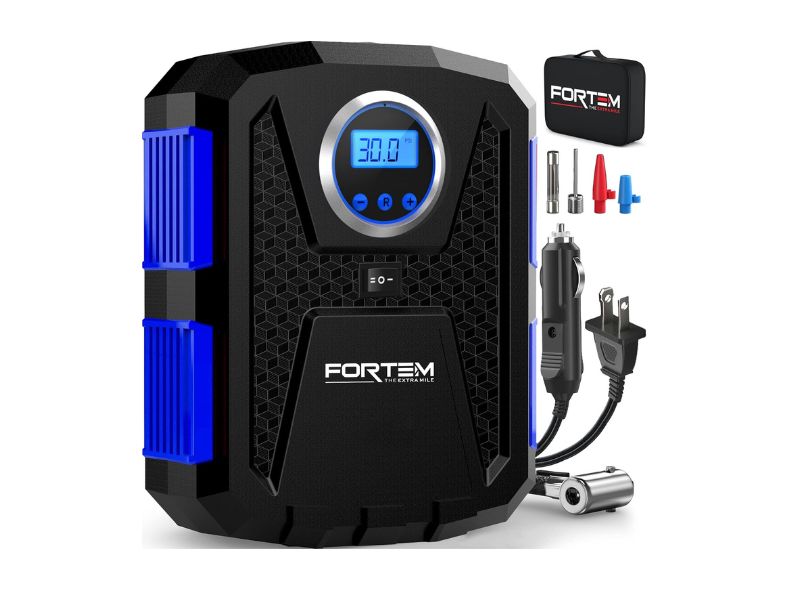
The FORTEM Tire Inflator is my overall recommendation because it provides the features most everyday drivers need without becoming unnecessarily large or complicated.
Its combination of a digital pressure gauge, automatic shutoff, strong 150 PSI maximum pressure, and convenient power options makes it suitable for both emergency tire inflation and routine pressure maintenance.
Key Features
- Up to 150 PSI maximum pressure
- Approximately 25 L/min airflow
- Digital pressure display
- Automatic shutoff
- 12V DC vehicle power
- 110V AC home-power compatibility
- Approximately 14-foot total reach
- Integrated LED light
- Multiple inflation nozzles
- Compact carrying case
- Multiple pressure units
- Lightweight portable design
Detailed Review
One of the biggest strengths of the FORTEM is how easy it is to use.
Connect the air hose to the tire valve, select the desired pressure on the digital controls, and start the compressor. The inflator monitors pressure and automatically stops when the selected value is reached.
That feature is particularly useful during roadside emergencies because you do not need to continually stop the compressor and check pressure with a separate gauge.
The 150 PSI maximum pressure gives the inflator plenty of pressure capacity for normal passenger-car tires, SUVs, motorcycles, and bicycles. Maximum PSI does not tell the whole story, however. Its approximately 25 L/min airflow is more meaningful for normal car-tire inflation and provides reasonable performance for routine top-offs.
Power flexibility is another advantage.
The inflator can work from a vehicle’s 12V accessory outlet, making it suitable for roadside use. The compatible AC configuration also allows convenient operation from a household wall outlet when you are checking tire pressure in the garage.
The long overall reach makes it easier to access tires around a normal passenger vehicle without awkwardly repositioning the compressor.
I also appreciate the integrated LED light. A low tire does not always happen during daylight, and being able to illuminate the valve area can make nighttime inflation considerably easier.
What I Like
The FORTEM combines simple digital controls, automatic shutoff, useful airflow, long reach, and versatile power in a compact package.
It is also easy to keep permanently in a vehicle because the cables and accessories can be stored together.
What I Do Not Like
It is not intended to replace a high-volume compressor for oversized off-road tires or repeated commercial use.
Like most small compressors, extended continuous operation can generate significant heat, so proper cooldown periods are important.
Verdict
For the typical car, crossover, or SUV owner, the FORTEM is the most balanced flat tire inflator in this lineup. It offers the right mix of portability, pressure control, accessibility, and everyday emergency capability.
2. DEWALT DCC020IB 20V MAX Corded/Cordless Inflator – Best Versatile Power Option

The DEWALT DCC020IB is a better fit for buyers who want a more substantial inflator that can serve both roadside and garage duties.
Its biggest advantage is power-source flexibility. Depending on your setup and accessories, the unit can work with a compatible 20V MAX battery, 12V DC vehicle power, or AC power.
Key Features
- 20V MAX battery compatibility
- 12V DC operation
- AC-power capability
- High-pressure inflation mode
- Automatic pressure shutoff
- Digital pressure controls
- High-volume inflation mode
- Deflation capability
- Threaded tire chuck
- Integrated LED light
- Onboard accessory storage
- Rubber stabilizing feet
Detailed Review
The DCC020IB feels more like a proper workshop tool than a small emergency-only compressor.
For car tires, the high-pressure mode is the important part. Set your desired pressure on the digital control panel, connect the threaded chuck, and let the compressor work until automatic shutoff activates.
The threaded connection forms a secure seal on a Schrader valve and is particularly useful if you dislike lever-style connectors that sometimes shift during inflation.
The ability to operate from a cordless tool battery is another major advantage. If you already own compatible batteries, you can move around the vehicle without worrying about power-cord length.
If a battery is unavailable, the alternative power options provide additional flexibility.
The unit also includes a separate high-volume function for larger low-pressure inflatables. That feature does not directly improve tire inflation, but it increases overall usefulness for camping equipment, air mattresses, and recreational items.
For flat-tire situations, the DEWALT’s sturdy body and stable base are appealing. It can sit on the pavement while you monitor inflation without feeling as delicate as many pocket-size rechargeable pumps.
The tradeoff is size.
This is compact compared with a conventional shop compressor, but it is noticeably larger than handheld inflators such as the AstroAI L7.
What I Like
The main strength is power flexibility. Cordless battery operation is convenient, while the alternative power inputs give you backup options.
I also like the automatic shutoff, threaded chuck, stable construction, and onboard accessory organization.
What I Do Not Like
The tool-only configuration may require buyers to already own or separately obtain compatible battery or power accessories.
It also occupies more trunk space than a small rechargeable tire pump.
Verdict
The DEWALT DCC020IB is an excellent choice for drivers who want one inflator for the vehicle, garage, and workshop. It is especially attractive if you already use compatible cordless tools.
3. AstroAI L7 Tire Inflator Portable Air Compressor – Best Compact Cordless Pick

The AstroAI L7 takes a completely different approach.
Instead of using a long 12V cable, it contains a rechargeable battery and fits into a compact handheld body weighing roughly a pound.
For routine tire-pressure corrections and emergency top-offs, that convenience is hard to beat.
Key Features
- Cordless rechargeable design
- 4000mAh internal battery
- Up to 150 PSI
- Approximately 17 L/min airflow
- Automatic shutoff
- Digital pressure display
- Multiple inflation modes
- Custom pressure mode
- Four pressure units
- Integrated LED emergency light
- USB charging capability
- Compact handheld dimensions
Detailed Review
The biggest advantage of the L7 is that there is almost no setup required.
Take it from the vehicle, connect the hose, select your desired pressure, and start inflation. You do not need to locate a 12V outlet or stretch a cable around the vehicle.
That makes it particularly convenient when only one tire needs a few extra PSI.
The compressor reaches up to 150 PSI, although normal car tires operate at a fraction of that pressure.
Its airflow is better suited to routine passenger-car tire corrections than repeatedly filling large truck tires from completely flat.
The digital control system includes preset operating modes for different applications. Car, motorcycle, bicycle, and ball modes make the device approachable even for users who rarely operate a compressor.
Automatic shutoff stops inflation after reaching the selected target.
The built-in rechargeable battery is both the biggest advantage and the primary limitation.
Cordless operation is convenient, but the inflator must be charged periodically. Leaving it untouched in a vehicle for months without checking its battery defeats the purpose of carrying emergency equipment.
Cold temperatures can also temporarily reduce lithium battery performance.
What I Like
The L7 is exceptionally easy to store and deploy.
Its small size, cordless design, digital pressure gauge, automatic shutoff, and integrated lighting make it one of the most convenient pumps for normal car and motorcycle owners.
What I Do Not Like
It is not intended for large truck, RV, trailer, or oversized off-road tires.
A small internal battery also limits how much continuous inflation work it can perform compared with a direct-powered compressor.
Verdict
Choose the AstroAI L7 when portability and cordless convenience matter more than maximum airflow. It is ideal for quickly correcting pressure loss in normal passenger tires.
4. VIAIR 88P Portable Compressor Kit – Best for Larger Tires
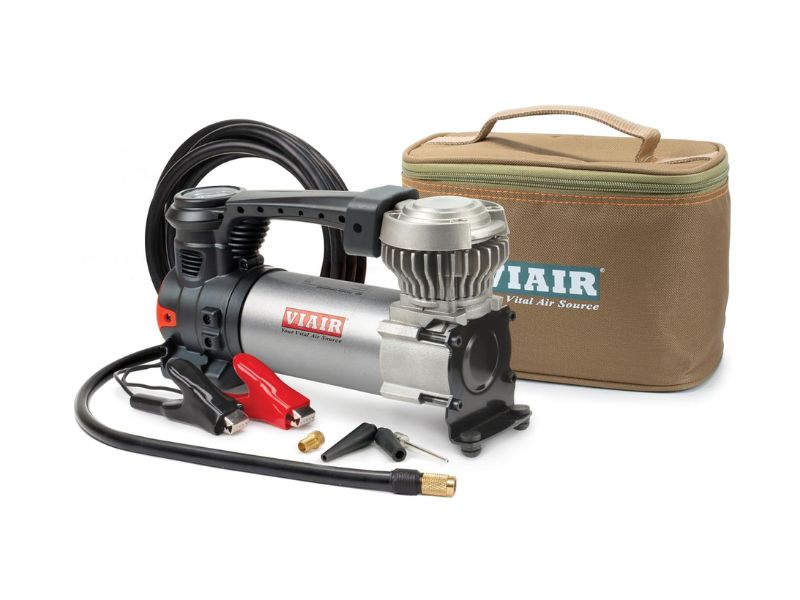
The VIAIR 88P is the most traditional heavy-duty portable compressor in this group.
Instead of drawing power through a small accessory socket, it connects directly to the vehicle battery with clamps. That arrangement supports stronger current draw and helps the compressor deliver useful airflow for larger tires.
Key Features
- 12V direct battery connection
- Dual battery clamps
- Up to 120 PSI
- Approximately 1.47 CFM free-flow rating
- Suitable for tires up to approximately 33 inches
- 16-foot air hose
- 10-foot power cable
- Brass twist-on tire chuck
- Integrated pressure gauge
- LED power/work light
- Multiple inflation tips
- Carrying bag
Detailed Review
The VIAIR is particularly appealing if the phrase “flat tire” means more than adding three or four PSI.
A larger tire that has lost most of its air contains substantially more volume than a slightly underinflated passenger-car tire. Moving that much air requires a compressor with reasonable airflow.
The 88P provides approximately 1.47 CFM of free airflow, making it much more suitable for larger SUV, crossover, light-truck, and off-road tires than many tiny battery-powered pumps.
VIAIR rates the compressor for tires up to approximately 33 inches.
The long 16-foot hose is another practical advantage. Combined with the power cable, it gives you excellent reach around larger vehicles.
Direct battery clamps are both an advantage and inconvenience.
The advantage is that the compressor is not constrained by the relatively low current capacity of many 12V accessory outlets.
The disadvantage is that you need access to the vehicle battery and must connect the clamps correctly.
The pressure gauge is also more traditional than the programmable digital systems on several other products here. Drivers who prioritize automatic shutoff may therefore prefer FORTEM or DEWALT.
What I Like
The 88P provides strong airflow, excellent hose reach, direct battery power, and better large-tire capability than most tiny emergency pumps.
Its brass chuck and straightforward mechanical design also suit buyers who prefer simplicity.
What I Do Not Like
Direct battery connection requires opening the hood and properly attaching the clamps.
It also lacks the same convenient preset automatic shutoff interface found on several digital inflators.
Verdict
The VIAIR 88P is my preferred option for larger SUV, pickup, and off-road tires when airflow matters more than having the smallest possible compressor.
5. Milwaukee M18 2848-20 Cordless Tire Inflator – Best Fast Cordless Pick

The Milwaukee M18 Inflator is built for buyers who value inflation speed, durability, and cordless operation more than minimal size.
It uses the M18 battery platform and is optimized for passenger vehicles and light trucks.
Key Features
- M18 cordless battery system
- 150 PSI maximum pressure
- Approximately 1.41 SCFM at 0 PSI
- Approximately 1.10 SCFM at 35 PSI
- Automatic pressure shutoff
- TrueFill pressure-check technology
- Four pressure memory slots
- 36-inch air hose
- Brass Schrader chuck
- Anti-vibration feet
- Onboard hose storage
- Multiple inflation adapters
Detailed Review
This is the most performance-focused cordless inflator in the group.
Its airflow remains strong even as tire pressure increases, making it particularly useful when you have larger passenger or light-truck tires.
The manufacturer specifically optimizes it for passenger cars, light trucks, and similar medium-duty applications.
TrueFill pressure control is another useful feature.
Instead of immediately assuming the reading is stable, the system checks pressure during the inflation process and continues filling until the programmed target is achieved.
Once the tire reaches that setting, automatic shutoff stops the compressor.
Four memory locations allow common tire-pressure settings to be stored, which is helpful if you regularly maintain several vehicles.
The 36-inch hose and brass Schrader connection also give the tool a more professional feel than many pocket inflators.
The biggest consideration is battery ownership.
If you already use M18 tools, this inflator makes considerable sense. If you do not, buying into an entirely new battery platform solely for tire inflation can make the total package harder to justify.
What I Like
The Milwaukee offers excellent cordless performance, fast airflow, accurate target-pressure control, and sturdy construction.
It is especially useful for households with multiple vehicles or drivers who frequently adjust tire pressure.
What I Do Not Like
It is larger and heavier than compact handheld pumps.
The tool-only configuration also makes more sense for someone who already owns compatible batteries.
Verdict
The Milwaukee M18 is the best performance-oriented cordless option in this lineup. It is particularly suitable for frequent tire maintenance and larger passenger or light-truck tires.
Flat Tire Inflator Comparison
| Product | Power Source | Max Pressure | Approx. Airflow | Auto Shutoff | Digital Gauge | Cordless Option | Best Tire Type | Best For |
| FORTEM Tire Inflator | 12V DC / AC | 150 PSI | 25 L/min | Yes | Yes | No | Car/SUV | Best overall |
| DEWALT DCC020IB | Battery / 12V / AC | High-pressure mode | Performance-focused | Yes | Yes | Yes | Car/SUV/Light Truck | Versatility |
| AstroAI L7 | Rechargeable battery | 150 PSI | 17 L/min | Yes | Yes | Yes | Car/Motorcycle | Compact use |
| VIAIR 88P | Direct 12V battery clamps | 120 PSI | 1.47 CFM | No | Gauge | No | SUV/Truck/Up to 33″ | Larger tires |
| Milwaukee M18 | M18 battery | 150 PSI | 1.41 SCFM at 0 PSI | Yes | Yes | Yes | Car/Light Truck | Fast cordless use |
The FORTEM offers the best overall balance for normal drivers because it combines automatic pressure control, good portability, useful power flexibility, and straightforward operation.
The DEWALT is better if you want one inflator that can move between roadside, garage, and workshop use.
AstroAI is the easiest to store and carry.
For larger-volume tires, the VIAIR 88P’s direct-powered compressor is a stronger fit.
The Milwaukee M18 is the most attractive high-performance cordless option, particularly for drivers already invested in its battery platform.
What Is a Flat Tire Inflator?
A flat tire inflator is a portable air compressor designed to restore air pressure to a tire.
Depending on the design, it may receive power from a vehicle’s 12V electrical system, directly from the vehicle battery, from a household outlet, or from an internal rechargeable battery.
Modern portable inflators often include digital pressure gauges, programmable target pressures, automatic shutoff, LED lighting, and adapters for bicycle tires or recreational equipment.
However, an inflator should not be confused with a tire repair system.
A compressor can restore pressure only when the tire, wheel, and valve system can still contain compressed air.
Can a Tire Inflator Fix a Completely Flat Tire?
It depends on why the tire is flat.
If the tire has slowly lost air through a small puncture or leaking valve but remains structurally intact and seated on the wheel, a sufficiently capable compressor may restore pressure.
If the tire has a major sidewall tear, large tread puncture, damaged wheel, failed valve stem, or separated bead, simply pumping air into it may accomplish nothing.
A tire that has been driven while completely flat can also suffer internal damage that is not immediately visible.
That is why a flat tire should be viewed as more than an inflation problem.
Before adding air, visually inspect the tire for obvious damage.
Inflator vs. Tire Sealant: What Is the Difference?
An inflator supplies compressed air.
Tire sealant attempts to temporarily seal certain small punctures while also allowing pressure to be restored.
These are different functions.
A standalone compressor is reusable and does not introduce sealant into the tire. It is ideal for normal pressure loss, slow leaks, seasonal temperature changes, and situations where the puncture has already been properly repaired.
Sealant may be useful in particular emergencies, but it has limitations and compatibility considerations.
Some tire-pressure monitoring systems, tire manufacturers, and repair shops have specific recommendations regarding sealants.
If you simply need to restore pressure, a conventional inflator is generally the cleaner solution.
How to Choose the Best Flat Tire Inflator
Consider How Flat the Tire May Be
There is a major difference between adding 4 PSI and inflating a nearly empty tire.
A small cordless compressor may handle routine pressure corrections easily but require much longer to move enough air into a larger tire that has dropped close to zero.
If you are buying specifically for emergency flat-tire recovery, airflow deserves more attention than it would for ordinary maintenance.
Owners of pickups, large SUVs, and off-road vehicles should consider higher-volume models.
Look at Airflow, Not Only PSI
Maximum pressure is easy to advertise, which is why so many inflators prominently display figures such as 120 PSI or 150 PSI.
Normal car tires require far less.
The important question during flat-tire inflation is how quickly the compressor can move air.
Airflow may be listed in liters per minute, cubic feet per minute, or standard cubic feet per minute.
Higher airflow is generally more helpful for larger tire volumes.
Match the Inflator to Tire Size
A subcompact car tire and a 33-inch truck tire are dramatically different inflation tasks.
A tiny cordless pump can be excellent for the car while being frustratingly slow on the truck.
Check the manufacturer’s recommended tire-size range whenever available.
For large SUVs and pickups, models such as the VIAIR 88P or Milwaukee M18 offer stronger performance than the smallest handheld units.
Choose the Right Power Source
There are four common options.
12V accessory power is convenient because almost every conventional vehicle provides an appropriate outlet.
Direct battery connection supports higher current draw but requires opening the hood and using battery clamps.
Cordless tool batteries deliver excellent mobility but are most economical when you already own compatible batteries.
Built-in rechargeable batteries provide maximum portability but require regular charging.
There is no universally best arrangement.
For emergency readiness, reliability matters more than novelty.
Automatic Shutoff Makes Inflation Easier
Automatic shutoff allows you to select a target pressure and let the compressor stop when that pressure is reached.
This is particularly useful during a stressful roadside situation.
Instead of repeatedly checking the gauge, you can monitor the vehicle and surrounding traffic while the inflator works.
Models such as FORTEM, DEWALT, AstroAI, and Milwaukee provide this convenience.
Check Pressure-Gauge Quality
The built-in pressure gauge should be easy to read and reasonably consistent.
A digital screen is particularly useful at night.
However, even a good integrated gauge can have a small tolerance.
Keeping a separate quality tire-pressure gauge in the vehicle is useful for occasional verification.
Hose Length Matters
A compressor may look perfect until you discover that its hose or power cable cannot comfortably reach the tire.
This is especially important for pickups, long-wheelbase SUVs, trailers, and vehicles where the accessory outlet is located near the front console.
The VIAIR’s long hose is particularly useful for large vehicles.
Pay Attention to Duty Cycle
Compressors create heat.
A duty cycle describes how long a compressor can operate before it needs to cool.
Small portable inflators often have more restrictive duty cycles than heavy-duty models.
If you are filling a nearly flat tire, especially a large one, the compressor may run considerably longer than it does during a routine 3-PSI top-off.
Following the recommended operating and cooling intervals helps protect the motor and seals.
What PSI Should You Inflate a Flat Tire To?
Inflate the tire to the vehicle manufacturer’s recommended cold tire pressure, not automatically to the maximum pressure shown on the tire sidewall.
The recommended pressure is normally displayed on a placard inside the driver’s door area and in the owner’s manual.
Many passenger vehicles specify pressures somewhere in the 30–40 PSI region, but there are numerous exceptions.
Front and rear pressures may also differ.
The tire sidewall’s maximum pressure is not necessarily the correct everyday operating pressure for the vehicle.
Why Tires Lose Air
A tire does not need a dramatic puncture to lose pressure.
Temperature Changes
Air pressure decreases as temperature falls.
A cold morning can therefore trigger the tire-pressure warning even when the tire has no puncture.
Small Tread Punctures
Nails and screws can create slow leaks that allow a tire to lose several PSI over hours or days.
Valve Problems
A damaged valve stem or valve core can leak.
Wheel-Bead Leaks
Corrosion or contamination around the tire bead can allow gradual pressure loss.
Wheel Damage
Bent or cracked wheels can also leak.
Natural Permeation
Even healthy tires gradually lose small amounts of air over time.
A portable inflator is useful for several of these scenarios, but recurring pressure loss should still be investigated.
Flat Tire Safety Before Inflation
Before connecting an inflator, examine the tire as safely as conditions allow.
Look for severe sidewall damage, exposed internal cords, large cuts, obvious separation, or a tire that has come off the wheel bead.
If the tire is visibly destroyed, inflation is not the appropriate solution.
Also consider where the vehicle is stopped.
If the car is positioned dangerously close to traffic, personal safety takes priority over repairing or inflating the tire immediately.
Move to a safer location when possible.
Can You Inflate a Tire With a Nail in It?
Sometimes, but that does not mean the tire is repaired.
A nail or screw may partially seal its own puncture, creating a slow leak rather than an immediate loss of pressure.
Adding air may provide enough temporary pressure to reach a safer location.
However, puncture location matters.
Damage in the tread area may sometimes be professionally repairable. Sidewall and shoulder damage generally raises much more serious concerns.
The tire should be properly inspected rather than assuming inflation solved the problem.
What If the Tire Is at 0 PSI?
A tire displaying zero pressure deserves additional caution.
First determine whether it is still seated correctly on the wheel.
Portable inflators generally work best when the tire bead remains sealed.
If the bead has separated from the rim, a small portable compressor may not provide enough instantaneous airflow to reseat it.
Also inspect for damage caused by driving with no air pressure.
A tire can look normal externally while having compromised internal sidewall structure.
Cordless vs. Corded Flat Tire Inflators
Cordless Advantages
Cordless inflators are fast to deploy.
There is no cable to route through the vehicle, and you can move easily between tires.
They are also useful for motorcycles, bicycles, trailers, and other situations where a vehicle outlet may not be conveniently accessible.
Cordless Disadvantages
Batteries lose charge in storage.
A cordless inflator that has been ignored for six months may not be ready when a roadside emergency occurs.
Extreme temperatures also affect lithium battery performance.
Corded Advantages
A corded compressor can draw energy directly from the vehicle.
You do not need to maintain a separate internal battery.
Direct-powered designs can also support higher sustained current.
Corded Disadvantages
Power cables can be awkward.
The compressor’s practical reach depends on cord length and outlet location.
For most motorists, either design can work well. The important point is choosing one you will actually keep ready.
How Fast Should a Good Flat Tire Inflator Work?
There is no single correct inflation time because tire volume and starting pressure vary enormously.
Adding air to a tire from 30 PSI to 35 PSI may take less than two minutes with many inflators.
Taking a large tire from almost empty to normal road pressure can take several times longer.
Be cautious when comparing advertised inflation times.
Meaningful comparisons should use the same tire size and the same starting and ending pressures.
For emergency use, a slightly larger compressor with better airflow is often worth carrying.
Should You Keep an Inflator in Your Car?
Yes. A portable inflator is one of the more practical pieces of emergency equipment to keep in a vehicle.
It can help with:
- Seasonal pressure drops
- Slow punctures
- Minor valve leaks
- Low spare tires
- Tire-pressure warning lights
- Motorcycle tires
- Bicycle tires
- Trailer tires
- Recreational equipment
It also reduces dependence on public air pumps.
However, an inflator should complement—not replace—a spare tire, tire repair equipment, roadside assistance, or other appropriate emergency preparation.
Keeping Your Inflator Ready
Check It Periodically
Do not discover a damaged hose or dead battery during an emergency.
Inspect the inflator a few times per year.
Recharge Cordless Models
Recharge battery-powered models according to manufacturer recommendations.
Check them before long road trips.
Protect It From Moisture
Portable compressors contain electrical components that should remain dry.
Keep Accessories Together
Valve adapters and power cables are easy to lose.
Use the provided case or a dedicated emergency-kit compartment.
Inspect the Hose
Heat, age, and repeated bending can eventually damage rubber or plastic hoses.
Replace damaged components before relying on the inflator.
What Else Should Be in a Flat Tire Emergency Kit?
A tire inflator is only one part of a well-prepared roadside kit.
Useful complementary equipment includes a quality tire-pressure gauge, flashlight, reflective warning equipment, work gloves, portable jump starter, basic first-aid supplies, and your vehicle’s appropriate spare-tire tools.
Vehicles equipped with a spare should also have a functioning jack and lug-wrench system.
The spare tire itself needs periodic pressure checks.
A perfectly maintained inflator cannot help if the actual tire damage is too severe to hold air.
Frequently Asked Questions
What is the best flat tire inflator?
The FORTEM Tire Inflator is the best overall choice for most drivers.
It combines 150 PSI capability, automatic shutoff, a digital pressure gauge, useful airflow, long reach, and flexible roadside/home power options. It provides enough capability for ordinary passenger cars and SUVs without becoming overly bulky.
Can a portable inflator fill a completely flat car tire?
Yes, if the tire remains structurally sound and properly seated on the wheel.
Inflation time depends on tire size and compressor airflow. A nearly empty tire takes considerably longer than a routine pressure top-off. If the bead is unseated or the tire has major damage, a portable compressor may not solve the problem.
Is 150 PSI enough for a flat tire?
Yes. 150 PSI is far above the operating pressure required by normal passenger-car tires.
Airflow is usually more important than maximum pressure when filling a flat tire. A compressor capable of moving more air can inflate a large tire faster even if its maximum PSI rating is lower.
Can I drive after inflating a flat tire?
Only if the tire can safely hold pressure and has no serious damage.
Adding air does not repair a puncture. If the tire rapidly loses pressure again, has visible sidewall damage, or has been driven while flat, it should be professionally inspected before normal driving.
What PSI should I set my tire inflator to?
Use the pressure recommended by the vehicle manufacturer.
Look for the tire-information placard inside the driver’s door area or consult the owner’s manual. Do not automatically use the maximum pressure printed on the tire sidewall.
Is a cordless tire inflator better for emergencies?
Cordless models are more convenient, but only when their batteries are charged.
They are easy to deploy and require no vehicle power cable. Corded pumps have the advantage of drawing power directly from the vehicle and therefore do not depend on a separate stored battery.
Which inflator is best for a truck tire?
Higher-airflow models such as VIAIR 88P or Milwaukee M18 are better suited to larger tires.
Truck tires contain significantly more air volume than small passenger tires. Always verify the manufacturer’s recommended maximum tire size before choosing an inflator.
Can I leave a tire inflator in my car year-round?
Usually yes, provided its specified storage conditions are respected.
Extreme heat and cold are especially important for battery-powered inflators. Follow the manufacturer’s temperature guidance and periodically inspect the device.
Can a tire inflator damage a tire?
Improper inflation can damage a tire or create an unsafe pressure condition.
Use the vehicle manufacturer’s recommended PSI and avoid exceeding tire limits. Automatic shutoff reduces the chance of accidental overinflation but does not eliminate the need for proper pressure settings.
Should I run the engine while using a 12V tire inflator?
Follow the specific inflator manufacturer’s instructions.
Some compressors recommend operating the vehicle while the inflator runs to maintain electrical supply. Direct-battery compressors can have their own operating procedures. Always follow the product manual and vehicle safety guidance.
Why does my portable tire inflator get hot?
Air compression generates heat, particularly in small high-speed compressors.
The hose fitting and compressor housing can become very warm during prolonged operation. Follow the specified duty cycle and allow the device to cool when required.
Can an inflator reseat a tire bead?
Small portable inflators generally are not ideal for reseating an unseated tire bead.
Bead seating often requires a rapid volume of air that compact compressors cannot supply. A tire that has separated from the rim should generally receive appropriate professional attention.
Can I use a car tire inflator on a motorcycle?
Yes, many portable inflators work well with motorcycle tires.
Use the correct recommended pressure and make sure the hose connection fits the valve stem properly. Compact cordless models are particularly convenient for motorcycle use.
Can I use a flat tire inflator on bicycle tires?
Yes, if the inflator supports the required valve type and pressure range.
Many models include a Presta adapter or other bicycle accessories. High-pressure road-bike tires require careful pressure control.
How often should I check tire pressure?
Checking approximately once a month and before long trips is a practical routine.
Tires should normally be checked when cold for the most consistent reading. Seasonal temperature changes can also make more frequent checks useful.
Final Recommendation
For most drivers looking for the best flat tire inflator, the FORTEM Tire Inflator Portable Air Compressor is my first choice. Its 150 PSI capability, digital controls, automatic shutoff, useful airflow, long reach, and flexible power options give it the strongest combination of everyday convenience and emergency usefulness.
The DEWALT DCC020IB is the better option if you want a more versatile inflator for regular garage and vehicle use, especially if compatible cordless batteries are already part of your tool collection.
The AstroAI L7 is the easiest model to carry when compact size and cordless operation matter most.
For larger SUV and pickup tires, the VIAIR 88P provides stronger airflow and excellent hose reach through its direct-battery design.
Finally, the Milwaukee M18 Inflator is the performance-oriented cordless choice, combining substantial airflow with automatic pressure management and a durable tool-platform design.
Whichever inflator you choose, remember that adding air is not the same as repairing a damaged tire. A portable compressor is most valuable when pressure has dropped but the tire remains capable of safely holding air. Used together with regular tire inspections, a pressure gauge, and appropriate roadside equipment, a dependable inflator can turn many low-pressure emergencies into manageable situations.