A dead car battery does not always need to be replaced immediately. If the battery is simply deeply discharged because a vehicle sat unused, lights were left on, cold weather reduced available capacity, or a parasitic load slowly drained it, the right car battery charger may be able to bring it back to a usable state.
The challenge is choosing a charger that can recognize a very low-voltage battery, deliver enough current for a full-size automotive battery, and switch safely from bulk charging to absorption and maintenance without overcharging.
My first selection by current buyer-feedback volume is the NOCO GENIUS1 1A Smart Car Battery Charger. Its biggest advantage for a dead battery is Force Mode, which can manually begin charging batteries whose voltage has fallen below the charger’s normal detection threshold. It is compact, handles several battery chemistries, and works particularly well when recovery speed is not your main concern. The important limitation is its 1-amp output: it is a slow charger, and its specified charging-capacity range is much smaller than the battery found in many full-size cars.
If I were dealing with a typical deeply discharged 50Ah, 70Ah, or larger automotive battery and wanted a more practical recovery time, I would step up to the NOCO GENIUS10 10A Smart Car Battery Charger. Its 10-amp output, support for batteries up to 230Ah, low-voltage Force Mode, 12V Repair function, temperature compensation, and automatic maintenance make it much better suited to recovering a full-size car or truck battery.
For drivers who also want a charger capable of quickly adding enough energy for an engine start, the Schumacher Electric SC1281 Battery Charger and Engine Starter is the most versatile option in this group. It combines normal charging with a 30A boost and 100A engine-start function, plus battery and alternator diagnostics. It is bulkier than a compact smart charger, but it makes sense in a home garage where dead batteries are a recurring problem.
One important point before buying: a charger can recover a discharged battery, but it cannot reliably repair a battery with an internal short, broken plate, severe physical damage, or cells that can no longer hold a charge. Recovery and desulfation modes may help certain neglected lead-acid batteries, but they are not a substitute for replacement when the battery has actually failed.
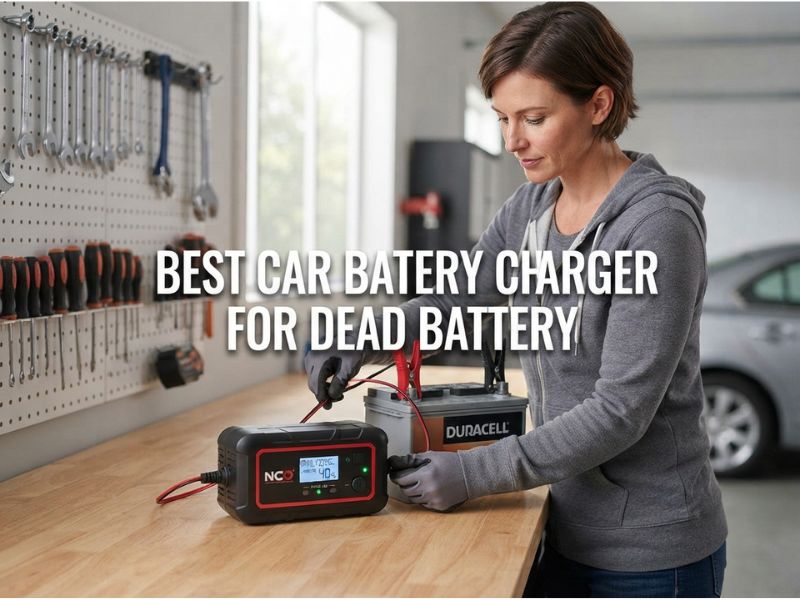
Best Car Battery Charger for Dead Battery
| Image | Product Name | Check Price |
|---|---|---|
Best Choice | NOCO GENIUS1 1A Smart Car Battery Charger | Check Price |
Second Best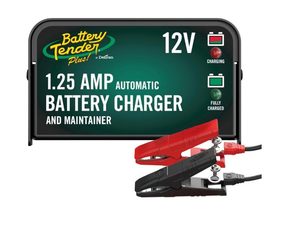 | Battery Tender Plus 021-0128 1.25A Battery Charger | Check Price |
Third Choice | NOCO GENIUS10 10A Smart Car Battery Charger | Check Price |
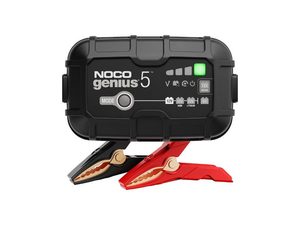 | NOCO GENIUS5 5A Smart Car Battery Charger | Check Price |
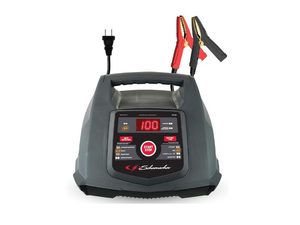 | Schumacher Electric Battery Charger and Engine Starter | Check Price |
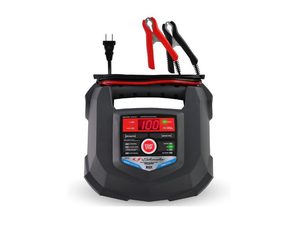 | Schumacher 15A Fully Automatic Battery Charger | Check Price |
 | NOCO GENIUS2 2A Smart Car Battery Charger | Check Price |
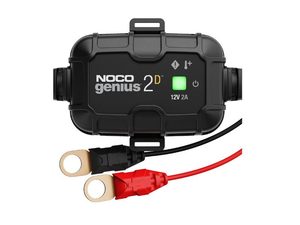 | NOCO GENIUS2D 2A Direct-Mount Battery Charger | Check Price |
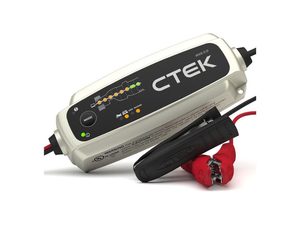 | CTEK MXS 5.0 12V Battery Charger and Maintainer | Check Price |
1. NOCO GENIUS1 1A Smart Car Battery Charger – Most Reviewed Low-Voltage Pick

Key Features
- 1A smart charging
- 6V and 12V operation
- Low-voltage detection to approximately 1V
- Force Mode for extremely discharged batteries
- AGM, flooded, gel, EFB, and compatible lithium support
- Automatic temperature compensation
- Reverse-polarity and short-circuit protection
- Automatic maintenance after charging
The GENIUS1 is unusual because its modest 1-amp charging rate is paired with sophisticated low-voltage recovery technology. In normal operation, it can detect a 6V or 12V battery down to approximately 1 volt. If voltage has fallen below that point, Force Mode allows charging to be started manually, even when the battery is effectively at zero volts.
That feature makes the GENIUS1 relevant to batteries that many ordinary automatic chargers simply refuse to recognize. A conventional smart charger may interpret an extremely low terminal voltage as “no battery connected” and remain in standby. Force Mode gives the user a way to initiate recovery after confirming that the battery is the correct voltage and chemistry.
The charger supports flooded lead-acid, AGM, gel, EFB, maintenance-free, calcium, and compatible lithium batteries. An integrated thermal sensor adjusts charging behavior for ambient temperature, helping reduce the risk of undercharging in cold weather or overcharging in hot conditions.
Its automatic maintenance function is another advantage. After the battery reaches full charge, the unit can monitor and maintain it rather than continuing to push maximum current indefinitely.
However, the 1A output needs to be understood realistically. The specified charging range is up to about 30Ah, although it can maintain larger batteries once they are charged. A typical passenger-car battery can be 45–80Ah or more. Recovering one from a deep discharge at only 1 amp can therefore take a very long time.
Detailed Review
The GENIUS1 makes the most sense when compact size, very low-voltage detection, and long-term battery care matter more than charging speed.
It is particularly useful for smaller automotive batteries, classic vehicles that sit for long periods, motorcycles, lawn equipment, auxiliary batteries, and vehicles whose batteries need periodic maintenance.
For a full-size dead car battery, patience is required. A 60Ah battery that is deeply depleted could theoretically require dozens of hours at a 1A charge rate once charging losses and the slower absorption stage are considered.
That does not make the GENIUS1 ineffective; it simply means that buyers should not confuse sophisticated electronics with high charging power.
Force Mode also deserves caution. Manually forcing current into a battery overrides some normal detection safeguards. It should only be used after confirming that the battery is physically safe, correctly connected, and compatible.
What I Like
The low-voltage capability is excellent for batteries that ordinary automatic chargers fail to detect. I also like the broad battery-chemistry support, small physical size, temperature compensation, and automatic maintenance behavior.
What I Do Not Like
One amp is slow for a deeply discharged full-size automotive battery, and its normal charging-capacity specification is smaller than many passenger-car batteries.
Verdict
The GENIUS1 is a strong low-voltage recovery and maintenance charger, especially when time is not critical. For a typical large car battery that needs to be restored as quickly as practical, I would choose a 5A, 10A, or 15A model instead.
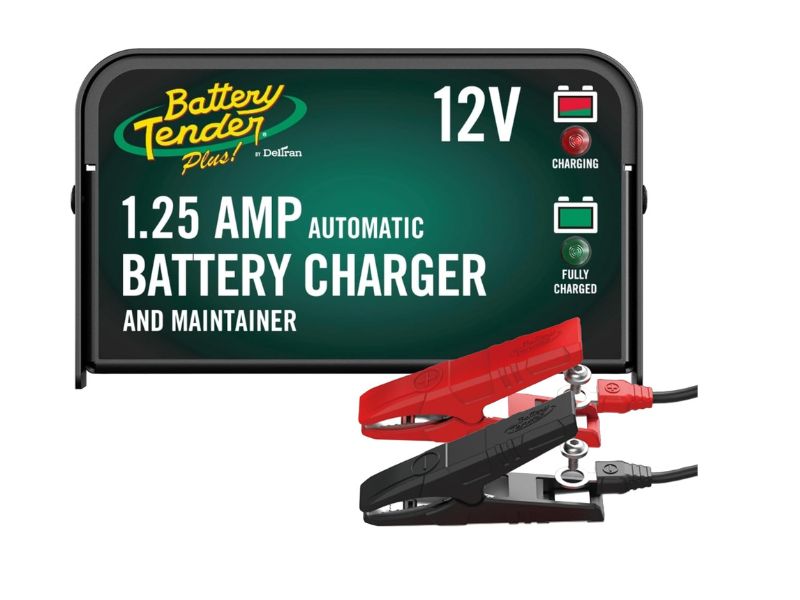
2. Battery Tender Plus 021-0128 1.25A Battery Charger – Best Slow Charge and Maintenance
Key Features
- 12V charging
- 1.25A output
- Intended for automotive batteries up to about 80Ah
- Automatic charge-to-maintenance transition
- AGM, gel, flooded, and sealed lead-acid support
- Reverse-polarity protection
- Spark-resistant connection design
- Long-term maintenance capability
The Battery Tender Plus has been a familiar choice for drivers who want a simple charger that can remain connected after charging is complete.
Its 1.25A output is still relatively slow, but the manufacturer rates it for automotive batteries up to approximately 80Ah. That makes it more directly appropriate for normal passenger cars than ultra-low-output powersports maintainers.
The charging system automatically progresses through its charging stages before reducing output into maintenance. That is the key difference between a proper smart maintainer and an old-fashioned unregulated trickle charger.
Compatibility includes conventional flooded lead-acid, AGM, gel, and sealed lead-acid automotive batteries. It is particularly well suited to cars that spend weeks or months parked.
Detailed Review
For dead-battery recovery, the Battery Tender Plus works best when time is available.
A heavily discharged 60Ah battery could require well over a day to recover at this output, depending on its state of charge, condition, temperature, and charging efficiency. That makes the Plus a poor choice when you need the vehicle ready in two hours but a good choice when the car can sit overnight or longer.
The benefit of charging slowly is gentler battery treatment and minimal heat generation. For owners of collector cars, second vehicles, seasonal vehicles, and cars that suffer from gradual discharge during storage, that approach can be desirable.
It is not the model I would select for a battery that has fallen to essentially zero volts and needs manual low-voltage intervention. Higher-output chargers with explicit Force or recovery modes are better equipped for that scenario.
What I Like
It is simple, established, appropriately sized for many passenger-car batteries, and excellent for transitioning from charging directly into long-term maintenance.
What I Do Not Like
The 1.25A output makes deeply discharged battery recovery slow. It also lacks the aggressive low-voltage Force Mode found on several NOCO models.
Verdict
The Battery Tender Plus is a good choice for slow, controlled recovery followed by storage maintenance, particularly for vehicles that sit unused regularly.
3. NOCO GENIUS10 10A Smart Car Battery Charger – Best for Deeply Discharged Full-Size Batteries

Key Features
- 10A charging current
- 6V and 12V support
- Up to approximately 230Ah charging capacity
- Force Mode for extremely low-voltage batteries
- 12V Repair Mode
- AGM, flooded, gel, EFB, and compatible lithium support
- Temperature compensation
- IP65-rated housing
- Automatic maintenance
For the actual task of restoring a dead full-size car battery, the GENIUS10 is one of the most capable products in this list.
Its 10A output is high enough to recharge normal automotive batteries within a practical timeframe without moving into a large wheeled shop charger. NOCO specifies charging capacity up to approximately 230Ah, covering passenger cars, SUVs, pickups, RV batteries, marine batteries, and many larger deep-cycle applications.
Like the smaller GENIUS models, it can detect batteries down to about 1 volt and provides Force Mode for batteries below that threshold.
It also adds a dedicated 12V Repair Mode for old, idle, sulfated, or stratified lead-acid batteries. Repair mode uses a different charging strategy and higher voltage in an attempt to improve certain degraded batteries.
Detailed Review
Ten amps is a very useful charging rate for a normal automotive battery.
Consider a 70Ah battery at roughly 20% state of charge. It may need around 55Ah of energy to return near full capacity. Because charging is not perfectly efficient and current tapers as the battery approaches full charge, the real charge time will be longer than simply dividing 55 by 10. Even so, an overnight recovery is realistic in many situations.
The GENIUS10 is also much more versatile than a basic 10A charger. It supports dedicated AGM and lithium modes, compensates for ambient temperature, and can continue maintaining the battery after charging.
For a battery that has fallen extremely low, Force Mode is useful, but it should not be treated casually. When the charger cannot automatically recognize a battery, there may be a good reason. Always inspect for swelling, leakage, freezing, damaged terminals, or other physical problems before forcing a charge.
Repair Mode is another feature that needs realistic expectations. It may improve certain sulfated or stratified lead-acid batteries, but a cell that has internally shorted or lost active material is not going to become new again because a repair button was pressed.
What I Like
The 10A output is powerful enough for normal car batteries without making the charger excessively bulky. Force Mode, Repair Mode, broad chemistry support, temperature compensation, and high battery-capacity compatibility make it unusually versatile.
What I Do Not Like
It costs more than simple chargers, and the interface relies more heavily on LEDs than on a detailed numerical display.
Verdict
For most drivers specifically trying to recharge a deeply discharged full-size car battery, the GENIUS10 is one of the most practical choices in the entire group.
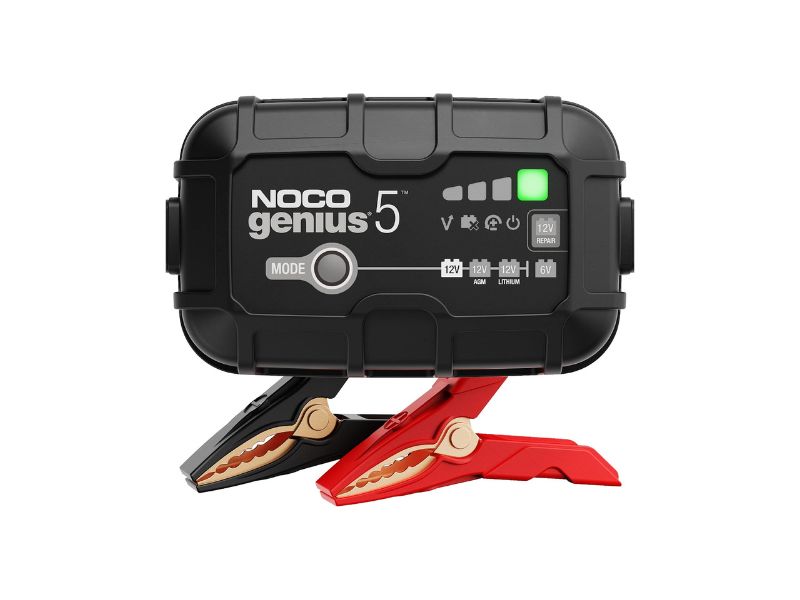
4. NOCO GENIUS5 5A Smart Car Battery Charger – Best Mid-Power Smart Charger
Key Features
- 5A charging
- Up to approximately 120Ah charging capacity
- 6V and 12V compatibility
- Force Mode
- 12V Repair Mode
- Multiple lead-acid chemistries plus compatible lithium
- IP65 enclosure protection
- Automatic thermal compensation
- Long-term maintenance
The GENIUS5 occupies an appealing middle position between the slow GENIUS1/GENIUS2 models and the more powerful GENIUS10.
It delivers 5 amps and supports batteries up to approximately 120Ah, which comfortably covers many conventional car and light-truck starting batteries.
Like the GENIUS10, it includes both Force Mode and 12V Repair Mode. That combination is particularly useful when a vehicle has been parked for months and the battery is not simply low but may also have experienced sulfation from remaining undercharged.
The charger supports 6V and 12V systems and multiple battery chemistries, including flooded lead-acid, AGM, gel, EFB, maintenance-free, calcium, and compatible lithium batteries.
Detailed Review
Five amps is a sensible compromise for a home garage.
A deeply discharged 60Ah automotive battery will not recover as quickly as it would on a 10A or 15A charger, but the process is far faster than using a 1A maintainer.
For many owners, that means connecting the charger in the evening and having a significantly recovered or fully charged battery by the following day, depending on initial state and battery health.
The charger is also easier to store than a large engine-start unit. That matters if the goal is to keep one reliable charger on a garage shelf rather than maintain a dedicated battery-service station.
The integrated thermal sensor is useful in the United States, where garage temperatures can vary dramatically between northern winters and hot southern summers. Charging voltage requirements change with temperature, and automatic compensation helps reduce charging errors.
What I Like
Five amps is enough for real automotive charging while keeping the charger compact. The combination of Force Mode, Repair Mode, temperature compensation, and a 120Ah capacity range makes it highly versatile.
What I Do Not Like
Drivers with larger truck batteries or those who routinely need quick turnaround may still prefer the GENIUS10.
Verdict
The GENIUS5 is probably the best balance of size, charging speed, dead-battery recovery, and maintenance capability for a typical home user.
5. Schumacher Electric Battery Charger and Engine Starter – Best Charger and Engine Starter Combo

Key Features
- 6V and 12V charging
- Automatic charging and maintenance
- 30A boost mode
- 100A engine-start mode
- Standard, AGM, gel, and deep-cycle compatibility
- Battery testing
- Alternator testing
- Reverse hook-up protection
- Digital display
The SC1281 is built for a different type of buyer.
Instead of focusing entirely on compact smart charging, Schumacher combines normal battery charging with a 30A boost mode and 100A engine-start function.
That is important because charging and jump starting solve two different problems. A charger restores energy to the battery over time. An engine-start function provides a much larger temporary current so the starter motor can crank while the unit is connected to household AC power.
The SC1281 also incorporates battery and alternator testing, automatic voltage detection, and support for 6V and 12V batteries.
Detailed Review
This is the unit I would consider when a dead battery is more than an occasional inconvenience.
For example, a home mechanic may work on several vehicles, own seasonal equipment, or regularly deal with project cars that sit for extended periods. In that environment, having normal charging, rapid boost, engine start, and diagnostic functions in one unit is useful.
The 30A boost can add energy to a severely discharged battery much more quickly than a low-amp maintainer. The 100A start mode can then provide assistance while cranking, assuming the battery and vehicle are otherwise serviceable.
Unlike a portable lithium jump starter, however, the SC1281 requires AC power. It is garage equipment, not a self-contained roadside battery pack.
Its larger housing and heavier construction also make it less convenient to carry or store than a GENIUS5 or GENIUS10.
What I Like
The combination of charging, boosting, engine starting, battery testing, and alternator testing gives it considerably more utility than a basic smart charger.
What I Do Not Like
It is heavier and bulkier, must remain connected to AC power, and is more complicated than a simple plug-and-charge smart unit.
Verdict
For a home garage where dead batteries are common, the SC1281 is the most versatile charger-and-starting station in this guide.
6. Schumacher 15A Fully Automatic Battery Charger – Best 15A Automatic Charger

Key Features
- Up to 15A charging
- 3A maintenance function
- 6V and 12V operation
- Automatic voltage detection
- Standard, AGM, gel, and deep-cycle battery support
- Digital voltage and charge display
- Reverse hook-up protection
- Fully automatic operation
The SC1280 is a better choice than the SC1281 if your priority is straightforward battery charging rather than engine-start capability.
It delivers up to 15 amps for charging and automatically detects whether it is connected to a 6V or 12V battery. Schumacher specifies compatibility with standard flooded batteries, AGM, gel, and deep-cycle batteries.
Its digital display can show battery voltage and estimated charge percentage, giving users more numerical information than many indicator-light-only chargers.
After the main charging cycle is complete, the unit transitions into maintenance operation.
Detailed Review
Fifteen amps is a useful rate when a car battery is genuinely dead and you do not want to wait all weekend for it to recover.
A typical 60Ah battery that is heavily discharged can theoretically accept a large portion of its missing energy within several hours, although the real process slows as the battery approaches full charge.
Automatic voltage detection simplifies setup, while the digital percentage readout provides a rough way to monitor progress without pulling out a multimeter every hour.
The SC1280 lacks the 100A starting function of the SC1281, but that also makes the product simpler and substantially lighter.
For a driver who wants a charger rather than a multipurpose shop machine, that can be an advantage.
What I Like
The 15A charging rate is fast enough for meaningful dead-battery recovery, and the digital display is useful for monitoring progress.
What I Do Not Like
It does not offer the same explicit zero-volt Force Mode as the NOCO GENIUS chargers. Extremely low batteries may therefore require a different recovery approach.
Verdict
The SC1280 is one of the strongest options if you want a fast automatic charger for conventional automotive batteries without paying for an engine-start feature.
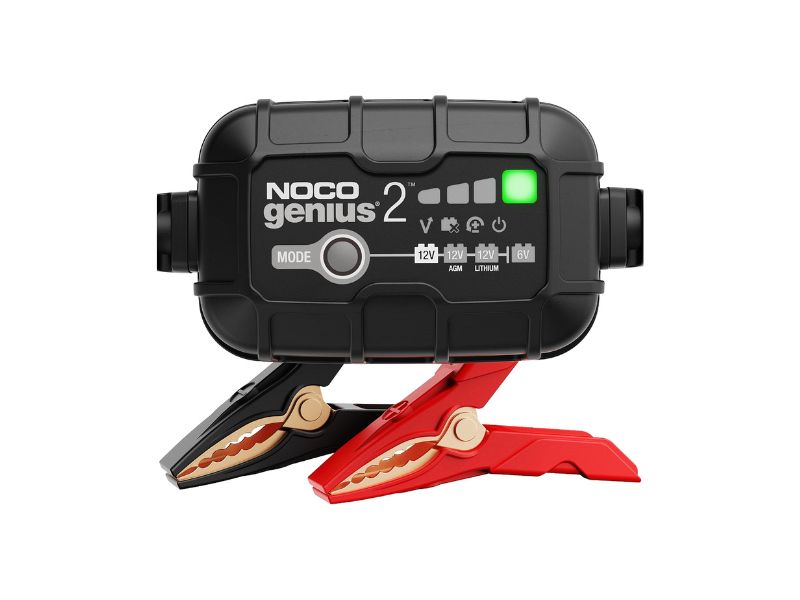
7. NOCO GENIUS2 2A Smart Car Battery Charger – Best Compact 2A Recovery Charger
Key Features
- 2A output
- 6V and 12V
- Up to approximately 40Ah charging capacity
- Force Mode
- AGM and lithium-specific modes
- Temperature compensation
- IP65 protection
- Reverse-polarity protection
- Automatic maintenance
The GENIUS2 doubles the output of the GENIUS1 while retaining the same basic smart-charger concept.
It provides 2A charging, supports 6V and 12V systems, and is rated for batteries up to approximately 40Ah for charging. Larger batteries can be maintained after they are fully charged.
More importantly for dead batteries, the GENIUS2 supports low-voltage detection and Force Mode for batteries below 1V.
It also supports flooded, AGM, gel, EFB, calcium, maintenance-free, and compatible lithium batteries.
Detailed Review
The GENIUS2 is a better choice than the GENIUS1 when you want the same compact format but do not want to wait quite as long.
However, its 40Ah charging-capacity specification still places it below many modern full-size car batteries.
That makes it most attractive for smaller starting batteries, compact vehicles, auxiliary batteries, motorcycles, powersports equipment, and maintenance duty.
The Force Mode remains valuable because deeply discharged batteries often fall below the detection threshold of basic smart chargers.
Unlike the GENIUS5 and GENIUS10, the GENIUS2 does not provide the same dedicated 12V Repair Mode. If restoring a sulfated automotive battery is important, moving to the 5A model is worthwhile.
What I Like
It is compact, weather resistant, easy to store, and capable of initiating charge on extremely low-voltage batteries.
What I Do Not Like
Two amps is still slow for a large automotive battery, and the specified 40Ah charging range is below many passenger-car starting batteries.
Verdict
Choose the GENIUS2 when you want better speed than a 1A charger without giving up compact size or low-voltage recovery.
8. NEXPEAK NC201 10A Smart Battery Charger – Best 12V/24V Value Charger
Key Features
- 10A-class smart charging
- 12V and 24V operation
- Lead-acid battery compatibility
- LCD information display
- Temperature compensation
- Pulse-repair mode
- Automatic maintenance
- Reverse-polarity and overheating protections
The NEXPEAK NC201 offers substantially more charging current than many compact maintainers while adding a large digital display.
It is designed for 12V and 24V lead-acid battery systems, making it useful beyond normal passenger cars. Depending on voltage and operating mode, it can handle automotive, truck, motorcycle, marine, lawn-equipment, and other lead-acid batteries.
The display provides useful information such as battery voltage, current, charge level, and temperature-related data.
A pulse-repair function is included for attempting to improve older or sulfated lead-acid batteries.
Detailed Review
The NC201 appeals to buyers who like having more information directly on the charger.
Rather than interpreting a row of status LEDs, the display gives a clearer picture of charging progress and current operating conditions.
Its higher charging current also makes it much more practical than a 1A or 2A charger when recovering an ordinary car battery.
The pulse-repair function can be useful for an older battery that has spent a long time partially discharged. However, repair modes should never be interpreted as guaranteed battery restoration.
A battery that repeatedly falls flat, cannot hold charge after a complete charging cycle, or fails a proper load test should be considered for replacement.
What I Like
The combination of higher output, 12V/24V flexibility, digital information, and repair functionality offers strong value.
What I Do Not Like
The product ecosystem and long-term support history are not as extensive as the most established charger brands in this guide.
Verdict
The NEXPEAK NC201 is a good choice for buyers who want a digital 10A-class charger with 12V/24V versatility at a value-focused level.
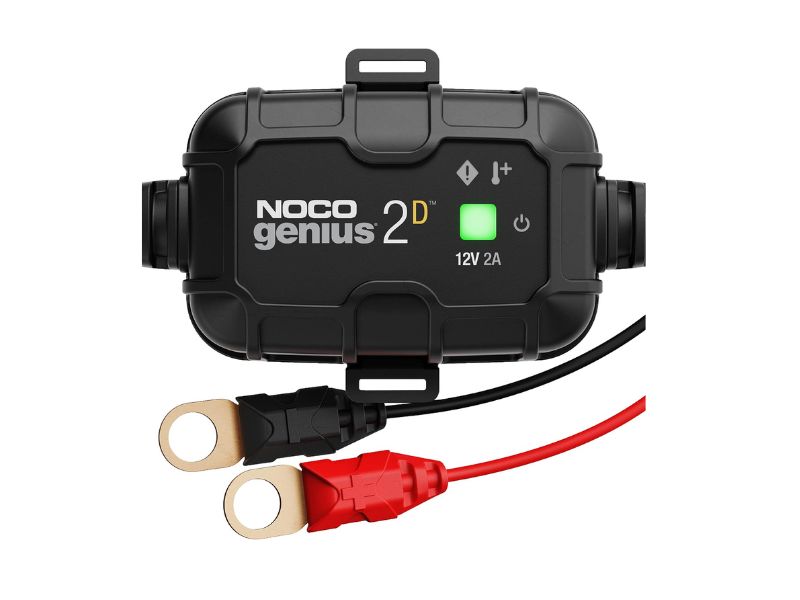
9. NOCO GENIUS2D 2A Direct-Mount Battery Charger – Best Onboard Charger
Key Features
- 2A direct-mount charging
- 12V lead-acid compatibility
- Up to approximately 40Ah charging capacity
- Permanent onboard installation
- Automatic maintenance
- Temperature compensation
- Reverse-polarity protection
- Rugged IP65 construction
The GENIUS2D is designed to stay with the vehicle.
Instead of being a portable charger that is taken out of a cabinet whenever the battery dies, this 2A direct-mount charger can be installed close to the battery and connected permanently.
It works with 12V lead-acid batteries, including flooded, AGM, gel, EFB, maintenance-free, and related automotive chemistries.
Its housing is engineered for the vibration, temperature changes, moisture exposure, and grime encountered around an engine compartment.
Detailed Review
The GENIUS2D solves a different problem from a conventional dead-battery charger: preventing repeated dead batteries in a vehicle that spends long periods parked.
Classic cars, weekend vehicles, seasonal trucks, recreational vehicles, and equipment that sits in a garage can benefit from a charger that is already installed.
When the vehicle is parked near AC power, the owner simply connects the charger’s power lead rather than opening the hood and attaching clamps every time.
Its 2A output means it is not the fastest recovery option for a completely flat large car battery. It is better thought of as a charger-maintainer that can restore moderate discharge and then keep the battery ready.
What I Like
Permanent installation makes regular battery maintenance almost effortless, and the rugged housing suits long-term vehicle use.
What I Do Not Like
The 2A output is slow for large deeply discharged batteries, and the fixed 12V lead-acid focus is less versatile than portable multi-voltage models.
Verdict
The GENIUS2D is ideal if your real problem is a car that repeatedly develops a dead battery while sitting, rather than a one-time emergency.
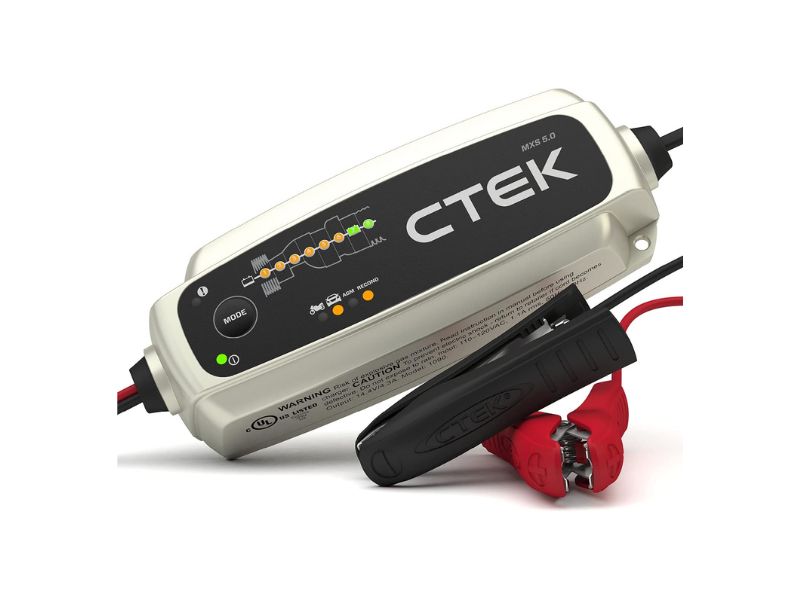
10. CTEK MXS 5.0 12V Battery Charger and Maintainer – Best Premium Lead-Acid Reconditioner
Key Features
- 5A charging
- 12V lead-acid operation
- 1.2–110Ah charging range
- RECOND program
- AGM charging program
- Automatic desulfation
- Battery-condition analysis
- Temperature compensation
- IP65 protection
- Float/pulse maintenance
The CTEK MXS 5.0 is a sophisticated 5A lead-acid charger designed around an eight-stage charging process.
It supports 12V lead-acid batteries from approximately 1.2Ah to 110Ah for charging, with maintenance capability extending to larger batteries.
Its most relevant feature for this topic is RECOND mode, which is specifically intended for deeply discharged and stratified lead-acid batteries.
The MXS 5.0 also provides a dedicated AGM program, temperature compensation, automatic desulfation, charge-retention analysis, and float/pulse maintenance.
Detailed Review
CTEK takes a methodical approach to battery recovery.
The charger does not simply apply a fixed voltage until a timer expires. Its staged process evaluates battery condition, performs bulk and absorption charging, analyzes whether the battery can retain charge, and then transitions into maintenance.
RECOND mode is intended for certain deeply discharged flooded lead-acid batteries and should be used according to battery and vehicle instructions. Reconditioning uses elevated voltage, so it is not a mode that should be activated casually on every battery.
Five amps is also a useful compromise for normal automotive batteries. It is fast enough for overnight charging in many situations while remaining suitable for long-term maintenance after the battery is full.
Unlike several NOCO models, the MXS 5.0 reviewed here is focused on 12V lead-acid batteries rather than lithium.
What I Like
The eight-stage charging process, strong lead-acid focus, battery analysis, RECOND program, AGM support, and IP65 housing make it an excellent specialist charger.
What I Do Not Like
It does not provide the same lithium versatility as the GENIUS5 or GENIUS10, and 5A charging is slower than the 10A and 15A options.
Verdict
The MXS 5.0 is particularly compelling for owners who want a premium 12V lead-acid charger with sophisticated reconditioning and long-term maintenance.
Comparison of the Best Car Battery Chargers for Dead Batteries
| Product | Charging Output | Voltage | Typical Battery Support | Low-Voltage/Recovery Feature | Maintenance | Best Use |
| NOCO GENIUS1 | 1A | 6V/12V | Lead-acid + compatible lithium | Force Mode | Yes | Slow low-voltage recovery |
| Battery Tender Plus | 1.25A | 12V | Flooded, AGM, gel | Smart staged charging | Yes | Slow charge and storage |
| NOCO GENIUS10 | 10A | 6V/12V | Lead-acid + compatible lithium | Force + Repair | Yes | Full-size dead batteries |
| NOCO GENIUS5 | 5A | 6V/12V | Lead-acid + compatible lithium | Force + Repair | Yes | Balanced home-garage use |
| Schumacher SC1281 | Multi-rate | 6V/12V | Standard, AGM, gel, deep-cycle | 30A boost | Yes | Charging + engine start |
| Schumacher SC1280 | 15A | 6V/12V | Standard, AGM, gel, deep-cycle | Automatic charging | Yes | Faster conventional charging |
| NOCO GENIUS2 | 2A | 6V/12V | Lead-acid + compatible lithium | Force Mode | Yes | Smaller batteries |
| NEXPEAK NC201 | Up to 10A class | 12V/24V | Lead-acid | Pulse repair | Yes | Digital value option |
| NOCO GENIUS2D | 2A | 12V | Lead-acid | Smart onboard charging | Yes | Permanently installed maintenance |
| CTEK MXS 5.0 | 5A | 12V | Lead-acid | RECOND + desulfation | Yes | Premium lead-acid care |
Which One Should You Choose?
If the battery is extremely low in voltage, one of the NOCO models with Force Mode is especially useful because it can manually initiate charging when automatic detection fails.
If you have a normal 50–100Ah car battery that has been deeply discharged and you want it charged in a reasonable amount of time, the NOCO GENIUS10, NOCO GENIUS5, Schumacher SC1280, or NEXPEAK NC201 makes more practical sense than a 1A maintainer.
If you need to get an engine turning quickly while working in a garage with AC power, the Schumacher SC1281 adds a 30A boost and 100A engine-start function.
For long-term battery storage, the Battery Tender Plus, GENIUS2D, and CTEK MXS 5.0 are particularly strong.
What Does “Dead Car Battery” Actually Mean?
The phrase dead battery can describe several very different conditions.
A battery can be discharged but otherwise healthy. It can also be sulfated, internally damaged, frozen, mechanically broken, or simply worn out from age.
Understanding the difference prevents you from wasting hours trying to charge a battery that needs replacement.
Discharged but Healthy Battery
This is the best-case scenario.
Common causes include:
- Headlights or interior lights left on
- Car parked for several weeks
- Dash camera or accessory drain
- Cold-weather capacity loss
- Repeated short trips
- Temporary alternator or charging-system issue
A healthy battery in this condition can often be recharged successfully.
Deeply Discharged Battery
A deeply discharged 12V lead-acid battery may show a resting voltage far below its normal level.
At this point, some automatic chargers may not detect it.
A low-voltage recovery or Force Mode becomes valuable here.
Sulfated Battery
Lead sulfate naturally forms during discharge. Normally, charging converts much of it back into active material.
If a lead-acid battery remains undercharged for a long time, harder sulfate crystals can develop and reduce usable capacity.
Some chargers use pulse, desulfation, or reconditioning modes in an attempt to improve this condition.
Results vary. Mild sulfation may improve; severe sulfation may be permanent.
Failed Battery
A battery should not be treated as a normal recharge candidate if it has:
- A shorted cell
- Cracked housing
- Electrolyte leakage
- Severe swelling
- Internal plate damage
- Inability to hold voltage after charging
- Repeated rapid self-discharge
No charger can restore every failed battery.
How Many Amps Should a Car Battery Charger Have?
For most full-size automotive batteries, I consider 5A to 15A the most useful range for home charging.
1A to 2A Chargers
These are excellent for maintenance and smaller batteries.
They can recharge a larger car battery, but recovery may take a day or several days.
Best for:
- Seasonal vehicles
- Slow charging
- Small batteries
- Preventing discharge
- Long-term connection
5A Chargers
Five amps is a very balanced rate.
It is fast enough to recover many passenger-car batteries overnight while remaining compact and easy to manage.
Best for:
- Sedans
- Crossovers
- Small SUVs
- AGM batteries
- Home garage use
10A Chargers
Ten amps is my preferred range for many deeply discharged full-size batteries.
It can replenish a substantial amount of capacity within several hours.
Best for:
- Cars
- SUVs
- Pickups
- Larger AGM batteries
- Deeply discharged batteries
15A to 25A Chargers
Higher-output units reduce charging time further.
They are useful for:
- Large automotive batteries
- Trucks
- Workshops
- Multiple vehicles
- Drivers who cannot wait overnight
Always make sure the battery manufacturer permits the selected charge rate.
How Long Does It Take to Charge a Dead Car Battery?
Charging time depends on:
- Battery capacity in amp-hours
- Remaining state of charge
- Charger output
- Battery chemistry
- Battery temperature
- Battery age
- Charging efficiency
- Current taper near full charge
A useful rough estimate is:
Charging time ≈ amp-hours that must be replaced ÷ charger output, plus additional time for charging losses and the absorption stage.
Imagine a 60Ah battery at approximately 20% state of charge.
It may need roughly 48Ah restored.
A theoretical comparison would look like this:
| Charger Output | Rough Minimum Bulk-Charge Time | Practical Expectation |
| 1A | 48 hours | Two days or more |
| 2A | 24 hours | About a day or longer |
| 5A | 9.6 hours | Roughly overnight |
| 10A | 4.8 hours | Several hours |
| 15A | 3.2 hours | A few hours |
These are not guarantees.
Smart chargers reduce current as the battery approaches full charge, so the final portion always takes longer than simple arithmetic suggests.
Why Some Chargers Will Not Recognize a Dead Battery
Many smart chargers contain a voltage-detection circuit.
The charger checks for battery voltage before allowing current to flow. This protects against:
- Clamps touching each other
- No battery being connected
- Incorrect voltage
- Certain connection errors
The problem occurs when a legitimate battery has discharged so far that its terminal voltage falls below the detection threshold.
The charger may assume nothing is connected.
That is why manual low-voltage recovery or Force Mode can be useful.
However, bypassing normal detection reduces automatic protection. Use such a mode only after physically inspecting the battery and confirming voltage, polarity, and chemistry.
Force Mode vs Repair Mode
These two features are frequently confused.
Force Mode
Force Mode is primarily about starting the charging process on an extremely low-voltage battery.
It bypasses part of the normal voltage-detection logic.
It does not automatically mean the battery is being chemically repaired.
Repair or Reconditioning Mode
Repair modes attempt to improve problems such as:
- Sulfation
- Acid stratification
- Long-term undercharging
They may use controlled pulses or elevated charging voltage.
These modes are generally intended for lead-acid batteries, not every battery chemistry.
Repair modes should also not be used routinely simply because they exist. Elevated voltage can be inappropriate for connected vehicle electronics or certain battery types.
Can a Battery Charger Really Repair a Dead Battery?
Sometimes it can improve a neglected battery, but the word repair needs context.
A charger may improve a battery affected by reversible or partially reversible electrochemical conditions.
It cannot rebuild physically damaged internal components.
A battery with a broken plate, internal short, severe material shedding, damaged separator, or failed cell needs replacement.
A good recovery test is straightforward:
- Charge the battery completely.
- Let it rest.
- Measure voltage.
- Load test or conductance test it.
- Observe whether it retains charge.
If it quickly loses voltage after a complete charge, the battery itself may be failing.
AGM vs Flooded vs EFB vs Gel Batteries
Battery chemistry matters because different designs prefer different charging voltages.
Flooded Lead-Acid
Traditional flooded batteries contain liquid electrolyte.
They are common, affordable, and tolerant of many conventional chargers.
They can release hydrogen during charging, so ventilation is important.
AGM
Absorbent Glass Mat batteries immobilize electrolyte in glass-fiber separators.
They are common in modern vehicles, performance cars, start-stop systems, and vehicles with high electrical loads.
Choose a charger with an explicit AGM mode when possible.
EFB
Enhanced Flooded Batteries are an upgraded flooded design commonly found in vehicles with basic start-stop systems.
Many modern smart chargers specifically list EFB compatibility.
Gel
Gel batteries require carefully controlled voltage.
Use a charger that explicitly supports gel batteries.
Lithium Iron Phosphate
LiFePO4 batteries require a charging profile designed for lithium chemistry and normally rely on a Battery Management System.
Do not use an ordinary lead-acid repair or desulfation mode on a lithium battery.
What About Start-Stop Vehicle Batteries?
Modern start-stop vehicles commonly use AGM or EFB batteries.
These batteries experience many more start cycles than conventional batteries and often work with sophisticated energy-management systems.
When charging one:
- Identify the battery chemistry
- Use the correct charger mode
- Follow the vehicle manufacturer’s charging-point instructions
- Use designated under-hood terminals when specified
Some vehicles also monitor battery current through a sensor on the negative terminal. Connecting incorrectly can interfere with battery-management calculations.
Smart Charger vs Manual Charger
A modern smart charger uses a microprocessor to control charging.
It may automatically perform:
- Battery detection
- Bulk charging
- Absorption charging
- Current tapering
- Float maintenance
- Temperature compensation
- Fault detection
For most home users, a smart charger is the safer and easier choice.
Traditional manual chargers give the operator more direct control but also require greater understanding of charging current, voltage, and time.
For modern cars filled with sensitive electronics, automatic control is generally preferable.
Charger vs Jump Starter
A battery charger and a jump starter are not the same tool.
A charger:
- Requires time
- Usually needs AC power
- Restores energy to the battery
- Can maintain the battery afterward
A jump starter:
- Provides a short burst of high current
- Can crank an engine quickly
- Does not fully recharge the battery
- Is usually portable
If you discover a dead battery in your garage and have several hours, a charger is the better way to restore it.
If you are stranded in a parking lot and need the engine running immediately, a portable jump starter is usually more appropriate.
What Does Engine Start Mode Do?
Products such as the Schumacher SC1281 provide an engine-start mode.
This uses AC power to deliver a much higher temporary output while the vehicle starter is operating.
It should not be confused with a portable jump pack because the charger still needs to be plugged into household power.
Engine-start mode is useful when:
- The battery is weak but not physically failed
- You have AC power nearby
- A short boost has already added some battery energy
- You need enough current to crank the engine
Always follow the charger’s duty-cycle limitations.
Temperature Compensation Matters
Battery charging voltage changes with temperature.
A voltage that is appropriate in mild weather may undercharge a cold battery or overcharge a very hot one.
Chargers with temperature compensation adjust charging behavior automatically.
This is particularly valuable for:
- Unheated garages
- Northern winters
- Hot southern climates
- Outdoor equipment
- Seasonal vehicles
Temperature compensation does not make it safe to charge a frozen battery.
Never Charge a Frozen Battery
A discharged lead-acid battery is more vulnerable to freezing because the electrolyte’s specific gravity drops as charge decreases.
Charging a frozen battery can be dangerous.
If you suspect freezing:
- Do not connect a charger
- Move the battery only if it can be handled safely
- Allow professional evaluation
- Inspect for cracks or swelling
A cracked case can leak sulfuric acid.
How to Charge a Dead Car Battery Safely
Always follow your vehicle, battery, and charger manuals first.
A general process is:
1. Turn the Vehicle Off
Switch off the ignition and accessories.
2. Inspect the Battery
Do not proceed if the battery is visibly cracked, leaking, severely swollen, frozen, or physically damaged.
3. Verify Battery Type
Identify whether it is:
- Flooded
- AGM
- EFB
- Gel
- Lithium
Select the correct charger mode.
4. Work in a Ventilated Area
Lead-acid batteries can release hydrogen gas.
Avoid flames, cigarettes, sparks, and poorly ventilated enclosed spaces.
5. Connect the Charger Correctly
With the charger disconnected from AC power, attach the clamps according to the charger and vehicle instructions.
On many vehicles:
- Positive clamp goes to positive
- Negative clamp goes to the specified ground point
Some manufacturers provide designated remote charging terminals.
6. Connect AC Power
Only after the battery connection is secure should the charger normally be connected to household power, unless the charger’s instructions specify another procedure.
7. Select the Correct Mode
Choose the correct voltage and chemistry.
Do not select lithium mode for lead-acid or AGM mode without verifying battery type.
8. Monitor the Initial Charging Period
Check that:
- There is no excessive heat
- The battery is not swelling
- The charger does not report a fault
- Connections remain secure
9. Allow the Smart Charger to Finish
A fully automatic charger will normally reduce current as the battery approaches full charge.
10. Disconnect According to Instructions
Typically, AC power is removed before the battery clamps, but follow the exact charger manual.
Should You Remove the Battery From the Car?
Often, no.
Many modern chargers are designed to charge a battery while it remains installed.
However, removal or electrical disconnection may be recommended when:
- Using a high-voltage repair mode
- Vehicle electronics are sensitive
- The battery is being tested separately
- Manufacturer instructions require it
- Corrosion or battery damage requires service
Never disconnect a battery casually on a modern vehicle without understanding possible effects on security systems, learned settings, modules, and battery-management systems.
How to Know Whether a Battery Is Charging
A smart charger usually indicates:
- Charging stage
- Charge percentage
- Current
- Voltage
- Maintenance status
- Fault condition
A multimeter can provide additional information.
For a conventional 12V lead-acid battery at rest, approximately 12.6–12.8V often indicates a high state of charge, while substantially lower voltage indicates increasing discharge.
These numbers vary with chemistry, temperature, surface charge, and battery condition, so voltage alone is not a perfect health test.
Why a Battery Can Show 12V but Still Be Bad
Voltage measures electrical potential, not usable starting capacity.
A damaged battery can sometimes show a seemingly normal open-circuit voltage and then collapse under starter load.
This is why a load test or conductance test matters.
If voltage drops dramatically when the starter operates, the battery may have high internal resistance or insufficient capacity even though it appeared charged minutes earlier.
When Should You Replace the Battery Instead of Charging It?
Replacement becomes more likely when:
- The battery case is damaged
- A cell is shorted
- The battery will not accept charge
- Voltage collapses immediately under load
- It rapidly self-discharges
- It is repeatedly dead despite correct charging
- It fails professional testing
- It is well beyond its expected service life
A charger is diagnostic in this sense: if a battery cannot successfully complete or retain a proper charge, that tells you something important about its condition.
Why Did the Battery Go Dead?
Before assuming the battery itself is defective, consider the cause.
Vehicle Sat Too Long
Modern vehicles consume small amounts of power even when parked.
Alarm systems, keyless entry, telematics, modules, and other electronics create parasitic draw.
Lights Were Left On
Headlights, dome lights, cargo lights, or accessories can drain a battery overnight.
Alternator Problem
If the charging system does not restore battery energy while driving, repeated dead batteries will occur.
Parasitic Drain
An abnormal electrical load can slowly discharge the battery while the car is off.
Corroded Connections
Poor terminal contact increases resistance and can mimic battery problems.
Old Battery
Automotive batteries eventually lose capacity.
Charging cannot reverse normal aging indefinitely.
How to Test the Alternator After Charging
A dead battery can be the symptom rather than the cause.
After the battery is fully charged and the engine is running, the charging system should be evaluated.
A healthy alternator typically raises system voltage above the battery’s resting voltage, although the exact value varies with vehicle design, temperature, electrical load, and modern smart-charging strategies.
Some chargers, including the Schumacher SC1281, include alternator-testing features.
For definitive diagnosis, use the vehicle manufacturer’s specifications or professional testing equipment.
Why Short Trips Kill Batteries
Starting an engine consumes a significant amount of energy.
If the car then travels only a few minutes, the alternator may not have enough time to fully replace what was used during starting—especially in winter with:
- Heated seats
- Defrosters
- Blower motor
- Headlights
- Wipers
- Rear-window heater
Repeated short trips can gradually leave the battery undercharged.
A smart maintainer is useful for vehicles used in this pattern.
Best Charger for a Car That Sits for Months
If the problem is predictable seasonal discharge rather than emergency recovery, choose a charger with an excellent maintenance mode.
Good candidates include:
- Battery Tender Plus
- NOCO GENIUS5
- NOCO GENIUS10
- NOCO GENIUS2D
- CTEK MXS 5.0
A permanently mounted GENIUS2D is particularly convenient when the same vehicle needs continuous maintenance every winter.
Best Charger for a Completely Dead Battery
For a battery whose voltage has fallen below the detection threshold of ordinary chargers, I prefer a model with explicit manual low-voltage activation.
The GENIUS1, GENIUS2, GENIUS5, and GENIUS10 provide Force Mode.
Among those, the GENIUS10 is the most practical for a normal full-size automotive battery because its 10A output dramatically reduces recovery time.
Best Charger for an AGM Battery
AGM batteries benefit from a charger with a dedicated AGM profile.
Strong options here include:
- NOCO GENIUS5
- NOCO GENIUS10
- CTEK MXS 5.0
- Schumacher SC1280
- Schumacher SC1281
Always confirm the voltage requirements of your specific AGM battery.
Best Charger for Fast Dead-Battery Recovery
If speed is the main consideration, look at charging output rather than maintenance capability.
The Schumacher SC1280 at 15A is one of the faster conventional charging choices here.
The NOCO GENIUS10 at 10A offers slightly slower charging but adds sophisticated low-voltage and repair capabilities.
The Schumacher SC1281 is useful when an engine-start function is also required.
Can You Overcharge a Car Battery?
Yes, an uncontrolled charger can overcharge a lead-acid battery.
Overcharging can cause:
- Excessive gassing
- Electrolyte loss
- Heat
- Plate corrosion
- Reduced battery life
Modern automatic chargers minimize this risk by reducing or stopping charging when the battery reaches the appropriate stage.
That is one reason I prefer a genuine smart charger for unattended home use.
Is Slow Charging Better for Battery Life?
Moderate charging is generally easier on a battery than unnecessarily aggressive charging.
However, “slower is always better” is too simplistic.
A 1A charger may take days to restore a large battery, while a quality 10A smart charger can charge the same battery efficiently and automatically reduce current as necessary.
The correct charging rate depends on battery capacity and manufacturer recommendations.
How to Store a Battery Charger
Keep the charger:
- Dry
- Away from corrosive fumes
- Protected from physical impact
- Within its specified temperature range
- With cables loosely coiled
- With clamps prevented from shorting together
Do not wrap cables tightly around a hot charger immediately after use.
Inspect clamps and insulation periodically.
Common Mistakes to Avoid
Choosing a Maintainer When You Need a Fast Charger
A 1A unit can eventually recharge a battery, but waiting two days is inconvenient when a 10A charger could complete the job much sooner.
Selecting the Wrong Battery Chemistry
AGM, gel, flooded, and lithium batteries do not all use identical charging profiles.
Using Repair Mode on Every Battery
Repair modes are specialized tools, not routine charging settings.
Assuming a Charger Can Fix Physical Failure
No electronic charging sequence can rebuild broken internal battery components.
Charging a Frozen or Damaged Battery
This can create serious safety risks.
Ignoring the Reason the Battery Died
If the alternator, parasitic drain, or electrical system is the real problem, the battery will simply go dead again.
Frequently Asked Questions
What is the best car battery charger for a dead battery?
For a deeply discharged full-size car battery, the NOCO GENIUS10 is one of the most practical choices.
Its 10A output is suitable for normal automotive battery capacities, while Force Mode allows it to begin charging very low-voltage batteries. It also includes a 12V Repair function for certain sulfated or stratified lead-acid batteries and can transition automatically into maintenance after charging is complete.
Can a battery charger revive a completely dead car battery?
Yes, if the battery is discharged but still internally healthy.
Some chargers can detect very low battery voltage, while others provide a manual recovery mode. A battery that is shorted, physically damaged, frozen, or unable to hold a charge may not be recoverable and should be professionally tested.
Can NOCO GENIUS chargers charge a zero-volt battery?
Selected GENIUS models provide Force Mode for batteries below the normal detection threshold.
The GENIUS1, GENIUS2, GENIUS5, and GENIUS10 can manually initiate charging on extremely low-voltage compatible batteries. Force Mode bypasses normal sensing protections, so polarity, battery condition, voltage, and chemistry must be confirmed first.
Is a 1A charger enough for a dead car battery?
It can work, but it may take a very long time.
A normal automotive battery can store 50–80Ah or more. Recovering most of that capacity at 1 amp can take days once charging inefficiency and the absorption stage are considered. A 5A or 10A charger is usually more practical.
Is a 10A charger safe for a car battery?
Yes, 10A is a common and practical charging rate for many full-size automotive batteries.
Use a quality automatic charger and follow the battery manufacturer’s recommended maximum charge rate. Smart chargers reduce current as the battery becomes full rather than continuously forcing maximum output.
How long will a 10A charger take to charge a dead car battery?
A typical deeply discharged battery may require several hours to overnight.
A 60Ah battery needing approximately 48Ah restored would theoretically require about five hours of bulk charging at 10A, but real charging takes longer because efficiency is not 100% and current tapers near full charge.
How long will a 5A charger take?
A deeply discharged normal car battery often requires roughly overnight charging.
Exact time depends on battery capacity and remaining charge. A larger 80Ah battery will naturally take longer than a 45Ah compact-car battery.
Can I leave a smart battery charger connected overnight?
Many fully automatic chargers are specifically designed for overnight and long-term operation.
Once charging is complete, they transition into maintenance. Verify that the exact charger supports unattended maintenance and that the battery is in a safe, ventilated location.
What voltage is considered a dead 12V car battery?
There is no single universal cutoff, but a resting voltage far below 12V indicates severe discharge.
A healthy fully charged lead-acid battery is usually around the mid-12-volt range at rest. Temperature, chemistry, and recent charging influence readings, so voltage should be interpreted alongside battery condition and load testing.
Why does my charger say no battery is connected?
The battery voltage may be below the charger’s automatic detection threshold.
Poor clamp contact or corrosion can create the same symptom. Clean and verify connections first. If voltage is genuinely extremely low, a charger with an approved low-voltage recovery function may be required.
What is desulfation mode?
Desulfation mode attempts to reduce certain lead-sulfate buildup associated with prolonged undercharging.
It may help batteries with mild or moderate sulfation but cannot reverse every form of deterioration. Severe physical or chemical battery damage usually requires replacement.
Does repair mode really work?
It can help certain neglected lead-acid batteries, but results depend on the type and severity of damage.
A repair function may improve stratification or sulfation. It will not fix a shorted cell, broken plate, cracked case, or battery that has permanently lost most of its active material.
Should I charge an AGM battery differently?
Yes, use a charger or charging mode specifically approved for AGM batteries.
AGM batteries often require different charging-voltage targets from ordinary flooded batteries. Many modern chargers automatically or manually provide an AGM-specific profile.
Can I charge the battery without removing it from the car?
Usually yes, if the charger and vehicle manufacturer permit in-vehicle charging.
Modern vehicles may specify particular positive and negative charging points. Always follow the owner’s manual because some cars use battery-monitoring sensors or sensitive electronics that affect connection procedures.
Do I disconnect the battery terminals before charging?
Not always, but some charging or repair procedures may require disconnection.
Normal smart charging can often be performed with the battery installed. Higher-voltage reconditioning modes may require the battery to be electrically isolated from vehicle electronics.
Can I start the car while the charger is connected?
Only if the charger specifically provides an engine-start function and its instructions permit it.
Ordinary 1A, 2A, 5A, or 10A chargers are not substitutes for engine-start boosters. Trying to crank an engine through a charger that is not designed for it can damage the charger.
Is a battery charger better than jumper cables?
They perform different jobs.
Jumper cables help start a vehicle using another battery. A charger restores the discharged battery’s stored energy. If time and AC power are available, fully charging the battery is better than repeatedly relying on jump starts.
What if my battery goes dead again the next day?
The battery or vehicle electrical system needs diagnosis.
Possible causes include an old battery, parasitic drain, alternator fault, loose connection, corroded terminal, or an electrical accessory remaining active after shutdown.
Can a charger tell me if my battery is bad?
Some chargers can identify obvious charging failures, but a dedicated battery test provides better diagnosis.
A battery may accept a full charge yet still lack enough cold-cranking capacity to start the vehicle reliably. A proper load or conductance test is useful after charging.
Should I buy a charger with an engine-start mode?
It is worthwhile if you frequently work on dead batteries in a garage with AC power.
For occasional charging, a compact smart charger is easier to store and use. Engine-start chargers are larger but can provide immediate cranking assistance when needed.
Final Recommendation
Finding the best car battery charger for dead battery recovery requires balancing review history with the actual technical requirements of a deeply discharged automotive battery.
The NOCO GENIUS1 leads this list by established buyer-feedback volume and has an excellent low-voltage Force Mode. It is small, intelligent, and capable of starting a charging cycle on batteries that many automatic chargers will not detect. Its limitation is charging speed and battery-capacity range, so it makes the most sense when slow recovery is acceptable.
For a normal full-size passenger-car or truck battery that is deeply discharged, the NOCO GENIUS10 is the stronger practical choice. Ten amps provides much faster recovery, its capacity range comfortably covers large starting batteries, and Force Mode plus 12V Repair give it tools for both extreme discharge and certain forms of lead-acid deterioration.
The NOCO GENIUS5 is the middle-ground choice when you want similar technology at a lower output. The Schumacher SC1281 is more suitable for a garage where a 30A boost and 100A engine-start function are valuable, while the Schumacher SC1280 is one of the better straightforward high-output chargers when you simply want to restore battery capacity quickly.
Battery Tender Plus remains excellent for slow charging and long-term maintenance. The GENIUS2 and GENIUS2D work best with smaller batteries or maintenance-focused applications, NEXPEAK NC201 provides useful output and a detailed display, and the CTEK MXS 5.0 remains an excellent specialist choice for 12V lead-acid battery conditioning.
Whichever charger you choose, remember that charging and repairing are not the same thing. A discharged healthy battery may recover completely. A sulfated battery may improve. A physically damaged or internally failed battery should be replaced rather than repeatedly forced through recovery cycles.