A bulky workshop charger is unnecessary if your main goal is keeping a car battery healthy, restoring a moderately discharged battery, or maintaining a vehicle that sits unused for weeks. The best handheld car battery charger should be genuinely compact, simple to connect, safe enough for routine unattended maintenance, and compatible with the battery chemistry in your vehicle.
My first recommendation is the NOCO GENIUS1 1A Smart Battery Charger. It is exceptionally small, works with both 6V and 12V batteries, supports multiple lead-acid chemistries plus compatible lithium batteries, and includes temperature compensation and automatic maintenance. Its huge buyer history also makes it one of the most established compact smart chargers in this category.
For simple 12V battery maintenance, I also like the Battery Tender Junior 12V 750mA Charger. Its low charging current makes it especially suitable for vehicles that sit for long periods, while its lightweight body and included clamp/ring-terminal connection system make routine use straightforward.
If you want a little more charging output while keeping the charger genuinely portable, the NOCO GENIUS2 2A Smart Battery Charger is the strongest step-up option here. It doubles the output of the GENIUS1 while retaining 6V/12V support, AGM and lithium modes, automatic maintenance, and a compact 1.1-pound body.
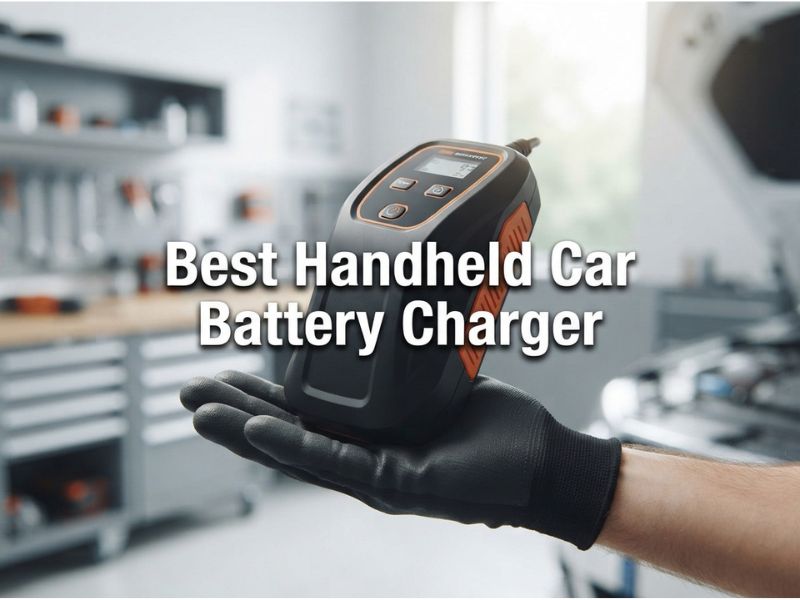
5 Best Handheld Car Battery Charger
| Image | Product Name | Check Price |
|---|---|---|
Best Choice | NOCO GENIUS1 1A Smart Battery Charger – Best Overall | Check Price |
Second Best | Battery Tender Junior 12V 750mA Charger | Check Price |
| Third Choice | Battery Tender Plus 12V 1.25A Charger | Check Price |
 | NOCO GENIUS2 2A Smart Battery Charger | Check Price |
 | FOVAL 12V 1000mA Automatic Battery Charger | Check Price |
1. NOCO GENIUS1 1A Smart Battery Charger – Best Overall

The NOCO GENIUS1 earns my first position because it is one of the strongest examples of what a handheld smart battery charger should be: extremely compact, light, versatile, and largely automatic after you select the correct battery mode.
Its rated charging output is 1 amp, and it supports both 6V and 12V batteries. Compatible chemistries include wet lead-acid, gel, AGM, calcium, EFB, maintenance-free batteries, and compatible lithium batteries. NOCO rates it for actively charging batteries up to 30Ah while allowing maintenance of larger battery sizes.
The physical size is particularly impressive. The charger body measures roughly 3.62 x 2.32 x 1.26 inches and weighs around 0.77 pound. That makes it small enough to hold comfortably in one hand and easy to store inside a toolbox, cabinet, trunk organizer, or small vehicle-storage compartment.
Key Features
- 1A charging output
- 6V and 12V support
- Wet, AGM, gel, EFB, MF, calcium, and lithium modes
- Automatic battery maintenance
- Integrated temperature compensation
- Spark-resistant connection protection
- Reverse-polarity protection
- Overcharge and overheating protection
- Force Mode for compatible extremely discharged batteries
- Compact 0.77-pound body
- Three-year limited warranty
A major strength of the GENIUS1 is that it does more than deliver a constant low current.
Its charging system monitors the battery and adjusts operation automatically. A built-in thermal sensor allows charging voltage to respond to ambient temperature, reducing the risk of undercharging in cold conditions or inappropriate charging behavior during hotter weather.
That is useful for garages because vehicle batteries experience very different conditions in January than they do in July.
Another advantage is battery chemistry support. Many inexpensive handheld trickle chargers are limited to conventional 12V lead-acid batteries. The GENIUS1 supports 6V operation as well as specific AGM and compatible lithium charging modes.
That means one small charger can potentially maintain a car, motorcycle, lawn tractor, ATV, classic vehicle, or other compatible battery-powered equipment.
The charger can also work with batteries that have fallen below the voltage required for normal automatic detection through its Force Mode. That feature deserves caution because manually overriding automatic detection requires you to verify polarity and battery condition carefully.
The main limitation is charging speed.
One amp is excellent for maintenance and gradual recovery but not ideal when you need a normal 60–80Ah car battery recharged quickly. NOCO’s own approximate charging chart illustrates that an 80Ah battery at roughly 50% depth of discharge can require many hours with a 1A charger.
That does not make the GENIUS1 weak. It simply means this model is best understood as a compact smart charger and maintainer, not a high-speed garage charger.
What I Like
- Extremely compact
- Lightweight enough for one-handed handling
- Works with multiple battery chemistries
- 6V and 12V capability
- AGM-specific mode
- Compatible lithium mode
- Excellent automatic safety protections
- Temperature-compensated charging
- Very large long-term buyer history
- Easy to store
What I Do Not Like
- 1A charging is slow for large automotive batteries
- Not appropriate when rapid recovery is the priority
- Battery-condition information is mostly communicated through LEDs rather than a detailed display
Verdict
The NOCO GENIUS1 is my best handheld car battery charger overall because its genuinely tiny body, broad battery compatibility, smart safety system, and automatic maintenance capabilities make it particularly easy to own and use.
2. Battery Tender Junior 12V 750mA Charger – Best for Battery Maintenance

The Battery Tender Junior is one of the most established compact battery maintainers available and has accumulated an exceptionally large volume of buyer feedback over many years. Current listing data shows roughly 49,000+ ratings, putting it among the most reviewed compact chargers in this category.
Its output is 750mA, or 0.75 amp, so it is deliberately designed around slow charging and maintenance rather than speed.
The current model supports 12V lead-acid, AGM, gel, and sealed maintenance-free batteries from approximately 3Ah to 30Ah for normal charging applications. The charger itself measures about 4.4 x 2.15 x 2.9 inches and weighs approximately 0.65 pound.
Key Features
- 12V operation
- 750mA charging output
- Automatic smart charging
- Float/maintenance operation
- AGM support
- Gel battery support
- Flooded/sealed lead-acid compatibility
- Spark-resistant connection design
- Reverse-polarity protection
- Alligator clips and ring terminals
- Approximately 0.65-pound charger body
- Five-year limited warranty
The Battery Tender Junior makes the most sense for a vehicle that spends significant time parked.
Classic cars, secondary family vehicles, seasonal sports cars, motorcycles, convertibles, and cars stored during winter can slowly lose charge even when there is no obvious electrical problem.
Modern vehicles may also have small parasitic loads from alarms, computers, keyless-entry modules, trackers, and other electronics.
The Junior helps address that problem by automatically maintaining the battery instead of forcing you to remember to recharge it periodically.
One feature I particularly like is the connection system.
The charger includes alligator clips for temporary charging plus ring terminals that can be attached more permanently to an accessible battery. Once installed, you can connect the charger through the quick-disconnect lead without repeatedly opening battery covers or trying to position clamps.
That can make maintenance much more convenient.
The tradeoff is speed. At only 750mA, this is not what I would choose if a normal full-size car battery has been discharged substantially and you need it ready later the same day.
Its mission is maintaining and gently charging.
For that use, the lower output is perfectly appropriate.
What I Like
- One of the most established compact battery maintainers
- Huge buyer-feedback history
- Very lightweight
- Simple automatic operation
- Excellent for vehicles in storage
- Ring terminals included
- Alligator clamps included
- Long connection reach
- Five-year warranty
What I Do Not Like
- Only 12V
- 750mA is slow for a deeply discharged full-size car battery
- No dedicated lithium mode on this version
- Better as a maintainer than a fast charger
Verdict
The Battery Tender Junior is my favorite option for long-term battery maintenance. If your car frequently sits unused and you want a compact charger that can remain connected according to its instructions, it is an excellent choice.
3. Battery Tender Plus 12V 1.25A Charger – Best for Stored Cars

The Battery Tender Plus takes the maintenance-focused philosophy of the Junior and adds somewhat more charging current.
Its output is 1.25 amps, and it is designed for 12V automotive and powersports batteries. The current manufacturer information positions it for automotive batteries up to roughly 80Ah, making it better suited to normal passenger-car batteries than ultra-low-current motorcycle maintainers.
The Plus also has a substantial buyer history, with current listing data showing more than 21,000 reviews/ratings.
Key Features
- 12V charging
- 1.25A output
- Automatic charging
- Float/maintenance mode
- Flooded lead-acid compatibility
- AGM compatibility
- Gel compatibility
- Reverse-polarity protection
- Ring-terminal connection
- Alligator clamps
- Compact charger body
- Long-term storage suitability
The 1.25A output is still modest compared with a workshop charger, but the extra current gives the Plus an advantage over the Junior for typical passenger-car batteries.
It is particularly useful for:
- Classic cars
- Weekend vehicles
- Collector vehicles
- Seasonal cars
- Garage-kept convertibles
- Vehicles stored during travel
- Cars driven only occasionally
The charger automatically transitions into maintenance behavior after the battery reaches its target charge, helping avoid the uncontrolled overcharging associated with old-fashioned constant-output trickle chargers.
Another advantage is physical size.
The charger is only around 4.4 inches along its longest dimension and weighs roughly 1.5 pounds, making it easy to move between vehicles or keep stored on a garage shelf.
I also prefer its permanent ring-terminal option for cars that stay connected for long periods.
For a vehicle that is stored every winter, attaching the quick-disconnect lead once is more convenient than installing battery clamps over and over again.
The limitation is versatility.
Unlike the NOCO GENIUS1 and GENIUS2, this specific Battery Tender Plus is centered around 12V traditional lead-acid chemistry rather than providing the same broad 6V and lithium flexibility.
What I Like
- Strong reputation for long-term maintenance
- More charging output than Battery Tender Junior
- Suitable for many normal car batteries
- Automatic float maintenance
- Compact form factor
- Easy permanent ring-terminal connection
- Excellent choice for seasonal vehicles
What I Do Not Like
- 12V-only design
- Slower than 2A, 5A, or 10A smart chargers
- Less chemistry versatility than NOCO GENIUS models
- Not the best option when a deeply discharged battery needs rapid recovery
Verdict
Choose the Battery Tender Plus if your primary concern is keeping a normal 12V car battery healthy through weeks or months of limited vehicle use.
4. NOCO GENIUS2 2A Smart Battery Charger – Best Faster Handheld Charger

The NOCO GENIUS2 is my preferred choice when you want genuinely compact dimensions but find a 750mA or 1A charger too slow.
It supplies 2 amps and supports both 6V and 12V batteries across wet, gel, AGM, calcium, EFB, maintenance-free, and compatible lithium chemistries. NOCO rates it for charging batteries up to approximately 40Ah while allowing maintenance of larger batteries.
Despite producing twice the current of the GENIUS1, it remains remarkably small at approximately 3.7 x 2.4 x 1.69 inches and around 1.1 pounds.
Key Features
- 2A charging output
- 6V and 12V operation
- AGM mode
- Lithium mode
- Flooded, gel, EFB, calcium, and MF support
- Temperature compensation
- Automatic maintenance
- Reverse-polarity protection
- Spark protection
- Overcharge protection
- IP65-rated charger enclosure
- Mounting bracket included
- Three-year warranty
The GENIUS2 is particularly appealing because it preserves the portability of a small maintainer while offering a noticeable improvement in charging time.
NOCO estimates that, under its stated conditions, a 40Ah battery at about 50% discharge takes around 15 hours with the GENIUS2 versus roughly 30 hours with the GENIUS1. Actual times vary with battery condition, temperature, chemistry, and depth of discharge, but the basic advantage of doubling the charging current remains clear.
For passenger-car owners, this makes the GENIUS2 easier to justify when the charger needs to do more than maintain.
Its 2A output is still gentle enough for overnight charging but can restore meaningful energy more quickly than a sub-1A maintainer.
The chemistry flexibility is another major strength.
Having dedicated AGM and lithium support means the charger can remain useful if you change vehicles or own several types of equipment.
Its IP65-rated enclosure also offers better environmental protection than many basic indoor maintainers, although it should still be used according to the manufacturer’s instructions and never treated as something that can be submerged.
The main question is whether 2A is enough.
For ordinary battery maintenance, absolutely.
For quickly charging a large 70–100Ah automotive battery, you will still be better served by a 5A or 10A charger.
But those faster units tend to become larger, which starts moving away from the handheld car battery charger requirement.
What I Like
- Twice the charging output of GENIUS1
- Still genuinely handheld
- 6V and 12V support
- Excellent chemistry compatibility
- AGM and lithium modes
- IP65 enclosure
- Automatic maintenance
- Temperature-compensated charging
- Strong safety system
- Around 1.1 pounds
What I Do Not Like
- More expensive than basic 1A maintainers
- 2A is still slow for large deeply discharged batteries
- Charging-status LEDs provide less information than a digital screen
Verdict
The NOCO GENIUS2 is the best faster handheld charger in this group. It makes the most sense if you want compact storage but need more real charging capability than a basic maintainer provides.
5. FOVAL 12V 1000mA Automatic Battery Charger – Best Budget Compact Pick

The FOVAL 12V 1A charger is a straightforward choice for buyers who want a genuinely small lead-acid charger without paying for more advanced multi-voltage or lithium features.
The established listing has accumulated roughly 14,000+ ratings and has remained a popular compact trickle-charger option.
Its body measures approximately 3.9 x 2.4 x 1.25 inches and weighs around 10.6 ounces, making it one of the smallest and lightest products in this comparison.
Key Features
- 12V charging
- 1A output
- Four-step automatic charging
- AGM support
- Wet lead-acid support
- Gel battery support
- SLA and VRLA compatibility
- Float maintenance
- Reverse-polarity protection
- Overcurrent protection
- Overvoltage protection
- Short-circuit protection
- Ring terminals and clamps
- Approximately 10.6-ounce body
The FOVAL uses a basic four-stage charging process consisting of initialization, bulk charge, absorption, and float operation.
Once the connected battery reaches the appropriate charge state, the unit can transition into low-current maintenance instead of continually delivering full charging output.
That makes it useful for older cars, recreational vehicles, lawn equipment, motorcycles, and other equipment with traditional 12V lead-acid batteries.
The included connection options add useful flexibility.
Alligator clamps work well when you only connect the charger occasionally. Ring terminals make more sense if one particular vehicle remains on maintenance charging frequently.
The biggest advantage, however, is simply how little room it requires.
At under four inches long and around two-thirds of a pound, this is truly a handheld charger.
The disadvantages are equally clear.
It is a 12V lead-acid-focused device and does not offer the same wide chemistry support as the NOCO models. One amp is also slow when restoring a deeply discharged automotive battery.
For maintaining a conventional battery at an affordable cost, however, the basic design can be entirely adequate.
What I Like
- Very compact
- Very light
- Simple four-stage automatic charging
- AGM compatibility
- Ring terminals included
- Battery clamps included
- Multiple electronic protections
- Strong buyer history
- Good value for basic maintenance
What I Do Not Like
- Only 12V
- No lithium charging mode
- 1A charging is slow
- Less sophisticated temperature management than premium models
- Not designed as a rapid dead-battery charger
Verdict
The FOVAL 1A is my budget compact pick for buyers who have a conventional 12V lead-acid car battery and primarily need charging and maintenance rather than advanced battery-management features.
Handheld Car Battery Charger Comparison Table
| Product | Output | Voltage | Battery Compatibility | Approx. Charger Weight | Automatic Maintenance | Best For |
| NOCO GENIUS1 | 1A | 6V/12V | Wet, AGM, Gel, EFB, MF, Calcium, Lithium | 0.77 lb | Yes | Best overall |
| Battery Tender Junior | 0.75A | 12V | Lead-Acid, AGM, Gel, Sealed | 0.65 lb | Yes | Long-term maintenance |
| Battery Tender Plus | 1.25A | 12V | Flooded, AGM, Gel | About 1.5 lb | Yes | Stored cars |
| NOCO GENIUS2 | 2A | 6V/12V | Wet, AGM, Gel, EFB, MF, Calcium, Lithium | 1.1 lb | Yes | Faster handheld charging |
| FOVAL 1A | 1A | 12V | SLA, VRLA, AGM, Gel, Wet | 10.6 oz | Yes | Budget maintenance |
The NOCO GENIUS1 gives me the strongest overall balance because it is genuinely tiny yet more versatile than most basic maintainers.
The Battery Tender Junior is best when keeping a stored battery healthy is more important than charging speed. Battery Tender Plus adds a little more current for passenger-car applications.
The GENIUS2 is the choice I would make if charging time matters but you still want something easily held in one hand. FOVAL offers a simple lower-cost alternative for conventional 12V batteries.
What Is a Handheld Car Battery Charger?
A handheld car battery charger is essentially a compact AC-powered smart charger or battery maintainer that is small enough to carry easily and store without taking up the space required by a traditional workshop charger.
It should not be confused with a jump starter.
A battery charger normally needs access to household AC electricity. It restores energy to the battery gradually.
A jump starter stores energy internally and provides a short burst of high current to start the engine.
That difference is critical when deciding what you actually need.
Handheld Battery Charger vs. Portable Jump Starter
Handheld Battery Charger
Best for:
- Restoring a discharged battery gradually
- Maintaining a car during storage
- Preventing battery discharge
- AGM battery maintenance
- Seasonal vehicles
- Classic cars
- Vehicles driven infrequently
It normally plugs into an electrical outlet.
Portable Jump Starter
Best for:
- Roadside emergencies
- Starting a dead vehicle quickly
- Situations without an electrical outlet
- Emergency trunk storage
It has an internal rechargeable battery.
Many drivers benefit from owning both.
A charger helps keep the vehicle battery healthy at home, while a jump starter provides backup when something goes wrong away from home.
How to Choose the Best Handheld Car Battery Charger
Check the Battery Voltage First
Most modern passenger cars use 12V batteries.
However, some classic vehicles, motorcycles, tractors, and equipment may use 6V systems.
A dual-voltage charger such as the NOCO GENIUS1 or GENIUS2 provides greater flexibility if you own multiple vehicles.
Do not connect a charger using the wrong voltage mode.
Match the Battery Chemistry
Battery chemistry matters.
Common automotive battery types include:
- Flooded lead-acid
- AGM
- EFB
- Gel
- Maintenance-free lead-acid
- Lithium iron phosphate in specialized applications
AGM batteries are increasingly common in modern vehicles, particularly those equipped with start-stop systems or high electrical loads.
If your car has an AGM battery, select a charger with a suitable AGM mode.
Lithium batteries require even more care. Only use a lithium-compatible charging mode when the battery manufacturer allows it.
Understand Charging Amps
A charger’s amperage determines how quickly it can return energy to a battery.
0.75A
Excellent for battery maintenance.
Not ideal for rapidly restoring a large discharged car battery.
1A
Useful for maintenance and gradual charging.
This is the range of the NOCO GENIUS1 and FOVAL.
1.25A
A small improvement for ordinary automotive battery charging while remaining maintenance-focused.
2A
Much more practical when you occasionally need meaningful overnight charging.
The GENIUS2 is the strongest option here when you want to remain within a genuinely handheld form factor.
Do Not Expect Fast Charging From a Tiny Maintainer
This is one of the biggest buying mistakes.
Suppose you have a 70Ah battery that has lost approximately 35Ah of usable charge.
A 1A charger cannot theoretically return 35Ah in less than 35 hours, and real charging takes longer because the charger reduces current during later charging stages and energy is lost in the process.
A 5A or 10A charger would complete the job much faster.
The tradeoff is physical size.
If compactness is your priority and charging can happen overnight or over several days, a handheld charger makes excellent sense.
If speed matters more, choose a higher-output charger.
Why Automatic Maintenance Matters
Old battery chargers often provided current until somebody disconnected them.
Modern smart chargers are different.
They monitor battery voltage and change charging behavior according to battery condition.
A typical smart process may include:
- Battery detection
- Bulk charging
- Absorption
- Optimization
- Float or maintenance charging
Once the battery is full, the charger reduces its output rather than continuing to force maximum current into the battery.
This is essential for long-term storage applications.
What Is Float Charging?
Float charging keeps a full lead-acid battery at an appropriate maintenance voltage.
The charger supplies small amounts of energy only as necessary to compensate for self-discharge and parasitic loads.
That is why smart maintainers are so useful for:
- Classic cars
- Collector cars
- Seasonal vehicles
- Motorcycles
- Boats
- ATVs
- Lawn equipment
A properly compatible automatic maintainer can remain connected according to its manufacturer’s instructions without behaving like an old uncontrolled trickle charger.
AGM Battery Compatibility
AGM stands for Absorbent Glass Mat.
These batteries are sealed and are increasingly common in modern cars.
They can require different charging voltages than traditional flooded batteries.
If your car has AGM technology, I recommend selecting a charger with a clearly defined AGM mode rather than simply assuming any 12V charger is appropriate.
Both NOCO models reviewed here support AGM batteries, as do the Battery Tender and FOVAL options within their stated lead-acid compatibility.
What About Lithium Car Batteries?
Lithium automotive batteries are still less common than lead-acid units, but they appear in some performance vehicles, specialty cars, motorcycles, and aftermarket applications.
The important point is that lithium batteries require an appropriate charging profile.
The NOCO GENIUS1 and GENIUS2 include lithium modes for compatible batteries.
Never put a charger into lithium mode simply because it sounds more advanced.
Confirm exactly which chemistry is installed in the vehicle first.
Is 1 Amp Enough to Charge a Car Battery?
Yes, but it can take a long time.
A 1A charger is especially appropriate when:
- The battery is only moderately discharged
- You can leave it connected overnight or longer
- You mainly need maintenance charging
- The vehicle is stored frequently
- Charging speed is not important
If a large battery is deeply discharged and needs to be ready within a few hours, 1A is not sufficient for practical fast charging.
A 5A or 10A charger is more appropriate in that situation.
Are Handheld Chargers Safe to Leave Connected?
A modern automatic maintainer can often remain connected for extended periods when its manufacturer explicitly allows it.
Important safety features include:
- Reverse-polarity protection
- Overcharge protection
- Short-circuit protection
- Temperature protection
- Automatic maintenance
- Spark protection
Even with these features, periodically inspect the battery and charging setup.
Never attempt normal charging on a battery that is visibly swollen, cracked, leaking, frozen, or severely damaged.
Temperature Compensation
Battery charging behavior changes with temperature.
Cold batteries can require a different charging approach from batteries sitting in a hot garage.
Chargers such as the NOCO GENIUS1 and GENIUS2 use temperature compensation to adjust charging based on ambient conditions.
This is a meaningful feature for vehicles stored year-round in garages where temperatures change substantially between seasons.
Clamp Connection vs. Ring Terminals
Battery Clamps
Best for occasional charging.
Advantages:
- Quick installation
- No permanent modification
- Easy to move between vehicles
Ring Terminals
Best for frequent maintenance.
Advantages:
- Can stay attached to the battery
- Secure connection
- Easy quick-disconnect access
- Useful when the battery is difficult to reach
For a weekend car or collector vehicle, I strongly prefer ring terminals once they are installed correctly.
Can a Small Charger Recover a Dead Battery?
Sometimes.
A battery that is merely discharged can often be restored with sufficient charging time.
However, a battery may be beyond recovery if it has:
- An internally shorted cell
- Severe plate damage
- Physical swelling
- Leakage
- Major corrosion
- Repeated deep-discharge damage
- Very low remaining capacity
Some smart chargers also refuse to begin normal charging when battery voltage is extremely low.
Force or manual modes can sometimes overcome this detection threshold, but they do not repair a physically failed battery.
Battery Desulfation Explained
Lead sulfate naturally forms during battery discharge.
When a battery remains undercharged for extended periods, harder sulfate crystals can accumulate and reduce effective battery performance.
Some smart chargers include automatic desulfation or repair-oriented charging behavior.
These modes may help certain recoverable batteries, but they should not be treated as guaranteed battery restoration.
A worn-out battery eventually needs replacement.
How to Use a Handheld Car Battery Charger
First, confirm the battery’s voltage and chemistry.
Make sure the vehicle is parked safely and the charging area has adequate ventilation.
Connect the charger according to its instructions.
In many normal situations:
- Red goes to positive
- Black connects to the approved negative terminal or grounding location
Select the appropriate charging mode.
Then connect the charger to AC power if the manufacturer’s sequence requires that order.
Allow the smart charger to complete its charging cycle.
When finished, disconnect everything according to the manufacturer’s instructions.
Always prioritize the instructions included with your charger and vehicle because battery locations and recommended grounding points can differ.
Common Handheld Charger Mistakes
Buying a Maintainer and Expecting Fast Charging
A 750mA charger may require a very long time to restore a large automotive battery.
Know whether your main goal is charging or maintaining.
Selecting the Wrong Battery Mode
Do not use lithium mode on AGM.
Do not use AGM mode blindly on every lead-acid battery.
Check the battery label.
Ignoring Battery Damage
Do not automatically connect a charger to a battery that is swollen, leaking, cracked, frozen, or giving off unusual odors.
Reversing the Clamps
Smart protection can reduce risk, but correct polarity remains essential.
Check twice before starting.
Using an Indoor Charger in Rain
Weather resistance varies considerably.
Even an IP-rated charger should be operated according to its instructions rather than left exposed unnecessarily to water.
Forgetting That the Charger Needs AC Power
A handheld charger is not normally an emergency roadside starter.
If you want to start a car in a parking lot where no power outlet is available, carry a lithium jump starter instead.
Frequently Asked Questions
What is the best handheld car battery charger?
The NOCO GENIUS1 is my best overall handheld car battery charger.
It weighs less than one pound, supports 6V and 12V batteries, works with several lead-acid chemistries plus compatible lithium batteries, and includes automatic maintenance, temperature compensation, and extensive safety protection.
What is the smallest car battery charger?
NOCO GENIUS1 and FOVAL 1A are among the smallest practical chargers in this comparison.
Both are less than four inches along their main charger-body dimension and can easily be held in one hand. The FOVAL weighs roughly 10.6 ounces, while the NOCO GENIUS1 weighs about 0.77 pound.
Can a handheld charger charge a completely dead car battery?
It may charge a deeply discharged but healthy battery, although the process can be slow.
Some smart chargers need to detect a minimum voltage before beginning. Models with manual or Force modes can sometimes start charging extremely low-voltage batteries, but no charger can reliably restore a battery with serious internal damage.
Is a handheld battery charger the same as a jump starter?
No. A charger gradually restores energy; a jump starter provides immediate starting power.
A car battery charger normally needs AC electricity. A jump starter stores energy internally so it can start the vehicle away from an electrical outlet.
Is 1A enough for a car battery?
One amp is enough for slow charging and maintenance but not ideal for fast recovery.
It works especially well when the car sits unused or when you have plenty of time. For faster charging of a larger battery, move to 2A, 5A, or higher.
Is 2A better than 1A?
Two amps generally charges the same compatible battery faster.
That is why the NOCO GENIUS2 is a strong option for buyers who want more charging performance while retaining a compact form factor.
Can I leave a smart charger connected overnight?
Usually yes when the manufacturer specifically supports automatic maintenance charging.
A compatible smart charger monitors battery condition and reduces output after reaching full charge. Always follow the specific product instructions.
Can I use a handheld charger on an AGM battery?
Yes, when the charger explicitly supports AGM batteries.
Every product in this comparison supports AGM within its stated battery compatibility, although charging modes and voltage support differ.
Can I charge a lithium car battery?
Only use a charger and mode specifically approved for the battery’s lithium chemistry.
The NOCO GENIUS1 and GENIUS2 support compatible lithium batteries. The Battery Tender and FOVAL models reviewed here are better suited to their specified lead-acid battery types.
How often should I maintain a car battery?
A vehicle driven infrequently may benefit from regular or continuous smart maintenance.
If the car sits for several weeks at a time, parasitic electrical loads and natural self-discharge can gradually lower battery voltage. A compatible automatic maintainer helps keep it ready.
Can a battery charger fix a bad battery?
No charger can repair every form of battery failure.
Charging may help a battery that is simply discharged or mildly sulfated. A battery with damaged cells, severe capacity loss, swelling, or internal failure generally requires replacement.
Which handheld charger is best for a stored car?
Battery Tender Plus is particularly strong for long-term 12V vehicle maintenance.
Its 1.25A output provides a useful balance between slow charging and automatic float maintenance. The GENIUS1 is the better choice if you want broader voltage and battery-chemistry compatibility.
Final Thoughts
The best handheld car battery charger should be compact enough that storing it is effortless but smart enough to charge and maintain your battery without constant supervision.
The NOCO GENIUS1 is my first choice overall. Its tiny 0.77-pound body, 6V/12V operation, AGM and lithium compatibility, automatic maintenance, temperature compensation, and comprehensive safety protections give it the strongest combination of size and versatility.
The Battery Tender Junior is excellent when your priority is keeping a stored vehicle’s battery healthy over long periods rather than quickly charging it.
The Battery Tender Plus is better suited to normal passenger-car batteries when you want slightly greater output while preserving a maintenance-first design.
For buyers who need more charging performance, the NOCO GENIUS2 is my preferred step up. Its 2A output is considerably more practical for restoring charge while the unit remains small enough to qualify as genuinely handheld.
Finally, the FOVAL 1A offers a compact, straightforward alternative for conventional 12V lead-acid batteries when advanced features are less important.
For most drivers who want one small charger for battery maintenance, AGM compatibility, safe automatic charging, and easy garage storage, I would choose the NOCO GENIUS1.