The best car battery charger and booster should do more than slowly top up a battery. It should be able to recover a discharged automotive battery, provide a higher-current boost when you cannot wait all day, and ideally offer an engine-start mode for those mornings when the battery does not have enough cranking power. Automatic charging, AGM compatibility, reverse-polarity protection, and maintenance capability also make a major difference in day-to-day garage use.
My first recommendation is the Schumacher Electric SC1281 Fully Automatic Battery Charger and Engine Starter. It combines 6V/12V charging, a 30A boost mode, 100A engine-start assistance, automatic maintenance, battery testing, and alternator diagnostics in a relatively portable package. It also has the strongest customer-review history among the relevant charger/booster models I compared, making it my primary choice for most home garages.
For owners of trucks, SUVs, larger batteries, or multiple vehicles, I would move up to the Schumacher Electric SC1309 Wheeled Battery Charger and Engine Starter. Its 40A boost and 200A engine-start function provide considerably more reserve power, while wheels and a retractable handle make the heavier charger manageable around a workshop.
My third recommendation is the Schumacher Electric SC1361 Fully Automatic Battery Charger and Engine Starter. It is a simpler 12V option with automatic charging, a 10A boost, and 50A engine-start assistance. Drivers who want more charging speed in a compact case should also look closely at the DEWALT DXAEC100, while the Schumacher SC1307 provides useful 6V/12V versatility and an 85A engine-start mode.
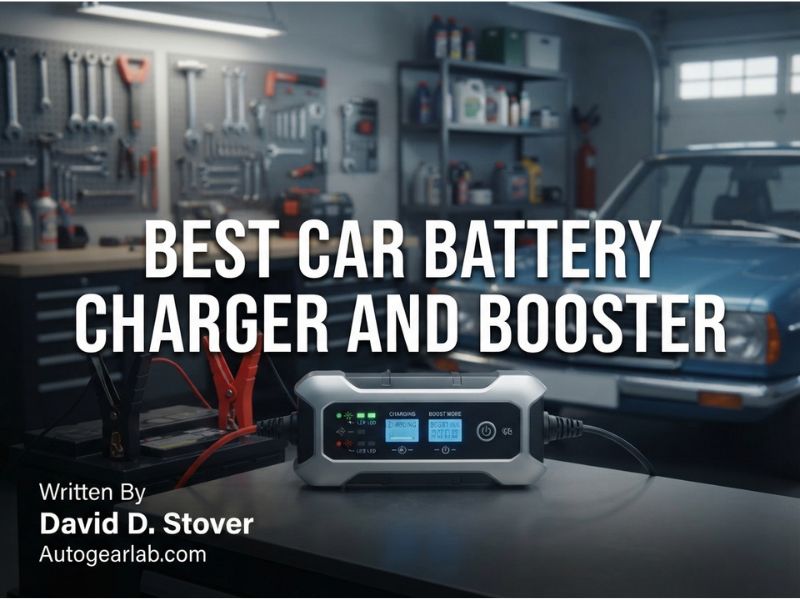
Best Car Battery Charger and Booster
| Image | Product Name | Check Price |
|---|---|---|
Best Choice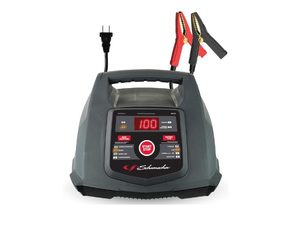 | Schumacher Electric Fully Automatic Battery Charger and Engine Starter | Check Price |
Second Best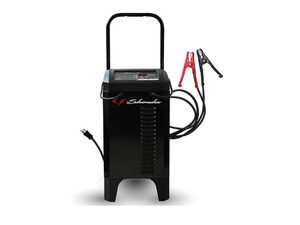 | Schumacher Electric SC1309 Wheeled Battery Charger and Engine Starter | Check Price |
Third Choice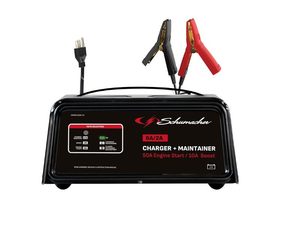 | Schumacher Electric SC1361 Fully Automatic Battery Charger and Engine Starter | Check Price |
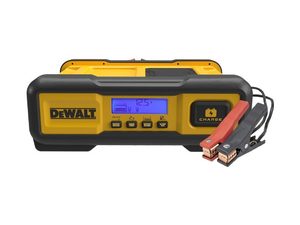 | DEWALT DXAEC100 Professional Battery Charger and Engine Starter | Check Price |
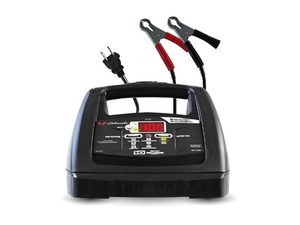 | Schumacher Electric SC1307 Fully Automatic Battery Charger and Engine Starter | Check Price |
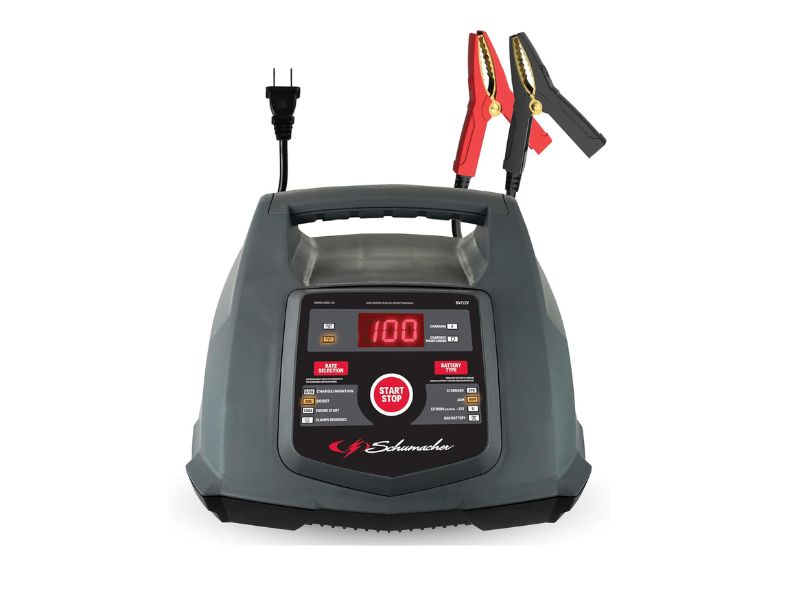
1. Schumacher Electric Fully Automatic Battery Charger and Engine Starter – Best Overall
Key Features
- 6V and 12V charging
- Up to 100A engine-start assistance
- 30A boost charging
- 6A normal charging
- 2A maintenance charging
- Automatic multi-stage charging
- Standard flooded battery support
- AGM, gel, and deep-cycle compatibility
- Battery and alternator testing
- Automatic voltage detection
- Battery reconditioning function
- Reverse-polarity protection
- Digital display
The Schumacher SC1281 is my first choice because it strikes an unusually useful balance between charging capability, boost power, engine-start assistance, automatic operation, and physical portability.
For routine battery charging, it operates much differently from an old manual shop charger. Its microprocessor monitors the battery and automatically manages charging output rather than requiring you to estimate charging time and constantly watch an analog meter.
That makes the SC1281 considerably easier to use for occasional home-garage maintenance.
Its 30A boost mode is particularly useful when a battery is deeply discharged and the regular charging rate would take too long. Boost mode can put meaningful energy into the battery before you attempt an engine start.
If the battery still cannot provide enough cranking current, the charger offers 100A engine-start assistance.
This distinction is important.
Normal charging, boost charging, and engine-start assistance are three different functions. The 100A figure does not mean the charger continuously charges your battery at 100 amps. That higher output is intended for short cranking assistance.
The SC1281 also supports 6V and 12V batteries, expanding its usefulness beyond modern passenger cars. Older vehicles, tractors, motorcycles, lawn equipment, and some specialty batteries may use 6V systems.
Battery compatibility is another strength. The charger supports common flooded batteries as well as AGM, gel, and deep-cycle lead-acid batteries when used according to the correct settings.
I also like its diagnostic functions.
A built-in battery tester can help you evaluate charge status, while the alternator-test function provides basic information about whether the vehicle’s charging system is operating properly.
These tools do not replace professional load testing or a full charging-system diagnosis, but they can help a home mechanic understand why a vehicle is repeatedly suffering from a low battery.
Automatic maintenance is another valuable feature.
Once charging is complete, the unit can move into a lower-output maintenance stage instead of continuing to aggressively charge an already full battery.
That makes it useful for seasonal vehicles and cars that spend significant periods parked.
What I Like
The SC1281 does almost everything a typical home mechanic needs from an AC-powered battery charger.
You get normal charging, a substantial 30A boost, 100A starting assistance, automatic maintenance, battery diagnostics, alternator testing, multiple battery chemistries, and 6V/12V operation.
Its automatic controls also make it much easier to live with than an old manual charger.
What I Do Not Like
It still requires access to household AC power, so it is not a substitute for a self-contained roadside jump starter.
The unit is also larger and heavier than a small smart maintainer. If you only want to keep a healthy battery topped up during storage, a 1A–5A compact charger may be more convenient.
Verdict
The Schumacher SC1281 is the best overall car battery charger and booster for most home garages. It provides enough boost and starting capability for real dead-battery situations while maintaining the automatic smart-charging features that make routine use straightforward.
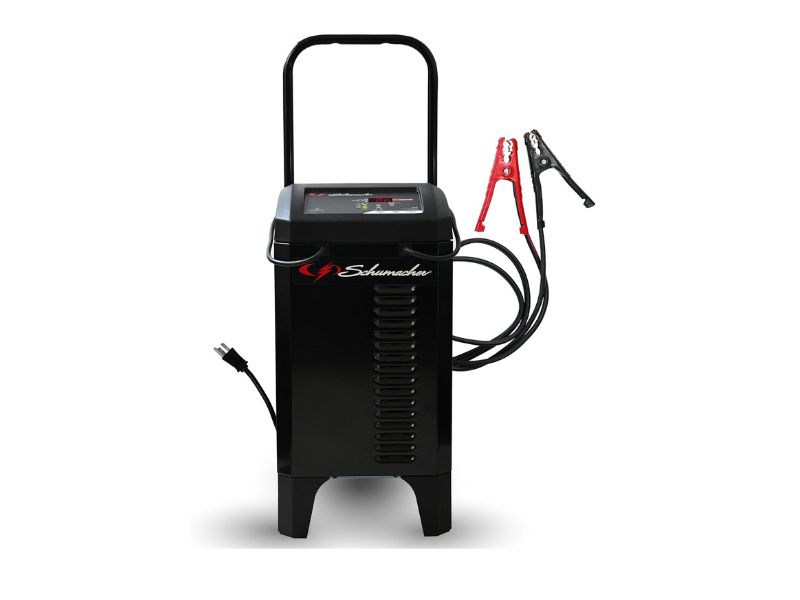
2. Schumacher Electric SC1309 Wheeled Battery Charger and Engine Starter – Best Heavy-Duty Pick
Key Features
- 6V and 12V battery support
- 200A engine-start assistance
- 40A boost charging
- Automatic 6A-to-2A charging and maintenance
- Wheeled steel cabinet
- Retractable handle
- Standard battery support
- AGM compatibility
- Deep-cycle compatibility
- Battery reconditioning
- Battery and alternator testing
- Reverse-polarity protection
- Digital status display
- Long output-cable reach
The Schumacher SC1309 is the charger I would choose when the SC1281 is simply not heavy-duty enough for the garage.
Its headline advantage is the combination of a 40A boost mode and 200A engine-start function.
That additional starting reserve makes it particularly attractive for:
- Full-size SUVs
- Pickup trucks
- Larger gasoline engines
- Multiple-vehicle garages
- RV starter batteries
- Marine applications
- Workshop use
The SC1309 is not simply an oversized jump-start box.
It remains a fully automatic battery charger and maintainer.
During normal charging, the unit can automatically adjust charging output and transition into maintenance when the battery reaches an appropriate charge level.
That means you do not have to use high-current boost mode every time.
For a healthy battery that simply needs recharging, the automatic charging process is gentler and more appropriate.
The 40A boost function comes into play when the battery is deeply discharged and you want to restore enough charge much faster than the normal charging stage would allow.
Its 200A starting mode then provides additional cranking assistance when required.
Physical design is another major difference.
The SC1309 weighs far more than a compact bench charger, so Schumacher mounts the hardware in a wheeled cabinet with a retractable handle.
This makes sense in a garage where you move the charger from one vehicle to another.
Rather than carrying a large transformer-style charger across the shop, you simply roll it beside the vehicle.
Heavy-duty output cables are another advantage. Larger clamps and substantial cable construction make this style of charger better suited to regular garage work than tiny lightweight leads.
Battery and alternator diagnostics are built in as well.
That provides basic troubleshooting information when a vehicle repeatedly fails to start.
What I Like
The 200A starting mode gives the SC1309 a meaningful advantage for larger vehicles and stubborn dead-battery situations.
I also like the wheels. They may sound like a minor feature, but a charger this substantial is much more convenient when it can roll between vehicles.
Automatic charging and maintenance make it easier to use than a traditional manual wheeled charger.
What I Do Not Like
This is not a compact tool.
A homeowner with one small sedan probably does not need a charger this large, and it requires much more garage storage than the SC1281 or DXAEC100.
It also requires AC power during use.
Verdict
Choose the Schumacher SC1309 if you need a heavy-duty charger and booster for trucks, SUVs, larger batteries, or a multi-vehicle garage.
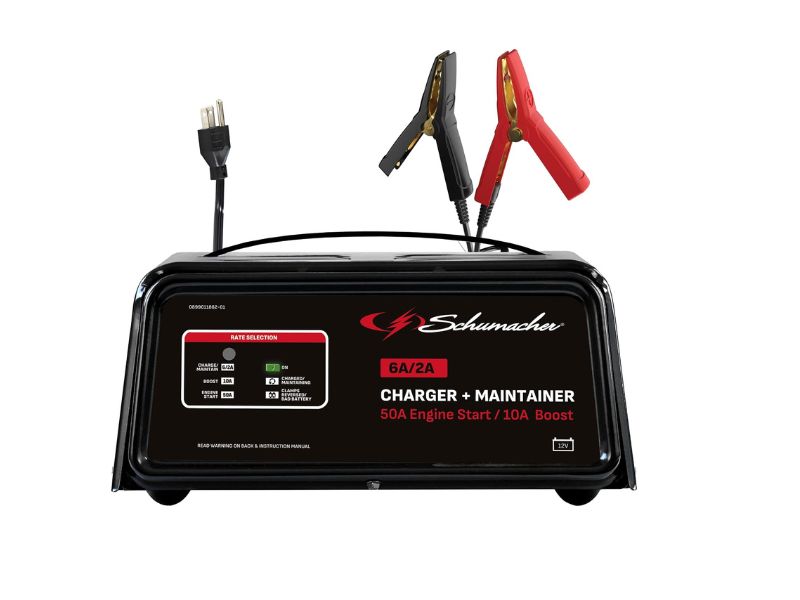
3. Schumacher Electric SC1361 Fully Automatic Battery Charger and Engine Starter – Best Everyday 12V Pick
Key Features
- 12V automotive charging
- 50A engine-start assistance
- 10A boost mode
- Automatic charging and maintenance
- Microprocessor-controlled operation
- Multi-stage charging
- Float-mode monitoring
- Standard lead-acid battery support
- AGM compatibility
- Reverse-hookup protection
- Heavy-duty metal enclosure
- Simple LED indicators
The Schumacher SC1361 is a more straightforward charger/booster for someone who does not require 100A or 200A starting assistance.
It focuses on 12V automotive batteries, which covers the overwhelming majority of modern cars, SUVs, pickups, and RV starter batteries.
Its automatic charging system monitors battery condition and adjusts charging behavior rather than continuously applying maximum output.
After charging, float-mode monitoring helps keep the battery at an appropriate state of charge.
The 10A boost mode provides additional current when a battery is too low for normal charging to deliver the result you need quickly.
It is less aggressive than the 30A and 40A boost modes found on my first two choices, but that can be perfectly adequate for ordinary passenger vehicles.
The 50A engine-start function is similarly moderate.
It will not provide the same starting assistance as a 100A or 200A garage charger, yet not every car needs that level of output.
For a normal sedan or crossover, the simpler design may be enough.
The rugged metal housing is another reason to consider the SC1361.
It feels more like traditional garage equipment than a lightweight plastic maintainer and is suitable for regular workshop storage.
Battery compatibility is narrower than the SC1281, however.
The SC1361 is primarily intended for standard and AGM 12V lead-acid batteries. Owners of lithium, gel, or unusual battery chemistries should select a charger explicitly approved for their battery.
What I Like
The SC1361 is simple.
There are fewer specifications and modes to think about, and automatic charging reduces the amount of supervision required.
Its 10A boost and 50A starting functions provide useful backup for routine automotive battery problems without moving into a massive wheeled machine.
What I Do Not Like
It is less versatile than the SC1281.
You give up stronger boost current, stronger starting assistance, broader battery-type support, and 6V capability.
Verdict
The Schumacher SC1361 makes sense for someone who primarily owns conventional 12V vehicles and wants a straightforward automatic charger with moderate boost and engine-start capability.
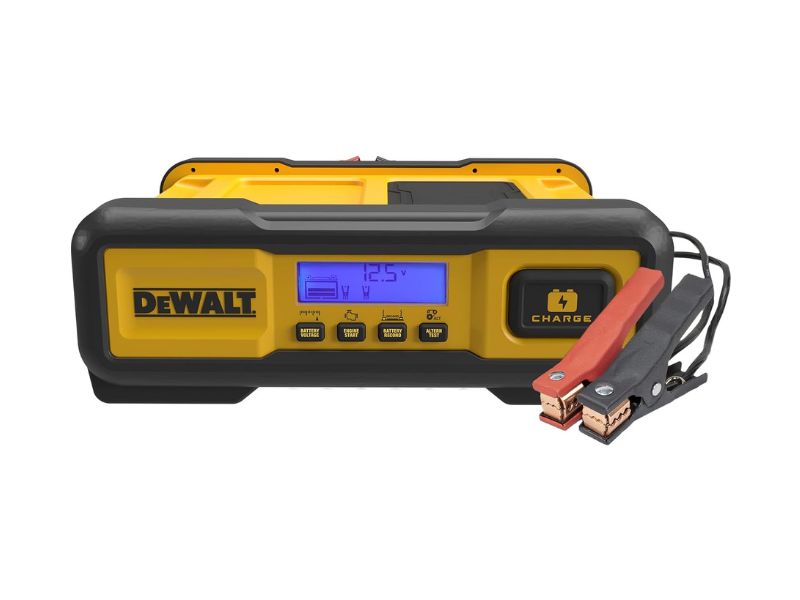
4. DEWALT DXAEC100 Professional Battery Charger and Engine Starter – Best Fast Charging Pick
Key Features
- 30A automotive battery charging
- 3A battery-maintenance mode
- 100A engine-start assistance
- Automatic charging operation
- AGM battery compatibility
- GEL battery compatibility
- WET/flooded battery compatibility
- Alternator check
- Battery-reconditioning pulse technology
- LCD information display
- One-touch controls
- Compact portable housing
The DEWALT DXAEC100 approaches the charger-and-booster category differently from the Schumacher models.
Its major strength is 30A battery charging.
That is a substantial charging rate for an AC-powered portable automotive charger and can be useful when you need to restore significant battery capacity without waiting through the extremely long charging periods associated with 1A or 2A maintainers.
It also includes a 3A maintenance mode, so the unit is not limited to high-current charging.
Once the battery has been restored, lower-current maintenance can help keep a stored vehicle ready.
For immediate starting assistance, the DXAEC100 provides a 100A engine-start mode.
That places its starting capability in roughly the same general class as the SC1281 while emphasizing a considerably stronger regular charging rate.
Battery compatibility includes common WET/flooded, AGM, and GEL lead-acid batteries.
An alternator-check function adds diagnostic value, while electric pulse technology is intended to help address sulfate buildup on compatible lead-acid battery plates.
Battery-repair features need realistic expectations.
Pulse or desulfation technology may help certain batteries affected by recoverable sulfation, but it cannot repair broken plates, internal shorts, damaged cells, or a battery that has reached the end of its useful service life.
The LCD display is another advantage.
It provides clearer operating information than simple status lights and makes the charger easier to understand for occasional users.
What I Like
The combination of 30A charging and 100A engine-start assistance is excellent.
It is particularly attractive when you want actual battery charging speed rather than primarily a low-current maintainer with a boost button.
The LCD interface and alternator test also add practical value.
What I Do Not Like
The DXAEC100 is intended around common lead-acid automotive batteries, not every modern battery chemistry.
It also does not offer the same heavy-duty 200A starting reserve as the SC1309.
Verdict
Choose the DEWALT DXAEC100 if normal charging speed matters just as much as engine-start assistance.
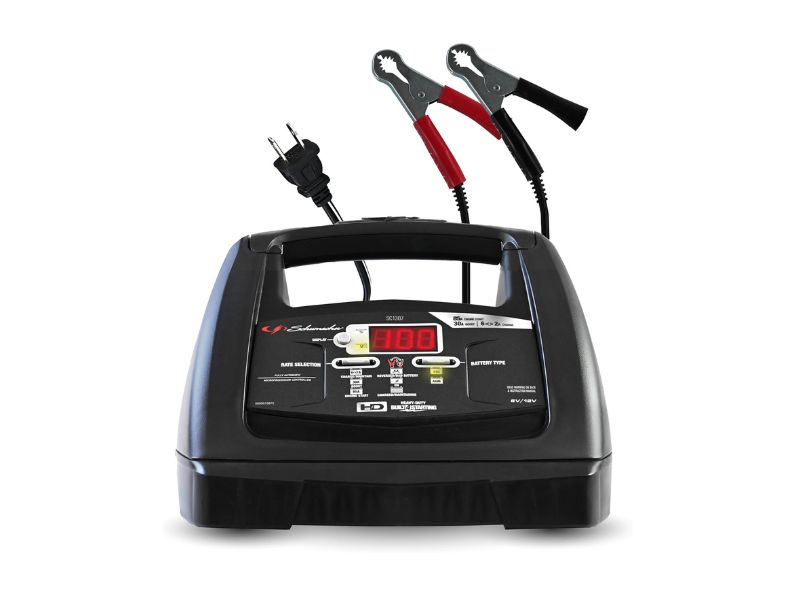
5. Schumacher Electric SC1307 Fully Automatic Battery Charger and Engine Starter – Best 6V/12V Alternative
Key Features
- 6V and 12V battery operation
- 85A engine-start assistance
- 30A boost charging
- 6A normal charging
- 2A maintenance charging
- Fully automatic operation
- Automatic voltage detection
- Multi-stage charging
- Float-mode monitoring
- Battery and alternator testing
- Standard battery compatibility
- AGM support
- Deep-cycle support
- Reverse-polarity warning
- Digital display
The Schumacher SC1307 rounds out the list as a versatile alternative to the SC1281.
Its specifications follow a similar philosophy: automatic normal charging, a substantial boost mode, engine-start assistance, diagnostic functions, and support for both 6V and 12V batteries.
The main difference is output.
The SC1307 provides an 85A engine-start function, slightly below the 100A capability of the SC1281.
Its 30A boost mode, however, remains substantial enough to add charge rapidly to a deeply discharged battery before a starting attempt.
Normal charging takes place at a much lower rate, with the charger automatically managing the process and moving into maintenance when appropriate.
This makes the SC1307 suitable for both active battery recovery and longer-term vehicle storage.
Automatic voltage detection is convenient when you own multiple batteries.
The charger can recognize supported 6V and 12V systems, reducing the risk of selecting the wrong voltage manually.
Its diagnostic functions are another useful addition.
The battery tester provides charge-level information, while the alternator test can help identify a charging-system issue.
If a battery repeatedly becomes discharged even after being fully charged, testing the alternator and the battery itself is much more useful than simply continuing to boost the vehicle every morning.
What I Like
The SC1307 offers an excellent collection of functions for a conventional home garage.
You get 6V/12V support, automatic charging, a strong 30A boost, 85A starting assistance, maintenance, and basic diagnostics.
What I Do Not Like
The SC1281 provides slightly stronger starting output and has a much larger ownership history.
If both models are readily available, I would normally choose the SC1281 first.
Verdict
The Schumacher SC1307 is a strong alternative for buyers who want automatic 6V/12V charging, a meaningful boost mode, and engine-start capability in a relatively portable charger.
Best Car Battery Charger and Booster Comparison
| Product | Voltage | Normal Charging | Boost | Engine Start | Battery Types | Automatic Maintenance | Diagnostics |
| Schumacher SC1281 | 6V/12V | Up to 6A | 30A | 100A | Standard, AGM, Gel, Deep-Cycle | Yes | Battery + Alternator |
| Schumacher SC1309 | 6V/12V | 6A–2A | 40A | 200A | Standard, AGM, Deep-Cycle | Yes | Battery + Alternator |
| Schumacher SC1361 | 12V | Automatic charge/maintain | 10A | 50A | Standard, AGM | Yes | Basic status |
| DEWALT DXAEC100 | 12V lead-acid applications | 30A | Charging-focused | 100A | WET, AGM, GEL | 3A maintain | Alternator Check |
| Schumacher SC1307 | 6V/12V | Up to 6A | 30A | 85A | Standard, AGM, Deep-Cycle | Yes | Battery + Alternator |
Quick Comparison
For most buyers, Schumacher SC1281 provides the best overall balance.
It has enough engine-start power for typical cars and SUVs, meaningful boost capability, broad battery compatibility, maintenance charging, diagnostics, and 6V/12V versatility.
The Schumacher SC1309 is the better garage machine when large vehicles and stronger starting assistance matter.
The Schumacher SC1361 is a simpler choice for normal 12V vehicles.
Choose DEWALT DXAEC100 when faster regular battery charging is particularly important.
The Schumacher SC1307 offers a good compromise between the SC1281’s versatility and the SC1361’s simpler design.
What Is a Car Battery Charger and Booster?
A car battery charger and booster is an AC-powered battery charger that can provide multiple levels of charging current.
A typical unit may include:
- Normal battery charging
- Low-current battery maintenance
- High-current boost charging
- Engine-start assistance
These modes solve different problems.
Normal Charging
Normal charging restores energy to the battery at a controlled rate.
This is what you should normally use when the battery has enough time to recharge properly.
Maintenance Charging
Maintenance mode keeps an already charged battery at an appropriate state of charge during storage.
It is useful for:
- Classic cars
- Seasonal vehicles
- Weekend cars
- Stored trucks
- Motorcycles
- RV starter batteries
Boost Charging
Boost mode applies substantially more charging current for a relatively short period.
Its purpose is to put useful energy into a deeply discharged battery faster than normal charging.
Engine-Start Assistance
Engine-start mode provides a brief high-current output while the engine is being cranked.
It is not a charging mode and should only be used for the duration specified by the charger manufacturer.
Charger and Booster vs Portable Jump Starter
These products are frequently confused.
They are not the same.
AC Battery Charger and Booster
A charger/booster:
- Requires access to an electrical outlet
- Can properly recharge the battery
- Can maintain stored batteries
- May provide boost charging
- May provide engine-start assistance
- Is ideal for a garage
Portable Jump Starter
A portable jump starter:
- Contains its own rechargeable battery
- Works without an AC outlet during the jump
- Is designed for roadside emergencies
- Provides short-term cranking power
- Does not properly recharge the vehicle battery
For home use, I prefer having a proper battery charger.
For roadside emergencies, I prefer carrying a separate portable jump starter in the vehicle.
How Many Charging Amps Do You Need?
Charging amperage has a major effect on how long battery recovery takes.
1A–3A
Low-current charging is ideal for:
- Battery maintenance
- Small batteries
- Motorcycle batteries
- Long-term storage
It can take a very long time to restore a large discharged automotive battery.
5A–10A
This range works well for normal home automotive charging.
It balances charging speed with manageable heat and battery stress.
15A–30A
Higher-current charging is useful when you regularly work with larger automotive batteries or cannot leave a battery charging overnight.
The DEWALT DXAEC100 is particularly interesting here because of its 30A charging capability.
30A–40A Boost
A 30A or 40A boost is intended for relatively short higher-current charging.
It is useful when a deeply discharged battery needs enough additional energy for a starting attempt.
How Long Does It Take to Charge a Car Battery?
Battery charging time depends on:
- Battery capacity
- State of charge
- Charger amperage
- Temperature
- Battery chemistry
- Battery age
- Charging efficiency
A simplified example helps.
Suppose a 60Ah battery is approximately half discharged.
It needs roughly 30Ah restored.
Ignoring losses and charging taper:
At 2A: roughly 15 hours.
At 6A: roughly 5 hours.
At 10A: roughly 3 hours.
At 30A: theoretically around 1 hour during the high-current portion.
Actual charging takes longer because battery charging is not perfectly efficient and smart chargers reduce current as the battery approaches full charge.
Does a Higher-Amp Charger Charge Better?
Not necessarily.
Higher amperage primarily means the charger can restore energy faster.
The best charging rate depends on battery:
- Capacity
- Chemistry
- Temperature
- Condition
- Manufacturer specifications
A 30A charger is not automatically healthier for every battery than a 6A charger.
For routine overnight charging, a moderate smart-charging rate may be preferable.
High-current boost should be used only when needed.
What Does 100A or 200A Engine Start Mean?
This specification is often misunderstood.
A charger labeled 100A engine start does not continuously charge at 100 amps.
The high-current mode is designed to assist the vehicle battery for a short period while the starter motor cranks the engine.
The SC1281 provides 100A starting assistance.
The SC1309 provides 200A.
Higher engine-start output can be helpful for:
- Larger engines
- Trucks
- SUVs
- Cold weather
- Severely discharged batteries
But more is not automatically necessary.
A normal passenger vehicle may be well served by a 50A–100A engine-start charger.
6V vs 12V Battery Chargers
Most modern cars use 12V batteries.
Six-volt batteries remain relevant for:
- Antique cars
- Vintage tractors
- Older motorcycles
- Classic equipment
- Specialty applications
If all your vehicles are modern, a 12V-only charger may be perfectly adequate.
If you work on older vehicles, a dual-voltage charger such as the SC1281, SC1309, or SC1307 gives you more flexibility.
Understanding Battery Chemistry
Voltage is only part of compatibility.
Battery chemistry matters too.
Flooded Lead-Acid
Traditional flooded batteries remain widely used in cars and trucks.
They contain liquid electrolyte and are generally well supported by automotive chargers.
AGM
Absorbent Glass Mat batteries are common in newer cars, SUVs, motorcycles, and vehicles with heavy electrical demands.
They can require different charging behavior from traditional flooded batteries.
Choose a charger with explicit AGM support.
GEL
Gel batteries also require controlled charging voltage.
The SC1281 and DXAEC100 are examples of products intended to support compatible gel lead-acid applications.
Deep-Cycle Batteries
Deep-cycle lead-acid batteries are designed differently from ordinary starter batteries.
They are common in RV, marine, and auxiliary-power applications.
Make sure the charger supports deep-cycle batteries if you plan to use it beyond automotive starter batteries.
Lithium Batteries
This is an important limitation.
The chargers in this list are primarily intended for lead-acid battery systems.
Do not connect a lithium or LiFePO4 automotive battery unless the exact charger model explicitly supports that chemistry.
A 12V label alone does not establish compatibility.
Why Automatic Charging Matters
Modern automatic chargers use microprocessors to monitor battery conditions and regulate output.
A typical charging process may involve:
Initialization
The charger checks connection polarity and battery voltage.
Bulk Charging
Higher available current restores most of the battery’s missing capacity.
Absorption
Charging current gradually falls as the battery approaches full charge.
Maintenance
The charger monitors the full battery and adds only the energy necessary to keep it ready.
This automatic process is much more convenient than manually estimating charging time.
What Is Battery Reconditioning?
Some chargers offer a desulfation or battery-repair mode.
Sulfation occurs when lead sulfate crystals build up on lead-acid battery plates, particularly after extended periods in a discharged state.
A repair program may use specialized charging behavior intended to reduce certain recoverable sulfate buildup.
However, reconditioning has limits.
It cannot repair:
- Shorted battery cells
- Physically damaged plates
- Cracked battery cases
- Severe electrolyte loss
- Internal mechanical failure
- A completely worn-out battery
Do not buy a charger expecting it to permanently revive every old battery.
Why an Alternator Tester Is Useful
A dead battery is not always caused by the battery itself.
If the alternator does not properly recharge the battery while the engine is running, you may repeatedly experience no-start situations.
A basic alternator-test function can provide a useful first indication of charging-system behavior.
Possible causes of recurring low battery charge include:
- Weak alternator
- Faulty voltage regulator
- Loose drive belt
- Corroded battery terminals
- Bad battery
- Parasitic electrical draw
- Poor ground connection
A charger fixes the immediate low-charge condition.
It does not fix the underlying vehicle fault.
When Should You Use Boost Mode?
Use boost when the battery is significantly discharged and normal charging is taking too long.
A sensible workflow is:
Connect the charger according to the vehicle and charger instructions.
Confirm battery voltage and chemistry.
Allow the charger to evaluate the battery.
Use the normal charging mode when time allows.
Select boost only when faster energy restoration is necessary.
Return to normal charging when appropriate.
Boost mode should not become your everyday substitute for proper charging.
When Should You Use Engine-Start Mode?
Use engine-start mode when the battery does not have enough cranking power and you need to attempt starting the vehicle.
Follow the charger’s specified procedure.
Most engine-start chargers limit how long you can crank before requiring a cooling period.
Repeated continuous cranking can overheat:
- Charger electronics
- Transformer
- Battery cables
- Vehicle starter
- Battery
If the engine repeatedly refuses to start, investigate the vehicle rather than continuing endless start attempts.
Can a Charger Start a Completely Dead Battery?
Sometimes.
The result depends on battery condition.
A healthy battery that was simply drained by headlights or long storage can often be recharged and returned to service.
A severely discharged battery may need boost charging before engine-start mode becomes effective.
However, a battery suffering from an internal failure may not accept or hold enough charge to start the vehicle.
Signs of a failing battery can include:
- Rapid voltage drop after charging
- Slow cranking despite full-charge indication
- Repeated need for boosting
- Swollen case
- Leaking electrolyte
- Battery age beyond normal service life
Have the battery load-tested if problems continue.
Can You Charge the Battery While It Is Installed?
Many vehicles allow in-vehicle battery charging.
However, modern cars may use:
- Battery monitoring sensors
- Dedicated charging terminals
- Chassis-ground connection points
- Battery management systems
- Start-stop battery systems
Always follow the vehicle owner’s manual.
On some vehicles, connecting directly to the negative battery terminal can bypass a battery-current sensor. Manufacturers may instead specify an approved chassis ground.
Safety Tips
Automotive batteries can produce explosive gas and contain corrosive electrolyte.
Always work carefully.
Use the charger in a ventilated location.
Keep sparks, flames, and cigarettes away from the battery.
Inspect the battery before charging.
Do not charge a battery that is:
- Cracked
- Leaking
- Frozen
- Severely swollen
- Physically damaged
Confirm positive and negative terminals before connecting clamps.
Keep the charger away from moving engine components.
Use only the charging modes approved for your battery type.
Do not place a charger directly on top of the battery.
Common Buying Mistakes
Buying Only by Engine-Start Amps
The biggest number on the front is not automatically the most important specification.
Normal charging performance matters too.
Ignoring Battery Chemistry
AGM, flooded, gel, and lithium batteries can have different charging requirements.
Confusing Boost with Engine Start
Boost adds battery charge.
Engine-start mode provides short-term cranking assistance.
They are related but different functions.
Buying an Oversized Wheeled Charger for One Small Car
A 200A shop machine is excellent in the right garage but unnecessary for many sedan owners.
Expecting Roadside Portability
These chargers require an AC outlet.
A self-contained lithium jump starter is better for the trunk.
Ignoring Automatic Maintenance
If a car sits for weeks, maintenance mode may be more useful over time than maximum starting amperage.
Repeatedly Boosting a Failing Battery
If a battery continually needs assistance, diagnose the problem instead of treating every incident as an isolated dead battery.
Frequently Asked Questions
What is the best car battery charger and booster?
The Schumacher SC1281 is my top overall choice for most home garages.
It combines 6V/12V automatic charging, a 30A boost mode, 100A engine-start assistance, maintenance charging, multiple lead-acid battery modes, battery testing, alternator diagnostics, and reverse-polarity protection. The SC1309 is the stronger option when larger trucks and batteries require more starting power.
What is the difference between a battery charger and booster?
A charger restores battery capacity gradually, while boost mode uses higher current to restore usable energy more quickly.
A charger may need several hours to properly recharge a depleted battery. Boost mode is designed for shorter periods when you want enough additional battery energy for a starting attempt.
Is a booster the same as a jump starter?
Not always. An AC-powered boost charger and a portable jump starter work differently.
A charger/booster requires electrical power and can actually recharge the battery. A portable jump starter contains its own internal battery and provides short cranking assistance without an outlet.
Is 100 amps enough to start a car?
A 100A engine-start charger can provide useful starting assistance for many passenger vehicles.
Actual starting requirements vary with engine size, fuel type, temperature, battery condition, oil viscosity, and starter design. Larger trucks and diesel engines may benefit from higher-output equipment.
Is a 200A charger better than a 100A charger?
Not automatically; the 200A figure normally refers to short engine-start assistance.
A 200A model provides additional cranking reserve, but it may also be larger, heavier, and more expensive. For a typical sedan, a 100A engine-start charger may be completely adequate.
Is 30A boost safe for a car battery?
It can be when the charger and battery manufacturer permit that boost rate and you follow the specified procedure.
Boost is intended for relatively short higher-current charging. Do not assume maximum current is the best setting for every battery.
How long should I use boost mode?
Use boost only for the period recommended by the charger manufacturer.
Charging time depends on battery condition and charger design. Avoid leaving a battery indefinitely on a high-current boost setting.
Can a charger and booster fix a dead battery?
It can recharge a healthy discharged battery but cannot repair serious internal battery failure.
A battery with damaged cells, severe plate deterioration, a cracked case, or very low remaining capacity generally requires replacement.
What charger is best for a completely dead car battery?
A charger with substantial boost capability is usually more practical than a low-current maintainer.
The SC1281 offers a 30A boost, while the SC1309 increases this to 40A. The DXAEC100 also provides relatively strong regular charging. Extremely low-voltage batteries may still require special procedures.
Which charger and booster is best for a truck?
The Schumacher SC1309 is my preferred choice for larger trucks and SUVs.
Its 40A boost and 200A engine-start mode provide more reserve than the smaller chargers in this guide, and the wheeled chassis suits frequent garage use.
Which model is best for a normal sedan?
The Schumacher SC1281 offers the most useful balance for a typical passenger car.
It is easier to store than a large wheel charger while still delivering meaningful boost and engine-start assistance.
Which charger is best for faster battery charging?
The DEWALT DXAEC100 is particularly attractive because of its 30A charging capability.
It also provides 3A maintenance and a 100A engine-start function, making it useful when normal charging speed matters.
Can I leave a smart charger connected overnight?
A properly configured automatic charger can manage its charging cycle and transition into maintenance when designed to do so.
Always use the correct battery mode and follow both charger and battery manufacturer instructions.
Can a battery charger overcharge a battery?
A malfunctioning or incorrectly used charger can, but modern automatic chargers regulate charging to reduce that risk.
Automatic maintenance mode is particularly useful because it lowers or pauses charging after the battery reaches the appropriate state of charge.
Can these chargers work with AGM batteries?
Yes, the models reviewed here provide AGM compatibility within their specified lead-acid applications.
Always select the appropriate mode where required.
Can I charge a lithium car battery with these chargers?
Do not assume so. Use only a charger explicitly approved for the exact lithium chemistry installed in your vehicle.
Most traditional charger/boosters are designed primarily around lead-acid batteries.
What is the best charging amp for a normal car battery?
Around 5A–10A is a practical general-purpose range for many automotive batteries.
Lower rates work well for maintenance, while higher charging rates can reduce recovery time. Always consider battery capacity and manufacturer specifications.
How do I know whether my battery or alternator is bad?
Charge and test the battery first, then evaluate charging voltage and alternator performance.
A healthy battery that repeatedly becomes discharged may indicate an alternator problem or parasitic electrical load. Models with basic battery and alternator diagnostics can provide useful initial information.
Why does my battery keep dying after I recharge it?
The battery may be worn out, or the vehicle may have a charging-system or parasitic-draw problem.
Repeatedly boosting the vehicle without diagnosing the underlying cause will not solve the issue.
Should I buy a charger/booster or a portable jump starter?
For garage battery care, buy a charger/booster; for roadside emergencies, carry a portable jump starter.
Ideally, having both provides the most complete coverage. The charger maintains and restores battery health, while the jump starter provides emergency independence away from an electrical outlet.
Conclusion
The best car battery charger and booster should match the way you actually deal with vehicle batteries.
For most home garages, the Schumacher SC1281 provides the strongest overall balance. Its automatic charging system handles routine battery care, the 30A boost helps recover deeply discharged batteries faster, and the 100A engine-start function provides useful emergency cranking assistance. Battery and alternator diagnostics make it even more versatile.
The Schumacher SC1309 is the better heavy-duty choice for pickups, large SUVs, multiple vehicles, and workshop environments. Its 40A boost and 200A engine-start mode provide substantially more reserve power, while the wheeled design makes the heavier hardware easier to move.
The Schumacher SC1361 is a straightforward alternative for conventional 12V vehicles when you do not need extreme output.
The DEWALT DXAEC100 stands out when faster normal battery charging matters, combining 30A charging with a 3A maintainer and 100A engine-start assistance.
Finally, the Schumacher SC1307 provides another versatile 6V/12V option with a strong 30A boost and 85A starting mode.
If I were buying one unit for a typical home garage, I would choose the Schumacher SC1281. It provides enough power to solve genuine dead-battery problems without the bulk of a large wheeled charger, while its automatic charging and maintenance features make it practical for routine battery care as well.