A dead car battery can turn a normal commute, winter morning, or road trip into a frustrating delay. Traditional jumper cables work, but they depend on another vehicle being nearby. A portable battery booster pack gives you an independent source of starting power that can stay in your trunk and be ready when your 12V battery cannot crank the engine.
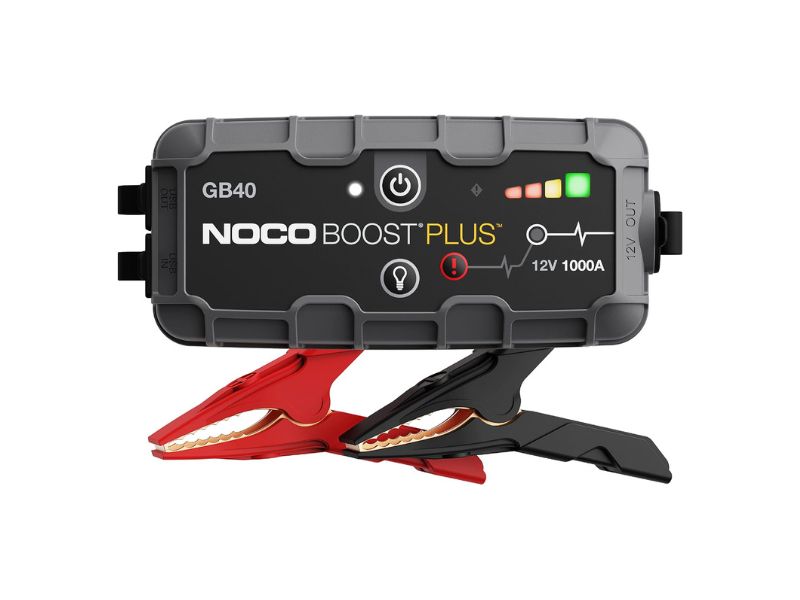
My first recommendation is the NOCO Boost GB40 1000A UltraSafe Portable Lithium Jump Starter. Its exceptionally large ownership history, compact lithium design, spark-proof connection system, reverse-polarity protection, and useful 1000A output make it the most balanced option here for normal passenger cars, SUVs, motorcycles, and light trucks.
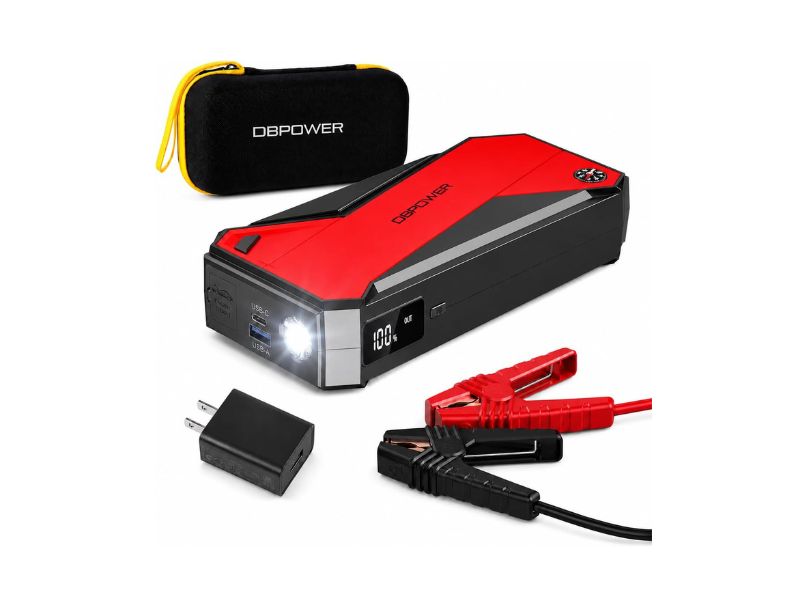
If you want substantially more advertised starting capacity while keeping a compact lithium format, I would consider the DBPOWER 3000A 18000mAh Portable Car Jump Starter. Its large review history, LCD battery indicator, smart clamps, USB outputs, and support for relatively large gas and diesel engines make it a strong multi-vehicle option.
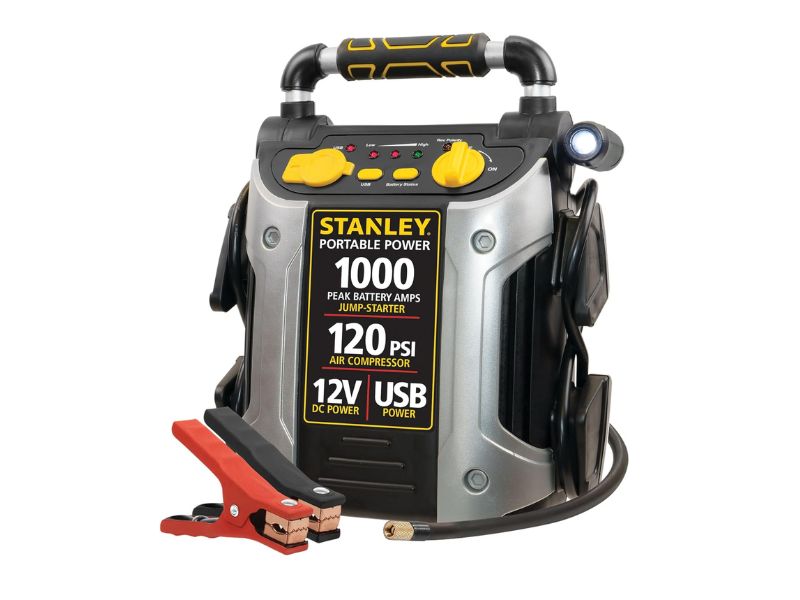
For drivers who prefer a traditional all-in-one emergency station, the STANLEY J5C09 1000 Peak Amp Jump Starter stands out. It is much heavier than the lithium packs, but the built-in 120 PSI air compressor, USB power, emergency light, and substantial lead-acid battery make it useful for a garage, pickup, SUV, or larger trunk.
Best Portable Battery Booster Packs
| Image | Product Name | Check Price |
|---|---|---|
Best Choice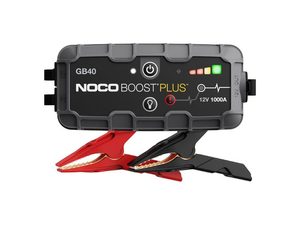 | NOCO Boost GB40 1000A UltraSafe Portable Lithium Jump Starter – Best Overall | Check Price |
Second Best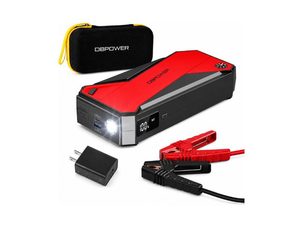 | DBPOWER 3000A 18000mAh Portable Car Jump Starter | Check Price |
Third Choice | STANLEY J5C09 1000 Peak Amp Jump Starter with Compressor | Check Price |
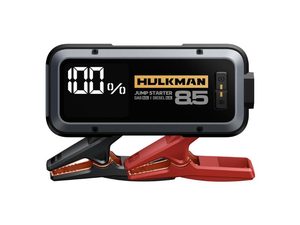 | HULKMAN Alpha85 2000A Smart Portable Jump Starter | Check Price |
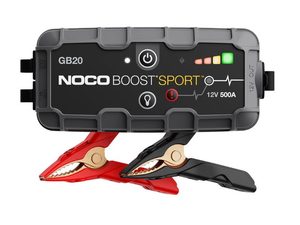 | NOCO Boost GB20 500A UltraSafe Portable Lithium Jump Starter | Check Price |
1. NOCO Boost GB40 1000A UltraSafe Portable Lithium Jump Starter – Best Overall
Key Features
- 1000A peak output
- 12V lithium jump starter
- Rated for up to 6.0L gasoline and 3.0L diesel engines
- Spark-proof connection technology
- Reverse-polarity protection
- Manual override for extremely discharged compatible batteries
- USB power-bank function
- 100-lumen LED flashlight
- Multiple lighting modes
- Compact, lightweight construction
- IP65-rated housing with ports closed
Detailed Review
The NOCO GB40 earns my first position because it combines one of the largest real-world ownership histories in this category with a design that is genuinely practical to keep in a vehicle.
Some battery boosters impress on paper but become inconvenient once you need to find space for them in a small sedan. The GB40 avoids that problem. Its lithium battery allows the complete unit to remain relatively compact while still producing enough starting output for many common cars, crossovers, SUVs, motorcycles, ATVs, lawn equipment, and smaller trucks.
The 1000A peak output may not be the largest number in this guide, but peak amperage is only one part of jump-start performance. Cable resistance, clamp quality, battery-cell condition, internal electronics, temperature, and the condition of the vehicle battery all influence whether a starter motor actually turns.
I place more value on the GB40’s safety design than on chasing the biggest advertised amp rating.
Its reverse-polarity protection helps prevent operation when the clamps are connected incorrectly. The spark-resistant design is also valuable when attaching clamps around a conventional lead-acid automotive battery.
Those protections are particularly helpful for drivers who do not routinely work on vehicles.
The unit supports engines up to approximately 6.0L gasoline and 3.0L diesel, which covers a large percentage of normal passenger vehicles.
The GB40 also functions as a USB power bank. That feature can become surprisingly useful during an actual roadside problem. Your phone may be needed for navigation, roadside-assistance calls, insurance information, or emergency communication, and a dead phone battery can make an already difficult situation worse.
Its built-in LED flashlight adds another useful emergency feature. Battery problems frequently happen early in the morning, late at night, or during poor weather, exactly when finding terminals and making secure clamp connections becomes more difficult.
A manual override mode can help with certain extremely discharged batteries that fall below the booster’s normal automatic detection threshold.
I would use that function carefully.
An automatic safety system may refuse to energize the clamps because it cannot confidently detect battery voltage or polarity. Override modes can bypass some normal detection behavior, so they should only be used after confirming correct voltage, battery type, polarity, and connection.
The biggest limitation is cable length. Modern engine compartments can place positive and negative jump points farther apart than expected, and compact booster packs commonly use relatively short cables.
I recommend checking your car’s designated jump-start points before an emergency to make sure the clamps can reach comfortably.
What I Like
The GB40 is compact enough for regular trunk storage, extremely easy to operate, and supported by a long ownership history. Spark protection and reverse-polarity protection make it friendlier for inexperienced users, while USB power and emergency lighting add genuine roadside value.
What I Do Not Like
The cables could be longer for vehicles with widely separated jump points. Drivers with large diesel engines will also need a stronger model.
Verdict
The NOCO GB40 is my best portable battery booster pack overall. It provides the right combination of portability, starting capability, safety, durability, and everyday usability for most passenger-vehicle owners.
2. DBPOWER 3000A 18000mAh Portable Car Jump Starter – Best High-Review Value
Key Features
- Up to 3000A peak output
- 18,000mAh internal lithium battery
- 12V vehicle compatibility
- Supports up to approximately 8.0L gas and 6.0L diesel engines
- Smart protection clamps
- LCD battery-status display
- USB device charging
- LED emergency lighting
- Compact storage case
- Up to roughly 30 starts under suitable conditions
Detailed Review
The DBPOWER is another extremely established battery booster pack and provides significantly more advertised peak output than the GB40.
The current version is rated at up to 3000A peak current, with stated compatibility extending to approximately 8.0L gasoline and 6.0L diesel engines.
That gives it wider theoretical engine coverage than the NOCO GB40.
The internal 18,000mAh lithium battery also provides plenty of reserve for emergency electronics use. When the booster is not being used to start an engine, its USB outputs can recharge phones, tablets, navigation devices, and other compatible electronics.
I particularly like its LCD battery indicator.
Simple jump packs often use four LEDs representing roughly 25%, 50%, 75%, and 100% charge. That works, but a numeric display makes it easier to judge whether the device should be recharged before a trip.
Knowing the booster has 82% charge is more informative than knowing that three of four lights are illuminated.
The smart clamp assembly adds multiple electrical protections intended to reduce the risk of improper connection or short circuits.
This is important because a jump starter can deliver enormous current in a very short period.
The unit is still compact enough to remain a realistic vehicle emergency tool. A hard storage case also helps keep the clamps, cables, and booster together instead of letting everything move freely around the trunk.
One issue with any lithium booster is storage discipline.
The fact that a jump starter can hold its charge for months does not mean you should forget about it indefinitely.
I recommend checking emergency booster charge several times per year and always before a long road trip.
Lithium batteries also dislike prolonged exposure to extreme heat. Vehicle interiors can become exceptionally hot in summer, so follow the manufacturer’s permitted storage-temperature range.
Another consideration is advertised peak current.
A 3000A specification should not be interpreted as the vehicle receiving 3000 amps continuously. Peak figures represent short-duration capability under defined conditions.
For buyers, the important question is whether the booster is rated for the engine you own.
What I Like
The DBPOWER offers an excellent combination of high advertised output, large battery capacity, compact size, smart clamps, LCD monitoring, emergency lighting, and USB charging.
What I Do Not Like
The higher peak number should not be treated as proof that it will outperform every lower-rated premium booster. Long-term battery condition also depends heavily on storage temperature and periodic charging.
Verdict
The DBPOWER is a strong choice if you want high starting headroom and an established compact booster pack without moving to a heavy lead-acid power station.
3. STANLEY J5C09 1000 Peak Amp Jump Starter with Compressor – Best All-in-One Emergency Station
Key Features
- 1000 peak amps
- 500 instant starting amps
- 12V sealed lead-acid internal battery
- Built-in 120 PSI air compressor
- USB charging port
- 12V DC power outlet
- Reverse-polarity warning
- Pivoting LED work light
- Integrated battery-status indicator
- Heavy-duty carrying handle
Detailed Review
The STANLEY J5C09 has a very different personality from the compact lithium packs.
This is a traditional portable battery booster station.
It is considerably larger and heavier, but that extra size allows STANLEY to incorporate a 120 PSI air compressor, larger internal lead-acid battery, USB power, 12V accessory power, and emergency lighting.
That makes it appealing to drivers who want to handle more than a dead battery.
A low tire is another common roadside problem. The integrated compressor lets you restore tire pressure without keeping a separate inflator in the vehicle.
For ordinary passenger-car tires, the compressor’s 120 PSI maximum is far beyond what you actually need.
Most passenger vehicles specify cold tire pressures somewhere around the 30–40 PSI range, although the correct value must come from the vehicle’s tire-information placard.
Never inflate a tire to 120 PSI simply because the compressor is capable of producing that pressure.
The jump-starting side produces 1000 peak amps and 500 instant starting amps, providing useful output for a broad selection of normal vehicles.
The J5C09 also includes a reverse-polarity warning. Unlike some lithium packs that electronically prevent current flow under several incorrect-connection conditions, traditional power stations still require careful operator attention.
Its biggest advantage is versatility.
You can:
- Jump-start a weak vehicle
- Inflate a low tire
- Recharge USB electronics
- Operate compatible 12V accessories
- Illuminate an engine bay or roadside work area
That makes it particularly useful in trucks, SUVs, work vehicles, garages, and larger family vehicles where carrying an 18-pound emergency station is not a serious inconvenience.
Weight is unquestionably its largest disadvantage.
Modern lithium jump starters can weigh around one or two pounds. A lead-acid booster station can weigh many times as much.
The internal battery also requires regular charging.
Lead-acid batteries suffer when stored in a discharged state. If you buy the STANLEY, build periodic charging into your maintenance routine rather than leaving it forgotten in the trunk.
What I Like
The J5C09 combines strong starting assistance, a useful air compressor, USB power, 12V accessory power, and emergency lighting in one proven design.
What I Do Not Like
It is dramatically heavier and larger than lithium alternatives. Its internal lead-acid battery also requires more diligent storage maintenance.
Verdict
Choose the STANLEY J5C09 if you want a portable roadside power station rather than the smallest possible booster pack.
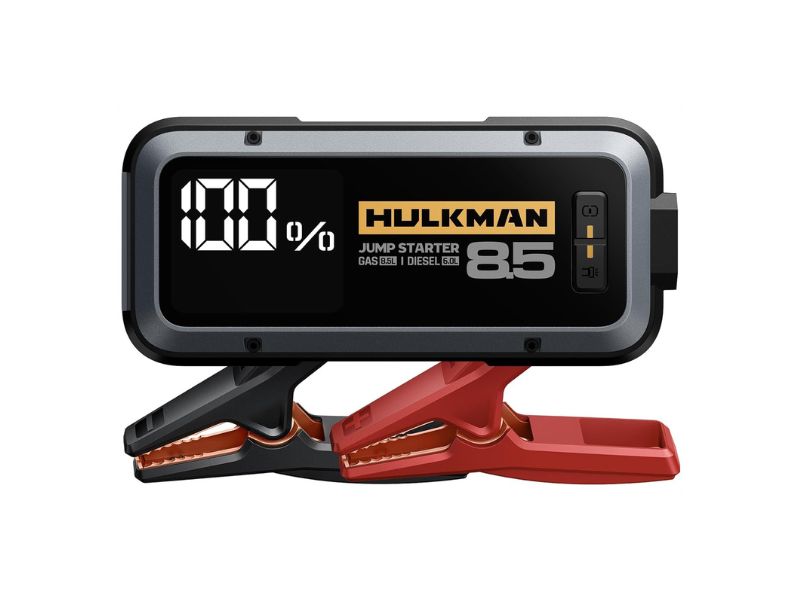
4. HULKMAN Alpha85 2000A Smart Portable Jump Starter – Best Premium Smart Booster
Key Features
- 2000A peak output
- 20,000mAh lithium battery
- 12V operation
- Supports up to approximately 8.5L gasoline and 6.0L diesel engines
- Large digital status display
- 65W USB-C charging
- USB power-bank functionality
- Smart clamp protection system
- IP65-rated housing
- Multi-mode LED flashlight
- Approximately 4.5-pound weight
Detailed Review
The HULKMAN Alpha85 is one of the more polished portable booster packs in this comparison.
Its most obvious difference is the large digital interface.
Instead of relying primarily on small LEDs and warning symbols, the Alpha85 provides clearer information about battery state and operating status.
That can make a meaningful difference during an emergency.
When a car will not start, drivers want straightforward instructions—not cryptic flashing lights that require searching for the manual.
The 2000A peak output places the Alpha85 comfortably above the needs of most normal four-cylinder and six-cylinder passenger cars.
Its stated engine coverage also extends into larger gasoline and diesel vehicles.
The 20,000mAh battery provides enough stored energy to serve as a substantial USB power bank when jump-starting is not required.
One of my favorite features is 65W USB-C charging.
USB-C Power Delivery can recharge the jump pack considerably faster than old low-output USB charging systems when the correct charger and cable are used.
That matters because a booster pack is only useful when it contains enough charge.
A device that takes all day to recharge is easier to neglect.
The Alpha85 also has a relatively rugged enclosure and IP65 protection, giving it improved resistance to dust and water exposure when the relevant ports and covers are properly secured.
That does not make it waterproof.
It should still be kept away from standing water, heavy exposure, and unsafe environmental conditions.
At approximately 4.5 pounds, the Alpha85 is noticeably heavier than minimalist lithium jump starters.
The weight comes partly from its 20,000mAh battery and robust housing.
It remains genuinely portable, but it is less likely to disappear into a small glove compartment.
The high-capacity design makes more sense for an SUV, pickup, RV, boat, or multi-vehicle household where greater reserve power is useful.
What I Like
The large digital display, strong output, 20,000mAh capacity, USB-C charging, weather-resistant housing, and smart safety system give the Alpha85 a premium feel.
What I Do Not Like
It is heavier and bulkier than the NOCO GB40 and GB20. Drivers with small engines may also be paying for far more starting capability than they need.
Verdict
The HULKMAN Alpha85 is my preferred premium smart battery booster pack for drivers who value a clear display, fast USB-C charging, and substantial reserve power.
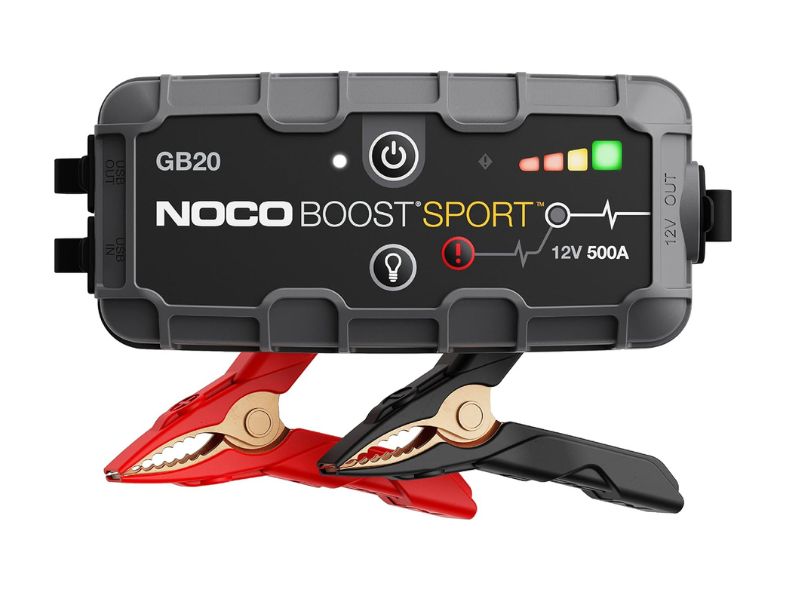
5. NOCO Boost GB20 500A UltraSafe Portable Lithium Jump Starter – Best Ultra-Compact Pick
Key Features
- 500A peak output
- 12V lithium battery booster
- Designed for smaller gasoline engines
- Suitable for motorcycles and many passenger vehicles
- Spark-proof technology
- Reverse-polarity protection
- USB power-bank capability
- Integrated LED flashlight
- Lightweight design
- Manual override function
Detailed Review
The GB20 is the smallest and lowest-output jump starter among these five picks, but that is precisely why some drivers should consider it.
Not everybody owns a large SUV or diesel truck.
For a compact sedan, small crossover, motorcycle, ATV, lawn tractor, or similar vehicle, carrying a huge 3000A pack may provide little practical benefit.
The GB20 offers 500A peak output in a much smaller package.
Its compact size makes it easier to keep inside a small emergency bag, under a seat, in a motorcycle pannier, or in a trunk compartment where larger units would be inconvenient.
The GB20 incorporates the same general UltraSafe philosophy found in the larger GB40, including spark-resistant connections and reverse-polarity protection.
I consider those features particularly valuable on a compact booster because products like this are often purchased by drivers who want an emergency solution they can operate without mechanical experience.
The integrated flashlight can illuminate terminals at night, while USB output lets the unit act as an emergency electronics charger.
The real question is engine size.
The GB20 should not be purchased simply because it is compact if your vehicle’s engine falls outside its specified capability.
Large V8 engines, heavy-duty diesel pickups, and commercial equipment require more starting capacity.
In those situations, the GB40, DBPOWER, HULKMAN, or another appropriately rated larger booster is a better choice.
The GB20 is also a good example of why bigger is not automatically better.
A booster that fits easily in your vehicle and remains charged may provide more real-world value than a larger pack you leave in the garage because it occupies too much space.
What I Like
The GB20 is exceptionally easy to store, lightweight, simple to operate, and equipped with useful reverse-polarity and spark protection.
What I Do Not Like
The 500A output limits engine compatibility. It is not the right product for large trucks, substantial diesel engines, or owners wanting maximum multi-vehicle versatility.
Verdict
The NOCO GB20 is the best option here when small size and low weight matter more than maximum starting output.
Portable Battery Booster Pack Comparison
| Product | Peak Output | Battery Type | Engine Coverage | Power Bank | Flashlight | Compressor | Main Advantage | Best For |
| NOCO GB40 | 1000A | Lithium | Up to 6.0L gas / 3.0L diesel | Yes | Yes | No | Excellent balance | Most drivers |
| DBPOWER 3000A | 3000A | Lithium | Up to 8.0L gas / 6.0L diesel | Yes | Yes | No | High-output value | Multiple vehicles |
| STANLEY J5C09 | 1000A peak | Sealed lead-acid | Passenger vehicles | Yes | Yes | 120 PSI | All-in-one station | Garage, truck, SUV |
| HULKMAN Alpha85 | 2000A | Lithium | Up to 8.5L gas / 6.0L diesel | Yes | Yes | No | Display and USB-C | Premium buyers |
| NOCO GB20 | 500A | Lithium | Smaller gas engines | Yes | Yes | No | Ultra-compact | Small cars/powersports |
For most passenger-car owners, the NOCO GB40 provides the strongest combination of compact size, proven use, sensible power, and safety technology.
The DBPOWER 3000A gives you greater engine-size headroom while remaining compact.
The STANLEY J5C09 is the better option if you want tire inflation and other emergency functions built into the same unit.
The HULKMAN Alpha85 provides a more premium digital experience with higher battery capacity, while the NOCO GB20 is the easiest to carry when only modest starting capacity is needed.
What Is a Portable Battery Booster Pack?
A portable battery booster pack is a rechargeable device capable of supplying high current to a vehicle’s starter circuit when the vehicle battery is too weak to crank the engine normally.
You may also see these products called:
- Portable jump starters
- Car battery boosters
- Battery jump packs
- Booster boxes
- Jump boxes
- Lithium jump starters
- Emergency battery packs
- Battery starter packs
Although the wording varies, the primary purpose is the same: help start a vehicle without another donor vehicle.
Modern compact models typically use lithium-ion or lithium-polymer cells, while traditional large booster stations may use sealed lead-acid batteries.
Portable Battery Booster vs. Jumper Cables
Jumper cables are inexpensive and have no internal battery that can lose charge.
Their biggest problem is dependency.
You need another vehicle with a healthy battery positioned close enough for the cables to reach.
A portable booster pack eliminates that requirement.
Advantages of a Booster Pack
A good portable booster lets you:
- Start your vehicle independently
- Avoid positioning another vehicle nearby
- Reduce reliance on strangers
- Carry emergency USB power
- Use integrated lighting
- Store the complete system in one small case
Advantages of Jumper Cables
Traditional cables still provide benefits:
- No internal battery
- No charging required
- Low purchase cost
- Can work for many years
- Suitable for repeated use when an appropriate donor vehicle is available
For maximum roadside preparedness, carrying both is reasonable.
Battery Booster Pack vs. Car Battery Charger
These devices solve different problems.
A booster pack provides a short burst of high current so the starter motor can crank.
A battery charger gradually restores energy to the battery over several hours.
For example, a smart charger might provide 5 or 10 amps.
A jump starter may briefly deliver hundreds or thousands of amps.
That does not mean the jump starter is charging the battery more effectively.
Its purpose is starting the engine.
Once the engine starts, the vehicle’s charging system begins supplying electrical power.
If the battery was deeply discharged, however, normal driving may not be the best or safest way to restore it completely. Connecting an appropriate smart charger afterward can properly return the battery to a full state of charge.
Lithium vs. Lead-Acid Battery Booster Packs
Lithium Booster Packs
Lithium packs dominate the compact market.
Their advantages include:
- Low weight
- Compact dimensions
- High power-to-weight ratio
- Low self-discharge
- USB power-bank capability
- Easy trunk storage
The NOCO, DBPOWER, and HULKMAN products in this guide use lithium technology.
Lead-Acid Booster Packs
Traditional models such as the STANLEY use sealed lead-acid batteries.
Advantages include:
- Proven technology
- Substantial stored energy
- Good sustained-output capability
- Easy integration with compressors and inverters
Disadvantages include:
- Much greater weight
- Larger dimensions
- More maintenance charging
- Lower energy density
For a normal passenger vehicle, I generally prefer lithium.
For a garage, work truck, RV, or large emergency station, lead-acid designs can still make sense.
How Many Amps Should a Battery Booster Pack Have?
This is one of the most common purchasing questions.
Unfortunately, there is no universal number.
Required starting current depends on:
- Engine displacement
- Gasoline versus diesel
- Engine compression
- Battery condition
- Ambient temperature
- Oil viscosity
- Starter condition
- Cable resistance
A compact gasoline car needs far less current than a large diesel pickup.
500A Class
A quality 500A booster can suit:
- Motorcycles
- ATVs
- Small cars
- Compact gasoline engines
- Lawn equipment
1000A Class
Around 1000A provides greater flexibility for:
- Sedans
- Crossovers
- SUVs
- Many light trucks
- Larger gas engines
- Some small diesel applications
2000A–3000A Class
Higher-output units can make sense for:
- Large gasoline engines
- Diesel engines
- Trucks
- RVs
- Work equipment
- Multi-vehicle households
Always use the manufacturer’s engine-displacement rating instead of relying exclusively on the peak-amp number.
Why Diesel Engines Need More Starting Power
Diesel engines generally operate at higher compression ratios than gasoline engines.
The starter motor therefore needs to overcome greater mechanical resistance during cranking.
Cold weather makes the situation more difficult.
Diesel engine oil becomes thicker, batteries produce less current when cold, and additional electrical systems such as glow plugs can increase demand.
This is why a jump starter may be rated for a much larger gasoline engine than diesel engine.
For example, the same booster might support an 8.0L gasoline engine but only a 6.0L diesel.
Peak Amps vs. Cranking Amps
Peak amps are heavily promoted because they produce large numbers.
They describe the maximum short-duration current a booster can produce under specified conditions.
Cranking performance is more complicated.
The starter may need substantial current for several seconds.
Real performance depends on:
- Battery-cell quality
- Internal resistance
- Cable thickness
- Clamp contact
- Temperature
- Electronic current limits
- Vehicle starter demand
This is why I would rather have a proven 1000A booster with good cables and reliable cells than an unknown product claiming an enormous peak rating.
How Big Should a Portable Battery Booster Be?
The best physical size depends on where you plan to keep it.
Compact Sedan
Choose a lithium pack that fits:
- Glove compartment
- Trunk organizer
- Spare-tire compartment
- Under-seat storage
SUV or Pickup
You can comfortably carry a larger high-capacity pack.
An integrated compressor can also become worthwhile.
RV
High capacity, multiple power outputs, and large-engine capability become more valuable.
Motorcycle
Size and weight dominate.
A 500A compact pack may be more appropriate than a huge multi-function booster.
Important Safety Features
Reverse-Polarity Protection
Connecting positive to negative and negative to positive is a dangerous mistake.
A modern smart booster should detect incorrect polarity and prevent or warn against operation.
Spark Protection
Spark-resistant technology reduces the likelihood of sparks during improper or incomplete connections.
Short-Circuit Protection
The pack should protect itself if the clamps accidentally touch.
Overcurrent Protection
Excessive current draw can overheat cells and electrical components.
Overtemperature Protection
Jump-starting creates heat.
A well-designed booster monitors internal temperature and restricts operation when necessary.
Low-Voltage Detection
Smart jump starters may refuse to operate when they cannot detect enough voltage from the vehicle battery.
Some include manual override for these situations.
What Is Manual Override or Boost Mode?
An extremely discharged battery may show such low voltage that a smart jump starter cannot identify it.
The booster may therefore refuse to energize its clamps.
Manual override allows certain models to bypass normal voltage detection.
This feature can be valuable, but it requires extra caution.
When automatic detection is bypassed, some safety protections may be reduced.
Before using override:
- Confirm the vehicle uses the correct voltage
- Identify positive and negative terminals
- Verify clamp polarity
- Check battery condition
- Read the booster instructions
- Make sure the battery is not frozen or physically damaged
Never treat override as the default starting mode.
How to Use a Portable Battery Booster Pack
Always follow the vehicle and booster manufacturer’s instructions.
A typical process begins by turning off the vehicle.
Switch off accessories such as:
- Headlights
- Climate control
- Heated seats
- Audio system
- Chargers
Locate the designated jump points.
On some cars, the battery itself may be in the trunk or beneath interior panels while dedicated jump terminals are located under the hood.
Connect the booster clamps according to the specified sequence.
Usually the red clamp connects to positive, while the black clamp connects to the approved negative terminal or grounding point.
Confirm the booster indicates a correct connection.
Attempt to start the engine.
Do not crank continuously.
If the engine does not start within the manufacturer’s recommended cranking period, stop and allow the booster and starter to cool.
Once the vehicle starts, disconnect the booster according to its instructions.
Recharge the booster after use.
Why Won’t My Jump Starter Start the Car?
A dead battery is only one cause of a no-start condition.
The jump pack may not solve problems involving:
- Failed starter motor
- Seized engine
- Fuel-delivery failure
- Ignition-system failure
- Immobilizer issue
- Failed starter relay
- Damaged battery cables
- Poor engine ground
- Major electrical fault
The vehicle battery may also have an internal short or other severe failure that makes boosting difficult.
If the starter does not respond despite a properly connected, fully charged booster, further diagnosis may be necessary.
Why Won’t the Booster Detect My Battery?
Smart boosters need to detect enough voltage to confirm a safe connection.
If the battery is extremely discharged, the voltage may be below the detection threshold.
Other causes include:
- Loose clamps
- Corroded terminals
- Incorrect polarity
- Poor grounding point
- Damaged battery cables
- Booster pack not sufficiently charged
Clean, solid metal contact is essential.
Clamping onto heavy corrosion can prevent sufficient current flow even if the booster itself is working perfectly.
Can a Booster Pack Start a Completely Dead Battery?
Sometimes.
If the vehicle battery is deeply discharged but otherwise structurally sound, a sufficiently powerful booster may start the engine.
A battery with an internal short, physical damage, frozen electrolyte, or failed cell can behave differently.
Never attempt normal jump-starting on a battery that is:
- Cracked
- Leaking
- Swollen
- Frozen
- Severely overheated
- Physically damaged
A booster pack is an emergency starting tool, not a way to make an unsafe battery usable.
How Often Should You Recharge a Battery Booster Pack?
Follow the specific manufacturer’s instructions.
As a general habit, I would check mine:
- Every three months
- Before winter
- Before summer road trips
- Before long-distance travel
- After each jump-start
- After using it extensively as a power bank
Do not wait for an emergency to discover that the booster has slowly self-discharged.
Setting a recurring reminder on your phone is an easy solution.
How Long Do Portable Jump Starters Hold a Charge?
Lithium jump starters can retain significant energy for months, but actual self-discharge depends on:
- Battery quality
- Age
- Storage temperature
- Internal electronics
- Initial charge level
- Parasitic internal loads
Older batteries generally lose stored energy faster.
Extreme heat also accelerates battery degradation.
That is why periodic inspection is more reliable than trusting an advertised standby period.
Is It Safe to Leave a Booster Pack in the Car?
Usually, provided the manufacturer’s storage-temperature range is respected.
This matters especially with lithium packs.
A closed vehicle parked in direct summer sun can reach temperatures far above the outdoor air temperature.
Repeated heat exposure accelerates lithium-cell aging and can create safety concerns if temperature limits are exceeded.
Cold temperatures also temporarily reduce available power.
Check the product’s storage and operating ranges and use common sense about extreme weather.
Cold Weather and Battery Booster Packs
Winter is when a booster pack is most likely to be needed.
Unfortunately, cold also reduces battery performance.
Your car battery produces less available current, while the engine requires more effort to crank because oil becomes more viscous.
The booster pack itself may also produce less effective output when extremely cold.
If practical, keep the booster within its recommended operating-temperature range.
For severe winter climates, buying more starting capacity than the minimum engine requirement can provide useful headroom.
Hot Weather and Lithium Booster Packs
Summer heat deserves equal attention.
Lithium batteries age faster when stored at elevated temperatures.
Avoid leaving a booster:
- On the dashboard
- In direct sunlight
- Beside heat-producing equipment
- Anywhere exceeding its rated storage temperature
If a lithium jump pack becomes swollen, cracked, unusually hot, or physically damaged, stop using it.
Booster Pack Maintenance
A portable booster requires little maintenance, but neglect can make it useless.
Keep It Charged
Periodically check the internal battery.
Inspect the Clamps
Look for:
- Corrosion
- Loose wiring
- Damaged insulation
- Bent jaws
- Dirt
Keep Connections Clean
Dirty clamp surfaces increase resistance.
Store Accessories Together
Use the supplied case or bag when available.
A jump pack without its clamp cable is useless.
Recharge After Every Use
Even if the battery indicator still appears high, restoring full charge ensures maximum emergency capacity.
Portable Booster Pack for SUVs and Trucks
Larger vehicles generally require more starting power.
For midsize SUVs and gasoline pickups, a quality 1000A-class unit may be sufficient depending on engine size.
Large diesel pickups deserve more careful selection.
Choose based on the manufacturer’s explicit diesel-engine rating.
The DBPOWER and HULKMAN products offer more headroom for larger engines than the GB20 and GB40.
For heavy commercial diesel equipment, consumer compact boosters may not be appropriate at all.
Portable Booster Pack for Motorcycles
Motorcycles require much less starting power than large cars and trucks.
A compact lithium unit is ideal because:
- Storage space is limited
- Battery capacity is smaller
- Weight matters
- Engine size is smaller
The NOCO GB20 is particularly well suited to this category.
Still, verify that your motorcycle uses a compatible 12V battery system.
Older motorcycles can use different electrical systems.
Portable Booster Pack for Hybrid Cars
Many hybrid vehicles still use a conventional low-voltage battery to activate computers, relays, and control systems.
A portable booster can sometimes be used on this 12V auxiliary battery.
However, hybrids are not all designed identically.
Never connect a standard 12V jump starter to high-voltage hybrid traction components.
Use only the vehicle manufacturer’s designated low-voltage jump points and follow the owner’s manual.
Can You Use a Booster Pack on an EV?
Some electric vehicles use a low-voltage 12V battery in addition to the high-voltage traction battery.
A compatible 12V booster may be useful for that low-voltage system if the vehicle manufacturer permits it.
It must never be connected to the EV’s high-voltage traction battery.
The traction battery requires completely different equipment.
Does a Jump Starter Charge the Battery?
Not in the same way as a battery charger.
A booster supplies enough current for the starter motor.
After the engine starts, the alternator or vehicle charging system supplies power.
If a battery has been deeply discharged, I recommend testing it and fully charging it using an appropriate smart charger rather than assuming a short drive has restored everything.
Repeatedly relying on jump starts can shorten battery life and may hide an underlying electrical problem.
Why Does My Car Battery Keep Dying?
If you need the booster frequently, diagnose the vehicle.
Common causes include:
Old Battery
Automotive batteries lose capacity over time.
Parasitic Drain
Lights, modules, dash cameras, alarms, USB adapters, and wiring faults can draw current while the vehicle is parked.
Faulty Alternator
A charging-system problem prevents the battery from recovering during driving.
Loose Battery Terminals
Poor connections create resistance and weak starting performance.
Short Trips
Frequent short drives may not replace all the energy used during starting.
Extreme Temperatures
Both severe cold and high heat accelerate battery problems.
A booster pack should be emergency equipment, not part of your normal starting routine.
Frequently Asked Questions
What is the best portable battery booster pack?
The NOCO GB40 is the best overall choice for most passenger-vehicle owners.
It combines 1000A starting capability, a compact lithium battery, reverse-polarity protection, spark-resistant technology, emergency lighting, and power-bank functionality. Its very large ownership history also provides more long-term real-world feedback than most competitors.
How many amps should a portable battery booster have?
Around 500–1000A can cover many passenger vehicles, while larger engines may need more.
Engine displacement and gasoline-versus-diesel compatibility matter more than choosing the largest advertised number. Always compare your vehicle against the manufacturer’s engine-size rating.
Is 1000 amps enough to jump-start a car?
Yes, a quality 1000A booster is sufficient for many normal gasoline passenger vehicles.
Large diesel engines and heavy-duty trucks may require more capability. Battery condition and cold temperatures can also increase the demand placed on the booster.
Is 3000 amps too much for a car?
No, the starter system draws the current it needs rather than automatically receiving the booster’s full peak rating.
The important requirements are correct voltage, proper connection, compatible vehicle specifications, and following the jump-starter instructions.
Which is better, a lithium or lead-acid booster?
Lithium is usually better for compact car storage, while lead-acid works well in larger emergency stations.
Lithium packs are significantly lighter and smaller. Lead-acid products are heavier but can integrate compressors, large inverters, and other high-capacity features economically.
Can I keep a portable booster in my trunk?
Yes, as long as storage temperatures remain within the manufacturer’s specified range.
Extreme heat accelerates lithium-battery aging, while extreme cold temporarily reduces output. Check the charge periodically rather than leaving the unit forgotten indefinitely.
How often should I charge my booster pack?
Check it every few months and recharge after every jump-start.
Also inspect the battery level before long road trips or severe-weather seasons. The manufacturer’s specific storage instructions take priority.
Can a jump starter charge my phone?
Many lithium booster packs include USB power-bank outputs.
This is useful during roadside emergencies, camping, outages, and travel. Charging electronics consumes some of the energy reserved for starting, so maintain enough battery capacity for emergency vehicle use.
Can a portable booster start a totally dead battery?
It may start a vehicle with a deeply discharged battery if the battery and vehicle are otherwise healthy.
Some smart boosters require manual override when voltage is too low for automatic detection. Batteries that are physically damaged, frozen, or internally failed should not be treated as normal jump-start situations.
What does reverse-polarity protection do?
It helps prevent operation when the positive and negative clamps are connected incorrectly.
This is one of the most useful safety features for drivers who do not regularly work with automotive batteries.
Why does my booster show a connection error?
Poor clamp contact, reversed polarity, or extremely low battery voltage are common causes.
Check that the clamps are attached to clean metal surfaces and that positive and negative connections match the manufacturer’s instructions.
Do portable jump starters work in winter?
Yes, but both the vehicle battery and booster produce less usable output when extremely cold.
Select a booster with enough engine-rating headroom and keep it within its recommended operating-temperature range whenever possible.
Can I use a portable booster on a diesel truck?
Yes, if the specific booster is rated for your diesel engine size.
Diesel engines generally need more starting current than gasoline engines. Do not rely only on peak amps; verify the manufacturer’s stated diesel displacement.
Is a battery booster the same as a battery charger?
No. A booster helps crank the engine immediately, while a charger restores battery energy over time.
A complete vehicle-maintenance setup ideally includes both tools.
Can a booster pack damage my car?
Improper voltage, incorrect polarity, unsafe override use, or inappropriate connection points can damage electrical systems.
Choose a compatible booster and follow both the vehicle and booster manufacturer’s procedures.
Final Verdict
The best portable battery booster pack should be compact enough that you actually keep it in the vehicle, powerful enough for your engine, easy to operate when conditions are stressful, and equipped with meaningful electrical protection.
My primary recommendation is the NOCO Boost GB40 1000A UltraSafe Portable Lithium Jump Starter. Its combination of manageable size, proven popularity, reverse-polarity protection, spark-resistant operation, useful engine compatibility, USB power, and emergency lighting makes it the strongest all-around choice for most drivers.
The DBPOWER 3000A 18000mAh Portable Car Jump Starter is an excellent alternative when you want more engine-size headroom and a larger internal power reserve while maintaining a compact lithium format.
The STANLEY J5C09 takes a different approach. It is heavier, but its integrated 120 PSI compressor, 12V power, USB charging, and work light make it more of a complete roadside emergency station.
The HULKMAN Alpha85 is my premium choice. Its 2000A output, 20,000mAh battery, large digital display, USB-C charging, rugged enclosure, and higher engine compatibility make it particularly attractive for SUVs, pickups, RVs, and multi-vehicle households.
Finally, the NOCO GB20 is the most sensible choice for drivers who prioritize minimum size and primarily own small gasoline vehicles, motorcycles, or powersports equipment.
For a typical passenger car, I would buy the NOCO GB40, keep it charged, store the clamps with the unit, and check its battery level every few months. More importantly, if your vehicle repeatedly needs a jump, treat the booster as an emergency tool and diagnose the underlying battery or charging-system problem instead of relying on repeated jump starts.