A small battery booster can be one of the most useful emergency tools to keep in a car. Unlike traditional jumper cables, a portable lithium booster does not require another vehicle. You connect it to the battery, follow the safety indicators, and use its stored energy to provide the short burst of current needed to crank the engine. The best compact models also function as USB power banks, emergency flashlights, and backup power sources without occupying much space in the trunk.
My primary recommendation is the NOCO Boost GB40 1000A UltraSafe Jump Starter. It combines compact dimensions with 1000A peak output, support for gasoline engines up to 6.0L and diesel engines up to 3.0L, spark-proof protection, reverse-polarity protection, USB power, and an IP65-rated housing. For the average car, crossover, motorcycle, or light truck, it provides one of the most balanced combinations of size, safety, and starting capability.
If you need substantially more engine capacity while still wanting a portable pack, the HULKMAN Alpha85 2000A Smart Jump Starter is my second choice. Its 2000A output, 20,000mAh internal battery, 3.3-inch display, USB-C connectivity, and support for engines up to 8.5L gas and 6.0L diesel make it particularly attractive for pickup and SUV owners.
For smaller gasoline vehicles where minimum size matters more than maximum power, the NOCO Boost GB20 500A UltraSafe Jump Starter is another excellent option. Its compact 500A design supports gasoline engines up to 4.0L, making it especially appropriate for four-cylinder cars, motorcycles, ATVs, lawn equipment, and other smaller 12V applications.
5 Best Small Battery Booster: Compact Emergency Power Picks
| Image | Product Name | Check Price |
|---|---|---|
Best Choice | NOCO Boost GB40 1000A UltraSafe Jump Starter – Best Overall | Check Price |
Second Best | HULKMAN Alpha85 2000A Smart Jump Starter | Check Price |
Third Choice | NOCO Boost GB20 500A UltraSafe Jump Starter | Check Price |
 | AstroAI S8 1500A Car Battery Jump Starter | Check Price |
 | NEXPOW Q10S 3000A Portable Car Jump Starter | Check Price |
1. NOCO Boost GB40 1000A UltraSafe Jump Starter – Best Overall

Key Features
- 1000A peak starting output
- 12V lithium-ion battery booster
- Up to 6.0L gasoline engines
- Up to 3.0L diesel engines
- Up to 20 jump starts per charge under suitable conditions
- Spark-proof connection technology
- Reverse-polarity protection
- Manual override for extremely low-voltage batteries
- USB device charging
- 100-lumen LED flashlight
- Multiple flashlight and emergency modes
- IP65-rated enclosure with ports closed
- Compact lightweight construction
The NOCO Boost GB40 takes my first position because it represents what a small automotive battery booster should be: compact enough to stay in the car, powerful enough for most normal passenger vehicles, and simple enough that an occasional user can operate it confidently during an emergency.
Its 1000A peak rating is designed for gasoline engines up to 6.0 liters and diesel engines up to 3.0 liters. That range covers a large percentage of U.S. passenger cars, crossovers, minivans, motorcycles, and many light trucks.
More output is not automatically better when choosing a compact jump starter. A 4000A or 6000A specification sounds impressive, but drivers with a 2.0L four-cylinder sedan may never need that extra capacity. A smaller, proven booster that stays charged and fits conveniently inside the vehicle can be far more useful.
Safety is one of the GB40’s strongest qualities.
With ordinary jumper cables, accidentally reversing the positive and negative connections can create sparks and potentially damage electrical components. The GB40 incorporates reverse-polarity and spark-proof protection, reducing the likelihood of a simple connection error causing a problem.
That protection is particularly valuable for drivers who may only use a booster once every few years.
The unit is also designed for deeply discharged batteries. When normal voltage detection cannot recognize the vehicle battery, a manual override can provide output. This should only be used after confirming correct polarity because some automatic safety detection is intentionally bypassed.
The GB40 also functions as a portable USB power source. During a breakdown, the ability to charge a phone can matter almost as much as starting the vehicle.
Its integrated 100-lumen flashlight has several lighting modes, including emergency signaling options. That makes battery-terminal connections easier after dark and gives the booster a secondary role in a roadside emergency kit.
The enclosure is rated IP65 with the ports closed, adding useful resistance to dust and water exposure.
This does not mean the booster should be submerged or left outside, but it is better prepared for normal automotive conditions than an unprotected electronics enclosure.
The main limitation is diesel capacity. A 3.0L diesel rating is enough for smaller diesel passenger vehicles, but owners of full-size diesel pickups should choose a larger booster.
What I Like
The GB40 provides an excellent balance between physical size and usable automotive power.
Its safety system makes it approachable for people who are uncomfortable using traditional jumper cables.
The engine rating is broad enough for most everyday passenger vehicles.
USB charging and emergency lighting increase its usefulness beyond jump-starting.
The compact enclosure makes permanent vehicle storage realistic rather than inconvenient.
What I Do Not Like
The 3.0L diesel limit is insufficient for larger diesel pickups.
Its charging system is less modern than some newer high-output USB-C designs.
The included clamp leads are relatively short, which may be inconvenient on vehicles with unusual battery locations.
Verdict
The NOCO Boost GB40 is the best small battery booster for most drivers. It offers enough starting capability for common vehicles while remaining compact, safe, and easy to keep available for an emergency.
2. HULKMAN Alpha85 2000A Smart Jump Starter – Best for Larger Engines
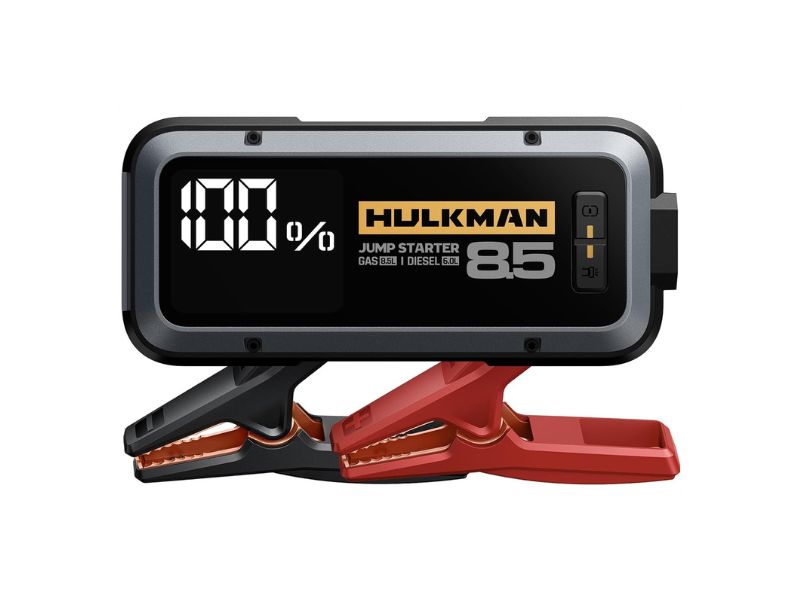
Key Features
- 2000A peak current
- 20,000mAh internal battery
- 74Wh lithium-polymer battery pack
- Up to 8.5L gasoline engines
- Up to 6.0L diesel engines
- 3.3-inch information display
- Force Start function
- USB-A charging output
- USB-C input/output
- 12V DC accessory output
- Up to 150W DC output
- Fast recharge support
- Multiple flashlight modes
- Approximately 9.6 x 4.1 x 1.8-inch main unit
The HULKMAN Alpha85 is bigger than the smallest pocket-style boosters, but its slim rectangular construction still qualifies as highly portable while delivering considerably more engine capacity than entry-level models.
Its peak output is rated at 2000 amps, with support for gasoline engines up to 8.5L and diesel engines up to 6.0L.
That makes it much more appropriate than a 500A compact booster for someone driving a V8 pickup, full-size SUV, larger van, diesel vehicle, tractor, or recreational equipment.
The internal battery is rated at 20,000mAh or 74Wh, giving it substantially more stored energy than many minimalist boosters.
That additional battery capacity supports more than just starting.
The Alpha85 can operate as a USB power bank through USB-A and USB-C ports and can provide 12V DC output for compatible automotive accessories.
One feature I particularly like is the 3.3-inch display.
Many compact boosters rely on four tiny battery-level LEDs. That system works, but it only provides a rough estimate of charge.
HULKMAN’s screen gives you a clearer indication of battery percentage, operating status, and error information. During an emergency, knowing whether the pack is at 85 percent rather than simply seeing three illuminated dots is useful.
The display also guides the user through connection status.
When the battery is connected correctly and conditions are appropriate, the unit indicates that it is ready to start.
For very low-voltage batteries, the Alpha85 includes a Force Start function.
This is useful when the vehicle battery has fallen below the voltage required for automatic detection.
However, Force Start must be treated differently from normal operation. When manual force output is activated, some automatic safety detection is disabled. You therefore need to verify polarity before using it.
Charging speed is another advantage.
With compatible charging hardware, the unit can recover enough internal charge for emergency use relatively quickly. That is useful when you discover shortly before leaving home that the booster itself is nearly empty.
At around 2.6 pounds for the main unit, Alpha85 is heavier than ultra-mini jump starters but still far easier to carry than an old lead-acid jump box.
What I Like
Its 8.5L gasoline and 6.0L diesel ratings make it suitable for significantly larger vehicles.
The 20,000mAh internal battery provides useful reserve.
The large display is easier to interpret than basic status LEDs.
USB-C, USB-A, and DC outputs make it an excellent multipurpose power pack.
The thin design remains easy to store despite its additional capacity.
What I Do Not Like
It is larger and heavier than minimalist compact boosters.
Owners of small four-cylinder cars probably do not need 2000A capability.
Force Start intentionally bypasses some safety detection and therefore requires careful use.
Verdict
Choose the HULKMAN Alpha85 if you want a small portable booster with enough reserve for larger gasoline and diesel engines without moving to a bulky traditional jump box.
3. NOCO Boost GB20 500A UltraSafe Jump Starter – Best for Small Cars

Key Features
- 500A peak starting output
- 12V lithium-ion jump starter
- Gasoline engines up to 4.0L
- Designed for lead-acid batteries
- Up to 20 starts per charge under suitable conditions
- Spark-proof protection
- Reverse-polarity protection
- 24Wh internal battery
- USB power output
- 100-lumen LED flashlight
- IP65 enclosure rating
- Approximately 7.7 x 3.2 x 1.7 inches
- Approximately 2.1 pounds including clamps and accessories
The NOCO Boost GB20 deserves a place in this guide because small-car owners frequently buy more jump starter than they actually need.
A compact sedan with a 1.8L or 2.0L gasoline engine does not require the same booster as a 6.7L diesel pickup.
The GB20 is rated at 500 amps and supports gasoline engines up to 4.0L.
That makes it ideal for small and midsize gasoline cars, motorcycles, ATVs, lawn tractors, recreational equipment, and similar 12V applications.
It is not recommended for diesel engines.
That limitation needs to be understood before purchase.
For the appropriate gasoline vehicle, however, reducing maximum output allows you to keep the overall booster straightforward and compact.
The GB20 measures only about 7.7 inches long, 3.2 inches high, and 1.7 inches deep.
That means it can fit into storage areas where large 20,000mAh packs would be inconvenient.
Its 24Wh internal lithium-ion battery can also provide USB power for portable electronics.
Like the GB40, the GB20 uses NOCO’s UltraSafe connection system with spark-proof and reverse-polarity protection.
That safety design is particularly valuable on motorcycles and compact cars where battery access may be tight and clamps can be awkward to position.
The integrated 100-lumen flashlight adds practical emergency value.
Changing a tire, checking a fuse, inspecting an engine bay, or simply making your vehicle more visible after dark becomes easier when the light source is already part of the booster.
Its enclosure carries an IP65 rating with the ports closed.
For something intended to spend years inside a vehicle and occasionally be used in poor weather, environmental protection is valuable.
One concern is power margin.
Although 500A is entirely appropriate for smaller gasoline engines, cold temperatures increase starter demand while simultaneously reducing battery output.
If you drive a larger V6, V8, or live where severe winter temperatures are common, I would choose the GB40 or a higher-output booster rather than operating close to the GB20’s limits.
What I Like
Extremely practical for four-cylinder and smaller gasoline vehicles.
Compact dimensions make storage easy.
500A output prevents you from paying for unnecessary capacity.
Spark-proof and reverse-polarity protections are excellent for occasional users.
It doubles as a USB power source and emergency flashlight.
What I Do Not Like
Not recommended for diesel engines.
Maximum 4.0L gasoline rating limits larger vehicle compatibility.
Cold-weather users with larger engines should choose a stronger model.
Verdict
The NOCO GB20 is one of the best choices for a small gasoline car, motorcycle, ATV, or lawn-equipment owner who prioritizes compact storage over maximum output.
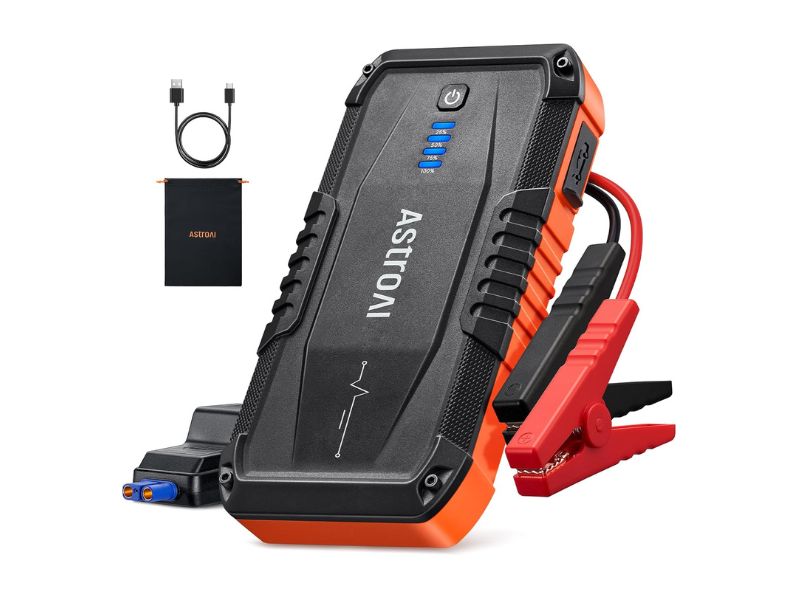
4. AstroAI S8 1500A Car Battery Jump Starter – Best Lightweight Value
Key Features
- 1500A peak current
- 12V jump-starting system
- Up to 6.0L gasoline engines
- Up to 3.0L diesel engines
- Approximately 10,000mAh battery capacity
- Smart boost function
- USB power-bank functionality
- Three-mode LED flashlight
- Multiple electrical safety protections
- Compact lightweight construction
- Storage bag included
- USB-C charging connection
The AstroAI S8 is a particularly compelling small battery booster for buyers who want good engine capacity without carrying a large premium power pack.
Its 1500A peak rating supports gasoline engines up to 6.0L and diesel engines up to 3.0L.
That places it in approximately the same everyday-vehicle compatibility range as the NOCO GB40 while providing a higher advertised peak-current specification.
Peak current should not be treated as the only measure of quality.
Manufacturers can measure and advertise maximum output differently, and actual jump-start performance depends on internal battery chemistry, state of charge, temperature, cable resistance, clamp contact, vehicle-battery condition, and starter demand.
Still, the S8 provides an attractive capability-to-size ratio.
Its internal capacity is approximately 10,000mAh, enough to support both jump-starting and emergency USB charging.
This is useful because a booster may spend years without being needed to start your own vehicle.
Using it to keep a phone powered during an outage, camping trip, or roadside delay gives the device more everyday value.
The S8 also incorporates a smart boost mode.
Normal smart clamps attempt to detect a connected battery before supplying current. When a vehicle battery becomes deeply discharged, its voltage can fall below the detection threshold.
Boost mode can help initiate starting under those conditions.
As with every manual or forced-boost function, you need to confirm that the clamps are connected correctly before activating it.
The included LED light provides standard illumination plus emergency flashing modes.
That may sound like a small extra, but a dead battery after sunset quickly makes engine-bay lighting important.
AstroAI’s multiple protection circuits are also valuable. A modern jump starter should provide safeguards for conditions such as reverse connection, short circuits, excessive current, high or low temperatures, and other electrical faults.
The S8’s greatest advantage is value.
It delivers useful automotive capability while remaining small enough for a glove-box-size emergency kit or compact trunk organizer.
What I Like
Strong output relative to its physical size.
Appropriate for many six-cylinder and smaller V8 gasoline applications.
Diesel support up to 3.0L adds versatility.
Compact size and low weight make it convenient to store.
USB charging, LED lighting, and smart boost increase emergency usefulness.
What I Do Not Like
A 3.0L diesel limit excludes full-size diesel pickups.
It does not provide the large display or extensive DC-output features of the HULKMAN Alpha85.
The internal battery should be checked regularly because any lithium booster becomes useless if allowed to discharge completely in storage.
Verdict
The AstroAI S8 is my preferred compact value booster for someone who wants useful starting power, low storage bulk, and basic emergency features without carrying a large power pack.
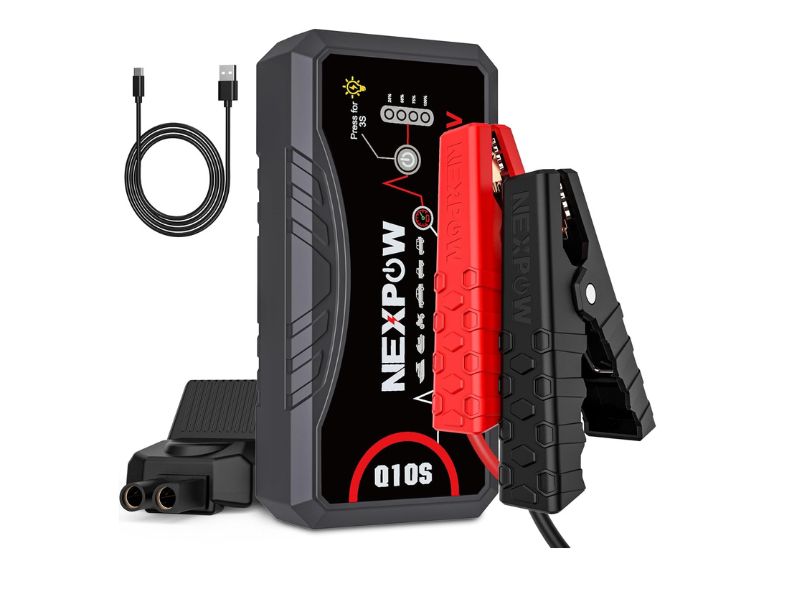
5. NEXPOW Q10S 3000A Portable Car Jump Starter – Best Slim Budget Pick
Key Features
- Current-generation listing rated up to 3000A peak
- 12V vehicle jump-starting
- Approximately 12,800mAh internal battery
- Slim body around 6.3 x 3.15 x 1.57 inches
- USB charging outputs
- Quick-charge capability
- Emergency LED flashlight
- Reverse-polarity protection
- Spark protection
- Overcurrent and temperature protections
- Portable lithium battery construction
- Compact storage profile
The NEXPOW Q10S finishes my five recommendations because it concentrates substantial advertised output into an unusually slim package.
The current version of this long-running model line is rated up to 3000A peak, while the main unit measures only about 6.3 inches long and 3.15 inches wide.
That footprint makes it particularly easy to keep inside a door compartment, emergency bag, trunk organizer, or under-seat storage area.
The internal battery capacity is around 12,800mAh, giving it enough energy to double as a portable USB power bank.
The ability to charge a phone is especially useful during roadside emergencies. Calling roadside assistance, checking maps, contacting family members, or using your phone as an emergency light can quickly consume battery power.
NEXPOW also includes an emergency LED light with multiple modes.
The smart jumper-cable system incorporates protections intended to reduce problems caused by incorrect polarity, excessive current, high temperatures, and other electrical faults.
The Q10S is particularly appealing for drivers who want to maximize output per cubic inch of storage space.
However, I would avoid comparing its 3000A advertised rating directly with the 1000A GB40 and concluding that it is automatically three times stronger.
Peak output ratings are not standardized enough across every manufacturer to support that assumption.
Instead, consider the Q10S a compact high-output option with a long buyer history and useful emergency features.
The main tradeoff with budget-focused compact starters is that premium models sometimes provide heavier housings, more refined clamps, stronger environmental protection, clearer documentation, or more sophisticated battery-management electronics.
If the booster will spend most of its life waiting in an emergency kit, protecting it from extreme heat and checking its charge periodically becomes especially important.
What I Like
Slim dimensions are excellent for small storage areas.
Strong advertised peak output provides useful starting reserve.
The internal battery can charge portable electronics.
Safety protections reduce risk during normal jump-starting.
Its established ownership history adds confidence compared with unknown ultra-cheap boosters.
What I Do Not Like
Peak-current claims should not be compared directly across brands.
The enclosure and overall presentation feel more value-oriented than premium competitors.
Vehicle storage temperatures can be hard on lithium batteries, so periodic inspection and charging remain essential.
Verdict
The NEXPOW Q10S is a strong slim budget battery booster for drivers who want maximum portability and useful emergency power without carrying a bulky jump box.
Small Battery Booster Comparison
| Product | Peak Output | Gas Engine Rating | Diesel Rating | Main Battery Capacity | USB Power | Main Strength |
| NOCO Boost GB40 | 1000A | Up to 6.0L | Up to 3.0L | Lithium-ion pack | Yes | Best overall balance |
| HULKMAN Alpha85 | 2000A | Up to 8.5L | Up to 6.0L | 20,000mAh / 74Wh | Yes | Larger-engine capability |
| NOCO Boost GB20 | 500A | Up to 4.0L | Not recommended | 24Wh | Yes | Small gasoline vehicles |
| AstroAI S8 | 1500A | Up to 6.0L | Up to 3.0L | Approx. 10,000mAh | Yes | Compact value |
| NEXPOW Q10S | Up to 3000A | Large 12V applications | Model-dependent | Approx. 12,800mAh | Yes | Slim high-output design |
The NOCO GB40 provides the strongest overall balance for a normal passenger vehicle. It is compact enough to keep in the car permanently while providing enough starting capacity for most gasoline cars and many smaller diesel vehicles.
The HULKMAN Alpha85 is the better choice for large-engine owners. Its 20,000mAh battery, 2000A rating, large display, and USB-C/DC power functions make it closer to a compact emergency power station.
The NOCO GB20 makes the most sense for smaller gasoline vehicles where minimizing size matters more than supporting large engines.
Choose the AstroAI S8 when value and low weight are priorities, while the NEXPOW Q10S is particularly attractive when you need an exceptionally slim pack.
What Is a Small Battery Booster?
A small battery booster is a portable rechargeable power pack designed to supply enough current to start a vehicle when its 12V battery is too weak to crank the engine.
Most modern compact boosters use lithium-ion or lithium-polymer batteries.
These batteries can store substantial energy in a much smaller package than traditional lead-acid jump boxes.
A typical compact booster includes the main lithium battery pack, short jumper cables with intelligent clamps, charging cable, USB output, and an emergency light.
The jumper cables connect directly to the vehicle battery or approved jump-start terminals.
Once the clamps confirm a safe connection, the booster supplies current to help the starter motor crank the engine.
Small Battery Booster vs Jumper Cables
Traditional jumper cables depend on a second vehicle.
That creates several disadvantages.
You need another driver.
Both vehicles must be positioned close enough for the cables to reach.
Incorrect connections can create sparks.
Poor-quality cables may have excessive resistance.
The donor vehicle’s electrical system becomes involved in the procedure.
A compact battery booster is self-contained.
You do not need another car, making it especially useful in an empty parking lot, garage, trailhead, campsite, or driveway.
Jumper cables still have one advantage: they do not contain a battery that gradually loses charge during storage.
For maximum preparedness, carrying both is reasonable.
Small Battery Booster vs Battery Charger
A battery booster and a battery charger solve different problems.
A battery booster provides a short burst of high current to help start the engine.
It does not necessarily restore the vehicle battery to full state of charge.
A battery charger uses AC electricity to slowly replace the energy stored inside the battery.
If you have several hours available and the vehicle is at home, properly charging the battery is better than repeatedly jump-starting it.
If you are stranded and simply need the engine running, a portable booster is much more useful.
How Many Amps Should a Small Battery Booster Have?
The answer depends on engine size, fuel type, weather, and battery condition.
For small gasoline vehicles, 500A to 1000A from a reputable booster can be sufficient.
For midsize and larger gasoline engines, 1000A to 2000A provides more reserve.
Large diesel engines typically require considerably more capability.
However, advertised peak amperage should not be the only factor in your decision.
A quality 1000A booster with excellent battery cells, cables, clamps, and internal electronics may outperform an inexpensive product carrying a dramatically larger marketing number.
Always consider the manufacturer’s engine-displacement rating alongside peak current.
Gasoline vs Diesel Engine Requirements
Diesel engines usually need more starting energy.
Their high compression ratios require the starter motor to work harder, particularly in cold conditions.
This explains why the NOCO GB40 can support gasoline engines up to 6.0L but diesel engines only up to 3.0L.
Likewise, HULKMAN Alpha85 supports a larger 8.5L gasoline engine but is rated for diesel engines up to 6.0L.
If you drive a diesel pickup, pay particular attention to the diesel rating rather than the gasoline specification.
What Size Booster Is Best for a Four-Cylinder Car?
A compact 500A to 1000A booster from a reputable manufacturer is usually a sensible starting point for a normal four-cylinder gasoline vehicle.
The NOCO GB20 is particularly well matched to small gasoline engines.
GB40 adds more reserve and is the better choice if you may use the booster on several different vehicles.
More capacity can also help during extremely cold weather.
What Size Booster Is Best for a V6?
For a V6 gasoline engine, I generally prefer at least a quality 1000A-class booster with explicit support for the engine displacement.
NOCO GB40 and AstroAI S8 are both well suited to many typical V6 applications.
Check the actual displacement rather than relying only on cylinder count.
A 2.7L turbocharged V6 and a 4.0L V6 are different applications.
What Size Booster Is Best for a V8?
For larger V8 engines, additional reserve becomes worthwhile.
HULKMAN Alpha85 is particularly attractive because its 2000A rating supports gasoline engines up to 8.5L.
Some smaller V8 passenger vehicles remain comfortably within GB40’s 6.0L gasoline rating.
Always check engine displacement.
Best Small Booster for a Diesel
Diesel owners need to be more selective.
GB20 is not recommended for diesel engines.
GB40 and AstroAI S8 cover diesel engines up to approximately 3.0L.
HULKMAN Alpha85 supports diesel engines up to 6.0L, making it my strongest choice among these five for larger diesel applications.
Owners of diesel engines exceeding that rating should select a more powerful booster specifically designed for their engine.
Why Compact Size Matters
A jump starter provides no benefit if it is sitting on a shelf at home when your battery dies in a parking lot.
That is why size matters.
The ideal emergency booster should be small enough that you do not mind keeping it in the vehicle permanently.
Compact lithium models can fit:
Inside a glove box, under a seat, in a trunk organizer, beside a spare tire, in a motorcycle storage compartment, or inside a roadside emergency kit.
Large lead-acid boosters often end up being removed from the vehicle simply because they occupy too much space.
Battery Capacity vs Peak Amps
These specifications describe different things.
Peak amps describe the maximum short-duration current the booster can provide under specific conditions.
Battery capacity describes how much energy the internal battery stores.
A high-capacity battery can support more jump attempts and provide more power for phones or accessories.
However, large battery capacity does not automatically mean better starting performance.
The booster also needs cells capable of delivering very high current quickly.
Why Smart Clamps Matter
Smart clamps contain electronics designed to monitor the jump-start connection.
Common protections include:
- Reverse-polarity detection
- Short-circuit protection
- Overcurrent protection
- High-temperature protection
- Low-temperature protection
- Overvoltage protection
- Spark reduction
These features make modern lithium boosters considerably easier for inexperienced users than old-fashioned jump cables.
No safety feature eliminates the need to connect the booster correctly.
Always identify positive and negative terminals before starting.
What Is Reverse-Polarity Protection?
Reverse polarity occurs when the positive and negative clamps are connected to the wrong terminals.
With basic jumper cables, reversing polarity can generate sparks, damage electrical systems, or create a dangerous battery condition.
Smart boosters detect the error and prevent normal output.
An indicator or audible warning usually tells the user to correct the connection.
What Is Manual Override or Force Start?
Some extremely discharged batteries have such low voltage that the booster’s automatic clamps cannot recognize them.
Manual override allows the jump starter to provide current despite the low voltage.
This can be extremely useful.
It also requires caution.
Automatic polarity or battery-detection protections may be reduced or disabled during manual override.
Never activate force mode until you have confirmed that the red clamp is connected correctly to positive and the negative connection follows the vehicle and booster instructions.
How to Use a Small Battery Booster
First, make sure the booster has adequate charge.
Turn off unnecessary vehicle accessories such as lights, climate control, audio systems, and heated seats.
Locate the vehicle’s approved jump-start points.
Connect the positive clamp to the positive terminal or designated positive jump post.
Connect the negative clamp according to the vehicle and booster instructions.
Many vehicles recommend an approved chassis ground rather than direct battery-negative connection.
Wait for the booster’s ready indicator.
Attempt to start the engine.
Do not crank continuously.
If the engine does not start, stop and follow the booster’s recommended waiting period before another attempt.
Once the engine starts, disconnect the booster according to its instructions.
How Long Should You Crank the Engine?
Portable boosters are designed for short bursts of extremely high current.
Continuous cranking creates heat inside the booster, clamps, starter motor, battery, and cables.
A common approach is to attempt starting for only a few seconds and then allow the system time to recover.
Exact timing varies by model.
Follow the jump starter’s manual rather than repeatedly holding the ignition in the start position.
Can a Booster Start a Completely Dead Battery?
Sometimes.
“Completely dead” can describe several very different conditions.
A healthy battery that has been accidentally discharged may still respond well to a booster.
A battery with a shorted cell, broken internal connection, severe sulfation, frozen electrolyte, or physical damage may not.
Extremely low voltage may also require manual override.
If a vehicle repeatedly requires jump-starting, diagnose and fix the underlying battery or charging-system problem.
Can a Booster Damage Your Car?
A properly designed booster used according to the instructions should not normally damage a compatible 12V vehicle.
Problems become more likely when polarity is reversed, an incompatible voltage is used, the booster is damaged, manual override is activated incorrectly, or the user ignores vehicle-specific jump-start procedures.
Modern vehicles can have sensitive electronics and designated jump points.
Always follow the owner’s manual.
Can You Use a Booster on an AGM Battery?
Yes, most jump starters designed for 12V lead-acid automotive systems can assist vehicles using AGM starting batteries.
Jump-starting is different from charging.
A charger must use an appropriate AGM charging profile over a long charging cycle.
A booster only supplies a short burst of starting current.
Still, verify the booster’s battery compatibility and follow your vehicle instructions.
Can You Use a Booster on a Start-Stop Vehicle?
Many start-stop cars use AGM or EFB batteries and sophisticated battery-monitoring systems.
A portable booster can often be used, but the vehicle may specify dedicated jump-start terminals.
Connecting directly to the battery in the wrong location could bypass current-monitoring sensors.
Use the jump points identified in the owner’s manual.
Can You Use a Small Booster on a Motorcycle?
Yes, when the booster is designed for the motorcycle’s battery voltage and chemistry.
NOCO GB20 is especially attractive for motorcycles because it is compact and does not provide unnecessarily excessive engine capacity.
Many motorcycles provide limited battery access, so clamp size and shape also matter.
Can You Use a Booster on a Lawn Mower?
Many riding lawn mowers and garden tractors use 12V lead-acid batteries.
A compatible 12V booster can often start them.
Verify battery voltage first.
Some smaller equipment uses different electrical systems, and a vehicle jump starter should never be connected without confirming compatibility.
Can a Small Booster Charge Your Phone?
Most modern lithium boosters include USB power output.
This transforms the device into a portable power bank when it is not being used for vehicle starting.
HULKMAN Alpha85 provides particularly strong secondary power functionality because it includes USB-A, USB-C, and 12V DC output.
For emergency use, keep enough reserve inside the booster for jump-starting rather than completely draining it into a phone.
Should You Keep a Booster in the Glove Box?
You can store a compact booster inside a vehicle, but temperature matters.
Vehicle interiors can become extremely hot in summer, particularly when parked in direct sunlight.
Lithium batteries generally age faster when exposed to prolonged high temperatures.
Check the manufacturer’s storage-temperature limits and place the booster in a protected location.
A trunk compartment or insulated emergency bag may be preferable to a dashboard or area receiving direct sunlight.
How Often Should You Recharge a Battery Booster?
Check the battery level every few months.
Also check it before:
- Winter
- Long road trips
- Camping trips
- Hurricane or storm season
- Extended airport parking
- Remote travel
- Extremely cold weather
Lithium packs usually retain charge reasonably well, but no emergency battery should be ignored indefinitely.
A booster showing 100 percent when you purchase it may not still be full a year later.
What Temperature Is Too Cold for a Jump Starter?
Lithium batteries lose output as temperatures fall.
A booster that easily starts a vehicle at 70°F may provide less usable current at 0°F.
At the same time, the vehicle battery also becomes weaker and the engine becomes harder to crank.
This combination makes winter one of the most demanding conditions for jump starters.
Check your booster’s specified operating-temperature range.
If possible, keeping it warmer before use can improve performance in extreme cold.
What Temperature Is Too Hot?
High heat accelerates lithium-battery aging.
A closed vehicle sitting under summer sun can become dramatically hotter than the outside air.
Do not leave the booster exposed on a dashboard.
Inspect it periodically for swelling, unusual odor, case deformation, or charging abnormalities.
A swollen lithium battery should not be used.
How Long Does a Small Jump Starter Last?
A quality lithium booster can provide years of service, but lifespan depends heavily on storage temperature, charging habits, number of cycles, cell quality, and age.
Even an unused lithium battery gradually deteriorates.
Replace the booster if:
The housing swells, the internal battery no longer holds charge, charging becomes abnormal, starting output becomes unreliable, the clamps or cables are damaged, or the unit has experienced significant impact or water damage.
What Should Be in a Roadside Battery Kit?
A small booster becomes even more useful when paired with a basic emergency kit.
Useful items include:
A flashlight, reflective warning equipment, tire-pressure gauge, tire inflator, basic first-aid supplies, gloves, charging cables, tire-plug equipment where appropriate, simple hand tools, and your vehicle’s emergency instructions.
Do not bury the jump starter underneath luggage.
Emergency equipment should remain accessible when you actually need it.
Common Small Battery Booster Mistakes
Buying Only by Peak-Amps Number
A giant advertised number does not automatically indicate the best product.
Consider real engine ratings, safety circuitry, battery capacity, clamp design, dimensions, temperature range, and manufacturer support.
Buying Too Small for a Diesel
Diesel engines require substantial starting current.
Always check the diesel-displacement rating.
Never Checking the Charge
This is probably the most common ownership mistake.
A booster with an empty internal battery cannot help.
Leaving It in Extreme Heat
Repeated exposure to very high vehicle temperatures can accelerate lithium-cell deterioration.
Using Manual Override Without Checking Polarity
Manual override may reduce normal safety protections.
Double-check every connection before activating it.
Repeatedly Cranking a Failed Battery
If the engine refuses to start after several correct attempts, investigate the problem rather than continuously stressing the booster.
Assuming a Jump Start Fixes the Battery
A jump starter only helps get the engine running.
It does not magically restore a deteriorated vehicle battery.
Frequently Asked Questions
What is the best small battery booster?
The NOCO Boost GB40 is my strongest all-around choice for most passenger vehicles.
Its 1000A output supports gasoline engines up to 6.0L and diesel engines up to 3.0L while maintaining a compact package. Spark-proof and reverse-polarity protections also make it especially suitable for occasional users. Drivers with substantially larger engines should consider HULKMAN Alpha85, while owners of small gasoline cars may prefer the even smaller GB20.
What is the smallest battery booster for a car?
The smallest practical booster depends on how much engine capacity your vehicle requires.
Compact gasoline cars can often use lower-output packs such as the NOCO GB20. Choosing a tiny booster that operates near its maximum rating leaves less reserve for cold weather or an unusually weak battery, so size should always be balanced against engine displacement.
Is a 500 amp jump starter enough?
A quality 500A booster can be sufficient for smaller gasoline engines.
NOCO GB20 is rated for gasoline engines up to 4.0L. It is not recommended for diesel engines. Larger gasoline engines and cold-weather applications generally benefit from more starting reserve.
Is a 1000 amp battery booster enough for a car?
Yes, 1000A from a quality booster covers many common passenger cars and light vehicles.
NOCO GB40 supports gasoline engines up to 6.0L and diesel engines up to 3.0L. Actual starting performance also depends on temperature, engine condition, battery condition, and the booster’s state of charge.
Is a 2000 amp booster too powerful for a small car?
No, a properly designed 12V smart booster does not continuously force its maximum current into the vehicle.
The starter draws the current required within the limits of the available power source. A higher-rated unit simply provides additional reserve. Correct voltage and connection procedure matter more than owning “too many” peak amps.
Can a mini jump starter start an SUV?
Yes, if its engine rating covers the SUV’s actual engine displacement.
Many crossovers and SUVs use four-cylinder or V6 engines that fit comfortably within compact-booster ratings. Large V8 SUVs and diesels require more capacity. Check displacement rather than relying on the vehicle’s physical size.
What small booster is best for a truck?
HULKMAN Alpha85 is the strongest truck-oriented option among these five.
Its 2000A rating supports gasoline engines up to 8.5L and diesel engines up to 6.0L. Owners of diesel trucks with engines larger than 6.0L should choose an appropriately rated heavy-duty model.
Can I keep a battery booster in my car all year?
Yes, but protect the lithium battery from excessive heat and periodically check its charge.
A car is exactly where an emergency booster is most useful. However, vehicle interiors experience harsh temperatures. Follow the manufacturer’s storage limits and inspect the unit periodically.
How often should I charge my portable booster?
Check it every few months and before long trips or extreme-weather seasons.
Self-discharge varies between products, and hot storage can accelerate capacity loss. Do not assume that a booster charged last year is still ready today.
Does a booster charge the car battery?
A jump starter primarily provides cranking power rather than fully charging the vehicle battery.
After the engine starts, the vehicle charging system begins replenishing energy. A deeply discharged battery is better restored with a proper external battery charger rather than repeatedly relying on the alternator.
Can I use the booster while it is plugged in?
Only if the manufacturer’s instructions specifically permit that operation.
Most compact lithium jump starters are designed to be charged first and then disconnected from their charging source before jump-starting a vehicle. Do not improvise charging or power arrangements.
Why will my booster not detect the car battery?
The vehicle battery may be too deeply discharged for automatic voltage detection.
Poor clamp contact, corrosion, reversed polarity, damaged cables, or a failed battery can produce the same symptom. Some boosters provide a manual override or force-start function for very low voltage.
Is manual override safe?
It is useful but requires greater care because some automatic protection may be bypassed.
Verify the positive and negative connections before activating forced output. Never use override merely because normal jump-starting failed without first determining why.
Can a booster start a car with no battery?
Portable boosters are generally designed to assist a vehicle battery, not replace the battery completely.
Vehicle electrical systems can require the installed battery to stabilize voltage and supply current. Do not assume a jump pack can safely operate as a substitute for a missing or internally disconnected battery.
Why does my car need repeated jump starts?
Repeated discharge usually indicates a battery, charging-system, connection, or parasitic-drain problem.
Possible causes include an aging battery, alternator failure, lights or accessories remaining on, poor terminals, wiring problems, or electronics drawing excessive power while parked. Diagnose the cause rather than treating repeated jump starts as normal.
Final Verdict
The best small battery booster should be compact enough to remain inside your vehicle, powerful enough for your engine, and dependable enough that you can trust it after months of storage.
The NOCO Boost GB40 remains my primary recommendation. Its 1000A output, 6.0L gasoline and 3.0L diesel engine capability, UltraSafe connection system, USB charging, 100-lumen flashlight, and IP65-rated enclosure provide an excellent combination of portability and everyday automotive capability.
For larger engines, the HULKMAN Alpha85 is the better choice. Its 2000A output, 20,000mAh battery, 8.5L gasoline and 6.0L diesel ratings, large status display, USB-C connectivity, and 12V accessory output make it significantly more versatile for trucks and SUVs.
Drivers with smaller gasoline vehicles should consider the NOCO GB20. It reduces output to 500A and focuses on engines up to 4.0L, giving small-car and motorcycle owners a genuinely compact alternative without unnecessary capacity.
The AstroAI S8 provides an excellent balance of price, portability, and 1500A starting capability, while the NEXPOW Q10S is especially attractive when an ultra-slim storage profile is a priority.
For most passenger vehicles, I would buy the NOCO GB40 first. For a large truck or diesel, step up to the HULKMAN Alpha85. For a small four-cylinder gasoline car where minimizing storage space is the goal, the NOCO GB20 is the most focused choice.
Whichever booster you choose, check its charge every few months, protect it from extreme heat, and learn how to activate it before an emergency happens. A compact jump starter is most valuable when it is charged, accessible, correctly sized for your engine, and familiar enough to use confidently when the battery is dead.