Choosing the best truck booster pack requires more starting capability than buying a basic jump starter for a small passenger car. Full-size pickups, V8 gasoline engines, diesel trucks, dual-battery systems, and cold-weather starts can place much greater demands on a booster pack, so battery output, real engine compatibility, cable construction, and clamp quality all matter.
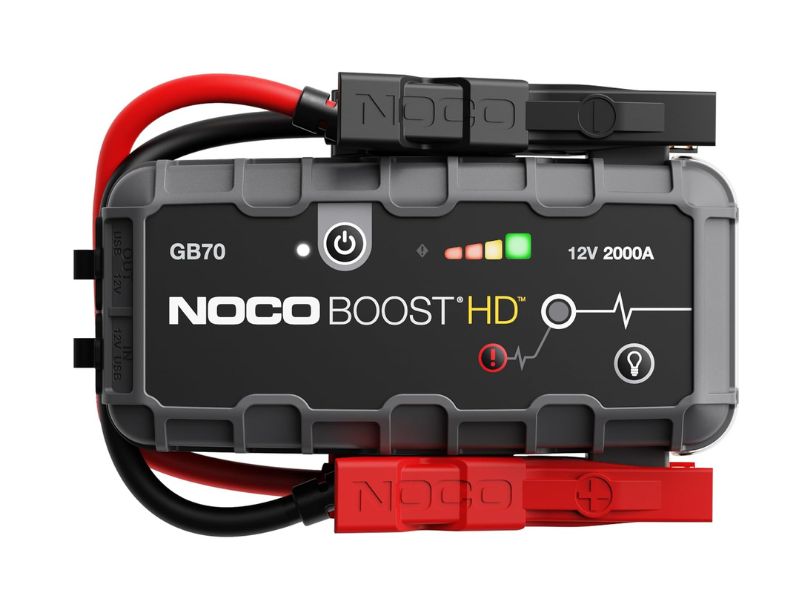
My primary recommendation is the NOCO Boost HD GB70 2000A Jump Starter. It combines a compact lithium design with enough starting capability for gasoline engines up to 8.0 liters and diesel engines up to 6.0 liters. It is rugged, water resistant, relatively easy to keep behind a truck seat, and includes excellent connection-safety features.
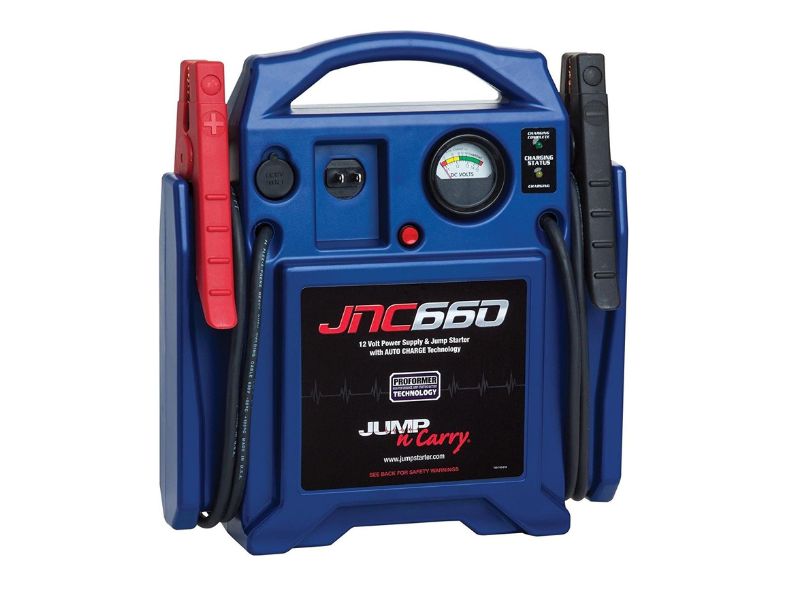
For drivers who prefer a traditional professional jump box, the Clore Automotive Jump-N-Carry JNC660 1700 Peak Amp Jump Starter is my second choice. Its dedicated AGM starting battery, 425 cranking amps, heavy #2 AWG cables, industrial clamps, and long-established professional use make it especially attractive for work trucks, farms, garages, and fleets.
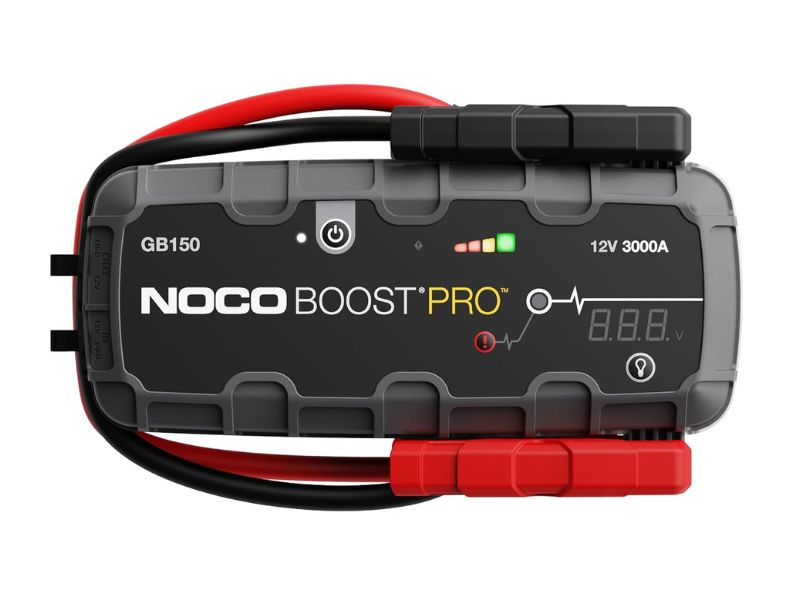
For larger diesel pickups or drivers wanting more lithium starting headroom, I recommend the NOCO Boost Pro GB150 3000A Jump Starter. It increases engine compatibility to gasoline engines up to 9.0 liters and diesels up to 7.0 liters while remaining much easier to carry than a traditional lead-acid jump box.
3 Best Truck Booster Pack Picks for Gas and Diesel Pickups
| Image | Product Name | Check Price |
|---|---|---|
Best Choice | NOCO Boost HD GB70 2000A Jump Starter – Best Overall | Check Price |
Second Best | Clore Automotive Jump-N-Carry JNC660 1700 Peak Amp Jump Starter | Check Price |
Third Choice | NOCO Boost Pro GB150 3000A Jump Starter | Check Price |
1. NOCO Boost HD GB70 2000A Jump Starter – Best Overall
Key Features
- 2,000A peak starting output
- Supports up to 8.0L gasoline engines
- Supports up to 6.0L diesel engines
- 12V lead-acid battery compatibility
- High-discharge lithium-ion internal battery
- Spark-proof connection system
- Reverse-polarity protection
- IP65-rated enclosure
- Built-in 400-lumen LED flashlight
- USB power-bank function
- 12V accessory output
- Compact truck-friendly construction
The NOCO Boost HD GB70 is my first choice because it provides one of the best combinations of truck-capable starting performance, portability, rugged construction, and proven real-world use.
A pickup-truck booster pack needs enough reserve to crank engines that can be substantially larger than those found in ordinary passenger cars. The GB70 is designed for gasoline engines up to 8.0 liters and diesel engines up to 6.0 liters, covering a broad range of half-ton and many diesel pickup applications.
Its 2,000A peak rating gives it much more starting headroom than small 500A or 1,000A emergency packs.
The real advantage, however, is not simply the amp number.
NOCO combines its lithium cells with relatively substantial clamps, short high-current leads, and electronics designed specifically for automotive starting. This creates a much more convincing truck package than a miniature generic jump starter that advertises an enormous peak number but provides tiny clamps and lightweight wiring.
Excellent Size for Permanent Truck Storage
The GB70 weighs only a few pounds and has a relatively compact rectangular housing.
That makes it practical to store:
- Behind a pickup seat
- In an under-seat storage compartment
- In a truck toolbox
- Inside an emergency tote
- In an RV storage compartment
This matters because emergency equipment only helps when it is actually in the vehicle.
Traditional lead-acid jump boxes can provide excellent performance, but their additional size and weight make them less appealing for drivers who want to carry the pack every day.
Good Match for Gasoline Trucks
For gasoline pickups, the GB70 offers plenty of compatibility.
Its 8.0L gasoline rating covers common:
- V6 pickups
- Turbocharged gasoline engines
- 5.0L V8 trucks
- 5.3L V8 trucks
- 5.7L V8 trucks
- 6.2L V8 applications
- Many older large-displacement gasoline engines
This makes it particularly versatile for a household with more than one vehicle.
You can keep it in a pickup while still using it for a sedan, SUV, ATV, motorcycle, boat, or lawn tractor when necessary.
Useful for Many Diesel Pickups
The 6.0L diesel rating also makes the GB70 considerably more relevant to truck owners than a normal car-oriented booster.
However, pay close attention to your actual engine displacement.
If you drive a 6.7L diesel, for example, the engine exceeds the GB70’s stated 6.0L diesel rating. In that situation I would step up to the larger GB150 or another booster specifically rated above your engine displacement.
Buying a little additional capacity is particularly sensible in cold climates.
Strong Connection Safety
Connecting a booster pack incorrectly can create dangerous sparks or electrical damage.
The GB70 incorporates reverse-polarity and spark-protection electronics to make the connection process more forgiving.
You should still visually verify positive and negative terminals every time.
Safety electronics should be treated as a backup—not an excuse to connect clamps carelessly.
Built for Outdoor Vehicle Use
The enclosure carries an IP65 rating with the appropriate ports closed, providing useful protection against dust and water exposure.
That does not mean you should submerge the booster or leave it permanently exposed in an open pickup bed.
It does mean the housing is better prepared for normal truck environments than a delicate consumer power bank.
The rubberized exterior also helps protect both the booster and nearby vehicle surfaces.
Built-In Emergency Light
The 400-lumen flashlight is genuinely useful on a truck booster pack.
A dead battery rarely occurs under ideal daylight conditions.
The light can help you:
- Find battery terminals
- Inspect cable connections
- Work beside the road
- Signal other motorists
- Illuminate the engine compartment
It also includes emergency lighting modes.
Power-Bank Capability
The internal battery can charge USB devices, allowing the GB70 to serve as emergency power for phones and other compatible electronics.
There is also 12V accessory functionality, increasing the pack’s usefulness during camping and roadside situations.
I would avoid heavily draining the booster for electronics when you are relying on it as your only emergency starting source.
What I Like
- Excellent truck-size engine compatibility
- Approximately 30K-plus current customer-rating history
- Compact compared with traditional jump boxes
- Strong 2,000A output
- Excellent for gasoline pickups
- Suitable for diesels up to 6.0L
- Spark-proof connection protection
- Reverse-polarity protection
- Rugged IP65 enclosure
- Built-in emergency flashlight
- USB and 12V power functions
- Easy to keep inside a truck permanently
What I Do Not Like
- Not officially sized for diesels above 6.0L
- More expensive than many generic lithium packs
- Short clamp cables can be restrictive on unusual battery layouts
- Older charging system is not as fast as newer high-wattage USB-C designs
Verdict
The NOCO Boost HD GB70 is the best truck booster pack for most gasoline pickups and diesel trucks up to its 6.0L rating. It has enough power for serious vehicle use without becoming so large that carrying it every day becomes inconvenient.
2. Clore Automotive Jump-N-Carry JNC660 1700 Peak Amp Jump Starter – Best Professional Jump Box
Key Features
- 1,700 peak amps
- 425 cranking amps
- 12V operation
- Dedicated Clore PROFORMER AGM battery
- 46-inch jumper cable leads
- Heavy-duty #2 AWG cables
- Industrial-grade clamps
- Built-in automatic charger
- Voltmeter for internal battery status
- 12V DC accessory outlet
- Approximately 18-pound construction
The Jump-N-Carry JNC660 demonstrates why advertised peak amps should never be the only specification you use when buying a truck booster.
On paper, its 1,700 peak amps look lower than the 2,000A GB70 and dramatically lower than some inexpensive products advertising 4,000A, 5,000A, or more.
But the JNC660 provides something many lightweight lithium packs do not clearly publish: 425 cranking amps.
Cranking amps are particularly meaningful when you need sustained current to turn over a stubborn truck engine rather than producing one impressive momentary peak.
Designed Around Repeated Vehicle Starting
The JNC660 uses a dedicated PROFORMER AGM battery engineered specifically around jump-starting demands.
That makes it particularly useful for:
- Automotive repair shops
- Fleet yards
- Farms
- Towing operations
- Used-car lots
- Work-truck owners
- Multiple-vehicle households
Where a compact lithium booster emphasizes storage convenience, the JNC660 prioritizes repeated cranking ability.
For someone who jump-starts vehicles several times a month rather than once every two years, that difference matters.
#2 AWG Jumper Leads
One of the strongest features is the #2 AWG cable construction.
Heavy-gauge wire reduces electrical resistance and allows more usable current to reach the truck.
The cables are approximately 46 inches long, providing better reach than many compact lithium boosters whose short clamps require the entire pack to sit immediately beside the battery.
This can be helpful on pickups where:
- Batteries sit deep inside the engine compartment
- Plastic covers limit access
- Dual batteries are installed
- Remote jump points are used
- The booster needs to sit safely away from belts and fans
Industrial-Grade Clamps
A booster is only as effective as the electrical connection it makes.
The JNC660 uses substantial clamps designed to maintain strong contact with battery terminals.
Cheap clamps can introduce significant resistance, particularly when:
- Battery posts are dirty
- Terminals are partially corroded
- The available contact area is small
- High current is required
Heavy clamps and large cables are a major reason traditional professional jump boxes remain relevant even as lithium technology has become popular.
Better for Frequent Garage Use
At approximately 18 pounds, the JNC660 is clearly heavier than the GB70.
That weight is a disadvantage for casual travel but less important when the booster lives:
- In a shop
- In a truck toolbox
- In a work van
- At a farm
- In a garage
- In a fleet service vehicle
The integrated handle makes it reasonably easy to move short distances.
Built-In Charging
The charger is incorporated into the unit, reducing the chance of losing a proprietary charging brick.
Automatic charging also makes it practical to keep the JNC660 topped up and ready.
A booster pack should be checked periodically regardless of design.
Discovering that your emergency starter is discharged only after the truck battery has died defeats the purpose of carrying it.
Best Choice for Repeated Starts
If you run a fleet, own several work vehicles, or regularly help customers and neighbors with dead batteries, I prefer the JNC660 over small consumer lithium packs.
Its design is purpose-built around sustained vehicle starting.
The compromise is obvious: size and weight.
What I Like
- Roughly 19K-plus current customer-rating history
- Proven professional-style construction
- 425 cranking amps
- 1,700 peak amps
- Heavy #2 AWG cables
- 46-inch cable reach
- Industrial clamps
- Excellent for frequent jump starting
- Built-in automatic charging system
- Dedicated AGM booster battery
- 12V accessory outlet
What I Do Not Like
- Approximately 18 pounds
- Large compared with lithium boosters
- Requires more deliberate charging maintenance
- Less convenient for compact under-seat storage
- No USB-focused modern power-bank features
Verdict
The Jump-N-Carry JNC660 is the best choice for work trucks, garages, farms, fleets, and buyers who care more about repeated professional-grade cranking capability than minimum size.
3. NOCO Boost Pro GB150 3000A Jump Starter – Best for Large Diesel Trucks
Key Features
- 3,000A peak starting current
- Supports gasoline engines up to 9.0L
- Supports diesel engines up to 7.0L
- 88Wh lithium-ion internal battery
- Spark-proof connection technology
- Reverse-polarity protection
- IP65-rated housing with ports closed
- 500-lumen LED flashlight
- USB power-bank capability
- 12V accessory output
- Heavy-duty portable construction
The GB150 takes the basic strengths of the GB70 and adds a significant amount of starting capacity.
Its 3,000A output, 9.0L gasoline rating, and 7.0L diesel rating make it particularly attractive to drivers with larger pickups.
This is the model I would choose over the GB70 for common 6.7L diesel applications because the GB150’s stated diesel range reaches 7.0 liters.
Better Headroom for Diesel Engines
Diesel engines generally require substantially more cranking effort than gasoline engines of similar displacement.
Their higher compression ratios place greater demand on:
- Starter motors
- Vehicle batteries
- Booster packs
- Battery cables
- Electrical connections
Cold weather makes the situation more difficult.
A booster that works comfortably on a warm 5.0L gasoline V8 may struggle with a large diesel after the truck has sat outside overnight in freezing temperatures.
The additional capacity of the GB150 provides useful headroom.
Good Choice for 6.7L-Class Pickups
A large portion of the diesel pickup market uses engines around:
- 6.6L
- 6.7L
- Other similar heavy-duty displacements
The GB150’s 7.0L diesel rating makes it substantially better suited to these trucks than a booster limited to 5.0L or 6.0L diesel.
Always verify the exact starting procedure for your truck, especially when it uses two batteries.
Dual-Battery Diesel Trucks
Many diesel pickups use two 12V batteries connected in parallel.
This does not automatically mean the truck is a 24V system.
Two 12V batteries connected in parallel still supply approximately 12 volts while providing greater available cranking current.
However, connection points and approved jump procedures vary.
Follow the vehicle manufacturer’s instructions instead of guessing which battery or terminal should receive the booster clamps.
88Wh Internal Battery
The GB150’s larger internal lithium battery provides substantially more stored energy than smaller compact boosters.
That can translate into:
- More starting attempts
- Better reserve for difficult engines
- More accessory power
- Greater confidence on large vehicles
NOCO rates the unit for numerous jump starts per charge under appropriate conditions.
Real-world results will vary significantly with engine size, temperature, battery condition, and how long each crank attempt lasts.
500-Lumen Flashlight
The stronger built-in flashlight is useful around full-size trucks because large engine compartments can be difficult to illuminate with a phone flashlight.
Emergency modes also provide roadside visibility.
Rugged Enclosure
Like the GB70, the GB150 uses a tough enclosure with useful dust and water resistance when properly closed.
For contractors, farmers, campers, and truck owners, that construction is more useful than a glossy plastic casing intended primarily for indoor storage.
Portability Compared With Traditional Packs
The GB150 weighs noticeably more than the GB70, but it is still relatively easy to carry compared with an 18- to 30-pound traditional booster.
That makes it an appealing compromise for truck owners who want serious diesel capability but do not want to dedicate substantial cargo space to a lead-acid jump box.
What I Like
- Approximately 13K current customer-rating history
- Strong 3,000A peak output
- Supports gasoline engines up to 9.0L
- Supports diesel engines up to 7.0L
- Good choice for large pickup diesels
- Large 88Wh internal battery
- Spark-proof connections
- Reverse-polarity protection
- Rugged IP65 housing
- Powerful 500-lumen flashlight
- Portable relative to professional jump boxes
What I Do Not Like
- Significantly more expensive than smaller boosters
- Larger and heavier than the GB70
- Still 12V only
- More power than most gasoline-truck owners actually need
- Older charging interface is less convenient than newer high-power USB-C designs
Verdict
The NOCO Boost Pro GB150 is my preferred lithium booster for larger diesel pickups and truck owners who need more starting headroom than the GB70 provides.
Truck Booster Pack Comparison
| Product | Peak Output | Cranking Rating | Gas Engine Rating | Diesel Engine Rating | Battery Type | Weight Class | Best For |
| NOCO Boost HD GB70 | 2,000A | — | Up to 8.0L | Up to 6.0L | Lithium-ion | Lightweight | Best overall |
| Clore Jump-N-Carry JNC660 | 1,700A | 425A | Application dependent | Application dependent | AGM lead-acid | Heavy | Professional/repeated use |
| NOCO Boost Pro GB150 | 3,000A | — | Up to 9.0L | Up to 7.0L | Lithium-ion | Medium | Large diesel pickups |
Quick Comparison Summary
The NOCO Boost HD GB70 is the best overall choice for most truck owners because it provides substantial starting capability without taking up much cargo space.
The Clore Jump-N-Carry JNC660 is the stronger option when repeated vehicle starting, thick cables, industrial clamps, and professional-style construction matter more than portability.
The NOCO Boost Pro GB150 is the most appropriate of these three for larger diesel pickups, particularly when your engine exceeds the GB70’s 6.0L diesel rating.
How I Chose the Best Truck Booster Packs
Truck jump starting can place much greater demand on a booster than restarting a small sedan.
I therefore prioritized:
- Large-engine compatibility
- Diesel engine rating
- Starting-current capability
- Cranking performance
- Cable gauge
- Clamp construction
- Battery capacity
- Cold-weather suitability
- Electrical safety
- Portability
- Ruggedness
- Charging convenience
- Established owner feedback
I also intentionally included both lithium booster packs and a traditional AGM jump box.
The two technologies solve slightly different problems.
Lithium vs. Lead-Acid Truck Booster Packs
Lithium Booster Packs
Lithium units such as the GB70 and GB150 are excellent for personal trucks.
Their advantages include:
- Low weight
- Compact construction
- High peak output
- Long storage convenience
- USB power
- Built-in lights
- Easy transportation
They are ideal when the booster spends most of its life stored in the truck and is only needed occasionally.
Lead-Acid Jump Boxes
Traditional jump boxes such as the JNC660 are much larger.
Their advantages include:
- Strong sustained cranking
- Heavy cables
- Larger clamps
- Proven professional use
- Repeated jump capability
- Straightforward operation
They make particular sense in:
- Repair shops
- Fleets
- Farms
- Dealerships
- Service trucks
For ordinary personal use, lithium generally wins on convenience.
For repeated professional use, I would strongly consider a dedicated jump box.
How Many Amps Does a Truck Booster Pack Need?
There is no single number that applies to every pickup.
A smaller gasoline truck may start easily with a quality 1,000A-class booster.
A large diesel may require considerably more reserve.
Do not select solely from the peak-amp figure.
Look at the manufacturer’s engine-displacement rating.
For example, a booster explicitly rated for a 7.0L diesel provides more useful guidance to a 6.7L diesel owner than a generic product simply claiming “5,000 peak amps.”
What Size Booster Pack for a V6 Truck?
Most gasoline V6 pickups do not require an enormous booster.
A quality lithium starter rated for engines comfortably above the truck’s displacement should provide sufficient headroom.
The GB70 is more than capable on paper for typical V6 gasoline applications.
That additional reserve can help when:
- The temperature is low
- The battery is deeply discharged
- The truck has been sitting for weeks
- Electrical connections are less than perfect
What Size Booster Pack for a V8 Truck?
A full-size V8 gasoline truck deserves more starting capacity than a small car.
The GB70’s 8.0L gasoline rating covers most common pickup V8s.
Examples include many engines around:
- 5.0L
- 5.3L
- 5.7L
- 6.2L
For extremely large gasoline engines or commercial applications, stepping up to the GB150 provides more reserve.
Best Booster Pack for a 5.9L Diesel
A booster rated for at least a 6.0L diesel is the minimum range I would consider.
The GB70 fits that requirement closely.
However, if you regularly face below-freezing conditions or a marginal truck battery, additional capacity from a larger booster is attractive.
A traditional professional jump box can also perform very well because of its sustained cranking ability.
Best Booster Pack for a 6.7L Diesel
A 6.7L diesel exceeds the GB70’s 6.0L diesel specification.
I would therefore choose the GB150 among these products.
Its 7.0L diesel rating provides appropriate manufacturer-stated compatibility.
This is exactly why engine-rating specifications matter.
A product can be an excellent jump starter while still being undersized for a particular engine.
What About 6.6L Diesel Trucks?
The same principle applies.
A 6.6L diesel sits above a 6.0L booster rating.
The GB150’s 7.0L diesel compatibility makes it the more appropriate choice.
When dealing with large diesel pickups, I prefer some reserve instead of selecting a product that sits exactly at the engine’s required limit.
Can a Truck Booster Pack Start Dual Batteries?
Many diesel pickups use two 12V batteries.
A sufficiently capable 12V booster can often be used according to the vehicle manufacturer’s specified procedure.
However, do not improvise.
Dual batteries can be wired differently depending on the vehicle and application.
Consult the owner’s manual for:
- Approved connection point
- Positive terminal
- Ground location
- Battery isolation requirements
- Recommended start procedure
12V vs. 24V Trucks
This distinction is critical.
Most passenger pickups sold for personal use operate on 12V electrical systems.
Heavy commercial trucks and specialized equipment may use 24V systems.
The three booster packs reviewed here are intended for appropriate 12V applications.
Never connect a 12V-only booster to a 24V system unless the manufacturer explicitly says the product supports that voltage.
For commercial 24V equipment, choose a dedicated 12V/24V professional booster.
Peak Amps vs. Cranking Amps
Peak amps are widely advertised because the number looks impressive.
However, peak output represents a short-duration maximum rather than sustained starter performance.
Cranking amps indicate current delivery over a defined period and can be useful when comparing professional starting equipment.
This is why the JNC660’s 425 cranking amps deserve attention even though its advertised 1,700 peak amps look modest compared with some lithium competitors.
A truck starter needs usable current long enough to turn the engine—not simply a huge instantaneous number.
Why Cable Quality Matters
The booster battery does not directly touch the vehicle starter.
Current must travel through:
- Internal conductors
- Jumper leads
- Clamps
- Battery terminals
- Vehicle wiring
Resistance anywhere in this path reduces the voltage available to the starter.
Heavy cables are especially important on large trucks because starter demand can be substantial.
The JNC660’s #2 AWG leads are one reason it remains attractive for professional work.
Clamp Quality Matters Too
A weak clamp can make an otherwise powerful booster perform poorly.
Good truck-booster clamps should provide:
- Strong spring pressure
- Large conductive contact surfaces
- Insulated handles
- Secure cable attachment
- Easy polarity identification
Corroded truck battery terminals should be cleaned and repaired rather than relying on a booster to overcome a poor permanent electrical connection.
Best Truck Booster Pack for Cold Weather
Cold weather creates one of the hardest starting situations.
At low temperature:
- Engine oil becomes more viscous
- Chemical activity inside the truck battery slows
- Available battery output drops
- Starter load increases
This is why I recommend additional starting capacity for winter use.
For gasoline pickups, the GB70 provides useful headroom.
For large diesels, I prefer the GB150 or a professional unit such as the JNC660.
Keep lithium boosters within their specified storage and operating temperature limits.
Portable Booster Pack vs. Jumper Cables
Jumper cables remain useful, but they require another functioning vehicle.
A booster pack is completely independent.
That matters when the truck is:
- Parked alone at a job site
- On a remote trail
- At a campsite
- On a farm
- In an empty parking lot
- Parked at home when no second vehicle is available
For this reason, I consider a booster pack one of the most useful pieces of emergency equipment to carry in a pickup.
Booster Pack vs. Battery Charger
A booster pack and battery charger perform different jobs.
A booster pack provides high current for a short period so the engine can start.
A battery charger slowly restores energy to the battery.
If you are at home and have several hours available, properly charging the battery is generally preferable.
If you are stranded beside the road, a booster pack is far more practical.
Truck owners who regularly deal with battery issues may benefit from owning both.
Important Battery Condition Warning
A booster pack is not intended to make a dangerous battery usable.
Do not attempt to jump-start a battery that is:
- Frozen
- Swollen
- Cracked
- Leaking
- Physically damaged
- Producing unusual odors
Replace or professionally inspect unsafe batteries.
How to Use a Truck Booster Pack Safely
Begin by reading the truck’s owner’s manual.
Modern pickups may provide dedicated jump terminals that differ from the actual battery posts.
Turn off unnecessary electrical loads.
Confirm that the booster is designed for the truck’s system voltage.
Connect the positive clamp to the approved positive point.
Connect the negative clamp according to the vehicle manufacturer’s instructions.
Confirm that the booster indicates a correct connection.
Attempt to start the truck.
Avoid repeatedly cranking for extended periods. Allow the booster and starter to cool according to their instructions.
After the engine starts, remove the pack according to the specified sequence.
What Is Manual Override or Force Start?
Some lithium boosters automatically look for battery voltage before energizing their clamps.
If the vehicle battery is extremely discharged, the booster may not detect it.
Certain products provide a manual override function.
This bypasses part of the automatic safety logic and should only be used when:
- You understand the connection
- Polarity has been positively confirmed
- The manufacturer specifically instructs you to use the mode
Never casually activate a manual override.
How Often Should You Recharge a Truck Booster Pack?
Do not throw a booster behind the seat and forget it for years.
Check the state of charge periodically.
A good routine is to check it:
- Every few months
- Before winter
- Before long road trips
- Before towing trips
- Before remote off-road travel
- After every jump start
- After using it as a power bank
Traditional AGM jump boxes may benefit from more frequent maintenance charging.
Where Should You Store a Booster Pack in a Truck?
An interior storage location is generally preferable.
Good locations include:
- Under a rear seat
- Behind a rear seat
- In an interior storage bin
- Inside a protected toolbox
- In an insulated emergency case
Avoid unnecessary exposure to:
- Extreme heat
- Standing water
- Direct sunlight
- Crushing loads
- Fuel or chemical spills
Always follow the battery manufacturer’s temperature recommendations.
Can You Keep a Lithium Booster in a Hot Truck?
Lithium battery packs tolerate a range of conditions, but repeated extreme heat can accelerate battery deterioration.
Truck interiors can become exceptionally hot during summer.
Do not store a lithium booster somewhere that exceeds the manufacturer’s specified storage limits.
Check the housing periodically.
Stop using a battery pack if you see:
- Swelling
- Cracking
- Deformation
- Leakage
- Unusual odors
- Excessive heat
What Else Should Be in a Truck Emergency Kit?
A booster pack becomes more useful as part of a complete roadside kit.
Consider carrying:
- Tire inflator
- Accurate tire-pressure gauge
- Flashlight
- Reflective vest
- Warning triangles
- Work gloves
- Basic hand tools
- Tow strap rated for the intended application
- First-aid kit
- Drinking water
- Phone charging cable
Truck owners traveling in remote areas may need additional recovery and survival equipment.
Common Truck Booster Pack Buying Mistakes
Buying Only by Peak Amps
A 6,000A sticker does not automatically mean better real-world cranking than a well-engineered 2,000A unit.
Consider engine compatibility, battery capacity, clamps, cables, and manufacturer reputation.
Ignoring Diesel Engine Size
A booster rated for 5.0L diesel should not be your first choice for a 6.7L diesel pickup.
Buying Too Small for Winter Use
Cold-weather starting requires more reserve.
Select additional capacity if your truck routinely sits outside in freezing temperatures.
Forgetting About System Voltage
Never assume every truck uses the same electrical system.
Not Checking the Booster Charge
The most powerful booster pack in the world is useless if its internal battery is empty.
Ignoring Cable Reach
Large engine compartments can create awkward battery access.
Check whether the clamps comfortably reach the approved terminals.
Frequently Asked Questions
What is the best truck booster pack?
The NOCO Boost HD GB70 is my best overall choice for most gasoline pickups and compatible diesel trucks.
It combines 2,000A starting capability, an 8.0L gasoline and 6.0L diesel rating, compact lithium construction, rugged housing, and excellent electrical protection. Drivers of larger diesels should consider the GB150 instead.
What truck booster pack has the most reviews?
The NOCO GB70 has the largest current customer-feedback history among the three picks in this guide.
Its long market history is one reason I place it first. The Clore JNC660 also has an exceptionally substantial feedback base, while the more powerful GB150 has accumulated many thousands of ratings.
Is a 2,000A jump starter enough for a truck?
Yes, for many gasoline trucks and diesel engines within the manufacturer’s stated engine rating.
A quality 2,000A unit such as the GB70 is rated for gasoline engines up to 8.0L and diesels up to 6.0L. Larger diesel engines may need additional capacity.
What size jump starter do I need for a V8 truck?
A quality 2,000A-class booster is suitable for many gasoline V8 pickups.
Engine-displacement compatibility is more useful than peak amps alone. The GB70’s 8.0L gasoline rating covers most common modern pickup V8s.
What booster pack do I need for a 6.7L diesel?
Choose a unit explicitly rated for at least a 6.7L diesel engine.
The GB150 is rated up to 7.0L diesel, making it the appropriate choice among these three products.
Is the NOCO GB70 good for trucks?
Yes, especially gasoline pickups and diesel trucks within its 6.0L diesel limit.
Its compact dimensions make it easier to keep in a truck permanently than a large traditional jump box.
Is the NOCO GB150 better than the GB70?
The GB150 is more powerful, but the GB70 is more practical for many truck owners.
The GB150 supports larger engines and provides greater battery capacity. The GB70 is smaller, lighter, and sufficiently powerful for many pickups.
Is the JNC660 better than a lithium jump starter?
It can be better for repeated professional use, while lithium is better for everyday portability.
The JNC660 provides a dedicated AGM starting battery, 425 cranking amps, #2 AWG cables, and industrial clamps. Its main disadvantage is its approximately 18-pound weight.
Can a booster pack start a completely dead truck battery?
Some boosters can start vehicles with extremely discharged batteries, but battery condition matters.
If the booster cannot detect voltage, certain units may provide a manual override. Never attempt to jump a physically damaged or frozen battery.
Can I jump a diesel truck with two batteries?
Often yes, but follow the truck manufacturer’s exact dual-battery jump procedure.
Many dual-battery pickups still use a 12V electrical system because their batteries are connected in parallel. Do not assume the correct clamp location.
Can I use a 12V booster on a 24V truck?
No, not unless the booster is specifically rated for 24V operation.
Connecting an incompatible booster can damage the device and vehicle electronics.
How many amps do diesel trucks need to start?
There is no universal number because engine displacement, temperature, battery condition, and starter design all affect demand.
Choose according to the booster manufacturer’s diesel engine rating rather than using peak amps alone.
Are lithium booster packs safe?
Quality lithium boosters incorporate multiple electrical protection systems, but correct operation remains essential.
Use only compatible voltages, verify polarity, inspect the pack for damage, and follow the manufacturer’s instructions.
How long does a truck booster pack hold a charge?
A lithium booster can retain useful energy for months, but it should still be checked periodically.
Temperature, battery age, parasitic electronics, and storage conditions all influence charge retention.
Should I buy a booster pack or jumper cables for my truck?
A booster pack is more independent because it does not require another vehicle.
I still like keeping quality jumper cables as a secondary backup, particularly in work trucks with ample storage space.
Will a booster pack charge my dead truck battery?
No, jump starting and battery charging are different functions.
A booster primarily supplies enough current to start the engine. Once running, the vehicle charging system begins replenishing the battery. A deeply discharged battery should later receive proper charging and testing.
Why does my truck keep needing a jump?
Repeated discharge usually indicates an underlying battery, charging-system, connection, or parasitic-draw problem.
Possible causes include an aging battery, alternator failure, poor terminals, aftermarket electronics, or extended periods without driving.
Can I use a truck booster pack on a car?
Yes, when the voltage and battery type are compatible.
The smaller vehicle draws the current it requires. A high-capacity 12V booster does not automatically force its maximum peak output into a normal 12V car.
Is a 3,000A jump starter too powerful for a pickup?
No, provided it is designed for the same electrical system and used correctly.
The extra output provides additional reserve rather than automatically delivering excessive current.
What is the best booster pack for a work truck?
The Clore JNC660 is especially attractive for frequent work-truck and fleet use.
Its heavy cables, industrial clamps, dedicated starting battery, and sustained cranking capability suit repeated use better than many tiny emergency packs.
Conclusion
Choosing the best truck booster pack comes down to matching the booster to your engine size and how often you expect to use it.
My primary recommendation is the NOCO Boost HD GB70 2000A Jump Starter. It provides the best overall combination of starting performance, established owner feedback, ruggedness, electrical safety, and portability for gasoline pickups and diesel trucks up to its 6.0L rating.
The Clore Automotive Jump-N-Carry JNC660 is the better option for mechanics, farms, fleets, and work-truck owners who prioritize sustained cranking performance, industrial clamps, and heavy #2 AWG cables over lightweight storage.
For larger diesel pickups, the NOCO Boost Pro GB150 3000A Jump Starter is my preferred choice. Its 7.0L diesel rating makes it far more appropriate for 6.6L and 6.7L-class pickups than a booster rated for only 6.0L diesel.
For most gasoline trucks, I would buy the GB70. For frequent professional use, I would choose the JNC660. For a large modern diesel pickup, I would step up to the GB150.