Finding the best Ford Ranger leveling kit is mostly about choosing the right amount of front lift without creating unnecessary suspension compromises. A leveling kit can reduce the Ranger’s factory nose-down rake, improve its stance, create additional front-body clearance, and provide more room for selected wheel-and-tire combinations. However, model year, drivetrain, suspension package, wheel offset, tire size, alignment capability, and how you actually use the truck all matter.
A 2.5-inch front kit is popular because it produces a noticeably flatter stance without becoming a full suspension lift. The tradeoff is that raising the front changes control-arm, CV-axle, tie-rod, and alignment geometry, so proper installation and a post-installation alignment are essential.
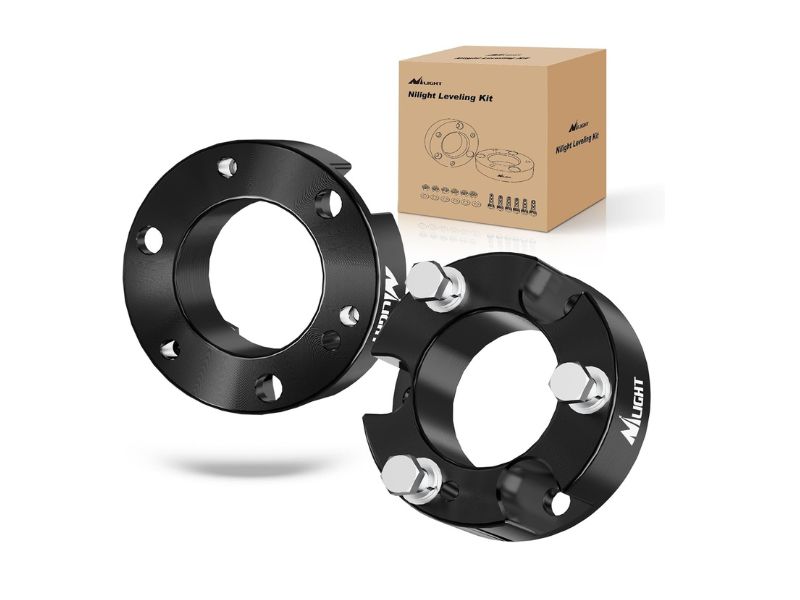
My primary recommendation is the Nilight 2.5-Inch Leveling Lift Kit for 2019-2022 Ford Ranger for owners of compatible 2019–2022 2WD or 4WD Rangers. Its 6061 aluminum construction, approximately 2.5-inch advertised front lift, and simple spacer design make it a practical choice when you want an affordable way to remove most of the factory rake.
I would consider the Rough Country 50100 2.5-Inch Ford Ranger Leveling Kit when I want a widely established truck-suspension option with a straightforward bolt-on design. Current manufacturer fitment covers a broad range of modern Rangers, but trim-specific exclusions—including certain suspension and headlight configurations—make checking the exact truck especially important.
For buyers who prefer machined aluminum spacers and broader current year coverage, the Dynofit 2.5-Inch Front Leveling Kit for Ford Ranger is another sensible option. Its forged aluminum construction, Grade 10.9 hardware, and 2WD/4WD application range make it attractive for a stock-suspension daily driver.
The right leveling kit should match your Ranger first and produce the stance you want second. Do not select one based only on the largest advertised lift number.
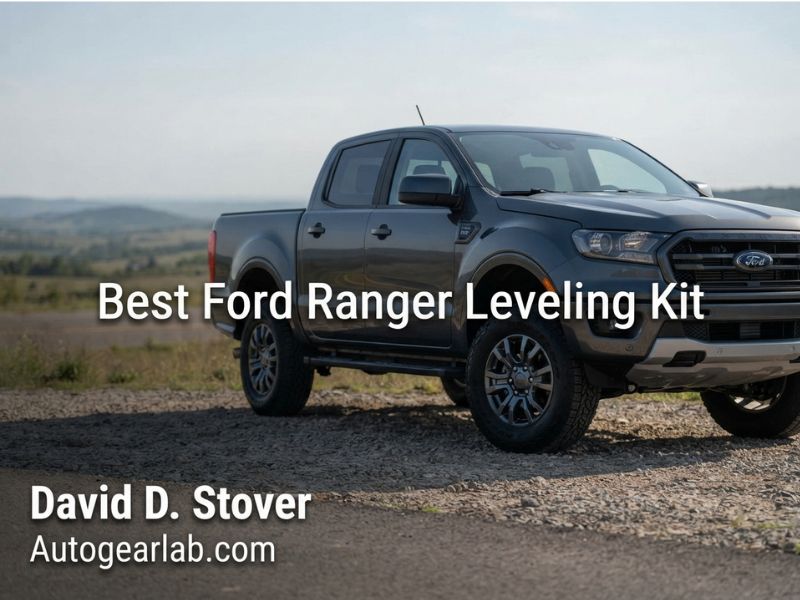
Best Ford Ranger Leveling Kit
| Image | Product Name | Check Price |
|---|---|---|
Best Choice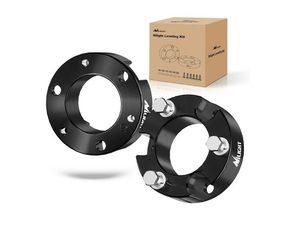 | Nilight 2.5-Inch Leveling Lift Kit for 2019-2022 Ford Ranger | Check Price |
Second Best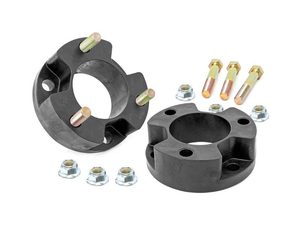 | Rough Country 50100 2.5-Inch Ford Ranger Leveling Kit | Check Price |
Third Choice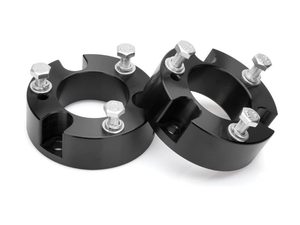 | Dynofit 2.5-Inch Front Leveling Kit for Ford Ranger | Check Price |
1. Nilight 2.5-Inch Leveling Lift Kit for 2019-2022 Ford Ranger
Key Features
- Designed for 2019–2022 Ford Ranger
- Compatible with listed 2WD and 4WD applications
- Approximately 2.5 inches of front lift
- Spacer itself measures roughly 1.54 inches thick
- Constructed from 6061 aluminum alloy
- Precision CNC-machined construction
- Black anodized surface
- Bolt-on installation
- No cutting or drilling intended
- Alignment recommended after installation
The Nilight kit takes the first position because it combines straightforward construction, useful 2.5-inch leveling height, and strong relevance to the commonly modified 2019–2022 Ford Ranger.
The first thing to understand is that the spacer itself is not 2.5 inches thick.
It measures approximately 1.54 inches, yet the suspension geometry is designed to produce around 2.5 inches of front ride-height increase. This is normal with strut-spacer leveling systems.
The relationship between spacer thickness and actual vehicle lift is not necessarily 1:1 because the spacer acts through the suspension geometry.
That is an important distinction because inexperienced buyers sometimes assume that receiving a spacer physically shorter than the advertised lift means the wrong product was supplied.
It does not necessarily mean that.
Nilight uses 6061 aluminum alloy, a material commonly used in automotive spacer components because it combines relatively low weight with good strength and corrosion resistance. The black anodized finish adds another protective layer against road moisture and surface oxidation.
For a Ranger primarily used as a daily driver, this type of spacer kit is attractive because it retains the existing factory strut and spring rather than replacing the entire suspension unit.
That helps preserve much of the original ride character.
However, saying that a spacer retains factory components is not the same as saying it has zero effect on suspension operation.
Raising the front changes the resting position and angles of several components, including:
- Upper control arms
- Ball joints
- Tie rods
- CV axles on 4WD trucks
- Sway-bar geometry
- Alignment angles
At 2.5 inches, those changes deserve consideration.
For a mostly street-driven Ranger with stock or moderately larger tires, I consider 2.5 inches close to the upper end of what many owners should pursue with a simple front spacer before evaluating whether upgraded suspension components would better suit their needs.
The kit’s main purpose is to remove the nose-down appearance created by the truck’s factory rake.
Factory rake is intentional. Manufacturers often design pickups with the rear sitting higher because adding passengers, cargo, or trailer tongue weight lowers the rear suspension.
A leveled unloaded truck looks more balanced, but if you routinely tow a heavy trailer or carry substantial cargo, eliminating all of the rake can make the truck appear rear-low when loaded.
That is why I would think carefully about your real use before automatically choosing the largest leveling height.
The Nilight kit is especially appropriate for someone who:
- Drives mostly unloaded
- Wants a flatter stance
- Wants moderate additional tire clearance
- Does not want a complete suspension replacement
- Has a confirmed 2019–2022 application
- Is willing to perform a wheel alignment afterward
Installation is marketed as bolt-on without drilling or cutting. That makes the hardware itself relatively simple, but front suspension work should not be confused with an easy cosmetic accessory installation.
The front suspension must be safely unloaded and manipulated to remove or reposition the strut assembly.
On a 4WD truck, one of the practical concerns is avoiding excessive pulling on the CV axle while moving suspension components. Overextending or partially separating a CV joint during installation can turn a basic leveling job into a more complicated repair.
After installation, an alignment is essential.
Front lift can change toe, camber, and caster. Even when the truck feels reasonably straight during the first test drive, incorrect alignment can cause uneven tire wear over thousands of miles.
Tire clearance also needs realistic expectations.
A leveling kit creates additional vertical space at the front, but whether a particular tire fits depends on much more than nominal diameter.
Important variables include:
- Tire section width
- Actual measured tire diameter
- Wheel width
- Wheel offset
- Backspacing
- Tire brand
- Fender-liner shape
- Crash-bar clearance where applicable
- Suspension compression
- Steering angle
A tire that clears while driving straight may still rub at full steering lock or during suspension compression.
What I Like
- Solid 6061 aluminum construction
- Useful 2.5-inch front lift for reducing factory rake
- Works with listed 2WD and 4WD applications
- Does not require replacement of the factory strut
- Anodized surface helps resist corrosion
- Bolt-on concept avoids cutting or welding
What I Do Not Like
- Fitment is narrower than some alternatives
- 2.5 inches may be more lift than frequent towing or hauling users need
- Suspension geometry still changes even though factory struts are retained
Verdict
I recommend the Nilight kit first for a compatible 2019–2022 Ranger when the goal is a conventional 2.5-inch front level without replacing the complete suspension. It provides a simple mechanical solution, but I would budget for an alignment and verify wheel-and-tire clearance separately rather than assuming every oversized tire will fit.
2. Rough Country 50100 2.5-Inch Ford Ranger Leveling Kit
Key Features
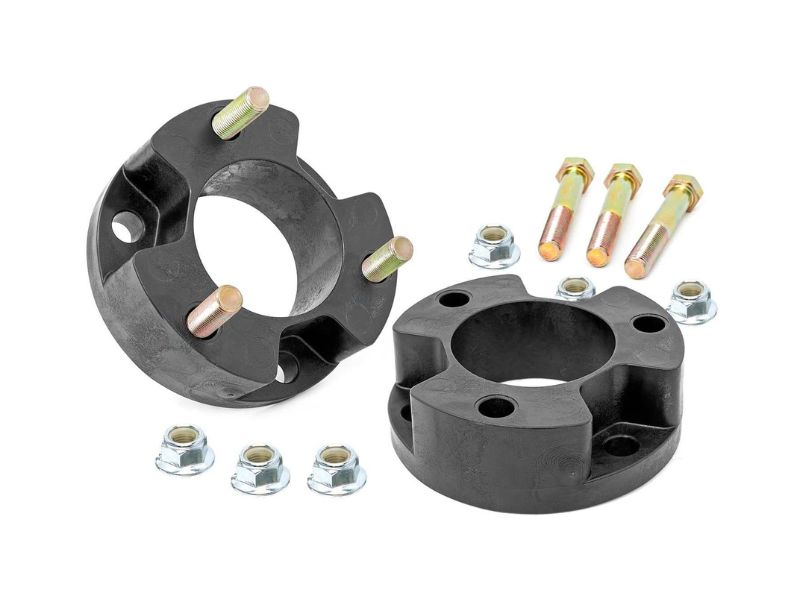
- Approximately 2.5 inches of front leveling
- Vehicle-specific Ranger spacer system
- Front strut spacers and installation hardware
- Bolt-on design
- No strut disassembly required by the kit design
- Powder-coated spacer construction
- Intended to reduce factory rake
- Compatible with listed 2WD and 4WD Rangers
- Supports selected larger wheel-and-tire combinations
- Trim and equipment exclusions require checking
The Rough Country 50100 is the option I would consider when I want a simple leveling spacer from a company focused heavily on truck and off-road suspension.
The concept is straightforward: spacers extend the effective installed length of the Ranger’s front strut assembly enough to raise the front approximately 2.5 inches.
This reduces the factory nose-down stance while preserving the original springs and dampers.
One particularly useful design characteristic is that the kit does not require the front strut itself to be disassembled to install the spacer. That avoids compressing and separating the coil spring from the shock assembly, which is one of the more hazardous operations involved in conventional strut work.
You still have to remove and manipulate suspension components, however, so I would not describe the entire job as risk-free or trivial.
Proper jack stands or a vehicle lift, suitable hand tools, a torque wrench, and competent suspension knowledge are still important.
The 2.5-inch height gives the Ranger a noticeable change in stance.
For many stock Rangers, the visual effect is substantial because the factory front-to-rear rake is easy to see from the side.
After leveling, the rocker panels and body lines generally appear flatter relative to the ground.
The additional front ride height can also improve the truck’s approach clearance, although it is important to distinguish that from differential ground clearance.
A front spacer does not physically raise the rear differential housing farther from the ground.
Only increasing the tire’s actual radius raises a solid axle differential relative to the terrain.
The leveling kit does raise front chassis and body components, which can improve clearance in some situations.
Wheel and tire planning is where this product requires more thought.
Rough Country publishes specific wheel dimensions, center-bore requirements, backspacing limits, and examples where trimming may be necessary.
That is useful because tire clearance should never be described only by diameter.
A 285-width tire mounted on a low-offset wheel can create much more rubbing risk than a narrower tire of similar diameter on a wheel positioned closer to stock.
Increasing track width by selecting a more aggressive wheel offset may improve clearance from some suspension components but reduce fender and liner clearance.
Everything interacts.
Fitment also deserves attention.
Modern Ford Ranger generations and trims can differ significantly. Certain Tremor configurations, automatic or auto-adjusting headlight systems, Ranger Raptor models, and other special suspension packages may require a different kit or special installation considerations.
Always use the current fitment information for the exact year and trim instead of assuming that a part fitting one modern Ranger automatically fits all of them.
This is particularly important for 2024-and-newer North American Rangers because the truck moved to a newer generation.
If your truck is a 2024+ model, I would use the current manufacturer application data rather than relying on older descriptions written when the kit was originally introduced for the 2019–2023 generation.
Ride quality should stay relatively familiar because the factory spring and damper remain in place.
But there is another nuance here.
The damper may be unchanged, while the suspension’s operating position and available droop relationship have changed.
A spacer kit can therefore retain the character of the original shock without being mechanically identical to stock suspension geometry.
For pavement, dirt roads, and occasional mild trails, that tradeoff can be reasonable.
For frequent high-speed off-road driving, repeated hard compression, or significant articulation, I would rather use suspension components engineered to create lift through extended or adjustable struts rather than relying entirely on a large top spacer.
Another consideration is headlights.
Raising the front changes the body’s angle relative to the road. Headlights can consequently aim higher.
After leveling, check the headlight aim—especially if other drivers begin flashing their high beams at you.
Vehicles with advanced driver-assistance or automatic headlight systems may require additional calibration or may be excluded from certain kits altogether.
What I Like
- Established truck-specific leveling design
- Strong 2.5-inch correction of factory rake
- Factory strut does not need spring disassembly
- Bolt-on installation concept
- Detailed wheel and tire fitment information is useful
- Keeps factory springs and dampers
What I Do Not Like
- Special trims and equipment configurations have important exclusions
- Tire clearance can still require trimming
- 2.5 inches meaningfully alters suspension geometry
- New-generation Ranger fitment must be checked especially carefully
Verdict
I would choose the Rough Country 50100 when I want a straightforward 2.5-inch spacer kit and my exact Ranger falls within the current fitment requirements. I particularly like the amount of wheel-and-tire guidance available, but I would not ignore its trim exclusions or skip the post-installation alignment.
3. Dynofit 2.5-Inch Front Leveling Kit for Ford Ranger
Key Features
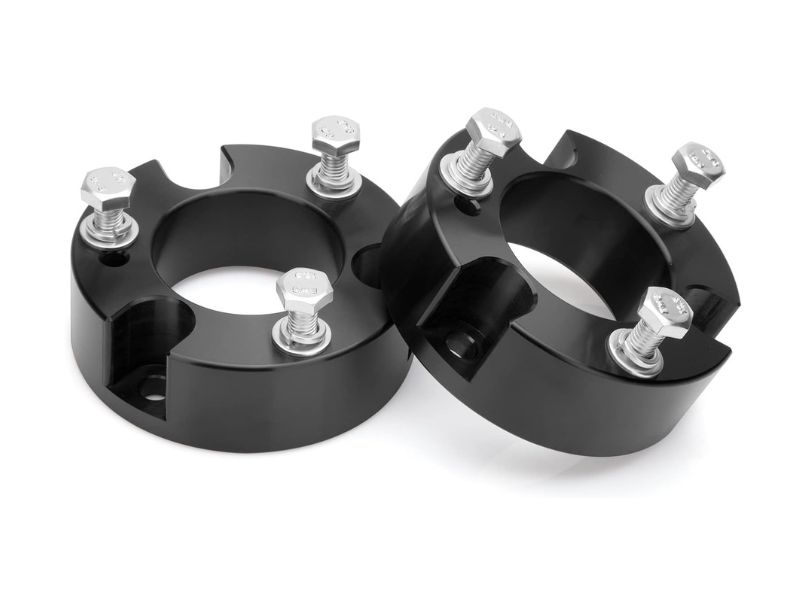
- Approximately 2.5-inch front lift
- Listed for multiple 2019–2026 Ford Ranger applications
- Compatible with listed 2WD and 4WD trucks
- Forged aircraft-grade aluminum construction
- CNC-machined spacers
- Black anodized finish
- Grade 10.9 hardware
- Bolt-on installation
- Factory strut retained
- Not intended for Ranger Raptor applications
The Dynofit kit is my third choice, but it may actually be the most logical of these three products for an owner whose model year falls outside the Nilight range.
Its primary strengths are broad listed fitment, forged aluminum construction, and high-strength installation hardware.
The spacers are produced from aircraft-grade aluminum and use a black anodized finish.
Aluminum works particularly well in a leveling spacer because it provides high strength without unnecessary weight. Properly machined aluminum also maintains accurate mounting surfaces, which matters when a spacer sits between structural suspension components.
The included Grade 10.9 bolts are another worthwhile specification.
Metric Grade 10.9 hardware is a high-strength fastener class commonly used in demanding automotive applications. The grade does not make the entire suspension indestructible, but it is appropriate for a component subjected to repeated suspension loads.
Dynofit advertises approximately 2.5 inches of front lift.
Again, do not expect the physical spacer to measure exactly 2.5 inches.
Suspension leverage means spacer thickness and final ride-height change differ.
One of this product’s major advantages is its listed compatibility with both 2WD and 4WD modern Rangers across a broader model-year span.
That makes it useful for buyers with newer trucks.
However, the Ranger Raptor is excluded.
That exclusion makes sense because the Raptor uses significantly different suspension hardware and geometry from a standard Ranger.
I would also verify Tremor fitment independently rather than assuming that broad Ranger coverage automatically includes every factory off-road package.
This kit makes particular sense if your priorities are:
- Keeping the original front struts
- Achieving close to a 2.5-inch front level
- Using machined aluminum rather than a more complex suspension system
- Avoiding cutting or welding
- Fitting a compatible late-model Ranger
- Maintaining a relatively stock-like daily-driving character
I would be less enthusiastic about any 2.5-inch spacer-only setup if the truck spends most of its life on demanding trails.
The reason is geometry rather than spacer strength.
As you raise an independent front suspension vehicle without changing all of the surrounding components, upper control-arm angle, ball-joint position, CV angle, and available droop change.
That may be acceptable within the manufacturer’s intended range, but it becomes increasingly important as lift height grows.
Owners planning repeated rough off-road use may get more benefit from an adjustable performance strut or complete suspension lift engineered around travel and geometry.
For most daily-driven Rangers, though, a spacer is attractive precisely because it is simple.
You are not changing spring rate.
That means the leveling kit does not inherently make the coil spring stiffer.
If the ride feels different afterward, possible reasons include the altered geometry, alignment, tire change, wheel change, or changed suspension operating position rather than a new spring rate.
Installation is described as bolt-on and generally requires no cutting or special fabrication.
Nevertheless, any work involving the front suspension needs proper support and correct torque procedures.
I would also avoid using an impact wrench as the final tightening method on critical suspension hardware unless the installation specification explicitly permits it.
A calibrated torque wrench gives much better control.
Once installation is complete, schedule an alignment immediately.
Do not wait until uneven tire wear becomes visible.
Modern all-terrain tires can be expensive, and a poor toe setting can remove thousands of miles from their usable life.
What I Like
- Broad modern Ranger fitment
- Forged aluminum construction
- CNC-machined spacer surfaces
- Grade 10.9 fasteners
- Black anodized corrosion protection
- Bolt-on configuration
What I Do Not Like
- Ranger Raptor is excluded
- 2.5-inch spacer lift still changes front suspension geometry
- Alignment is an additional required step
- Frequent hard off-road use may justify a more complete suspension solution
Verdict
I would choose the Dynofit kit when I have a compatible modern Ranger and value machined aluminum construction plus broad year coverage. It is a particularly useful alternative for trucks outside the Nilight model-year range, provided the exact trim is supported.
Ford Ranger Leveling Kit Comparison
| Product | Front Lift | Main Fitment | Drivetrain | Material | Design | Factory Struts Retained | Alignment Needed | Main Limitation |
| Nilight 2.5-Inch Leveling Kit | Approx. 2.5 in. | 2019–2022 Ranger | 2WD/4WD | 6061 aluminum | Front strut spacer | Yes | Yes | Narrower year range |
| Rough Country 50100 | Approx. 2.5 in. | Selected modern Rangers | 2WD/4WD applications | Steel/alloy spacer construction | Front strut spacer | Yes | Yes | Trim/equipment exclusions |
| Dynofit 2.5-Inch Leveling Kit | Approx. 2.5 in. | Selected 2019–2026 Ranger | 2WD/4WD | Forged aluminum | Front strut spacer | Yes | Yes | Not for Ranger Raptor |
All three products use the same broad strategy: raise the front while retaining the factory front struts.
The Nilight is most straightforward for a confirmed 2019–2022 truck. Rough Country offers an established vehicle-specific system with detailed wheel fitment guidance, while Dynofit combines broad modern application coverage with forged aluminum and Grade 10.9 hardware.
What Does a Ford Ranger Leveling Kit Actually Do?
A stock pickup usually sits higher at the rear than the front.
This difference is called rake.
The rear suspension is intentionally positioned higher because pickups are designed to carry cargo and trailer tongue weight. Adding weight compresses the rear suspension and reduces that rake.
A front leveling kit raises the front ride height so the unloaded truck sits closer to level.
Typical reasons for installing one include:
- More balanced appearance
- Additional front-body clearance
- Greater room around larger tires
- Improved front approach clearance
- Correcting an overly nose-down appearance after adding accessories
A leveling kit does not increase payload capacity.
It also does not make the truck capable of safely carrying additional trailer tongue weight.
Those limits are determined by vehicle engineering and ratings, not stance.
2-Inch vs. 2.5-Inch Ford Ranger Leveling Kits
The ideal lift depends on how much factory rake you actually have.
Do not assume every Ranger sits at exactly the same height.
Ride height can vary because of:
- Trim level
- 2WD versus 4WD
- Factory suspension package
- Accessories
- Springs
- Vehicle mileage
- Bed equipment
- Constant cargo
- Tire pressure
Measure before ordering.
Park on a level surface and measure vertically from the wheel center to the fender opening on both front and rear.
Using the wheel center instead of the ground reduces the effect of tire-size differences.
If the rear is approximately 2 inches higher, a 2-inch kit may provide the stance you want.
If the difference is closer to 2.5 inches, a 2.5-inch kit can produce a flatter unloaded profile.
Why I Would Not Always Eliminate Every Inch of Rake
A perfectly level empty truck is not ideal for every owner.
If you regularly tow or carry heavy equipment, leaving some rake provides room for the rear to settle under load without creating a nose-high attitude.
For a work Ranger, I often prefer slightly less front lift than the measured unloaded rake.
Spacer Thickness vs. Actual Lift Height
This creates confusion with leveling kits.
A spacer that creates a 2.5-inch vehicle lift may physically measure considerably less than 2.5 inches.
That happens because the suspension geometry creates a leverage ratio between the strut mounting point and wheel.
For example, the Nilight spacer is roughly 1.54 inches thick but is designed to create approximately 2.5 inches of front ride-height increase.
Always compare the advertised vehicle lift height, not just raw spacer thickness.
Will a Leveling Kit Affect Ride Quality?
A spacer kit that retains factory springs and dampers generally preserves more of the stock ride character than replacing those components with much stiffer suspension parts.
However, saying the ride is completely unaffected is an oversimplification.
Raising the truck changes:
- Suspension resting position
- Control-arm angle
- Ball-joint angle
- CV angle
- Droop availability
- Alignment
Those changes can influence steering and suspension behavior.
Installing heavier all-terrain tires at the same time can make an even bigger difference.
A larger LT-rated tire may add unsprung and rotational mass and use a stiffer carcass than the factory tire. Drivers sometimes attribute the resulting harsher ride entirely to the leveling kit when the tire change is responsible for a significant portion of it.
Will a Leveling Kit Increase Ground Clearance?
It increases clearance in some areas, but not everywhere underneath the truck.
Raising the front suspension can improve clearance beneath front body and chassis components and can improve the approach angle.
However, a spacer does not directly raise the lowest point of every drivetrain component.
For example, on a solid rear axle, the differential’s ground clearance is primarily determined by tire radius.
If you install taller tires after leveling, the increased tire radius can then increase differential clearance.
This distinction matters for off-road buyers.
What Tire Size Fits a Leveled Ford Ranger?
There is no single correct answer because tire diameter is only one variable.
You also need to consider:
Tire width: Wider tires move closer to control arms, liners, and bodywork.
Wheel offset: Lower or more negative offset pushes the tire outward.
Wheel width: Changing wheel width alters where the tire sits.
Backspacing: More backspacing moves the wheel farther inward.
Actual tire dimensions: Two tires carrying the same sidewall size can measure differently.
Tread design: Aggressive side lugs can rub even when the casing clears.
Steering lock: Clearance must be checked throughout the steering range.
Suspension compression: A setup that clears on flat pavement can rub on trails.
A leveling kit should therefore be viewed as one piece of a complete wheel-and-tire fitment plan.
Understanding Wheel Offset and Backspacing
Wheel Offset
Offset measures the relationship between the wheel’s mounting surface and its centerline.
Positive offset generally positions the wheel farther inward.
Lower or negative offset pushes it outward.
Changing offset can create clearance in one location while causing rubbing somewhere else.
Backspacing
Backspacing measures from the wheel’s mounting surface to its inner edge.
Greater backspacing generally puts more wheel inward toward suspension components.
When fitting larger tires, do not buy wheels based only on diameter and bolt pattern.
Do You Need an Alignment After Installing a Leveling Kit?
Yes. A proper wheel alignment should be treated as part of the leveling-kit installation.
Changing front ride height changes suspension geometry.
The alignment technician should check:
- Toe
- Camber
- Caster
Toe is especially important for tire wear.
A truck can appear to drive reasonably straight while excessive toe steadily scrubs the tires.
For best results, install the leveling kit first, install the final wheel-and-tire package if changing it, then perform the alignment.
What Happens to CV-Axle Angles?
On a 4WD Ranger, the front CV axles connect the differential to the front hubs.
Raising the suspension increases their operating angle.
A moderate increase may remain within the system’s functional range, but increasing the angle can affect:
- CV-joint operating position
- Boot flex
- Long-term joint wear
- Available droop
This is another reason I would avoid stacking multiple leveling spacers or exceeding a kit’s designed lift height.
If substantially more front lift is needed, use a suspension system engineered around the desired height.
Upper Control Arms and Ball-Joint Angles
Raising an independent front suspension truck changes the angle of the upper control arms and ball joints.
At modest heights, the stock components may remain serviceable.
As lift increases, potential concerns include:
- Reduced droop
- Ball-joint angle
- Difficulty achieving alignment
- Contact between components
- Increased wear
If your alignment technician cannot bring caster or camber within an appropriate range after leveling, aftermarket upper control arms designed for lifted geometry may be worth considering.
Leveling Kit vs. Suspension Lift
These terms are often confused.
Leveling Kit
A leveling kit primarily raises the front to reduce rake.
Advantages:
- Simpler
- Fewer parts
- Retains factory struts in spacer systems
- Moderate stance change
- Lower installation complexity
Suspension Lift
A suspension lift can raise the entire truck and may include:
- New struts
- Shocks
- Springs
- Upper control arms
- Differential brackets
- Crossmembers
- Rear blocks or springs
- Sway-bar components
A full suspension system is more appropriate when you need substantial height, articulation, tire clearance, or off-road performance beyond what a simple level provides.
Leveling Spacer vs. Leveling Strut
Spacer
A spacer changes installed ride height while reusing the factory spring and damper.
It is ideal when those components are in good condition and the goal is mostly stance and modest clearance.
Leveling Strut
A leveling strut creates lift through a replacement or adjustable strut assembly.
It can be a better choice when:
- Original struts are worn
- You want improved damping
- Off-road performance matters
- You want adjustable ride height
- You are already paying the labor to remove the struts
Do not spend money installing spacers over badly worn shocks.
Does Leveling Affect Towing?
A leveling kit does not automatically reduce the truck’s published towing rating, but it changes the unloaded stance and may affect how the truck sits when trailer tongue weight is applied.
A truck that is perfectly level when empty may become visibly nose-high once the rear compresses under a trailer.
That can affect:
- Headlight aim
- Steering feel
- Front tire loading
- Appearance
If towing is frequent, I would retain some rake rather than aggressively leveling the truck.
Proper trailer setup and tongue weight remain essential.
A leveling kit is not a substitute for a correctly adjusted weight-distribution system when one is required.
Ford Ranger Leveling Kit Installation Guide
Suspension installation involves heavy components under significant spring and vehicle load. If you are not confident supporting and disassembling front suspension safely, professional installation is appropriate.
1. Measure the Truck Before Installation
Record the front and rear ride heights.
This lets you confirm the actual change afterward.
2. Park on a Level Surface
Use appropriate wheel chocks and lifting equipment.
3. Safely Raise the Front
Support the chassis using properly rated stands at approved points.
Never rely only on a hydraulic jack while working underneath.
4. Remove the Front Wheels
This gives access to the suspension.
5. Disconnect Necessary Components
The exact process varies, but it can involve sway-bar, tie-rod, knuckle, or other connections depending on the installation method.
6. Protect the CV Axles
On 4WD models, avoid allowing the knuckle to pull excessively outward and overextend the CV joint.
7. Remove or Reposition the Strut Assembly
Follow the kit-specific instructions rather than assuming all spacer systems install identically.
8. Install the Spacer and Hardware
Verify its orientation carefully.
Use the supplied high-strength hardware where specified.
9. Torque Fasteners Correctly
Follow the manufacturer or factory torque requirements.
10. Reassemble the Suspension
Confirm that brake hoses, ABS wiring, and other lines are not stretched or trapped.
11. Reinstall the Wheels
Torque wheel fasteners correctly.
12. Settle the Suspension
Move the truck and allow the suspension to settle before final ride-height measurement.
13. Get an Alignment
Do not treat this as optional.
14. Recheck the Truck
After the initial driving period, inspect the installation and follow any manufacturer-specified fastener recheck procedure.
Common Ford Ranger Leveling Kit Mistakes
Buying Without Checking the Model Year
A newer-generation Ranger may have different suspension hardware.
Ignoring Tremor or Raptor Fitment
Factory off-road packages can use different suspension components and ride heights.
Assuming a 1.5-Inch-Thick Spacer Only Gives 1.5 Inches of Lift
Suspension geometry can produce more wheel-height change than physical spacer thickness.
Skipping the Alignment
This can quickly turn a relatively inexpensive suspension modification into premature tire replacement.
Choosing Tires Before Checking Offset
Wheel offset can determine whether a tire rubs just as much as tire diameter.
Expecting Differential Clearance From the Spacer Alone
A front level does not magically lift every low point under the vehicle.
Stacking Spacers
Combining lift components without understanding geometry can create excessive angles and unsafe suspension travel.
Ignoring Worn Struts
If factory dampers are already near the end of their life, consider replacing or upgrading them rather than paying labor to reinstall them with spacers.
Fully Leveling a Truck That Constantly Tows
Leaving some rake can be more practical for loaded use.
Forgetting Headlight Aim
The raised nose can point the headlights higher.
Frequently Asked Questions
What is the best Ford Ranger leveling kit?
The best Ford Ranger leveling kit is one that matches your exact year, trim, drivetrain, and desired lift height.
For compatible 2019–2022 trucks, I prefer the Nilight 2.5-Inch Leveling Kit from these three choices. Rough Country is a strong alternative when its current trim-specific fitment matches your Ranger, while Dynofit is attractive for buyers needing broader modern model-year coverage.
How much should I level my Ford Ranger?
About 2 to 2.5 inches is a common range, but you should measure the factory rake first.
Measure from the center of each wheel to the fender opening on level ground. If the rear sits roughly 2 inches higher, a 2-inch front level may be sufficient. If the difference is closer to 2.5 inches and the truck is usually unloaded, a 2.5-inch kit can create a flatter stance.
Will a 2.5-inch leveling kit make my Ranger completely level?
It can bring many Rangers close to level, but actual final height varies between individual trucks.
Factory suspension package, accessories, mileage, springs, cargo, drivetrain, and previous modifications can alter the starting rake. Measure the vehicle before ordering and again after installation rather than assuming the advertised lift guarantees a perfectly level stance.
Does a leveling kit hurt Ford Ranger ride quality?
A quality spacer kit can retain much of the factory ride feel, but suspension geometry still changes.
Because the original spring and damper remain, spring rate does not automatically become stiffer. However, control-arm angles, CV angles, available droop, and alignment are altered. Larger and heavier tires fitted at the same time may also noticeably change ride quality.
Do I need an alignment after leveling my Ford Ranger?
Yes, an alignment should be performed after changing the front ride height.
A leveling kit can alter toe, camber, and caster. Incorrect toe can wear expensive tires surprisingly quickly even when the truck does not pull strongly to one side. Install the final wheel-and-tire setup first when possible, then have the alignment completed.
Can I install a Ford Ranger leveling kit myself?
Yes, an experienced DIY mechanic can install many spacer kits, but proper suspension safety and tools are essential.
The spacers themselves may be simple bolt-on components, yet reaching them requires manipulating the front suspension. Proper jack stands, suitable sockets, a torque wrench, and an understanding of CV-axle and brake-line limitations are important. Professional installation is sensible if you are not experienced with suspension work.
Can I put larger tires on a Ranger after leveling it?
Yes, leveling can create additional tire clearance, but it does not guarantee that every larger tire will fit.
Actual fitment depends on tire width, diameter, wheel width, offset, backspacing, steering angle, suspension compression, and trim configuration. Some combinations require minor trimming even with a leveling kit.
Does a leveling kit increase off-road ground clearance?
It increases front-body and chassis clearance, but tire size determines clearance beneath some low drivetrain components.
The raised front can improve approach clearance and reduce contact with terrain in certain areas. However, components such as a solid rear axle differential do not rise simply because a front spacer was installed. Taller tires are required to increase clearance beneath those components.
Will a leveling kit affect my Ranger’s CV axles?
A front lift increases CV operating angles on 4WD Rangers.
A properly engineered moderate leveling kit can remain within usable limits, but more angle means the joints and boots operate differently from stock. Avoid stacking lift spacers or exceeding the designed ride height, particularly on a daily-driven 4WD truck.
Do I need aftermarket upper control arms with a 2.5-inch level?
Not every Ranger requires them, but they can become useful when alignment or ball-joint geometry is compromised.
Start by installing a properly designed kit and getting a professional alignment. If caster or camber cannot be brought into an acceptable range, or if the upper ball-joint angle becomes problematic, control arms designed for lifted geometry may be appropriate.
Will leveling affect Ford Ranger towing?
The truck may sit more nose-high when loaded because the leveling kit removes some of its factory rake.
Factory rake gives the rear suspension room to settle under cargo or trailer tongue weight. If your Ranger frequently tows or hauls heavy loads, a smaller front level may be more practical than eliminating every inch of rake.
Does a 2.5-inch leveling spacer physically measure 2.5 inches?
Usually not, because spacer thickness and final wheel lift are affected by suspension geometry.
For example, a spacer can be around 1.5 inches thick while producing approximately 2.5 inches of front ride-height increase. Use the manufacturer’s advertised vehicle lift rather than assuming physical spacer thickness must equal final lift.
Will a leveling kit void my warranty?
A modification does not automatically erase every vehicle warranty, but related failures can become warranty disputes.
Suspension modifications can affect how a manufacturer or service provider evaluates a claim involving altered components. Keep installation records, use correctly fitted parts, follow torque and alignment procedures, and understand the warranty terms applicable to your specific vehicle.
Should I level a Ranger before buying wheels and tires?
Usually yes, because the final ride height helps you evaluate wheel and tire clearance more accurately.
Plan the entire setup together, though. Wheel offset and tire width are just as important as lift height. A tire can rub despite adequate vertical clearance if an aggressive wheel position pushes it into the fender liner at steering lock.
Is a leveling kit better than a full lift kit for a daily driver?
A leveling kit is usually simpler when you only want a flatter stance and modest tire clearance.
It uses fewer components, typically costs less to install, and can retain the original struts. A full suspension lift becomes more appropriate when you want significantly larger tires, additional overall height, increased off-road capability, or suspension components engineered specifically around extended travel.
Conclusion
Choosing the best Ford Ranger leveling kit comes down to balancing stance, fitment, suspension geometry, tire plans, and how the truck is actually used.
The Nilight 2.5-Inch Leveling Lift Kit remains my primary recommendation for compatible 2019–2022 Rangers. Its CNC-machined 6061 aluminum spacers provide a straightforward way to remove most of the factory rake while retaining the original front struts.
The Rough Country 50100 is the alternative I would consider when I want an established truck-suspension design and detailed wheel-and-tire fitment guidance. Its application-specific exclusions are important, so verify your exact trim and equipment before installation.
The Dynofit 2.5-Inch Front Leveling Kit is especially useful for owners looking at broader late-model Ranger coverage. Forged aluminum construction and Grade 10.9 hardware are meaningful strengths, although Raptor and other special suspension applications require separate consideration.
Whichever kit you select, measure the truck before installation, confirm 2WD/4WD and trim compatibility, plan wheel offset and tire size carefully, protect CV components during installation, and schedule a professional alignment afterward.
For a daily-driven Ranger that spends most of its time unloaded, a properly installed 2–2.5-inch front level can deliver the balanced stance many owners want without moving into the complexity of a full suspension lift.