Choosing an analog battery load tester can be confusing when many compact meters appear to offer the same 6V and 12V functions. The important differences are load capacity, clamp quality, readability, battery compatibility, cooling, and how easily a beginner can interpret the result.
My first choice is the Schumacher Electric BT-100 6V/12V Battery Load Tester. It combines battery, charging-system, and starter-draw checks in one unit, while its large analog meter and top-mounted switch keep the process straightforward. Support for batteries up to 1,000 CA also makes it useful across cars, motorcycles, boats, lawn equipment, and RVs.
My second choice is the NEIKO 40510A 100 Amp 6V/12V Automotive Battery Load Tester. It is a strong alternative for home garages and DIY owners who want a portable tester with a protected meter, anti-sparking internal switchgear, and clearly marked positive and negative clamp grips.
This comparison covers 10 leading options, explaining where each one fits, what its specifications mean in everyday use, and which limitations deserve attention. The buying guidance also covers safe setup, load-test timing, compatibility, storage, maintenance, common mistakes, and questions beginners often ask.
.amz-product-card:hover{transform:translateY(-3px)!important;box-shadow:0 10px 26px rgba(20,70,110,.12)!important;border-color:#bdd7ea!important;}
10 Best Analog Battery Load Tester
I selected these products by comparing their stated testing functions, voltage coverage, load capacity, clamp and case design, portability, and available customer-feedback evidence. Brand variety was also considered when a competing option offered a meaningful difference for a particular garage, vehicle type, or use pattern.
| # | Image | Product | Price on Amazon |
|---|---|---|---|
| 1 |  |
Schumacher Electric BT-100 6V/12V Battery Load Tester | Check Price |
| 2 |  |
NEIKO 40510A 100 Amp 6V/12V Automotive Battery Load Tester | Check Price |
| 3 | 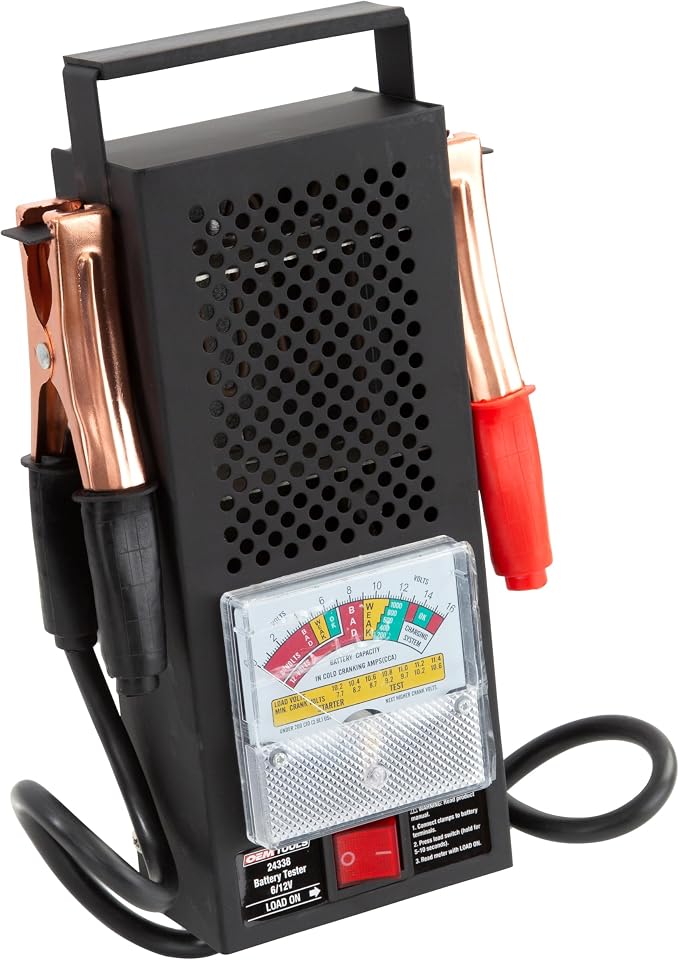 |
OEMTOOLS 24338 6V/12V Automotive Battery Load Tester | Check Price |
| 4 |  |
Battery Tender 026-0020 6V/12V Battery Load Tester | Check Price |
| 5 |  |
OTC 3181 130 Amp Heavy-Duty 6V/12V Battery Load Tester | Check Price |
| 6 |  |
KAIHENG 6V/12V Automotive Battery Load Tester | Check Price |
| 7 |  |
QWORK 24338 6V/12V 100 Amp Battery Load Tester | Check Price |
| 8 |  |
Yaegoo 12V 100A/6V 50A Battery Load Tester | Check Price |
| 9 |  |
TOPDC 100A 6V/12V Battery Load Tester | Check Price |
| 10 |  |
Lianshi 6V/12V Automotive Battery Load Tester | Check Price |
Schumacher Electric BT-100 6V/12V Battery Load Tester
The Schumacher Electric BT-100 earns the top position because it covers the three checks most vehicle owners want from one compact tool: battery health, charging-system performance, and starter motor draw. That makes it more useful than a basic voltage meter when a vehicle cranks slowly, repeatedly needs charging, or shows uncertain battery condition.
Its 6V and 12V coverage suits a broad mix of equipment, including motorcycles, ATVs, lawn tractors, cars, boats, light trucks, and RVs. The tester applies a 50-amp load to 6V batteries and a 100-amp load to 12V batteries, with support for batteries rated up to 1,000 CA. This range is practical for a mixed household garage, although the tester should still be matched to the battery’s intended test procedure.
Operation is beginner-friendly. A top-mounted rocker switch controls the test, and the highly visible analog meter is designed for quick reading while the unit is held. The included user manual is useful for owners who have not previously performed a load test, but an analog result still requires careful attention to the correct voltage scale and test timing.
Pros
- Tests battery condition, charging performance, and starter draw.
- Works with 6V and 12V batteries up to 1,000 CA.
- Large analog meter and simple rocker-switch operation.
- Suitable for many automotive, marine, powersports, and RV applications.
Cons
- Load testing requires careful timing and correct meter interpretation.
- It is a diagnostic tool, not a battery charger.
My Opinion
The BT-100 is the most balanced choice for a general-purpose garage. It offers broad compatibility and useful diagnostic coverage without adding a complicated digital interface, making it especially appealing to owners who want one straightforward tool for several types of vehicles.
NEIKO 40510A 100 Amp 6V/12V Automotive Battery Load Tester
The NEIKO 40510A is a strong second choice for buyers who want portable, DIY-friendly testing with a durable-feeling layout. Its protected analog voltage meter helps shield the display during ordinary garage handling, while the external top handle makes it easier to carry between a parked vehicle, workbench, or storage shelf.
This model uses a fixed 100-amp load for 12V batteries and a 50-amp load for 6V batteries. It is specified for batteries up to 1,000 cold cranking amps, with voltage accuracy listed at ±0.2V. That combination makes it suitable for cars, vans, boats, trucks, SUVs, motorcycles, RVs, and similar 6V or 12V applications.
The copper clamp connectors have red positive and black negative rubber grips, reducing the chance of confusing terminal placement. An anti-sparking internal switchgear design adds another practical safety consideration, although users should still connect the clamps correctly, keep the test area ventilated, and avoid holding the load longer than the stated maximum of 10 seconds.
Compared with the Schumacher, the NEIKO is a little more narrowly described around load and voltage checking rather than a broad three-test package. It may therefore suit a DIY owner who primarily wants battery and charging-system diagnosis and values the protected meter and carry handle.
Pros
- Supports 6V and 12V batteries up to 1,000 CCA.
- Protected analog meter and portable top handle.
- Color-coded rubber clamp grips simplify connection.
- Suitable for home garages and a wide range of vehicles.
Cons
- Maximum load duration is limited to 10 seconds.
- The fixed load may be less flexible for specialized testing needs.
My Opinion
The NEIKO 40510A is an excellent alternative for a practical home-garage toolkit. It ranks just behind the Schumacher because its stated function set is slightly less comprehensive, but its clear layout, broad battery coverage, and protective design make it easy to recommend.
OEMTOOLS 24338 6V/12V Automotive Battery Load Tester
The OEMTOOLS 24338 stands out for buyers who prioritize rugged handling and quick results. Its sturdy steel case is intended to tolerate the bumps that can occur in a workshop or mobile service setup, while the shock-resistant meter housing gives the display additional protection during transport and storage.
Although the product name emphasizes automotive 12V use, the supplied specifications indicate compatibility with both 6V and 12V batteries up to 1,000 CCA. It can be used with automotive and deep-cycle batteries, so it may fit a garage that handles ordinary starting batteries as well as marine, RV, or utility applications.
The tester is designed to provide results in about 10 seconds and measures state of charge, cranking volts, and charging-system performance. Heavy-duty copper-plated clamps are important here because a secure connection helps reduce misleading readings caused by poor contact. The clamps are also described as suitable for use in different climates, though the tool should still be kept clean and dry between jobs.
This is a sensible choice for a mechanic, fleet owner, or serious DIY user who expects the instrument to move around frequently. Someone who mainly tests one car at home may not need the extra emphasis on steel-case durability and could prefer a simpler or lighter option.
Pros
- Sturdy steel case with shock-resistant meter protection.
- Works with 6V and 12V batteries up to 1,000 CCA.
- Tests state of charge, cranking voltage, and charging performance.
- Heavy-duty copper-plated clamps provide a secure connection.
Cons
- The rugged case may be more than a casual owner needs.
- Results still depend on correct connection and load timing.
My Opinion
The OEMTOOLS 24338 is a convincing workshop-oriented option. It earns third place because it combines broad compatibility with a tough case and useful diagnostic coverage, though buyers seeking the simplest possible household tool may find its heavy-duty construction less important.
Battery Tender 026-0020 6V/12V Battery Load Tester
The Battery Tender 026-0020 is designed for owners who want a clearly marked instrument for both starter and deep-cycle batteries. It supports 100-amp load testing on 12V batteries and 50-amp testing on 6V batteries, covering up to 1,000 cranking amps across automotive, marine, powersports, and RV applications.
Its useful strength is the combination of several related checks in one device. It can help assess battery condition and load, examine starter motor draw, and assist with charging-system diagnosis. That range is helpful when a vehicle problem could come from the battery, alternator, or excessive starting-system demand rather than from one obvious source.
The analog display is clearly marked and color-coded, allowing users to identify results more quickly than they might with an unmarked scale. A rubber-insulated carrying handle improves portability, and color-coded heavy-duty alligator clamps make positive and negative placement easier to recognize before applying a load.
As with similar tools, this tester is not a replacement for a charger or a complete electrical-system diagnostic platform. The 10-second load limit should be respected, and the battery should be connected according to the manual before the toggle switch is used. Buyers with unusually specialized battery systems should confirm that the fixed 6V/12V load format fits their application.
Pros
- Supports starter and deep-cycle batteries.
- Tests 6V and 12V systems across several vehicle categories.
- Color-coded display, clamps, and insulated carrying handle.
- Assists with battery, starter-draw, and charging-system checks.
Cons
- Fixed load levels may not suit every specialized battery application.
- It cannot recharge a weak or discharged battery.
My Opinion
The Battery Tender 026-0020 is a well-rounded pick for marine, RV, powersports, and general automotive owners. Its color coding and broad battery-use description make it approachable, while the Schumacher and NEIKO remain slightly stronger choices for shoppers seeking the highest overall versatility or portability.
OTC 3181 130 Amp Heavy-Duty 6V/12V Battery Load Tester
The OTC 3181 is the heavy-duty choice in this group. Its 130-amp load capacity gives it a more substantial testing profile than the many 100-amp models listed here, which may appeal to a busy garage or owner who wants a robust instrument for repeated automotive checks.
An extra-large display covers a 0–16 volt range and includes zero adjustment. A larger scale can be easier to read from different angles, especially when the tester is positioned near a battery compartment or held at arm’s length. Zero adjustment is also useful for helping the pointer begin from the correct reference position before interpreting a result.
The uniquely shaped clamps are designed to grip both top-post and side-post batteries. That detail matters because battery-post access varies considerably between vehicles, and a secure connection is necessary for a dependable load reading. Side tabs store the clamps on the tool, while rear brackets support storage on a wall or toolbox.
OTC describes the tester as delivering results in about 10 seconds. The supplied data confirms 6V and 12V compatibility, but it does not specify a maximum CCA range. Buyers working with particularly high-capacity batteries should confirm the appropriate application before purchase rather than assuming the 130-amp rating alone answers that question.
Pros
- 130-amp heavy-duty load capability.
- Large 0–16V display with zero adjustment.
- Clamps designed for top- and side-post batteries.
- Built-in clamp storage and wall or toolbox storage brackets.
Cons
- Maximum supported CCA is not specified in the supplied data.
- Heavy-duty capacity may be unnecessary for occasional personal use.
My Opinion
The OTC 3181 is the most compelling option for buyers who value a larger display, strong load capability, and flexible clamp access. It ranks fifth because the unspecified CCA range leaves more compatibility homework for the buyer than the leading models require.
KAIHENG 6V/12V Automotive Battery Load Tester
The KAIHENG Battery Load Tester offers a straightforward approach for home users who need battery, starter-draw, and charging-system checks without visiting a shop. It is designed for cars, pickup trucks, SUVs, motorcycles, RVs, boats, ATVs, and other vehicles using 6V or 12V batteries.
Its fixed load is 100 amps for 12V batteries and 50 amps for 6V batteries, with voltage accuracy listed at ±0.2V. The stated test method simulates starter motor consumption by drawing current for up to 10 seconds. That makes the tool useful for distinguishing a battery that looks acceptable at rest from one that drops too far when placed under demand.
Red and black rubber grips on the copper clips help identify positive and negative placement, and the insulated top handle makes the unit easier to carry. The layout is intentionally simple, but new users should still learn the meter’s color zones and verify that the clamps are firmly attached before moving the load switch.
With a 4.3 customer rating from 444 ratings in the supplied data, this model has less feedback volume and a slightly lower score than the higher-ranked choices. That does not rule it out, but it makes the KAIHENG better suited to buyers who value its broad vehicle coverage and simple operation more than the strongest available customer-feedback signal.
Pros
- 6V and 12V testing for many vehicle types.
- 100-amp 12V and 50-amp 6V load settings.
- Insulated handle and color-coded copper clips.
- Supports battery, starter-draw, and charging checks.
Cons
- Customer-feedback score is lower than the leading options in this list.
- Load duration should not exceed 10 seconds.
My Opinion
KAIHENG provides the essential functions at a sensible level for a DIY garage. It is a reasonable value-oriented choice, but shoppers who place greater weight on established feedback volume or more rugged case details may prefer OEMTOOLS, Schumacher, or NEIKO.
QWORK 24338 6V/12V 100 Amp Battery Load Tester
The QWORK 24338 is aimed at owners of cars, trucks, RVs, and golf carts who want battery and alternator testing in one portable tool. Its stated compatibility with both 6V and 12V batteries makes it more flexible than a 12V-only tester, particularly for households with older equipment or golf-cart applications.
Its maximum CCA rating is 1,000, and the 100-amp load capacity is intended to handle demanding vehicle batteries within that range. Heavy-duty copper-plated clamps help maintain a stable connection, while the shock-resistant steel case offers useful protection for transport between vehicles or storage locations.
The compact design and included handle are practical for users who do not want a permanent workbench instrument. The alternator-testing function can also help narrow down whether a no-start or weak-electrical problem is connected to charging performance rather than battery condition alone.
The supplied information does not specify warranty details, so buyers who consider warranty support important should verify that information before ordering. Also, because the product title emphasizes 12V and 100A while the detailed data mentions both 6V and 12V compatibility, checking the included instructions for the exact 6V procedure is a sensible setup step.
Pros
- Tests batteries and alternators in one unit.
- Compatible with 6V and 12V batteries up to 1,000 CCA.
- Shock-resistant steel case and copper-plated clamps.
- Portable design suits vehicles, golf carts, and RVs.
Cons
- Warranty details are not specified in the supplied information.
- Buyers should confirm the exact 6V operating instructions.
My Opinion
QWORK is a useful multi-vehicle option with a durable case and strong stated CCA range. It ranks below the better-established all-around picks because its documentation details are less complete, but it deserves attention from golf-cart, RV, and ATV owners seeking portability.
Yaegoo 12V 100A/6V 50A Battery Load Tester
The Yaegoo Battery Load Tester focuses on simple operation and practical portability. It handles 6V and 12V batteries up to 1,000 CCA, making it suitable for cars, trucks, RVs, motorcycles, boats, and similar equipment that can be reached without specialized shop equipment.
The 50-amp 6V and 100-amp 12V load levels are clearly stated, as is voltage accuracy of ±0.2V. Its color-coded analog display is intended to make the result easier to interpret, while red and black rubber grips on the copper clips help prevent terminal confusion during setup.
A notable design detail is the perforated case surface. Those openings are intended to improve ventilation during heavy-duty use and help manage heat while the tester is applying a load. Ventilation is beneficial, but it does not remove the need to follow the maximum test duration or to allow the tool to cool if it becomes hot between repeated tests.
The insulated top handle and compact format make it convenient for occasional testing at home or in a garage. It may be less appealing to buyers who want a documented heavy-duty case or the broadest diagnostic explanation, but it offers the core functions many beginners actually need.
Pros
- Supports 6V and 12V batteries up to 1,000 CCA.
- Ventilated case helps manage heat during use.
- Color-coded display and clip grips simplify operation.
- Portable for household garages and varied vehicle types.
Cons
- Cooling openings do not replace proper load-test timing.
- It offers less stated construction detail than some higher-ranked models.
My Opinion
Yaegoo is a practical pick for a beginner who wants broad compatibility and an easy-to-carry format. Its ventilated housing is a useful ownership detail, while buyers needing the strongest case design or more extensive stated diagnostic coverage may find OEMTOOLS or Schumacher more reassuring.
TOPDC 100A 6V/12V Battery Load Tester
The TOPDC 100A Battery Load Tester brings together a 100-amp capacity, 6V and 12V compatibility, and a stated 100–1,000 CCA testing range. It is designed for cars, motorcycles, RVs, boats, ATVs, and other vehicles, so it can serve a mixed garage rather than a single automotive application.
Its 50-amp 6V and 100-amp 12V load specifications give the buyer a clear idea of the intended operating range. The tool also checks voltage, cranking power, and charging-system performance, which makes it more useful than a meter that only reports resting voltage.
TOPDC emphasizes a perforated design for cooling, along with a shock-resistant meter, rubber grips, and color-coded heavy-duty alligator clips. These details support transport and repeated use, although users should keep the ventilation openings clear and avoid placing the tester on surfaces that could block airflow.
The compact format is convenient, but the supplied information does not provide a detailed maximum load duration. Because similar fixed-load testers commonly require short timed applications, buyers should follow the included instructions rather than holding the switch longer in hopes of obtaining a more definitive result.
Pros
- 6V and 12V coverage with a 100–1,000 CCA range.
- Checks voltage, cranking power, and charging performance.
- Perforated case supports ventilation during operation.
- Portable construction with color-coded clips and rubber grips.
Cons
- Maximum load duration is not specified in the supplied data.
- Cooling openings must remain unobstructed during use.
My Opinion
TOPDC offers a useful blend of vehicle coverage and practical physical design. It is a good candidate for a mixed-use garage, but the lack of a stated load duration means careful attention to the instructions is especially important before the first test.
Lianshi 6V/12V Automotive Battery Load Tester
The Lianshi Battery Load Tester is a compact DIY-oriented option for cars, vans, boats, trucks, SUVs, motorcycles, and ATVs. It combines battery-condition testing, load testing, starter-motor consumption checks, and charging-system assistance through a single switch and color-coded display.
Its fixed load is 100 amps for 12V batteries and 50 amps for 6V batteries. The supplied voltage accuracy is ±0.3V, which is slightly less precise on paper than several alternatives listed above. For basic garage troubleshooting, that may still be useful, but the buyer should avoid treating a borderline pointer position as a complete diagnosis.
Red and black rubber handles on the copper clips help identify the correct terminals, and the rubber-insulated carrying handle improves portability. The perforated outer shell is intended to provide ventilation and support stable operation, but the tool should still be given appropriate breaks between repeated load applications.
The stated test method allows a load to be held for up to 10 seconds to simulate starter-motor drain. Beginners should connect the clips first, confirm polarity, then apply the load only for the instructed period. If the result is uncertain, checking the battery’s charge state and repeating the procedure correctly is safer than simply extending the load.
Pros
- Useful 6V and 12V coverage for many vehicle categories.
- Single-switch operation and color-coded display.
- Ventilated shell and insulated carrying handle.
- Supports battery, starter-draw, and charging-system checks.
Cons
- Listed voltage accuracy is ±0.3V, behind several competing models.
- It should not be used as a substitute for a charger or complete diagnosis.
My Opinion
Lianshi is a sensible entry-level choice for occasional household testing. It ranks tenth because its stated accuracy is a little less favorable and its customer-feedback volume is smaller, but the core functions and broad vehicle compatibility remain useful for basic troubleshooting.
How I Selected This Analog Battery Load Tester Shortlist
The ranking emphasizes practical usefulness rather than a single specification. I gave more weight to products that support both 6V and 12V systems, cover common vehicle categories, provide a clear load rating, and include features that make connection, reading, carrying, or storage easier for a beginner.
Customer-feedback evidence was used as one signal rather than treated as proof of performance. The leading products have stronger supplied rating and feedback volume, while lower-ranked options can still make sense when they offer a useful difference such as ventilation, a steel case, 130-amp capacity, golf-cart compatibility, or a compact format.
The comparison also considers what the data does not establish. None of these specifications alone proves that a battery is good in every situation, and details such as warranty coverage, exact load duration, or maximum CCA are not equally complete across all products.
Choose the tester that matches the battery voltage and intended load range first; extra portability or ruggedness matters only after basic compatibility is confirmed.
A load tester is a decision aid, not a complete electrical diagnosis. A weak result can point to a battery problem, but charging state, cable condition, temperature, and connection quality still matter.
How to Choose an Analog Battery Load Tester
Start with the batteries you actually expect to test. A tester that supports both 6V and 12V systems is usually the most flexible choice for a household garage, but buyers should also compare the stated load, CCA range, meter readability, clamp design, and instructions before deciding.
Key buyer takeaways
- Match voltage: Confirm that the instrument supports the battery’s nominal voltage, especially when testing older equipment, golf carts, motorcycles, or specialty vehicles.
- Check load capacity: Compare the 6V and 12V amperage ratings with the battery’s expected cranking range instead of assuming every 100-amp tester is interchangeable.
- Look for clear polarity marking: Red positive and black negative grips reduce setup errors, particularly for first-time users.
- Consider the case: A steel or shock-resistant housing can be worthwhile for mobile mechanics, while a compact ventilated design may suit occasional home use.
- Read the timing instructions: Load testing creates heat and draws substantial current, so the permitted test duration matters as much as the headline amperage.
6V, 12V, and battery type
Nominal voltage is the first compatibility check. The products in this list are generally designed around 6V and 12V automotive-style systems, including starting and, in several cases, deep-cycle batteries.
Do not assume that a tester designed for ordinary lead-acid automotive use automatically covers every modern battery chemistry or battery-management system. If the battery label, vehicle manual, or manufacturer instructions specify a particular testing method, follow that guidance before applying a fixed load.
Load rating and CCA range
Load amperage describes how much current the tester draws during the test. Several models use 100 amps at 12V and 50 amps at 6V, while the OTC 3181 is listed at 130 amps. A higher number is not automatically better if the tester is not intended for the battery being checked.
CCA, or cold cranking amps, gives context about starting capability. Models with a stated range up to 1,000 CCA provide clearer guidance for common vehicle batteries, while a missing CCA limit means the buyer should seek additional instructions rather than infer compatibility from amperage alone.
Analog meter readability
Analog meters are quick to view and do not depend on a digital display or internal battery. Their drawback is that the pointer can be harder to interpret when it lands near a boundary, especially in poor lighting or when the user is reading from an angle.
A large face, clear color zones, zero adjustment, and an easy-to-see scale can make a meaningful difference. Buyers who are uncomfortable interpreting a pointer should spend extra time with the manual before applying a load, rather than relying on the position alone.
Clamp and handle design
Heavy-duty or copper-plated clamps are valuable because a firm electrical connection helps prevent unstable readings. Color-coded rubber grips also improve safety and reduce the chance of reversing polarity.
A top handle matters when the tester will be carried between vehicles. For workshop use, built-in clamp storage, a steel case, or wall-storage brackets may be more valuable than saving a small amount of space on a shelf.
How to Use a Battery Load Tester Safely
Before testing, park the vehicle securely, switch off electrical accessories, and inspect the battery and cables for visible damage. Work in a ventilated area, keep sparks and flames away from the battery, and wear appropriate eye protection when the battery manufacturer recommends it.
- Confirm whether the battery is 6V or 12V and identify the positive and negative terminals.
- Make sure the tester’s load switch is off before attaching the clamps.
- Connect the red clamp to positive and the black clamp to negative, ensuring both grips are secure.
- Read the resting voltage if the instructions call for it, then apply the load for no longer than the specified period.
- Release the load switch, observe the meter, and compare the result with the tester’s marked zones or manual.
- Disconnect the negative clamp first, then the positive clamp, unless the battery or vehicle instructions state another procedure.
Never hold a fixed load longer simply because the pointer has not settled. The load creates heat inside the tester and draws current from the battery, so repeated tests should include reasonable cooling breaks.
Understanding the Result
A healthy-looking resting voltage does not guarantee that a battery can supply strong current under demand. That is the main reason to use a load test: it places the battery under a simulated starting burden rather than judging it only while unloaded.
A result in a weak or replace zone can reflect a genuinely worn battery, but it can also be affected by a low state of charge, dirty terminals, loose clamps, cold conditions, or an incorrect test procedure. Charge the battery according to its normal instructions and inspect the connections before treating one uncertain reading as final.
If the battery passes but the vehicle still cranks slowly, the next suspects may include cable resistance, ground connections, the starter motor, or the charging system. If the battery repeatedly loses charge, a passing load result does not rule out an alternator issue or an electrical drain while the vehicle is parked.
Compatibility and Ownership Tips
Use the tool across different vehicles
Many of these testers can serve cars, trucks, motorcycles, ATVs, boats, RVs, and lawn equipment, but broad compatibility does not mean every battery should receive the exact same procedure. Confirm voltage, battery type, and the recommended test method before moving from a 12V car to a 6V recreational or utility battery.
Side-post batteries may need a tester with clamps that can grip securely in a confined position. The OTC 3181 specifically emphasizes top- and side-post access, while other models may be easier to use on standard top-post layouts.
Allow cooling between tests
Perforated housings can improve airflow, and shock-resistant cases can help protect the instrument, but neither feature eliminates heat from load testing. Place the tester where its ventilation openings remain clear and avoid stacking it on fabric, loose papers, or other materials that could block airflow.
If several batteries need checking, organize the work so the tester can cool between applications. This is especially important when testing larger batteries or repeating a test after correcting a clamp connection.
Store the clamps and meter carefully
Disconnect the tester after every use and keep the clamps from touching each other or conductive objects in storage. Built-in clamp tabs, where provided, are useful because they reduce loose cable clutter and protect the grips from unnecessary bending.
Store the unit in a dry location away from battery acid, moisture, and excessive heat. Before the next use, inspect the clamp jaws, cable insulation, switch, meter face, and carrying handle for visible damage.
Common Mistakes to Avoid
Most poor load-test results come from setup or interpretation errors rather than from the meter alone. A careful, repeatable procedure is more valuable than applying a longer load or repeating the same uncertain test several times.
- Testing the wrong voltage: Verify 6V versus 12V before connecting the tool.
- Reversing polarity: Match the red clamp to positive and the black clamp to negative.
- Using dirty terminals: Corrosion or loose contact can interfere with the reading.
- Testing a deeply discharged battery: Recharge it according to the applicable instructions before drawing a conclusion.
- Holding the load too long: Follow the stated maximum duration and allow the tester to cool.
- Blocking ventilation: Keep perforated surfaces open during operation.
- Reading the wrong scale: Check that the pointer is being interpreted on the correct 6V or 12V markings.
- Calling a battery good from resting voltage alone: Starting performance requires a test under load.
When a result seems surprising, stop and check polarity, clamp contact, battery charge, and the selected voltage before repeating the load.
Analog Battery Load Tester FAQ
What does a battery load tester measure?
It places a controlled electrical load on a battery and shows how the voltage responds. Many models also help check charging-system performance and starter-motor draw, depending on the stated functions.
Can one tester check both 6V and 12V batteries?
Yes, several products in this comparison are designed for both nominal voltages. The load is typically lower for 6V batteries than for 12V batteries, so select the correct scale and procedure before testing.
How long should the load be applied?
Follow the specific manual. Multiple models in this group state a maximum of 10 seconds, but the safest approach is to use the shortest procedure that produces a clear reading and never exceed the stated limit.
Can a load tester charge a weak battery?
No. A load tester consumes battery current for diagnostic purposes; it does not restore charge. Use an appropriate charger first when the battery is substantially discharged, then test it once the charging procedure is complete.
Does a passing test prove the battery is perfect?
No. A passing result is useful evidence of performance under that test, but cable condition, terminal cleanliness, temperature, charging behavior, and intermittent faults can still affect vehicle operation.
Can this type of tester check an alternator?
Several listed models include charging-system or alternator-testing functions. Those checks can help identify charging problems, but they do not replace a complete electrical diagnosis when the result is unclear.
Final Thoughts
The Schumacher Electric BT-100 6V/12V Battery Load Tester is the best overall choice because it combines broad compatibility with battery, starter-draw, and charging-system checks. The NEIKO 40510A 100 Amp 6V/12V Automotive Battery Load Tester is the best alternative for DIY owners who want a portable, clearly marked instrument with a protected meter. Either is a practical starting point when you want an analog battery load tester for dependable garage troubleshooting.