A fuel door is one of the simplest-looking parts of a car, yet several components may be working behind it. Drivers open it every time they refuel, but many do not know the difference between the fuel door, fuel cap, filler neck, release mechanism, and fuel door actuator.
If you are wondering what is a fuel door, the basic answer is simple: it is the small exterior panel that covers and protects the vehicle’s fuel-filling area. Depending on the vehicle, the door may open when you press it, pull an interior lever, push a dashboard button, or unlock the vehicle.
The fuel door can also be called a fuel filler door, gas door, or fuel flap. Behind it you may find a traditional gas cap, a capless fuel-filler system, the filler-neck opening, and sometimes locking hardware.
This guide explains what a fuel door means, what its parts do, how the actuator works, where the fuel door and release are located, why manufacturers put fuel doors on different sides, and what to check when the door will not open or close properly.
What Is a Fuel Door?
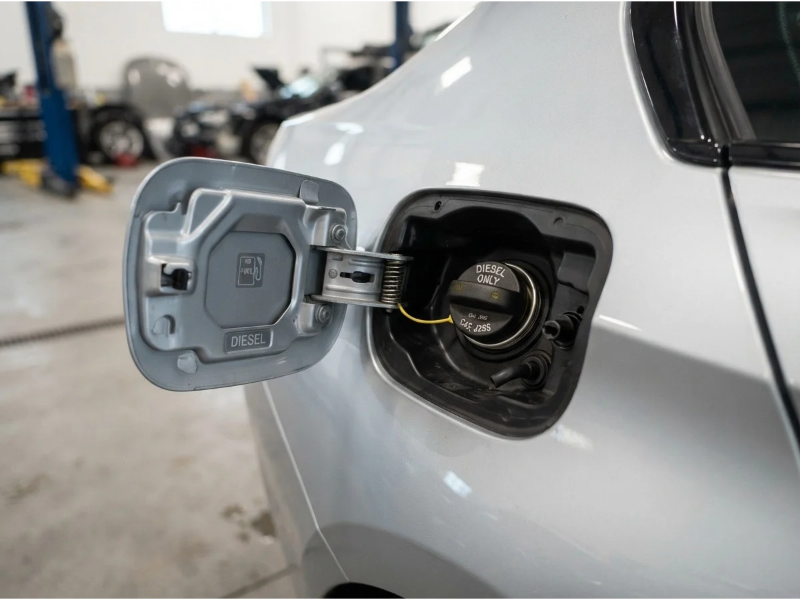
A fuel door is the hinged exterior panel that covers the opening used to add gasoline or diesel fuel to a vehicle. It is usually located on one of the rear quarter panels, close to the fuel tank.
The fuel door itself normally does not seal the fuel system. Instead, it acts as a protective and cosmetic cover over the actual fuel-filling components.
Behind the door, a vehicle may have:
- A removable fuel cap
- A capless fuel-filler opening
- A fuel filler neck
- A locking pin or latch
- A drain area
- A fuel-door hinge
- A fuel-door release mechanism
The design varies considerably between cars, trucks, SUVs, and vans.
On older vehicles, the fuel door may be nothing more than a spring-loaded metal flap. On newer vehicles, it can be connected to the central locking system so that the fuel door locks automatically when the vehicle is locked.
What Does Fuel Door Mean?
If you see the term fuel door in an owner’s manual, dashboard message, repair guide, or replacement-parts listing, it normally means the exterior door covering the fuel-filler opening.
In everyday American English, many drivers simply call it the gas door.
The word “fuel” is more technically accurate because the vehicle could use gasoline, diesel, or another liquid fuel.
A dashboard warning such as “Check Fuel Door” or “Fuel Door Open” may refer to the exterior door itself, although the exact meaning depends on the vehicle. Some vehicles monitor the fuel-filler system rather than the physical outer flap.
What Is the Fuel Door Called on a Car?
The fuel door on a car can be called several different names.
Common terms include:
- Fuel door
- Fuel filler door
- Gas door
- Fuel flap
- Gas flap
- Fuel-filler flap
Automakers, repair manuals, parts catalogs, and mechanics may use slightly different terminology.
“Fuel filler door” is one of the more precise technical names because the panel provides access to the vehicle’s fuel filler.
In casual conversation in the United States, “gas door” is probably the most familiar term for gasoline-powered vehicles.
Is a Fuel Door the Same as a Gas Cap?
No. The fuel door and gas cap are different parts.
The fuel door is the exterior body panel that you open first.
The gas cap, more properly called the fuel filler cap, is the cap that seals the filler-neck opening on vehicles that use a removable cap.
A typical arrangement looks like this:
Car body → fuel door → fuel cap → filler neck → fuel tank
Some modern vehicles do not have a removable gas cap. They use a capless fuel-filler system with internal spring-loaded sealing doors.
In that design, you still have an exterior fuel door, but you may not see a traditional screw-on gas cap behind it.
Is the Fuel Door Part of the Fuel Tank?
Not directly.
The fuel door is mounted to the vehicle’s body. The fuel tank is located farther inside or underneath the vehicle.
The fuel door gives you access to the fuel filler neck, which connects the exterior filling point to the fuel tank.
This distinction matters when diagnosing a problem. A damaged fuel door does not automatically mean that anything is wrong with the fuel tank itself.
Main Parts Around a Fuel Door
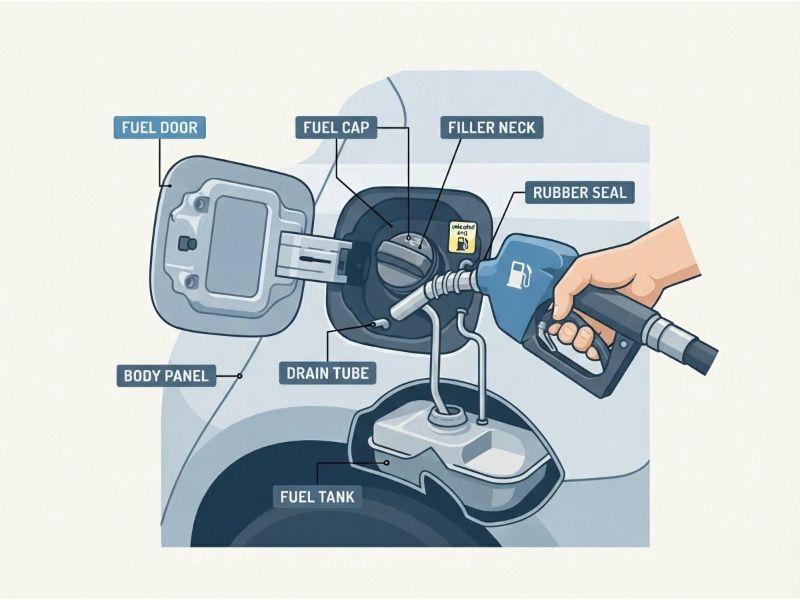
Although the exterior flap looks simple, several parts may work together in the fuel-door area.
Fuel Door Panel
This is the painted exterior panel that you see from outside the vehicle.
It is normally shaped to sit nearly flush with the surrounding bodywork.
Fuel Door Hinge
The hinge allows the door to swing open and closed.
Some hinges use a spring so the door remains open during refueling or snaps closed afterward.
Fuel Door Latch
A latch holds the door in its closed position.
Depending on the vehicle, the latch may be mechanical, spring-loaded, or controlled by a locking actuator.
Fuel Door Actuator
The actuator is an electrical or electromechanical device that can lock or unlock the fuel door.
It is common on vehicles where the fuel door is connected to the power-locking system.
Fuel Filler Neck
The fuel filler neck is the tube that carries fuel from the filling opening toward the tank.
On a traditional system, the gas cap attaches to the upper end of this neck.
Fuel Cap or Capless Filler
Older and many current vehicles use a removable fuel cap.
Other vehicles use capless refueling systems with internal sealing flaps that open when the proper fuel nozzle is inserted.
What Is a Fuel Door Actuator?
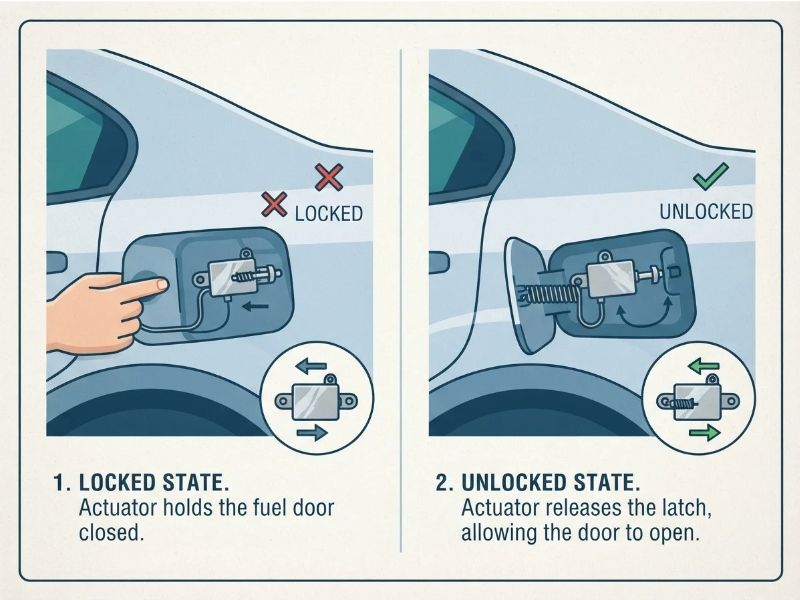
A fuel door actuator is a small powered mechanism that locks or unlocks the fuel door.
On many modern vehicles, the actuator is tied to the vehicle’s central locking system. When you lock the car, a small pin may extend into the fuel-door mechanism. When the car is unlocked, the actuator retracts the pin so the fuel door can open.
The exact design varies by manufacturer.
Some actuators use a tiny electric motor. Others use a solenoid or a motor-driven plastic gear mechanism.
How Does a Fuel Door Actuator Work?
A common fuel-door actuator works in four basic stages.
- You lock or unlock the vehicle.
- The body-control system sends electrical power or a control signal to the actuator.
- The actuator moves a small locking pin.
- The pin either blocks or releases the fuel door.
When the vehicle is unlocked, you can usually press the fuel door and release it.
When the vehicle is locked, the pin prevents the fuel door from opening.
This arrangement lets the manufacturer secure the fueling point without requiring a separate key-operated gas cap.
Does Every Vehicle Have a Fuel Door Actuator?
No.
Many vehicles use simpler systems such as:
- A mechanical cable
- A spring-loaded push-to-open latch
- A manual lever
- A non-locking fuel door
- A lock built into the fuel cap
Older cars are especially likely to use purely mechanical arrangements.
What Happens When a Fuel Door Actuator Fails?
A failing actuator can prevent the fuel door from unlocking or locking correctly.
Possible symptoms include:
- Fuel door will not open
- Fuel door remains unlocked when the car is locked
- Clicking or buzzing near the fuel door
- Door opens intermittently
- Door only opens after repeatedly locking and unlocking the vehicle
- Locking pin does not move
- Actuator works in warm weather but sticks in cold conditions
A stuck door does not always mean the actuator itself has failed. Ice, dirt, a misaligned hinge, broken plastic parts, a weak spring, or an electrical problem can create similar symptoms.
How Does a Fuel Door Open?
There is no single system used on every vehicle.
Manufacturers commonly use one of four designs.
Push-to-Open Fuel Door
With this design, the vehicle usually needs to be unlocked first.
You press lightly on one edge of the fuel door, and a spring-loaded mechanism pops it outward.
This setup is common on newer vehicles.
Interior Fuel Door Lever
Some vehicles have a small mechanical lever inside the cabin.
Pulling the lever operates a cable that releases the fuel-door latch.
The lever often displays a small fuel-pump symbol.
Dashboard Fuel Door Button
Some vehicles use an electronic push button instead of a mechanical lever.
Pressing the button releases the door electronically.
Manual Fuel Door
On simpler systems, there may be no interior release at all.
You simply pull on the door from outside.
Security may be provided by a locking gas cap instead of a locking fuel door.
Where Is the Fuel Door?
If you are asking where is the fuel door, look on the rear portion of either side of the vehicle.
Most passenger vehicles place it on either the:
- Left rear quarter panel
- Right rear quarter panel
It is usually positioned relatively close to the fuel tank and filler-neck routing.
The exact side depends on the vehicle’s engineering and body design.
How Can You Tell Which Side the Fuel Door Is On?
You usually do not need to get out of the car and check.
Look at the fuel-gauge symbol on the instrument panel.
Many vehicles have a small triangle or arrow beside the fuel-pump icon.
For example:
◀ fuel-pump symbol
usually indicates that the fuel door is on the left side.
fuel-pump symbol ▶
usually indicates that the fuel door is on the right side.
This is especially useful when driving a rental car or a vehicle you do not use regularly.
Does the Fuel-Hose Picture Show Which Side the Fuel Door Is On?
Do not rely on the direction of the hose drawn on the fuel-pump icon.
The small arrow or triangle is the useful indicator on vehicles equipped with one.
Some older cars do not have a fuel-door arrow at all.
Where Is the Fuel Door Release?
The answer to where is the fuel door release depends on how the vehicle is designed.
A fuel door release may be located:
- Near the driver’s seat
- On the floor beside the seat
- On the lower dashboard
- On the driver’s door panel
- Near the hood or trunk-release controls
- Directly in the fuel-door mechanism
Many newer vehicles do not have a separate interior release.
Instead, unlocking the vehicle releases the fuel door, and you press directly on the door to open it.
Where Is the Fuel Door Release Located?
If you cannot find the release, start with the driver’s side of the cabin.
Near the Driver’s Seat
Some cars have a small lever on the floor or lower trim beside the driver’s seat.
Look for a fuel-pump symbol.
Be careful not to confuse it with the trunk-release lever.
Lower Dashboard Area
Some electronic fuel-door releases are positioned on the lower dashboard to the left of the steering wheel.
They may sit beside switches for:
- Trunk release
- Hood release
- Traction-control settings
- Instrument lighting
Driver’s Door Panel
A few vehicles place electronic release controls on or near the driver’s door panel.
On the Fuel Door Itself
A growing number of vehicles use a push-to-release fuel door.
There is no visible cabin button.
You unlock the car and gently push the rear portion of the fuel door. The latch releases and the door pops outward.
Check the Owner’s Manual When the Release Is Not Obvious
Fuel-door designs differ enough that guessing can sometimes make things worse.
Do not pry open a door that appears locked. Plastic hinges, painted panels, and latch components can break relatively easily.
If the normal opening method is unclear, the vehicle owner’s manual should identify the proper release method.
Why Are Fuel Doors on Different Sides?
Drivers often wonder why are fuel doors on different sides instead of manufacturers simply putting every fuel door on the same side.
There is no universal rule requiring passenger vehicles in the United States to have the filler door on one particular side.
Manufacturers choose the location based on factors such as:
- Fuel-tank design
- Filler-neck routing
- Exhaust-system placement
- Suspension layout
- Underbody packaging
- Body structure
- Crash-safety considerations
- Manufacturing requirements
- Available space
The best location for one vehicle platform may not be the best location for another.
Fuel Tank and Filler-Neck Packaging
The fuel filler neck has to run from the exterior opening to the fuel tank.
Engineers generally want routing that works safely and efficiently while avoiding interference with other major components.
Changing the fuel-door side may simplify this packaging.
Exhaust System Location
Hot exhaust components must be considered when engineers route fuel-system components.
The vehicle’s muffler, exhaust piping, emissions equipment, and fuel tank can all influence the available space.
Suspension and Structural Components
Rear suspension parts, frame rails, wheel wells, and body reinforcements compete for space underneath the rear of a vehicle.
The filler neck needs a practical path through this area.
Vehicle Platform Design
Automakers often build multiple models on related vehicle platforms.
A particular platform may be designed around one fuel-tank layout, which can influence the side used for several different models.
Is the Fuel Door Side Based on Which Side You Drive On?
Not reliably.
You may hear that fuel doors are intentionally placed on one side so drivers stand away from traffic while refueling. That idea may appear logical, but fuel-door placement across modern vehicles is too inconsistent for it to be treated as a universal design rule.
Engineering and packaging requirements play a major role.
Why Do Some Cars Have Fuel Doors on the Left?
A left-side fuel door may provide the most practical route between the filler opening and tank on a particular vehicle.
It may also fit more easily around the rear suspension, exhaust, or body structure.
For drivers in the United States, a left-side filler can feel convenient because it is on the driver’s side, but convenience alone does not explain every manufacturer’s design.
Why Do Some Cars Have Fuel Doors on the Right?
The same engineering principles apply.
A right-side fuel door may work better with the specific fuel tank, exhaust, structural members, or body design used by that vehicle.
Neither side automatically indicates better quality, safety, or performance.
What Is Behind the Fuel Door?
Opening the fuel door can reveal several different layouts.
Traditional Fuel Cap
The most familiar system uses a threaded or ratcheting fuel cap.
You turn the cap counterclockwise to remove it and clockwise to reinstall it.
Many caps click when they are properly tightened.
Capless Fuel-Filler System
A capless system uses internal spring-loaded seals instead of a removable cap.
When the proper fuel nozzle enters the filler opening, the internal flaps open.
After the nozzle is removed, the seals close again.
Capless systems reduce the chance of losing or incorrectly reinstalling a traditional fuel cap.
Fuel-Type Label
The inside of the fuel door may contain important information such as:
- Gasoline requirement
- Diesel designation
- Recommended octane rating
- Ethanol compatibility
- Warning against certain fuels
Always follow the specifications listed for the actual vehicle rather than assuming all models use the same fuel.
Does the Fuel Door Keep Fuel From Leaking?
Not by itself.
The exterior fuel door is mainly a cover.
Fuel containment depends on components deeper in the system, including the filler-neck design, fuel cap or capless sealing mechanism, tank, valves, hoses, and evaporative-emissions components.
If the outer fuel door is missing, the vehicle may still retain fuel, although the filling area becomes less protected from dirt, water, impacts, and tampering.
Does a Fuel Door Need to Be Closed While Driving?
Yes, the fuel door should normally be closed before driving.
An open door can:
- Catch airflow
- Be damaged by objects
- Strike the body panel
- Allow dirt or water into the filler area
- Create an unnecessary protrusion from the vehicle
A loose or damaged fuel door should be repaired rather than left hanging open.
Why Won’t My Fuel Door Open?
A fuel door can become stuck for several reasons.
Common causes include a:
- Failed fuel door actuator
- Stuck locking pin
- Frozen door
- Broken release cable
- Damaged spring
- Misaligned hinge
- Broken latch
- Weak electrical connection
- Discharged vehicle battery
- Damaged push-to-open mechanism
Before assuming a part has failed, make sure the vehicle is fully unlocked.
On some models, the fuel door remains locked unless the driver’s door or entire vehicle is unlocked.
Fuel Door Frozen Shut
In freezing weather, moisture can freeze around the edge of the door.
Avoid aggressively prying against the painted panel.
Gentle warming and removing ice around the seam is safer than forcing the hinge or latch.
Fuel Door Actuator Stuck
Try locking and unlocking the vehicle again.
If the actuator is operating weakly, you may hear movement or clicking near the filler door without the locking pin fully retracting.
Some vehicles have an emergency fuel-door release accessible from inside the trunk or cargo area.
Its location is vehicle-specific.
Where Is the Emergency Fuel Door Release?
Not every car has one.
On vehicles that do, the emergency release is commonly accessed from:
- The trunk
- The rear cargo area
- Behind an interior trim panel close to the fuel door
It may be a cable, pull tab, or small manual lever.
Because interior trim and release mechanisms vary widely, use the vehicle owner’s manual before removing panels.
Pulling unrelated cables or forcing trim pieces can create additional damage.
Why Won’t My Fuel Door Stay Closed?
A door that keeps popping open may have a problem with the:
- Latch
- Catch
- Spring
- Hinge
- Push-release mechanism
- Locking pin
- Door alignment
Sometimes a minor impact or repeatedly leaning against the door can shift the panel enough to stop the latch from lining up correctly.
A broken plastic catch is also possible.
Why Won’t the Fuel Door Lock?
If the vehicle locks normally but the fuel door remains unlocked, the fuel-door actuator or locking pin may not be moving correctly.
Possible causes include:
- Failed actuator motor
- Broken actuator gear
- Jammed locking pin
- Electrical wiring problem
- Damaged latch
- Misalignment
First confirm that the vehicle was originally designed with a locking fuel door. Some vehicles intentionally leave the fuel door itself unlocked.
Can You Drive With a Broken Fuel Door Actuator?
A failed actuator usually does not prevent the engine from operating, but the practical problem depends on how it fails.
If it fails in the unlocked position, you may still be able to refuel normally, although the filler area may no longer lock with the car.
If it fails in the locked position, you may be unable to refuel until the door can be manually released or repaired.
Do not force the painted fuel door open. Breaking the door, hinge, or quarter-panel mounting area can turn a relatively small repair into a more expensive body repair.
Fuel Door vs. Fuel Cap vs. Fuel Filler Neck
These three terms are easy to confuse.
| Component | What It Is | Main Purpose |
| Fuel door | Exterior hinged body panel | Covers the fueling area |
| Fuel cap | Removable sealing cap | Seals the filler opening on capped systems |
| Fuel filler neck | Tube leading toward the tank | Carries fuel from the opening to the tank |
| Fuel door actuator | Electric locking mechanism | Locks or unlocks the fuel door |
| Fuel door release | Lever, button, latch, or cable | Allows the door to open |
Understanding these names makes troubleshooting and shopping for replacement parts much easier.
Fuel Door vs. Charge Port Door on Electric Vehicles
A battery-electric vehicle does not need a gasoline fuel door because it does not use liquid fuel.
Instead, it has a charging-port door covering the electrical charge connector.
The two panels can look similar from the outside, but their functions are completely different.
Plug-in hybrid vehicles may have both:
- A fuel door for gasoline
- A charge-port door for electricity
They may be located on opposite sides of the vehicle.
How to Use a Fuel Door Correctly
Using a fuel door is straightforward, but a few habits can prevent unnecessary damage.
First, use the release method designed for your vehicle. Do not pry the door outward if it seems locked.
Next, open the door gently and avoid placing your weight against it.
If the vehicle has a removable gas cap, reinstall it according to the owner’s instructions.
After refueling, close the fuel door until the latch engages.
If the car uses a locking fuel door, locking the vehicle may also secure the filler area.
Can a Fuel Door Be Replaced?
Yes.
Fuel doors, hinges, springs, latches, actuators, and related components can usually be replaced separately.
Replacement difficulty varies significantly by vehicle.
A simple fuel-door panel or hinge may be relatively accessible. An actuator mounted behind interior trim or body panels can require more disassembly.
Replacement exterior doors may also need to be painted to match the vehicle.
When Should a Fuel Door Be Repaired?
Consider repairing the system if the fuel door:
- Will not open reliably
- Will not remain closed
- Hangs loosely
- Scrapes against the body
- No longer locks
- Has a broken hinge
- Has a broken latch
- Requires excessive force
- Is visibly damaged
Addressing a small hinge or latch problem early can help prevent damage to the painted door or surrounding body panel.
Common Fuel Door Mistakes to Avoid
One of the biggest mistakes is forcing a locked fuel door open.
Modern fuel doors often use relatively small plastic components. A screwdriver or other prying tool can easily damage paint, distort the panel, or snap the hinge.
Another mistake is assuming the fuel door and fuel cap are the same thing. If a warning light relates to the evaporative-emissions system, replacing an exterior fuel door usually will not solve a leak caused by a loose cap or another fuel-vapor component.
Finally, do not assume a stuck fuel door always needs a new actuator. Check the basic mechanical parts and the vehicle’s locking status first.
FAQs About What Is a Fuel Door
What does fuel door mean on a car?
A fuel door is the exterior panel covering the vehicle’s fuel-filler opening. It may also be called a gas door, fuel filler door, or fuel flap.
Its job is mainly to protect and conceal the filling area.
What is a fuel door actuator?
A fuel door actuator is a small electrical mechanism that locks or unlocks the fuel door. It commonly operates with the vehicle’s central locking system.
When the car unlocks, the actuator retracts a locking pin so the fuel door can open.
What is the fuel door called on a car?
Common names include fuel door, fuel filler door, gas door, and fuel flap.
Parts catalogs often use “fuel filler door” or “fuel door assembly.”
Where is the fuel door?
The fuel door is normally located on the left or right rear quarter panel of the vehicle.
Check the small arrow beside the fuel-pump icon on the instrument cluster to identify the side on many vehicles.
Where is the fuel door release?
The fuel door release may be near the driver’s seat, on the lower dashboard, on the door panel, or built into the exterior fuel-door mechanism.
Some modern cars do not have a separate interior fuel-door release.
Where is the fuel door release located if there is no button?
If no interior button or lever is visible, unlock the vehicle and gently press the fuel door.
Many cars use a push-to-open design connected to the central locking system.
Why are fuel doors on different sides?
Fuel doors are on different sides because manufacturers have to work around the fuel tank, filler-neck routing, exhaust system, suspension, body structure, and other underbody components.
There is no single universal side required for passenger vehicles in the United States.
How do I know what side my fuel door is on?
Look beside the fuel-pump symbol on the dashboard.
A small left-pointing or right-pointing arrow usually indicates which side of the vehicle contains the fuel door.
Can a fuel door actuator stop me from getting gas?
Yes. If the actuator fails while the fuel door is locked, it can prevent you from opening the door and accessing the filler opening.
Some vehicles provide a manual emergency release in the trunk or cargo area.
Does every fuel door lock?
No.
Some fuel doors lock with the vehicle, some use a mechanical cabin release, and others remain unlocked and rely on a locking fuel cap or other design.
Conclusion
Understanding what is a fuel door is easier once you separate the exterior panel from the fuel cap, filler neck, latch, and actuator behind it. The fuel door is primarily a protective body panel that gives you access to the vehicle’s refueling point.
Depending on the vehicle, it may open with a lever, button, push-to-release latch, or central-locking system. A fuel door actuator may lock the door automatically, while the fuel filler neck carries fuel toward the tank.
The fuel door can be on either side of a car because manufacturers must work around the fuel tank, exhaust, suspension, structure, and available packaging space. If you are ever unsure where the door or its release is located, the dashboard fuel-pump arrow and owner’s manual are usually the quickest places to check.