The best place to get your car windows tinted is a reputable automotive window tint shop or an authorized installer for a recognized window film manufacturer. Professional tint shops have specialized tools, suitable installation areas, and experience applying film to curved automotive glass.
You can also get windows tinted at certain auto detailing businesses, car accessory shops, dealerships, and mobile tinting services. However, not every business offers the same film quality, workmanship, or warranty coverage.
Choosing the right installer matters because poor installation can leave bubbles, dust particles, uneven edges, peeling film, or damaged rear-window defroster lines. A low price may seem appealing initially, but replacing defective film can increase the total cost.
A qualified installer should also help you choose a tint shade that complies with local laws while meeting your privacy, heat rejection, and visibility preferences.
In this article, I explain where to get windows tinted, how to find trustworthy installers, and which types of businesses offer professional tinting. You’ll also learn about installation costs, ceramic and regular tint options, warranty coverage, questions to ask before booking, and how to inspect the finished windows.
Where to Get Windows Tinted: 6 Common Installation Options
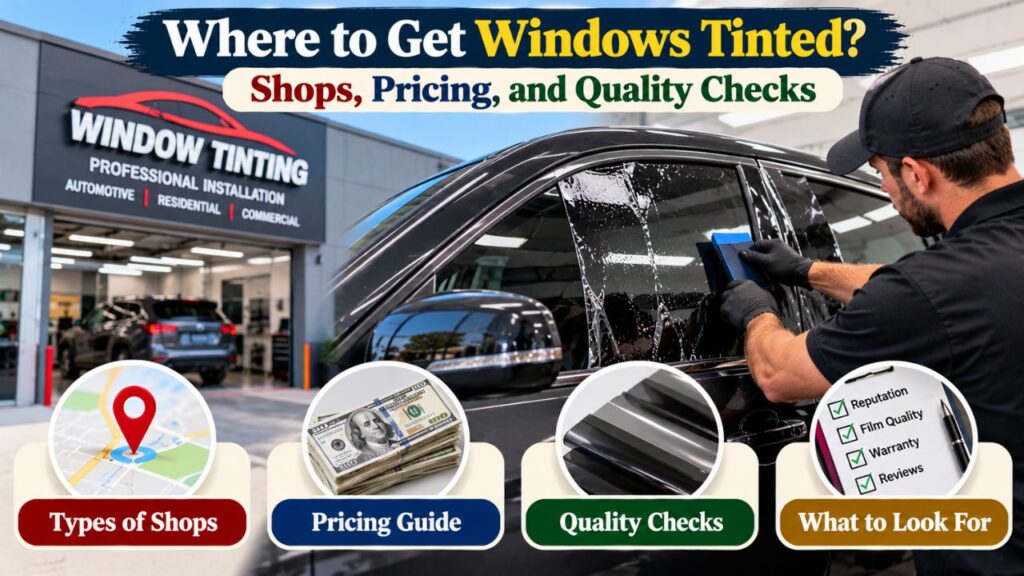
Several types of automotive businesses provide window tinting services. Some specialize exclusively in film installation, while others include tinting among their vehicle customization services.
The best choice depends on the film you want, the vehicle’s design, installation quality, and available warranty support.
1. Professional Automotive Window Tint Shops
A dedicated automotive window tint shop is generally the best starting point.
These businesses specialize in installing tint film on vehicle windows.
Experienced tint technicians typically work with:
- Front driver and passenger windows.
- Rear passenger windows.
- Rear windshields.
- Quarter windows.
- Sunroofs and panoramic glass.
- Windshield tint strips where legally permitted.
Specialized shops may offer dyed, carbon, ceramic, and other high-performance film options.
Many also provide tint removal and replacement services.
A reputable shop should be able to explain the differences between films, show actual product specifications, and discuss the legal restrictions for your vehicle.
Best for: Drivers wanting professional installation, multiple film choices, and clear warranty information.
2. Authorized Window Film Dealers
Authorized dealers are another strong option, particularly when you’re interested in a specific film brand.
These businesses participate in a manufacturer’s dealer network and offer designated products.
Depending on the manufacturer, authorized dealers may receive product training, installation guidance, and access to manufacturer-backed warranty programs.
For example, you can use the 3M Automotive Window Film Installer Locator to access the company’s installer search and locate businesses offering 3M automotive films.
Authorized status is useful, but it should not replace checking the individual shop’s workmanship and customer service.
Two authorized businesses can still provide different installation experiences.
Best for: Drivers seeking specific premium films, manufacturer-recognized installers, and documented product warranties.
3. Auto Detailing Shops
Some professional auto detailing businesses also install window tint.
These businesses may offer services such as paint correction, ceramic coatings, interior cleaning, and paint protection film.
Tinting can be convenient if you’re already having several vehicle appearance services completed.
However, not every detailer is an experienced window film installer.
Before booking, ask whether the business has a dedicated tint technician or outsources the service to another company.
Also request examples of completed tint installations rather than relying only on the shop’s detailing reviews.
Best for: Vehicle owners combining tint installation with other appearance or protection services.
4. Car Dealerships
Some dealerships offer window tinting as an optional service during vehicle purchases.
The tint may be installed before delivery or included in an additional vehicle protection package.
This can be convenient when buying a new or used car.
However, dealership tinting may be completed by an independent contractor rather than the dealership’s own technicians.
Before purchasing a dealership tint package, ask:
- Which company installs the film?
- What exact film brand and series are used?
- Is the tint professionally installed or factory privacy glass?
- What warranty is included?
- Who handles bubbling, peeling, or other defects?
- How does the price compare with an independent tint shop?
A dealership package isn’t automatically higher quality because it is sold with a vehicle.
Best for: Buyers prioritizing convenience during a vehicle purchase.
5. Mobile Window Tinting Services
Mobile window tinting businesses travel to a customer’s location instead of requiring the vehicle to be brought to a shop.
Depending on the provider, installation may take place in a garage or another suitable sheltered environment.
This option can be convenient for busy vehicle owners.
However, window film installation requires careful cleaning and protection against contamination.
Outdoor wind, dust, rain, and unstable temperatures can make installation more difficult.
Ask whether the mobile installer requires an enclosed garage or another controlled work area.
Avoid providers who plan to install expensive film outdoors in obviously unsuitable conditions.
Best for: Drivers wanting installation at home or work when a suitable indoor workspace is available.
6. Automotive Accessory and Customization Shops
Some car audio, vehicle wrap, and automotive customization shops offer window tinting.
These businesses may combine tint installation with:
- Vehicle wraps.
- Paint protection film.
- Audio upgrades.
- Dashcam installation.
- Lighting accessories.
- Interior customization.
A well-equipped customization shop may have experienced tint installers.
However, tinting expertise varies.
Choose the business based on its actual window film experience rather than assuming all vehicle accessory shops provide equivalent results.
Best for: Drivers planning several vehicle customization services.
Which Type of Window Tint Installer Is Best?
The following comparison can help narrow your options.
| Installation provider | Main advantage | What to verify |
| Dedicated tint shop | Specialized installation experience | Film brands, workmanship, reviews |
| Authorized film dealer | Access to recognized film products | Current authorization, warranty |
| Auto detailing shop | Convenient combination of services | Tint technician’s experience |
| Car dealership | Easy to arrange during purchase | Actual installer, package pricing |
| Mobile tint service | Installation at your location | Clean workspace, warranty support |
| Car accessory shop | Multiple customization services | Window tint portfolio and equipment |
My recommendation is to start with a dedicated tint shop or an authorized manufacturer dealer. These businesses are often the most straightforward choice for comparing film specifications, installation workmanship, and warranty coverage.
How to Find a Good Window Tint Shop Near You
Finding a nearby tint business is relatively easy. Determining which shop will do quality work requires more attention.
Use a combination of online searches, manufacturer directories, reviews, and direct questions.
Search for Local Automotive Tint Specialists
Start with search phrases that match the service you need.
Useful examples include:
- Car window tinting near me.
- Professional auto tint shop near me.
- Ceramic window tint installers.
- Authorized window tint dealers.
- Window tint removal and replacement.
- Mobile car window tinting near me.
Search engines and map services can help identify nearby businesses.
However, appearing near the top of search results doesn’t automatically establish installation quality.
Check the business’s services, customer photos, and recent reviews.
Use Official Manufacturer Dealer Locators
Manufacturer directories can help identify installers that offer specific film brands.
For example, the LLumar Find a Dealer directory allows customers to search for dealers using a location and product category.
You can use the directory to find businesses offering LLumar automotive films and then contact those businesses for availability and pricing.
Other automotive film manufacturers maintain their own installer or dealer networks.
Using an official directory can help verify whether a business is associated with the film manufacturer it advertises.
However, confirm current authorization directly with the dealer or manufacturer when necessary.
Read Recent Customer Reviews
Reviews can provide useful information about installation quality and service.
Look beyond the overall star rating.
Pay attention to comments discussing:
- Bubbling or peeling after installation.
- Uneven film edges.
- Dust trapped beneath the film.
- Customer service after payment.
- Warranty claims.
- Whether the quoted price matched the final bill.
- How the shop handled installation problems.
Recent reviews are particularly useful because businesses can change employees, ownership, or operating practices.
A handful of positive reviews doesn’t guarantee good workmanship.
Likewise, one negative review may not represent the business’s typical service.
Look for consistent patterns.
Check Photos of Completed Tint Jobs
Ask to see recent photographs of vehicles tinted by the shop.
Look for clear images of window edges, curved rear glass, and the finished appearance.
The best photos reveal more than just how dark the windows look.
They should help you evaluate trimming, alignment, and the general cleanliness of the installation.
If possible, inspect a completed vehicle in person.
Get Multiple Written Quotes
Contact at least two or three suitable installers before booking.
Give each business the same information about your vehicle and desired service.
Ask them to quote the same film type, window coverage, and removal requirements.
This makes price comparisons more meaningful.
A very low quote may exclude services included in another business’s price.
Key Takeaway: A trustworthy tint shop should provide clear product information, realistic pricing, current reviews, and written warranty terms before installation begins.
What Should You Ask a Window Tint Shop Before Booking?
Asking the right questions can prevent misunderstandings about film quality, legality, and warranty coverage.
Questions to Ask Your Tint Installer
| Question | Why it matters |
| Which film brand and exact series will be installed? | Confirms the actual product |
| Is the film dyed, carbon, ceramic, or another type? | Helps compare technology |
| What are its VLT and TSER ratings? | Identifies darkness and solar performance |
| Will the finished tint comply with local law? | Reduces compliance problems |
| Is old tint removal included? | Prevents unexpected charges |
| Who performs the installation? | Clarifies installer experience |
| Is there a manufacturer warranty? | Identifies product coverage |
| Is workmanship covered separately? | Clarifies installation-related repairs |
| How long will installation take? | Helps with scheduling |
| How long before I can lower the windows? | Helps prevent premature damage |
Ask for the answers in writing when possible.
A reliable installer should be comfortable identifying the products and services included in the quote.
Why the Exact Film Brand Matters
The term ceramic tint does not describe one standardized level of performance.
Different ceramic films may provide substantially different heat rejection, optical clarity, and warranty coverage.
A shop advertising ceramic tint should be able to identify the actual manufacturer and film series.
For example, asking for the exact product is more useful than accepting a quote described only as premium ceramic.
You can then compare the technical specifications independently.
Why the Final Tint Percentage Matters
Visible Light Transmission (VLT) measures how much visible light passes through glass or film.
For example:
- 70% VLT is relatively light.
- 50% VLT provides modest darkening.
- 35% VLT is medium-dark.
- 20% VLT is dark.
- 5% VLT is extremely dark.
However, the percentage on a film package is not necessarily the final transmission of the installed window.
Original vehicle glass already blocks some light.
Ask whether the installer measures the combined glass-and-film VLT.
How Much Does It Cost to Get Car Windows Tinted?
Professional window tinting prices vary according to vehicle size, film technology, installation complexity, and local labor rates.
Premium ceramic film generally costs more than basic dyed tint.
The number of windows also has a major effect on the total.
Estimated Window Tinting Prices in the United States
The following are broad planning ranges for professional installation, not fixed national prices or guaranteed quotes.
| Tinting service | Approximate price |
| Two front side windows | 80–300 |
| Full sedan, basic dyed film | 150–350 |
| Full sedan, carbon or comparable midrange film | 250–500 |
| Full sedan, ceramic film | 350–900+ |
| SUV or larger vehicle, ceramic film | 450–1,000+ |
| Existing tint removal | Additional charge varies by job |
Full-vehicle estimates generally refer to side and rear windows, excluding the windshield unless the installer explicitly states otherwise.
Actual prices may fall outside these ranges.
Luxury vehicles, highly curved glass, large SUVs, premium film series, and difficult tint removal can increase costs.
Why Some Tint Shops Charge More
A higher installation price may reflect:
- More expensive film.
- Experienced technicians.
- Dedicated indoor installation facilities.
- Difficult glass shapes.
- Additional preparation and cleaning.
- Better documented warranty coverage.
- Regional labor costs.
However, a high price doesn’t automatically guarantee good results.
Compare the product and workmanship rather than selecting a shop solely because it is expensive.
Is Cheap Window Tinting Worth It?
Low-cost tinting can be reasonable when a reputable installer uses an appropriate entry-level film.
However, an unusually cheap quote deserves closer inspection.
Ask whether the price includes all windows, preparation, removal of old tint, taxes, and warranty coverage.
Some inexpensive products may provide less solar heat rejection or have limited long-term color stability.
Don’t assume all budget tinting is poor quality, but don’t purchase an unidentified film simply because the price is attractive.
Should You Choose Ceramic Tint or Regular Tint?
The best tint depends on whether your main goal is privacy, appearance, heat reduction, or a combination of these benefits.
Regular Dyed Window Tint
Dyed tint primarily reduces visible light transmission.
It can provide a darker appearance and reduce daytime glare.
It is often one of the more economical options.
However, basic dyed films may provide less overall heat rejection than premium solar-control technologies.
Carbon Window Tint
Carbon-based films use carbon-containing materials to influence visible light and solar transmission.
Performance varies by manufacturer.
Some carbon products offer better solar performance and color stability than basic dyed films.
Compare the specifications rather than relying on the carbon label alone.
Ceramic Window Tint
Ceramic window tint uses specialized nonmetallic particles to manage solar energy.
High-performance ceramic films can provide substantial heat rejection while allowing relatively high visible light transmission.
This makes them attractive for drivers who want cooling benefits without extremely dark windows.
However, ceramic film quality varies.
A premium ceramic product can cost considerably more than a basic dyed film.
Which Film Should You Ask the Shop to Install?
| Your main goal | Film worth considering |
| Affordable darker appearance | Quality dyed film |
| Moderate price and solar performance | Suitable carbon film |
| Strong heat rejection | Tested high-performance ceramic or multilayer film |
| UV protection without heavy darkening | Light UV-blocking automotive film |
| Dark rear-window privacy | Legally compliant darker film |
| Better nighttime visibility | High-VLT film |
If heat rejection is important, ask for the Total Solar Energy Rejection (TSER) rating.
A darker film does not automatically reject more total heat than a lighter high-performance product.
Is It Better to Get Windows Tinted at a Dealership or Tint Shop?
A dedicated tint shop is often the more direct choice because you can discuss the product and installation with the business performing the work.
However, dealerships can be convenient, especially when purchasing a vehicle.
Advantages of Dealership Window Tinting
Dealership tinting may offer:
- Convenient scheduling during vehicle purchase.
- Coordination before vehicle delivery.
- Optional inclusion in a protection package.
- A single point of contact for the initial service.
However, the dealership may hire an outside installer.
The actual film and workmanship determine the result, not the location where you purchased the service.
Advantages of a Specialized Tint Shop
A dedicated tint shop may offer:
- A broader selection of film brands.
- Detailed shade and performance comparisons.
- Direct contact with the installation technician.
- Experience removing old tint.
- Specific workmanship warranty terms.
- More opportunities to inspect installation samples.
The better option is the one that offers a suitable film, experienced installation, clear pricing, and reliable after-sales support.
Should You Pay for Dealer-Installed Tint?
Ask for the exact film specifications and installation details before accepting the package.
If the dealership cannot identify the film series or warranty provider, compare its offer with independent shops.
A dealership package may still be convenient, but convenience should be evaluated alongside product quality and price.
Can You Get Car Windows Tinted at Home?
Yes. Mobile window tinting services can install film at your location when suitable working conditions are available.
However, professional tinting needs a clean environment.
What Mobile Tint Installers Usually Need
A mobile provider may require:
- An enclosed garage or sheltered work area.
- Sufficient space around the vehicle.
- Appropriate temperature and weather conditions.
- Adequate lighting.
- Access to electricity or other required equipment.
- A reasonably clean environment.
The requirements vary by provider.
Some mobile businesses arrive with specialized equipment, while others expect the customer to provide an appropriate workspace.
Is Mobile Tinting as Good as Shop Tinting?
It can be, provided the technician is experienced and the working environment is suitable.
The main concern is controlling dust, wind, moisture, and other sources of contamination.
An indoor installation bay generally provides more predictable conditions than an exposed driveway.
Ask the mobile installer how installation quality and warranty repairs are handled.
If a provider plans to install premium film outdoors during windy or rainy weather, consider choosing a shop with an indoor facility.
Can You Get Just One or Two Car Windows Tinted?
Yes. Many professional tint shops offer partial installation.
You do not necessarily need to purchase a full-vehicle package.
Tinting Only the Front Two Windows
Tinting the front side windows is a common request, particularly for vehicles with darker factory privacy glass in the rear.
However, matching the appearance of factory privacy glass can be challenging.
The original glass and aftermarket film may have different colors, reflectivity, and transmission properties.
Also, front side windows often face stricter legal restrictions than rear windows.
An exact visual match may not be possible while remaining legal.
Tinting Only the Rear Windows
Some drivers tint only the rear passenger windows and back glass for privacy.
This may be practical when local regulations permit darker rear tint.
However, consider visibility through the rear windshield when reversing or driving at night.
Replacing Tint on a Single Window
If the film on one window is peeling or damaged, a tint shop may be able to remove and replace it.
Matching old tint can be difficult because the existing film may have faded or changed color.
Ask whether the shop can identify the original product.
If not, compare available replacement shades before installation.
How Long Does Professional Window Tinting Take?
Installation time depends on the number of windows, vehicle design, film type, and whether old tint must be removed.
A straightforward two-window job may be completed in a relatively short appointment.
Tinting an entire vehicle generally requires more time, particularly when the rear windshield has complicated curvature.
Old adhesive removal, damaged film, and special glass features may increase labor requirements.
What Happens During a Professional Tint Appointment?
A typical installation follows these stages:
- Inspect the vehicle and existing glass.
- Confirm the selected film and shade.
- Clean the windows thoroughly.
- Cut or plot the film to match the glass.
- Heat-shape film where necessary.
- Apply the film to the interior glass surface.
- Remove installation solution and trapped air.
- Finish the edges and inspect the work.
- Explain the curing and aftercare requirements.
The exact procedure depends on the shop.
Ask for the expected completion time when booking.
How Long Before You Can Roll Down Tinted Windows?
Freshly installed tint needs time for the adhesive to settle and moisture to evaporate.
The required waiting period varies according to the film, installation conditions, and manufacturer instructions.
Many installers recommend leaving the windows closed for several days, but the exact period should come from your installer.
Follow those instructions rather than assuming every film cures at the same rate.
How to Know Whether a Window Tint Shop Does Good Work
Installation quality is one of the main reasons to choose a reputable professional.
A good installer should prepare the glass properly, cut the film accurately, and inspect the finished result.
Signs of a Quality Tint Installation
Look for:
- Even, clean film edges.
- Consistent appearance across matching windows.
- No major creases or trapped debris.
- No obvious peeling.
- Proper adhesion around curved glass.
- No damage to surrounding trim.
- Clear aftercare instructions.
Certain vehicles have ceramic-dot patterns around the glass edges.
These dot-matrix areas can affect how film adheres and may create a slightly different appearance even with careful installation.
Ask about expected cosmetic limitations for your particular vehicle.
Are Small Bubbles Normal After Installation?
Some temporary moisture patterns or haze may appear shortly after installation.
They can disappear as the film cures.
However, hard particles, significant creases, persistent air bubbles, or poorly trimmed edges may indicate installation defects.
Allow the recommended curing period before judging minor moisture-related appearance changes.
If problems remain, contact the installer and request an inspection.
Should You Inspect the Tint Before Paying?
Yes, inspect the visible workmanship before accepting the completed service.
Review the windows under suitable lighting.
Confirm that the installed shade and film match the quotation.
Also collect the invoice, product information, and warranty documents.
Some curing-related effects cannot be evaluated immediately, so retain the shop’s contact details for follow-up.
What Warranty Should a Window Tint Shop Offer?
Warranty coverage can vary considerably between film manufacturers and installers.
Some products include a manufacturer-backed limited warranty, while the shop may offer separate workmanship coverage.
These two types of protection are not necessarily interchangeable.
Manufacturer Film Warranty
A manufacturer warranty may cover specified product defects such as:
- Certain color changes.
- Adhesive failure.
- Bubbling or peeling caused by covered product defects.
- Other issues specifically described in the warranty terms.
Coverage, duration, exclusions, and replacement procedures differ by manufacturer.
Some warranties require installation by an authorized dealer and proper documentation.
Installation Workmanship Warranty
A workmanship warranty addresses problems caused by the installation process rather than film manufacturing defects.
For example, it may cover certain trimming or application problems.
However, the actual terms depend on the shop.
Ask whether the business will remove and replace defective film at no charge if a covered workmanship issue appears.
Documents to Keep After Installation
Retain:
- The original invoice.
- Film manufacturer and series information.
- Installed tint shade.
- Warranty certificate or registration.
- Installer contact information.
- Written care instructions.
These documents can help if you need warranty service or a future replacement.
Key Takeaway: A reputable installer should explain exactly what is covered, for how long, and who handles repairs.
How to Check Window Tint Laws Before Choosing an Installer
Window tint laws vary across U.S. states.
Requirements can depend on the window’s location, vehicle classification, visible light transmission, reflectivity, and other restrictions.
Front Side Window Tint Requirements
Many states require front side windows to allow a minimum percentage of visible light through.
A shade that is legal on a rear passenger window may be prohibited on the front side windows.
For example, some states permit relatively dark front side tint, while others require much lighter glass.
Check the current laws in your state through the relevant government agency.
Windshield Tint Restrictions
Windshield tinting is commonly subject to stricter limitations.
Many states permit only a designated upper windshield strip, with specific placement and transmission requirements.
Certain clear or nearly clear UV-control films may be permitted under particular rules, but this varies by jurisdiction.
Do not assume a film is legal for the windshield because it looks transparent.
Why the Final Installed VLT Matters
Automotive glass already blocks some visible light.
Aftermarket film further reduces transmission.
For a simplified estimate:
Combined VLT = Original glass VLT × Film VLT ÷ 100
For example, original glass transmitting 80% of visible light combined with nominal 35% film gives:
80 × 35 ÷ 100 = 28% combined VLT
This is an approximation rather than a certified measurement.
Ask whether the installer uses a calibrated tint meter and can confirm the final window meets the applicable requirements.
Important: An installer offering an illegal tint shade doesn’t make the finished vehicle legal. Verify the rules before agreeing to the work.
Should You Get Windows Tinted Professionally or Do It Yourself?
DIY tinting kits are available, but applying automotive film correctly can be challenging.
Window tinting involves more than placing adhesive film against glass.
The surface must be thoroughly cleaned, the film cut accurately, and curved sections shaped without permanent creases.
Advantages of Professional Installation
Professional tinting offers several potential benefits:
- Experienced application.
- Specialized cutting and installation tools.
- Better control of dust and contamination.
- Access to professional film products.
- Workmanship support.
- Possible manufacturer warranty eligibility.
- Assistance choosing compliant tint shades.
These advantages depend on the installer, so choosing a reputable business still matters.
Advantages of DIY Tinting
DIY tinting may reduce labor expenses.
It can be practical for someone with appropriate tools, patience, and experience.
However, mistakes can waste the film and require complete removal and replacement.
Large curved rear windshields are especially difficult for beginners.
Which Option Is Better?
For a premium ceramic film or a full-vehicle installation, professional tinting is generally the more dependable choice.
For a simple, low-cost project, DIY installation may be reasonable if you understand the process and accept the risk of imperfect results.
In either case, use suitable automotive film and follow all applicable tint laws.
Common Mistakes When Choosing Where to Get Windows Tinted
A little research can prevent expensive installation problems.
Choosing a Shop Based Only on Price
The cheapest quote may not include the same film quality, preparation, and warranty as another offer.
Compare the exact product and services.
An inexpensive job can become costly if the film must be replaced.
Not Asking for the Film Brand
A business advertising premium ceramic tint should be able to identify the manufacturer and exact series.
Avoid agreeing to an unidentified product when you’re paying for specific performance benefits.
Ignoring the Shop’s Recent Reviews
A business’s reputation can change over time.
Recent customer experiences may reveal issues that older ratings don’t reflect.
Read reviews discussing actual tint installations, not just unrelated services.
Choosing a Tint Shade Before Checking the Law
A very dark tint may look appealing but create legal or nighttime visibility problems.
Check the limits for each window and the expected combined VLT before installation.
Assuming Every Tint Shop Has the Same Experience
Some installers specialize in side windows but have limited experience with complicated rear windshields, frameless glass, or unusual vehicle designs.
Ask whether the business has worked on your make and model.
Ignoring Aftercare and Warranty Instructions
Rolling down windows too early or using unsuitable cleaning methods can affect new film.
Follow the installer’s specific aftercare guidance and retain warranty information.
Final Checklist Before Booking a Window Tint Appointment
Use this checklist when comparing installers:
- Confirm that the business regularly installs automotive window tint.
- Check recent customer reviews and completed-work photographs.
- Ask for the exact film brand and series.
- Compare film VLT, TSER, and UV-rejection specifications.
- Confirm the shade complies with the applicable law.
- Ask whether old tint removal is included.
- Get a written quote for the selected windows.
- Confirm installation will take place in a suitable environment.
- Review manufacturer and workmanship warranty terms.
- Ask about curing time and window-cleaning instructions.
Completing these checks helps you compare shops based on actual service quality rather than price or advertising claims.
Conclusion
Knowing where to get windows tinted starts with identifying businesses that specialize in professional automotive film installation.
Dedicated tint shops and authorized film dealers are usually the best places to begin. Auto detailing businesses, dealerships, accessory shops, and mobile installers can also be suitable when they have qualified technicians and appropriate installation facilities.
Before booking, compare the exact film products, customer reviews, written prices, and warranty coverage.
For drivers interested in heat rejection, premium ceramic or other high-performance film may be worth considering. For those mainly seeking privacy and a darker appearance, a suitable lower-cost film may be enough.
I recommend contacting at least two or three reputable tint installers and requesting quotes for the same film category and window coverage.
Choose the shop that provides clear product information, reliable workmanship, legal installation, and dependable warranty support—not simply the lowest advertised price.
FAQs About Where to Get Windows Tinted
Where Is the Best Place to Get Car Windows Tinted?
A reputable automotive window tint shop or authorized film dealer is generally the best option.
These businesses specialize in film installation and can help compare different tint shades, technologies, and warranty terms.
Choose an installer based on verified experience, product transparency, and recent customer reviews.
Can You Get Windows Tinted at a Car Dealership?
Yes. Some dealerships offer window tinting during vehicle purchases or through optional protection packages.
However, the work may be outsourced to an independent installer.
Ask which film is used, who performs the installation, and how warranty claims are handled.
Can Auto Detailing Shops Tint Windows?
Yes. Some auto detailing shops provide professional window tinting alongside cleaning, coatings, and other vehicle appearance services.
However, not every detailer has specialized tint installation experience.
Check the technician’s qualifications and examples of completed window film work before booking.
How Much Does It Cost to Get Two Car Windows Tinted?
Two front side windows may cost roughly 80–300 for professional installation in the United States, depending on the film and local pricing.
Premium ceramic products may cost more than basic dyed film.
Request a vehicle-specific quote to confirm the total, including any old film removal.
Can You Get Windows Tinted at Home?
Yes. Mobile window tinting businesses may provide installation at your home or workplace.
A clean, sheltered working environment is important for controlling dust and other contaminants.
Ask about workspace requirements, warranty coverage, and how installation defects are handled.
How Long Does It Take to Get Windows Tinted Professionally?
The time depends on the number of windows, vehicle design, film type, and whether old tint needs removal.
Tinting two side windows typically requires less time than a full-vehicle installation.
Ask the shop for a specific appointment schedule and curing instructions.
Do You Need an Appointment to Get Windows Tinted?
Many tint shops accept appointments, while some may offer walk-in service.
Availability depends on the business and its workload.
Booking in advance is generally useful when you want a specific film series or a complete vehicle installation.
Can You Get Old Window Tint Removed and Replaced?
Yes. Many professional tint shops offer removal and replacement services.
The installer must remove the old film and adhesive before applying the replacement.
Extra care is required around rear-window defroster lines and sensitive glass components. Removal may cost extra, particularly when the old film is deteriorated.