You can purchase automotive window tint at AutoZone, Advance Auto Parts, O’Reilly Auto Parts, Walmart, Amazon, and specialty window film retailers. If you want premium ceramic tint professionally installed, authorized window tint dealers and local automotive tint shops are usually better options.
The best place to buy depends on whether you plan to install the film yourself or pay a professional. Auto parts stores and online retailers are convenient for basic DIY tint rolls, while specialty suppliers may offer more film types, precut kits, and professional-grade materials.
However, not every retailer sells the same products. Some carry inexpensive dyed film, while others specialize in carbon, ceramic, or multilayer solar-control films. Choosing an unfamiliar seller without checking the product specifications can lead to poor heat rejection, fading, or installation problems.
You also need to consider the tint’s visible light transmission, vehicle compatibility, warranty, and state regulations before purchasing.
In this article, I explain where to purchase window tint online and locally, including auto parts stores, major retailers, manufacturer-authorized dealers, and professional installation shops. I also compare buying options, explain how to choose suitable film for your vehicle, and cover pricing, authenticity, installation supplies, and common purchasing mistakes.
Where to Purchase Window Tint: Best Buying Options Compared
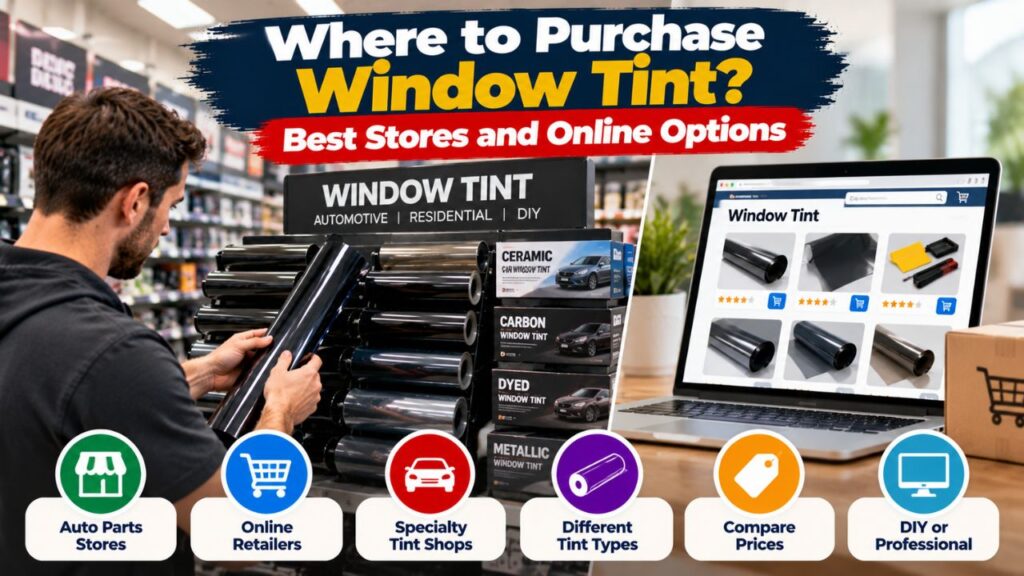
Several types of retailers sell automotive window film in the United States.
However, the available film categories, installation services, and technical support vary.
| Where to Buy | Common Products | Best For |
| AutoZone | DIY automotive tint rolls and accessories | Convenient local purchases |
| Advance Auto Parts | Window tint products and installation supplies | DIY car owners |
| O’Reilly Auto Parts | Automotive films and related accessories | In-store shopping |
| Walmart | Budget DIY tint rolls and kits | Affordable projects |
| Amazon | Tint rolls, precut kits, and various film types | Broad online selection |
| Home improvement stores | Selected DIY window films | Basic window film purchases |
| Specialty tint suppliers | Carbon, ceramic, and professional-grade films | More specific performance needs |
| Manufacturer-authorized dealers | Premium film products with installation | Professional-quality results |
| Local tint shops | Installed film packages | Drivers avoiding DIY installation |
Availability varies by store and location.
A large retailer may sell a particular film online without stocking it in nearby physical stores.
Before visiting, check local inventory or contact the retailer directly.
Key Takeaway: Buy DIY window film from an established auto parts store or trusted online supplier. For premium professionally installed tint, start with an authorized dealer or reputable tint shop.
1. Buy Window Tint at AutoZone
AutoZone is a practical place to look for automotive window tint if you prefer shopping at a physical auto parts store.
Its window tint selection can include products intended for DIY installation.
Availability depends on the specific location and current inventory.
What Types of Window Tint Can You Find at AutoZone?
Depending on stock, you may find:
- Automotive window tint rolls.
- Different visible light transmission percentages.
- Static-cling tint products.
- Window film installation supplies.
- Cleaning and application accessories.
Some products are designed for a straightforward DIY project, while others may require more installation experience.
Read the packaging before buying.
Why Buy Window Tint at AutoZone?
The main advantage is convenience.
You may be able to purchase the film and application supplies during the same visit.
Shopping in person also allows you to inspect the packaging and confirm basic specifications before paying.
However, the store may have fewer film choices than a specialty supplier.
Best for: Drivers who need readily available DIY window tint and prefer buying from an established automotive retailer.
2. Buy Window Tint at Advance Auto Parts
Advance Auto Parts is another option for purchasing automotive tint and related installation materials.
Its selection may include universal film rolls or vehicle-specific products, depending on current availability.
Advantages of Buying at Advance Auto Parts
Shopping through a major auto parts retailer can make it easier to:
- Check product descriptions.
- Compare basic tint percentages.
- Review available installation tools.
- Purchase through an established retailer.
- Arrange pickup when offered.
However, not every store carries the same inventory.
Some products may only be available online or through shipping.
What Should You Check Before Buying?
Confirm the film’s dimensions and intended application.
For example, a roll suitable for small side windows may not be wide enough for a large SUV window.
Also determine whether the film requires heat shaping.
Buying the wrong size or type can make installation unnecessarily difficult.
Best for: DIY installers who want to compare automotive tint products and purchase basic installation supplies.
3. Purchase Window Tint at O’Reilly Auto Parts
O’Reilly Auto Parts is another automotive retailer where window tint products may be available.
Its inventory can vary by location and online availability.
This option is useful when you want to purchase film without ordering from an unfamiliar website.
What to Look for at O’Reilly
Check whether the retailer carries:
- Adhesive automotive tint film.
- Static-cling window film.
- Different VLT percentages.
- Application kits.
- Cleaning tools.
- Squeegees and other installation accessories.
Don’t assume every product labeled window film is intended for automotive glass.
Some films are designed specifically for residential windows.
Is In-Store Window Tint Better Than Online Tint?
Not automatically.
An in-store product can be convenient, but its quality depends on the manufacturer and film specifications.
Likewise, an online product isn’t necessarily inferior.
Compare material type, performance ratings, dimensions, and warranty coverage rather than selecting based solely on where it is sold.
Best for: Shoppers who want a local automotive retailer and prefer checking product details before purchase.
4. Buy Window Tint at Walmart
Walmart sells automotive window tint products through its retail and online shopping channels.
The selection may include basic tint rolls, removable films, and various aftermarket brands.
However, individual products may be sold by Walmart or by third-party marketplace sellers.
That distinction matters.
Benefits of Buying Window Tint at Walmart
Potential advantages include:
- Access to budget-friendly products.
- Online product comparisons.
- Customer reviews.
- Different tint percentages.
- Pickup or delivery options on eligible items.
Walmart may be convenient for simple DIY projects when you don’t need a specialized film.
What to Watch Out For
Read the seller information carefully.
Confirm whether the product is sold directly by the retailer or by a marketplace seller.
Check the manufacturer’s identity and whether the listed specifications are complete.
Very low-cost films may provide limited technical information.
For example, a product advertised as ceramic may not provide verified total solar energy rejection data.
If heat rejection is your priority, choose a film with reliable performance specifications.
Best for: Budget-conscious drivers looking for basic DIY tint products.
5. Buy Automotive Window Tint on Amazon
Amazon provides access to a broad selection of automotive window tint products.
Depending on current listings, you may find universal rolls, precut kits, carbon films, ceramic films, and installation accessories.
However, product quality and seller reliability can vary significantly.
Advantages of Buying Tint on Amazon
Amazon can be useful when you want to compare:
- Multiple film categories.
- Different VLT ratings.
- Roll widths and lengths.
- Precut kits.
- Installation tools.
- Customer feedback.
Online listings can make it easier to compare specifications without visiting several stores.
How to Avoid Low-Quality Window Tint
Before buying, check the following:
- The exact manufacturer and product name.
- The type of film.
- The visible light transmission percentage.
- Roll dimensions or vehicle fitment.
- Published UV and heat rejection specifications.
- Warranty terms.
- Seller information.
- Return eligibility.
Don’t assume that a high product rating proves strong solar performance.
Customer reviews may focus on appearance and ease of installation rather than measured heat rejection.
Is Amazon Window Tint Good Quality?
Some products can be suitable for DIY installation, but quality varies.
A recognized manufacturer’s product sold by a reputable seller may be a reasonable purchase.
An unidentified film with exaggerated claims and no technical documentation is a less dependable choice.
Best for: Buyers who want a wide selection and are comfortable evaluating products and sellers carefully.
6. Purchase Window Tint at Home Improvement Stores
Some home improvement retailers sell window film and installation accessories.
However, it’s important to distinguish between automotive and architectural window films.
Where to Look
Retailers such as Home Depot and Lowe’s may offer selected window film products.
The product category can include:
- Residential heat-control film.
- Decorative window film.
- Privacy film.
- Selected automotive products.
- Film installation accessories.
Inventory varies.
Can You Use Home Window Film on a Car?
Don’t substitute residential window film for automotive film unless the manufacturer specifically approves the application.
Automotive glass differs from residential glazing in its shape, construction, operating conditions, and installation requirements.
Vehicle windows may be curved and repeatedly raised or lowered.
A film designed for a flat household window may not perform or adhere correctly on automotive glass.
Some films also have different thermal behavior.
Choose a product specifically labeled for automotive use.
Best for: Buyers who find a verified automotive film product or need suitable installation accessories.
7. Buy Window Tint Directly Through a Manufacturer’s Retail Network
Purchasing through a manufacturer’s approved sales network can reduce uncertainty about product authenticity and intended use.
It can also make warranty information easier to verify.
Gila Automotive Window Tint
Gila is an established DIY window film brand.
Its automotive products are available through various retail channels, including auto parts stores, major retailers, and online sellers.
The company identifies retailers such as AutoZone, Advance Auto Parts, O’Reilly Auto Parts, Walmart, Home Depot, Lowe’s, and Amazon among its distribution channels.
To check local availability, use the official Gila Window Film retailer locator.
The locator allows shoppers to select automotive products and search by ZIP or postal code.
Availability still depends on the retailer and product.
Why Manufacturer Retailer Directories Are Useful
A manufacturer’s directory can help you identify established purchasing channels.
It may also provide access to:
- Product details.
- Application instructions.
- Installation accessories.
- Technical specifications.
- Warranty documentation.
This can be more dependable than purchasing from an unfamiliar seller that provides little information about the film.
Can You Buy Premium Film Directly From Any Manufacturer?
Not always.
Some manufacturers focus on professional distribution and installation.
Their premium films may be available mainly through authorized installers rather than ordinary retail stores.
Others sell products specifically designed for DIY installation.
Check the manufacturer’s official buying options before assuming a particular film is available as an uninstalled roll.
8. Purchase Premium Window Tint From Authorized Dealers
If you want professional-grade ceramic or advanced solar-control film, an authorized dealer is often the better place to start.
Premium brands may use dealer networks that provide product selection and installation as one service.
Buying LLumar Window Tint
LLumar offers automotive window film through dealer and distributor networks.
The brand provides an official LLumar dealer locator for finding businesses that carry its products.
You can search for nearby dealers and check the available services.
Authorized dealers can help you select a film based on your vehicle and performance goals.
Buying 3M Window Tint
3M also distributes automotive window film through authorized installers.
Its automotive product lines include films designed for different privacy, UV protection, and solar heat-control requirements.
Rather than buying an unidentified roll advertised under a familiar brand name, verify the product and installer through the manufacturer’s official network.
Buying XPEL Window Tint
XPEL offers automotive window film products through professional installation channels.
Its film lines include options designed for different levels of solar heat rejection and visible light transmission.
When considering XPEL, use its official dealer resources to locate a business carrying the intended film.
Benefits of Authorized Dealers
Authorized dealers may provide:
- Access to specific manufacturer product lines.
- Professional installation.
- Film selection assistance.
- Verified product documentation.
- Manufacturer-supported warranty processes.
- Appropriate vehicle-specific installation methods.
However, an authorized designation doesn’t automatically guarantee every installation will be perfect.
You should still review the shop’s workmanship and warranty terms.
Best for: Drivers interested in premium ceramic or advanced films who want professional installation and clear product documentation.
9. Buy Window Tint Through a Local Professional Tint Shop
A local automotive tint shop can be the simplest purchasing option when you don’t plan to install the film yourself.
Instead of purchasing a roll separately, you pay the shop for the film and installation.
What Professional Tint Shops Offer
A typical shop may help with:
- Choosing a legal tint percentage.
- Comparing dyed, carbon, and ceramic films.
- Measuring the existing glass darkness.
- Selecting film for side and rear windows.
- Removing old window tint.
- Installing and finishing the film.
- Explaining maintenance and curing requirements.
Some shops offer multiple brands, while others work with one manufacturer.
Should You Buy Your Own Film and Ask a Shop to Install It?
Some installers accept customer-supplied film, but many prefer to use materials from their own suppliers.
There are practical reasons for this.
A shop may not know the quality or installation requirements of an unfamiliar film.
It may also be unwilling to provide a normal workmanship warranty when the customer supplies the material.
Before purchasing a roll, ask whether the installer accepts outside film and what warranties apply.
How to Choose a Reliable Window Tint Shop
Compare more than the advertised installation price.
Look for:
- Clearly identified film brands.
- Exact product series.
- Published technical specifications.
- Reasonable workmanship warranties.
- Good finishing quality.
- Experience with your vehicle type.
- Clear explanations of legal VLT limits.
Ask whether the shop uses the same film named in its quote.
A trustworthy installer should be willing to identify the material being applied.
Best for: Drivers who want a finished installation without handling the film themselves.
10. Buy Precut Window Tint Kits Online
Precut tint kits are designed for specific vehicles.
Rather than trimming a universal roll entirely by hand, you purchase film cut to match selected window shapes.
These kits are commonly available through specialized automotive tint suppliers and online sellers.
How Precut Tint Kits Work
A precut kit generally requires you to choose:
- Vehicle manufacturer.
- Model.
- Model year.
- Body style.
- Window locations.
- Film type.
- Tint percentage.
The supplier then provides pieces intended for those windows.
However, precut doesn’t always mean installation-ready without additional work.
Curved glass may still require careful heat shaping.
Advantages of Precut Tint
Precut kits may help reduce:
- Manual trimming.
- Material waste.
- Fitment guesswork.
- The need to cut directly against window edges.
They can be particularly convenient for side-window installations.
Disadvantages of Precut Kits
Incorrect fitment information can result in unusable film.
Vehicle windows can differ between body styles and model years.
For example, a two-door vehicle may have different side-window dimensions from a four-door version of the same model.
Some kits also exclude small quarter windows or rear glass.
Confirm the included pieces before purchasing.
Precut Kit vs. Universal Tint Roll
| Feature | Precut Tint Kit | Universal Tint Roll |
| Vehicle-specific sizing | Usually yes | No |
| Cutting required | Often less | Usually more |
| Compatibility | Must match exact vehicle | Depends on roll dimensions |
| Flexibility | Limited to selected windows | Can cover different window shapes |
| Installation difficulty | Still requires care | Requires more measuring and cutting |
| Best use | Specific DIY vehicle project | Multiple windows or custom shapes |
Best for: DIY installers who want vehicle-specific pieces and less manual cutting.
How Much Does It Cost to Purchase Window Tint?
Window tint prices vary with the film technology, amount of material, and installation method.
Buying an uninstalled roll generally costs less than purchasing a full professional installation.
However, a DIY project also requires tools and suitable application conditions.
DIY Window Tint Prices
Basic DIY film rolls may cost a few dozen dollars, while larger rolls, specialty films, and complete kits cost more.
The price depends on:
- Film width.
- Film length.
- Film type.
- Brand.
- Number of windows covered.
- Installation accessories.
Premium ceramic film may cost substantially more than basic dyed film, even when both are sold in similar quantities.
A cheap roll isn’t always economical if it is difficult to install or doesn’t provide the advertised performance.
Professional Window Tint Prices
Professional installation generally costs several hundred dollars for a typical passenger vehicle.
Basic film packages are usually less expensive than premium ceramic installations.
Larger SUVs, additional windows, and old-film removal may increase the price.
When comparing a DIY roll with professional service, remember that the professional price includes installation labor and may include warranty support.
Should You Buy the Cheapest Window Tint?
Not necessarily.
Low-cost film may work for a simple appearance-focused project.
However, inexpensive products with unclear manufacturing details may be more likely to disappoint.
Before choosing, check:
- UV rejection.
- Solar heat performance.
- Optical clarity.
- Film durability.
- Warranty.
- Intended glass application.
If long-term performance matters, paying more for a well-documented film may provide better value.
What Type of Window Tint Should You Buy?
The best purchasing location also depends on the type of film you want.
Some films are widely available for DIY use, while others are more commonly offered through professional installers.
Dyed Window Tint
Dyed film is generally among the most affordable options.
It is useful when appearance, visible sunlight reduction, and daytime privacy are the main goals.
You can often find basic dyed films through auto parts stores and online retailers.
However, solar heat rejection and color stability vary.
Carbon Window Tint
Carbon film is a middle-priced option worth considering for drivers who want a dark appearance and improved color stability.
Some carbon films provide useful heat rejection without relying on metallic coatings.
However, performance differs by product.
Check the manufacturer and film specifications.
Ceramic Window Tint
Ceramic films are popular for managing solar heat.
High-performance products can reject infrared energy while maintaining a relatively light appearance.
Premium ceramic tint is often available through professional installers, although some DIY ceramic products are also sold online.
Don’t assume every online product described as nano-ceramic has verified premium performance.
Metalized Window Tint
Metalized film contains thin metallic coatings that can reflect portions of solar energy.
These films may provide useful heat rejection.
However, some metallic constructions can interfere with certain electronic signals.
Check vehicle compatibility before purchasing.
Clear UV-Protective Film
Clear or nearly clear automotive films may provide substantial UV protection without visibly darkening the windows as much as conventional dark tint.
Some also offer infrared heat rejection.
These are worth considering when you want solar protection while maintaining visibility.
However, even a nearly clear film must comply with applicable windshield and side-window regulations.
How to Choose the Correct Tint Percentage Before Buying
Window tint percentage refers to Visible Light Transmission (VLT).
A lower VLT creates a darker appearance.
| Film VLT | General Appearance | Main Consideration |
| 5% | Very dark | Strong visibility limitations |
| 20% | Dark | Greater privacy, less nighttime visibility |
| 35% | Moderately dark | Balance between darkness and visibility |
| 50% | Light to medium | More visible light transmitted |
| 70% | Relatively light | Suitable for a subtle appearance |
| 80%–90% | Nearly clear | Minimal darkening |
These values describe nominal film ratings.
They don’t necessarily represent the completed window after installation.
Why Factory Glass Matters
Most vehicle glass already reduces some visible light.
Adding film further decreases the final VLT.
A simplified estimate is:
Final VLT (%) = Glass VLT (%) × Film VLT (%) ÷ 100
For example, if the original window has 80% VLT and you add a 35% film:
80 × 35 ÷ 100 = 28% estimated final VLT
The actual measurement may differ because of the glass and film specifications.
A tint meter is useful for checking the completed window.
Check Your State’s Tint Laws
Automotive tint rules vary across U.S. states.
Front side windows may have different requirements from rear side windows or rear windshields.
Windshield tinting is often subject to stricter restrictions.
Before purchasing:
- Check your state’s official vehicle tint regulations.
- Identify the rules for each window.
- Confirm whether vehicle type changes the requirements.
- Measure the existing glass.
- Choose a film that keeps the completed window within the legal limit.
Don’t buy a dark tint based only on how it looks in online photos.
Legal compliance and outward visibility should come first.
What Window Tint Size Should You Buy?
Window tint is commonly sold in rolls measured by width and length.
The correct dimensions depend on the vehicle’s glass.
Window Tint Roll Width
DIY automotive film may be available in widths such as 20, 24, 30, or 36 inches, depending on the manufacturer.
Professional film may be available in wider formats.
A roll must be wide enough to cover the intended glass, including the trimming allowance.
For example, if a window requires a film section wider than 24 inches in the orientation needed, a 24-inch roll may be unsuitable.
Measure before buying.
How Much Film Do You Need?
First, identify how many windows you plan to tint.
Measure the approximate width and height of each glass surface.
Add a reasonable allowance for trimming and installation.
For curved windows, consider the additional material needed for proper shaping.
Some installers use specialized cutting layouts to reduce waste.
For DIY projects, purchasing a small additional allowance can be useful in case of mistakes.
Can One Roll Tint an Entire Car?
Sometimes.
A sufficiently large roll may provide enough material for several windows.
However, the roll must have adequate width, not just total length.
Large rear windshields may require wider film than ordinary side windows.
Don’t assume a roll labeled full-car kit fits every vehicle.
What to Check Before Purchasing Window Tint Online
Buying automotive film online is convenient, but incomplete product information can make comparisons difficult.
Use the following checklist.
1. Confirm It Is Automotive Film
The product must be intended for vehicle glass.
Don’t purchase architectural window film unless the manufacturer explicitly approves automotive installation.
2. Identify the Film Type
Look for clear descriptions of whether the film is dyed, carbon, ceramic, metalized, or another construction.
Avoid relying only on vague labels such as premium or professional.
3. Check UV Protection
Many quality films provide high ultraviolet rejection.
Look for published UVA and UVB performance specifications.
A darker film doesn’t automatically provide better UV protection.
4. Compare Heat Rejection
If heat control is your priority, look for Total Solar Energy Rejection (TSER) specifications.
TSER is more useful for overall solar heat performance than tint darkness alone.
Infrared rejection can also be informative, but measurement methods vary.
5. Verify Film Dimensions
Make sure the roll is wide and long enough.
For precut kits, confirm the exact vehicle year, model, body style, and included windows.
6. Check Seller Authenticity
Look for established retailers, authorized dealers, or well-documented specialty suppliers.
Be cautious with listings that use a familiar manufacturer’s name without clear evidence of product authenticity.
7. Read the Warranty
Check whether the warranty covers:
- Peeling.
- Bubbling.
- Color fading.
- Adhesive failure.
- Manufacturing defects.
A DIY film warranty may cover materials but not the labor needed to replace them.
8. Review the Return Policy
Some film products may have restrictions on returns once opened, cut, or installed.
Check those conditions before purchasing an expensive roll or vehicle-specific kit.
What Tools Do You Need When Purchasing DIY Window Tint?
Buying film alone may not be enough to complete the installation.
A suitable DIY setup commonly includes several tools.
Window Tint Application Tools
Depending on the product, you may need:
- Film application solution.
- A suitable squeegee.
- A sharp trimming tool.
- Lint-free microfiber cloths.
- Glass preparation tools.
- A spray bottle.
- A heat gun for films and glass requiring heat shaping.
- Appropriate protective equipment.
Use tools recommended by the film manufacturer.
Should You Buy a Complete Tint Installation Kit?
A complete kit may be convenient for beginners because it combines several basic supplies.
However, check what is included.
Some kits contain application tools but no film.
Others contain film but omit specialized tools needed for curved glass.
Before purchasing, compare the kit contents with the manufacturer’s installation requirements.
Is DIY Installation Difficult?
Tinting flat side windows may be manageable for a careful beginner.
Curved rear glass, windows with tight seals, and complicated trim can be more challenging.
Common problems include contamination, wrinkles, trapped bubbles, poor trimming, and damaged film.
If you are purchasing an expensive ceramic product, professional installation may reduce the risk of wasting material.
Where Should You Avoid Buying Window Tint?
Not every purchasing option offers reliable product quality or support.
Certain warning signs suggest that a seller or product may not be a good choice.
Sellers With No Identifiable Manufacturer
Avoid products that don’t clearly identify the manufacturer.
An anonymous listing makes it difficult to verify performance, warranty coverage, or material construction.
Listings With Exaggerated Claims
Be skeptical of claims such as:
- 100% heat rejection.
- Complete invisibility from outside.
- Guaranteed legal in every state.
- Unlimited lifetime performance.
- Identical performance to all premium films.
Real window film performance depends on measured characteristics and application conditions.
No tint shade is automatically legal everywhere.
Products Without Technical Specifications
A film advertised only by darkness and color may not provide enough information to evaluate its solar performance.
If you need heat rejection or UV protection, choose products with published test data.
Unknown Third-Party Sellers Claiming Premium Branding
Counterfeit or misrepresented products are a concern when the seller cannot verify the manufacturer’s identity and product source.
Use established retailers or the manufacturer’s authorized sales network.
Residential Film Advertised for Car Windows
Residential window film may not be appropriate for automotive glass.
Different glass types, temperatures, window movement, and installation conditions can create problems.
Select film designed for automotive use.
Is It Better to Buy Window Tint Online or From a Local Shop?
Both options can work.
The better choice depends on your installation plans, budget, and desired film quality.
Buying Online
Online shopping is often more convenient for comparing products.
Advantages include:
- Broad selection.
- Easy access to film specifications.
- Different VLT options.
- Availability of precut kits.
- Convenient delivery.
However, you must evaluate the seller carefully.
You also need to confirm fitment and handle the installation yourself unless a local installer agrees to use customer-supplied film.
Buying From an Auto Parts Store
Physical stores may be preferable when you need film quickly.
You can inspect the packaging and purchase application supplies during the same trip.
However, selection may be more limited.
Buying Through a Professional Tint Shop
A professional tint shop can handle product selection, installation, and aftercare.
This is often the better option for premium films or vehicles with complicated glass.
However, the total cost includes labor.
Which Option Is Best?
| Your Priority | Recommended Buying Channel |
| Cheapest practical DIY option | Established auto parts store or reputable online retailer |
| Simple local purchase | AutoZone, Advance Auto Parts, or similar retailer |
| Vehicle-specific precut film | Specialty online tint supplier |
| Premium ceramic film | Manufacturer-authorized dealer |
| Professional installation | Reputable automotive tint shop |
| Comparing many film products | Online specialty supplier or manufacturer resources |
| Warranty-supported installed film | Authorized professional installer |
Common Mistakes When Purchasing Automotive Window Tint
Buying the Wrong Film Width
A roll may have enough total material but still be too narrow for the intended window.
Measure both dimensions before ordering.
Choosing Darkness Without Checking the Law
Some dark film percentages may be unsuitable for front windows or windshields.
Verify the completed glass-and-film VLT requirement.
Assuming All Ceramic Films Are Equal
Ceramic films use different technologies and formulations.
Compare the exact film series and performance data rather than the ceramic label alone.
Paying Extra for Darker Tint to Reduce Heat
Darker tint doesn’t automatically reject more solar heat.
A lighter high-performance film may offer better total solar energy rejection.
Ignoring Installation Difficulty
A large curved rear windshield can be difficult for a beginner.
Buying expensive film without considering the installation process may result in unnecessary waste.
Forgetting the Application Supplies
A roll of film doesn’t always include cleaning solution, squeegees, or shaping tools.
Check the package contents.
Buying Film Before Confirming Installer Acceptance
If a shop will install the film, confirm that it accepts customer-supplied products before ordering.
Otherwise, you may be left with a film the installer refuses to use.
Ignoring Warranty Conditions
A manufacturer’s warranty and an installer’s workmanship warranty are not necessarily the same.
Understand what each covers.
How to Purchase the Right Window Tint Step by Step
A simple buying process can help prevent costly mistakes.
Step 1: Decide Between DIY and Professional Installation
If you are comfortable installing film, compare retail rolls and precut kits.
If you prefer professional work, identify local installers or manufacturer-authorized dealers.
Step 2: Determine Your Main Goal
Decide whether you primarily want:
- Daytime privacy.
- A darker appearance.
- UV protection.
- Solar heat rejection.
- Reduced visible glare.
- A combination of these benefits.
Different films prioritize different characteristics.
Step 3: Check Tint Laws
Verify the allowed VLT and other applicable requirements for each intended window.
Don’t assume a popular shade is legal.
Step 4: Measure Your Windows
For DIY film, determine the necessary roll dimensions.
For precut kits, confirm exact vehicle fitment.
Step 5: Compare Film Specifications
Look beyond the film’s appearance.
Compare VLT, UV rejection, TSER, optical quality, and warranty coverage.
Step 6: Verify the Seller
Choose an established retailer, reputable specialty supplier, or authorized dealer.
Check the product identification and return policy.
Step 7: Get the Complete Cost
For DIY installation, account for film and tools.
For professional installation, obtain an itemized quote identifying the film, windows, labor, and any additional charges.
Step 8: Inspect the Product Before Installation
Check that the film matches the ordered product, dimensions, and shade.
Inspect the packaging for visible damage.
Confirm any instructions regarding installation temperature, glass compatibility, and curing.
Conclusion
Knowing where to purchase window tint helps you find the right product without overpaying or buying unsuitable film.
For DIY installation, established retailers such as AutoZone, Advance Auto Parts, O’Reilly Auto Parts, Walmart, and reputable online suppliers are convenient starting points. Precut tint kits are also available through specialty sellers for specific vehicle models.
If you want premium ceramic or professionally installed film, I recommend starting with a manufacturer-authorized dealer or reputable automotive tint shop. This provides access to product guidance, installation experience, and potentially stronger warranty support.
Before purchasing, verify the exact film type, VLT, UV rejection, heat-rejection performance, window compatibility, and state regulations.
The best place to buy isn’t necessarily the store with the lowest price. It’s the seller that provides authentic, suitable window film with clear specifications and dependable support.
FAQs About Where to Purchase Window Tint
Where Can I Buy Window Tint Near Me?
You can check nearby auto parts stores such as AutoZone, Advance Auto Parts, and O’Reilly Auto Parts.
Some major retailers also carry DIY window film.
For professional installation, search for local automotive tint shops or use a film manufacturer’s authorized dealer locator.
Can You Buy Window Tint at AutoZone?
Yes. AutoZone sells selected automotive window tint products and related supplies.
However, product availability and film types vary by location.
Check current inventory before visiting a store.
Does Walmart Sell Car Window Tint?
Yes. Walmart carries automotive window tint products through its retail and online channels.
The selection may include basic tint rolls, installation accessories, and products sold by third-party marketplace sellers.
Check the seller and specifications before purchasing.
Where Can I Buy Ceramic Window Tint?
Ceramic window film may be available through specialty online suppliers, selected retailers, and authorized professional installers.
For premium products from brands such as 3M, LLumar, or XPEL, an authorized dealer is a practical starting point.
Check the exact film series and its published performance data.
Can I Buy Window Tint From Amazon?
Yes. Amazon offers a range of automotive window film products, including universal rolls and precut kits.
However, quality varies by brand and seller.
Verify the manufacturer’s identity, film specifications, dimensions, and warranty before ordering.
Where Can I Buy Precut Window Tint for My Car?
Vehicle-specific precut kits are available through specialty automotive tint retailers and selected online marketplaces.
Choose the exact make, model, year, body style, and windows.
Confirm whether the kit requires additional heat shaping.
Can I Buy Professional Window Tint and Install It Myself?
Some professional-grade films may be available through specialty suppliers, but certain premium product lines are distributed mainly through authorized installers.
Check the manufacturer’s purchasing restrictions and warranty conditions.
Professional-grade film can also require more installation experience than a basic DIY product.
Is It Cheaper to Buy Window Tint Online?
It can be, especially for DIY rolls and kits.
However, shipping, required tools, wasted material, and possible installation mistakes can increase the total cost.
Compare the complete project expense rather than the film price alone.
Do Window Tint Shops Sell Film Without Installation?
Some shops may sell uninstalled film, while others only offer complete installation services.
Policies vary.
Contact the shop before visiting and ask whether it sells film separately.
What Should I Check Before Buying Window Tint?
Check the film’s VLT, material type, UV rejection, total solar energy rejection, dimensions, manufacturer, warranty, and intended glass application.
Also confirm the applicable state tint laws and whether you need a DIY roll, precut kit, or professional installation.