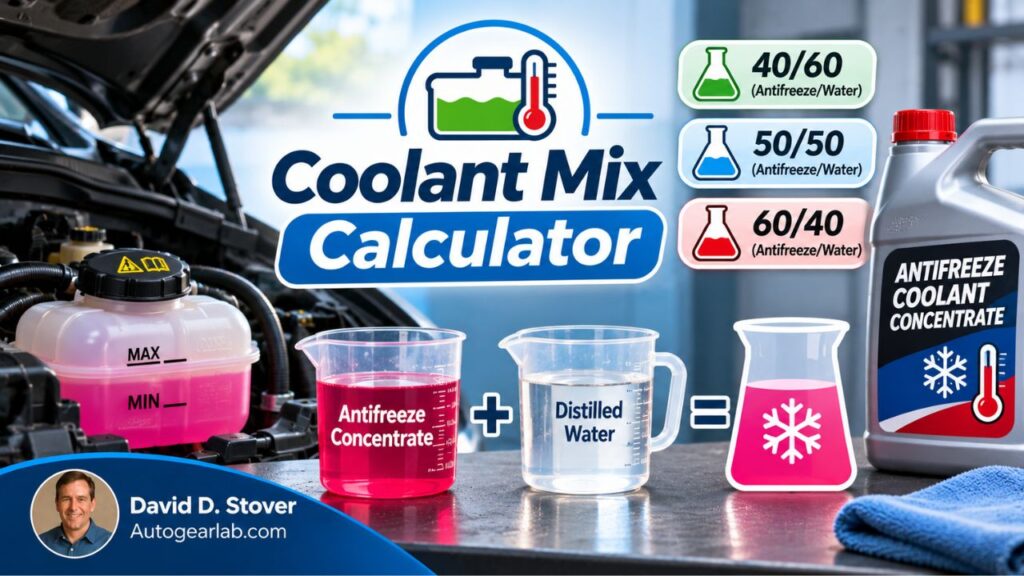
This Coolant Mix Calculator estimates how much full-strength antifreeze concentrate and distilled water you need to prepare a specific coolant mixture for an empty vehicle cooling system. Enter the system’s refill capacity, select US gallons or liters, and choose your target antifreeze percentage to calculate the required amounts of concentrate and water.
A properly prepared coolant mixture helps protect an engine against freezing, overheating, and internal corrosion. Although a 50/50 antifreeze-to-water mixture is common in many vehicles, the correct concentration depends on the manufacturer’s requirements, coolant chemistry, and operating conditions.
The calculator is useful when planning a complete cooling-system refill, estimating how much coolant concentrate to purchase, or comparing 40/60, 50/50, and 60/40 mixing ratios. It assumes the system is empty and that you’re using undiluted commercial coolant concentrate, not ready-to-use premixed coolant.
Below the calculator, I explain how to enter the correct cooling-system capacity, calculate antifreeze and water quantities, understand mixing ratios, choose compatible coolant, and avoid common filling, maintenance, and safety mistakes.
AUTO GEAR LAB TOOLS FREE CALCULATOR
Coolant Mix Calculator
Calculate concentrate and distilled-water quantities for an empty cooling system.
Enter your details
Your results
For an empty system and full-strength concentrate only. Follow vehicle and coolant product specifications; never open a hot cooling system.
How to Use My Coolant Mix Calculator
My Coolant Mix Calculator helps determine the correct quantities of antifreeze concentrate and distilled water needed to prepare a selected mixture for an empty engine cooling system.
The calculator uses three inputs:
- Volume unit
- Empty cooling-system fill volume
- Target antifreeze concentration
It then displays the recommended quantities based on your selected ratio.
Step 1: Select Your Preferred Volume Unit
Start by choosing the Volume Unit in the calculator.
You can select:
- US Gallons: For cooling-system capacity measured in US gallons.
- Liters: For capacity measured in liters.
Many vehicles sold in the United States provide coolant capacity specifications in quarts or liters.
If your owner’s manual lists capacity in quarts, convert it to gallons before entering the value.
4 US quarts = 1 US gallon
For example, if the specified cooling-system capacity is 12 US quarts:
12 ÷ 4 = 3 US gallons
You would select US gallons and enter 3.
The calculator automatically displays the equivalent quantities in liters.
Step 2: Enter the Empty Cooling-System Fill Volume
Find the Empty Cooling-System Fill Volume field.
Enter the total volume of coolant mixture required to fill an empty system.
For example, if your vehicle’s specified cooling-system capacity is 3 US gallons, enter 3.
The calculator uses 3 gallons as its default example value.
Important: This input must represent the intended refill volume. A system that has only been partially drained may retain a substantial amount of coolant inside the engine block, heater core, hoses, and other passages.
Use the manufacturer’s specified capacity and service procedure rather than assuming the amount drained equals the system’s total capacity.
Step 3: Choose Your Target Antifreeze Concentration
In the Target Antifreeze Concentration field, enter the percentage of full-strength coolant concentrate you want in the finished mixture.
For example, enter 50 for a 50/50 mixture.
This means:
- 50% full-strength antifreeze concentrate
- 50% distilled water
The calculator allows concentration inputs from 10% to 70%.
However, the supported mathematical input range is not a recommendation to use every concentration. Many vehicles specify approximately 50%, with a narrower permissible range.
The calculator displays an additional warning when the selected antifreeze concentration is below 40% or above 60%.
Always follow your vehicle manufacturer’s requirements and the coolant product instructions.
Step 4: Click Calculate
Once the input fields are complete, click Calculate.
The calculator immediately determines how much coolant concentrate and water are required.
For example, if you enter:
| Input | Value |
|---|---|
| Volume Unit | US gallons |
| Empty Cooling-System Fill Volume | 3 gallons |
| Target Antifreeze Concentration | 50% |
The results will be:
| Result | Calculated Amount |
|---|---|
| Full-strength coolant concentrate | 1.50 US gal |
| Distilled water | 1.50 US gal |
| Total mixture | 3.00 US gal |
| Antifreeze concentration | 50% |
| Water concentration | 50% |
The calculator also displays a visual mixture bar showing the proportions of concentrate and water.
Step 5: Review the Visual Coolant Mixture
The visual result illustrates how the selected mixture is divided between antifreeze and water.
For a 50/50 ratio, the two portions are equal.
For a 60/40 ratio, antifreeze concentrate represents 60% and water represents 40%.
For a 40/60 ratio, antifreeze concentrate represents 40% and water represents 60%.
The illustration represents the proportions mathematically. It does not measure the coolant’s actual chemical composition or predict a precise freezing temperature.
Step 6: Check the Total Volume and Unit Conversions
The calculator displays:
- Total system volume
- Concentrate required
- Distilled water required
- Equivalent amounts in liters
- Final concentrate-to-water percentage
For example, 3 US gallons is approximately 11.36 liters.
At a 50/50 ratio:
- Concentrate: approximately 5.68 liters
- Distilled water: approximately 5.68 liters
The results help you plan the quantities of coolant concentrate and water to prepare.
They do not guarantee the exact volume a real cooling system will accept during a particular refill procedure.
How Does My Coolant Mix Calculator Work?
The calculator uses simple percentage formulas to divide the selected total cooling-system volume into two portions.
The first portion represents full-strength coolant concentrate.
The second portion represents distilled water.
The calculations assume a fresh mixture prepared from undiluted commercial coolant concentrate and water.
Formula for Calculating Coolant Concentrate
Coolant Concentrate Required = Total System Volume × Antifreeze Percentage ÷ 100
Where:
- Total System Volume is the desired finished coolant volume.
- Antifreeze Percentage is the selected percentage of concentrate.
- Coolant Concentrate Required is the estimated volume of concentrate to prepare.
Formula for Calculating Distilled Water
Distilled Water Required = Total System Volume − Coolant Concentrate Required
Alternatively:
Water Required = Total System Volume × (100 − Antifreeze Percentage) ÷ 100
Both formulas produce the same mathematical result.
Example: 3-Gallon Cooling System With 50/50 Coolant
Suppose an empty cooling system requires 3 gallons of coolant.
You want a 50/50 mixture.
Concentrate calculation:
3 × 50 ÷ 100 = 1.5 gallons
Water calculation:
3 − 1.5 = 1.5 gallons
The estimated mixture is:
- 1.5 gallons full-strength antifreeze concentrate
- 1.5 gallons distilled water
Total = 3 gallons
Example: 4-Gallon System With 60/40 Coolant
Suppose the cooling system requires 4 gallons of finished coolant.
The manufacturer permits a 60% antifreeze concentration for your particular application.
Concentrate:
4 × 60 ÷ 100 = 2.4 gallons
Water:
4 − 2.4 = 1.6 gallons
The mathematical result is:
- 2.4 gallons concentrate
- 1.6 gallons distilled water
Total = 4 gallons
A 60/40 mixture should only be used when permitted by the vehicle and coolant manufacturers.
Example: 10-Liter Cooling System With 50/50 Coolant
If your cooling system requires 10 liters:
Concentrate:
10 × 0.50 = 5 liters
Water:
10 − 5 = 5 liters
The estimated quantities are:
- 5 liters concentrate
- 5 liters distilled water
Total = 10 liters
Important Formula Assumptions
The calculator treats full-strength commercial concentrate as the concentrate component of the mixture.
That does not mean the product is chemically 100% ethylene glycol. Commercial concentrates typically contain a glycol base and an additive package.
The formulas also treat the liquid volumes as approximately additive.
Actual mixed volume can vary slightly because of temperature, fluid properties, and volume contraction when ingredients are combined.
For routine planning, the percentage formulas are practical. For precise chemical or laboratory work, manufacturer-specific mixing data would be necessary.
What Is a Coolant Mixing Ratio?
A coolant mixing ratio describes the relative quantities of antifreeze concentrate and water in the finished engine coolant.
For example:
50/50 coolant = 50% concentrate + 50% water
60/40 coolant = 60% concentrate + 40% water
40/60 coolant = 40% concentrate + 60% water
In this guide, the concentrate percentage is always listed first.
This convention matters because some people refer to mixtures as water-to-coolant ratios rather than coolant-to-water ratios.
Check the order before measuring the ingredients.
Why Do Engines Need Both Coolant Concentrate and Water?
A properly formulated engine coolant provides several functions.
Water has useful heat-transfer properties that help move heat away from engine components.
The antifreeze component helps provide freeze protection and changes the liquid’s boiling characteristics.
Coolant additives also help protect compatible metals, seals, and other cooling-system components against corrosion and deterioration.
The correct mixture balances those properties rather than maximizing the concentration of one ingredient.
Coolant Mixing Ratio Chart
The following chart compares the quantities of concentrate and water needed for common mixture percentages.
Coolant Mixing Ratio for a 3-Gallon System
| Antifreeze Ratio | Concentrate | Distilled Water |
|---|---|---|
| 40/60 | 1.2 gal | 1.8 gal |
| 50/50 | 1.5 gal | 1.5 gal |
| 60/40 | 1.8 gal | 1.2 gal |
These are calculation examples, not universal recommendations.
50/50 Antifreeze Mixing Chart in US Gallons
| Cooling-System Volume | Concentrate | Distilled Water |
|---|---|---|
| 1 gallon | 0.5 gal | 0.5 gal |
| 2 gallons | 1 gal | 1 gal |
| 3 gallons | 1.5 gal | 1.5 gal |
| 4 gallons | 2 gal | 2 gal |
| 5 gallons | 2.5 gal | 2.5 gal |
| 6 gallons | 3 gal | 3 gal |
50/50 Antifreeze Mixing Chart in Liters
| Cooling-System Volume | Concentrate | Distilled Water |
|---|---|---|
| 4 L | 2 L | 2 L |
| 6 L | 3 L | 3 L |
| 8 L | 4 L | 4 L |
| 10 L | 5 L | 5 L |
| 12 L | 6 L | 6 L |
| 15 L | 7.5 L | 7.5 L |
These calculations assume an empty system and undiluted commercial coolant concentrate.
What Is the Best Antifreeze-to-Water Ratio?
A 50/50 antifreeze-to-water mixture is commonly recommended for many conventional automotive cooling systems.
However, the correct concentration is determined by the vehicle manufacturer and the particular coolant product.
Some vehicles require a relatively narrow concentration range. Certain specialized vehicles and cooling systems have different requirements.
50/50 Coolant Mixture
A 50/50 mixture contains equal parts coolant concentrate and water.
It is a common choice because it provides a practical balance between freezing protection, boiling protection, and heat transfer when used with an approved coolant formulation.
For many conventional ethylene-glycol-based coolants, an approximately 50/50 mixture provides freeze protection near -34°F to -35°F (-37°C), although the exact protection varies by formulation.
Ford’s official engine coolant guidance explains the importance of using the specified coolant and typically diluting approved concentrate with distilled water at a 50/50 ratio.
This is a useful starting point, but your specific owner’s manual takes priority.
60/40 Coolant Mixture
A 60/40 mixture contains:
- 60% coolant concentrate
- 40% water
Some approved coolant formulations permit higher concentrate percentages for particularly cold climates.
However, higher antifreeze concentrations do not automatically improve overall engine cooling.
Increasing glycol content can reduce the mixture’s heat-transfer efficiency compared with a higher-water mixture.
Some manufacturers specifically prohibit concentrations above 60%.
A 60/40 mixture should therefore be selected only when supported by the vehicle and coolant manufacturers.
40/60 Coolant Mixture
A 40/60 mixture contains:
- 40% coolant concentrate
- 60% water
Some coolant systems may permit this concentration, particularly under specified warm-climate operating conditions.
However, reducing antifreeze concentration can also reduce freeze protection and may affect the amount of corrosion inhibitor available in the cooling system.
Do not assume that a 40/60 mixture is appropriate simply because you live in a warm area.
Follow your vehicle’s specified minimum concentration.
Is 70/30 Coolant Better Than 50/50?
Not necessarily.
A 70/30 mixture contains substantially more concentrate and less water than a 50/50 mixture.
Although some coolant products publish performance information for high-glycol mixtures, many vehicle manufacturers do not permit such concentrations.
Excessive glycol concentration can negatively affect heat transfer and does not provide unlimited freeze protection.
More antifreeze is not always better.
If the calculator accepts 70%, that only means it can perform the mathematical calculation. It does not mean 70% is safe or recommended for your vehicle.
Antifreeze Freeze Protection and Mixing Ratio
One of the main reasons antifreeze is mixed with water is to protect the cooling system in freezing temperatures.
As the glycol concentration changes, the mixture’s freezing characteristics also change.
However, the relationship is not linear.
Does 50/50 Antifreeze Protect Against Freezing?
A properly formulated 50/50 ethylene-glycol coolant mixture commonly provides protection near -34°F to -35°F (-37°C).
The actual value depends on the coolant chemistry and manufacturer specifications.
For reliable protection, consult the product’s concentration chart and verify the finished coolant with an appropriate tester.
Does Increasing Antifreeze Always Lower the Freezing Point?
No.
Increasing the glycol concentration initially improves freeze protection, but the freezing-point relationship has limits.
Beyond the mixture’s optimal range, adding more glycol can reduce freeze protection rather than improve it.
The exact relationship depends on whether the coolant contains ethylene glycol, propylene glycol, or another formulation.
Do not use a simple percentage formula to predict freeze protection.
The Coolant Mix Calculator calculates ingredient quantities, not actual freezing points.
Can You Use the Calculator to Predict Boiling Point?
No.
The calculator does not calculate boiling temperature.
Boiling protection depends on coolant formulation, mixing ratio, system pressure, radiator cap rating, and other operating conditions.
Always refer to coolant product data and the vehicle manufacturer’s cooling-system requirements.
Concentrated Antifreeze vs. 50/50 Premixed Coolant
This is one of the most important distinctions when using the calculator.
What Is Concentrated Antifreeze?
Concentrated antifreeze is a product intended to be diluted according to its label and applicable vehicle specifications.
It contains the antifreeze base and additive package in concentrated form.
The product must normally be mixed with an appropriate amount of water before use.
What Is 50/50 Premixed Coolant?
Premixed coolant, sometimes labeled prediluted, ready-to-use, or 50/50 coolant, already contains antifreeze concentrate and water in the specified proportions.
It is intended to be used according to its product instructions without adding more water.
Can I Enter 50/50 Premix as Concentrate?
No.
The current Coolant Mix Calculator assumes you are starting with full-strength commercial concentrate.
If you enter a 3-gallon system and select 50%, the result is:
- 1.5 gallons concentrate
- 1.5 gallons distilled water
You should not replace the 1.5 gallons of concentrate with 1.5 gallons of 50/50 premix.
That would make the finished mixture weaker than intended.
How Much Premixed Coolant Do I Need?
If your cooling system is genuinely empty and requires 3 gallons of finished coolant, you would generally need approximately 3 gallons of compatible, ready-to-use premixed coolant.
You would not add an additional 1.5 gallons of water.
Follow the service procedure and account for any coolant remaining in the system.
Can You Mix Antifreeze With Distilled Water?
Yes, when the coolant manufacturer specifies dilution with distilled or deionized water.
Distilled water is commonly recommended because it contains fewer dissolved minerals than ordinary tap water.
Mineral contamination can contribute to scale formation and other cooling-system problems.
Distilled Water vs. Tap Water for Coolant
Tap water may contain calcium, magnesium, and other dissolved minerals.
Their concentration varies depending on the water source.
Over time, mineral deposits can interfere with heat transfer and coolant circulation.
Distilled or deionized water is generally preferred when preparing coolant concentrate.
The Prestone coolant replacement and filling guide recommends using distilled water with its coolant concentrate to prepare the specified mixture.
Can You Use Purified Drinking Water?
Not all purified drinking water is equivalent to distilled or deionized water.
Some bottled drinking water contains added minerals.
Use the water type specified by the coolant manufacturer rather than assuming all bottled water is suitable.
Can You Use Tap Water in an Emergency?
Some vehicle manufacturers allow clean water temporarily in certain emergencies when the correct coolant is unavailable.
However, this does not make ordinary water an appropriate long-term substitute for specified engine coolant.
If emergency water is added, the system may require professional inspection, correction of concentration, or coolant replacement afterward.
Do not continue driving an overheating vehicle simply because water has been added.
How to Find Your Vehicle’s Cooling-System Capacity
The calculator requires the intended coolant fill volume.
Using an incorrect capacity can produce quantities that do not match the vehicle’s actual refill needs.
Check the Owner’s Manual
The most reliable starting point is the vehicle manufacturer’s documentation.
Look for sections titled:
- Capacities and Specifications
- Engine Cooling System
- Engine Coolant Capacity
- Fluid Specifications
- Maintenance and Service
The specified capacity may depend on engine size, trim, transmission equipment, or the presence of additional cooling components.
Distinguish Total Capacity From Service Refill Capacity
Total system capacity and service refill quantity are not always identical.
For example, a cooling system may have a total capacity of 12 quarts, but a routine radiator drain may remove considerably less.
Coolant can remain inside the engine block, heater core, hoses, and other passages.
If the system is not completely empty, the calculator’s assumption is no longer satisfied.
Does the Coolant Reservoir Count Toward Capacity?
The coolant reservoir or expansion tank is part of many cooling systems.
However, total coolant capacity specifications are generally intended to describe the relevant complete cooling-system volume, according to the manufacturer’s definition.
Do not automatically add the entire reservoir capacity on top of a published total system capacity.
Follow the manufacturer’s fill-level and service instructions.
How to Convert Coolant Capacity
Useful conversions include:
- 1 US gallon = 4 US quarts
- 1 US gallon = approximately 3.785 liters
- 1 US quart = approximately 0.946 liters
- 1 liter = approximately 1.057 US quarts
For example:
12 US quarts ÷ 4 = 3 US gallons
3 × 3.785 = approximately 11.36 liters
The calculator supports gallons and liters directly.
How to Mix Antifreeze and Water Before Refilling
When your vehicle requires diluted coolant and you are preparing a mixture from concentrate, follow the product and vehicle service instructions.
The following process is general guidance for preparing the correct quantity, not a substitute for the vehicle’s specific coolant replacement procedure.
Step 1: Confirm Coolant Compatibility
Check the exact manufacturer coolant specification.
Use an approved product matching the required specification.
Do not select coolant solely based on its color.
Step 2: Determine the Required Concentration
Find the recommended coolant-to-water ratio in the owner’s manual or coolant product instructions.
For many vehicles, that will be approximately 50/50.
Do not select a different ratio without confirming that it is permitted.
Step 3: Calculate the Required Amounts
Enter the empty-system fill volume and target concentration into the calculator.
Record the recommended quantities of concentrate and water.
Step 4: Prepare Suitable Measuring Equipment
Use clean measuring containers suitable for automotive chemicals.
Wear appropriate protective gloves and eye protection.
Keep food, beverages, children, and pets away from the work area.
Step 5: Measure the Concentrate
Measure the required quantity of full-strength coolant concentrate.
For a 3-gallon system with a 50/50 target:
Concentrate = 1.5 gallons
Step 6: Measure the Distilled Water
Measure the corresponding quantity of distilled or deionized water.
For the same example:
Water = 1.5 gallons
Step 7: Prepare the Mixture as Directed
Use an appropriate clean container if the coolant manufacturer permits or requires premixing.
Avoid contaminating the coolant with oil, dirt, cleaning chemicals, or another coolant type.
Follow the manufacturer’s procedure for adding the mixture to the cooling system.
Step 8: Refill and Remove Trapped Air
The correct filling procedure varies between vehicles.
Some cooling systems have dedicated bleed screws, vacuum-filling requirements, or electronic bleeding procedures.
Improper filling can leave air pockets that interfere with coolant circulation.
Follow the vehicle service information and avoid improvising a bleeding procedure.
Step 9: Check the Coolant Level After Service
After the system has been filled and serviced according to the manufacturer’s procedure, allow the engine to cool completely before checking the coolant level.
Inspect the reservoir and verify the level against the designated cold markings.
Recheck the coolant level as instructed during subsequent driving.
Never open a pressurized cooling-system cap while the engine is hot.
Can You Use the Calculator When Topping Off Coolant?
The current calculator is designed for an empty cooling system, not a partially filled one.
When topping off coolant, the existing liquid already contains some proportion of antifreeze and water.
The final concentration depends on:
- How much coolant remains
- The existing antifreeze concentration
- The amount being added
- The concentration of the added coolant
The calculator does not accept the existing coolant volume or measured concentration as inputs.
Therefore, it cannot determine how much concentrate or water should be added to correct an existing mixture.
Example: Why a Partial Refill Is Different
Suppose your cooling system has a total capacity of 3 gallons.
You drain 1 gallon but leave 2 gallons of an unknown coolant mixture inside.
Preparing 3 gallons of new 50/50 coolant would be unnecessary because the system does not have room for the entire amount.
Adding concentrate or water without knowing the remaining mixture could also produce an incorrect final concentration.
If the remaining coolant’s condition or composition is uncertain, consult the appropriate service procedure.
Should You Top Off With Water or Premixed Coolant?
Follow the vehicle manufacturer’s instructions.
Many manufacturers recommend an approved premixed coolant for ordinary topping off.
Adding plain water can dilute the existing antifreeze and corrosion inhibitors.
If the coolant level is repeatedly dropping, investigate the cause instead of continually adding fluid.
How to Check the Actual Coolant Mixing Ratio
Calculating ingredient quantities and measuring the finished coolant concentration are different tasks.
The calculator determines a theoretical mixture based on your inputs.
A coolant tester measures properties of the liquid already in the cooling system.
Using a Coolant Refractometer
An automotive coolant refractometer estimates coolant concentration or freeze protection from the liquid’s refractive properties.
Use a tester suitable for the coolant chemistry and follow the calibration instructions.
For an accurate reading, the sample should be collected according to the vehicle and instrument manufacturer’s safety procedures.
Some vehicle manufacturers specifically recommend refractometers rather than other testing methods.
Using a Coolant Hydrometer
A coolant hydrometer uses fluid density or a related measurement to estimate concentration or freezing protection.
Its suitability depends on the coolant type and instrument design.
Some modern vehicle service procedures do not recommend hydrometers for their specified coolant.
Check the owner’s manual before selecting a testing method.
Why Testing Matters
Testing can help identify:
- Excessively diluted coolant
- Concentration outside the specified range
- Inadequate freeze protection
- Incorrect mixture after servicing
However, concentration testing alone does not establish that the coolant’s corrosion inhibitors are still effective or that the coolant is chemically compatible with the vehicle.
Different Types of Automotive Antifreeze
Not all engine coolants use the same corrosion-inhibitor technology.
The required product depends on the engine materials, vehicle design, and manufacturer specifications.
Inorganic Additive Technology (IAT)
Traditional IAT coolant formulations use inorganic corrosion inhibitors.
They are associated with some older cooling-system designs.
Service intervals and compatibility depend on the product and vehicle.
Organic Acid Technology (OAT)
OAT coolant formulations use organic-acid-based corrosion inhibitors.
These are common in various modern automotive applications.
Different OAT products are not automatically interchangeable.
Hybrid Organic Acid Technology (HOAT)
HOAT coolants combine organic-acid inhibitors with selected inorganic additives.
There are multiple HOAT formulations with different chemistry and manufacturer approvals.
Phosphate-Enhanced Organic Acid Technology
Some automotive applications use phosphate-enhanced organic acid coolant technology.
The correct choice depends on the specific manufacturer’s requirements.
Is Coolant Color a Reliable Compatibility Guide?
No.
Coolant colors such as green, orange, pink, yellow, blue, and purple are not universal indicators of chemistry.
Different manufacturers may use similar colors for products with different specifications.
Two coolants having the same color does not prove they are compatible.
Likewise, different colors do not automatically prove incompatibility.
Always prioritize the exact OEM coolant specification over color alone.
Can You Mix Different Brands or Types of Coolant?
Some products are designed and tested for compatibility with a range of coolant technologies, while others require specific formulations.
Mixing incompatible coolants can reduce corrosion protection or cause other cooling-system problems.
Even when two products contain similar glycol bases, their corrosion-inhibitor packages may differ.
Mixing Coolant Brands
Brand names alone do not determine compatibility.
Check each product’s approved specifications and the vehicle manufacturer’s requirements.
An aftermarket coolant should meet the vehicle’s required specification, not merely be marketed as broadly compatible.
Mixing Different Coolant Technologies
Do not assume that IAT, OAT, and HOAT coolant formulations can be mixed freely.
Follow the vehicle and coolant manufacturer’s guidance.
What If You Don’t Know Which Coolant Is Already Inside?
Do not add an arbitrary coolant based on appearance.
Review the service history, check product labels, and consult the manufacturer or a qualified service technician.
If the existing coolant is contaminated or incompatible, proper system servicing may be necessary.
Common Coolant Mixing Mistakes
Using Premixed Coolant as Concentrate
Ready-to-use 50/50 coolant already contains water.
Treating it as full-strength concentrate produces an incorrect mixture.
Assuming the System Is Completely Empty
A normal drain may leave coolant trapped in the system.
The calculator does not account for residual fluid.
Entering the Wrong Unit
A capacity of 12 quarts is not the same as 12 gallons.
Convert the units correctly before calculating.
Using Too Much Antifreeze
More concentrate does not automatically mean better cooling or freezing protection.
Excessive concentration can reduce heat-transfer performance and violate manufacturer limits.
Using Too Little Antifreeze
Insufficient concentrate can reduce freeze protection and the amount of corrosion inhibitor in the cooling system.
Choosing Coolant by Color
Coolant color is not a reliable substitute for manufacturer specifications.
Using Mineral-Rich Tap Water
Water with substantial mineral content may contribute to deposits and corrosion problems.
Use the water type recommended for the specific coolant.
Ignoring Trapped Air After Refilling
Air pockets can interfere with coolant circulation.
Follow the manufacturer’s bleeding or vacuum-filling procedure.
Overfilling the Reservoir
Coolant expands as it heats.
Do not fill beyond the specified cold-fill limit.
Opening the Cooling System While Hot
A hot cooling system can be pressurized.
Removing its cap may cause hot coolant or steam to escape suddenly, resulting in serious burns.
Wait until the engine has cooled and follow the vehicle manufacturer’s instructions.
Coolant Safety, Storage, and Disposal
Engine coolant should be handled carefully because many formulations contain chemicals that are harmful if swallowed.
Keep Coolant Away From Children and Pets
Many automotive coolants contain ethylene glycol, which is toxic when ingested.
Store coolant in its original labeled container, secured where children and animals cannot access it.
Never transfer coolant into drinking-water bottles, cups, or food containers.
Clean up spills promptly using suitable protective equipment and absorbent materials.
If coolant is swallowed or poisoning is suspected, contact Poison Control or emergency medical services immediately. In the United States, Poison Control can be reached at 1-800-222-1222.
Handle Coolant With Appropriate Protection
Wear gloves and appropriate eye protection when handling coolant.
Avoid unnecessary skin contact.
Follow the precautions on the product’s Safety Data Sheet and packaging.
How to Dispose of Used Antifreeze
Do not pour used coolant onto the ground, into a storm drain, or into household plumbing.
Keep used coolant in a suitable sealed and labeled container.
Do not mix it with used engine oil, gasoline, or other automotive chemicals because this may complicate recycling.
The Ohio Environmental Protection Agency’s used-antifreeze disposal guidance recommends recycling household antifreeze through appropriate collection facilities or participating automotive service locations.
Follow your local recycling and waste-management requirements.
When Should You Change Engine Coolant?
There is no universal coolant replacement interval for every vehicle.
Service life depends on:
- Vehicle manufacturer requirements
- Coolant formulation
- Engine and cooling-system design
- Operating conditions
- Maintenance history
- Coolant contamination
Some long-life coolant products have substantially longer replacement intervals than older formulations.
However, a product’s advertised service life should not override the vehicle manufacturer’s maintenance schedule.
Signs That Coolant May Need Attention
Possible warning signs include:
- Coolant below the specified level
- Repeated coolant loss
- Visible leaks
- Engine overheating
- Contaminated or unusual-looking coolant
- Rust or sediment
- Unusual odors
- Poor heater performance
- Cooling-system warning messages
These symptoms can have multiple causes.
Do not assume that changing the antifreeze ratio will correct a mechanical cooling-system problem.
When to Seek Professional Help
Arrange a qualified inspection if your vehicle repeatedly overheats, loses coolant, develops pressure-related problems, or shows evidence of fluid contamination.
A technician can evaluate the cooling system, inspect for leaks, verify coolant condition, and carry out the appropriate service procedure.
Coolant Mix Calculator FAQs
How Do I Calculate a 50/50 Coolant Mixture?
Divide the desired total coolant volume by two. For an empty 3-gallon system, use approximately 1.5 gallons of full-strength antifreeze concentrate and 1.5 gallons of distilled water, assuming the manufacturer specifies a 50/50 mixture.
How Much Antifreeze Do I Need for a 4-Gallon Cooling System?
At a 50/50 ratio, you need approximately 2 gallons of concentrate and 2 gallons of distilled water. This assumes the system is empty and the product is undiluted commercial concentrate.
What Is the Best Coolant-to-Water Ratio?
Many conventional automotive cooling systems use a 50/50 mixture. However, the correct concentration depends on the manufacturer’s requirements, coolant formulation, and operating conditions.
Can I Mix 50/50 Antifreeze With More Water?
Adding water to premixed 50/50 coolant lowers the antifreeze concentration. Do not dilute it further unless the vehicle and coolant manufacturers specifically permit the resulting mixture.
Can You Use 100% Antifreeze Without Water?
Undiluted conventional coolant concentrate is generally not recommended for systems designed to use a water-and-antifreeze mixture. Proper dilution is important for heat transfer and freeze protection. Follow the vehicle and coolant product instructions.
Is 60/40 Antifreeze Better Than 50/50?
Not necessarily. A 60/40 mixture may provide different freeze protection, but it also has different heat-transfer properties. Use it only when permitted by the vehicle and coolant manufacturers.
Does More Antifreeze Make an Engine Run Cooler?
No. Increasing antifreeze concentration does not automatically improve engine cooling. Water generally transfers heat more effectively than glycol, and excessive concentrate can reduce cooling performance.
Can I Use Tap Water With Antifreeze?
Distilled or deionized water is generally preferred when specified by the coolant manufacturer. Mineral-rich tap water can contribute to scale and deposits.
Can I Mix Two Different Colors of Coolant?
Coolant color does not reliably identify chemistry or compatibility. Check the products’ specifications and your vehicle manufacturer’s requirements before mixing coolants.
How Do I Know My Cooling-System Capacity?
Check the vehicle owner’s manual or official service documentation. Pay attention to the difference between total system capacity and the amount removed during a routine drain.
Does the Calculator Work in Liters?
Yes. Select liters as the volume unit, enter the intended empty-system fill volume, and choose the antifreeze percentage.
Can I Calculate 40/60 Coolant?
Yes. Enter 40 as the antifreeze concentration. The calculator will show 40% full-strength concentrate and 60% distilled water. Confirm that this ratio is approved for your vehicle.
Can I Calculate 60/40 Coolant?
Yes. Enter 60 as the target antifreeze percentage. The calculator will determine the corresponding concentrate and water quantities. Only use this concentration when supported by the manufacturers.
Does the Calculator Determine the Coolant Freezing Point?
No. The tool estimates mixing quantities. Actual freezing protection depends on coolant chemistry and concentration and should be verified using product data or an appropriate coolant tester.
Can I Use This Calculator to Top Off Existing Coolant?
Not reliably. The current tool assumes an empty cooling system. Topping off requires accounting for the amount and concentration of coolant already present.
Does 50/50 Coolant Need More Water?
No. A ready-to-use 50/50 coolant product already contains the intended proportion of water and antifreeze. Do not add more water unless specifically instructed.
Can I Mix Antifreeze in a Separate Container?
Yes, when the coolant manufacturer’s instructions permit premixing. Use a clean, suitable container and the specified water type, and protect the mixture from contamination.
Why Is My Coolant Level Low After Refilling?
The level may change as trapped air is removed or coolant circulates through the system. However, persistent coolant loss can indicate a leak or another cooling-system problem. Follow the vehicle’s service procedure and arrange inspection if necessary.
How Accurate Is the Coolant Mix Calculator?
The percentage calculations are mathematically accurate for the entered values, subject to rounding. Real-world accuracy depends on the actual system fill volume, residual coolant, product specifications, and measurement conditions.
Conclusion
The Coolant Mix Calculator provides a simple way to estimate how much full-strength antifreeze concentrate and distilled water are required to prepare a specified coolant mixture for an empty cooling system.
By entering the intended refill volume and antifreeze concentration, you can quickly calculate the ingredient quantities in US gallons or liters and compare common ratios such as 40/60, 50/50, and 60/40.
For most applications, the correct starting point is the vehicle manufacturer’s coolant specification rather than a universal mixing percentage. Use compatible coolant, follow the recommended water type, and verify the actual concentration when necessary.
Remember that the calculator assumes an empty system and does not account for residual coolant, precise freezing protection, or vehicle-specific bleeding procedures. Proper maintenance, safe handling, and correct filling practices are just as important as calculating the mixture itself.