
CCS is generally the more practical DC fast-charging standard for most electric vehicle owners in the United States because it has broader charging-station support, while CHAdeMO is an older fast-charging standard commonly associated with previous-generation Nissan LEAF models and Japanese EVs. Both can charge electric vehicles quickly, but they use different connectors and communication systems and are not directly interchangeable.
CCS, or Combined Charging System, supports AC and DC charging through a combined vehicle inlet. CHAdeMO is designed for DC fast charging and normally requires a separate port for AC charging.
Charging speed is another important distinction. CCS charging stations commonly provide 50–350 kW, while many existing CHAdeMO installations operate at approximately 50 kW. However, newer CHAdeMO specifications support much higher theoretical power levels, so the connector alone does not determine charging speed.
The comparison is also changing as North America adopts the NACS/SAE J3400 connector.
In this article, I compare CCS vs CHAdeMO in connector design, charging speeds, vehicle compatibility, station availability, bidirectional charging, and adapters. I also explain how both systems work, which vehicles use them, and what drivers should consider before buying an EV or planning a road trip.
CCS vs CHAdeMO: Key Differences at a Glance
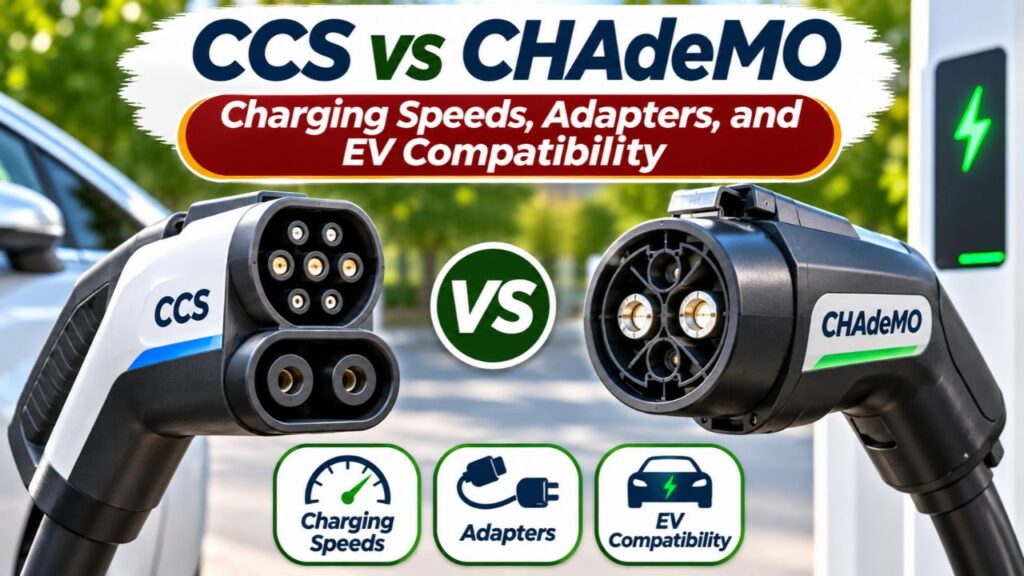
Both CCS and CHAdeMO are standards for direct-current (DC) fast charging.
Unlike ordinary home AC charging, DC fast charging delivers controlled direct current to the vehicle’s high-voltage battery, bypassing the onboard AC-to-DC charger.
However, CCS and CHAdeMO use different physical connectors and communication methods.
CCS vs CHAdeMO Comparison Chart
| Feature | CCS | CHAdeMO |
| Full name | Combined Charging System | CHArge de MOve |
| Primary purpose | AC and DC charging through a combined vehicle inlet | DC fast charging |
| Origin | International automotive industry collaboration | Japan |
| Common connector types | CCS1 and CCS2 | Traditional CHAdeMO connector |
| AC charging | Supported through the AC portion of the combined inlet | Requires a separate AC charging connection |
| DC charging | Yes | Yes |
| Common public charging power | Frequently 50–350 kW, depending on station | Many deployed chargers operate around 50 kW |
| Higher-power capability | Supports high-power charging, including 350 kW and higher implementations | Newer protocols support substantially higher theoretical power |
| Communication method | Power-line communication (PLC) | Controller Area Network (CAN) |
| Bidirectional charging | Supported by newer standards and compatible equipment | Long-established commercial V2G implementations |
| North American availability | Extensive existing infrastructure | More limited and declining |
| European use | CCS2 is widely established | Limited compared with CCS2 |
| Japanese use | Market-dependent | Historically important |
| Connector compatibility | Does not directly fit CHAdeMO | Does not directly fit CCS |
| North American direction | CCS1 remains important alongside growing NACS adoption | Declining support for new passenger EVs |
The U.S. Department of Energy’s Alternative Fuels Data Center identifies CCS, CHAdeMO, and SAE J3400/NACS as the major DC fast-charging connector systems in the United States.
Key Takeaway: CCS generally offers better public charging access in North America, while CHAdeMO remains relevant for compatible older EVs and certain bidirectional charging applications.
What Is CCS Charging?
CCS stands for Combined Charging System. It is a standardized electric vehicle charging system that supports AC and DC charging through one combined vehicle inlet.
The system was developed through collaboration among automotive manufacturers, charging equipment companies, and industry organizations.
Its goal is to provide a consistent charging interface for multiple charging power levels.
How Does CCS Work?
A CCS vehicle inlet contains the contacts required for AC charging and additional contacts for DC fast charging.
When using a compatible AC charging connector, the vehicle’s onboard charger converts alternating current into direct current for the battery.
When using a CCS DC fast charger, the external charging equipment supplies DC power through the dedicated high-power contacts.
The vehicle’s battery management system communicates with the charger to control the charging process.
CCS1 vs CCS2
There are two main CCS connector configurations.
CCS Type 1 (CCS1)
CCS1 is based on the SAE J1772 Type 1 charging connector.
It is commonly associated with North American EVs.
A CCS1 inlet has:
- A five-contact J1772 section for AC charging.
- Two large additional contacts for DC fast charging.
The vehicle uses the same combined inlet for compatible AC and DC charging connectors.
CCS Type 2 (CCS2)
CCS2 is based on the Type 2 AC charging connector.
It is widely used in Europe and other markets.
The vehicle inlet combines the Type 2 AC interface with two additional DC contacts.
CCS1 and CCS2 are not physically interchangeable because their AC connector sections differ.
Where Is CCS Used?
CCS1 has been widely used by non-Tesla electric vehicles in North America.
CCS2 is the established DC fast-charging standard for many vehicles sold in Europe.
Other regions use CCS1, CCS2, CHAdeMO, GB/T, NACS, or combinations of these systems depending on local standards.
According to CharIN, the Charging Interface Initiative, CCS supports vehicle voltage systems from approximately 200 to 1,000 volts and charging implementations rated at 350 kW or higher.
Main Advantages of CCS
CCS provides several practical benefits:
- One combined vehicle inlet for AC and DC charging.
- Broad support across vehicle manufacturers.
- High-power DC charging capability.
- Established public charging infrastructure.
- Standardized communication and charging control.
- Support for Plug & Charge implementations.
- A pathway to bidirectional charging through newer standards.
However, actual charging performance still depends on the EV and charging equipment.
What Is CHAdeMO Charging?
CHAdeMO is a DC fast-charging standard developed in Japan.
It became one of the earliest widely deployed public DC fast-charging systems.
The name is associated with the expression CHArge de MOve.
CHAdeMO has been used by several Japanese electric vehicles, particularly older Nissan LEAF models.
How Does CHAdeMO Work?
A CHAdeMO charging station converts electricity into controlled DC power.
The charger connects to the vehicle through a dedicated CHAdeMO charging port.
During charging, the vehicle and charging equipment exchange information about:
- Battery voltage.
- Permitted charging current.
- Charging status.
- Safety conditions.
- Requested charging power.
- When the charging session should stop.
The battery management system controls how much power the battery can safely accept.
Why Does CHAdeMO Need a Separate AC Port?
The traditional CHAdeMO connector is designed for DC charging.
It does not provide the combined AC and DC interface found in CCS.
Therefore, a CHAdeMO-equipped vehicle normally has a separate connection for AC charging.
For example, older North American Nissan LEAF models typically use:
- J1772 for Level 1 and Level 2 AC charging.
- CHAdeMO for DC fast charging.
Which Vehicles Use CHAdeMO?
Examples include certain versions and model years of:
- Nissan LEAF.
- Nissan e-NV200.
- Mitsubishi i-MiEV.
- Mitsubishi Outlander PHEV.
- Earlier Kia Soul EV models.
Connector equipment varies by model year and market.
Do not assume every vehicle bearing one of these model names has a CHAdeMO port.
For example, the 2026 Nissan LEAF in the United States uses NACS for DC charging, not CHAdeMO.
Is CHAdeMO Still Being Developed?
Yes.
Although CHAdeMO passenger-car infrastructure is declining in North America, the technical standard continues to evolve.
In May 2026, the CHAdeMO Association released CHAdeMO 2.1, a protocol revision supporting charging specifications up to 800 kW with compatible equipment using the existing CHAdeMO connector configuration.
Separately, CHAdeMO 3.0, associated with the next-generation ChaoJi connector, specifies even higher power capabilities.
These developments do not mean that ordinary CHAdeMO vehicles or existing 50 kW chargers can deliver those power levels.
See the CHAdeMO Association’s June 2026 protocol announcement for the latest published technical developments.
Key Takeaway: CHAdeMO remains an active technical standard, but its continued development does not guarantee broad adoption in new North American passenger vehicles.
CCS vs CHAdeMO Connector Design
The connector is the most obvious physical difference.
A CCS plug and a CHAdeMO plug have different shapes, electrical contacts, and locking arrangements.
They cannot be inserted into each other’s vehicle inlets.
What Does a CCS Connector Look Like?
A CCS1 connector has two distinct sections.
The upper section resembles the familiar J1772 AC charging plug.
The lower section contains two large contacts used for DC fast charging.
The full CCS1 connector plugs into the combined vehicle inlet during DC charging.
A CCS2 connector follows the same overall concept but uses the Type 2 AC interface.
What Does a CHAdeMO Connector Look Like?
The traditional CHAdeMO connector has a relatively large, rounded housing.
Its contact layout differs from CCS.
A CHAdeMO charging cable may also use a different locking or release mechanism.
The specific handle design varies between charger manufacturers.
Physical Connector Comparison
| Characteristic | CCS1 | CCS2 | CHAdeMO |
| General appearance | J1772-style upper section plus two large DC contacts | Type 2 upper section plus two large DC contacts | Distinct rounded DC connector |
| AC charging through same combined vehicle inlet | Yes | Yes | No |
| Dedicated DC contacts | Yes | Yes | Yes |
| Common region | North America | Europe | Japan and older EV markets |
| Directly interchangeable | No | No | No |
The U.S. Department of Transportation’s EV charging guide includes illustrations of the major charging connectors.
Which Connector Is Easier to Use?
CCS combines AC and DC functionality into one vehicle inlet, reducing the need for separate AC and DC charging ports.
CHAdeMO normally requires separate ports.
However, connector convenience also depends on:
- Cable weight.
- Handle design.
- Charge-port location.
- Accessibility.
- Locking mechanisms.
- Charger placement.
A high-power CCS cable can be heavy, particularly at stations with large cables.
Physical convenience is therefore not determined by the charging standard alone.
CCS vs CHAdeMO Charging Speed
CCS generally provides access to faster public charging options in North America, but that does not mean every CCS-equipped EV charges faster than every CHAdeMO-equipped EV.
Charging power depends on the vehicle, charger, battery voltage, current limits, and battery conditions.
Typical CCS Charging Speeds
Common public CCS fast-charging equipment includes stations rated at:
- 50 kW.
- 100 kW.
- 150 kW.
- 250 kW.
- 350 kW.
Some newer systems support higher power levels.
The U.S. Department of Transportation describes typical DC fast-charging outputs of approximately 50–350 kW.
However, a vehicle rated for 100 kW DC charging will not automatically accept 350 kW from a 350 kW station.
Typical CHAdeMO Charging Speeds
Many older CHAdeMO public chargers provide approximately 50 kW.
Some chargers and vehicles support higher outputs.
For example, Nissan’s 2025 U.S. LEAF specifications list:
- LEAF S: 50 kW CHAdeMO quick-charge port.
- LEAF SV PLUS: 100 kW CHAdeMO high-output quick-charge port.
These are vehicle specifications rather than guarantees of real-world charging power.
See Nissan’s official 2025 LEAF brochure.
What About CHAdeMO’s Higher-Power Specifications?
The CHAdeMO standard has continued to develop beyond early 50 kW equipment.
| CHAdeMO Version | Specified Maximum Power | Important Context |
| CHAdeMO 1.2 | Up to 200 kW | Requires compatible equipment |
| CHAdeMO 2.0 | Up to 400 kW | Not representative of most older chargers |
| CHAdeMO 2.1 | Up to 800 kW | Published in 2026; requires compatible high-power hardware |
| CHAdeMO 3.0 / ChaoJi | Up to 900 kW | Next-generation connector and equipment |
These are protocol or system capabilities, not typical charging speeds experienced by drivers.
The CHAdeMO Association’s protocol development documentation distinguishes the generations and their applications.
Is CCS Faster Than CHAdeMO?
In practical North American public charging, CCS vehicles frequently have more opportunities to use stations rated at 150 kW or 350 kW.
Many older CHAdeMO vehicles are limited to much lower DC charging power.
However, the real comparison should be between specific vehicles and compatible stations.
A CCS vehicle limited to 50 kW cannot charge at 150 kW simply because it uses CCS.
Likewise, a CHAdeMO vehicle rated for 100 kW may charge faster than a CCS vehicle limited to 50 kW when compatible equipment is available.
Key Takeaway: CCS has broader high-power charging availability, but maximum charging power is determined by the complete vehicle-and-charger combination.
How Long Does CCS vs CHAdeMO Charging Take?
Charging time is not determined by connector type alone.
The main factors include:
- Battery capacity.
- Starting state of charge.
- Target state of charge.
- Vehicle charging limit.
- Charger output.
- Battery temperature.
- Battery management restrictions.
- Charging taper.
Example: Charging a 50 kWh Battery
Suppose an EV has 50 kWh of usable battery capacity.
You want to charge from 20% to 80%.
The required energy is:
Energy Required = Battery Capacity × Change in State of Charge
[
50 \times (0.80-0.20)=30\text{ kWh}
]
Theoretical charging time can be estimated using:
Charging Time (hours) = Energy Required (kWh) ÷ Average Charging Power (kW)
Theoretical Charging Time Comparison
| Constant Average Charging Power | Time to Add 30 kWh |
| 25 kW | 72 minutes |
| 50 kW | 36 minutes |
| 75 kW | 24 minutes |
| 100 kW | 18 minutes |
| 150 kW | 12 minutes |
These are simplified calculations, not predictions for a particular car.
Actual charging time is generally longer because charging power changes during the session and charging losses occur.
Why Does Charging Slow Down Near 80%?
Lithium-ion batteries cannot necessarily accept their maximum charging power at every state of charge.
The battery management system regulates current to protect the battery.
Charging power often decreases as the battery approaches a high state of charge.
This is commonly called charging taper.
Battery temperature can also reduce charging power.
For this reason, many manufacturers advertise charging times from 10% to 80% rather than from empty to full.
Does a 350 kW CCS Charger Always Charge Faster?
No.
A 350 kW station is capable of supplying high power to compatible vehicles.
However, the vehicle determines how much power it can accept at a given moment.
If an EV can accept only 75 kW, the station cannot force it to charge at 350 kW.
The same limitation applies to high-power CHAdeMO equipment.
Key Takeaway: Compare the vehicle’s charging curve and the available station power, not simply the CCS or CHAdeMO logo.
CCS vs CHAdeMO Charging Station Availability
Charging-station availability is one of the most important practical differences.
A charging standard is only useful when compatible equipment is available where you drive.
CCS Availability in the United States
CCS1 has been widely installed across U.S. public charging networks.
Many existing public fast-charging locations support CCS1.
This includes stations along major highways, in shopping areas, and at urban charging hubs.
However, North America is also transitioning toward SAE J3400/NACS, so new EVs and chargers increasingly support that connector.
CHAdeMO Availability in the United States
CHAdeMO stations remain available, but the connector has a smaller and declining role in North American public charging.
Some older stations provide both CCS and CHAdeMO cables.
Others may offer only CCS and NACS connections.
Not every charging network continues to install new CHAdeMO connectors.
A September 9, 2026 analysis of U.S. Alternative Fuels Data Center information reported that CHAdeMO connector counts declined during the first eight months of 2026, while CCS1 and NACS installations increased.
The analysis appeared in EV Charging Stations’ charging infrastructure report.
CCS vs CHAdeMO in Europe
CCS2 is the dominant DC charging connector for many modern European passenger EVs.
CHAdeMO can still be found at certain locations, especially older charging stations.
However, newer European EVs commonly use CCS2.
For example, the latest European-market Nissan LEAF uses CCS2 rather than the older CHAdeMO connector.
CCS vs CHAdeMO in Japan
CHAdeMO has historically been an important fast-charging standard in Japan.
Its installed infrastructure and technical ecosystem remain more relevant there than in North America.
However, vehicle and charger specifications still vary by model and location.
Regional Comparison
| Region | CCS | CHAdeMO |
| United States | Extensive CCS1 infrastructure; growing NACS transition | Available but declining |
| Canada | CCS1 remains important alongside NACS | Being phased out |
| Europe | CCS2 widely established | Limited compared with CCS2 |
| Japan | Depends on vehicle and market | Historically significant |
| Other markets | CCS1 or CCS2, depending on country | Availability varies |
How to Find Compatible Fast Chargers
Use the U.S. Department of Energy’s Alternative Fueling Station Locator.
You can filter for:
- CCS.
- CHAdeMO.
- J3400/NACS.
- DC fast charging.
- Public access.
- Charging network.
Before traveling, check current availability and connector compatibility in the charging network’s app.
A location may be listed even when a particular connector is temporarily unavailable.
Key Takeaway: CCS1 has better practical fast-charging access than CHAdeMO in much of North America, while NACS is becoming increasingly important.
CCS vs CHAdeMO for Bidirectional Charging
Bidirectional charging allows electricity to move in both directions between an EV battery and compatible external equipment.
This can enable the vehicle to provide power for a home, building, appliance, or electrical grid under suitable conditions.
What Is Vehicle-to-Grid (V2G)?
Vehicle-to-grid, or V2G, allows compatible equipment to transfer energy from an EV battery to the electrical grid.
Potential applications include:
- Grid balancing.
- Demand-response programs.
- Supporting renewable energy integration.
- Providing stored energy during selected operating periods.
However, V2G requires more than a compatible connector.
The vehicle, charger, communications system, electrical installation, and utility arrangements must support the function.
CHAdeMO and Bidirectional Charging
CHAdeMO has a long history of supporting bidirectional DC charging.
The CHAdeMO Association’s V2G documentation describes commercially deployed and certified bidirectional charging systems.
This is one of CHAdeMO’s important technical strengths.
Certain compatible vehicles and chargers can support vehicle-to-home or vehicle-to-grid applications.
However, having a CHAdeMO port does not automatically guarantee every V2G feature.
CCS and Bidirectional Charging
CCS also has a pathway to bidirectional power transfer.
The ISO 15118-20 standard defines communication requirements for bidirectional energy transfer between EVs and charging equipment.
This supports the development of compatible CCS bidirectional charging systems.
The International Organization for Standardization’s ISO 15118-20 documentation explicitly covers bidirectional power transfer.
However, implementation depends on vehicle and charging-equipment support.
A CCS vehicle does not automatically become bidirectional simply because the standard supports it.
Which Is Better for V2G?
CHAdeMO has more established historical experience with commercially deployed bidirectional DC systems.
CCS provides a modern standards-based framework for expanding bidirectional charging.
The better choice depends on whether a complete, supported system is actually available for your specific vehicle.
Key Takeaway: CHAdeMO has established V2G deployments, while CCS supports bidirectional charging through newer standards. Neither connector guarantees V2G without compatible hardware and software.
Can You Use a CCS Charger With a CHAdeMO Car?
Not directly. A CCS charging cable cannot plug into a traditional CHAdeMO vehicle inlet.
The connectors have different shapes and communication systems.
Why Are They Incompatible?
CCS and CHAdeMO differ in several ways.
CCS typically uses power-line communication between the vehicle and charger.
CHAdeMO uses Controller Area Network communication.
The systems also use different connector layouts and charging-control arrangements.
Therefore, changing the physical shape of the plug alone is not enough.
Are CCS-to-CHAdeMO Adapters Available?
Specialized active adapters exist for certain applications, but compatibility is limited and highly dependent on the vehicle, adapter, and charging equipment.
They are not comparable to a simple mechanical plug converter.
An adapter may need to translate communication between the standards and safely manage the charging process.
For ordinary EV owners, do not assume that any advertised CCS-to-CHAdeMO adapter will work.
Is a Passive Adapter Safe?
A simple passive adapter that only changes the connector shape is not a general solution for CCS and CHAdeMO fast charging.
The charging systems require appropriate communication and safety controls.
Do not modify charging connectors or bypass interlocks.
Use only properly certified, explicitly vehicle-compatible equipment supported by the manufacturer or another qualified provider.
Can You Use a CHAdeMO Charger With a CCS Car?
Not directly.
The same physical and communication differences apply.
Specialized conversion equipment may exist, but it should not be assumed to work universally.
Key Takeaway: CCS and CHAdeMO require more than different plug shapes. Check supported compatibility carefully rather than relying on generic adapters.
CCS vs CHAdeMO vs NACS: What’s Changing?
North America’s transition to NACS/SAE J3400 is changing the practical importance of both CCS1 and CHAdeMO.
What Is NACS?
NACS stands for North American Charging Standard.
It is based on the charging connector developed by Tesla.
SAE International standardized the connector family through J3400.
Unlike traditional CHAdeMO, NACS supports AC and DC charging through the same connector interface.
How Does NACS Compare With CCS?
CCS1 and NACS are different physical connectors.
However, compatibility can be possible using manufacturer-approved adapters and supported charging equipment.
Tesla’s Supercharger network has also expanded access to certain non-Tesla EVs.
That access depends on the vehicle manufacturer, station type, charging protocol compatibility, and approved hardware.
See Tesla’s official Supercharging guidance for other EVs.
How Does NACS Compare With CHAdeMO?
CHAdeMO-equipped vehicles generally do not have the same straightforward access to NACS charging through manufacturer-supported adapters.
This makes the North American shift toward NACS particularly important for drivers relying on older CHAdeMO fast-charging infrastructure.
Connector Comparison
| Feature | CCS1 | CHAdeMO | NACS / J3400 |
| AC charging | Yes, through combined inlet | Separate AC port | Yes |
| DC fast charging | Yes | Yes | Yes |
| Established U.S. infrastructure | Extensive | More limited | Extensive and expanding |
| Older Nissan LEAF compatibility | Not directly | Yes, on compatible model years | Not directly |
| Typical use in newer U.S. EVs | Existing and some new vehicles | Limited | Increasing |
| Adapter support | Certain approved NACS adapters | Specialized and limited | Certain approved CCS adapters |
Will NACS Replace CCS?
The U.S. passenger-EV market is moving strongly toward NACS, but CCS1 remains important because many existing vehicles and stations use it.
CCS2 also remains widely established outside North America.
Therefore, describing CCS as obsolete worldwide would be inaccurate.
Will CHAdeMO Disappear?
CHAdeMO is losing ground in North American passenger-EV charging, but it has not disappeared.
Existing CHAdeMO vehicles and chargers remain in service.
The standard also continues developing, including higher-power and bidirectional applications.
However, drivers should consider the declining availability of new CHAdeMO infrastructure when evaluating a used EV.
Key Takeaway: NACS is the major emerging connector in North America, CCS remains important, and CHAdeMO is increasingly associated with existing vehicles and specialized applications.
Nissan LEAF CCS vs CHAdeMO: Why Model Year Matters
The Nissan LEAF is one of the clearest examples of how charging standards can change between vehicle generations.
2025 Nissan LEAF
The U.S.-market 2025 LEAF uses CHAdeMO for DC fast charging.
Its published specifications identify different charging limits depending on trim.
| 2025 U.S. LEAF Trim | Published DC Charging Port Rating |
| LEAF S | 50 kW CHAdeMO |
| LEAF SV PLUS | 100 kW CHAdeMO |
These are manufacturer ratings, not guaranteed sustained charging speeds.
2026 Nissan LEAF
The redesigned 2026 U.S.-market LEAF no longer uses CHAdeMO for DC fast charging.
Instead, it has:
- NACS DC fast-charging port.
- J1772 AC charging port.
- Support for compatible CCS charging stations through a Nissan CCS adapter.
Nissan specifies the NACS connection in its official 2026 LEAF press kit.
Nissan also confirms the need for a CCS adapter when using compatible CCS stations.
What About the European Nissan LEAF?
The latest European-market LEAF uses CCS2 for DC charging.
This differs from the U.S. model’s NACS configuration.
Therefore, the charging connector should always be verified for the vehicle’s specific country, model year, and version.
What Does This Mean for Used-EV Buyers?
If you’re considering an older LEAF, investigate local CHAdeMO availability before purchasing.
A used CHAdeMO EV may still be practical when:
- You primarily charge at home.
- Your daily driving is within the vehicle’s range.
- Reliable CHAdeMO fast chargers are available nearby.
- You rarely need long highway charging stops.
However, limited public CHAdeMO availability may make long-distance trips more difficult.
Key Takeaway: The Nissan LEAF’s charging connector depends on generation and market. Older LEAF models commonly use CHAdeMO; the 2026 model uses NACS in the U.S. and CCS2 in Europe.
CCS vs CHAdeMO for Home Charging
For most EV owners, CCS versus CHAdeMO matters more when using public DC fast chargers than when charging at home.
Level 1 Charging
Level 1 charging in the United States generally uses a standard 120-volt AC electrical supply.
Compatible vehicles use an AC charging connection.
A traditional CHAdeMO vehicle does not use its CHAdeMO fast-charging port for ordinary Level 1 charging.
Level 2 Charging
Level 2 charging commonly uses a 208–240-volt AC supply in North America.
Many vehicles use J1772 or NACS equipment, depending on the vehicle.
A CCS1-equipped vehicle can use compatible J1772 AC charging through the AC section of its combined inlet.
Older CHAdeMO-equipped vehicles often use a separate J1772 AC charging port.
Does CHAdeMO Make Home Charging Slower?
Not inherently.
The CHAdeMO port is for DC fast charging.
Home AC charging speed depends on:
- The vehicle’s onboard charger.
- The available electrical supply.
- EV charging equipment.
- Circuit capacity.
- Battery conditions.
For example, two EVs with similar AC onboard charging limits may charge at similar speeds at home even if one uses CHAdeMO for public DC charging and the other uses CCS.
Can You Install CHAdeMO DC Charging at Home?
Technically, specialized DC charging equipment exists.
However, DC fast-charging hardware is generally far more expensive and electrically demanding than ordinary residential Level 2 equipment.
For most home EV owners, an appropriate Level 2 AC charger is the practical choice.
Installation must comply with applicable electrical codes and should be performed by a qualified electrician.
Key Takeaway: CCS versus CHAdeMO primarily affects DC fast charging. Ordinary home charging depends much more on the AC charging equipment and the vehicle’s onboard charger.
Is CCS or CHAdeMO Cheaper to Use?
Neither connector standard automatically determines charging cost.
Public charging prices depend on the network and location.
What Affects DC Charging Prices?
Charging operators may price sessions using:
- Electricity delivered in kilowatt-hours.
- Time connected or charging.
- Membership plans.
- Idle fees.
- Congestion fees.
- Location-specific rates.
- Other operator charges.
The applicable pricing method can also depend on local regulations.
Does Faster CCS Charging Cost More?
Not necessarily.
A network may charge the same price per kilowatt-hour for multiple fast-charging power levels.
Another network may use different pricing tiers.
Check the station’s displayed rate before beginning a session.
Does CHAdeMO Charging Cost More?
Not inherently.
However, if a CHAdeMO vehicle charges more slowly at a station that bills by time, the total cost for the same energy may be higher.
The reverse can also occur depending on pricing.
The connector is not the sole cause.
Can Charging Speed Affect Travel Costs?
Yes.
A slower charging session can increase the time spent at a station.
It may also affect the practicality of long trips.
For many drivers, charger availability and reliability are more important than small differences in per-session price.
CCS vs CHAdeMO: Which Is Better for Road Trips?
For most U.S. drivers, CCS has historically offered substantially better public fast-charging access than CHAdeMO.
However, NACS compatibility is now another important consideration.
Why Station Availability Matters
A vehicle’s advertised charging speed is useful only when a compatible charger is available.
A route with many CCS or NACS stations can offer more options for:
- Charging stops.
- Backup stations.
- Route changes.
- Busy charging locations.
- Higher-power charging.
A CHAdeMO driver may have fewer alternatives if the only compatible cable at a location is occupied or unavailable.
What Should CHAdeMO Owners Check?
Before a long trip:
- Identify CHAdeMO charging stations along the route.
- Check current connector availability.
- Verify the charger’s maximum power.
- Confirm the station’s operating status.
- Check recent driver reports when available.
- Identify backup charging locations.
- Plan around the vehicle’s actual charging performance.
- Leave sufficient battery reserve between stops.
What Should CCS Owners Check?
CCS owners should also verify their charging options.
A station rated at 350 kW may not deliver that power to every vehicle.
In addition, not every CCS EV can use every NACS station through an adapter.
Check the vehicle manufacturer’s approved charging-network access and hardware.
Best Charging Choice by Driving Pattern
| Driving Pattern | Main Consideration |
| Mostly home charging | Reliable AC charging and vehicle range |
| Frequent U.S. highway trips | Broad CCS/NACS access |
| Older Nissan LEAF ownership | CHAdeMO station locations and reliability |
| City commuting | Convenient charging near home or work |
| Travel across Europe | CCS2 compatibility |
| Travel in Japan | Local CHAdeMO and vehicle compatibility |
| Vehicle-to-grid projects | Verified vehicle-and-charger V2G support |
Key Takeaway: For road trips, the most important factor is a reliable network of chargers compatible with your specific vehicle.
Which Is Better: CCS or CHAdeMO?
Neither standard is universally better in every technical category.
However, they have different strengths in practical use.
Choose a CCS-Compatible Vehicle When
A CCS-compatible EV may be more practical when:
- You frequently use public DC fast chargers.
- You drive long distances in North America.
- You want access to existing CCS1 infrastructure.
- You need a vehicle with higher DC charging capability.
- You drive in a region where CCS2 is widely deployed.
Also consider whether the manufacturer provides supported NACS charging access.
CHAdeMO Can Still Make Sense When
A CHAdeMO-equipped EV may be suitable when:
- You already own one.
- You primarily charge at home.
- Reliable local CHAdeMO stations are available.
- Your driving pattern requires limited public fast charging.
- A specific supported bidirectional charging system is important.
However, the declining North American CHAdeMO network should be part of the decision.
What About Buying a New EV?
For U.S. buyers, I would place more weight on actual CCS1/NACS charging access than on choosing between CCS and CHAdeMO alone.
CHAdeMO is increasingly uncommon in new North American passenger vehicles.
For a modern EV, evaluate:
- Native connector type.
- Supported charging networks.
- Approved adapters.
- Maximum DC charging power.
- Real charging curves.
- Battery preconditioning.
- Charging reliability.
- Long-distance route coverage.
A vehicle with lower peak power but a reliable charging curve may be more convenient than one with a higher advertised maximum but poor real-world performance.
Common Mistakes When Comparing CCS and CHAdeMO
Assuming CCS Is Always Faster
CCS supports many high-power charging installations, but an individual vehicle may have a low charging limit.
Check the vehicle’s actual DC charging capability.
Assuming CHAdeMO Is Limited to 50 kW
Many existing chargers operate at 50 kW, but the standard supports higher power.
The 2026 CHAdeMO 2.1 protocol specifies capabilities far beyond early-generation equipment.
However, compatible high-power hardware is required.
Confusing Standard Power With Vehicle Power
A 350 kW charger does not make every connected EV charge at 350 kW.
The vehicle and battery management system control charging limits.
Assuming Every Charger Has Both Connectors
Some locations offer both CCS and CHAdeMO.
Others have only one connector type or have transitioned toward NACS.
Verify the charging equipment before traveling.
Assuming All Nissan LEAF Models Use CHAdeMO
Older LEAF generations use CHAdeMO in many markets.
The 2026 U.S. LEAF uses NACS for DC fast charging, and the latest European LEAF uses CCS2.
Always check the model year and market.
Assuming a Simple Adapter Can Convert CCS and CHAdeMO
The two standards use different physical connectors and communication protocols.
A passive mechanical converter is not a universal solution.
Ignoring Charging Taper
Maximum advertised power may only be available during part of the charging session.
Compare realistic charging times instead of peak ratings alone.
Confusing NACS With CCS
NACS and CCS are separate physical connector standards.
Some vehicles can use both through supported adapters, but compatibility depends on the vehicle and network.
Assuming V2G Works on Every CHAdeMO or CCS Vehicle
Bidirectional charging requires a complete compatible system.
The connector alone is not enough.
Ignoring Current Charger Availability
A charging location listed on an old map may no longer provide the same connector.
Check live station information whenever possible.
Conclusion
In the CCS vs CHAdeMO comparison, CCS is generally the more practical choice for public DC fast charging in North America because of its broader infrastructure and access to high-power charging stations.
CCS uses a combined vehicle inlet that supports AC and DC charging, while traditional CHAdeMO uses a dedicated DC fast-charging connector alongside a separate AC connection.
CHAdeMO has an important history in EV fast charging and commercially deployed bidirectional charging systems. It also continues to evolve through higher-power protocol specifications.
However, older CHAdeMO-equipped vehicles may face limitations as North American charging networks increasingly favor CCS1 and NACS.
For existing Nissan LEAF owners and other CHAdeMO drivers, the standard can still meet daily needs, particularly when most charging happens at home.
For buyers considering a newer EV, connector compatibility, station availability, and real charging performance matter more than theoretical charging power.
Choose an EV with charging access that matches your driving habits, and verify its exact connector, model year, and supported networks before making a decision.
FAQs About CCS vs CHAdeMO
Is CCS Better Than CHAdeMO?
For most U.S. drivers who rely on public fast charging, CCS is generally more practical because it has broader charging infrastructure.
However, CHAdeMO remains useful for compatible vehicles and certain bidirectional charging systems.
The best choice depends on vehicle compatibility and local charger availability.
Is CCS Faster Than CHAdeMO?
CCS commonly provides access to higher-power public charging stations.
However, individual charging speed depends on the vehicle and charger.
Newer CHAdeMO specifications support high theoretical power, but many existing CHAdeMO chargers and vehicles operate at much lower rates.
Can a CCS Car Use a CHAdeMO Charger?
Not directly.
CCS and CHAdeMO use different connectors and communication protocols.
Specialized active conversion hardware may exist for certain applications, but ordinary passive adapters are not a general solution.
Can a CHAdeMO Car Use a CCS Charger?
Not directly.
A compatible active adapter would need to support the vehicle and charging equipment.
Do not assume a generic adapter provides safe or reliable CCS-to-CHAdeMO charging.
Does the Nissan LEAF Use CCS or CHAdeMO?
It depends on the model year and market.
The 2025 U.S.-market LEAF uses CHAdeMO for DC fast charging.
The redesigned 2026 U.S. LEAF uses NACS for DC charging.
The latest European-market LEAF uses CCS2.
Is CHAdeMO Being Phased Out?
CHAdeMO is declining in North American public passenger-EV charging infrastructure.
However, the standard remains in use and continues technical development.
Existing CHAdeMO vehicles and stations have not disappeared.
Is CHAdeMO the Same as Level 3 Charging?
CHAdeMO is a DC fast-charging standard.
The term Level 3 is sometimes used informally to describe DC fast charging, but connector standards and charging levels describe different aspects of charging.
CHAdeMO itself is not a specific power level.
Does CHAdeMO Support Bidirectional Charging?
Yes.
CHAdeMO has established support for bidirectional charging, including vehicle-to-grid applications.
However, the vehicle and external charging equipment must be specifically compatible.
Does CCS Support Vehicle-to-Grid Charging?
Yes, newer CCS-related communication standards support bidirectional power transfer.
ISO 15118-20 defines the relevant communication requirements.
Actual V2G capability depends on the vehicle, charging hardware, and supporting systems.
Can You Use CCS for Home Charging?
A CCS vehicle inlet also supports compatible AC charging through its AC portion.
For example, a CCS1 vehicle can generally use J1772 AC charging.
Most residential EV charging uses AC equipment rather than installing a high-power CCS DC fast charger.
Can a CHAdeMO Car Charge at a Tesla Supercharger?
Not ordinarily through its CHAdeMO port.
Tesla’s North American access programs primarily support compatible NACS-equipped and CCS1-equipped vehicles using approved hardware.
CHAdeMO vehicles do not have the same general supported access pathway.
Is CCS or NACS Better for a New Electric Car?
For a new U.S. EV, both CCS1 and NACS access can matter.
NACS is increasingly adopted by manufacturers, while CCS1 infrastructure remains extensive.
Evaluate the vehicle’s native connector, approved adapters, eligible charging networks, and actual charging performance rather than assuming one connector guarantees better charging.