
A 50-amp EV charger can deliver 12 kW at 240 volts, compared with 9.6 kW from a 40-amp charger, making it 25% more powerful when the vehicle accepts the full output. However, 50-amp charging generally requires a higher-capacity hardwired circuit, while 40-amp charging typically fits a properly installed 50-amp circuit and may support a compatible plug-in unit. Both usually cost about the same to deliver a given amount of electricity.
Be careful with the numbers: a 50-amp circuit does not mean the charger can supply 50 amps continuously. A 50-amp branch circuit normally supports only 40 amps of continuous EV charging. Similarly, an EV with a 40-amp onboard AC charging limit will not charge any faster from a 50-amp unit.
For everyday driving, 40 amps is already a capable home charging rate. The extra power of a 50-amp unit matters mainly when you need to replenish a large battery quickly and have sufficient electrical capacity.
In this guide, I compare charging speed, breaker sizes, plug-in versus hardwired installation, equipment costs, and electricity expenses. You’ll also learn how to check your vehicle’s AC charging limit, estimate charging time, and decide whether the upgrade is worthwhile.
40 Amp vs 50 Amp EV Charger: Key Differences
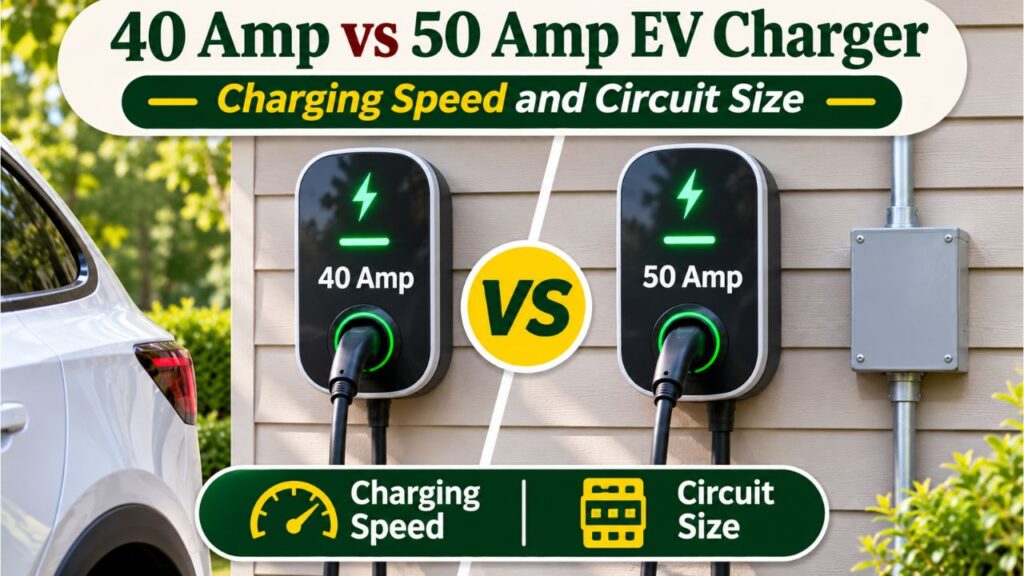
Both 40-amp and 50-amp EV chargers are considered Level 2 charging equipment in the United States.
They normally operate at 240 volts in residential installations.
The main differences are charging power, circuit requirements, installation options, and compatibility with the vehicle’s onboard charging system.
40 Amp vs 50 Amp EV Charger Comparison Chart
| Feature | 40-amp EV charger | 50-amp EV charger |
| Charging level | Level 2 | Level 2 |
| Typical home voltage | 240V | 240V |
| Maximum output current | 40A | 50A |
| Maximum power at 240V | 9.6 kW | 12 kW |
| Minimum circuit-load calculation | 50A | 62.5A |
| Typical manufacturer-specified breaker | 50A | 70A or 80A, depending on equipment |
| Installation method | Plug-in or hardwired, if supported | Generally hardwired |
| Theoretical power difference | Baseline | 25% higher |
| Charging time for equal energy | Baseline | Up to 20% shorter |
| Electricity cost per kWh | Utility rate | Utility rate |
| Electrical installation | Usually less demanding | May require larger conductors or upgrades |
| Best for | Most daily home charging needs | Compatible EVs needing faster charging |
The table compares actual charging output, not breaker ratings.
Real charging speed depends on the vehicle, electrical supply, temperature, and charger settings.
Which Is Better?
A 40-amp charger is generally sufficient for most single-EV households because 9.6 kW can replenish substantial driving range overnight.
A 50-amp charger makes more sense when:
- Your vehicle supports 50-amp AC charging.
- You need faster charging between trips.
- Your electrical system has sufficient capacity.
- The additional installation expense is reasonable.
- You want additional flexibility for future compatible EVs.
However, the 48-amp charging option is also worth considering.
It provides nearly the same power as a 50-amp charger while commonly using a 60-amp circuit.
What Is a 40 Amp EV Charger?
A 40-amp EV charger is Level 2 equipment capable of supplying up to 40 amps of AC charging current.
At a 240-volt supply, it delivers a maximum of 9.6 kilowatts.
How Much Power Does a 40 Amp EV Charger Provide?
Use the formula:
Power (watts) = Voltage × Current
At 240 volts:
240 × 40 = 9,600 watts
Convert watts to kilowatts:
9,600 ÷ 1,000 = 9.6 kW
This means the charger can supply approximately 9.6 kWh of electrical energy during one hour of operation at full output.
Some of that energy is lost during charging before it reaches the battery.
How Fast Does a 40 Amp EV Charger Charge?
A 40-amp charger can add approximately 25–35 miles of driving range per hour for many EVs.
However, this is not a universal figure.
Actual range depends on vehicle energy consumption and charging efficiency.
For example, a relatively efficient sedan may gain more miles per hour than a large electric pickup.
What Circuit Does a 40 Amp Charger Need?
A 40-amp EV charger generally requires a properly designed 50-amp branch circuit.
This follows the usual continuous-load calculation:
40A × 125% = 50A
The electrical installation must also have appropriately sized conductors, connections, and protection.
A 40-amp charging current is not the same as a 40-amp breaker rating.
Can a 40 Amp Charger Be Plugged Into an Outlet?
Yes, if the charging equipment is specifically designed for plug-in operation and the electrical installation is suitable.
Common configurations include:
- NEMA 14-50.
- NEMA 6-50.
The outlet and branch circuit must meet the applicable equipment and electrical-code requirements.
Do not assume that an existing receptacle is suitable simply because the charger’s plug fits.
What Is a 50 Amp EV Charger?
A 50-amp EV charger is Level 2 charging equipment capable of delivering up to 50 amps of AC charging current.
At 240 volts, it provides a theoretical maximum of 12 kilowatts.
How Much Power Does a 50 Amp Charger Provide?
Using the same formula:
240 × 50 = 12,000 watts
Convert to kilowatts:
12,000 ÷ 1,000 = 12 kW
Compared with a 40-amp charger:
12 − 9.6 = 2.4 kW
The additional output is:
2.4 ÷ 9.6 × 100 = 25%
A 50-amp charger can therefore transfer electrical energy 25% faster, provided the vehicle can accept the full power.
How Fast Does a 50 Amp EV Charger Charge?
A 50-amp charger may add approximately 30–40 miles of range per hour for many vehicles, depending on energy efficiency.
Some vehicles gain more or less.
However, the vehicle’s onboard AC charger must support 50 amps to use the full output.
Many common EVs are limited to 32 or 48 amps of AC charging.
What Breaker Does a 50 Amp EV Charger Need?
For ordinary continuous-load sizing:
50A × 125% = 62.5A
A circuit must be designed with sufficient capacity for that continuous load.
For example, ChargePoint specifies 70-amp or 80-amp breaker configurations for full 50-amp output on its Home Flex equipment.
The exact breaker and conductor requirements depend on the charger, electrical installation, and applicable codes.
A licensed electrician should determine the correct configuration.
Can a 50 Amp EV Charger Use a NEMA 14-50 Outlet?
Not at its full 50-amp continuous output.
A 50-amp receptacle and circuit do not authorize 50 amps of continuous EV charging.
For many common plug-in installations, the maximum charging output is 40 amps on a suitable 50-amp circuit.
A charger capable of 50-amp output generally needs hardwiring to use that full setting.
40 Amp vs 50 Amp EV Charger Breaker Size Explained
This is one of the most important distinctions in home EV charging.
EV charging commonly operates as a continuous electrical load.
That means the circuit must be sized appropriately for sustained current draw.
Why Does a 40 Amp Charger Need a 50 Amp Circuit?
The usual continuous-load rule requires the circuit to be sized for at least 125% of the charging current.
The U.S. Environmental Protection Agency’s home EV charging guide specifically explains this requirement and gives 40-amp charging on a dedicated 50-amp circuit as an example.
Therefore:
40A × 1.25 = 50A
A properly installed 50-amp circuit can normally support 40 amps of continuous EV charging, subject to applicable requirements.
Circuit Breaker vs. Charging Output
| Circuit breaker rating | Common maximum continuous EV charging current | Output at 240V |
| 20A | 16A | 3.84 kW |
| 30A | 24A | 5.76 kW |
| 40A | 32A | 7.68 kW |
| 50A | 40A | 9.60 kW |
| 60A | 48A | 11.52 kW |
| 70A | 50A where equipment supports it | 12.00 kW |
This table illustrates common manufacturer configurations.
Actual circuit design must follow the equipment instructions, electrical code, conductor ratings, and electrical load calculation.
Does a 50 Amp Charger Always Need a 70 Amp Breaker?
Not every charger labeled “50 amp” has the same requirements.
Some products use the term to describe an EVSE rated for installation on a 50-amp circuit.
That equipment may have a maximum continuous output of 40 amps.
Other products are genuinely capable of delivering 50 amps.
For example, the ChargePoint Home Flex installation FAQ specifies:
- 40A charging output on a 50A circuit.
- 48A output on a 60A circuit.
- 50A output on certain 70A or 80A circuit configurations.
Always check whether a product specification describes charging output or circuit amperage.
Can You Put a 50 Amp Charger on a 50 Amp Breaker?
Only if the charger is configured to draw no more than the current permitted for that circuit.
For an ordinary 50-amp EV charging circuit, that is generally 40 amps.
A 50-amp-output-capable charger with adjustable settings may be installed on a suitable 50-amp circuit if the manufacturer permits it and the maximum charging current is correctly configured.
It must not be set to draw 50 amps continuously.
Can You Replace a 50 Amp Breaker With a 70 Amp Breaker?
Not without evaluating and potentially upgrading the circuit.
The breaker must protect the installed wiring and electrical components.
Simply installing a larger breaker can create an overheating and fire hazard.
An electrician must confirm the conductor sizing, circuit design, panel capacity, and equipment requirements before increasing charging current.
Key Takeaway: The electrical circuit must be rated appropriately for the actual charging output. A 50-amp outlet does not mean 50-amp continuous charging is permitted.
40 Amp vs 50 Amp EV Charger Charging Speed
At the same voltage, a higher amperage allows more power to reach a compatible vehicle.
However, charging time depends on the amount of energy the battery needs.
Power Difference at 240 Volts
| Charger output | Power |
| 32 amps | 7.68 kW |
| 40 amps | 9.60 kW |
| 48 amps | 11.52 kW |
| 50 amps | 12.00 kW |
Moving from 40 amps to 50 amps increases theoretical power by 25%.
However, it reduces charging time by approximately 20%, not 25%, when both operate at full power.
Why Is Charging Time Only 20% Shorter?
Charging time is inversely related to charging power.
If a task requires a fixed amount of energy:
Charging time = Required energy ÷ Charging power
Suppose you need to draw 48 kWh from the electrical supply.
At 40 amps:
48 ÷ 9.6 = 5 hours
At 50 amps:
48 ÷ 12 = 4 hours
The 50-amp charger finishes one hour sooner.
That is a 20% reduction from the original five-hour charging time.
Charging Time Comparison
The following table shows theoretical times for energy drawn from the electrical supply.
| Electricity drawn | 40A at 9.6 kW | 50A at 12 kW | Time saved |
| 10 kWh | 1.04 hr | 0.83 hr | 13 min |
| 20 kWh | 2.08 hr | 1.67 hr | 25 min |
| 40 kWh | 4.17 hr | 3.33 hr | 50 min |
| 60 kWh | 6.25 hr | 5.00 hr | 75 min |
| 80 kWh | 8.33 hr | 6.67 hr | 100 min |
These values assume constant output at 240 volts.
They exclude variations in vehicle charging power, battery conditioning, and energy lost during conversion.
Actual charging sessions may take longer.
Does a 50 Amp Charger Always Charge Faster?
No.
The EV must support the additional current.
If the car’s onboard charger only accepts 32 amps, both a 40-amp and 50-amp charging station will operate at 32 amps or less.
The more powerful charging station provides no immediate speed advantage for that vehicle.
40 Amp vs 50 Amp EV Charger: Miles Added Per Hour
Miles of range added per hour depends on how efficiently the vehicle uses electricity.
A smaller efficient EV may gain more range per charging hour than a heavy SUV or pickup.
Example Using Vehicle Efficiency
Assume:
- Voltage: 240V.
- Charging efficiency: 90%.
- Vehicle battery-energy consumption: 0.30 kWh per mile.
The 90% charging efficiency is a simplified assumption for calculation, not a guaranteed figure.
40 Amp Charging
Wall power:
9.6 kW
Estimated battery energy added per hour:
9.6 × 0.90 = 8.64 kWh
Estimated miles added:
8.64 ÷ 0.30 = 28.8 miles per hour
50 Amp Charging
Wall power:
12 kW
Estimated battery energy added per hour:
12 × 0.90 = 10.8 kWh
Estimated miles added:
10.8 ÷ 0.30 = 36 miles per hour
Range Added Per Hour Comparison
| Vehicle energy use | 40A charger | 50A charger |
| 25 kWh per 100 miles | 34.6 miles/hr | 43.2 miles/hr |
| 30 kWh per 100 miles | 28.8 miles/hr | 36.0 miles/hr |
| 35 kWh per 100 miles | 24.7 miles/hr | 30.9 miles/hr |
| 40 kWh per 100 miles | 21.6 miles/hr | 27.0 miles/hr |
These estimates assume 90% charging efficiency and full charger output.
Your EV’s actual energy consumption and charging limit may produce different results.
How Much Faster Is 50 Amp Charging for a Daily Commute?
Suppose you drive 50 miles each day.
Your EV consumes 30 kWh per 100 miles.
You therefore use:
50 × 0.30 = 15 kWh
At 90% charging efficiency, the outlet must supply:
15 ÷ 0.90 = 16.67 kWh
With a 40-amp charger:
16.67 ÷ 9.6 = 1.74 hours
With a 50-amp charger:
16.67 ÷ 12 = 1.39 hours
The difference is approximately 21 minutes.
For a typical overnight charging schedule, that may not matter much.
However, the difference becomes more useful when you need to recharge between multiple trips.
40 Amp vs 50 Amp EV Charger for a 60 kWh Battery
Consider a vehicle with a 60-kWh usable battery.
Suppose you want to charge from 20% to 80%.
Calculate Required Battery Energy
80% − 20% = 60%
60 kWh × 0.60 = 36 kWh
The battery needs approximately 36 kWh of additional energy.
Account for Charging Losses
Assuming 90% charging efficiency:
36 ÷ 0.90 = 40 kWh from the outlet
Charging Time at 40 Amps
40 ÷ 9.6 = 4.17 hours
Charging Time at 50 Amps
40 ÷ 12 = 3.33 hours
Charging Time Comparison
| Measurement | 40A charger | 50A charger |
| Battery capacity | 60 kWh | 60 kWh |
| Starting charge | 20% | 20% |
| Target charge | 80% | 80% |
| Battery energy added | 36 kWh | 36 kWh |
| Assumed charging efficiency | 90% | 90% |
| Wall electricity required | 40 kWh | 40 kWh |
| Estimated charging time | 4 hr 10 min | 3 hr 20 min |
In this example, a 50-amp charger saves approximately 50 minutes.
The difference is useful, but both charging setups can typically complete the session within an overnight parking period.
40 Amp vs 48 Amp vs 50 Amp EV Charger
A 48-amp charger is an important alternative because many residential EV charging products and vehicles support that output.
At 240 volts:
- 40A delivers 9.6 kW.
- 48A delivers 11.52 kW.
- 50A delivers 12 kW.
Charging Power Comparison
| Output | Power | Increase over 40A | Common circuit requirement |
| 40A | 9.60 kW | Baseline | 50A |
| 48A | 11.52 kW | 20% | 60A |
| 50A | 12.00 kW | 25% | Equipment-specific 70A/80A configuration |
Is 50 Amps Much Faster Than 48 Amps?
Not significantly.
The difference is:
12 − 11.52 = 0.48 kW
That is approximately 4.2% more power.
For example, drawing 40 kWh from the wall would take:
- 48A: approximately 3.47 hours.
- 50A: approximately 3.33 hours.
The difference is only about eight minutes.
Is a 48 Amp Charger a Better Choice?
It can be.
A 48-amp charger provides nearly the same speed as a 50-amp charger and commonly operates on a suitable 60-amp hardwired circuit.
However, the appropriate choice depends on the charger’s installation instructions, electrical capacity, and vehicle charging limit.
For many households, the difference between 48 and 50 amps is too small to justify substantial additional installation costs.
Does a 50 Amp Charger Work With Every Electric Car?
A 50-amp EV charger may be compatible with many electric vehicles, but compatibility does not guarantee full charging speed.
There are two separate requirements:
- The connector and communication system must be compatible.
- The vehicle’s onboard AC charger must accept the available power.
What Is an Onboard EV Charger?
In normal Level 2 AC charging, the vehicle contains an onboard charging system that converts AC electricity into DC electricity for the battery.
The wall-mounted charging station supplies and controls the available AC power.
The vehicle determines how much current it can accept within the advertised limit.
Vehicle Charging Limits Matter
Common onboard AC charging limits include:
- 32 amps.
- 40 amps.
- 48 amps.
- Other model-specific values.
A vehicle rated for 32-amp AC charging cannot use the full output of a 40-amp or 50-amp station.
Similarly, a vehicle with a 48-amp AC charging limit cannot draw the full 50 amps.
Example: EV Limited to 32 Amps
Suppose your EV supports a maximum of 32 amps at 240 volts.
Its maximum AC charging power is approximately:
240 × 32 = 7.68 kW
Whether you connect a 40-amp or 50-amp charger, the vehicle will generally remain limited to approximately 7.68 kW.
Paying for 50-amp output would not improve its AC charging speed.
Example: EV Limited to 48 Amps
A 48-amp-capable vehicle can use:
240 × 48 = 11.52 kW
A 40-amp charger would limit it to 9.6 kW.
A 50-amp charger could provide enough capacity for the vehicle to reach 11.52 kW, but the EV would not draw the full 12 kW.
How to Find Your EV’s Maximum AC Charging Rate
Check:
- The manufacturer’s technical specifications.
- The owner’s manual.
- The vehicle’s charging settings.
- The rated onboard AC charger capacity.
If the specification is listed in kilowatts rather than amps, divide the power in watts by the relevant voltage for an approximate current calculation.
For example:
11,500W ÷ 240V = approximately 47.9A
That corresponds to approximately 48-amp AC charging.
40 Amp vs 50 Amp EV Charger Installation Cost
The purchase price of the charging station is only part of the total expense.
Electrical installation can have a greater impact on the final cost.
Typical Level 2 Home Charger Costs
For Level 2 home charging generally, the EPA identifies these broad U.S. planning ranges:
- Equipment: approximately 400–1,000.
- Installation: approximately 300–2,000.
These ranges are not specific price guarantees for 40-amp or 50-amp chargers.
Higher-output installations can exceed them when additional wiring, load management, or electrical-service work is required.
Does a 50 Amp Charger Cost More?
Sometimes.
A charger rated for 50-amp output may require different internal components or installation arrangements than a simpler 40-amp unit.
However, some adjustable chargers support both charging levels.
In that case, the equipment purchase price may be identical.
The real price difference may come from the electrical installation.
Example Installation Comparison
Consider these hypothetical quotes:
| Expense | 40A installation | 50A installation |
| Charger equipment | $550 | $550 |
| Wiring and electrical work | $650 | $1,050 |
| Permits and inspection | $150 | $150 |
| Estimated project total | $1,350 | $1,750 |
In this example, the 50-amp installation costs $400 more.
However, your actual quotes could be closer together or much farther apart.
The difference depends on wire length, service capacity, equipment requirements, and labor.
Why Can 50 Amp Installation Cost More?
A full 50-amp charging installation may require:
- Higher-capacity circuit protection.
- Larger or differently rated conductors.
- Hardwired equipment.
- Sufficient electrical-panel capacity.
- Additional load calculations.
- Potential electrical upgrades.
The cost difference can become significant when the charger is located far from the panel.
Does a 50 Amp Charger Require a 200 Amp Electrical Panel?
Not necessarily.
A home’s main electrical-service rating does not automatically determine whether a particular EV charger can be installed.
The electrician must evaluate the existing household loads and available capacity.
Some homes with 100-amp service can support Level 2 charging.
Others may need lower charging current or an approved load-management system.
Do not assume a main-panel upgrade is unavoidable.
Plug-In vs Hardwired: Which Installation Is Better?
The installation method is another difference between 40-amp and 50-amp charging.
40 Amp Plug-In EV Charger
Some 40-amp chargers are designed to connect through a suitable NEMA 14-50 or 6-50 receptacle.
Advantages of this arrangement include:
- Potentially using an existing compliant outlet.
- Easier equipment removal.
- Convenient replacement of compatible chargers.
- Portability for certain products.
However, an existing outlet must be inspected for suitability.
EV charging places a sustained load on the electrical circuit.
A damaged or poorly installed receptacle can overheat.
40 Amp Hardwired EV Charger
A 40-amp unit may also be hardwired.
Hardwiring eliminates the plug-and-receptacle connection.
It can be convenient for permanent garage or outdoor installations.
The actual cost depends on local code requirements and the electrical work involved.
50 Amp Hardwired EV Charger
Full 50-amp output generally requires a suitable hardwired installation.
A common 50-amp receptacle is not intended to carry 50 amps continuously for ordinary home EV charging.
The circuit, wiring, breaker, and equipment must be installed and configured according to the manufacturer’s requirements.
Is Hardwiring Always More Expensive?
No.
If you already have a suitable outlet, a plug-in charger may be economical.
However, when installing a new circuit from scratch, hardwiring may avoid the cost of a heavy-duty receptacle and certain associated components.
The final comparison depends on the site and code requirements.
What About GFCI Protection?
EV charging equipment incorporates protection against certain electrical faults.
However, the electrical-code requirements for receptacles and hardwired installations differ.
Plug-in EV charging receptacles may require GFCI protection at the circuit breaker.
Local code adoption and equipment instructions determine the exact requirements.
Have a qualified electrician select the correct protection rather than assuming one circuit design is suitable everywhere.
40 Amp vs 50 Amp EV Charger Electricity Cost
A higher-amperage charger draws more power each hour.
However, that does not automatically make it more expensive to deliver the same amount of energy.
Electricity is generally billed in kilowatt-hours.
Charging Cost Formula
Electricity cost = Energy consumed (kWh) × Electricity rate ($/kWh)
Suppose your electricity rate is $0.18 per kWh.
This is an illustrative rate; actual U.S. utility prices vary by location and plan.
Cost Per Charging Hour
At full output:
40A charger:
9.6 kWh × $0.18 = $1.73 per hour
50A charger:
12 kWh × $0.18 = $2.16 per hour
The 50-amp charger costs more per hour because it transfers more energy.
But it also operates for less time to deliver the same energy.
Cost to Draw 40 kWh
At $0.18 per kWh:
40 × $0.18 = $7.20
Both chargers cost $7.20 to draw 40 kWh at the same electricity rate.
Their charging times differ:
- 40A: approximately 4.17 hours.
- 50A: approximately 3.33 hours.
The actual total cost may vary slightly due to charging efficiency and other electrical losses.
Does 50 Amp Charging Use More Electricity?
Not necessarily for the same battery-energy requirement.
A faster charger can transfer the required energy in less time.
Charging efficiency may vary with current, battery temperature, vehicle electronics, and other factors.
Therefore, neither amperage should be assumed to always have a lower operating cost.
Is Charging Overnight Cheaper?
It may be if your utility offers a time-of-use electricity plan.
Some utilities charge less during off-peak hours.
A 50-amp charger can replenish more battery energy during a short discounted period.
However, a 40-amp charger may already be fast enough to complete your normal charging within that period.
Check your utility’s rates before paying for additional charging power.
Can a 50 Amp EV Charger Save Money?
A 50-amp charger may save money in certain circumstances, but faster charging alone does not guarantee lower costs.
Potential Savings From Off-Peak Charging
Suppose your utility offers a four-hour discounted charging window.
At full output:
A 40-amp charger can draw:
9.6 × 4 = 38.4 kWh
A 50-amp charger can draw:
12 × 4 = 48 kWh
The 50-amp charger can transfer 9.6 kWh more during that window.
If you regularly need that additional energy, the faster unit may help avoid higher electricity prices later.
However, the vehicle must accept the output.
Potential Savings From Avoiding Public Charging
A faster home charger may reduce the need to visit public charging stations.
This matters if your existing home charger cannot replenish enough energy between trips.
Public charging can cost more than residential electricity.
The savings depend on actual local prices and how frequently you would otherwise charge away from home.
Does the Extra Installation Cost Pay for Itself?
Not always.
Suppose upgrading to 50 amps adds $500 to the installation cost.
If the higher power provides no meaningful electricity-rate savings or reduction in public charging, the upgrade may have little direct financial return.
Its value would mainly be convenience and additional charging flexibility.
Which Is Better for Everyday Home Charging?
A 40-amp charger already provides enough charging power for many daily driving schedules.
The advantage of 50 amps becomes more noticeable when the vehicle needs substantial energy in a limited period.
Example: Short Daily Commute
Suppose you drive 25 miles daily.
Your EV uses 30 kWh per 100 miles.
You consume approximately:
25 × 0.30 = 7.5 kWh of battery energy
Assuming 90% charging efficiency, you need about 8.33 kWh from the wall.
At 40 amps:
8.33 ÷ 9.6 = approximately 52 minutes
At 50 amps:
8.33 ÷ 12 = approximately 42 minutes
The difference is only around 10 minutes.
Better value: Usually 40A.
Example: Moderate Daily Commute
Suppose you drive 60 miles daily.
Battery energy consumption:
60 × 0.30 = 18 kWh
Wall energy required at 90% efficiency:
18 ÷ 0.90 = 20 kWh
Charging time:
- 40A: approximately 2.08 hours.
- 50A: approximately 1.67 hours.
Both can easily fit into a typical overnight charging window.
Better value: Usually 40A, unless quicker charging is important.
Example: Long Daily Commute
Suppose you drive 120 miles daily.
Battery energy consumption:
120 × 0.30 = 36 kWh
Wall energy required:
36 ÷ 0.90 = 40 kWh
Charging time:
- 40A: approximately 4.17 hours.
- 50A: approximately 3.33 hours.
The 50-amp charger saves about 50 minutes.
That may be useful, but a 40-amp unit can still replenish the energy overnight.
Better choice: Depends on the charging window and installation cost.
Example: Two EVs Sharing Charging Equipment
A household with two electric cars may benefit from higher charging capacity.
However, sharing a charger requires compatible equipment or suitable charging arrangements.
Approved load-sharing systems can distribute available electrical power between chargers.
A higher amperage rating does not automatically mean one charging station can charge two vehicles simultaneously.
Better choice: Evaluate total household charging needs and an appropriate load-management system.
When Should You Choose a 40 Amp EV Charger?
A 40-amp charger is a practical choice for many homeowners.
Consider it when:
- Your vehicle supports 40 amps or less.
- You usually charge overnight.
- Daily driving is moderate.
- You have a suitable 50-amp circuit.
- You want a compatible plug-in installation.
- Your electrical-panel capacity is limited.
- You want to control installation costs.
Why 40 Amps Is Often Enough
At 9.6 kW, a 40-amp charger can transfer approximately 76.8 kWh from the electrical supply in eight hours.
That is substantial energy for ordinary daily driving.
Actual battery energy added will be lower after charging losses.
The vehicle also must have enough battery capacity available to accept the energy.
For many households, a full eight-hour charging session is rarely necessary.
When Should You Choose a 50 Amp EV Charger?
A 50-amp charger may be worthwhile when you need the additional charging power and can use it effectively.
Consider it when:
- Your EV supports 50-amp AC charging.
- You have a large battery.
- You frequently drive long distances.
- You need shorter charging sessions.
- You have a limited off-peak charging window.
- Your home can support the required circuit.
- The additional installation cost is modest.
Is 50 Amps Necessary for a Large-Battery EV?
Not automatically.
A large battery does not necessarily require high charging amperage.
The important question is how much energy you need to replenish between drives.
For example, a large electric pickup used for only 20 miles per day may have modest daily charging requirements.
A smaller EV driven 150 miles every day may need more charging energy.
Base the decision on actual usage rather than battery size alone.
How to Choose the Right EV Charger Amperage
Before purchasing a charger, check your vehicle, household electrical capacity, and driving habits.
Step 1: Check the Vehicle’s AC Charging Limit
Find the maximum Level 2 charging power or amperage supported by your EV.
If the limit is 32 or 40 amps, a 50-amp charger will not provide faster charging for that vehicle.
Step 2: Estimate Daily Energy Use
Use:
Daily battery energy (kWh) = Daily miles × Vehicle energy use (kWh/mile)
For example:
50 miles × 0.30 kWh/mile = 15 kWh
Account for charging losses when estimating how much electricity must be drawn from the wall.
Step 3: Determine Your Charging Window
Calculate how long the vehicle can remain plugged in.
If the car is parked for 10 hours every night, a 40-amp setup may provide more than enough charging.
If the vehicle is often parked for only two or three hours, higher output may be useful.
Step 4: Have an Electrician Evaluate the Home
Ask a qualified electrician to check:
- Electrical-service capacity.
- Existing household loads.
- Panel space.
- Circuit requirements.
- Wiring route.
- Charger location.
- Applicable permits and code requirements.
- Whether load management is appropriate.
Do not select circuit protection solely from the charger’s advertised maximum amperage.
Step 5: Compare Installation Quotes
Request a written quote for the charging output you need.
If considering 40, 48, and 50 amps, ask about all three.
A 48-amp installation may deliver nearly the same speed as 50 amps at a lower electrical infrastructure cost.
Step 6: Choose the Correct Connector
North American EVs commonly use J1772 or J3400/NACS connectors for AC charging.
Confirm your vehicle’s charging port and any approved adapter requirements.
A charger’s amperage does not determine its connector type.
Step 7: Consider Future Vehicles
An adjustable charger can provide flexibility if you plan to purchase another EV.
However, adjustable equipment does not eliminate the need for an appropriately rated circuit.
Changing the setting to a higher output may require electrical upgrades and installer reconfiguration.
Common Mistakes When Comparing 40 Amp and 50 Amp EV Chargers
Several misunderstandings can lead to unnecessary expense or unsafe installations.
Confusing Charger Amperage With Breaker Amperage
A 50-amp breaker generally supports 40 amps of continuous EV charging.
It does not mean the EV can draw 50 amps continuously.
Assuming More Amps Always Mean Faster Charging
The vehicle’s onboard AC charging limit can restrict the actual current.
A 32-amp-limited EV will not charge faster simply because you connect a 50-amp-capable station.
Using a 50 Amp Outlet for 50 Amp Continuous Charging
A NEMA 14-50 receptacle is not a substitute for a properly designed full-50-amp hardwired charging installation.
Increasing Breaker Size Without Checking Wiring
A larger breaker can leave undersized wiring inadequately protected.
Circuit changes require appropriate electrical evaluation.
Ignoring the 48 Amp Option
A 48-amp charger supplies 11.52 kW at 240 volts.
That is only slightly less than 12-kW charging at 50 amps.
Assuming Higher Power Means Higher Total Electricity Cost
A higher-powered charger uses more electricity each hour but charges for fewer hours.
For the same energy delivered, the cost can be similar.
Buying a Charger Before Checking Electrical Capacity
An expensive charger may not be usable at its maximum output without additional electrical work.
Check capacity first.
Choosing an Unsafe Charging Cable or Outlet
Use properly certified equipment and a suitable electrical installation.
Avoid ordinary extension cords, damaged receptacles, and improvised connections.
Ignoring Installation Distance
Long wiring runs can substantially increase costs, especially at higher current ratings.
Charger location affects the total project budget.
Paying for Charging Speed You Do Not Need
If 40-amp charging can replenish your normal driving range in a few hours, 50 amps may offer little practical benefit.
Conclusion
In the 40 amp vs 50 amp EV charger comparison, the main difference is charging power.
A 40-amp charger delivers approximately 9.6 kW at 240 volts, while a 50-amp charger delivers up to 12 kW.
That gives the 50-amp unit 25% more power and the potential to complete an equal-energy charging session approximately 20% faster.
However, this advantage is available only when the vehicle supports the additional current.
Electrical installation is another important difference.
A 40-amp charger commonly uses a suitable 50-amp circuit, while full 50-amp charging requires a higher-capacity circuit and generally a hardwired installation.
For most daily driving schedules, 40-amp charging provides more than enough energy overnight.
A 50-amp charger is more appealing when charging time is limited and the vehicle can accept its full output.
The 48-amp alternative also deserves consideration because it delivers nearly the same power as 50 amps.
My recommendation is to choose 40 amps for typical home charging unless your driving schedule requires faster replenishment, and compare 48-amp and 50-amp hardwired options before paying for additional electrical capacity.
Always match the charger’s configured output to the vehicle, circuit, and manufacturer’s requirements.
FAQs About 40 Amp vs 50 Amp EV Charger
Is a 50 Amp EV Charger Faster Than a 40 Amp Charger?
Yes, when the vehicle supports both charging rates. At 240 volts, a 40-amp charger supplies 9.6 kW, while a 50-amp charger supplies 12 kW. The 50-amp unit delivers 25% more power and can reduce charging time by approximately 20% for the same energy requirement.
Can I Use a 50 Amp EV Charger on a 50 Amp Breaker?
Only at a properly configured lower output, generally no more than 40 amps of continuous charging on a suitable 50-amp circuit. A charger actually delivering 50 amps continuously requires a higher-capacity circuit designed according to the equipment instructions and applicable electrical code.
What Size Breaker Do I Need for a 40 Amp EV Charger?
A 40-amp Level 2 charger generally requires a dedicated 50-amp circuit because EV charging is normally treated as a continuous load. The wiring, breaker, and other electrical components must be appropriately rated and installed.
What Size Breaker Do I Need for a 50 Amp EV Charger?
A true 50-amp continuous-output charger requires at least 62.5 amps of circuit capacity under the usual 125% calculation. Some manufacturers specify 70-amp or 80-amp circuit configurations. Follow the exact charger’s installation requirements and have a qualified electrician determine the correct breaker and conductors.
Is a 40 Amp EV Charger Enough for Home Charging?
Yes, for many households. A 40-amp charger provides up to 9.6 kW at 240 volts, allowing substantial battery replenishment overnight. Whether it is sufficient depends on daily mileage, vehicle efficiency, and available charging time.
Is a 50 Amp Charger Better Than a 48 Amp Charger?
A 50-amp charger provides approximately 4.2% more power than a 48-amp charger at the same voltage. In real use, the charging-time difference may be small. A 48-amp setup commonly uses a suitable 60-amp hardwired circuit, making it a practical alternative.
Does a 50 Amp Charger Cost More Electricity Than a 40 Amp Charger?
Not necessarily. A 50-amp charger draws more electricity per hour but generally requires fewer hours to deliver the same energy. At the same electricity rate, the total energy cost can be similar. Charging efficiency and time-of-use rates may create differences.