
Battery voltage is the electrical potential measured across a battery’s terminals, while state of charge (SoC) is an estimate of how much usable charge remains, usually expressed as a percentage. Voltage can help estimate SoC in a rested lead-acid battery, but the same approach is much less reliable for lithium batteries, especially lithium iron phosphate (LiFePO4), whose voltage stays relatively flat across much of the discharge range.
The difference matters when checking a car’s 12V battery, monitoring an RV or solar battery, or interpreting an electric vehicle’s dashboard. A reading of 12.4 volts means something very different for a flooded lead-acid battery at rest than for a 12.8V nominal lithium battery. Charging current, electrical loads, temperature, age, and chemistry can all change the voltage you measure without an equivalent change in charge percentage.
In this article, I explain voltage and SoC, show a manufacturer-based 12V lead-acid reference chart, and discuss why lithium voltage charts can mislead. I also cover resting-voltage measurements, battery monitors and BMS estimates, EV applications, state of health, and common diagnostic mistakes.
Battery Voltage vs State of Charge: Key Differences
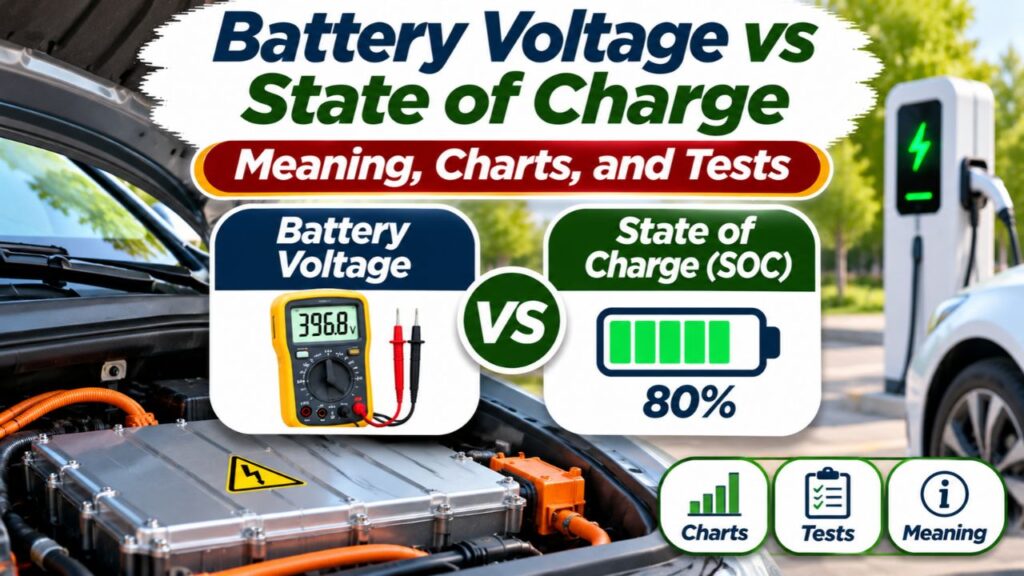
The main difference is that voltage measures an electrical condition, while state of charge estimates the battery’s remaining charge relative to its usable capacity.
Voltage is measured directly with a voltmeter or another suitable measuring device.
State of charge is estimated using battery measurements and a calculation or model.
These measurements are related, but they are not interchangeable.
Battery Voltage vs. State of Charge Comparison Table
| Feature | Battery Voltage | State of Charge (SoC) |
| Definition | Electrical potential difference between battery terminals | Estimated remaining charge relative to usable capacity |
| Unit | Volts (V) | Percentage (%) |
| Measurement | Measured electrically | Estimated or calculated |
| Typical display | 12.6 V, 13.2 V, 400 V | 100%, 80%, 50%, 20% |
| Main purpose | Evaluate electrical conditions | Estimate remaining battery charge |
| Changes under load | Yes | Usually changes more gradually |
| Changes while charging | Yes | Increases as charge is stored |
| Affected by temperature | Yes | Estimated usable capacity and accuracy may also be affected |
| Depends on chemistry | Strongly | Yes, through measurement and estimation methods |
| Can indicate battery health? | Only indirectly | Not directly |
| Useful for EV range estimates? | Limited by itself | Yes, when combined with usable energy and consumption |
| Best measurement approach | Suitable voltage measurement | Battery monitor or BMS using multiple inputs |
Consider a 12V lead-acid battery.
Its voltage might measure approximately 12.7 V after a full charge and adequate rest.
As the battery discharges, its resting voltage generally decreases.
However, a lithium iron phosphate battery can remain near a similar voltage across a broad range of charge levels.
That is why there is no universal voltage-to-SoC conversion chart for all batteries.
What Is Battery Voltage?
Battery voltage is the electrical potential difference between the battery’s positive and negative terminals.
It is measured in volts.
Voltage helps determine how electrical energy can be delivered to connected equipment.
However, a battery’s terminal voltage is not fixed.
It changes with operating conditions.
Nominal Voltage vs. Actual Voltage
The nominal voltage is a standardized or approximate value used to describe a battery system.
The actual terminal voltage can be higher or lower.
For example, a conventional 12V lead-acid battery contains six cells.
Each cell has a nominal voltage of approximately 2 V.
Together, they form a nominal 12V battery.
However, a healthy, fully charged lead-acid battery at rest typically measures above 12 V.
Similarly, a common four-cell LiFePO4 battery has a nominal voltage of approximately 12.8 V, but its actual voltage varies throughout operation.
Open-Circuit Voltage
Open-circuit voltage (OCV) is the voltage measured when a battery is not supplying or receiving current and has had sufficient time to stabilize.
OCV can provide useful information about a lead-acid battery’s charge level.
However, its relationship to SoC depends on battery chemistry and temperature.
For accurate voltage-based SoC estimates, the battery must not be actively charging or discharging.
Voltage Under Load
A battery’s terminal voltage normally falls when it supplies substantial current.
For example, a car’s 12V battery may show a temporary voltage drop while the starter motor operates.
That does not mean its state of charge instantly fell by the same proportion.
The voltage drop reflects electrical resistance and electrochemical effects inside the battery.
When the load is removed, the voltage may recover.
Charging Voltage
Battery voltage normally rises while charging.
A 12V lead-acid battery connected to an operating charging system may show a voltage around 14 V, depending on the vehicle and charging conditions.
That does not mean the battery is 100% charged.
The higher reading reflects the voltage being applied during charging.
Key Takeaway: Voltage is a real electrical measurement, but the reading depends on whether the battery is resting, charging, or supplying power.
What Is State of Charge (SoC)?
State of charge describes the estimated amount of charge remaining in a battery relative to its usable charge capacity.
It is usually expressed as a percentage.
The concept is similar to a fuel gauge.
A battery at 100% SoC is considered fully charged within the system’s defined operating range.
A battery at 50% SoC has approximately half of its defined usable charge capacity remaining.
A battery at 0% SoC has reached the system’s defined discharged limit.
That does not necessarily mean its voltage is zero or that every bit of electrochemical energy has been removed.
State of Charge Formula
A simplified definition is:
SoC (%) = Remaining charge capacity ÷ Current full-charge capacity × 100
For example, suppose a battery has a usable capacity of 100 amp-hours (Ah).
If approximately 60 Ah remains:
60 ÷ 100 × 100 = 60% SoC
This is a simplified example.
Real batteries have losses, temperature effects, changing capacity, and operating limits.
Battery monitoring systems use more sophisticated methods to account for these factors.
What Does 80% State of Charge Mean?
An 80% SoC reading indicates that approximately 80% of the battery’s defined usable charge capacity remains.
For an EV with a usable battery energy capacity of 60 kWh, an 80% display would correspond to approximately:
60 × 0.80 = 48 kWh
This is an approximate energy interpretation.
Actual available energy depends on the battery management system, temperature, aging, and other vehicle-specific conditions.
Is State of Charge Directly Measured?
Not usually.
SoC is generally an estimate.
A battery monitoring system may combine:
- Voltage
- Current
- Temperature
- Battery capacity
- Charging and discharging history
- Battery chemistry models
- Calibration information
The resulting percentage is intended to be more useful than voltage alone.
However, SoC estimates can also contain errors.
Battery Voltage vs State of Charge Chart for 12V Lead-Acid Batteries
A voltage chart is most useful when it is matched to a specific battery chemistry and measured under appropriate conditions.
For conventional flooded lead-acid batteries, open-circuit voltage generally decreases as the battery discharges.
The following table uses published values from Trojan Battery’s battery maintenance guide.
12V Flooded Lead-Acid Battery Voltage Chart
| State of Charge | Open-Circuit Voltage |
| 100% | 12.73 V |
| 90% | 12.62 V |
| 80% | 12.50 V |
| 70% | 12.37 V |
| 60% | 12.27 V |
| 50% | 12.10 V |
| 40% | 11.89 V |
| 30% | 11.81 V |
| 20% | 11.66 V |
| 10% | 11.51 V |
Important: This table is specific to Trojan’s flooded lead-acid reference values under open-circuit conditions. It is not a universal chart for every automotive starter battery, AGM battery, gel battery, or lithium battery.
Trojan recommends allowing the battery to rest without charging or discharging for at least six hours, preferably 24 hours, before taking accurate open-circuit readings.
Temperature and battery construction also influence the results.
What Does 12.7 Volts Mean?
For many healthy, rested 12V lead-acid batteries, a reading near 12.7 V suggests a high state of charge.
In Trojan’s flooded deep-cycle reference chart, 12.73 V corresponds to 100% SoC.
However, some battery designs have different full-charge voltages.
A voltage reading alone cannot confirm that the battery is healthy or capable of supplying high current.
What Does 12.4 Volts Mean?
For the flooded lead-acid battery represented in Trojan’s chart, 12.4 V falls between its 70% and 80% reference readings.
That suggests a partly discharged battery.
However, the same reading from an AGM battery or a battery under load may require a different interpretation.
Do not treat 12.4 V as one universal charge percentage.
What Does 12.2 Volts Mean?
For Trojan’s flooded lead-acid reference, 12.2 V falls between the 50% and 60% readings.
That suggests the battery is substantially discharged.
However, voltage alone cannot establish its exact SoC.
A battery that has recently been used may show a temporarily depressed voltage.
A rested reading is more meaningful.
Is 12.0 Volts a Dead Battery?
Not necessarily.
A rested 12V flooded lead-acid battery measuring around 12.0 V is deeply discharged relative to its normal operating range.
However, it is not automatically defective.
It may recover after proper charging if it has not suffered significant damage.
A battery that cannot hold charge or deliver its rated current may require testing or replacement.
Do not diagnose battery failure from one voltage reading alone.
Does the Voltage Chart Change for AGM Batteries?
Yes.
AGM batteries are a form of sealed lead-acid battery, but their voltage-to-SoC relationship can differ from conventional flooded batteries.
For example, Trojan publishes the following reference values for certain AGM battery products.
| State of Charge | Trojan AGM Open-Circuit Voltage |
| 100% | 12.84 V |
| 75% | 12.54 V |
| 50% | 12.24 V |
| 25% | 11.94 V |
| 0% | 11.64 V |
These values come from Trojan’s AGM battery maintenance specifications.
They illustrate an important distinction.
A voltage of 12.24 V corresponds to approximately 50% SoC in this particular AGM reference.
However, 12.24 V falls nearer 60% in Trojan’s flooded lead-acid chart.
The same voltage can therefore correspond to different charge levels depending on battery design.
What About Gel Batteries?
Gel batteries also belong to the lead-acid family.
However, their recommended charging voltages and voltage-to-SoC relationships can differ.
Use the battery manufacturer’s specifications.
Do not assume that a flooded lead-acid chart applies equally to gel batteries.
Battery Voltage vs State of Charge for Lithium Batteries
Lithium batteries behave differently from lead-acid batteries.
This is particularly important when monitoring lithium systems used in EVs, RVs, solar installations, and portable power equipment.
Lithium batteries are not all the same.
Different lithium chemistries have different nominal voltages, operating limits, and discharge characteristics.
Lithium-Ion Battery Voltage Behavior
Many lithium-ion batteries maintain a relatively stable voltage through much of their usable charge range.
The voltage generally decreases during discharge, but the relationship is not always steep enough for accurate percentage estimation.
A particular voltage may correspond to a relatively broad SoC range depending on current, temperature, and recent operating history.
LiFePO4 Battery Voltage Behavior
Lithium iron phosphate batteries are commonly used in RV, solar, marine, and stationary energy-storage applications.
They have a particularly flat voltage profile across much of their usable capacity.
According to Battery University’s guide to measuring state of charge, the relatively flat discharge curves of several lithium chemistries make voltage-based SoC estimation difficult.
For LiFePO4 batteries, this problem is especially noticeable.
A 12.8V nominal LiFePO4 battery may remain around the low-13V range across a substantial part of its discharge.
Small voltage changes can therefore correspond to large changes in remaining charge.
Why a LiFePO4 Voltage Chart Can Be Misleading
Suppose a LiFePO4 battery reads approximately 13.2 V.
That alone does not reliably tell you whether the battery is at 40%, 60%, or another charge level.
The result depends on the specific cells, resting conditions, current, temperature, and manufacturer.
A simplified voltage chart may provide rough upper and lower indications.
However, it is not a dependable replacement for a properly configured battery monitor.
Do Lithium Batteries Need a Battery Monitor?
For applications where knowing remaining capacity matters, a compatible battery monitor or battery management system is strongly preferable to estimating SoC from voltage alone.
For example, an RV owner using a LiFePO4 house battery may want to know how much charge remains before running appliances overnight.
A properly configured monitor that tracks current entering and leaving the battery is usually more useful than a basic voltmeter.
Key Takeaway: Voltage-based SoC estimates are generally more useful for rested lead-acid batteries than for lithium batteries with flat discharge curves.
Lead-Acid vs Lithium: Voltage and SoC Comparison
The relationship between voltage and remaining charge depends strongly on battery chemistry.
| Characteristic | Lead-Acid | Lithium-Ion / LiFePO4 |
| Voltage change during discharge | Often more noticeable | Often flatter over substantial portions |
| Resting voltage for SoC estimation | Can be useful | Often limited, especially for LiFePO4 |
| Effect of charging and load | Significant | Significant |
| Temperature influence | Important | Important |
| Recommended SoC method | Manufacturer OCV chart or suitable monitoring | BMS or suitable current-tracking monitor |
| Full-charge voltage | Chemistry and product specific | Chemistry and product specific |
| Need for current monitoring | Useful | Particularly valuable |
| Universal voltage chart available? | No | No |
A 12V lead-acid battery and a 12.8V nominal LiFePO4 battery should never be evaluated with the same voltage percentage chart.
Their electrical characteristics are different.
How Battery Voltage Changes During Charging and Discharging
Voltage is affected by whether electricity is entering or leaving the battery.
This is one of the main reasons a direct voltage-to-SoC conversion can be misleading.
During Charging
When a battery receives charging current, terminal voltage generally rises.
For example, a lead-acid battery may show a voltage significantly above its resting voltage while a charger is operating.
The voltage can remain elevated even before the battery has reached full charge.
A high charging voltage does not prove that all usable capacity has been restored.
Immediately After Charging
After charging stops, a lead-acid battery can retain a temporarily elevated surface charge.
This may make the battery appear more fully charged than it actually is.
The voltage gradually stabilizes.
That is why an appropriate rest period matters for open-circuit measurements.
During Discharging
When a battery supplies current, terminal voltage often drops.
The amount depends partly on the current being drawn and the battery’s internal resistance.
A large load can produce a much lower voltage reading than a small load.
This does not mean the battery’s SoC has fallen by the same percentage.
After Removing a Load
The battery voltage may recover once the electrical load is removed.
This is normal battery behavior.
For example, voltage measured during engine cranking is not directly comparable with voltage measured after the vehicle has been parked.
Why Resting Voltage Is Important
A rested reading reduces the influence of recent charging and discharging.
It does not eliminate every source of error, but it can improve voltage-based SoC estimates.
For lead-acid batteries, follow the manufacturer’s recommended resting period and reference chart.
How to Measure Battery Voltage Correctly
A digital multimeter can measure the terminal voltage of an accessible low-voltage battery.
However, the measurement must be interpreted according to the battery chemistry and operating condition.
Step 1: Identify the Battery Type
Determine whether the battery is:
- Flooded lead-acid
- AGM
- Gel
- Lithium iron phosphate
- Another lithium-ion chemistry
Also identify the nominal system voltage.
A voltage that is normal for one type may be inappropriate for another.
Step 2: Turn Off Charging and Electrical Loads
For an open-circuit measurement, the battery should not be receiving charging current or supplying a significant load.
On a conventional 12V car battery, this usually means measuring with the engine off after the vehicle has been parked.
However, modern vehicles may retain small electrical loads even when switched off.
A parked-car measurement is therefore not always a true open-circuit reading.
Do not disconnect vehicle electronics or the battery unnecessarily merely to obtain a perfect resting reading.
Follow vehicle and battery manufacturer instructions.
Step 3: Allow the Battery to Rest
For lead-acid batteries, follow the manufacturer’s recommended rest period.
Trojan recommends at least six hours without charging or discharging, preferably 24 hours, for accurate open-circuit measurements in its battery maintenance procedure.
Other manufacturers may specify different conditions.
A battery measured immediately after charging or heavy use may give a misleading result.
Step 4: Set the Multimeter Correctly
Select DC voltage measurement.
Choose a suitable range if the meter does not automatically select one.
Use equipment rated for the voltage being measured.
A 12V battery can be tested with an appropriately rated multimeter.
Do not attempt to measure an EV’s high-voltage traction battery directly. High-voltage automotive systems can cause fatal electric shock and require specialized procedures and training.
Step 5: Measure the Accessible Terminals
For a conventional accessible 12V battery:
- Place the black probe on the negative terminal.
- Place the red probe on the positive terminal.
- Read the displayed DC voltage.
- Keep tools and probes from bridging the terminals.
Avoid creating a short circuit.
Remove metal jewelry when appropriate and follow battery safety precautions.
Lead-acid batteries can release flammable gases, so keep sparks and flames away.
Step 6: Compare With the Correct Reference
Use a chart supplied by the battery manufacturer.
Confirm whether the chart is intended for resting voltage, charging voltage, or loaded voltage.
Do not compare a reading taken during charging with an open-circuit SoC chart.
Step 7: Evaluate Battery Condition Separately
If the battery repeatedly fails to start a vehicle or cannot hold charge, further testing may be necessary.
A load test, conductance test, or other appropriate diagnostic procedure can provide more information than resting voltage alone.
How Is State of Charge Measured?
SoC cannot normally be determined by a single direct measurement.
Battery monitoring systems estimate it through one or more methods.
1. Open-Circuit Voltage Method
This method uses a known relationship between resting voltage and charge level.
It can work reasonably well for certain lead-acid batteries.
However, it requires appropriate resting conditions.
It is less dependable for batteries with very flat voltage curves.
2. Coulomb Counting
Coulomb counting measures electrical current flowing into and out of the battery over time.
The system estimates how much charge has been added or removed.
For example, imagine a 100 Ah battery starting at 100% SoC.
If it supplies 20 A for two hours:
20 × 2 = 40 Ah
Under simplified ideal conditions, approximately 60 Ah remains.
That corresponds to about 60% SoC.
However, real monitoring systems must consider charge efficiency, changing capacity, measurement errors, and other battery characteristics.
3. Battery Management System Estimation
A battery management system, or BMS, can estimate SoC using several measurements.
These may include:
- Current
- Voltage
- Individual cell voltages
- Temperature
- Charging history
- Battery models
- Calibration data
The exact method depends on the manufacturer.
A BMS also performs functions other than estimating charge percentage, including monitoring and protecting the battery within its operating limits.
4. Shunt-Based Battery Monitoring
A battery shunt measures current flowing through a known electrical resistance.
A compatible battery monitor uses that information to track charging and discharging.
This can provide more reliable SoC information than voltage alone in RV and solar battery systems.
However, the monitor must be installed and configured correctly.
Battery capacity, charge efficiency, and other settings influence accuracy.
5. Specific Gravity Testing
For accessible flooded lead-acid batteries, electrolyte specific gravity can provide useful charge information.
It is measured using a suitable hydrometer.
Trojan notes that specific gravity is an important method for determining SoC in its flooded lead-acid batteries.
However, electrolyte testing is not appropriate for sealed AGM, gel, or lithium batteries.
It also involves handling hazardous battery acid and should be performed only by people familiar with the necessary safety procedures.
Why a Battery Monitor Can Be More Accurate Than Voltage
A well-configured battery monitor can account for energy entering and leaving a battery over time.
It is therefore more informative than a voltage-only display in many applications.
However, battery monitors are not automatically exact.
Current Tracking
A monitor can measure how much current is flowing during charging and discharging.
That helps track changing SoC even when battery voltage remains relatively stable.
This is particularly useful for LiFePO4 batteries.
Capacity Settings
The monitor needs an appropriate battery capacity setting.
For example, a monitor configured for 200 Ah will not necessarily provide correct SoC estimates when connected to a battery with substantially different usable capacity.
The settings should match the battery and manufacturer guidance.
Synchronization
Small measurement errors can accumulate over time.
As a result, a current-tracking monitor may gradually drift away from the battery’s actual SoC.
According to Victron Energy’s SmartShunt manual, reliable SoC monitoring requires periodic synchronization.
The monitor uses charging conditions such as voltage, current, and time to recognize when a full-charge condition has been reached.
Battery Aging
The battery’s usable capacity may decline as it ages.
If a monitor continues using an outdated capacity setting, its SoC calculations may become less accurate.
This is one reason monitoring systems may need periodic verification and calibration.
A good battery monitor provides a better estimate, not a guarantee of perfect accuracy.
Battery Voltage vs State of Charge in Electric Vehicles
An electric vehicle’s dashboard typically displays battery charge as a percentage.
It may also show estimated remaining driving range.
These values are different from the high-voltage battery pack’s measured terminal voltage.
Why EVs Do Not Use Voltage Alone
An EV traction battery contains many cells connected in series and parallel.
Its electrical characteristics change with:
- Cell chemistry
- Temperature
- Charging and discharging current
- Battery aging
- Cell balancing
- Operating limits
The battery management system estimates SoC using data from the pack.
Simply measuring the total pack voltage would not provide a sufficiently dependable charge percentage across all conditions.
What Does 400V or 800V Mean?
Electric vehicles are commonly described as having approximately 400V or 800V battery architectures.
These are broad voltage categories, not fixed voltages or charge percentages.
Actual battery voltage varies with cell count, chemistry, SoC, and operating conditions.
An 800V-class battery is not automatically more charged than a 400V-class battery.
The systems have different nominal operating voltages.
Does Higher Voltage Mean More Charge?
Not when comparing different EV battery architectures.
A 400V-class battery at 100% SoC can be fully charged.
An 800V-class battery at 20% SoC can be substantially discharged.
Their total pack voltages cannot be compared directly to determine remaining charge.
Within one battery system, voltage can provide some useful information, but SoC estimation requires more context.
How Do EVs Display Remaining Range?
Estimated range depends on more than SoC.
A vehicle may consider:
- Available battery energy
- Recent driving efficiency
- Speed
- Temperature
- Climate-control use
- Terrain
- Other operating conditions
Therefore, an EV showing 80% SoC does not necessarily have exactly 80% of its maximum advertised driving range remaining.
SoC describes the charge level.
Estimated range predicts driving distance under particular conditions.
Can You Check an EV’s SoC With a Voltmeter?
Use the vehicle’s dashboard, manufacturer app, or approved diagnostic tools.
Do not attempt to measure traction battery voltage directly.
EV high-voltage systems require specialized training and equipment.
The high-voltage battery is not comparable to an ordinary accessible 12V automotive battery.
Battery Voltage vs State of Charge vs State of Health
These three measurements describe different battery characteristics.
Battery Voltage
Voltage tells you the battery’s electrical potential difference at the time of measurement.
It may be useful for checking charging conditions and identifying obvious electrical problems.
State of Charge
State of charge estimates how much usable charge remains relative to the battery’s defined capacity.
It is the battery equivalent of a fuel gauge.
State of Health
State of health (SoH) describes how the battery’s condition compares with a suitable reference, often its condition when new.
Capacity retention is a common SoH measure.
Internal resistance and other indicators may also be considered.
Comparison Table
| Measurement | Typical Unit | Main Question Answered |
| Voltage | V | What electrical potential is present? |
| State of charge | % | How much charge remains? |
| State of health | % or other indicators | How much has the battery deteriorated? |
Can a Battery Be 100% Charged but Have Poor Health?
Yes.
Imagine a battery that originally stored 100 Ah but now stores only 70 Ah because of aging.
It can still reach 100% SoC relative to its current usable capacity.
However, its usable capacity is lower than when new.
In a simplified capacity-based comparison, it may retain approximately 70% of its original capacity.
This is why a battery can display a full charge and still perform poorly.
Can Voltage Tell You Battery Health?
Not reliably by itself.
A deteriorated battery may show a normal resting voltage but fail under heavy electrical load.
For example, a car battery can measure approximately 12.7 V at rest yet struggle to crank the engine because its ability to deliver current has deteriorated.
A proper battery health test is more informative.
How Temperature Affects Voltage and State of Charge
Temperature influences battery behavior.
However, its effects differ by chemistry and measurement conditions.
Cold Temperatures
Cold conditions can reduce a battery’s available power and increase internal resistance.
A battery may show a larger voltage drop under load.
In an EV, cold temperatures can also reduce temporarily available energy and affect charging performance.
That does not necessarily mean the battery has suffered permanent capacity loss.
Hot Temperatures
Higher temperatures influence electrochemical behavior and battery aging.
Heat can also accelerate unwanted reactions inside some battery types.
A voltage reading taken at an elevated temperature may not match a reference chart developed under cooler conditions.
Temperature and Lead-Acid Voltage Charts
Lead-acid voltage-to-SoC relationships depend partly on temperature.
Use the battery manufacturer’s specified reference conditions.
A voltage measured on a freezing morning should not automatically be interpreted using a chart without considering temperature.
Temperature and Lithium Batteries
Lithium battery management systems commonly monitor temperature because charging and discharging limits depend on it.
Some lithium batteries restrict charging when cells are too cold.
Others use heaters or active thermal management.
Follow manufacturer guidance rather than inferring safe charging conditions from voltage alone.
Can You Convert Battery Voltage Directly Into State of Charge?
Sometimes an approximate conversion is possible, but only when the battery type and measurement conditions are known.
There is no universal formula such as:
SoC = Battery voltage ÷ Nominal voltage × 100
That calculation is incorrect.
For example, a 12V battery reading 12.6 V is not 105% charged.
Nominal voltage is not a full-charge reference for calculating percentage.
When Voltage-Based Conversion May Work
Voltage-based SoC estimation may be useful when:
- The battery is lead-acid.
- The chemistry and construction are known.
- The voltage is measured after sufficient rest.
- Temperature is considered.
- A suitable manufacturer chart is available.
Even then, the result is an estimate.
When Voltage-Based Conversion Is Unreliable
It is much less dependable when:
- The battery is being charged.
- A substantial load is operating.
- The battery has just been used.
- The chemistry is unknown.
- The battery is a LiFePO4 system with a flat voltage curve.
- The temperature differs substantially from the reference conditions.
- The battery is severely aged or damaged.
For these conditions, use a compatible battery monitor or other suitable diagnostic method.
Which Measurement Should You Use for Different Applications?
The best measurement depends on what you are trying to determine.
| Application | Most Useful Starting Measurement |
| Checking a parked car’s 12V battery | Resting voltage, followed by appropriate testing if needed |
| Checking whether an alternator is charging | Voltage and charging-system diagnostics |
| Monitoring a flooded deep-cycle lead-acid battery | Manufacturer OCV chart or suitable monitor |
| Monitoring an AGM battery | AGM-specific guidance and suitable monitoring |
| Monitoring an RV LiFePO4 battery | Compatible BMS or shunt-based battery monitor |
| Monitoring solar battery capacity | SoC from a properly configured monitor |
| Checking an EV’s remaining charge | Vehicle-displayed SoC |
| Diagnosing poor battery performance | Battery health and load testing |
| Estimating EV driving range | SoC, usable energy, and expected consumption |
For Car Owners
Voltage can be useful for identifying a discharged 12V battery or a charging-system issue.
However, voltage alone cannot determine whether the battery is capable of starting the engine reliably.
A load or conductance test may be necessary.
For RV Owners
SoC is often more useful for managing house battery capacity.
This is particularly true for lithium systems.
A properly configured current-monitoring system can help estimate how much energy remains for appliances and other loads.
For Solar Battery Systems
Voltage is useful for electrical diagnostics.
SoC is generally more useful for understanding stored energy availability.
Both values may be displayed by suitable solar monitoring equipment.
For EV Drivers
Use the vehicle’s SoC display to understand charge level.
Use estimated range as a separate planning indicator.
Follow the vehicle manufacturer’s charging and battery-care recommendations.
Common Mistakes When Comparing Battery Voltage and State of Charge
Several misunderstandings can lead to inaccurate conclusions.
1. Treating Voltage as a Direct Charge Percentage
Voltage and SoC are related, but they are not equivalent.
Use the correct chemistry-specific method.
2. Applying a Lead-Acid Chart to Lithium
A 12V lead-acid voltage chart is not suitable for a 12.8V nominal LiFePO4 battery.
The chemistry and voltage curves differ.
3. Measuring Immediately After Charging
Surface charge and other effects can temporarily elevate voltage.
Allow appropriate resting time when using open-circuit voltage for lead-acid SoC estimation.
4. Measuring During Heavy Electrical Loads
Voltage may drop significantly during high-current discharge.
Do not interpret loaded voltage using a resting-voltage reference chart.
5. Assuming a Full Voltage Reading Means a Healthy Battery
A battery can show normal voltage but have reduced usable capacity or poor current-delivery capability.
Battery health testing may be needed.
6. Ignoring Temperature
Temperature affects voltage, internal resistance, available capacity, and charging behavior.
Consider the conditions under which the reading was obtained.
7. Using the Wrong Battery Chemistry Setting
Some monitors require the correct battery type and capacity settings.
Incorrect configuration can produce misleading SoC estimates.
8. Failing to Synchronize the Battery Monitor
Current-counting monitors can accumulate estimation errors.
Follow the manufacturer’s synchronization and calibration instructions.
9. Assuming 0% SoC Means Zero Volts
A battery at 0% displayed SoC can still have substantial terminal voltage.
The percentage refers to the defined usable charge range.
10. Confusing SoC With Battery Health
A worn-out battery can show 100% SoC relative to its reduced capacity.
SoC does not indicate how much capacity the battery has lost since new.
11. Comparing 400V and 800V EV Batteries Directly
These are different electrical architectures.
The higher nominal voltage does not indicate a higher charge percentage.
12. Attempting to Probe an EV Traction Battery
High-voltage EV systems are dangerous.
Use vehicle-approved displays and diagnostic equipment rather than attempting direct measurements.
Conclusion
The main difference in battery voltage vs state of charge is that voltage measures electrical potential, while SoC estimates the percentage of usable charge remaining.
For rested lead-acid batteries, voltage can provide a useful approximate SoC indication when compared with the correct manufacturer chart.
For lithium batteries, particularly LiFePO4, voltage alone is much less reliable because it changes relatively little over much of the discharge range.
Current, temperature, charging activity, recent loads, and battery age can also affect how voltage readings should be interpreted.
For a conventional car’s 12V battery, I recommend using a proper resting-voltage measurement as an initial check and obtaining a battery health test when performance is questionable.
For RV, marine, and solar lithium systems, a compatible battery monitor or BMS is generally more useful for tracking remaining charge.
For electric vehicles, rely on the vehicle’s SoC display rather than attempting to calculate charge percentage from the traction battery’s total voltage.
Understanding both measurements helps you avoid inaccurate battery percentage estimates, improve charging decisions, and recognize when a battery needs more than a simple voltage check.
FAQs About Battery Voltage vs State of Charge
Is Battery Voltage the Same as State of Charge?
No.
Battery voltage is measured in volts and describes the electrical potential difference across the battery.
State of charge is expressed as a percentage and estimates how much usable charge remains.
Voltage can help estimate SoC in certain conditions, but the two measurements are not interchangeable.
What Voltage Is a 12V Battery at 100% State of Charge?
A healthy, fully charged 12V lead-acid battery commonly has a resting voltage around 12.6–12.8 V, depending on its construction.
Trojan’s flooded deep-cycle reference specifies 12.73 V at 100% SoC.
Some AGM batteries have different values.
Always use the appropriate manufacturer reference.
What State of Charge Is 12.4 Volts?
For Trojan’s rested flooded lead-acid reference, 12.4 V falls between the 70% and 80% readings.
However, another lead-acid battery may have a different voltage-to-SoC relationship.
If the battery is lithium, charging, or supplying a load, that interpretation does not apply.
Can You Calculate Battery SoC From Voltage?
You can estimate SoC from resting voltage when the battery chemistry, temperature, and manufacturer reference values are known.
This is most useful for certain lead-acid batteries.
It is much less reliable for LiFePO4 and other batteries with relatively flat discharge curves.
Why Does Battery Voltage Drop Under Load?
Battery voltage drops under load partly because of internal resistance and electrochemical effects.
A high-current load can temporarily reduce terminal voltage even when the battery retains significant charge.
The voltage may recover after the load is removed.
Why Does a Lithium Battery Show Almost the Same Voltage at Different Charge Levels?
Many lithium batteries, especially LiFePO4, have a relatively flat discharge voltage curve.
That means a substantial amount of charge can be removed without a large change in terminal voltage.
A suitable BMS or battery monitor is generally better for estimating SoC.
Can a Battery Be 100% Charged but Still Be Bad?
Yes.
A battery can reach full charge relative to its remaining usable capacity while having lost substantial capacity because of aging.
It may also struggle to supply high current.
State of charge does not replace battery health testing.
Is State of Charge or Voltage More Important for an EV?
State of charge is generally more useful for understanding the EV’s remaining battery charge.
Voltage remains important to the vehicle’s battery management and electrical systems.
The BMS uses multiple measurements to monitor and manage the battery rather than relying on voltage alone.