
Choosing the best car speakers without amplifier can be confusing because peak wattage numbers rarely tell the whole story. Factory radios have limited power, so sensitivity, impedance, fit, and speaker design matter just as much as headline output.
My first choice is BOSS Audio Systems CH6530 6.5-Inch 3-Way Car Speakers. Its 90 dB sensitivity should help it produce useful volume from a factory stereo, while the poly injection cone and rubber surround support everyday durability.
My second choice is PIONEER F-Series TS-F1634R 6.5-Inch 2-Way Coaxial Car Speakers. The 25-watt nominal rating, 88 dB sensitivity, and standard 6.5-inch sizing make it a sensible match for many stock head units.
My third choice is Kenwood KFC-1666R Road Series 6.5-Inch 2-Way Coaxial Car Speakers. Kenwood KFC-1666R Road Series Car Speakers Pair 6.5 2-Way Car earns my third-choice position with a cloth woofer, balanced dome tweeter, shallow depth, and a useful 40 Hz to 22 kHz response. It is especially appealing when clear highs and easy installation matter more than maximum output claims.
This guide compares all five options, explains what their specifications mean in a factory-powered system, and covers fitment, wiring, installation, sound tuning, maintenance, and common mistakes. The goal is to help a first-time buyer choose speakers that fit both the vehicle and the existing radio.
Best Car Speakers Without Amplifier
I selected these products for their relevance to factory-powered car audio, useful published specifications, practical installation details, and available customer-feedback evidence. The list also includes several established brands and different designs so that shoppers can compare conventional door speakers with a specialized sun-visor option.
| # | Image | Product | Price on Amazon |
|---|---|---|---|
| 1 |  |
BOSS Audio Systems CH6530 6.5-Inch 3-Way Car Speakers | Price on Amazon |
| 2 |  |
PIONEER F-Series TS-F1634R 6.5-Inch 2-Way Coaxial Car Speakers | Price on Amazon |
| 3 | 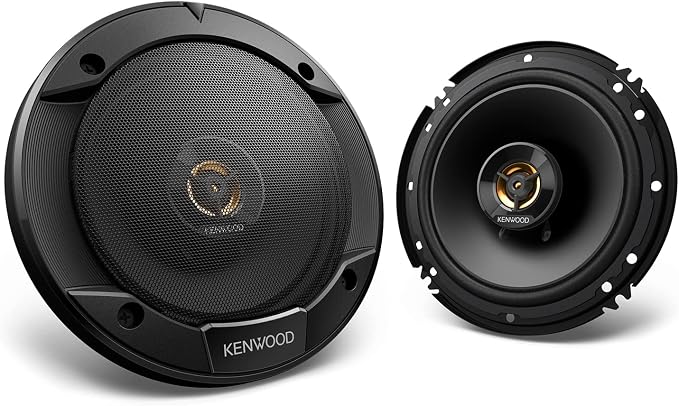 |
Kenwood KFC-1666R Road Series 6.5-Inch 2-Way Coaxial Car Speakers | Price on Amazon |
| 4 |  |
Pyle PLTWVS 6-Way Sun-Visor Car Speakers | Price on Amazon |
| 5 |  |
KICKER 46CSC654 CS Series 6.5-Inch Coaxial Car Speakers | Price on Amazon |
BOSS Audio Systems CH6530 6.5-Inch 3-Way Car Speakers
The CH6530 is a pair of 6.5-inch, three-way speakers built around a poly injection cone, rubber surround, stamped basket, and 1-inch voice coil. That combination gives buyers a conventional replacement format with a cone material intended to handle regular movement and a surround that can flex as the speaker produces bass and midrange.
Its 90 dB sensitivity is one of the most useful numbers for a factory-radio installation. A sensitive speaker can make better use of the limited power coming from an original head unit, so this model is a logical choice when the goal is a noticeable upgrade without adding an amplifier. The stated frequency response runs from 100 Hz to 18 kHz, which covers much of the audible vocal and music range but does not promise deep subwoofer-style bass.
Fit still deserves attention. The speaker has a 5.5-inch mounting hole and 2.1-inch mounting depth, with a 4-ohm impedance. Those dimensions may suit many 6.5-inch locations, but a vehicle-specific adapter or grille adjustment can still be necessary. The pair weighs 1.3 pounds, so it should not create an unusually heavy door installation.
Pros
- 90 dB sensitivity is helpful with low-power factory radios.
- Three-way layout offers separate high-frequency and midrange elements.
- Rubber surrounds and poly injection cones suit everyday vehicle use.
- Useful 4-ohm impedance and common 6.5-inch category.
Cons
- Published response begins at 100 Hz, so very deep bass is limited.
- 5.5-inch mounting hole and 2.1-inch depth still require vehicle measurement.
My Opinion
This is the strongest all-around starting point for a stock-radio replacement when sensitivity and broad sound coverage are priorities. Confirm the hole pattern and clearance first, and do not confuse the 300-watt headline with the amount a factory stereo can actually deliver.
PIONEER F-Series TS-F1634R 6.5-Inch 2-Way Coaxial Car Speakers
Pioneer takes a simpler approach with the TS-F1634R: a 6.5-inch, two-way coaxial design that places the tweeter in the same speaker assembly as the woofer. For a beginner, that format is attractive because it replaces a standard door speaker without requiring separate tweeter locations or a more complicated crossover arrangement.
The key limitation is the power specification. The speaker is listed at 200 watts maximum but 25 watts nominal, and the nominal figure is the more useful reference when pairing it with a factory radio. Its 4-ohm impedance is common for car audio, while the 88 dB sensitivity should still allow reasonable volume from a lower-power source. That makes it better suited to a clean factory-radio upgrade than to a high-output system built around a powerful external amplifier.
Standard 6.5-inch sizing improves the odds of fitting common door locations, but it does not guarantee a direct installation in every vehicle. Door depth, mounting tabs, wiring plugs, and the original grille can vary. The traditional black finish is unobtrusive, which is useful when the replacement needs to sit behind the factory trim rather than draw attention.
Sound-wise, a two-way coaxial speaker is a balanced middle ground. It can improve clarity over a worn factory driver, but it has fewer separate elements than a three-way design and should not be expected to produce subwoofer-level low frequencies from a door.
Pros
- Simple two-way coaxial format is approachable for first-time upgrades.
- 25-watt nominal handling is relevant to many factory head units.
- 4-ohm impedance and standard 6.5-inch sizing are broadly practical.
- Pioneer branding and 9,781 listed customer ratings provide useful buyer context.
Cons
- 88 dB sensitivity is lower than the top-ranked BOSS option.
- Maximum wattage should not be treated as factory-radio power output.
My Opinion
The Pioneer is a sensible second choice for a clean, uncomplicated door-speaker replacement. It makes the most sense for someone who values a conventional coaxial layout and modest factory-radio compatibility over the biggest specification numbers.
Kenwood KFC-1666R Road Series 6.5-Inch 2-Way Coaxial Car Speakers
Kenwood’s KFC-1666R uses a cloth woofer cone and balanced dome tweeter, a combination that targets a smoother, more natural presentation than a basic paper-cone replacement may provide. Its listed 40 Hz to 22 kHz response also covers a wide range on paper, although the final result will depend on the radio, door enclosure, music source, and installation quality.
The speaker carries a 30-watt nominal rating, 300-watt peak figure, and 4-ohm impedance. The nominal number is the one to focus on when no external amplifier is involved. It gives a reasonable reference for a factory head unit, while the 4-ohm load is familiar to many car audio systems. The speakers can be used in front or rear positions, which gives a buyer more flexibility when refreshing only one pair.
A heavy-duty magnet, lower tweeter height, and shallow depth are practical details rather than just marketing language. A shallow speaker can be easier to place behind a door panel, and a lower tweeter profile may reduce interference with factory grilles. Kenwood also lists grilles for protection, though the original vehicle trim and mounting hardware should still be checked before ordering.
The main trade-off is that this is still a 2-way coaxial speaker, not a separate component system. It can improve clarity and range without requiring an amplifier, but buyers seeking a dramatic concert-style stage may eventually want more advanced installation equipment.
Pros
- Cloth woofer and balanced dome tweeter support detailed everyday listening.
- 40 Hz to 22 kHz listed response covers a broad musical range.
- Shallow depth and lower tweeter height can simplify door installation.
- Suitable for either front or rear speaker positions.
Cons
- Peak power is much higher than the 30-watt nominal rating relevant to stock radios.
- Vehicle-specific brackets and wiring may still be required.
My Opinion
The Kenwood is a strong fit for buyers who care about vocal clarity and practical installation details. I would choose it when the shallow design and cloth woofer are more important than chasing a higher sensitivity number.
Pyle PLTWVS 6-Way Sun-Visor Car Speakers
The Pyle PLTWVS is notably different from the other choices. Instead of replacing a conventional door speaker, this pair mounts to the sun visor with included straps, wires, and installation hardware. The sound is reflected from the windshield, creating a front-facing presentation that may appeal to someone who wants an add-on speaker location rather than a hidden factory-door replacement.
Its six-way arrangement uses four 60 mm piezo midrange elements and two 40 mm piezo tweeters. The listed frequency response is 2.5 kHz to 20 kHz, so the system is focused on upper midrange and treble rather than deep bass. That makes it more useful for adding presence, speech intelligibility, and brightness than for replacing a full-range door speaker by itself.
Pyle lists 100 watts RMS, 200 watts peak, 4-ohm impedance, and 90 dB sensitivity. The sensitivity and 4-ohm load are favorable for a lower-powered source, but the unusual frequency range means buyers should view this as a specialized supplement or a highly visible alternative—not a conventional full-spectrum replacement. The supplied straps may simplify setup, though the visor position can affect visibility, appearance, and access to the visor.
Because these speakers sit in the cabin, wire routing deserves extra care. Keep cables away from moving visor hinges and make sure the installation does not interfere with the driver’s view or any vehicle safety equipment.
Pros
- Sun-visor mounting hardware and wires are included.
- 90 dB sensitivity and 4-ohm impedance suit many modest-power systems.
- Windshield reflection can add forward-facing presence.
- Useful for buyers seeking an unusual add-on speaker location.
Cons
- 2.5 kHz lower frequency limit leaves out deep bass and much lower midrange.
- Visor mounting is less discreet and less universal than a door replacement.
- Only 163 listed customer ratings provide less feedback than the leading options.
My Opinion
This is a niche solution rather than a default recommendation. Choose it when visor mounting and extra upper-range projection are the main goals, but avoid treating it as a direct substitute for a full-range 6.5-inch door speaker.
KICKER 46CSC654 CS Series 6.5-Inch Coaxial Car Speakers
The KICKER 46CSC654 bundle includes two pairs, or four speakers, so it can refresh both the front and rear locations in one purchase. That is its biggest practical advantage. A complete front-and-rear replacement can create a more consistent tonal balance than mixing old factory speakers with one new pair.
Each speaker is listed at 100 watts RMS and 300 watts peak, with a 3.3-ohm impedance, 90 dB sensitivity, and 40 Hz to 20 kHz frequency response. The 90 dB figure is helpful for factory-radio use, but the 3.3-ohm load deserves attention. It is not the same nominal impedance as the more common 4-ohm options here, so buyers should confirm that their vehicle’s factory radio is suitable before installing all four.
The polypropylene woofer cones have UV-treated poly-foam surrounds, which is useful in doors exposed to heat and sunlight. KICKER also uses a heavy-duty EVC motor and zero-protrusion PEI tweeters with neodymium magnets. The low-profile tweeters are intended to fit beneath factory grilles, while included grilles and mounting hardware can make the upgrade more straightforward.
There is a trade-off in buying four speakers at once: it may be unnecessary if only one factory driver has failed, and the bundle’s low customer-feedback count means there is less long-term buying evidence than for the older, more widely rated options. Still, its broad response and full-cabin coverage make it compelling for a complete refresh.
Pros
- Four-speaker bundle covers front and rear installations.
- 90 dB sensitivity and 40 Hz to 20 kHz response support full-range listening.
- UV-treated surrounds and polypropylene cones suit hot vehicle interiors.
- Zero-protrusion tweeters can fit beneath many factory grilles.
Cons
- 3.3-ohm impedance requires careful factory-radio compatibility checking.
- Buying four may be excessive when only one pair needs replacement.
- Only 32 listed customer ratings offer limited ownership feedback.
My Opinion
The KICKER bundle is the most attractive choice for a full-cabin upgrade, provided the 3.3-ohm load is appropriate for the vehicle. Its low-profile construction and weather-conscious materials add practical value, but it is not the simplest pick for a single-pair replacement.
How I Selected These Best Car Speakers Without Amplifier
For the best car speakers without amplifier, I prioritized specifications that matter when the factory head unit remains in place: sensitivity, impedance, nominal power information, speaker format, frequency response, and physical installation details. Peak wattage was treated as secondary because it does not describe how much power a stock radio normally supplies.
I also considered whether each model solves a realistic buyer problem. The BOSS, Pioneer, Kenwood, and KICKER options are conventional speaker upgrades in the 6.5-inch category, while the Pyle option serves a different use case with sun-visor mounting and a high-frequency emphasis. That difference is important because a specialized product should not be judged as though it were a standard door speaker.
Customer-feedback volume was another part of the comparison. The BOSS and Pioneer listings have substantially more listed ratings than the Pyle and KICKER options, which provides more public ownership evidence but does not guarantee a particular result in every vehicle. Brand diversity also matters here because Pioneer, Kenwood, BOSS, Pyle, and KICKER use different design priorities.
A factory radio does not become more powerful because a speaker has a larger peak-wattage number. Sensitivity, nominal power, impedance, and correct fit are usually more useful starting points.
The most important selection step happens before checkout: confirm the vehicle’s opening, mounting depth, connector, grille clearance, and acceptable impedance.
How to Choose Best Car Speakers Without Amplifier
Choosing speakers for a factory-powered system is mainly a compatibility decision, not a race for the largest wattage claim. Start with the vehicle’s physical opening, then compare sensitivity and nominal power before considering construction details or cosmetic preferences.
- Measure the original speaker opening and mounting depth.
- Use nominal or RMS power as a practical reference, not peak power alone.
- Prefer higher sensitivity when the factory radio will remain in place.
- Confirm impedance before connecting a replacement speaker.
- Decide whether you need one pair, a full four-speaker bundle, or a specialized add-on.
Understand sensitivity and factory-radio power
Sensitivity describes how much sound a speaker can produce from a specified amount of input. In simple terms, a higher sensitivity rating can be helpful when the source is a modest factory radio. The BOSS, Pyle, and KICKER models list 90 dB, while Pioneer lists 88 dB. That difference does not automatically make one speaker better, but it can matter when maximum clean volume is limited.
Nominal or RMS power is more useful than peak power for matching an existing system. Pioneer lists 25 watts nominal, Kenwood lists 30 watts nominal, and KICKER lists 100 watts RMS per speaker. Those numbers should not be read as a promise that the stock radio will deliver that output. They are better used as a guide to how the speaker is rated and whether an external amplifier might eventually be appropriate.
Choose the right speaker format
A coaxial speaker combines the woofer and tweeter in one assembly, which keeps installation relatively simple. A three-way design adds another range-producing element, while the Pyle sun-visor model uses multiple piezo elements in a specialized location. For most first-time door upgrades, a conventional coaxial speaker is the least complicated route.
Do not select a sun-visor system simply because its peak wattage appears high. Its listed 2.5 kHz to 20 kHz response means it is intended for upper-range sound and will not replace the bass contribution of a normal full-range door speaker.
Balance sound goals with installation effort
Buyers wanting a quick replacement may prefer the Pioneer or Kenwood 2-way designs. Someone seeking higher sensitivity and a three-way layout may favor the BOSS. A buyer replacing all four locations may appreciate the KICKER bundle. These choices are more useful than declaring one model universally superior, because the best fit depends on the vehicle and the intended scope of the upgrade.
Check Vehicle Fit Before Ordering
A speaker labeled 6.5 inches is not guaranteed to drop into every 6.5-inch factory location. The diameter is only one measurement. The hole pattern, mounting tabs, basket shape, magnet clearance, grille height, and depth behind the door panel can all affect installation.
Measure the opening and depth
Remove the factory grille or speaker when practical and measure the mounting hole rather than relying only on the vehicle’s advertised speaker size. Compare that measurement with the BOSS 5.5-inch mounting hole and 2.1-inch mounting depth. For other models, verify the actual vehicle-specific dimensions before ordering.
Check connectors and adapters
Factory wiring plugs may not match aftermarket speaker terminals. A vehicle-specific harness adapter can avoid cutting the original wiring and makes future replacement easier. Mounting brackets may also be required when the original speaker uses an unusual bolt pattern or integrated spacer.
Protect grille and window clearance
Before tightening everything, test the door panel and window movement. A tweeter, magnet, or terminal can contact the grille or glass if the speaker sits too far forward or too deep. The KICKER zero-protrusion tweeter and Kenwood shallow-depth design may help in tight locations, but neither removes the need to verify clearance.
Install Factory-Replacement Speakers Safely
Speaker installation is usually manageable for a careful beginner, but vehicle doors can contain wiring for power windows, locks, side airbags, and other equipment. Disconnect the negative battery cable when appropriate for the vehicle, keep tools away from airbag wiring, and consult the vehicle service information if the door contains safety-system components.
- Remove the grille, door panel, or factory speaker cover without forcing clips.
- Photograph the original wiring and note the positive and negative terminals.
- Test-fit the replacement with the window fully raised and lowered.
- Use the correct adapter harness or secure crimp connections.
- Mount the speaker firmly, but do not overtighten screws into plastic or thin metal.
- Test the speaker at low volume before reinstalling the trim.
Keep polarity consistent
Connecting one speaker backward can reduce bass and make the stereo image feel hollow, particularly when the opposite speaker is wired correctly. Match positive and negative connections across the pair. If the factory terminals are not clearly marked, use the vehicle wiring information rather than guessing.
Seal loose mounting areas
Air leaks around a door speaker can reduce useful midbass and create rattles. A firm adapter and even mounting pressure help the speaker work more consistently. Avoid blocking drainage paths inside the door, and make sure the speaker cone can move without touching foam, wiring, or trim.
Set Up the System After Installation
Start with the radio’s equalizer, bass boost, and loudness controls at neutral settings. Play familiar music at a moderate level and listen for distortion, rattles, or a missing channel before increasing volume. This gives a clearer indication of whether the installation is correct than immediately turning every control to maximum.
Adjust bass carefully
A factory door location is not a sealed subwoofer enclosure. Adding a large bass boost can make a small stock radio clip sooner and can stress a speaker without producing genuinely deep bass. If the system sounds thin, first check polarity, mounting, and door-panel rattles before applying more equalization.
Use fading and balance to diagnose problems
Move the fade control fully forward and backward, then shift the balance from left to right. Each speaker should play clearly when isolated. A silent channel may indicate a loose connector, incorrect harness, damaged wire, or a failed speaker rather than an equalizer problem.
Allow your ears to adjust
A new speaker may sound different from a worn factory driver because its tweeter, cone material, or frequency balance is different. Give yourself time to compare familiar recordings at similar volume. Loudness alone can make a brighter speaker seem better, so make comparisons at a comfortable, matched level.
Reduce Door Rattles and Improve Sound
Many apparent speaker problems are actually caused by loose trim, a vibrating grille, or an unsecured wire. A speaker upgrade can expose those noises because clearer midrange makes rattles easier to hear.
- Secure wiring so it cannot touch the cone or door metal.
- Replace broken trim clips before the panel is reinstalled.
- Check that the grille does not press against the tweeter.
- Use suitable foam or gasket material around the mounting interface.
- Do not cover factory drainage openings with sound-deadening material.
Basic door treatment can improve perceived bass and reduce vibration, but it is not mandatory for every replacement. Keep any added material clear of window tracks, locks, wiring, and side-airbag components.
Maintain Car Speakers in Daily Use
Most maintenance is preventive rather than complicated. Keep drinks, cleaners, and excessive moisture away from the grille, and do not spray liquid directly onto a door speaker. Dust can be removed from the visible grille with a soft, dry brush or vacuum held nearby without touching the cone.
Sun exposure and temperature changes are unavoidable in a vehicle. The KICKER’s UV-treated surround is a useful construction detail for hot interiors, but no speaker should be exposed to unnecessary water or harsh chemicals. If a door has a known leak, fix the leak before replacing the speaker.
Pay attention to gradual changes. Crackling, intermittent sound, a rubbing noise, or a sudden loss of bass can point to a loose terminal, damaged surround, water intrusion, or a failing voice coil. Stop increasing the volume when distortion appears; distortion from the source can be more harmful than ordinary loud playback.
Common Mistakes to Avoid
Most disappointing installations result from choosing based on one headline specification or skipping the fit check. Avoid the following mistakes before and after installation.
- Do not assume every 6.5-inch speaker uses the same mounting hole or depth.
- Do not use peak wattage as the only guide for a factory-radio pairing.
- Do not ignore impedance, especially with the KICKER’s listed 3.3-ohm load.
- Do not install a visor speaker expecting it to deliver the bass of a full-range door speaker.
- Do not leave loose wires behind the door panel.
- Do not test a new system only at maximum volume.
- Do not reinstall trim until both channels and all window movements have been checked.
When sound quality is disappointing, check polarity, mounting, wiring, and rattles before assuming the speaker itself is defective.
When to Replace or Upgrade Again
A speaker may be ready for replacement when it crackles at ordinary volume, loses output, develops a scraping sound, or shows a torn surround or water damage. Replacing only the failed pair can be economical, but mixing very different speakers front and rear may create an uneven tonal balance.
An amplifier becomes more relevant when the factory radio cannot reach the desired clean volume or when the buyer wants stronger bass than door speakers can provide. Until then, a properly fitted, reasonably sensitive replacement can provide a meaningful improvement without adding another electronic component.
FAQS About Best Car Speakers Without Amplifier
Can factory car speakers be replaced without adding an amplifier?
Yes. Many aftermarket coaxial speakers can run from a factory radio, provided their impedance and physical fit are appropriate. The result depends on the radio’s available power, speaker sensitivity, wiring, and installation quality.
What sensitivity is useful for speakers powered by a factory radio?
A higher sensitivity rating is generally helpful because the speaker can produce more output from limited power. The 90 dB figures listed by BOSS, Pyle, and KICKER are favorable on paper, while Pioneer’s 88 dB rating can still be suitable for a modest system.
Is a 6.5-inch speaker guaranteed to fit a 6.5-inch car location?
No. Confirm the mounting-hole diameter, depth, bolt pattern, basket shape, terminal position, and grille clearance. Some vehicles require adapter brackets or wiring harnesses even when the replacement is labeled 6.5 inches.
Are peak watts important when choosing speakers for a stock stereo?
Peak watts are less useful than nominal or RMS power for this purpose. Peak ratings describe a short-duration limit, while nominal or RMS information is more helpful when considering the steady power a speaker can handle.
Can the Pyle sun-visor speakers replace standard door speakers?
They are better understood as a specialized visor-mounted system. Their listed response begins at 2.5 kHz, so they emphasize upper midrange and treble rather than providing the full-range bass and lower midrange expected from a conventional door speaker.
Is the KICKER 3.3-ohm impedance safe for every factory radio?
It should not be assumed to be safe for every vehicle. Check the factory radio or vehicle documentation before installing the KICKER bundle, especially if all four speakers will be connected. When uncertain, seek vehicle-specific guidance.
Final Thoughts
The best car speakers without amplifier depend on fit, sensitivity, impedance, and realistic power expectations. BOSS Audio Systems CH6530 is my top all-around choice, Pioneer F-Series TS-F1634R is the straightforward alternative, and Kenwood KFC-1666R is the strongest third option for clear sound and shallow installation. Measure first, wire carefully, and choose the model that matches the vehicle rather than the biggest number on the box.