
Choosing the best dash cam video recorder can feel harder than it should because resolution, camera coverage, parking protection, storage, and phone connectivity all affect the real ownership experience. A camera that looks impressive on a product page may still be inconvenient if it needs a separate hardwire kit, a specific charger, or frequent memory-card management.
My first choice is WDR Night Vision G-Sensor Auto Lock 2K Dash Camera. Its night vision, loop recording, and plug-and-play operation make it a sensible starting point for drivers who want straightforward daily coverage.
My second choice is IIWEY N6 360° Four-Channel Dash Cam. The included 128GB card, infrared night vision, GPS, fast Wi-Fi, and optional parking modes make it especially appealing for drivers who want coverage around the vehicle.
My third choice is IIWEY N5 Four-Channel 2K Dash Cam. It includes a 128GB card and a screen, but buyers should note that it must use the original cigarette-lighter charger and does not include GPS.
This guide compares all 10 models in rank order, explains the practical trade-offs behind each position, and then covers installation, storage, parking mode, night footage, app use, maintenance, and common ownership mistakes. The goal is to help you match camera coverage and power requirements to the way you actually drive.
10 Best Dash Cam Video Recorder Comparison
I selected these products for their relevance to everyday dash-camera buyers, the usefulness of their stated specifications, available customer-feedback signals, and practical differences between brands and camera layouts. Since the supplied information does not include hands-on testing, the rankings emphasize documented capabilities, setup requirements, storage support, coverage, and how clearly each model fits a particular type of driver.
| # | Image | Product | Price on Amazon |
|---|---|---|---|
| 1 |  |
WDR Night Vision G-Sensor Auto Lock 2K Dash Camera | Price on Amazon |
| 2 |  |
IIWEY N6 360° Four-Channel Dash Cam | Price on Amazon |
| 3 | 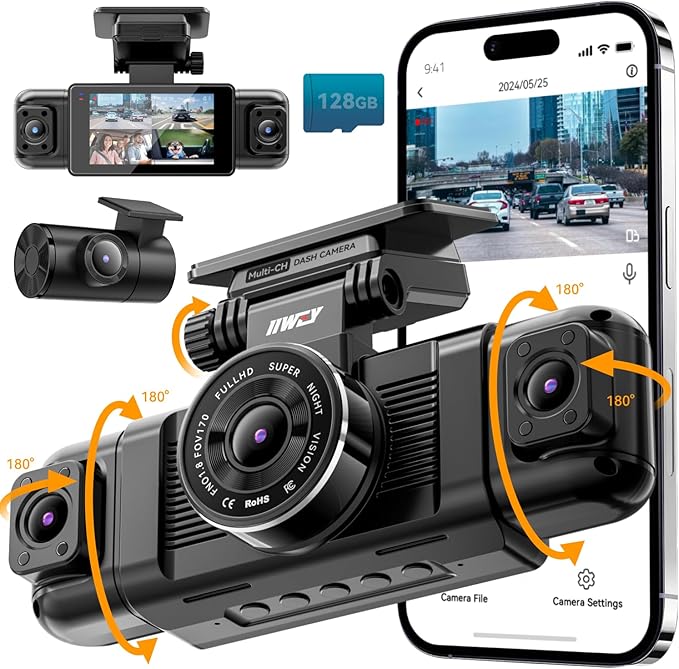 |
IIWEY N5 Four-Channel 2K Dash Cam | Price on Amazon |
| 4 |  |
galphi 4K Front Dash Cam | Price on Amazon |
| 5 |  |
Neideso N300 Four-Channel 360° Dash Cam | Price on Amazon |
| 6 |  |
BOTSLAB G300H Plus 4K Dual Dash Cam | Price on Amazon |
| 7 |  |
Affver Five-Channel 4K Dash Cam | Price on Amazon |
| 8 |  |
YUINWEN W5N Four-Channel 360° Dash Cam | Price on Amazon |
| 9 |  |
FAIMEE 4K Front-and-Rear Dash Cam | Price on Amazon |
| 10 |  |
AProX 4K+4K+1080P Three-Channel Dash Cam | Price on Amazon |
WDR Night Vision G-Sensor Auto Lock 2K Dash Camera
This model is a strong fit for drivers who want more than forward-facing footage without dealing with a complicated camera system. Its front camera records in 2K resolution through a 140-degree lens, while the secondary camera adds coverage behind or inside the vehicle depending on the supplied configuration. That extra view can help clarify what happened during a traffic incident or provide useful cabin protection.
Night vision and WDR are important here because ordinary cameras can lose detail when headlights, streetlights, and dark road areas appear in the same frame. The stated night-vision capability is intended to preserve useful information in low light, including details such as license plates. The built-in G-sensor automatically detects a sudden impact and locks the current clip, reducing the chance that an important file will be replaced by normal loop recording.
Operation is intentionally simple. After an 8GB to 32GB microSD card is inserted, recording starts automatically when the vehicle turns on, and older unlocked files are overwritten when the card becomes full. The two-inch screen allows basic confirmation and playback in the car, although it will not be as convenient as a larger display or a phone app. Buyers should also understand that the supplied data does not list GPS, Wi-Fi, or a memory card as included, so this is a focused recorder rather than a connected smart-camera system.
Pros
- 2K front recording with a 140-degree viewing angle.
- Secondary camera adds front-and-inside or rear coverage.
- Night vision, WDR, automatic recording, and G-sensor file locking.
- Simple two-inch screen and plug-and-play operation.
Cons
- Only supports the stated 8GB to 32GB microSD card range.
- No supplied information about GPS or Wi-Fi connectivity.
- The exact installation position of the secondary camera should be confirmed before purchase.
My Opinion
This is my top pick for a buyer who values uncomplicated daily recording and basic dual-camera protection over app features. Use a compatible card, format it in the camera, and confirm the second camera’s final placement before relying on it for regular evidence.
IIWEY N6 360° Four-Channel Dash Cam
The IIWEY N6 is aimed at drivers who want a broad view of the vehicle rather than a single perspective through the windshield. It records simultaneously through front, rear, and side cameras, with stated 2K recording and wide viewing angles of up to 170 degrees at the front and rear and 150 degrees at the sides. Adjustable side cameras can help reduce blind spots, which is useful for larger vehicles, frequent city driving, and rideshare work.
Infrared night vision gives the side and cabin-area views more usefulness after dark, while the included 128GB card allows longer recording before files begin to cycle. Loop recording keeps the camera running by replacing the oldest unlocked clips, and the G-sensor protects files associated with sudden braking, collisions, or other impacts. GPS also records speed and route information for playback through the app or computer viewer.
The important ownership limitation is power. This camera does not have a built-in battery and must remain connected to vehicle power through the included car charger. Its 48-hour parking options require the separate IIWEY hardwire kit, so buyers seeking parked-vehicle monitoring should budget for that installation. The 5.8GHz Wi-Fi connection can transfer files quickly, but the camera must be manually placed into Wi-Fi mode, and the feature turns off after roughly five minutes when not connected. Remove the protective lens film and configure the rear camera carefully; otherwise markings or guide lines can affect the image.
Pros
- Four-channel coverage with adjustable side cameras.
- 128GB card included and support for loop recording.
- GPS, 5.8GHz Wi-Fi, infrared night vision, and impact locking.
- Optional time-lapse and impact parking modes.
Cons
- Requires continuous wired power during use.
- Parking surveillance needs a separate hardwire kit.
- More cameras mean more cable routing and installation time.
My Opinion
The N6 is my preferred alternative for comprehensive coverage when front-only recording is not enough. It makes the most sense for owners willing to spend extra time on wiring and camera positioning in exchange for side coverage, GPS, and a larger included card.
IIWEY N5 Four-Channel 2K Dash Cam
The IIWEY N5 provides a broad four-camera layout covering the road ahead, rear area, sides, and cabin. Depending on the selected mode, the front channel can record at up to 2.5K while the other cameras record at 1080P, or all channels can be used at 1080P. That flexibility lets a buyer favor sharper forward detail or more even coverage across every direction.
A three-inch IPS screen makes initial positioning easier than on a screen-free camera, and the included 128GB microSD card gives the system useful out-of-box capacity. Loop recording starts when the engine turns on, saves files in segments, and replaces the oldest footage as storage fills. The G-sensor can lock an emergency clip when it detects a collision, helping preserve it from automatic deletion.
There are several setup details that matter more than the headline resolution. The N5 must use the original cigarette-lighter charger; it cannot be powered through a generic USB or Type-C cable. It uses a supercapacitor rather than a battery, so it needs to stay connected to power while operating. The rear camera must be wired to the front unit, and there is no GPS. Phone control uses built-in Wi-Fi rather than Bluetooth, with both 5GHz and 2.4GHz support. Parking modes are available, but the required hardwire kit is sold separately.
Pros
- Four-direction recording with a 2.5K front option.
- Three-inch IPS screen and 128GB card included.
- Wi-Fi app control, loop recording, and G-sensor file protection.
- Supports cards up to 256GB according to the supplied data.
Cons
- No GPS function.
- Must use the original cigarette-lighter charger.
- Rear-camera wiring and separate parking kit add installation work.
My Opinion
The N5 is a practical third choice for someone who wants four-channel coverage and a physical screen but does not need GPS. Its charger restriction is easy to overlook, so confirm that the included power arrangement works with your vehicle before installation.
galphi 4K Front Dash Cam
The galphi model takes a different approach from the multi-camera systems above: it concentrates on a single forward view in a compact, screen-free body. Its 4K resolution and 160-degree lens are intended to capture road details across several lanes, which can be helpful when a buyer’s main priority is readable forward footage rather than interior or side coverage.
The lack of a screen reduces visual distraction and allows the camera to sit discreetly behind the rearview mirror. That design may appeal to drivers who do not want a display glowing in the cabin or taking up dashboard space. Setup is described as straightforward, and the included memory card means the camera can be used without immediately shopping for a separate card. The supplied listing indicates a 32GB card is included, so buyers should confirm the package contents at the time of purchase if the listing has recently changed.
Fast 5GHz Wi-Fi and the companion app provide a convenient way to transfer footage, with stated speeds of up to 8MB per second. This is more convenient than removing the card, although phone connection quality and file size will still affect transfer time. Loop recording replaces the oldest files when storage is full, while the G-sensor locks footage after a sudden collision or shake. A 24-hour parking mode is available, but it requires a Type-C hardwire kit that is not included. That extra hardware and the single-camera layout are the main trade-offs.
Pros
- Sharp 4K forward recording through a 160-degree lens.
- Compact, screen-free design with less cabin distraction.
- 5GHz Wi-Fi app connection and included 32GB card.
- G-sensor protection and optional parking time-lapse.
Cons
- Records only the forward view.
- Parking mode requires a separate Type-C hardwire kit.
- No screen for immediate in-car playback or menu navigation.
My Opinion
This is a good match for a first-time owner who wants discreet 4K forward coverage and simple phone access. Choose it over a multi-channel camera only if side, rear, and cabin footage are not important to your driving situation.
Neideso N300 Four-Channel 360° Dash Cam
The Neideso N300 is built around flexible all-around coverage, with front, rear, side, and interior perspectives that can be adjusted to suit the vehicle. It offers several recording combinations, including a higher-resolution front mode and balanced 1080P multi-camera modes. That makes it useful for drivers who want to decide whether sharper forward footage or consistent four-channel coverage matters more.
Its built-in GPS adds speed, route, location, and time information to the driving record, while 5GHz Wi-Fi lets a phone display, save, and share clips through the app. Eight infrared lights and WDR are intended to control difficult lighting, especially when headlights or abrupt brightness changes make nighttime scenes hard to capture. Voice control can handle commands such as starting video, taking a photo, changing audio, switching Wi-Fi, or turning the screen on and off.
Parking monitoring is another notable capability. When the vehicle is turned off, the camera can switch into a low-power monitoring arrangement, with short startup behavior and event recording intended to capture nearby activity. The supplied information does not clearly specify every power accessory required for this mode, so buyers should confirm the wiring arrangement before assuming that the standard installation supports continuous parked monitoring. An OTA firmware update through the Tscam app is also recommended at first use, which can help keep the system stable and access later improvements.
Pros
- Adjustable four-channel coverage with multiple resolution modes.
- Built-in GPS, 5GHz Wi-Fi, voice control, and app access.
- Infrared lighting and WDR for difficult low-light scenes.
- Parking monitoring and recommended OTA firmware updates.
Cons
- More settings and cameras can make initial setup less simple.
- Parking-power requirements should be confirmed before installation.
- The supplied data does not state a memory card capacity or inclusion.
My Opinion
The N300 stands out for drivers who appreciate hands-free controls and adjustable camera coverage. It is a better fit for a feature-oriented owner than someone who wants the fewest possible menus, cables, and app steps.
BOTSLAB G300H Plus 4K Dual Dash Cam
The BOTSLAB G300H Plus focuses on high-quality front footage while retaining a separate rear camera for broader road protection. Its front camera records in 4K, the rear camera records in 1080P, and the front unit uses STARVIS 2 technology with an F1.5 aperture. Those specifications are particularly relevant to drivers who want more detail in dim conditions without moving to a five-camera system.
A 170-degree front viewing angle helps cover multiple lanes, and built-in GPS records speed, route, and location directly with the footage. The 5.8GHz Wi-Fi connection is intended to speed up phone transfers, which is useful when a clip needs to be saved or shared soon after an incident. Voice commands such as taking a photo or starting video can reduce the need to reach toward the camera while driving.
The included 64GB card supports continuous loop recording, and the camera can accept cards up to 256GB according to the supplied information. A supercapacitor supports operation in place of a conventional battery, while parking monitoring adds protection when the vehicle is unattended. Buyers using an iPhone should note a specific compatibility limitation: the phone cannot connect to this camera and CarPlay simultaneously because the phone supports only one active Wi-Fi connection at a time. The stated 18-month coverage and 24/7 support provide useful ownership reassurance, but they do not remove the need to route the rear cable neatly.
Pros
- 4K front and 1080P rear recording.
- STARVIS 2, F1.5 aperture, GPS, and 5.8GHz Wi-Fi.
- 64GB card included with support up to 256GB.
- Voice control, parking monitoring, and 18-month coverage.
Cons
- iPhones cannot use the camera Wi-Fi and CarPlay at the same time.
- Rear-camera wiring requires more installation than a front-only model.
- Dual-camera coverage does not provide side or cabin views.
My Opinion
This is a strong middle-ground option for drivers who want sharp forward footage, a rear camera, GPS, and a recognizable low-light emphasis. It is especially appealing when two-camera protection is enough and the iPhone-CarPlay limitation will not disrupt your routine.
Affver Five-Channel 4K Dash Cam
The Affver system is the most expansive coverage option in this group, recording the front, rear, left, right, and cabin views at the same time. The front camera records in 4K while the other four channels use 1080P. This arrangement is well suited to rideshare drivers, taxi operators, large SUVs, and anyone who wants a clearer record of activity around and inside the vehicle.
Built-in GPS adds speed, route, location, and timestamp information, while 5.8GHz Wi-Fi 6 is intended to make emergency file transfers faster through the phone app. The infrared cabin camera is useful after dark because it can record interior activity even when the cabin has very little light. For a driver handling passenger disputes or false-claim concerns, the additional viewpoints may be more valuable than simply increasing front-camera resolution.
The included 128GB card is a helpful starting point, but five channels generate a large amount of data. The camera supports up to 512GB, and the supplied guidance recommends a high-endurance, heat-resistant Class 10, U3, V30-or-higher card for stability. Parking surveillance requires the separate Affver hardwire kit, which adds time and cost but provides time-lapse or impact recording with low-voltage protection. Loop recording replaces older unlocked files, while the adjustable G-sensor protects collision footage from being overwritten.
Pros
- Five simultaneous views cover front, rear, both sides, and the cabin.
- 4K front recording with four additional 1080P channels.
- GPS, Wi-Fi 6, infrared cabin vision, and a 128GB card included.
- Supports up to 512GB with a suitable high-endurance card.
Cons
- Separate hardwire kit is required for parking surveillance.
- Five-channel recording uses storage quickly.
- Low customer-feedback volume makes the 4.9 rating a limited signal.
My Opinion
Affver is the specialist choice for maximum viewpoint coverage, particularly for commercial or rideshare use. It is more equipment than a typical commuter needs, but its cabin and side cameras can justify the extra storage and installation effort for the right owner.
YUINWEN W5N Four-Channel 360° Dash Cam
The YUINWEN W5N combines a 2K front camera with 1080P coverage from the other camera positions, giving buyers a broad view without moving to the five-channel layout of the Affver. Its 170-degree front lens is intended to capture a wide section of the road, while the three-inch IPS touch screen makes it easier to check framing and change settings from the driver’s seat when parked.
Eight infrared LEDs and WDR support nighttime visibility, especially when scenes contain a mixture of darkness and bright headlights. The camera uses a supercapacitor rather than relying on a conventional battery, which can be useful for dependable startup in changing temperatures. A 64GB card is included, and loop recording manages ordinary driving files by replacing older footage as the card fills.
The 5.8GHz Wi-Fi connection is rated for transfers of up to 20MB per second through the mobile app, allowing clips to be saved without removing the card. G-sensor protection locks footage after an impact, and the stated parking mode can monitor the vehicle with low-power recording and event detection. Buyers should still confirm how the parking function is powered in their vehicle before expecting continuous protection. A one-year warranty is listed, and the supplied customer rating is lower than several alternatives, so this model is best considered for its feature combination rather than assuming that its specifications guarantee superior real-world footage.
Pros
- 2K front recording with broad multi-camera coverage.
- Three-inch IPS touch screen and 5.8GHz Wi-Fi.
- 64GB card, WDR, infrared night vision, and supercapacitor.
- Loop recording, G-sensor protection, and parking mode.
Cons
- Lower stated customer rating than most models in this selection.
- Parking-power details should be checked before installation.
- 64GB may fill quickly when several channels record together.
My Opinion
The W5N offers a generous set of features for drivers who want a screen and fast phone access without paying for five channels. I would choose it when touch control matters, but I would select a higher-ranked model if long-term customer feedback carries more weight than feature breadth.
FAIMEE 4K Front-and-Rear Dash Cam
FAIMEE’s dual-camera system places its emphasis on image detail, with 4K front recording and 2K rear recording. Both cameras use 170-degree lenses, creating broad coverage across the road ahead and behind. The front camera’s F1.8 aperture and the stated WDR and night-vision processing are intended to preserve more useful detail when light levels change quickly.
This layout suits ordinary commuters who want sharper footage than a basic 1080P camera but do not need side or cabin channels. The compact screen unit can sit behind the rearview mirror, and the stick-on mount is intended to keep installation discreet. A 128GB high-endurance card is included, with support for up to 256GB, so there is room for longer daily driving before protected files and normal loop clips need attention.
Built-in GPS records speed, route history, and location coordinates, while dual-band Wi-Fi supports live viewing, file downloads, and app sharing. Time-lapse parking monitoring uses lower frame rates and reduced power consumption, and collision detection can lock important event footage. The supplied information does not specify every parking-power accessory, so confirm whether the intended parking setup needs additional wiring. FAIMEE lists an 18-month warranty and 24/7 technical assistance, which may be valuable for a first-time owner who wants help with camera pairing or installation questions.
Pros
- 4K front and 2K rear recording with 170-degree lenses.
- F1.8 aperture, WDR, night vision, GPS, and dual-band Wi-Fi.
- 128GB card included with support up to 256GB.
- Compact mounting design and 18-month warranty.
Cons
- No side or cabin camera coverage.
- Parking-power requirements are not fully specified in the supplied data.
- Higher-resolution files can use storage faster than standard 1080P footage.
My Opinion
FAIMEE is a balanced choice for drivers who want high-resolution front and rear footage without the complexity of four or five channels. It is a particularly sensible option for highway commuters who value GPS and image detail more than interior monitoring.
AProX 4K+4K+1080P Three-Channel Dash Cam
The AProX system offers a useful compromise between a two-camera setup and a full five-channel arrangement. Its front and rear cameras both record in 4K, while the cabin camera records in 1080P. With stated viewing angles of 170 degrees in front and 150 degrees at the rear and inside, it gives drivers strong road coverage plus a dedicated interior perspective.
That cabin channel is especially relevant for rideshare drivers, family vehicles, and anyone who wants a record of what happens inside the car. Four infrared lights support cabin visibility in complete darkness, while the stated HD night vision and WDR processing are intended to preserve detail in difficult road lighting. GPS embeds speed and location information in the footage, adding useful context when a clip is later examined.
The included 128GB card can be expanded to 512GB, which is helpful because two 4K channels can create large files quickly. Loop recording handles ordinary storage automatically, and G-sensor emergency locking protects important incident clips. Wi-Fi 6 on both 5.8GHz and 2.4GHz bands supports app transfers at up to 20MB per second, with OTA updates available through the TERUNSOUL app. Parking monitoring uses time-lapse and collision detection, but buyers should make sure the vehicle’s power arrangement supports the intended parked mode. The stated three-year guarantee and 24/7 support are the longest coverage terms in this group.
Pros
- 4K front, 4K rear, and 1080P cabin recording.
- Infrared interior vision, GPS, WDR, and night-vision support.
- 128GB card included with support up to 512GB.
- Wi-Fi 6, OTA updates, parking monitoring, and three-year guarantee.
Cons
- Two 4K channels can consume storage quickly.
- Parking-power details should be confirmed for the intended vehicle.
- Three-channel wiring is more involved than a front-only installation.
My Opinion
AProX is a compelling choice for drivers who want premium-looking coverage of the road and cabin without adding separate side cameras. Its large storage ceiling and long guarantee make it worth considering for high-mileage or rideshare use.
How I Selected These Dash Cam Video Recorders
The ranking considers more than the highest advertised resolution. I looked at how each camera balances coverage, image detail, night visibility, storage, power, app access, GPS, parking protection, and installation demands. A front-only camera can be the better purchase for a simple commute, while a four- or five-channel system may be more appropriate for rideshare work, a large vehicle, or frequent urban driving.
Customer feedback was considered when it was supplied, but the amount of feedback varies substantially. A high rating supported by only a small number of ratings should not be treated as equally persuasive as a slightly lower rating supported by thousands of customer responses. That is why the list also weighs clear documentation, practical accessories, compatibility notes, and whether the product’s limitations are easy for a buyer to understand.
Camera count is not automatically the same as better ownership. Every additional lens can improve protection, but it also increases cable routing, storage use, app complexity, and the importance of careful positioning.
The top three models were placed first because they cover different types of buyers well: simple dual-camera protection, broad four-channel coverage, and a four-channel system with a screen and a clearer charger requirement. The remaining products are still strong fits for specific needs, including discreet 4K forward recording, GPS-equipped dual cameras, cabin monitoring, and five-channel coverage.
Power requirements deserve equal attention to resolution. A camera that supports parking mode only with a separate hardwire kit may be excellent, but the buyer must include that installation step in the real ownership plan.
How to Choose a Dash Cam Video Recorder
For anyone searching for the best dash cam video recorder, the right choice depends on the evidence you need and the way your vehicle is used. Start with camera coverage and power, then compare resolution, storage, night performance, phone access, GPS, and the practical effort required to keep the system running.
- Choose the coverage first: Decide whether front-only, front-and-rear, four-channel, or cabin coverage fits your risks.
- Check the power arrangement: Confirm whether the camera uses a cigarette-lighter charger, USB-style power, or a separate hardwire kit.
- Match storage to channel count: Multi-camera systems need larger, high-endurance cards and more frequent file management.
- Do not judge night quality by resolution alone: WDR, aperture, infrared lighting, and sensor technology also affect useful detail.
- Consider how you will retrieve footage: A screen, Wi-Fi app, GPS, and computer viewer each solve different ownership needs.
Front, Rear, Side, or Cabin Coverage
A front camera is usually enough to document traffic ahead, road signs, lane changes, and many collision scenarios. Adding a rear camera helps with following impacts, parking incidents, and disputes involving the back of the vehicle. Side cameras provide more context at intersections and during lane changes, but they take longer to install and can require careful angle adjustment.
A cabin camera is most useful when passengers, deliveries, or activity inside the vehicle matter. Rideshare and taxi drivers may value it for documenting passenger interactions, while a family driver may prefer a simpler front-and-rear arrangement. More coverage is helpful only when the footage is pointed correctly and stored reliably.
Resolution and Lens Angle
Higher resolution can make small details easier to distinguish, particularly in well-lit scenes. However, 4K footage uses more storage than 1080P, and a wide lens can introduce edge distortion. A very wide angle captures more of the scene but may make distant objects appear smaller. Look for a sensible combination of resolution, lens angle, night processing, and storage support rather than choosing a number in isolation.
Night Recording and Difficult Lighting
Night footage is affected by headlights, reflective signs, streetlights, rain, tinted glass, and dark surroundings. WDR is intended to balance bright and shadowed areas, while infrared lights are more useful for cabin or close-range views than for seeing far down an unlit road. STARVIS 2, larger apertures, and dedicated night-vision processing can all support better low-light results, but correct windshield placement and a clean lens remain essential.
Storage Capacity and Card Endurance
A camera with several channels can fill a card much faster than a front-only unit. A 128GB card is a useful starting point for many multi-camera systems, while models supporting 256GB or 512GB provide more space for protected clips and longer drives. The card should match the camera’s supported capacity and be suitable for continuous recording. High-endurance cards are especially sensible for cameras that operate daily or monitor the vehicle while parked.
GPS, Wi-Fi, and Physical Screens
GPS can add speed, route, location, and time information to a clip, which may help reconstruct an incident. Wi-Fi makes it easier to transfer files to a phone without removing the card, although a wireless connection is not always faster than a computer card reader for large batches of footage. A built-in screen helps with alignment and immediate playback, while a screen-free design is often smaller and less distracting.
Installation and First Setup
Good installation begins before the camera is attached. Sit in the normal driving position, identify the area behind the rearview mirror, and make sure the lens will see the road without being blocked by the mirror housing, tint strip, or windshield sensors. Keep the camera inside the windshield’s cleaned and warmed viewing area so the adhesive mount can hold securely.
Use the Correct Power Cable
Do not assume every dash camera accepts any USB, Type-C, or cigarette-lighter cable. The IIWEY N5 specifically requires its original cigarette-lighter charger, while other models list Type-C hardwire equipment for parking use. Use the supplied power arrangement first, and only substitute a cable when the product documentation clearly supports it.
Route Cables Without Blocking Safety Equipment
Run cables along the upper windshield edge and tuck them behind suitable trim, but never place them across an airbag deployment path. Rear-camera cables should have enough slack at the hatch or trunk hinge to avoid being pulled tight when the vehicle opens. Avoid dangling wires near pedals, steering controls, gear selectors, and the driver’s view.
Complete the Initial Configuration
Insert and format the memory card through the camera if that option is available. Set the date and time, confirm the correct time zone, choose a sensible loop length, and select an appropriate G-sensor sensitivity. Test every camera channel while parked before hiding the cables. If the model supports an app, pair it while the vehicle is stationary and update firmware when the manufacturer recommends it.
Memory Cards and Recording Capacity
Dash cameras write and replace files continuously, which is harder on a memory card than occasional photography. Use a card that meets the camera’s stated capacity and speed requirements. A card that is too large, too slow, or not designed for repeated recording may produce missing clips, corrupted files, or unexpected recording stops.
Format the card in the camera at regular intervals when the manufacturer recommends it. Before formatting, copy any important incident files to a phone or computer. Protected clips can still occupy storage indefinitely, especially after repeated G-sensor events, so inspect the emergency folder and remove unnecessary locked files after preserving them elsewhere.
Capacity depends on resolution, channel count, frame rate, and clip length. A five-channel camera can consume a 128GB card much faster than a front-only camera, while two 4K channels create especially large files. If the system supports a larger card, choose a suitable high-endurance model rather than simply buying the largest capacity available.
Parking Mode and Vehicle Power
Parking mode is not always a single feature. Time-lapse recording captures frames at a reduced rate to conserve storage and power, while impact detection waits for a bump or vibration before preserving a short event clip. Some systems combine both options, but the camera still needs a dependable power source after the ignition is switched off.
Many models in this selection require a separate hardwire kit for continuous parked monitoring. A hardwire installation can connect the camera to the fuse box and may include low-voltage protection, but it should be fitted carefully. If you are not comfortable identifying a suitable circuit or routing trim safely, professional installation may be preferable to risking a blown fuse, drained battery, or obstructed airbag.
Check whether the camera begins parking mode automatically, whether it records a short pre-event or post-event period, and how long it can remain active. A vehicle used every day may recover its battery more easily than one parked for long periods. Parking mode is useful, but it should not be treated as unlimited surveillance without considering battery capacity, weather, and storage.
Getting Clearer Night Footage
Begin with the windshield, not the camera menu. Clean the glass on both sides of the lens, remove any protective film, and inspect for haze, suction marks, or residue. A dirty windshield can scatter headlights across the image and make a capable sensor appear ineffective.
Position the lens so the horizon sits near the middle of the frame and the road occupies most of the view. Too much sky can cause the camera to darken the road, while too much dashboard can reduce the useful scene. Keep the camera behind the wiper’s cleaned area whenever possible, particularly in rainy regions.
WDR and night modes can help with contrast, but they cannot eliminate glare from a dirty windshield or an incorrectly aimed lens. If a camera allows exposure or HDR adjustments, make small changes and check the result in several lighting conditions. Avoid judging footage only from a bright parking lot; compare a dark road, oncoming headlights, and streetlit areas.
Using Wi-Fi, GPS, and Companion Apps
Phone connectivity is convenient for saving a single clip at the roadside, but it is not the same as cellular internet. The phone usually connects directly to the camera’s Wi-Fi network, which may temporarily disconnect the phone from CarPlay, mobile data, or another wireless accessory. The BOTSLAB model specifically notes that iPhones cannot connect to the camera and CarPlay at the same time.
Stop in a safe location before opening the app, then turn on the camera’s Wi-Fi function if the model requires a button press. Some IIWEY cameras automatically turn Wi-Fi off after several minutes when no phone is connected, reducing heat and power use. Download important files promptly, rename them with the date and location, and keep a second copy on a computer or secure cloud service.
GPS data can show speed, route, location, and timestamps, but it should be checked for correct date and time settings. A camera that has recently lost satellite reception may need time to reacquire its position. GPS is useful context, not a substitute for checking the actual video and preserving the original file.
Maintenance and Long-Term Ownership
Wipe the lens gently with a clean microfiber cloth and clean the windshield around it. Do not use abrasive materials, excess liquid, or household cleaners that can leave a film. Inspect the mount occasionally, especially after extreme heat, cold, or a windshield replacement.
Check the camera after long periods in direct sun. Excessive heat can shorten memory-card life and affect electronics, so use the supplied ventilation design and avoid covering the unit. A supercapacitor-based camera still needs external power during operation; it is not intended to run as a portable battery camera.
Every few weeks, confirm that recording is continuing, the date and time are correct, and the rear or side cameras have not shifted. Triggering the G-sensor repeatedly on rough roads can create too many locked files, so adjust sensitivity if the emergency folder fills with ordinary bumps. Save important clips elsewhere before changing settings or formatting the card.
Common Mistakes to Avoid
Most dash-camera problems come from setup shortcuts rather than a lack of headline features. A camera can have excellent resolution and still produce poor evidence if the lens is covered, the card is incompatible, or the power connection stops during a drive.
- Leaving the protective film on the lens after installation.
- Using an unapproved card or exceeding the camera’s supported capacity.
- Assuming a standard charger will power a model with a specific charger requirement.
- Installing the camera where it blocks the driver’s view or an airbag path.
- Hiding cables before checking every camera angle and connector.
- Expecting parking mode to work without confirming the hardwire or power requirement.
- Failing to copy important locked clips before the card becomes full.
- Pairing an app or changing settings while driving.
Before relying on any camera, perform one parked test: confirm that every channel records, the date is correct, the audio setting is intentional, the card is recognized, and a saved clip can be played back.
FAQS About Best Dash Cam Video Recorder
What camera coverage is best for most drivers?
Front-and-rear coverage is a practical choice for many commuters because it records traffic ahead and incidents behind the vehicle. Four- or five-channel coverage is more useful for rideshare drivers, large vehicles, frequent city driving, and owners who want side or cabin evidence.
Is 4K necessary for a dash cam?
4K can preserve more detail in well-lit scenes, but it also creates larger files and may require more storage. A well-positioned 2K or 1080P camera with good WDR, night processing, and a clean lens can still be suitable for ordinary driving.
Do dash cameras record while the car is parked?
Some models offer time-lapse, motion, or impact parking modes. Continuous parked operation often requires a separate hardwire kit because the camera must receive power after the ignition is turned off. Confirm the power and low-voltage protection requirements before installation.
How large should the memory card be?
Choose a card within the camera’s stated capacity range. A 128GB card is a useful starting point for many dual- and multi-camera systems, while cameras with several high-resolution channels may benefit from 256GB or 512GB support. Use a high-endurance card for frequent recording.
Are GPS and Wi-Fi worth having?
GPS can add speed, route, location, and time information to a file. Wi-Fi can make it easier to transfer a clip to a phone without removing the card. Neither feature is essential for basic recording, but both can be valuable when footage must be saved or shared quickly.
Can I use any USB or Type-C charger?
No. Some cameras require a specific supplied charger, and the IIWEY N5 specifically cannot use a USB or Type-C cable in place of its original cigarette-lighter charger. Check the product instructions before substituting a power cable.
Final Thoughts
The best dash cam video recorder depends on the coverage and ownership effort you can realistically support. My top three are the WDR Night Vision G-Sensor Auto Lock 2K Dash Camera for simple dual-camera protection, the IIWEY N6 360° Four-Channel Dash Cam for broad coverage and GPS, and the IIWEY N5 Four-Channel 2K Dash Cam for screen-based four-channel recording without GPS. Choose the model that matches your vehicle, storage needs, parking plans, and willingness to manage cables and power.