
OEM floor mats usually win for factory fit, while aftermarket mats can offer better coverage, tougher materials, and lower cost. The right choice depends on retention hardware, carpet coverage, climate, and how hard you use your vehicle.
Have you ever bought a floor mat that looked fine in the box but curled up near the pedals? Or watched muddy water run past the mat and soak the carpet underneath?
I once rushed through a mat replacement before a long winter trip and grabbed a universal set because the price looked friendly. The driver’s mat slid sideways every time I braked, leaving a gritty patch of salt-stained carpet by the pedals. That’s a common mistake, not a dumb one.
I wrote this guide for anyone comparing OEM floor mats with aftermarket options and trying to avoid a bad fit. You’ll get the practical differences without the showroom talk.
Get the choice right, and you can protect the carpet, keep the pedals clear, spend your money wisely, and clean up messes faster. Choose poorly, and a mat can bunch under your feet, trap moisture, or leave expensive carpet exposed.
This takes about 9 minutes to read, and you’ll learn:
- How OEM and aftermarket mats differ in fit and retention
- Which mat materials suit snow, mud, sand, pets, and daily commuting
- How laser-measured and custom-fit mats compare with universal mats
- What to inspect before buying or installing a replacement set
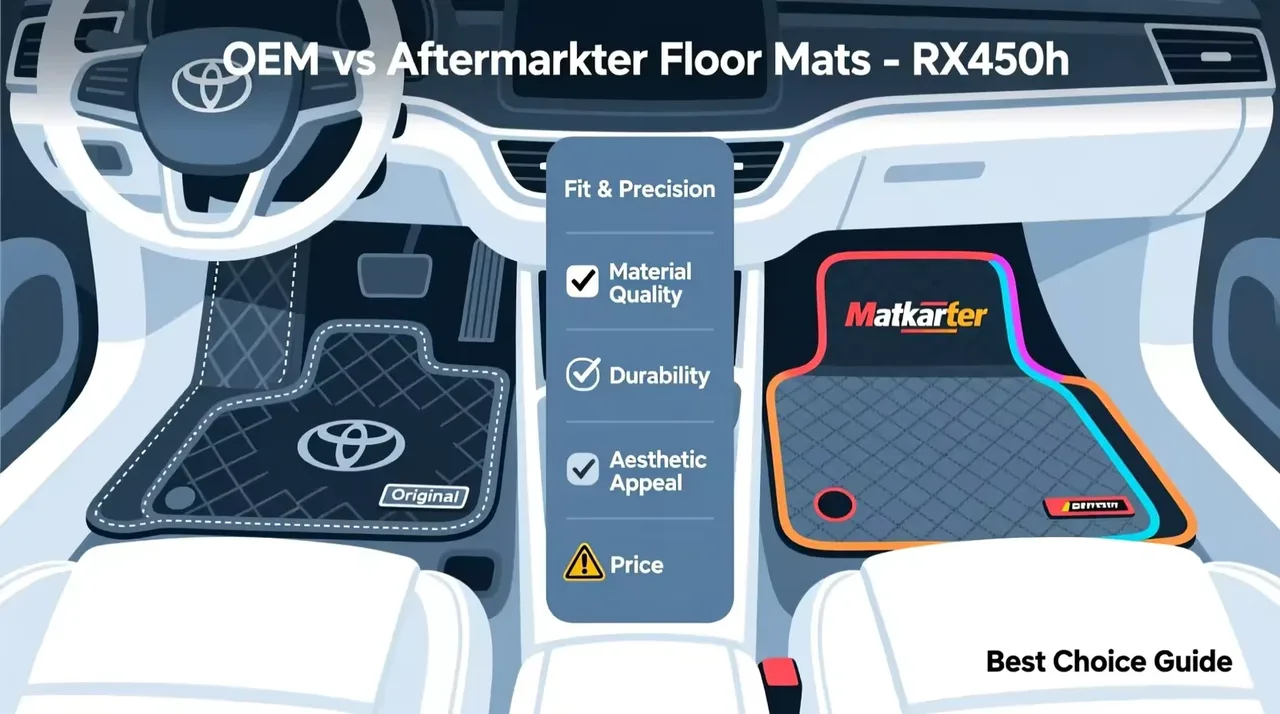
OEM vs Aftermarket Floor Mats: Which Choice Fits Your Vehicle?
OEM floor mats are made or approved for a specific vehicle make, model, trim, and often model year. Aftermarket floor mats come from independent manufacturers and may be universal, semi-custom, or custom-fit for a particular vehicle.
For most drivers, a properly retained mat with full pedal clearance matters more than the badge on the box. A basic OEM carpet mat can be a poor winter choice, while a well-designed aftermarket rubber or thermoplastic mat may protect the cabin far better.
| Factor | OEM Floor Mats | Aftermarket Floor Mats |
|---|---|---|
| Vehicle fit | Usually matched to make, model, and trim | Ranges from universal to tightly custom-fit |
| Retention | Often matches factory hooks or clips | May use original anchors, new clips, or grippers |
| Carpet appearance | Usually matches the cabin color and texture | Color and texture can vary |
| Coverage | Often follows the factory carpet shape | Some designs cover higher sidewalls and footwells |
| Materials | Commonly carpet, rubber, or molded plastic | Carpet, rubber, PVC, TPE, and layered materials |
| Price | Often midrange to premium | Budget through premium |
| Warranty and support | Tied to the vehicle brand or dealer | Depends on the manufacturer and seller |
| Best use | Factory look and predictable fit | Heavy messes, extra coverage, and more choices |
OEM fit is the simplest path when you want the same shape, color, edge profile, and anchor location as the original mat. You can usually identify the right set through the vehicle identification number, trim details, or the part number printed on the old mat.
Aftermarket choices need more homework. A product listed for a vehicle may still miss a trim change, a raised seat rail, a manual transmission hump, or a different second-row layout.
Can a universal mat work safely? Yes, but only if the mat stays flat, clears every pedal, and cannot slide forward or sideways during normal driving. Universal mats are easy to cut or reposition, yet that flexibility also creates more chances for a loose edge to catch under a pedal.
The most useful buying order is straightforward:
- Confirm the vehicle’s make, model, year, trim, and seating layout.
- Identify the factory retention points, such as hooks, posts, clips, or rings.
- Measure the footwell if the product is not listed as vehicle-specific.
- Choose a material that matches the mess, weather, and cleaning routine.
- Test the driver’s mat before driving, with every pedal pressed fully.
- Check the rear mats after installation so raised edges don’t block seat movement.
A clean-looking mat is not automatically a safe mat. The driver’s side deserves the final word because a small amount of movement near the accelerator or brake can become a serious distraction.
- OEM mats offer predictable shape, color, and factory anchor compatibility.
- Aftermarket mats often provide more material choices and greater weather coverage.
- Retention and pedal clearance matter more than the brand name.
- A universal mat needs a hands-on fit check before use.
Fit, Retention, and Coverage Matter More Than Branding
The safest floor mat is flat, properly sized, and locked into the vehicle’s retention points without touching the pedals. Fit also includes sidewall coverage, heel-pad placement, seat movement, and clearance around trim panels.
Retention systems keep a mat from sliding toward the pedals. Common designs include round posts, molded hooks, twist-lock rings, and fabric-backed grippers, but the system must match the vehicle and mat instead of merely looking similar.
Custom-fit aftermarket mats can match the floor shape closely, and many buyers compare them with universal designs before ordering. A careful look at custom-fit versus universal mats can help you judge how much extra coverage is worth paying for in your vehicle.
Some custom-fit products use digital scanning or laser measurement to map the footwell shape. If the term sounds like marketing fog, laser-measured floor mats refers to mats designed from detailed vehicle floor dimensions rather than a broad universal template.
Coverage reaches beyond the flat floor area. A good mat may rise along the door sill, transmission tunnel, seat tracks, and front kick panel, keeping slush or spilled coffee from reaching the carpet seams.
I once installed a thick molded mat in a vehicle with a slightly raised center hump and assumed the stiffness would make the fit better. The edge pressed against the trim, so I trimmed the wrong area first and had to replace the piece. The lesson was simple: dry-fit the mat and mark contact points before cutting anything.
Carpet, rubber, TPE, and PVC
Carpet mats give the cabin a factory appearance and feel comfortable underfoot. Nylon tends to resist wear better than low-cost polyester, while a dense backing helps keep moisture from reaching the carpet below.
Carpet works well for dry climates, office commuting, and drivers who care about color matching. It struggles with wet snow, beach sand, wet pets, and repeated muddy boots because debris settles deep into the fibers.
Rubber mats are flexible, grippy, and easy to rinse. Traditional rubber can have a noticeable smell when new, especially in a hot closed vehicle, and some lower-cost versions become stiff in cold weather.
TPE, or thermoplastic elastomer, is a molded material that combines flexible handling with a firm tray shape. TPE mats often keep their shape across changing temperatures and can include raised channels that hold water and grit.
PVC mats can cost less and may handle spills well, though the feel, odor, and cold-weather flexibility vary by formula. I’d rather pay a little more for a well-molded TPE mat than save money on a thin PVC mat that curls at the corners.
Floor mat sizing and trim details
Vehicle-specific mats can differ between front-wheel drive and all-wheel-drive layouts, bench and captain’s-chair second rows, coupe and sedan bodies, or standard and long-wheelbase versions. The same model name does not always mean the same cabin floor.
Check these details before ordering:
- Driver and passenger footwell shape
- Front seat track and seat-base clearance
- Center console or transmission tunnel shape
- Second-row seat rails and folding mechanisms
- Door-sill trim and raised carpet edges
- Factory anchor positions
- Cargo-area shape, if buying a full cabin set
A mat can be too short even when the product title names your vehicle correctly. Trim changes sometimes alter the footwell by an inch or two, and that difference can leave a strip of carpet exposed where road salt collects.
Pro Tip: Place the driver’s mat in the vehicle with the engine off, slide the seat through its full range, and press every pedal several times. A five-minute fit check beats discovering a problem in traffic.
Cost, Cleaning, and Long-Term Value
Aftermarket mats offer the broadest price spread, while OEM mats make sense when matching the original cabin and retention hardware is your main goal. Long-term value comes from protection, fit, cleanability, and replacement cost, not just the purchase price.
A low-cost universal mat may be fine for a temporary need, a second vehicle, or a garage-kept car. A daily driver carrying muddy boots, construction dust, children, or pets usually benefits from a better-shaped mat with taller edges.
| Driving situation | Practical choice | Reason |
|---|---|---|
| Dry city commuting | OEM carpet or quality carpet aftermarket | Comfortable and easy to match |
| Snow and road salt | Molded rubber or TPE | Holds meltwater and rinses clean |
| Muddy work sites | Deep-channel molded mat | Keeps grit away from carpet seams |
| Sand and beach trips | Full-coverage rubber or TPE | Limits sand spread and vacuums easily |
| Pets in the rear seat | Full-floor rear mat with raised edges | Catches hair, dirt, and spilled water |
| Frequent cargo hauling | Separate cargo liner plus cabin mats | Protects the floor and rear seatback area |
| Tight budget | Correctly sized universal mat | Works only after careful retention and pedal checks |
Cleaning habits affect how long either type lasts. Shake or vacuum carpet mats before washing them, because trapped grit acts like sandpaper against the fibers.
Rinse rubber and TPE mats with a hose, use mild soap, and let them dry fully before putting them back. A wet mat placed on carpet can hold moisture against the floor and create a stale smell.
Do you need a full set, or only a driver’s mat? Replacing one damaged mat costs less, but mismatched wear and color can look awkward, and the rear carpet may still be unprotected. A full set makes more sense when the mats have similar age, damage, or contamination.
Prices change with vehicle size, material, brand, and coverage. A basic universal mat may cost less than a vehicle-specific set, while premium molded mats can cost as much as or more than OEM options. Read the return policy before ordering because a mat that technically fits may still look wrong in your cabin.
The best custom-fit products tend to charge more for detailed shaping, stronger edges, and better material. A carefully made custom-fit car floor mat can be a good buy when you plan to keep the vehicle for years and want fewer compromises.
Installation and safety checks
Before installing any floor mat, remove the old mat and clear loose objects from the footwell. Never stack a new mat on top of an old one, because the combined thickness can reduce pedal clearance.
Use this installation sequence:
- Put the driver’s seat in a normal driving position.
- Lay the mat flat and connect every available retention point.
- Move the seat forward and backward to check for contact.
- Press the accelerator, brake, and clutch through full travel.
- Slide a hand around the edges to confirm the mat is not folded.
- Repeat the inspection after a short, low-speed drive.
Important Tip: Never cut around a factory anchor or pedal area while the mat is inside the vehicle. Remove the mat, mark the shape, cut it away from the cabin, and test the result again.
A loose mat can interfere with pedal movement, especially after the backing wears smooth or the mat shifts beneath the driver’s heel. If a mat moves, stop using it until the retention problem is fixed.
A heavy mat can also be a poor fit if it presses against seat rails or blocks a folding mechanism. Rear mats should stay clear of door tracks, middle-row sliding seats, and child-seat anchor access.
Common Problems and Practical Fixes
Most floor mat problems come from the wrong size, missing retention hardware, poor cleaning, or an edge that was forced into place. The fix usually starts with removing the mat and checking the actual contact points instead of pushing harder.
| Problem | Likely cause | Practical fix |
|---|---|---|
| Mat slides toward pedals | Missing or mismatched anchor | Use compatible retention hardware or replace the mat |
| Front corner curls upward | Mat stored rolled, wrong shape, or heat damage | Flatten it safely and confirm the vehicle fit |
| Water spills over the edge | Low sidewalls or too much liquid | Use a deeper molded mat and empty it often |
| Carpet smells damp | Mat returned while wet | Dry both mat and carpet before reinstalling |
| Heel area wears through | Thin carpet or high daily use | Choose a reinforced heel pad or molded surface |
| Rear mat blocks seat travel | Wrong second-row layout | Match the mat to seat configuration |
| Mat bunches at the center hump | Incorrect floor shape | Replace with a vehicle-specific design |
| Mat leaves carpet exposed | Coverage too short or trim mismatch | Confirm model year and cabin layout |
A curled mat sometimes settles after being laid flat in a warm room, but heat should not be used to soften or reshape a mat near the vehicle. High heat can warp molded edges, damage backing, or create a strong odor.
Don’t rely on aftermarket clips that look close enough. Retention hardware needs to hold the mat down without tearing the carpet or creating a hard bump beneath your heel.
If the floor carpet is already wet, remove the mat and dry the carpet before reinstalling anything. A towel can pull surface moisture, but trapped water under seat tracks may need longer airflow and professional drying.
When OEM makes more sense
OEM mats are a strong pick when the vehicle is new, the cabin has a distinctive color, or the factory anchors are unusual. A factory part also reduces the chance of ordering the wrong shape, though the part number still needs checking.
OEM carpet mats suit drivers who want a clean factory appearance and rarely face heavy mud or snow. OEM all-weather mats can work well too, but coverage and material vary across vehicle brands, so inspect photos and dimensions rather than assuming the name tells the whole story.
When aftermarket makes more sense
Aftermarket mats make more sense when you want deeper channels, stronger weather coverage, custom colors, or a replacement for a discontinued factory design. The aftermarket also gives you more choices for older vehicles and unusual use cases.
I’d choose a vehicle-specific aftermarket TPE set for a truck used around wet job sites, provided the anchors and sidewalls fit correctly. I’d choose OEM carpet mats for a clean commuter car where cabin appearance matters more than carrying muddy gear.
Universal mats belong in the “measure twice” category. They can solve a budget problem, but they shouldn’t be treated as a drop-in replacement without a pedal and retention check.
- Match the mat to the exact cabin layout, not just the vehicle name.
- Choose carpet for appearance and molded materials for wet or dirty use.
- Never stack mats or accept movement near the pedals.
- Replace a mat that cannot stay flat and securely retained.
FAQs About OEM vs Aftermarket Floor Mats
Are OEM floor mats better than aftermarket floor mats?
OEM floor mats are better for factory appearance, predictable shape, and matching retention points. Aftermarket floor mats can be better for tall sidewalls, harsh weather, unusual cargo use, or replacement availability. The safer option is the mat that stays flat, locks down correctly, and clears every pedal.
Do aftermarket floor mats fit as well as OEM mats?
Yes, vehicle-specific aftermarket floor mats can fit as well as OEM mats when the manufacturer uses accurate floor dimensions and matches the correct cabin layout. Universal aftermarket mats usually fit less precisely and need a careful check around pedals, seat rails, door sills, and factory anchors.
Are rubber or carpet floor mats better?
Rubber or molded TPE floor mats are better for snow, mud, spills, and frequent rinsing. Carpet floor mats are better for a factory appearance, quieter foot contact, and dry daily driving. A driver in a wet climate may prefer molded mats during winter and carpet mats during dry months.
Can I use universal floor mats in my car?
Yes, universal floor mats can be used if the size is correct and the mat cannot slide, curl, or touch the pedals. Remove trimming tabs before installation, never stack the universal mat over another mat, and replace the product if the finished shape leaves exposed carpet or creates movement.
How often should floor mats be replaced?
Floor mats should be replaced when the backing separates, the anchor holes tear, the driver’s heel area wears through, or the mat no longer stays flat. A visually worn carpet mat may still work, while a newer mat with damaged retention can be unsafe.
The Better Floor Mat Choice for Your Daily Use
OEM floor mats are the easy pick for a factory look and known fit. Aftermarket mats earn the nod when you need deeper coverage, tougher materials, or a shape designed around messy real-life use.
My practical choice is simple: use a properly retained carpet mat for clean commuting, and choose molded TPE or rubber for snow, mud, pets, and regular spills. Before buying, verify the exact vehicle layout and test the driver’s mat through every pedal movement.
That small check protects your carpet, your money, and your peace of mind. A floor mat doesn’t need to be fancy, but it does need to stay exactly where you put it.