Installing headers on a 5.3L Vortec can expose a weakness that was barely noticeable with the factory exhaust manifolds: spark plug wire heat. The short wires used on LS-based GM truck engines sit close to the exhaust ports, and a long-tube or tight-fitting header can place a hot primary tube only inches—or sometimes much less—from a plug boot.
That changes what matters when choosing the best spark plug wires for 5.3 Vortec with headers. A standard replacement wire may fit the coil and spark plug correctly yet still develop a burned boot, hardened insulation, voltage leak, or heat-related misfire if the header clearance is poor.
For the toughest header installations, my primary recommendation is the ACCEL Extreme 9000 9059C Ceramic Spark Plug Wire Set. The ceramic plug boots are the main attraction: ACCEL rates them for extremely high temperatures, pairs them with 8 mm Ferro-Spiral wire, and specifically positions the design for cramped engine bays and headers with close tolerances.
The Taylor Cable 79213 409 Spiro-Pro Spark Plug Wire Set is my second recommendation when the headers leave enough room for a high-quality silicone boot. Taylor specifically describes this set for LS truck headers, using 10.4 mm wire, 135-degree plug boots, and 11.75-inch leads.
The third option, MSD’s Super Conductor set, takes a different approach. It prioritizes very low resistance, excellent EMI suppression, durable insulation, and vehicle-specific GM truck fitment. It works especially well when the headers provide reasonable clearance or when additional thermal sleeves are added around the plug boots.
This guide focuses mainly on LS-based Vortec-era 5.3L trucks and SUVs such as the Chevrolet Silverado 1500, GMC Sierra 1500, Tahoe, Suburban, Yukon, and similar applications. Engines including the LM7, L59, L33, LH6, LMG, and LC9 can fall into this broader family, but exact wire length and coil mounting should still be checked before ordering.
3 Spark Plug Wire Sets That Handle 5.3 Vortec Header Heat
| Image | Product Name | Check Price |
|---|---|---|
Best Choice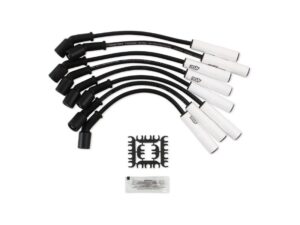 | ACCEL Extreme 9000 9059C Ceramic Spark Plug Wire Set | Check Price |
Second Best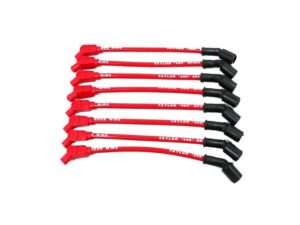 | Taylor Cable 79213 409 Spiro-Pro Spark Plug Wire Set | Check Price |
Third Choice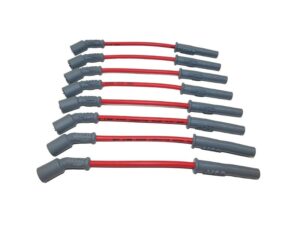 | MSD 32829 8.5mm Super Conductor Spark Plug Wire Set | Check Price |
The three sets below are not ranked simply by wire diameter or resistance.
Header use changes the priority order:
- Keep heat away from the plug terminal.
- Maintain enough clearance between the boot and header tube.
- Deliver ignition voltage without excessive loss.
- Suppress EMI and RFI so the engine-management electronics remain happy.
- Fit the truck’s coil location without stretching or leaving excessive wire near the exhaust.
That is why a ceramic-boot wire can rank ahead of an otherwise excellent low-resistance silicone wire when the engine has tight long-tube headers.
1. ACCEL Extreme 9000 9059C Ceramic Spark Plug Wire Set
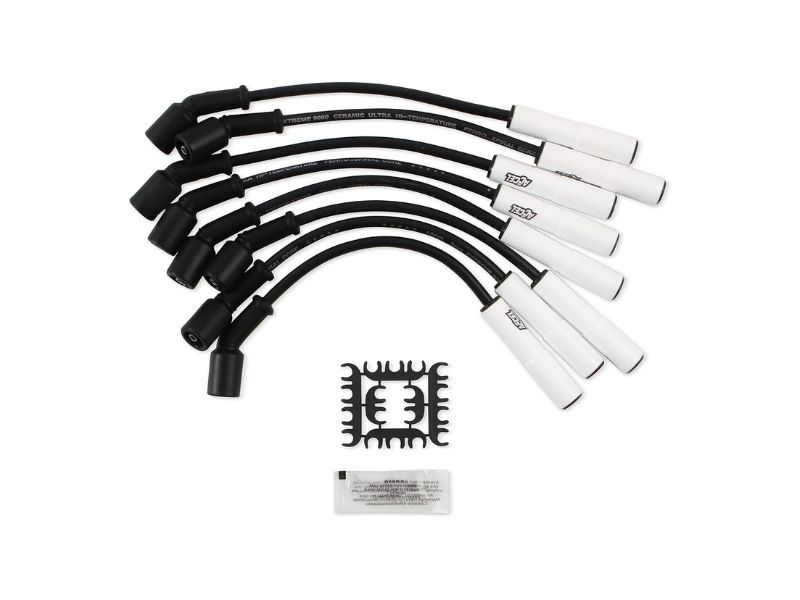
Key Features
- Ceramic spark plug boots
- 8 mm Ferro-Spiral wire
- Approximately 500 ohms per foot
- Double-silicone wire construction
- 12-inch leads for compatible GM LS truck applications
The ACCEL 9059C earns the first position because it directly addresses the biggest problem created by headers: radiant exhaust heat at the spark plug boot.
ACCEL uses ceramic on the spark-plug end instead of relying entirely on a conventional silicone boot. The company rates the ceramic boots for temperatures up to 2,000°F and describes the wires as appropriate for headers, tight engine compartments, and situations where ordinary boots are prone to melting. The cable itself uses an 8 mm Ferro-Spiral core and double-silicone construction rated for substantially lower—but still high—wire temperatures.
That distinction between boot temperature and wire temperature is important.
The ceramic section can tolerate extreme localized radiant heat near the header tube, but the flexible cable still needs sensible routing. A glowing-hot primary tube should not rest directly against the silicone wire just because the plug boot is ceramic.
On a 5.3 Vortec with long-tube headers, the tightest area is often around the first few inches leaving the spark plug. This is exactly where a ceramic boot is useful.
A normal silicone boot is a good electrical insulator and handles considerable engine-bay heat. The problem comes when a header tube sits close enough to continuously radiate heat into one side of the boot.
Over time, a conventional boot can:
- Harden
- Discolor
- Crack
- Carbon-track internally
- Lose dielectric strength
- Allow ignition voltage to arc toward the header
That last problem often creates a frustrating misfire.
The wire may look acceptable while the engine is cold. After several minutes of driving, the header reaches operating temperature and the damaged boot begins leaking voltage.
The truck then develops:
- Hesitation
- Misfire under acceleration
- Rough operation after warming up
- Flashing check-engine light in severe cases
- A cylinder-specific misfire code
Replacing the spark plug alone will not fix that problem.
The ceramic boot gives the ignition terminal a much more effective thermal barrier.
The 9059C set is also longer than many stock-style LS truck wires, which can help when headers require a different path from the original exhaust-manifold routing. JEGS lists this set as a 12-inch configuration for 1999–2015 GM LS V8 applications including 4.8L, 5.3L, 6.0L, and 6.2L engines.
Extra length can be either useful or annoying.
It helps when the stock route would place the wire directly against a primary tube. The wire can sometimes be moved around the tube and retained in a cooler location.
Too much slack, however, creates another problem. An unsecured wire can sag back onto the header.
That means clips and separators still matter.
The Ferro-Spiral conductor is rated around 500 ohms per foot. That is not as low as MSD’s Super Conductor design, but lower resistance is not the only objective in a street-driven EFI truck.
The ignition system also needs strong RFI/EMI suppression.
High-voltage ignition events can produce electromagnetic noise. A spiral-wound suppression conductor controls that interference while still carrying enough ignition energy to the spark plug.
For a 5.3 Vortec controlled by an ECU and surrounded by sensors and electronic modules, that balance is more useful than installing a solid-core racing cable simply because its resistance number is lower.
The ceramic boot has one practical drawback: it is not flexible like silicone.
You cannot bend a ceramic boot around an obstacle. Header geometry must allow the boot to sit at its designed angle without physically contacting the tube.
This is why ceramic is not automatically perfect for every header.
Before ordering, look at the angle between the spark plug and primary tube.
If there is enough room for the straight ceramic boot, the ACCEL set provides excellent thermal protection.
If the tube runs directly across the required boot path, a 135-degree design may route more naturally.
What I Like
- Ceramic boots directly address header heat
- Excellent choice for repeatedly burned plug boots
- 12-inch leads provide useful routing flexibility
- Spiral core maintains EMI/RFI suppression
- Strong fit for high-heat truck engine bays
What I Do Not Like
- Ceramic boots cannot flex around poorly positioned header tubes
- The wire still needs to be routed away from direct exhaust contact
- More expensive and more specialized than a normal replacement wire
For a 5.3 Vortec where long-tube headers have already burned a conventional boot—or where clearance looks dangerously tight—the ACCEL 9059C is the strongest choice of these three. The ceramic boot solves the exact problem that makes header-equipped trucks difficult on spark plug wires.
2. Taylor Cable 79213 409 Spiro-Pro Spark Plug Wire Set
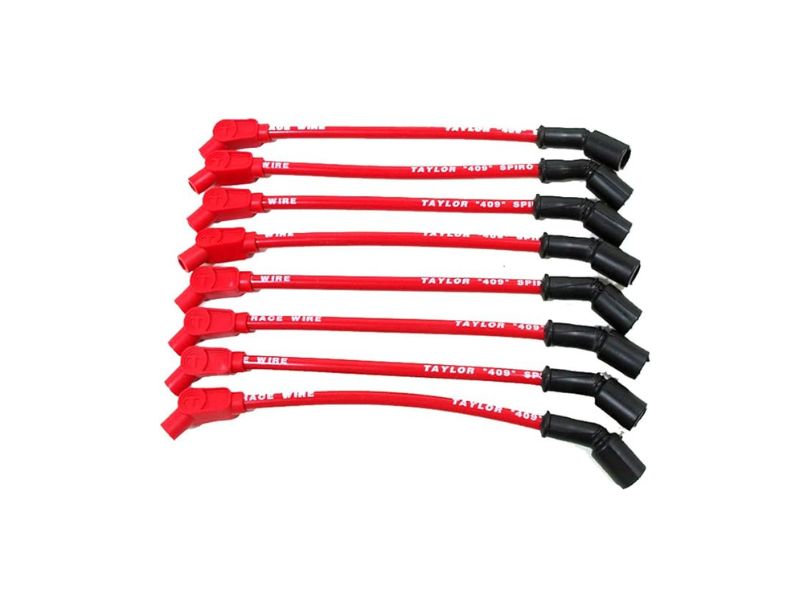
Key Features
- Specifically designed for LS truck header applications
- 10.4 mm wire diameter
- 135-degree plug boots
- Approximately 11.75-inch lead length
- Spiral-wound suppression core
The Taylor 79213 ranks second because it approaches the header problem through routing, insulation thickness, and boot angle rather than ceramic construction.
The product description specifically identifies the set for vehicles with LS truck headers, which makes it much more relevant to this keyword than a generic 5.3L replacement wire. The selected configuration uses a 135-degree spark-plug boot and approximately 11.75-inch wire length.
That 135-degree boot can make a real difference.
Header primary tubes do not always approach the spark plug in a straight line. Depending on header brand and chassis, a tube may sweep upward, downward, forward, or back immediately after leaving the exhaust port.
A straight boot that worked perfectly with the factory manifold may point directly toward the new tube.
Changing the exit angle allows the cable to leave the spark plug in a different direction.
That can be more valuable than simply adding thicker insulation.
The Taylor set uses 10.4 mm ignition wire, making it substantially thicker than a basic 7 mm or 8 mm replacement lead.
The additional diameter is not there to create a magically stronger spark.
Much of that size comes from the insulation and reinforcement surrounding the conductor.
Taylor’s 409 construction uses silicone insulation, fiberglass reinforcement, and additional silicone layers. Published specifications list continuous heat protection around 600°F and a dielectric strength of 102,000 volts. The spiral-wound version is listed around 350 ohms per foot.
Dielectric strength describes the insulation’s ability to resist electrical breakdown.
That matters because spark plug wires carry thousands of volts.
When insulation becomes damaged or overheated, ignition energy can find a path through the jacket toward the cylinder head or header instead of traveling through the spark plug gap.
A thick, well-built cable creates a stronger electrical barrier.
The 409 wire’s fiberglass reinforcement also helps with abrasion.
That matters around headers because the problem is not always heat alone.
A poorly routed wire can rub against:
- A header tube
- Heat shield
- Coil bracket
- Valve cover edge
- Wire separator
- Engine accessory bracket
Repeated engine movement can slowly damage the insulation.
A stronger outer jacket helps, but clearance remains the better solution.
The Taylor’s 350-ohm-per-foot resistance is a sensible middle ground for a street LS truck.
It is much lower than many traditional carbon-core OE wires but still uses a spiral-wound suppression design.
That helps preserve spark energy while controlling electrical interference.
The L31-style distributor issues from older Vortec engines do not apply here. A 5.3 LS-based Vortec uses individual ignition coils connected to each spark plug through short leads.
Because the wires are short, even a few hundred ohms per foot results in relatively modest total resistance.
The difference between a 12-inch lead at 350 ohms per foot and one at 500 ohms per foot is not something that should be viewed as an automatic horsepower difference.
Both can work perfectly well when the ignition system is healthy.
Heat protection and boot clearance matter more on a header-equipped street truck.
The 135-degree silicone boots are also more flexible than ceramic.
That makes installation easier in a cramped engine bay.
The downside is that silicone cannot tolerate the same direct radiant heat as a ceramic plug boot.
If the header primary is almost touching the boot, I would rather increase clearance, add a quality thermal sleeve, or move to the ceramic ACCEL set than rely on silicone alone.
This wire set becomes particularly attractive when there is roughly enough clearance but the stock wire exits at the wrong angle.
That is a common problem with long-tube headers.
What I Like
- Designed specifically around LS truck header use
- 135-degree boot can improve primary-tube clearance
- Thick 10.4 mm insulation offers strong protection
- Spiral-wound core provides noise suppression
- Good balance between street usability and performance construction
What I Do Not Like
- Silicone boots cannot match ceramic for extreme radiant heat
- Thick wires take more room around tight coil brackets
- Exact header geometry still determines whether the 135-degree angle works
For a header-equipped 5.3 where routing is the main challenge rather than outright boot melting, the Taylor 79213 is a very strong choice. The combination of a 135-degree boot, extra insulation, and longer header-oriented leads makes it easier to keep the wire away from hot primary tubes.
3. MSD 32829 8.5mm Super Conductor Spark Plug Wire Set
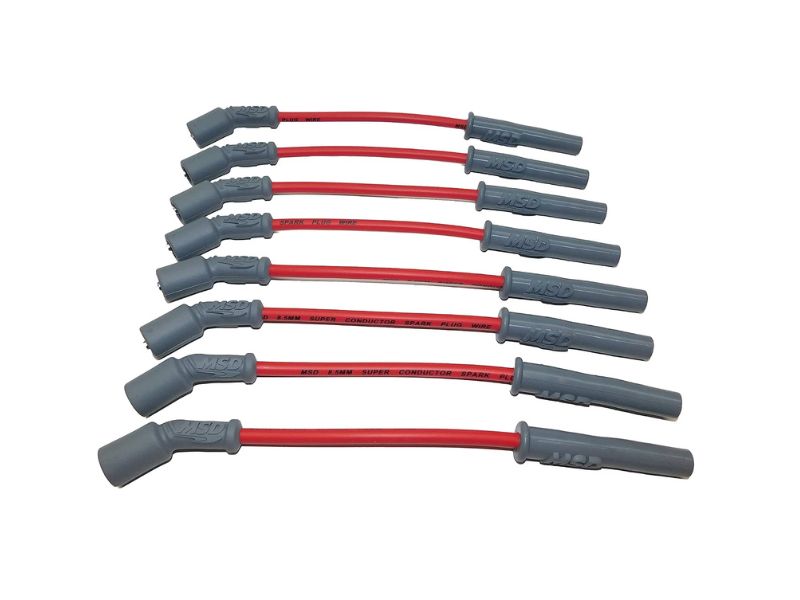
Key Features
- Vehicle-specific GM truck and SUV fitment
- 8.5 mm Super Conductor wire
- Very low resistance
- Strong EMI suppression
- High-heat and abrasion-resistant outer jacket
The MSD 32829 takes third place because it is an excellent ignition wire set, but it does not provide the same built-in extreme heat protection as a ceramic-boot design.
That does not make it a weak choice for headers.
In fact, when the headers leave adequate clearance around the plug boots, the MSD set offers one of the best combinations of low resistance, strong suppression, durable construction, and vehicle-specific fit.
MSD lists the 32829 specifically for 1999–2013 GM trucks and SUVs using engines including 4.8L, 5.3L, and 6.0L configurations. The wires are pre-cut for the application rather than supplied as a universal cut-to-fit kit.
The conductor is the most distinctive feature.
MSD uses a tightly wound copper-alloy conductor around a ferro-magnetic core. The company states that a single 11-inch lead has only around 40–50 ohms of resistance while still providing strong EMI suppression.
That is dramatically lower than many ordinary suppression wires.
Low resistance means less electrical energy is dissipated through the cable itself.
This is useful in high-output ignition systems, boosted engines, and modified combinations where cylinder pressure can increase ignition demand.
It is also perfectly usable on a stock truck.
The important part is that MSD does not achieve the low resistance by simply using an unsuppressed solid conductor.
The ferro-magnetic core and tightly wound conductor function as an EMI choke, helping keep ignition interference from affecting electronic systems.
That makes the design far more appropriate for an EFI-equipped GM truck than traditional solid-core racing wires.
MSD also gives the 8.5 mm jacket substantial mechanical protection.
The outer sleeve uses a silicone/synthetic blend designed to resist heat, abrasion, and tearing.
Inside, the conductor is reinforced to handle pulling forces, and the terminals use a dual-crimp arrangement.
One crimp grips the conductor.
The second grips the outer wire sleeve.
That reduces the chance of pulling the conductor away from the terminal during installation or later maintenance.
These details matter around headers because a wire may need to be routed at a slightly different angle and placed under some tension.
The wire should never be stretched tightly, but a securely crimped terminal handles normal routing better than a poorly assembled cable.
Why does the MSD rank third?
Because headers create a thermal problem before they create an electrical-resistance problem.
If a header tube runs a quarter-inch from the spark plug boot, the difference between 50 and 500 ohms of wire resistance is less important than whether the boot survives the exhaust heat.
The MSD outer jacket handles high temperatures well, but its conventional boot does not provide the ceramic barrier of the ACCEL.
That means header clearance becomes critical.
If the tubes leave reasonable space, the MSD is an excellent option.
If clearance is marginal, adding high-quality spark-plug boot sleeves can improve the setup considerably.
Thermal sleeves work by reducing radiant heat reaching the silicone boot.
They should be long enough to protect the boot and the first section of wire but should not be used as an excuse to let the cable rest directly on a header.
The best installation still has a physical air gap.
What I Like
- Extremely low resistance for a suppression-style wire
- Excellent EMI control
- Vehicle-specific GM truck lengths
- Durable 8.5 mm jacket
- Strong terminal construction
What I Do Not Like
- No ceramic plug boot
- Tight headers may require additional thermal sleeves
- Heat clearance matters more than its electrical advantages in extreme installations
The MSD 32829 is the strongest option here for a 5.3 with headers that already provide decent plug clearance. It combines excellent electrical performance with durable construction and works particularly well on modified engines where reliable ignition under load is important.
5.3 Vortec Header Spark Plug Wire Comparison
| Product | Boot Design | Wire Diameter | Resistance | Header Heat Strategy | Main Strength | Main Limitation |
| ACCEL 9059C | Straight ceramic | 8 mm | About 500 ohms/ft | Ceramic barrier at plug | Best protection from extreme localized heat | Straight rigid boot needs physical clearance |
| Taylor 79213 | 135° silicone | 10.4 mm | About 350 ohms/ft | Thick insulation and better routing angle | Excellent LS truck header routing | Silicone cannot tolerate direct extreme heat like ceramic |
| MSD 32829 | Performance silicone | 8.5 mm | About 40–50 ohms per 11-in. lead | Heat-resistant jacket plus proper clearance | Very low resistance and strong EMI suppression | Tight headers may need heat sleeves |
The biggest difference is how each set approaches heat.
ACCEL tries to make the spark-plug end extremely resistant to radiant exhaust temperatures.
Taylor focuses on changing the boot angle and surrounding the conductor with heavy insulation.
MSD focuses more heavily on electrical performance and durable conventional construction, which works best when the headers are already designed with sensible plug clearance.
Why Headers Are So Hard on 5.3 Vortec Spark Plug Wires
The factory exhaust manifold is designed around the original engine packaging.
Aftermarket headers prioritize exhaust flow.
That can change how the tubes pass the spark plugs.
A primary tube may move closer to:
- The spark plug boot
- The first few inches of ignition wire
- The coil
- Factory wire retainers
A long-tube header can also trap and radiate considerable heat after hard driving.
Radiant Heat vs Direct Contact
There are two different heat problems.
Direct contact occurs when the wire or boot physically touches the header.
This is the worst situation.
No conventional spark plug wire should be routed against a hot exhaust tube.
Radiant heat occurs even without physical contact.
A boot can sit near a header tube and absorb substantial thermal energy from it.
The closer the boot is to the tube, the more serious this becomes.
That is why a wire may fail even when it does not visibly touch the header.
Ceramic vs Silicone Spark Plug Boots
This is one of the most important decisions for a header-equipped 5.3.
Ceramic Boots
Ceramic is extremely resistant to heat.
It does not soften like rubber and acts as an effective thermal barrier around the plug terminal.
This makes ceramic attractive when header clearance is genuinely tight.
The tradeoff is rigidity.
A ceramic boot cannot bend.
The header has to provide a path for the boot’s fixed angle.
Silicone Boots
Silicone remains the standard material for quality performance ignition wires.
Its advantages include:
- Flexibility
- Good electrical insulation
- Strong general heat resistance
- Moisture resistance
- Easy installation
A silicone boot works very well when there is enough distance from the header.
The trouble begins when a glowing-hot primary tube sits too close.
Which Is Better?
For severe heat, ceramic.
For better routing flexibility with adequate air gap, high-quality silicone.
That is why the first two products in this guide are useful for different header designs rather than one being universally superior.
Boot Angle Can Matter More Than Wire Diameter
Many buyers focus on 8 mm vs 8.5 mm vs 10.4 mm wires.
The boot angle often matters more around headers.
Imagine a primary tube passing directly behind the spark plug.
A straight boot may point directly into it.
A 135-degree boot can turn the wire away from the tube immediately after leaving the spark plug.
That small change can create the difference between:
- A wire sitting safely in free air
- A wire touching the header
Before buying, look at every cylinder.
Header tube geometry is not identical from front to rear.
One set may have excellent clearance on seven cylinders and an uncomfortable fit on the eighth.
Long-Tube vs Shorty Headers
Shorty Headers
Shorty headers often retain routing closer to factory manifolds.
They can still increase local heat, but plug-wire clearance is frequently easier to manage.
A high-quality conventional wire may be enough.
Long-Tube Headers
Long tubes can use more aggressive primary routing.
Some designs create excellent spark plug access.
Others place one or more tubes extremely close to the plug boots.
Ceramic boots, 135-degree wires, or thermal sleeves become much more useful here.
Header Brand Matters
Not all headers route their primaries the same way.
Two trucks with the same 5.3 Vortec can need different plug-wire solutions if they use different header designs.
This is why engine fitment alone does not answer the question.
Why Spark Plug Wire Length Matters
LS truck engines use short leads between the coil packs and spark plugs.
Factory-length wires work well with factory manifolds.
Headers sometimes make that route inconvenient.
A slightly longer performance wire can provide room to:
- Route behind a primary tube
- Go above a tube
- Use a wire separator
- Keep the boot at a safer angle
Too much length is not automatically better.
Extra wire can sag toward the exhaust.
The goal is enough length to create a clean path without leaving unsupported loops.
Do Thicker Spark Plug Wires Make More Power?
Not by themselves.
A 10.4 mm wire does not make a larger spark simply because the jacket is thicker than an 8 mm wire.
Most of the extra diameter is insulation and reinforcement.
That can be extremely useful around headers.
Thicker performance wire may offer:
- Greater dielectric protection
- More abrasion resistance
- More thermal insulation
- Stronger construction
Electrical performance depends primarily on the conductor, resistance, terminal connections, and ignition system—not just outside diameter.
Understanding Spark Plug Wire Resistance
Spark plug wire resistance is often turned into a competition where the lowest number is automatically considered best.
That is too simplistic.
The wire has to perform two jobs:
- Deliver ignition voltage.
- Suppress electromagnetic interference.
Why Resistance Exists
Ignition systems produce rapid high-voltage pulses.
Those pulses can generate radio-frequency interference.
Suppression-style wires control that electrical noise.
Is Lower Resistance Better?
Lower resistance can reduce energy loss through the lead.
That becomes useful in demanding ignition applications.
But a modern street vehicle also needs proper EMI suppression.
A low-resistance spiral-core wire is usually more appropriate than an unsuppressed solid-core racing wire.
Why Total Resistance Is Low on LS Trucks Anyway
The wires on a 5.3 Vortec are short.
A wire rated at 500 ohms per foot that is only about a foot long has far less total resistance than a five-foot distributor wire built from the same conductor.
That is why the difference between 50, 350, and 500 ohms per foot should not be treated as the sole ranking factor.
For header applications, thermal survival often matters more.
EMI and RFI Suppression
EMI means electromagnetic interference.
RFI means radio-frequency interference.
Spark ignition naturally creates both.
Without proper suppression, ignition noise can interfere with:
- Engine electronics
- Sensors
- Audio equipment
- Radio reception
- Aftermarket gauges
- Data acquisition equipment
Performance spiral-core wires use tightly wound conductors and magnetic materials to suppress those emissions without requiring extremely high resistance.
That is why ACCEL, Taylor, and MSD all use some form of suppression-style conductor rather than a simple solid metallic core.
Do You Need Heat Sleeves With Ceramic Boots?
Usually not at the ceramic section itself.
Ceramic is already providing the primary heat barrier.
The flexible wire can still benefit from protection if a header tube passes close to the cable beyond the ceramic boot.
Thermal sleeves can therefore be used selectively.
Do not pile heat protection on unnecessarily.
A clean air gap and good routing remain the best first defense.
Do You Need Heat Sleeves With Taylor or MSD Wires?
They can be useful.
If the silicone boot has good clearance, sleeves may not be necessary.
If the boot sits close to a primary tube, a quality fiberglass or basalt-type heat sleeve can reduce radiant heat exposure.
A sleeve is especially useful on the one or two cylinders where header geometry creates a tighter area than the others.
How Much Clearance Should a Plug Wire Have From a Header?
More is better.
There is no single distance that guarantees success because header surface temperature, boot material, airflow, engine load, and thermal coating all affect heat transfer.
The practical rule is simple:
Do not let the boot or wire touch the header, and create as much air space as the installation allows.
If the boot is almost touching despite careful routing, use a different boot angle or ceramic solution rather than hoping thicker insulation will survive indefinitely.
Header Coatings and Wrap Can Change the Situation
Ceramic-coated headers can reduce external radiant heat compared with uncoated tubes in some conditions.
Header wrap also changes how heat is retained and released.
Neither should be used as a guarantee that conventional spark plug wires are safe.
Always inspect actual clearance.
How to Install Spark Plug Wires on a 5.3 Vortec With Headers
Let the Engine Cool Completely
This job involves working directly beside the exhaust.
Even a recently idled header can cause serious burns.
Wait until the engine and exhaust are cool.
Replace One Wire at a Time
The 5.3 uses an individual coil for each cylinder, so mixing wires is less confusing than on a distributor engine, but one-at-a-time replacement still makes the process cleaner.
Remove one old lead.
Compare its length with the intended replacement.
Install the new one before moving on.
Twist the Boot Before Pulling
Spark plug boots can stick firmly to the ceramic insulator.
Twist gently to break the seal.
Pull from the boot rather than yanking the wire.
Inspect the Spark Plug
Since the boot is already removed, look at the exposed plug.
Watch for:
- Cracked ceramic
- Oil around the plug
- Carbon tracking
- Loose plug
- Evidence that the old boot was arcing
A white or dark line running along the spark plug insulator can indicate previous voltage tracking.
Plan the Route Before Snapping Everything Together
Headers may require a route different from the factory one.
Hold the new wire in place and check clearance before fully seating both ends.
Look from several angles.
A wire that appears clear from above may be touching a primary tube underneath.
Use Retainers Where Possible
Wire retainers prevent the cable from moving.
Engine vibration can slowly shift an unsecured lead until it contacts the exhaust.
A simple clip can prevent a repeat failure.
Keep the Boot Fully Seated
A partially connected spark plug terminal can create resistance and intermittent ignition.
Push the boot until the terminal is securely engaged.
Do the same at the coil.
Use Dielectric Grease Sparingly
A small amount inside the sealing area of the boot can help with moisture and future removal.
Do not pack the electrical terminal full of grease.
Dielectric grease is an insulator.
How to Tell if a Header Has Burned a Plug Wire
Misfire Only When Hot
This is one of the strongest clues.
The truck may run properly during cold start and begin misfiring only after the headers become hot.
Visible Boot Damage
Look for:
- Brown or white heat discoloration
- Hardening
- Cracks
- Melted silicone
- Burn marks
- Ceramic damage
Carbon Tracking
Electrical leakage can leave dark tracks inside the boot or along the spark plug insulator.
Once carbon tracking becomes established, simply reinstalling the old wire is rarely a good solution.
Arcing in the Dark
In some cases, electrical leakage becomes visible as blue arcing in a dark engine bay.
Use caution around a running engine.
Do not put hands near ignition components, belts, fans, or hot headers.
Cylinder Misfire Code
A burned wire may cause a specific cylinder’s misfire code.
Before replacing an ignition coil, inspect the short plug lead—especially when headers are installed.
Why Header-Related Misfires Often Get Mistaken for Bad Coils
The 5.3 uses one ignition coil per cylinder.
When cylinder 5 or cylinder 7 begins misfiring, the coil is an obvious suspect.
But the coil is only part of the high-voltage path.
The spark still has to travel through the plug wire.
If the boot has been cooked by the header, swapping coils may not move the misfire because the damaged wire remains on the original cylinder.
Inspecting the boot first can save unnecessary parts replacement.
Should You Replace Ignition Coils With Performance Wires?
No, not automatically.
A healthy factory coil can work perfectly well with performance spark plug wires.
Replace a coil when:
- Diagnostic testing identifies a fault
- The housing is cracked
- The connector is damaged
- The misfire follows the coil during a swap test
Plug wires are maintenance and protection components.
They do not require a matching aftermarket coil simply because they are thicker or lower resistance.
Will Performance Wires Add Horsepower?
Usually not on a healthy stock engine.
A performance wire can restore power if the old lead is damaged, excessively resistant, or leaking voltage.
That restored performance may feel noticeable.
But once the spark plug is already receiving adequate energy, switching from a good factory wire to a premium wire does not create new airflow, fuel, compression, or displacement.
For a header-equipped truck, durability is the more realistic benefit.
Best Wire Type for a Stock 5.3 With Long-Tube Headers
The answer depends on clearance.
If the header tubes sit extremely close to the plug boots, ceramic is the safer choice.
If the tubes leave moderate clearance but the stock boot angle creates routing problems, a 135-degree performance wire can be more convenient.
If the headers were designed with generous plug access, a high-quality low-resistance silicone set such as MSD can work extremely well.
Best Wire Type for a Cammed 5.3 With Headers
A camshaft itself does not automatically require special spark plug wires.
However, modified trucks often have:
- Long-tube headers
- Higher rpm use
- Different ignition calibration
- Higher cylinder pressure depending on compression and other modifications
A durable low-resistance spiral-core set makes sense, but heat clearance remains the first concern.
Do not sacrifice thermal protection to chase the lowest resistance number.
Best Wire Type for a Boosted 5.3 With Headers
Boost increases cylinder pressure, which can raise ignition-voltage demand.
That makes:
- Healthy coils
- Correct plug heat range
- Proper plug gap
- Low-resistance wires
- Excellent insulation
all more important.
The header or turbo hot-side layout may also create much higher local temperatures than a naturally aspirated installation.
Ceramic boots or substantial thermal shielding can be especially valuable.
Common Mistakes With 5.3 Vortec Header Plug Wires
Buying Normal Replacement Wires Without Checking Header Clearance
A set can fit the engine perfectly and still burn on the headers.
Assuming Ceramic Boots Can Touch the Header
Ceramic handles extreme heat, but physical contact should still be avoided.
Choosing by Wire Diameter Alone
10.4 mm is not automatically better than 8 mm.
Boot material, routing, conductor design, and fitment matter too.
Choosing by Resistance Alone
A 40-ohm wire with a melted boot is worse than a 500-ohm wire that continues firing reliably.
Letting Excess Wire Hang Loose
Longer wires require proper retention.
Using the Wrong Boot Angle
A straight boot can point directly at a header primary where a 135-degree boot would clear it.
Adding Heat Sleeves Without Fixing Contact
A sleeve reduces radiant heat.
It should not be used to justify leaving the wire pressed against the exhaust.
Replacing Coils Before Inspecting Burned Boots
Header-related wire failures can mimic bad ignition coils.
Ignoring Spark Plug Carbon Tracking
A damaged boot can create a conductive track on the plug insulator.
Replacing only the wire may allow the new boot to arc along the existing track.
Buying Wires for a Later EcoTec3 Without Checking Length
Later 5.3L GM engines can use different coil locations and wire lengths from Vortec-era LS truck configurations.
Verify the engine generation.
Frequently Asked Questions
1. What are the best spark plug wires for 5.3 Vortec with headers?
ACCEL 9059C is the strongest option when header heat is severe because its ceramic boots provide exceptional thermal protection. Taylor 79213 is excellent when boot angle and routing are the bigger issues.
The correct choice depends on the headers. MSD 32829 also works very well when the primary tubes provide enough clearance for conventional high-temperature boots. The most important factor is preventing direct or extreme radiant heat from damaging the wire.
2. Do I need ceramic spark plug wires with headers?
Not always. Ceramic boots become especially useful when header tubes sit very close to the spark plugs or conventional boots have already burned.
A well-designed header with generous plug clearance can work perfectly with high-quality silicone boots. Ceramic adds another layer of protection for difficult installations but is not automatically necessary on every long-tube setup.
3. Can spark plug wires touch headers?
No. Spark plug wires and boots should be kept off the header whenever possible.
Even high-temperature wires can deteriorate when held directly against a hot exhaust tube. Ceramic boots tolerate far more heat, but maintaining physical clearance is still the better installation. Use routing clips, the correct boot angle, and thermal sleeves when necessary.
4. Are ceramic spark plug boots better than silicone?
Ceramic is better for extreme localized heat, while silicone is more flexible and easier to route.
A ceramic boot works especially well when the plug sits close to a primary tube. A quality silicone boot is often more practical when enough air gap exists and a curved or angled route is needed.
5. What boot angle is best for LS truck headers?
The best angle depends on the header tube position; 135-degree boots are particularly useful when a straight boot points directly toward a primary tube.
Inspect each cylinder before buying. Some long-tube headers have excellent straight-boot clearance, while others benefit significantly from an angled exit. Taylor’s LS truck header set uses a 135-degree plug boot specifically for this kind of routing problem.
6. Are ACCEL ceramic wires good for long-tube headers?
Yes. ACCEL’s Extreme 9000 ceramic wires are designed specifically for high-heat situations such as close-fitting headers.
The ceramic plug boots provide much greater thermal protection than ordinary silicone. The flexible wire itself still needs clearance and proper routing because the cable does not share the ceramic boot’s extreme temperature capability.
7. Are Taylor 409 wires good for a 5.3 with headers?
Yes. Taylor 79213 is specifically configured for LS truck header applications and uses a 135-degree plug boot.
The thick 10.4 mm construction provides substantial insulation, and the longer leads create more routing flexibility than short factory-style wires. They work best when there is enough space to keep the silicone boot away from direct exhaust contact.
8. Are MSD 32829 wires good with headers?
Yes, provided the headers leave reasonable clearance around the spark plug boots.
MSD 32829 offers very low resistance, excellent EMI suppression, and durable high-temperature insulation. For tighter header installations, adding quality heat sleeves or choosing a ceramic-boot set may provide better protection.
9. What resistance spark plug wires are best for a 5.3 Vortec?
There is no single ideal resistance number; quality suppression and reliable insulation matter along with conductivity.
The short LS truck wires mean total resistance remains relatively low even with a few hundred ohms per foot. A well-built spiral-core wire at 350–500 ohms per foot can work perfectly, while MSD achieves much lower resistance with an effective EMI-suppressing conductor.
10. Do low-resistance spark plug wires add horsepower?
Not normally on a healthy stock engine. They can reduce electrical loss, but the engine only needs enough spark energy to ignite the mixture reliably.
If old wires are damaged or excessively resistive, replacing them can restore lost performance. Once ignition is already reliable, additional horsepower requires changes to airflow, fuel, compression, boost, exhaust, or calibration.
11. Why does my 5.3 misfire only after the headers get hot?
A heat-damaged plug boot or wire is a strong possibility, especially when the misfire appears only after several minutes of driving.
As overheated insulation loses dielectric strength, voltage may arc to the header or cylinder head instead of firing the spark plug. Inspect the boot for burns, hardening, discoloration, and carbon tracks before replacing the ignition coil.
12. Can burned spark plug wires cause a P0300 code?
Yes. One or more damaged plug wires can contribute to a random or multiple-cylinder misfire code.
P0300 does not identify the failed component. Spark plugs, wires, coils, injectors, fuel pressure, intake leaks, and compression issues can all cause misfire. Header-equipped engines make wire heat damage particularly worth checking.
13. Should I use heat sleeves over spark plug boots?
Heat sleeves are useful when silicone boots run close to headers but still have some physical clearance.
They reduce radiant heat exposure and can extend boot life. They should not be treated as a solution for direct contact. If the boot physically presses against a header tube, change the wire route or boot design.
14. Do ceramic spark plug wires still need heat sleeves?
Usually not around the ceramic section, although the flexible wire may still benefit from protection where it passes close to the header.
Ceramic already provides exceptional heat resistance at the plug terminal. Focus on protecting the transition from ceramic boot to flexible wire and ensuring the cable does not sag onto the exhaust.
15. Can headers melt factory 5.3 spark plug wires?
Yes. Some header designs place the primary tubes much closer to the plug boots than factory exhaust manifolds do.
A factory wire that survived for years with the original manifold can overheat quickly after headers are installed. Boot angle, header design, routing, and thermal shielding determine how serious the problem becomes.
16. Should I replace all eight wires if only one burned?
If the set is old or several wires have been exposed to the same header heat, replacing all eight is usually the cleaner maintenance approach.
A single recent wire failure can sometimes be repaired individually, but heat aging may already have affected the others. A matched set also keeps wire length, resistance, insulation, and boot style consistent.
17. Should I change spark plugs when installing new wires?
Not automatically, but inspect the plugs—especially cylinders where the old wire arced or burned.
Carbon tracking on the spark plug ceramic can give voltage an established leakage path. A plug with severe tracking, cracked porcelain, excessive gap, or heavy fouling should be replaced rather than paired with a new wire.
18. Can I install header spark plug wires myself?
Yes. The job is straightforward if the engine is cool and the new wires are routed carefully.
Replace one lead at a time, verify both terminals click into place, and check clearance around every header primary. The installation is not finished until the wires stay clear of the exhaust throughout their entire length.
Conclusion
Choosing the best spark plug wires for 5.3 Vortec with headers requires a different mindset from buying ordinary replacement ignition wires.
Headers change the thermal environment around the spark plugs. A wire set that works perfectly with factory exhaust manifolds can begin misfiring after a long-tube installation simply because a primary tube sits too close to the boot.
For severe heat and tight clearance, the ACCEL 9059C stands out because its ceramic plug boots attack the heat problem directly. It is the most convincing option when ordinary boots have already melted or hardened.
Taylor 79213 takes a more routing-focused approach. Its 135-degree plug boots, 10.4 mm construction, and LS truck header configuration make it particularly useful when the primary tube interferes with the factory wire angle.
MSD 32829 is the strongest conventional performance option. Its very low resistance, strong EMI suppression, durable insulation, and vehicle-specific GM truck fit make it an excellent choice when the headers already provide enough physical clearance—or when thermal sleeves are added where needed.
Before ordering any set, inspect the header layout on both cylinder banks. Check the coil location, required wire length, boot angle, and the amount of air space between each plug and primary tube.
Then route every wire deliberately.
The best header spark plug wire is not simply the thickest or lowest-resistance cable. It is the one that reaches the plug cleanly, stays away from exhaust heat, contains the ignition voltage, and keeps doing that after the engine has been working hard for hours.