Yes, a 2000 amp jump starter is a strong choice for most cars, SUVs, and light-duty trucks, provided the specific unit is rated for your engine. It offers useful power reserve for larger engines and cold-weather starts, but the 2000A peak rating alone does not guarantee good performance.
For most drivers, a quality 2000 amp portable jump starter sits in a practical middle ground: significantly more capable than an entry-level booster without becoming as bulky or expensive as many professional units. The key is understanding what those 2,000 amps actually represent and matching the jump starter to your engine displacement, fuel type, battery voltage, and climate.
How Powerful Is a 2000 Amp Jump Starter?
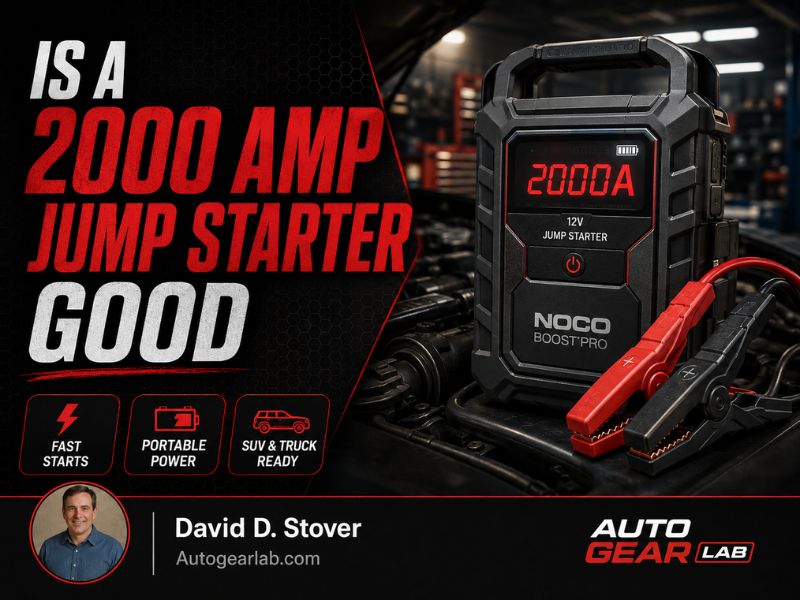
A reputable 2000A jump starter can provide substantial short-duration starting assistance to a weak or discharged 12-volt automotive battery.
As one real-world reference, NOCO currently rates its 2,000A GB70 for gasoline engines up to 8.0 liters and diesel engines up to 6.0 liters. That shows the level of vehicle a well-established 2,000A product may be designed to handle, but it should not be treated as a universal rating for every jump starter labeled 2000A.
Different manufacturers use different:
Internal battery cells, battery management systems (BMS), cable sizes, clamps, protection electronics, and methods for stating output.
Two products with “2000A” printed on the case can therefore perform differently when connected to the same vehicle.
This is why the manufacturer’s maximum gas and diesel engine ratings are often more useful to the average buyer than the headline amp number.
2000 Peak Amps Does Not Mean 2000 Amps Continuously
This distinction is essential.
Most compact lithium jump starters advertise peak amps. Peak current represents a short maximum-output condition rather than the amount of current the unit can continuously supply throughout a long cranking attempt.
Clore Automotive notes that peak amps do not have a single industry-agreed definition, meaning one brand’s peak-amp rating is not necessarily directly comparable with another brand’s number.
That does not mean peak amps are useless.
They provide a general indication of the product’s intended power class, especially when comparing models within the same manufacturer’s lineup. But they should be combined with other information.
A useful evaluation looks at:
Engine-size rating + fuel type + starting performance + cables and clamps + temperature range + safety electronics.
That gives you a much better idea of whether a 2000 amp jump starter is actually good.
What Vehicles Can a 2000 Amp Jump Starter Start?
There is no universal engine-size limit for all 2000A boosters, but a quality unit in this range can cover a large percentage of normal passenger vehicles.
Compact Cars and Sedans
For a small four-cylinder gasoline engine, 2000 peak amps is usually more capacity than necessary.
That is not inherently a problem.
A correctly designed 12V jump starter does not simply force all 2,000 advertised amps into the car. The starting system draws current according to its electrical requirements.
The disadvantage is mainly cost and size. If you only own a small commuter car, a lower-capacity quality unit may be cheaper, lighter, and still provide plenty of starting power.
SUVs and Crossovers
This is where a 2000A model becomes particularly attractive.
Modern SUVs can use anything from small turbocharged four-cylinder engines to large six- and eight-cylinder engines. Having additional starting reserve can be useful if the vehicle has a larger engine or regularly operates in cold weather.
Gasoline Pickup Trucks
A good 2000 amp booster is often well suited to gasoline pickup trucks, including many larger-displacement engines.
Again, check the actual manufacturer’s engine rating rather than relying only on the amp figure.
Diesel Vehicles
Diesel engines deserve more careful sizing.
Because of their higher compression and starting requirements, manufacturers commonly give lower maximum displacement ratings for diesel engines than gasoline engines.
NOCO’s 2,000A GB70, for example, is rated for up to 8.0L gasoline but 6.0L diesel engines.
For a large heavy-duty diesel pickup—particularly in extreme cold—verify the exact product specification instead of assuming every 2000A unit is sufficient.
Is 2000 Amps Too Much for a Small Car?
No, not simply because the jump starter has a high peak-current rating.
If the jump starter has the correct voltage and is designed for automotive jump starting, having more available current capacity than the engine normally requires is generally not the problem.
The critical compatibility issue is voltage.
A standard 12V passenger vehicle should be connected to an appropriate 12V jump starter, not a 24V output.
Think of available current as capacity rather than current that is automatically forced into the starter motor.
For a small car, the more relevant question is whether purchasing 2000A provides enough additional benefit to justify the extra price, dimensions, and weight.
If a smaller quality booster already comfortably covers your engine, you may not need 2000A.
Where 2000A Starts Making More Sense
A 2000 amp jump starter becomes easier to justify when your vehicle presents more demanding starting conditions.
A large-displacement gasoline engine is an obvious example. So is a midsize diesel.
Cold climates also favor additional capacity because low temperatures make starting more demanding while simultaneously reducing battery performance.
Another good reason is owning multiple vehicles. If your household includes a compact sedan, an SUV, and a pickup, buying one 2000A unit rated for the largest engine can be more practical than sizing the booster only for the smallest car.
It can also provide more confidence when the vehicle battery is substantially discharged rather than merely slightly weak.
Is 2000A Enough in Cold Weather?
It can be, but cold-weather performance depends on much more than the number printed on the housing.
Both the vehicle battery and the jump starter can produce less useful power as temperatures fall. Meanwhile, cold engine oil and increased mechanical resistance can increase the effort required to crank the engine.
The result is a more demanding starting event.
This is why someone driving a small gasoline sedan in Texas and someone driving a diesel truck through a northern winter should not necessarily choose the same booster even if both products advertise 2000A.
Look at the jump starter’s specified operating-temperature range and engine compatibility.
For severe winter use, additional power reserve is generally preferable to choosing a booster operating right at its stated maximum engine limit.
What Makes One 2000A Jump Starter Better Than Another?
Once you decide that the 2000A class suits your vehicle, the peak-current number becomes less important.
The quality of the rest of the system starts to matter more.
Engine Rating
This should be one of the first specifications you check.
A trustworthy manufacturer should clearly state something similar to:
Up to X.XL gasoline / X.XL diesel.
If a product advertises enormous amps but provides little useful information about actual vehicle compatibility, that deserves caution.
Clamps and Cable Quality
High starting current has to travel from the jump starter to the vehicle battery.
Weak springs, small contact areas, damaged connections, or poor cables can increase electrical resistance and reduce the useful voltage reaching the starting system.
A good clamp should grip the battery terminal securely.
Cable length matters too. Some vehicles have batteries or designated jump points in locations where extremely short leads become frustrating.
Safety Electronics
A modern consumer jump starter should provide appropriate protection against common connection problems.
Particularly valuable features include reverse-polarity protection, short-circuit protection, temperature protection, and clear connection indicators.
For example, NOCO lists spark-proof technology and reverse-polarity protection on its 2,000A GB70.
Safety circuitry is especially useful because jump starters often get used during stressful situations—in the dark, in bad weather, or by drivers who rarely work with batteries.
Internal Battery Quality
A jump starter needs more than a large marketing rating.
Its internal cells must be capable of producing a high discharge current without excessive voltage drop or immediate protection shutdown.
Battery quality also affects how well the unit holds a charge during storage.
A 2000A jump starter that is discharged every time you need it is not a good emergency tool.
1000 Amp vs. 2000 Amp Jump Starter
A 1000A jump starter can be perfectly adequate for many ordinary gasoline vehicles.
A 2000A model usually gives you more flexibility for larger engines and difficult starting conditions.
| Consideration | 1000A Class | 2000A Class |
| Small gasoline car | Usually plenty | More than normally needed |
| Average sedan | Good fit | Extra reserve |
| SUV | Depends on engine | Often better suited |
| Large gasoline truck | May be marginal by model | Usually better choice |
| Diesel | Limited by engine size | More capable |
| Severe cold | Less reserve | More reserve |
| Portability | Usually smaller | Usually somewhat larger |
| Price | Usually lower | Usually higher |
These categories are approximate because peak amp ratings are not standardized across manufacturers. Engine compatibility for the exact model should always take priority.
2000 Amp vs. 3000 Amp Jump Starter
Moving from 2000A to 3000A does not automatically make a jump starter 50% better in real-world use.
For a normal gasoline car, crossover, or midsize SUV, you may notice little practical benefit if the 2000A unit already exceeds the engine’s needs.
A higher-output unit becomes more attractive for large diesel engines, heavy trucks, severe cold, repeated starting, or professional use.
It may also offer additional starting attempts per charge, although that depends on the internal battery capacity rather than peak current alone.
For most private vehicle owners, once a high-quality 2000A unit comfortably covers the largest vehicle they own, going substantially larger offers diminishing returns.
Can a 2000A Jump Starter Start a Completely Dead Battery?
Sometimes, but “completely dead” can describe several different conditions.
A battery may simply be deeply discharged. In that situation, a sufficiently capable jump starter may get the engine running.
A battery can also have an internal failure, shorted cell, severe sulfation, frozen electrolyte, physical damage, or poor terminal connection. More jump-starter amps cannot fix those problems.
Smart lithium boosters can introduce another complication.
Some models need to detect a minimum battery voltage before activating normal boost output. NOCO’s GB70, for example, includes a manual override function for batteries below its normal detection threshold. The manufacturer warns that override disables normal safety protections, so it should be used only according to the instructions.
A high peak-amp rating therefore does not guarantee that every dead-battery situation can be solved.
Will a 2000 Amp Jump Starter Damage My Battery?
A properly designed jump starter of the correct voltage should not damage a healthy battery merely because its maximum current capacity is 2000A.
Problems are more likely to come from incorrect use.
Reversed polarity, wrong system voltage, damaged batteries, incorrect jump points, or improper manual-override use can create dangerous conditions.
Never attempt to jump-start a battery that is visibly swollen, leaking, severely damaged, or frozen.
Follow both the vehicle manufacturer’s jump-start procedure and the booster manufacturer’s instructions.
Is a 2000 Amp Jump Starter Worth Buying?
For many drivers, yes.
It is particularly easy to justify if you drive a large SUV, gasoline pickup, midsize diesel, multiple vehicles, or regularly experience cold winters.
For someone with only a small gasoline commuter car, 2000A may be more capability than necessary. A smaller high-quality unit can perform the same emergency job while costing less and taking up less storage space.
The key word is quality.
A reputable 1500A unit properly rated for your engine may be a better purchase than an unknown 2000A product with questionable specifications and weak clamps.
Frequently Asked Questions
Is a 2000 Amp Jump Starter Enough for Most Cars?
Yes. A quality 2000A jump starter is generally more than sufficient for typical passenger cars and has enough capacity for many SUVs and trucks. Always verify the manufacturer’s specific gas and diesel engine ratings.
Is 2000 Amps Good for a V8?
It can be an excellent choice for many gasoline V8 engines. Engine displacement varies significantly, however, so check the jump starter’s maximum gasoline-engine rating instead of relying solely on the V8 label.
Can a 2000 Amp Jump Starter Start a Truck?
Yes, many 2000A models are designed for pickup trucks. Large diesel trucks require more careful verification because diesel-engine limits are typically lower than gasoline-engine limits.
Is 2000 Amps Enough for a Diesel?
It depends on diesel displacement, temperature, and the specific jump starter. Some reputable 2000A models are rated for substantial diesel engines, while other products may have lower limits.
Is 2000A Better Than 1000A?
It provides more potential starting capacity, but that does not automatically make it the better purchase. A high-quality 1000A unit may be perfectly adequate for a small gasoline engine.
How Many Times Can a 2000A Jump Starter Start a Car?
There is no universal number. It depends on internal battery capacity, vehicle engine size, battery condition, temperature, cranking duration, and the particular jump starter.
Does Higher Peak Amps Mean Better Quality?
No. Peak amps measure output capability, not overall product quality, and peak ratings are not universally standardized. Clamp design, battery quality, safety electronics, cables, and manufacturer support also matter.
Should I Buy a 2000A or 2500A Jump Starter?
Choose the smaller unit if it already comfortably exceeds your engine’s requirements. Consider 2500A or more when the manufacturer specifically recommends the additional capacity for your large engine, diesel application, or demanding climate.
Can I Keep a 2000 Amp Jump Starter in My Car?
Usually, but follow its specified storage-temperature range and charging recommendations. Check its charge periodically so the internal battery is ready when an emergency occurs.
Does a 2000 Amp Jump Starter Charge the Car Battery?
Not in the same way as a battery charger. A jump starter provides short-duration starting assistance. A battery charger is designed to restore the vehicle battery’s state of charge over time.
Final Verdict: Is a 2000 Amp Jump Starter Good?
Yes, a 2000 amp jump starter is good for many drivers because it offers enough starting reserve for most passenger cars, many SUVs and gasoline trucks, and a range of diesel applications. The real question, however, is whether the specific 2000A model is properly rated for your engine and built well enough to deliver that power reliably.
Do not choose from peak amps alone. Check the gasoline and diesel engine-size ratings, 12V compatibility, clamp and cable quality, cold-weather operating range, battery technology, reverse-polarity protection, and manufacturer reputation.
For a small gasoline car, 2000A may be more than you need. For a larger SUV, pickup, multiple-vehicle household, or moderate diesel application, the extra capacity can provide valuable starting margin.
A well-designed 2000A jump starter matched to your vehicle is a strong all-around emergency choice—but a trustworthy rating and good electrical design matter more than simply having “2000 AMP” printed in large numbers on the case.