You should leave a jump starter connected only long enough to complete the starting attempt specified by its manufacturer, then disconnect it promptly once the engine starts. Many modern lithium jump starters are designed to start almost immediately after a correct connection rather than sit attached for several minutes.
The exact timing depends on the jump starter design, vehicle battery condition, engine size, temperature, and manufacturer’s duty cycle. The most important distinction is between how long you wait before cranking, how long you crank the engine, and how long the booster remains connected after the engine starts.
There Are Really Three Different Time Limits
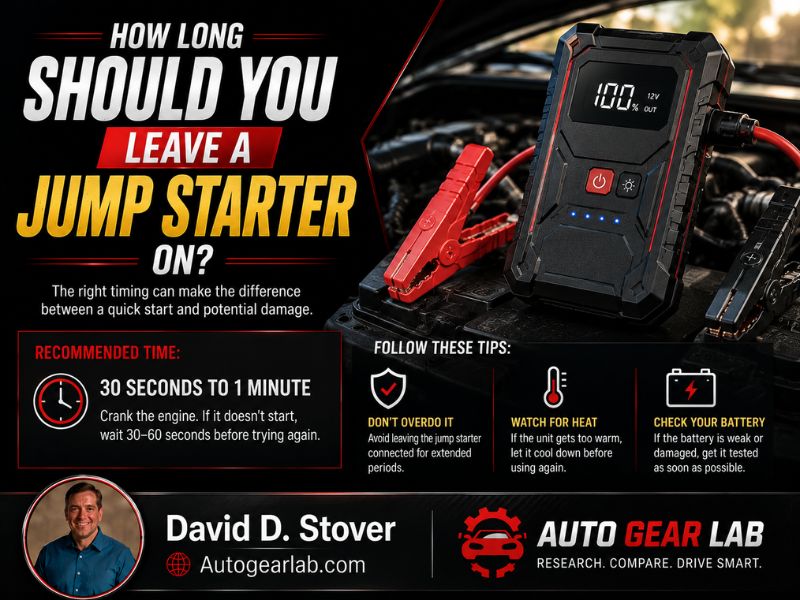
When someone asks how long to leave a jump starter on, they may be referring to three different stages of the process.
The first is the time between connecting the clamps and trying to start the vehicle. The second is the maximum cranking time during an individual attempt. The third is how long the jump starter should remain attached after the engine begins running.
Those times should not be treated as interchangeable.
For many modern lithium jump starters, you connect the unit, confirm its ready or boost indicator, and attempt to start the engine without a long waiting period. Some NOCO products, for example, begin a 60-second jump-start window as soon as they detect a battery and tell the user to attempt the start during that window.
Once the vehicle starts, the jump starter should normally be switched off and removed according to its instructions rather than left attached like a battery charger.
How Long Should You Wait Before Trying to Start the Car?
With a modern portable lithium booster, you usually do not need to wait several minutes if the unit shows that it is properly connected and ready to jump-start.
After connecting the positive and negative clamps correctly, turn on or activate the jump starter as directed. Once the unit confirms the battery connection, try starting the vehicle.
Some smart jump starters use electronic battery detection, so the indicator lights are more useful than an arbitrary waiting time. NOCO’s current Boost Air procedure, for example, instructs users to start the vehicle after the boost indicator confirms a proper connection.
An older lead-acid jump pack or certain heavy-duty starting situations may use a different procedure. Some manufacturers recommend allowing additional time between attempts so the booster can recover and some energy can transfer to the weak vehicle battery. That is why the product manual should override a universal timing rule.
What About a Completely Dead Battery?
A deeply discharged battery can complicate the process.
Some smart lithium boosters will not activate normally if the vehicle battery voltage is below their detection threshold. Certain models provide a manual override mode for this situation.
Manual override is not the same as simply leaving the jump starter attached longer.
For example, NOCO states that manual override on applicable models forces boost output when a battery is too low to be detected, but it also disables normal safety protection. That makes it a feature that should be used only when the manufacturer specifically directs you to use it.
Do not leave a booster connected indefinitely hoping that an internally failed battery will eventually become jump-startable.
How Long Should You Crank the Engine?
This is where timing becomes especially important.
A starter motor requires extremely high current. During cranking, the jump starter, cables, clamps, vehicle battery, and starter circuit all experience substantial electrical load.
Long continuous cranking can create heat and drain a portable booster rapidly.
There is no single cranking limit for every jump starter.
Clore Automotive, for example, advises in one of its jump-starting procedures that if the vehicle has not started within approximately six seconds of cranking, the jump starter should be allowed to cool for about three minutes before another attempt.
Other manufacturers use electronically controlled windows or different time limits.
The correct rule is therefore:
Crank only for the maximum duration specified in your jump starter and vehicle manuals.
Holding the key in the start position for 20 or 30 seconds because the engine has not started is generally not a good way to improve your chances.
How Long Should You Wait Between Jump-Start Attempts?
If the engine does not start on the first attempt, do not immediately perform repeated long cranking cycles.
The booster may need time to recover and cool.
Several current NOCO jump starters instruct users to wait about 20–30 seconds before another attempt when the vehicle does not start immediately. Some models also automatically disable their jump-start output after a 60-second window and require the unit to be reset before another sequence.
Heavy-duty or traditional jump starters can require longer recovery periods. Clore recommends a three-minute cooling period in one professional jump-starting procedure after a failed six-second cranking attempt.
This difference demonstrates why advice such as “always wait exactly one minute” is too simplistic.
A lithium booster with temperature monitoring and an older AGM jump box can have very different duty-cycle requirements.
A Practical Timing Example
Imagine you have a weak 12V battery and a compatible lithium jump starter.
You turn off the headlights, climate control, radio, and other unnecessary electrical loads. Then you connect the booster according to the vehicle and jump-starter instructions.
Once its ready indicator confirms a proper connection, you attempt to start the engine.
If the engine starts, you do not leave the jump starter connected for another five or ten minutes. Its starting job is complete, so you switch it off and disconnect it as directed.
If the engine does not start, you release the key or start button, stop cranking, and follow the booster’s specified recovery period before trying again.
That workflow is much safer than treating the jump starter as a temporary battery charger.
How Long Should the Jump Starter Stay Connected After the Engine Starts?
Generally, only as long as necessary to safely disconnect it.
Once the engine is running steadily, follow the manufacturer’s shutdown and disconnection sequence.
NOCO’s current instructions for several models tell users to power off the jump starter and disconnect the clamps once the vehicle has started.
A portable jump starter is designed primarily to provide high starting current, not to remain attached while the engine runs for an extended period.
Leaving it connected longer does not normally improve the jump start.
It also should not be confused with the advice sometimes given to keep the vehicle engine running after a jump start. The car may need to remain running because its own battery is discharged, but that does not mean the portable booster should remain connected.
These are two separate issues.
Can You Leave a Jump Starter Connected for 10 Minutes?
Unless your specific manufacturer instructs you to do so, there is usually no reason to leave a modern jump starter connected for ten minutes before or after starting.
The unit is not intended to operate as a normal battery charger.
A very weak vehicle battery may benefit from a specific recovery procedure, but that should come from the jump starter manufacturer rather than from simply choosing an arbitrary ten-minute waiting period.
If the vehicle still will not crank after correct connection and reasonable attempts, extending the connection indefinitely may not solve the actual problem.
You could instead be dealing with a failed battery, corroded battery terminals, bad ground connection, defective starter motor, ignition problem, fuel problem, or a jump starter that is undersized or insufficiently charged.
Can You Leave a Jump Starter Connected Overnight?
No. A normal portable jump starter should not be left connected overnight unless the manufacturer explicitly states that the device has a separate charging or maintaining function designed for that purpose.
A jump starter and a battery maintainer are different tools.
A maintainer is designed to remain connected while controlling charging current over an extended period. A jump starter is designed primarily to provide a powerful short-duration starting assist.
If your goal is to slowly recharge a dead vehicle battery, use a compatible smart battery charger rather than leaving the booster pack attached.
Why Jump Starters Need Recovery Time
A portable jump starter may be small, but starting an engine places an unusually large load on it.
High current creates heat within the internal battery, cables, electronic switches, and connections.
Repeated starting attempts without sufficient rest can trigger over-temperature protection or exceed the device’s intended duty cycle.
Clore specifically notes that every jump starter has a duty cycle involving a short cranking period followed by a required period of rest.
Some lithium units enforce these limits electronically.
NOCO’s AX65, for example, allows up to five consecutive jump-start attempts within a 15-minute period before requiring additional rest.
More attempts are not always better. If the engine consistently refuses to start despite strong cranking, you may need diagnosis rather than more booster time.
Signs You Should Stop Trying
Timing is only part of safe jump starting.
Stop the process if the jump starter, cables, or clamps become unusually hot, if you smell burning insulation, or if the unit displays an over-temperature or short-circuit warning.
Also stop if the vehicle battery is swollen, cracked, leaking, or frozen. A damaged battery should not simply receive a more powerful or longer jump attempt.
Clore advises inspecting both the booster and the vehicle battery and specifically warns against attempting to jump-start a frozen battery.
Repeated clicking with no meaningful cranking can also indicate that the battery connection or starting system needs attention.
Does Waiting Longer Help a Weak Battery?
Sometimes a short manufacturer-approved delay between attempts can help, but a jump starter is not intended to recharge the battery fully.
If a battery is merely discharged, the booster supplies enough additional current to turn the engine over.
If the battery has an internal defect, however, waiting longer may accomplish nothing.
For example, a battery with a shorted cell or severe internal failure can place an unusually heavy electrical load on the booster. The jump starter may repeatedly shut down or fail to produce adequate cranking.
At that point, continuing to leave it attached is not a solution.
Does Engine Size Affect How Long You Can Use the Booster?
Indirectly, yes.
A small gasoline engine may require substantially less starting current than a large diesel engine. That means the same portable booster can experience a very different load depending on the vehicle.
Cold temperatures make the difference even more pronounced.
A large diesel engine in freezing weather can place far more demand on a booster than a warm four-cylinder gasoline engine.
If your jump starter is operating close to its maximum engine rating, follow its duty-cycle limits carefully and do not assume it can tolerate repeated attempts just because its battery indicator still shows charge.
The Correct Connection Sequence Matters
Proper timing will not help if the clamps are incorrectly connected.
Before attaching a portable booster, turn off the vehicle ignition and unnecessary electrical loads.
Follow the vehicle manufacturer’s designated jump points whenever they are provided.
For a conventional negative-ground vehicle, typical guidance involves connecting the positive red clamp to the positive jump terminal and the negative black clamp to the manufacturer-recommended ground point.
Clore emphasizes using a solid vehicle ground away from the battery where appropriate, while also recommending eye protection and checking the jump starter’s condition before use.
Once connected, make sure the cables cannot contact fans, belts, or other moving components.
What If the Car Still Won’t Start?
If the jump starter provides strong cranking but the engine never fires, the dead battery may not be the real problem.
A gasoline engine also requires proper fuel delivery, ignition, compression, and engine management to start.
If the engine barely turns, investigate battery condition, terminal connections, grounds, starter motor condition, and booster capacity.
If the engine cranks normally but does not start, repeatedly leaving the jump starter connected longer is unlikely to solve the issue.
This distinction can prevent you from overheating a booster while diagnosing the wrong problem.
Frequently Asked Questions
How Long Should You Leave a Jump Starter Connected Before Starting?
Many modern lithium jump starters can be used once they confirm a proper battery connection; a long pre-charge period is usually unnecessary. Follow the ready indicator and model-specific instructions.
Should You Wait Five Minutes After Connecting a Jump Starter?
Not automatically. Some traditional or heavy-duty procedures may involve recovery time, but many current lithium boosters are designed for an immediate starting attempt after battery detection.
How Long Can You Crank With a Jump Starter?
The limit varies by product. One Clore procedure specifies stopping after about six seconds if the engine has not started and allowing approximately three minutes for the booster to cool before another attempt.
How Long Should You Wait Between Attempts?
Some current lithium units specify roughly 20–30 seconds, while other jump starters require several minutes. Always follow the duty cycle for your particular device.
Should You Disconnect the Jump Starter Immediately After Starting?
Once the engine is running, switch off and remove the jump starter according to its instructions rather than leaving it attached unnecessarily.
Can Leaving a Jump Starter Connected Too Long Damage It?
Extended or repeated high-current use can cause heat buildup and exceed the jump starter’s duty cycle. Modern units may automatically shut down to protect themselves from excessive temperature or use.
Can You Leave a Portable Jump Starter Connected While the Car Runs?
Normally, there is no need. Once the vehicle starts, the booster’s primary job is complete and it should be disconnected according to the manufacturer’s instructions.
How Many Times Can You Try to Jump-Start a Car?
It depends on the booster. Some NOCO units permit up to five consecutive attempts in a 15-minute period before requiring a longer rest, while other products have different limits.
Should You Leave a Jump Starter On to Charge a Dead Battery?
No. A jump starter is intended primarily for starting assistance, not full battery charging. Use a compatible battery charger when the goal is to restore the battery’s state of charge.
Why Does My Jump Starter Shut Off After One Minute?
Some smart lithium jump starters intentionally use a timed boost window. Certain NOCO models, for example, disable jump-start output after 60 seconds and require the unit to be turned off and back on before another sequence.
How Long Should You Leave a Jump Starter On? The Practical Rule
Leave a jump starter on only for the short period required by its manufacturer to perform a safe starting attempt, and disconnect it once the engine starts. Modern lithium units may be ready almost immediately after detecting the battery, while individual manufacturers specify different cranking limits and recovery periods between failed attempts.
Do not treat a jump starter like a battery charger by leaving it connected for 10 minutes, an hour, or overnight without specific manufacturer instructions.
More connection time is not necessarily more starting power. Correct clamp placement, a fully charged booster, adequate engine-size capacity, proper cranking duration, and sufficient recovery time matter far more.
If the engine repeatedly fails to start after several correct attempts, stop extending the connection time and diagnose the battery or vehicle. A jump starter is designed to provide a brief burst of starting power—not to compensate indefinitely for a failed battery or another mechanical or electrical problem.