A portable jump starter can often start a vehicle multiple times on one charge, with some consumer models rated for roughly 15 to 40 starts and larger units claiming even more. The actual number depends heavily on engine size, battery condition, temperature, cranking time, and jump starter capacity.
There is also a second meaning to this question: how many times the jump starter can be used during its entire service life. A rechargeable jump starter can potentially perform hundreds of starting events over its lifetime, but no single number applies to every lithium or AGM unit.
There Are Two Different “How Many Times” Questions
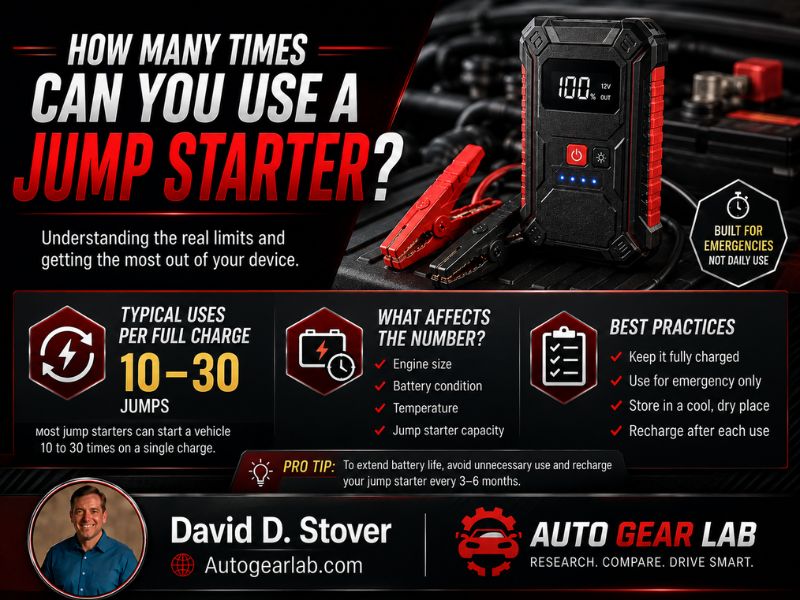
When manufacturers talk about the number of jump starts, they usually mean starts per full charge.
For example, current manufacturer specifications show substantial differences between models. Schumacher rates one compact 800A lithium unit for up to 15 jump starts per charge. NOCO rates its 1,000A GB40 for up to 20, its 2,000A GB70 for up to 40, and its larger GB150 for up to 80.
Those numbers should be viewed as maximum manufacturer claims under suitable conditions—not a guarantee that every user will get exactly that many starts.
The second question is total lifetime uses.
A rechargeable battery can go through many charge and discharge cycles before its capacity becomes too weak for dependable jump starting. Because one normal jump start usually consumes only part of the internal battery’s energy, one jump does not necessarily equal one complete battery cycle.
That distinction matters when estimating how long the device will last.
How Many Jump Starts Can You Get From One Charge?
For a typical portable lithium jump starter, a reasonable expectation may range from several starts to a few dozen, depending on the model and situation.
A small gasoline engine with a slightly weak battery may consume relatively little of the booster’s stored energy. The same jump starter connected to a large diesel engine with a deeply discharged battery in freezing weather may use significantly more energy during one event.
This is why two people using the exact same jump starter can get very different results.
If your jump starter advertises “up to 20 starts,” you should interpret that as maximum potential starting events under favorable conditions, not a requirement to use all 20 before recharging it.
For emergency readiness, recharging after use is usually the better habit.
What Determines How Many Times You Can Use It Per Charge?
The biggest factor is not simply the peak amp rating printed on the jump starter.
How much stored energy each starting attempt consumes depends on the load placed on the device.
Engine Size Makes a Major Difference
A small 1.5L or 2.0L gasoline engine generally requires less starting energy than a large V8 or diesel engine.
If a jump starter is rated for engines up to 6.0L gasoline and you repeatedly use it on a small four-cylinder car, it may complete more starts per charge than when operating near its maximum engine-size limit.
This is why engine displacement is important when evaluating both jump-starter size and expected runtime.
Diesel Engines Usually Demand More
A diesel engine typically requires more cranking effort than a similarly sized gasoline engine.
That increased demand means each starting event can consume more of the jump starter’s available reserve.
This is also why jump starter manufacturers commonly specify different maximum engine sizes for gasoline and diesel applications.
A unit rated for 8.0L gasoline engines might be rated for a substantially smaller diesel engine.
A Weak Battery and a Failed Battery Are Not the Same
The condition of the vehicle battery has a major effect on how hard the jump starter must work.
If the battery is simply slightly discharged, it may still contribute useful current to the starter motor. The portable booster supplements what the battery cannot provide.
If the vehicle battery is extremely discharged, the jump starter may have to contribute much more starting energy.
An internally failed battery can create an even more demanding situation.
A battery with a shorted cell, internal damage, severe sulfation, or another failure may prevent satisfactory starting even with a powerful booster. Repeatedly trying to jump such a battery can drain the portable unit quickly without getting the engine running.
More attempts do not necessarily solve a defective battery.
Cranking Time Has a Huge Effect
A vehicle that starts after one or two seconds of cranking uses much less jump starter energy than one requiring repeated long attempts.
That makes cranking duration one of the biggest variables affecting starts per charge.
If your engine normally starts quickly, one jump event may place a relatively modest demand on the pack.
If you crank for several seconds, stop, wait, and then repeat the process multiple times, the jump starter can lose a substantial portion of its charge during a single roadside event.
Long starting attempts also create heat in the internal battery, cables, clamps, and electronics.
For that reason, follow the manufacturer’s specified duty cycle and recovery time rather than continuing to crank until the booster is exhausted.
Cold Weather Reduces the Number of Starts
A jump starter that performs well in mild weather may deliver fewer successful starts in severe cold.
Cold temperatures affect the portable booster and the vehicle simultaneously.
The jump starter’s internal battery may provide less available power, while the vehicle’s battery also becomes weaker. At the same time, cold engine oil and increased mechanical resistance can make the engine harder to crank.
That combination increases the amount of work required from the booster.
If you keep a jump starter specifically for winter emergencies, do not plan around its maximum advertised number of starts.
Keeping a generous state of charge is more important.
Does a Bigger Jump Starter Give You More Uses?
Often, but not automatically.
A larger jump starter may contain a higher-capacity internal battery, which can provide more stored energy for repeated starting attempts.
The NOCO product range demonstrates this general relationship: its GB40 is advertised for up to 20 starts per charge, while the larger GB70 is rated for up to 40.
However, peak amps and battery capacity are different specifications.
A product advertising a very high peak-current number does not automatically have proportionally more stored energy.
If repeated starts per charge matter to you, check the manufacturer’s stated number of starts and internal watt-hour (Wh) capacity, not only peak amps.
How Many Times Can You Use a Jump Starter Before It Wears Out?
A quality rechargeable jump starter can potentially provide years of service and a large number of jump-starting events when maintained correctly.
The limiting component is usually its internal rechargeable battery.
Clore Automotive notes that its AGM jump starter batteries can typically handle roughly 700–800 battery cycles, while lithium batteries used in jump starters may support roughly 1,000–3,000 cycles, depending on the particular battery.
However, you should not interpret those figures as 700, 1,000, or 3,000 guaranteed jump starts.
A battery cycle represents accumulated discharge and recharge equivalent to a full cycle. A single quick jump start may use only a fraction of the battery’s available capacity.
For example, several light discharges can collectively equal one full battery cycle.
Actual lifespan also depends on temperature, depth of discharge, charging habits, battery construction, and age.
Lithium vs. AGM Jump Starter Lifespan
Both common jump starter battery types wear over time.
Lithium Jump Starters
Lithium-ion jump starters are popular because they can provide high starting current from a relatively lightweight battery pack.
They generally have good cycle life and low self-discharge, but heat and prolonged deep discharge can shorten their useful life.
A lithium booster that is regularly kept charged and protected from extreme temperatures can remain useful for years.
The internal electronics also matter. A modern battery management system (BMS) helps control charging, discharge, temperature, and other operating conditions.
AGM Jump Starters
Professional and traditional booster packs frequently use AGM lead-acid batteries.
They are heavier, but purpose-built AGM booster batteries can tolerate demanding high-current use effectively.
Like other lead-acid batteries, however, they particularly dislike remaining in a deeply discharged state.
Clore recommends recharging both lithium and lead-acid jump starters after use and charging stored units periodically.
Should You Recharge After Every Jump Start?
Yes, that is the safest maintenance habit.
A jump starter may advertise 20, 40, or more starts per charge, but there is rarely an advantage to deliberately using it repeatedly until the battery level becomes low.
Recharging after a jump helps restore its reserve capacity for the next emergency.
Clore specifically recommends fully recharging portable jump starters after use and avoiding leaving either lithium or lead-acid units in a discharged condition.
Schumacher similarly recommends charging its portable power jump starters after every use, along with periodic charging during storage.
Consider the advertised multi-start capability as emergency reserve rather than a recharge schedule.
What If You Need Several Starts in One Day?
Using a jump starter several times in one day is possible if the model has sufficient charge and the manufacturer allows repeated use.
This is particularly relevant for mechanics, towing services, fleet operators, or someone helping several stranded vehicles.
However, repeated starting generates internal heat.
A professional jump starter may be designed for a much more demanding duty cycle than a small consumer lithium booster.
If the unit becomes unusually hot or displays an over-temperature warning, allow it to cool rather than continuing.
You should also recharge it as soon as practical after a day involving several starts.
For frequent professional use, consider a jump starter specifically designed for repeated service rather than selecting a small consumer model only because it advertises high peak amps.
How Do You Know How Many Starts Are Left?
Most portable jump starters cannot tell you exactly how many successful engine starts remain.
They normally provide a battery level indicator, such as four LEDs or a digital percentage.
That indicator estimates remaining charge, but it cannot know how demanding your next vehicle will be.
For example, 50% remaining charge might still be more than enough for a small gasoline engine in warm weather. The same charge level could provide much less confidence when starting a large diesel in freezing temperatures.
Think of the indicator as a state-of-charge estimate rather than a “starts remaining” counter.
If the jump starter has fallen significantly below full charge, recharge it before relying on it.
Using the Power Bank Reduces Available Jump Starts
Many portable jump starters double as USB power banks.
Charging a phone, tablet, flashlight, or another electronic device uses the same internal stored energy that would otherwise be available for jump starting.
The effect may be small after one short phone charge, but repeated accessory use can noticeably reduce the reserve.
A unit that has not jump-started a car in months may therefore still be partially discharged if you have been using its USB ports.
Before a road trip, check the battery level even if the booster has not recently started a vehicle.
When Repeated Jump Starts Mean Something Is Wrong
A portable jump starter is emergency equipment. It should not become part of your daily starting routine.
If your vehicle needs a jump every morning or several times per week, the more important problem is the vehicle.
Common causes include a weak starting battery, charging-system problem, parasitic electrical drain, corroded terminals, poor ground connection, or another starting-system fault.
Continuing to use the jump starter may get the engine running temporarily, but it does not repair the cause.
Repeated deep use also adds unnecessary cycles and stress to the booster.
Test the vehicle battery and charging system instead of relying indefinitely on the portable jump pack.
Signs Your Jump Starter Is Reaching the End of Its Life
An aging jump starter does not always stop working suddenly.
Its performance may decline gradually.
One of the first signs is noticeably fewer starts from a full charge. A booster that previously handled several vehicles easily may begin losing most of its indicated charge after one attempt.
Another warning sign is rapid self-discharge. If the jump starter is fully charged, stored properly, and unexpectedly becomes nearly empty within a short period, the internal battery may be deteriorating.
You should also pay attention if it begins shutting down under loads it previously handled, takes unusually long to recharge, or experiences significant voltage collapse during starting.
Physical damage is more serious.
Stop using a lithium jump starter if you see swelling, case deformation, leakage, burn damage, excessive heat, or exposed battery components.
Battery swelling should not be treated as normal aging.
Ways to Get More Useful Life From a Jump Starter
The easiest way to extend service life is to avoid unnecessary deep discharge.
Recharge the booster after using it instead of waiting until the indicator reaches zero.
During storage, follow the manufacturer’s maintenance schedule. Clore commonly recommends recharging unused units approximately every 90 days, while Schumacher recommends every 30 days for some portable jump starters.
Temperature also matters.
Avoid prolonged storage in extreme heat when practical, and allow a battery exposed to severe temperatures to reach an appropriate charging temperature before plugging it in.
Keeping the clamps clean and ensuring a solid connection can also reduce wasted energy during starting.
A poor clamp connection creates electrical resistance, which can reduce effective starting performance and generate heat.
Frequently Asked Questions
How Many Times Can You Use a Jump Starter on One Charge?
Depending on the product and conditions, a portable jump starter may provide anything from several starts to dozens. Manufacturer examples currently range from up to 15 starts on one compact Schumacher unit to 20 or 40 starts on selected NOCO models.
Can You Use a Jump Starter Twice in a Row?
Yes, if it still has enough charge and remains within its specified temperature and duty-cycle limits. Allow the required recovery period between failed cranking attempts.
Should You Recharge a Jump Starter After One Use?
Yes. Even if plenty of charge appears to remain, recharging after use helps ensure maximum reserve for the next emergency.
Can a Jump Starter Be Used Every Day?
It can physically be used repeatedly if designed for the workload, but needing daily jump starts indicates that the vehicle’s battery or electrical system needs diagnosis. A jump starter should not replace a properly functioning starting battery.
How Many Years Does a Jump Starter Last?
There is no universal lifespan. Battery chemistry, charge cycles, storage temperature, depth of discharge, maintenance, and build quality all influence useful life.
Does One Jump Start Count as One Battery Cycle?
Not necessarily. A normal jump may use only part of the internal battery’s stored energy. Multiple partial discharges can collectively amount to one full battery cycle.
Does a 2000 Amp Jump Starter Last Longer per Charge?
It may provide more starts if it also has greater internal battery capacity, but peak amps do not directly measure stored energy. Check the manufacturer’s starts-per-charge and Wh specifications.
Why Does My Jump Starter Only Work Once Before Needing a Charge?
The starting event may be unusually demanding, or the internal battery may have lost capacity. Large engines, extreme cold, long cranking attempts, and deeply discharged vehicle batteries can all consume more energy.
Can Repeated Jump Starting Damage the Portable Starter?
Repeated high-current use can create heat and battery stress. Use the device within its specified duty cycle and allow it to cool when required.
When Should I Replace My Jump Starter?
Consider replacement when it no longer holds charge reliably, produces substantially weaker starts than before, shuts down repeatedly under normal loads, or shows physical battery damage.
How Many Times Can You Really Use a Jump Starter?
A portable jump starter can usually be used multiple times per charge and potentially hundreds of times over its overall service life, but there is no universal number. Some current consumer products advertise roughly 15–40 starts per charge, while larger-capacity models may claim considerably more.
Your real result depends on engine size, gasoline versus diesel, vehicle battery condition, temperature, cranking duration, internal battery capacity, and the age of the booster.
Do not treat a manufacturer’s maximum starts-per-charge claim as a target. Recharge the unit after using it, keep it properly maintained during storage, and avoid repeatedly draining it to empty.
The more useful measure of a good jump starter is not how many times you can force it to work before charging—it is whether it remains charged, healthy, and capable of delivering full starting power whenever your vehicle actually needs it.