A dead battery can turn a routine commute into a roadside problem, especially when another vehicle is unavailable. The best car jump starter booster should provide enough starting power for the vehicle, use dependable clamps, include appropriate safety protection, and remain charged while stored.
My primary recommendation is the NOCO Boost Plus GB40 1000A Jump Starter for most passenger cars, crossovers, and smaller trucks. It combines compact lithium construction with straightforward controls and compatibility with gas engines up to 6.0 liters and diesel engines up to 3.0 liters. I would choose the GOOLOO GP4000 4000A Jump Starter for larger engines or drivers wanting more advertised peak output and additional accessory-power capability. The Jump-N-Carry JNC660 1700 Peak Amp Jump Starter is more appropriate for garages, fleets, cold-weather use, and repeated jump-starting where weight is less important than heavy cables and sustained cranking performance.
These products serve different buyers. The NOCO and GOOLOO units are compact lithium jump packs designed for storage in a personal vehicle. The Jump-N-Carry uses a much heavier lead-acid-style internal battery and is better suited to regular professional or workshop use.
Best Car Jump Starter Booster Reviews
| Image | Product Name | Check Price |
|---|---|---|
Best Choice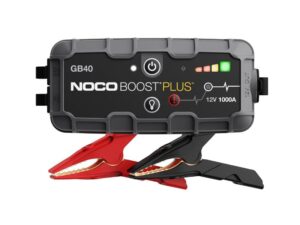 | NOCO Boost Plus GB40 1000A Jump Starter | Check Price |
Second Best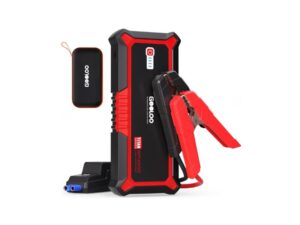 | GOOLOO GP4000 4000A Jump Starter | Check Price |
Third Choice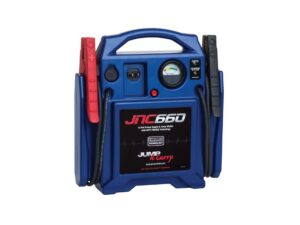 | Jump-N-Carry JNC660 1700 Peak Amp Jump Starter | Check Price |
1. NOCO Boost Plus GB40 1000A Jump Starter
Key Features
- 1,000-amp peak rating
- Designed for 12-volt lead-acid vehicle batteries
- Supports gas engines up to 6.0 liters
- Supports diesel engines up to 3.0 liters
- Compact lithium-ion internal battery
- Reverse-polarity protection
- Spark-resistant connection system
- Manual override for extremely discharged batteries
- USB power output
- 100-lumen multifunction flashlight
- IP65-rated housing with ports closed
- Approximately 1.65-pound unit weight
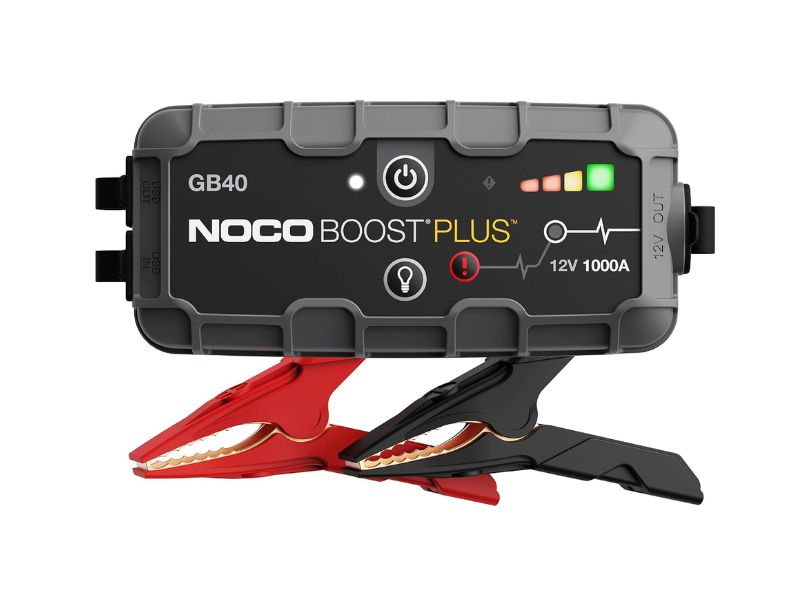
The NOCO Boost Plus GB40 is my primary recommendation because it offers the strongest balance of portability, compatibility, safety features, and ease of storage for the average car owner. It is compact enough for a glove compartment, console, trunk organizer, or emergency kit without taking up the space of a traditional booster box.
Its 1,000-amp peak rating is intended for gasoline engines up to 6.0 liters and diesel engines up to 3.0 liters. That coverage includes most compact cars, sedans, crossovers, minivans, and numerous light trucks. It is less suitable for large diesel pickups or commercial equipment with substantial cold-cranking requirements.
The GB40 is designed for 12-volt lead-acid batteries, including common wet-cell, maintenance-free, gel, enhanced flooded, and AGM types. It should not be treated as a universal booster for 24-volt electrical systems or unsupported lithium vehicle batteries.
Safety-oriented connection electronics are a major reason I rank it first. Reverse-polarity protection helps prevent normal operation when the clamps are connected to the wrong terminals, while spark-resistant circuitry reduces the chance of a spark during an ordinary connection attempt. These protections reduce risk but do not replace correct procedure, eye protection, ventilation, or battery inspection.
The interface is intentionally simple. Charge indicators show the remaining internal-battery level, and an error light helps identify an incorrect connection or unsuitable condition. The boost indicator confirms when starting output is active.
A manual-override function is provided for batteries whose voltage is too low for the booster to detect automatically. This feature should be used cautiously. Some automatic safety functions are bypassed in manual mode, making correct polarity essential. I would reserve it for users who understand the procedure and have confirmed that the vehicle uses a compatible 12-volt system.
The built-in flashlight has multiple brightness and signaling modes, including emergency flashing patterns. A flashlight is not the main reason to choose a jump starter, but it is useful when locating battery terminals, checking clamp placement, or making the vehicle more visible at night.
The USB output can recharge a phone or another small personal device. This secondary function is practical during a breakdown, but using the pack as an everyday power bank consumes energy that may be needed to start the car. The jump starter should be recharged after powering accessories.
NOCO states that the GB40 can provide multiple starts under suitable conditions, but the real number depends on engine size, battery condition, ambient temperature, and how long each attempt lasts. A deeply discharged large engine in cold weather can consume far more energy than a small warm gasoline engine.
Its published operating-temperature range reaches below freezing, but lithium batteries deliver less current when cold. Keeping the unit inside a heated home defeats its roadside purpose, while leaving it in a freezing vehicle can reduce immediate output. In severe winter climates, I would store it in the vehicle but periodically bring it indoors for charging and inspection.
The compact clamps are suitable for typical automotive battery posts, although their cable length is shorter than that of a professional booster. Battery placement can therefore affect access. Vehicles with remote jump terminals should be connected according to their owner’s manual rather than by reaching for a buried battery.
The GB40 is the most practical option for a driver who wants a compact emergency tool for an ordinary passenger vehicle. I would move to the GOOLOO GP4000 for a larger engine requiring more output margin, or the Jump-N-Carry JNC660 for repeated workshop use and extended cranking demands.
2. GOOLOO GP4000 4000A Jump Starter
Key Features
- 4,000-amp advertised peak output
- 12-volt lithium jump starter
- Intended for all gasoline engines
- Supports diesel engines up to 10.0 liters
- Reverse-polarity and connection protection
- Boost mode for severely discharged batteries
- USB device-charging capability
- USB-C input and output functionality
- 15-volt accessory output
- Multifunction LED flashlight
- Approximately 3.6-pound product weight
- Compact storage profile relative to its engine coverage
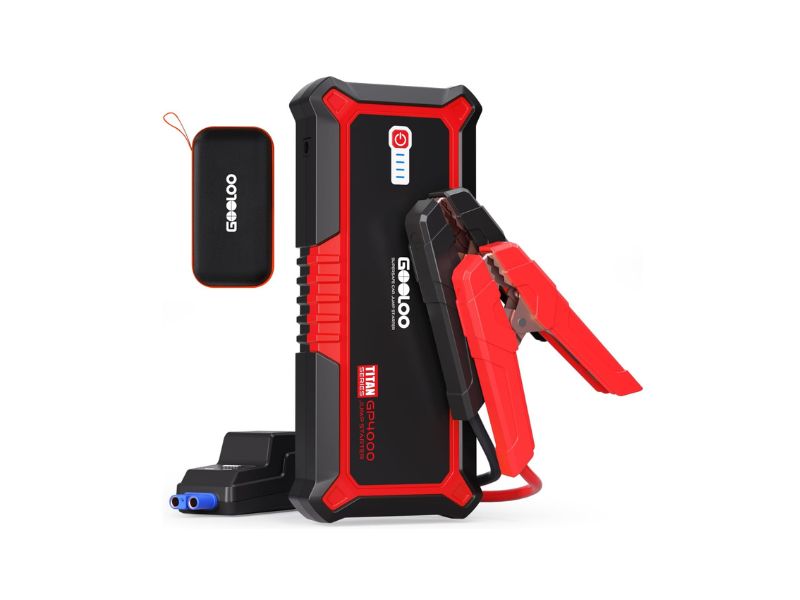
The GOOLOO GP4000 is the more appropriate choice for drivers who need broader engine compatibility than the NOCO GB40 provides. Its advertised 4,000-amp peak rating and stated coverage for all gasoline engines and diesel engines up to 10.0 liters make it relevant to full-size SUVs, gasoline pickups, larger diesel vehicles, boats, and equipment using compatible 12-volt systems.
Peak amperage should not be interpreted as continuous cranking current. Manufacturers can measure or present peak output differently, so comparing a 4,000-amp lithium pack directly with a traditional booster’s cranking-amp rating can be misleading. Engine coverage, battery type, cable design, low-temperature behavior, and tested starting performance are more useful than a single large number.
The GP4000 uses a lithium-polymer internal battery, keeping it substantially smaller and lighter than the Jump-N-Carry JNC660. It can be stored in a trunk or cargo compartment without occupying much room, although its larger body and accessories make it less compact than the NOCO.
Its high-output clamps incorporate protective electronics intended to detect common connection problems. A dedicated boost function can energize the clamps when the vehicle battery is too deeply discharged for normal detection.
As with every manual or forced-boost function, this mode requires extra care. Automatic polarity detection may be reduced or bypassed, depending on the operating state. The user must confirm that the red clamp is connected to the correct positive point and the black clamp is attached according to the vehicle manufacturer’s procedure.
The GP4000 also functions as a portable power source. USB charging ports can supply phones and other compatible devices, while a 15-volt accessory port can support certain automotive accessories when the proper adapter is used. Those features make the pack useful for camping, travel, and emergency preparation.
Accessory use introduces a maintenance tradeoff. A jump starter stored at a partial charge may not deliver its expected starting capability months later. After powering a phone, inflator, vacuum, or refrigerator, recharge the unit before returning it to the vehicle.
The integrated flashlight provides steady and emergency modes. Its broader body can also be easier to position on the ground than a very small power bank, although neither unit should be placed where it could contact moving belts, fans, or hot exhaust components.
GOOLOO recommends periodic recharging during storage. That practice is especially important for a high-output lithium pack. Lithium batteries have relatively low self-discharge, but the internal management electronics, environmental temperature, and battery age still affect stored energy.
The GP4000’s large-engine claim provides useful headroom, but no portable jump pack can correct a mechanically locked engine, failed starter, corroded battery cable, open main fuse, or severely damaged battery. If the starter does not respond, repeated boosting can create additional heat without solving the underlying problem.
Cable reach is another consideration. The pack needs to remain close to the battery or designated jump points. Check the arrangement under the hood before an emergency, particularly on diesel pickups with dual batteries or remote positive terminals.
The GOOLOO GP4000 is my preferred alternative for larger engines and buyers who want more power margin than a compact 1,000-amp unit provides. It is less appealing when maximum portability and a simpler interface matter more than engine coverage.
3. Jump-N-Carry JNC660 1700 Peak Amp Jump Starter
Key Features
- 1,700 peak amps
- 425 cranking amps
- Replaceable-style professional booster battery architecture
- 46-inch heavy-duty cables
- Number 2 AWG cable construction
- Industrial-grade clamps
- Built-in automatic charger
- Charge-status voltmeter
- 12-volt accessory outlet
- Designed for repeated jump-starting
- Approximately 18-pound weight
- One-year limited warranty
The Jump-N-Carry JNC660 is fundamentally different from the two lithium products. It uses a heavy internal battery developed for jump-starting and supplies a published 425 cranking amps in addition to its 1,700-amp peak figure. This makes it a more transparent choice for garages, roadside-assistance work, fleets, farms, and households with several vehicles.
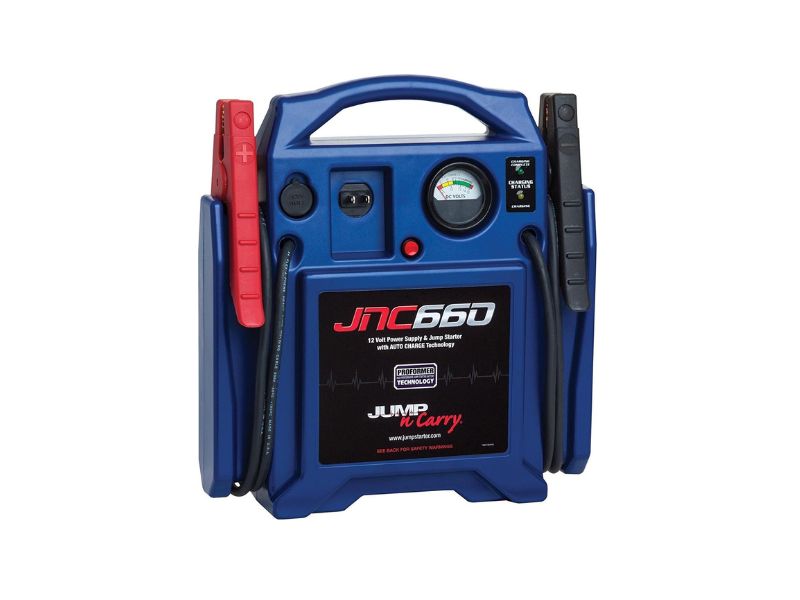
Its strongest practical advantage is the combination of 46-inch number 2 AWG cables and industrial-grade clamps. Longer cables provide more flexibility when a disabled vehicle is parked close to a wall, another car, or roadside barriers. Heavy conductors also reduce voltage loss compared with undersized cables.
The clamps are designed to establish substantial contact with battery posts or approved jump points. Good contact matters because even a powerful internal battery cannot deliver useful current through corrosion, paint, dirt, or a weak clamp connection.
At approximately 18 pounds, the JNC660 is far heavier than the NOCO and GOOLOO units. It is portable in the sense that it has a carrying handle, but it is not an ideal glove-compartment emergency device. It makes more sense in a garage, service vehicle, shop, or large cargo area.
The internal charger is built into the unit. That prevents the charging adapter from being separated and allows the booster to remain connected to suitable AC power according to its instructions. Keeping it in an always-ready charging state is convenient for a workshop that may need it without warning.
A front-mounted voltmeter shows the approximate condition of the internal battery. It is simpler than a digital percentage display but provides an immediate indication of readiness.
The 12-volt accessory outlet can power compatible devices or serve as part of the charging arrangement described in the operating instructions. The JNC660 does not focus on USB-C charging, phone-power functions, or compact travel convenience. Its design prioritizes starting current and repeat use.
Traditional booster batteries can be more dependable than small lithium packs during extended starting attempts, but they still lose performance in extreme cold. An 18-pound booster stored in an unheated garage should be kept fully charged and inspected regularly.
The JNC660 does not offer the same mistake-resistant user interface as the NOCO. Its professional-style design assumes careful clamp placement. Users must follow correct polarity, avoid moving engine components, and keep the unit away from the battery’s vent path.
This model is best for someone who expects to jump-start vehicles repeatedly rather than carry a booster only for a rare emergency. Its long cables, substantial clamps, and published cranking rating make it a strong shop tool. Its weight and lack of modern compact-device charging are meaningful limitations for ordinary commuters.
Car Jump Starter Booster Comparison
| Product | Internal Battery Type | Peak Rating | Published Engine Coverage | Weight | Cable Configuration | Safety Assistance | Power-Bank Function | Primary Use |
| NOCO Boost Plus GB40 | Lithium-ion | 1,000A | Up to 6.0L gas and 3.0L diesel | Approx. 1.65 lb | Compact precision clamps | Reverse-polarity and spark-resistant protection | USB output | Everyday passenger-vehicle emergency kit |
| GOOLOO GP4000 | Lithium-polymer | 4,000A | All gas and up to 10.0L diesel | Approx. 3.6 lb | High-output smart clamps | Connection protection and boost mode | USB, USB-C, and accessory output | Larger engines and multipurpose travel power |
| Jump-N-Carry JNC660 | Sealed professional booster battery | 1,700A peak; 425A cranking | Not stated by engine displacement | Approx. 18 lb | 46-in. number 2 AWG cables | Traditional user-controlled connection | 12V accessory outlet | Garages, fleets, cold weather, and repeated starts |
The NOCO GB40 is the easiest product to carry in an ordinary car. The GOOLOO GP4000 provides broader stated engine compatibility while remaining portable. The Jump-N-Carry JNC660 sacrifices compactness for heavy cables, industrial clamps, and a professional-style internal battery.
Lithium Versus Traditional Jump Starters
Lithium jump packs and traditional sealed-battery booster boxes solve the same problem differently.
Lithium Jump Starters
Lithium models provide high current from a small, lightweight battery. Their primary advantages are:
- Compact dimensions
- Low carrying weight
- Easy vehicle storage
- USB charging features
- Electronic connection protection
- Convenient emergency lighting
- Relatively low self-discharge
Their limitations include reduced cold-weather output, short clamp cables, battery aging, and reliance on internal electronics. They may also require a manual override when the vehicle battery is too discharged to be detected.
A lithium booster is usually the better choice for a commuter who wants an emergency device that remains in the vehicle.
Traditional Booster Boxes
A traditional booster such as the JNC660 is heavier because it uses a larger sealed battery and thick cables. Its advantages include:
- Published cranking current
- Longer, heavier cables
- Large clamps
- Strong repeat-starting capability
- Suitability for workshops
- Convenient continuous charging
- Better access to difficult battery locations
Its drawbacks are weight, bulk, and less emphasis on device charging. The internal battery also requires maintenance and eventual replacement.
A traditional booster is generally more appropriate when starting vehicles is an expected task rather than a rare emergency.
How to Choose the Best Car Jump Starter Booster
Match the Booster to the Engine
Engine displacement is a useful first filter. A small four-cylinder gasoline engine normally requires less cranking power than a large diesel engine.
Diesel engines need more starting current because of their higher compression. Cold temperatures also increase oil viscosity and reduce battery performance.
Choose a booster whose stated engine coverage meets or exceeds the largest vehicle you expect to start. Avoid selecting a product at the absolute edge of its rating if the vehicle operates in severe winter conditions.
Confirm System Voltage
The products reviewed here are intended for 12-volt vehicle systems. They are not general-purpose 24-volt boosters.
Applying a 12-volt-only product incorrectly to a 24-volt commercial system can damage the jump starter or vehicle electronics. Some vehicles use two 12-volt batteries connected in parallel and still operate at 12 volts, while others connect batteries in series for 24 volts.
When multiple batteries are present, follow the vehicle manufacturer’s jump-starting instructions.
Understand Peak Amps and Cranking Amps
Peak amps represent a brief maximum output under a manufacturer’s defined conditions. They do not indicate how much current the device can sustain throughout an extended cranking attempt.
Cranking amps measure current delivered for a longer standardized period at a specified temperature. Cold-cranking amps evaluate battery output at a much lower temperature.
Many compact lithium products advertise peak amps without providing a directly comparable cranking rating. Use engine-size coverage and overall design alongside the amp number rather than ranking products by peak output alone.
Check Clamp and Cable Quality
Starting current must pass through the cables and clamps before reaching the vehicle. Important qualities include:
- Sufficient conductor thickness
- Strong spring pressure
- Broad conductive surfaces
- Insulated handles
- Flexible cold-weather cable jackets
- Enough length to reach the jump points
- Secure connection to the jump pack
Short cables reduce resistance but may make awkward battery locations difficult to reach. Long cables improve access but need adequate conductor size to limit voltage drop.
Consider Battery Location
Some cars place the battery in the trunk, under a seat, beneath a cover, or behind other components. These vehicles often provide designated underhood jump terminals.
Read the owner’s manual before an emergency and locate the correct positive and negative connection points. Connecting directly to an inaccessible battery may be unnecessary or discouraged.
Prioritize Connection Protection
Reverse-polarity detection helps prevent normal activation when the clamps are reversed. Spark-resistant circuitry reduces the chance of sparks during an ordinary connection sequence.
These systems cannot make every situation safe. Manual override can bypass detection, and a damaged or frozen battery may still rupture or vent explosive gas.
Electronic protection should support correct procedure, not replace it.
Evaluate Cold-Weather Performance
Both the vehicle battery and jump starter lose output as temperature falls. Lithium packs can become noticeably weaker when left in a freezing vehicle.
For severe winters:
- Choose more output margin than the engine normally requires.
- Keep the booster fully charged.
- Inspect it more frequently.
- Warm the pack gradually when practical.
- Never place it on a hot engine or heater.
- Avoid charging a frozen lithium battery.
- Consider a larger traditional booster for repeated winter use.
Do not store the jump pack in a location where it could become a projectile during a collision.
Check Charging Method
A jump starter is useful only when charged. USB-C charging is convenient because compatible cables may already be available, but charging speed depends on the power adapter and supported input.
Some small boosters recharge slowly from low-power USB sources. A built-in AC charger is more convenient in a garage but less flexible during travel.
After every jump start, recharge the unit as soon as conditions allow.
Consider Power-Bank Features
USB outputs can keep a phone operational during an emergency. Higher-output accessory ports may run certain inflators, lights, or small refrigerators.
These features consume the same stored energy reserved for starting the vehicle. If emergency starting is the priority, treat device charging as a backup function rather than daily use.
Look at Storage and Weight
A booster stored in the garage cannot help when the battery dies away from home. Compact lithium units are more likely to remain in the car.
Choose a stable storage location protected from loose cargo, moisture, direct sunlight, and extreme heat. Keep the clamps from contacting metal objects.
An 18-pound professional unit requires a secure cargo position and may be inconvenient for users with limited lifting ability.
How to Use a Portable Jump Starter Safely
Always follow the vehicle and jump-starter instructions. The following sequence applies generally to compatible 12-volt systems, but vehicle-specific requirements take priority.
- Park safely and engage the parking brake.
- Turn off the ignition, lights, climate control, and accessories.
- Inspect the battery for cracks, swelling, leakage, or freezing.
- Confirm that the booster is intended for the vehicle voltage.
- Connect the positive clamp to the approved positive terminal.
- Connect the negative clamp to the approved negative or chassis point.
- Confirm that the booster shows a correct connection.
- Activate boost output if required.
- Attempt to start the engine for only the recommended duration.
- Pause between attempts to prevent overheating.
- After the engine starts, switch off the booster if instructed.
- Remove the negative clamp first.
- Remove the positive clamp second.
- Keep cables clear of belts, pulleys, and cooling fans.
- Recharge the booster after use.
Do not lean directly over the battery while making connections. Wear eye protection and keep flames, cigarettes, and sparks away from the battery area.
When Not to Use a Jump Starter
Do not connect a booster when:
- The battery case is cracked.
- The battery is visibly swollen.
- Electrolyte is leaking.
- The battery may be frozen.
- The vehicle voltage is incompatible.
- The jump starter is damaged or wet.
- The clamps or cables are burned or exposed.
- The battery terminals are physically loose or broken.
- The owner’s manual prohibits the proposed connection.
- Flammable vapors are present.
- The vehicle has suffered collision or flood damage affecting its electrical system.
A jump starter is designed to assist a discharged battery, not make a damaged electrical system safe.
Why a Car May Not Start After Boosting
A dead or weak battery is only one possible cause of a no-start condition.
Corroded Battery Connections
Corrosion creates resistance and blocks current. A booster cannot deliver full power through a poor connection.
Failed Starter Motor
A worn solenoid or motor may click without cranking. Repeated jump attempts can overheat wiring without solving the failure.
Empty Fuel Tank or Fuel-System Failure
If the engine cranks normally but does not fire, the problem may involve fuel delivery rather than battery power.
Immobilizer or Key Problem
Security systems can disable starting or fuel operation. Check warning lights and follow the vehicle’s key-recognition procedure.
Mechanical Engine Failure
A seized engine or internal mechanical problem will not respond to additional electrical current.
Failed Alternator
A jump may start the engine, but it can stall again if the alternator does not support the electrical system or recharge the battery.
Battery With an Internal Short
A damaged battery may absorb booster output or create unsafe heat. Discontinue use if the battery becomes hot, vents, or behaves abnormally.
Maintenance and Storage
A jump starter should be treated as an emergency battery rather than a tool that can be forgotten indefinitely.
Recharge Regularly
Check the charge level every one to three months or according to the manufacturer’s instructions. Recharge after every use, including phone charging.
Inspect the Cables
Look for cuts, exposed conductors, looseness, corrosion, burned contacts, or damaged insulation.
Control Storage Temperature
Avoid prolonged exposure to excessive heat. A closed vehicle can become much hotter than the outdoor temperature, accelerating battery aging.
Keep the Ports Covered
Close protective covers before storage to limit dust and moisture entry. An IP rating applies only under the stated conditions and does not make the unit suitable for submersion.
Secure the Booster
Use a storage bag or rigid compartment. Do not allow the clamps to contact tools, coins, or other conductive objects.
Replace an Aging Unit
Internal batteries lose capacity with age and cycling. A jump starter that charges unusually quickly, discharges rapidly, swells, overheats, or fails a readiness check should be removed from service.
Traditional booster batteries also wear out. A voltmeter reading alone may not prove that the battery can deliver cranking current.
Common Buying Mistakes
Choosing by Peak Amps Alone
Peak numbers are not always measured identically. Engine coverage, clamps, cables, temperature performance, and battery design matter.
Buying a Unit Too Small for a Diesel
Diesel engines typically need more starting current. Select a product explicitly rated for the engine displacement.
Ignoring Vehicle Voltage
A 12-volt booster should not be used on an unsupported 24-volt system.
Leaving the Unit Uncharged
A powerful jump starter is ineffective when its internal battery is depleted.
Using It as a Daily Phone Charger
Regular accessory use reduces emergency starting capacity unless the pack is recharged afterward.
Assuming Safety Electronics Prevent Every Error
Manual override and damaged batteries still present serious hazards. Correct polarity and inspection remain essential.
Storing It Loose in the Cabin
An unsecured booster can become dangerous during hard braking or a crash.
Expecting It to Repair a Failed Battery
A jump starter provides temporary cranking assistance. A battery that repeatedly dies needs testing and likely replacement or charging-system diagnosis.
Cranking Continuously
Long starting attempts can overheat the starter, clamps, cables, and booster. Observe the specified duty cycle.
Buying a Heavy Shop Booster for Occasional Travel
A large traditional unit may stay in the garage because it is inconvenient to carry. Match the design to where it will actually be used.
Frequently Asked Questions
What is the best car jump starter booster for most drivers?
The NOCO Boost Plus GB40 offers the strongest balance for ordinary passenger vehicles. It is compact, simple to store, and rated for gasoline engines up to 6.0 liters and diesel engines up to 3.0 liters.
How many amps should a car jump starter have?
Choose by verified engine coverage rather than relying only on peak amperage. A small gasoline car needs less current than a large diesel pickup. Temperature, battery condition, and cable quality also affect starting performance.
Can a 1,000-amp jump starter start a V8?
Yes, when the manufacturer rates it for the V8’s displacement and fuel type. The NOCO GB40 supports gasoline engines up to 6.0 liters, but larger engines and severe cold may justify more output margin.
Are lithium jump starters safe?
Yes, when undamaged units are used according to their instructions. Reverse-polarity and spark-resistant protection help, but users must still inspect the battery, confirm voltage, connect correctly, and avoid manual override unless necessary.
Is a jump starter the same as a battery charger?
No, a jump starter supplies brief high current while a charger replenishes the battery slowly. Some products include both functions, but the portable lithium models reviewed here are primarily boosters and power banks.
Can a jump starter recharge a dead car battery?
Not normally; it provides enough temporary current to crank the engine. Once running, the vehicle’s charging system may replenish the battery, but a deeply discharged battery should be charged and tested properly.
How long should I leave the jump starter connected?
Connect it only for the period specified by its instructions. Portable boosters are not intended to remain attached indefinitely. Disconnect them in the recommended sequence after the engine starts.
How many times can a portable booster start a car?
The number varies with engine size, temperature, battery condition, and attempt length. Published maximums generally assume favorable conditions. Recharge the unit after use rather than saving the remaining charge for another emergency.
Will a jump starter work in freezing weather?
Yes, but both lithium packs and vehicle batteries deliver less power in severe cold. Select extra capacity, keep the booster charged, and follow its operating-temperature limits. Never charge a frozen lithium battery.
Can I leave a jump starter in my car?
Yes, if it is secured and stored within its specified temperature range. Protect it from moisture, crushing, loose metal objects, and prolonged extreme heat. Inspect and recharge it regularly.
Can I use a jump starter in the rain?
Avoid exposing electrical connections to rain unless the instructions explicitly permit it. An enclosure rating with closed ports does not necessarily protect open clamps, connectors, or charging ports during operation.
Can a jump starter damage vehicle electronics?
Incorrect voltage, reversed polarity, or improper connection can damage electronics. Use the designated jump points and follow the vehicle manufacturer’s procedure, particularly on vehicles with sensitive battery-management systems.
What does manual override do?
Manual override energizes the clamps when an extremely discharged battery cannot be detected. It may bypass normal protection, so polarity must be confirmed before activation. Use it only as directed.
Should the black clamp go on the negative battery terminal?
Use the negative or chassis point specified by the vehicle manufacturer. Many vehicles recommend a designated ground away from the battery to reduce the chance of sparks near battery gases.
Why does the jump starter click but not crank the engine?
Poor clamp contact, insufficient charge, or a failed starter may be responsible. Clean the approved connection points, confirm booster charge, check the error indicators, and stop if cables or clamps become hot.
Can I jump-start a battery that is completely at zero volts?
Possibly, but automatic boosters may require a carefully used manual mode. First verify that the battery is not damaged, frozen, or internally shorted. Replacement may be safer than repeated boost attempts.
Can I use a car jump starter on a motorcycle?
Yes, when both use a compatible 12-volt battery and the instructions permit it. Ensure the clamps fit safely and avoid manual override unless the manufacturer’s procedure supports it.
Do I need to replace the battery after a jump start?
Not always, but repeated discharge indicates that testing is necessary. The cause may be battery aging, an alternator problem, parasitic drain, loose connections, or accessories left on.
How often should I recharge a stored jump pack?
Check it every one to three months and recharge after every use. Follow the product’s specific schedule because storage temperature, internal electronics, and battery age affect self-discharge.
Which is better, lithium or lead-acid jump starters?
Lithium is better for portability, while lead-acid boosters suit repeated professional use. A compact lithium pack fits a personal emergency kit; a heavy traditional unit offers longer cables and sustained shop-oriented performance.
Conclusion
The best car jump starter booster depends on the vehicle, climate, and frequency of use. A compact lithium pack is usually the most practical choice for a commuter, while larger engines and repeated starting require more output margin or a professional-style booster.
The NOCO Boost Plus GB40 remains my primary recommendation for most passenger cars and light-duty vehicles. It is small enough to remain in the vehicle, covers gas engines up to 6.0 liters and diesel engines up to 3.0 liters, and includes useful connection protection.
The GOOLOO GP4000 is the better alternative for larger gasoline and diesel engines. Its higher advertised peak output and additional accessory-power functions provide broader utility, although it is larger and should still be selected according to verified engine compatibility.
The Jump-N-Carry JNC660 is more suitable for a garage, fleet, farm, or frequent cold-weather use. Its 46-inch heavy cables, substantial clamps, and 425-amp cranking rating prioritize repeated starting over portability.
Whichever product you choose, recharge it regularly, secure it during storage, and inspect the vehicle battery before connecting. Locate the approved jump points in advance and never attempt to boost a frozen, swollen, leaking, or cracked battery. For an ordinary gasoline car, crossover, or smaller truck, I would keep the NOCO Boost Plus GB40 in the emergency kit and check its charge every few months.