Choosing the best automotive battery jump starter means matching the pack to your engine, climate, terminal access, and storage needs—not simply buying the highest advertised amp rating.
My primary recommendation is the WOLFBOX MegaVolt24 4000A Jump Starter because it combines broad engine coverage, a large 88.8Wh battery, fast 65W USB-C charging, and an easy-to-read display in a portable case.
I would choose the NOCO Boost X GBX55 1750A Lithium Jump Starter when compact construction, refined safety controls, and rapid USB-C charging matter more than maximum capacity.

The WOLFBOX MegaVolt16 Air 3000A Jump Starter With Air Compressor is more suitable for a road-trip kit because it combines battery starting assistance with a 160 PSI tire inflator. The GOOLOO GP2000 is a lighter option for ordinary passenger vehicles, while the Clore JNC660 is better suited to garages, fleets, and repeated professional-style use.
Best Automotive Battery Jump Starter Reviews
| Image | Product Name | Check Price |
|---|---|---|
Best Choice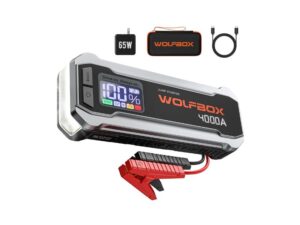 | WOLFBOX MegaVolt24 4000A Jump Starter | Check Price |
Second Best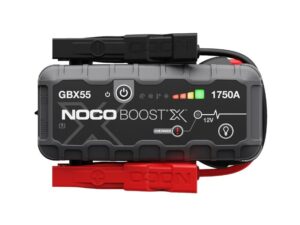 | NOCO Boost X GBX55 1750A Lithium Jump Starter | Check Price |
Third Choice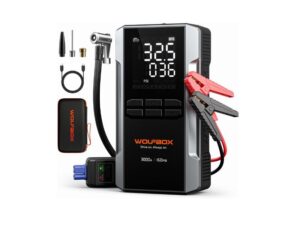 | WOLFBOX MegaVolt16 Air 3000A Jump Starter With Air Compressor | Check Price |
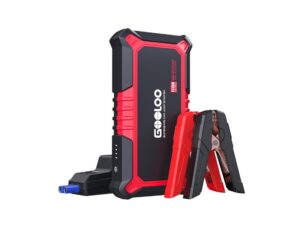 | GOOLOO GP2000 2000A Supersafe Jump Starter | Check Price |
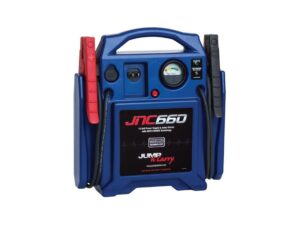 | Clore Automotive Jump-N-Carry JNC660 1700 Peak Amp Jump Starter | Check Price |
The order below emphasizes practical vehicle compatibility, starting capability, battery capacity, clamp design, safety, portability, and ease of charging. Advertised peak current is considered, but it is not treated as the only measure of performance.
1. WOLFBOX MegaVolt24 4000A Jump Starter
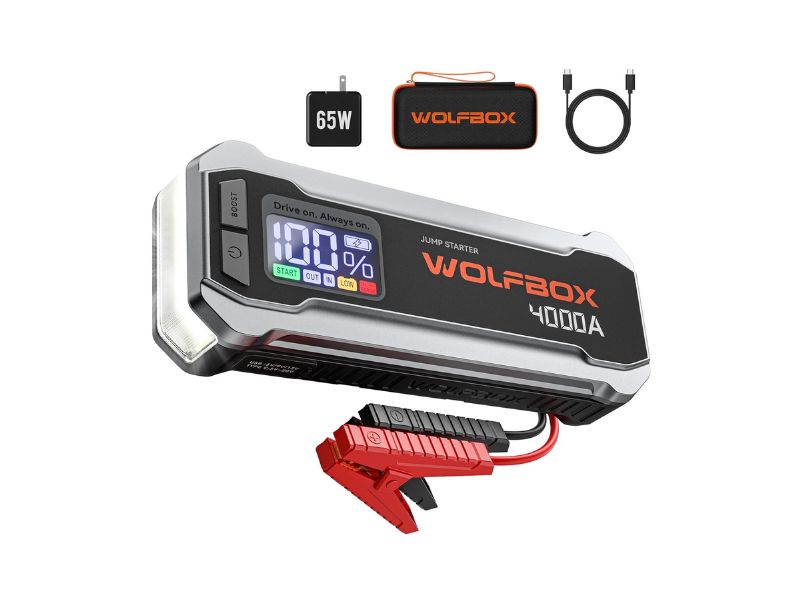
Key Features
- 4000A advertised peak current
- Rated for gasoline and diesel engines up to 10.0 liters
- 88.8Wh internal lithium battery
- 65W USB-C Power Delivery input and output
- Digital display, emergency light, boost mode, and protective case
The WOLFBOX MegaVolt24 is the most broadly capable portable model in this comparison. Its combination of high advertised starting current, a large internal battery, and generous engine-size coverage makes it appropriate for households with several vehicle types. It can serve a compact sedan without becoming irrelevant when the same household also owns an SUV, pickup, or larger-displacement gasoline vehicle.
Its 88.8Wh battery is one of its most meaningful advantages. A larger energy reserve does not guarantee that every difficult engine will start, but it can provide more margin for repeated attempts, cold-weather use, and charging phones or other USB devices. It also reduces the likelihood that one brief jump-start attempt will leave the unit nearly depleted.
The 65W USB-C Power Delivery port improves everyday usability. With a compatible charger and cable, the pack can recharge much faster than older jump starters that depend on low-power USB-A inputs. The same port can supply power to compatible phones, tablets, and some laptops, although using the unit as a power bank reduces the energy available for starting a vehicle.
The digital display is more informative than a four-light battery gauge. It allows the driver to check the remaining charge before leaving on a trip instead of estimating whether two or three illuminated LEDs provide enough reserve. The included case also keeps the clamps, charging cable, and main unit together while preventing loose metal objects in the trunk from contacting the clamp jaws.
Clamp reach is the most important practical limitation. The cables are adequate for batteries with exposed posts, but they may feel short when the vehicle uses recessed terminals, remote jump points, or tightly packaged engine-bay components. Buyers should inspect the location of their vehicle’s positive terminal and approved ground point before choosing any jump starter.
The MegaVolt24 also includes a low-voltage boost function for batteries that are too depleted for normal automatic detection. That mode should be treated as an emergency feature rather than the default starting method because manual boost functions may bypass some connection safeguards. Polarity must be verified before activation.
What I Like
- Broad gasoline and diesel engine coverage
- Large battery reserve for repeated starts and device charging
- Fast two-way USB-C charging
- Clear percentage-based display
- Protective storage case included
What I Do Not Like
- Short clamps may be inconvenient around recessed terminals
- Larger capacity is unnecessary for many small-car owners
- Manual boost requires extra care and correct polarity
The WOLFBOX MegaVolt24 offers the strongest balance for the widest range of ordinary drivers. I recommend it for multi-vehicle households, SUV and pickup owners, road trips, and anyone who prefers extra battery reserve without moving to a heavy professional lead-acid jump box.
2. NOCO Boost X GBX55 1750A Lithium Jump Starter
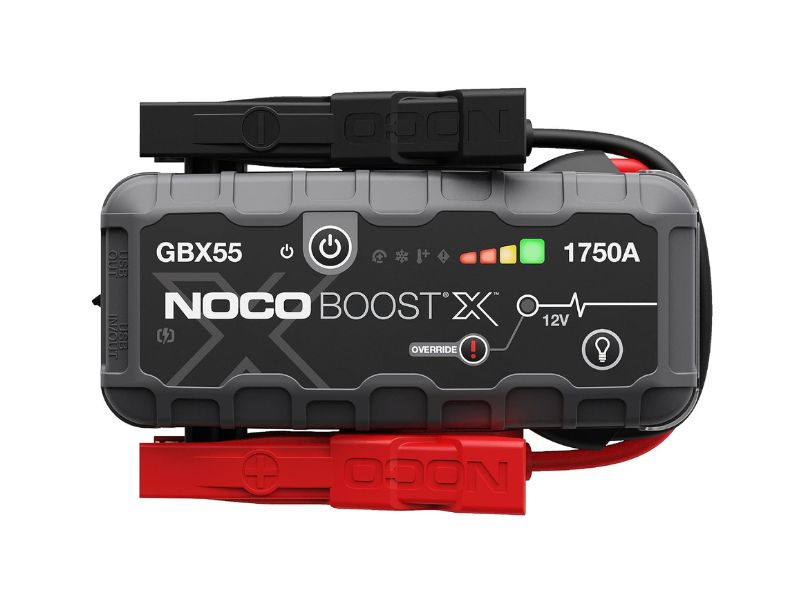
Key Features
- 1750A peak current
- Rated for gasoline engines up to 7.5 liters
- Rated for diesel engines up to 5.0 liters
- 46Wh lithium battery with 60W USB-C input and output
- Spark-resistant connection, reverse-polarity protection, manual override, and IP65-rated housing with ports closed
The NOCO Boost X GBX55 is a compact, well-integrated choice for drivers who prioritize portability and clear operating controls. Its rated engine range covers most passenger cars, crossovers, many SUVs, light trucks, motorcycles, boats, and moderate-displacement diesel applications.
At approximately 2.6 pounds, the GBX55 is easier to move between vehicles than a traditional sealed lead-acid jump box. It is also compact enough for a trunk organizer, under-seat compartment, or dedicated roadside bag. Its smaller 46Wh battery does not provide the same reserve as the MegaVolt24, but it is sufficient for the intended use when the pack is kept charged.
A major advantage is its 60W USB-C Power Delivery capability. With an appropriate 60W power source, the GBX55 can recharge much faster than jump starters that use basic USB inputs. It can also accept a brief emergency charge when the unit is depleted and a vehicle or wall USB-C source is available. The fastest charging performance depends on the charger and cable, so buyers should not assume that every phone charger will supply the required wattage.
The safety system is another reason to consider this model. Reverse-polarity protection helps identify an incorrect clamp connection, and spark-resistant circuitry reduces risk during ordinary setup. These protections do not replace proper procedure, but they make the unit more approachable for drivers who rarely work around automotive batteries.
Its IP65 rating applies when the ports are properly closed. That provides useful protection against dust and water jets, but the device should not be treated as submersible or left exposed to standing water. The port covers must remain clean and fully seated for the housing protection to be meaningful.
The 60-second power-conservation timeout can be helpful because it limits unnecessary drain, but it may surprise a driver who connects the pack and then spends too long returning to the driver’s seat. The manual override function can assist with an extremely low-voltage battery, yet it requires the same polarity checks and caution as other override systems.
The GBX55 uses a soft storage bag rather than a rigid case in its basic configuration. The bag keeps the components together, but it provides less crush protection when stored beneath heavy cargo.
What I Like
- Strong power-to-size balance
- Fast USB-C input and output
- Refined connection and polarity safeguards
- IP65 housing protection with the ports closed
- Clear controls and useful indicator lights
What I Do Not Like
- Maximum charging speed requires a compatible high-wattage charger
- Lower battery reserve than the MegaVolt24
- Soft storage bag offers limited impact protection
I would choose the NOCO Boost X GBX55 for a commuter car, crossover, light truck, or moderate-size diesel when portability matters. It is especially suitable for buyers who want modern USB-C charging and straightforward safety feedback without carrying an oversized pack.
3. WOLFBOX MegaVolt16 Air 3000A Jump Starter With Air Compressor
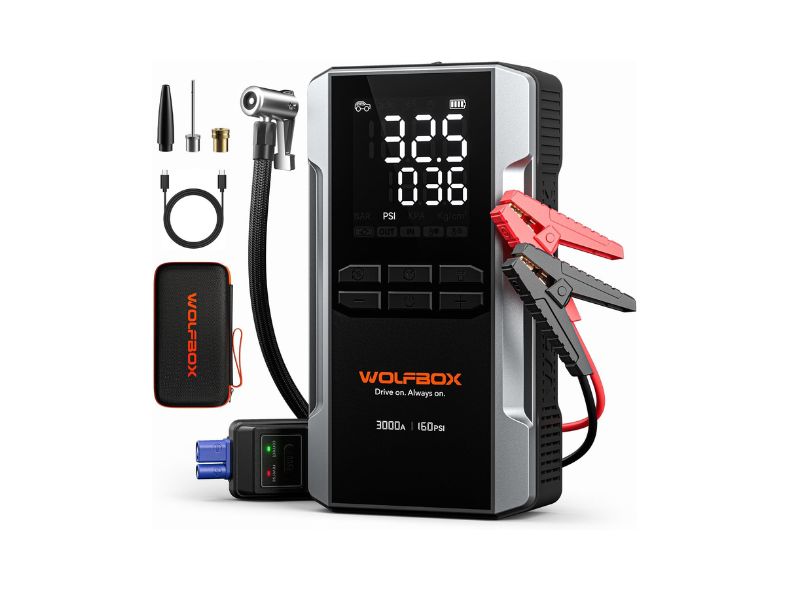
Key Features
- 3000A advertised peak current
- Rated for gasoline engines up to 8.0 liters
- Rated for diesel engines up to 6.0 liters
- 59.2Wh lithium battery with 65W USB-C charging
- Integrated 160 PSI air compressor and 400-lumen emergency light
The WOLFBOX MegaVolt16 Air is intended for drivers who want one device to address two common roadside problems: a discharged starting battery and low tire pressure. Combination products often compromise one function to add another, but this model is specified as a capable jump starter rather than a small inflator with a marginal boost feature.
Its 3000A advertised peak rating and 8.0-liter gasoline or 6.0-liter diesel engine range make it appropriate for most passenger vehicles, family SUVs, and many light trucks. As with every jump starter, the engine rating should be treated as an upper limit under suitable conditions rather than a guarantee that every neglected battery or cold diesel engine will start.
The 59.2Wh internal battery provides a useful middle ground between the higher-capacity MegaVolt24 and smaller compact packs. It supplies energy to both the jump-starting circuit and the compressor, which means extensive tire inflation reduces the reserve available for starting. On a road trip, I would check and recharge the unit after inflating several tires or assisting another vehicle.
The integrated compressor can reach a stated maximum of 160 PSI, although the maximum number is less important than inflation speed, hose access, and pressure control for ordinary vehicle tires. Drivers should set tire pressure according to the vehicle’s door-jamb label or owner’s manual, not the maximum pressure printed on the tire sidewall.
A built-in digital display simplifies pressure selection and battery monitoring. The compressor is useful for correcting gradual pressure loss, handling seasonal temperature changes, or adding air after a low-pressure warning. It is not a substitute for repairing a puncture, damaged valve stem, or sidewall problem.
The 65W USB-C connection allows relatively fast recharging with compatible equipment. It also makes the device more useful during travel because it can supply power to electronics. As with the MegaVolt24, power-bank use should be balanced against the need to preserve starting reserve.
Its physical size is the primary tradeoff. The compressor, hose, and larger housing require more storage space than a single-purpose lithium jump pack. The clamps are also somewhat blocky, which may complicate access to small or recessed terminals.
What I Like
- Combines two practical roadside tools
- Appropriate engine coverage for most family vehicles
- Useful compressor with digital pressure control
- Fast 65W USB-C charging
- Integrated light and protective storage case
What I Do Not Like
- Larger than a single-purpose jump starter
- Compressor use reduces the remaining starting reserve
- Bulky clamps may be awkward in tight engine bays
The MegaVolt16 Air is the most practical choice here for road trips, family SUVs, and drivers who regularly monitor tire pressure. I would prefer a dedicated jump starter for minimum size, but this combination model makes sense when reducing the number of separate roadside tools is more important.
4. GOOLOO GP2000 2000A Supersafe Jump Starter
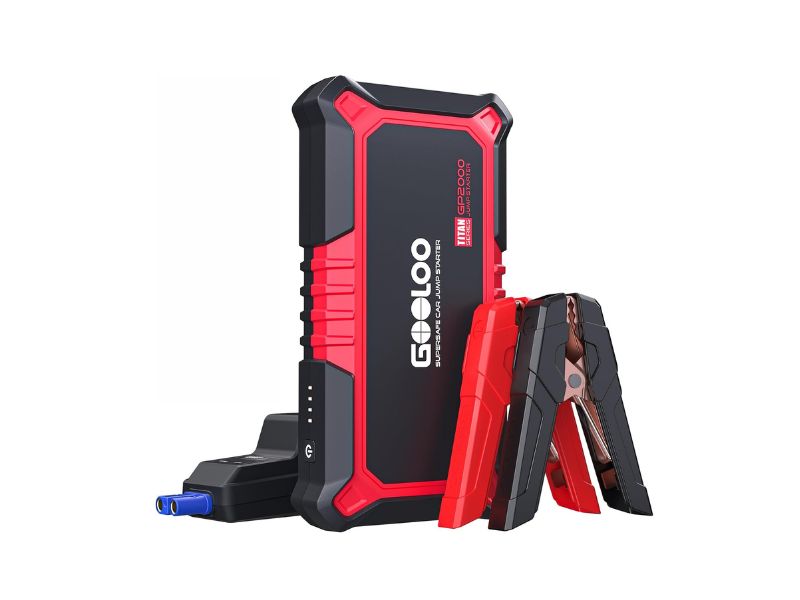
Key Features
- 2000A advertised peak current
- Rated for gasoline engines up to 8.0 liters
- Rated for diesel engines up to 6.0 liters
- Approximately 37Wh lithium battery
- Multiple electrical protections, dual USB outputs, and 400-lumen light
The GOOLOO GP2000 is a lightweight option for drivers who want a straightforward emergency pack for ordinary passenger vehicles. It weighs approximately 1.2 pounds and occupies less storage space than the higher-capacity WOLFBOX models or the lead-acid Clore unit.
Its advertised engine coverage is generous, but I would leave more operating margin than the headline numbers suggest. A 2000A compact pack may be entirely suitable for a four-cylinder sedan, V6 crossover, motorcycle, or normally maintained SUV, yet a large diesel or high-compression V8 in severe cold is a more demanding application. Buyers with those vehicles should consider a higher-capacity model rather than selecting solely by the claimed maximum engine size.
The GP2000 uses a simple four-level charge indicator instead of a percentage display. That design is easy to understand, but it offers less precision. Two illuminated lights do not reveal whether the remaining charge is close to 50 percent or nearing the next threshold. Checking and topping up the unit periodically is therefore especially important.
Its compact dimensions make it convenient for a glove compartment when the vehicle has enough space and the manufacturer’s storage-temperature guidance permits it. A protective case or dedicated bag is still worthwhile because the clamps should not move freely among tools, coins, or other metal objects.
Automatic protections address common connection problems such as reverse polarity, over-current, and short-circuit conditions. These safeguards improve usability but do not make careless connections acceptable. The driver should still identify the positive terminal, approved negative or chassis connection, and correct system voltage before attaching the pack.
Dual USB outputs allow the GP2000 to function as a basic power bank. Its charging system is less capable than the 60W or 65W USB-C systems on the higher-ranked models, so buyers who frequently charge laptops or want the shortest possible pack recharge time may find it limiting.
The built-in 400-lumen light is useful when locating terminals in a dark parking lot. Flashing modes can also improve visibility during an emergency, although the vehicle’s hazard lights and safe roadside positioning remain more important.
What I Like
- Lightweight and easy to store
- Sensible capability for common passenger vehicles
- Straightforward controls
- Useful connection protections
- Integrated light and USB device charging
What I Do Not Like
- Claimed engine limits leave little margin for difficult large-engine starts
- Four-light battery gauge is less precise than a digital percentage display
- Slower charging and lower energy reserve than premium alternatives
The GOOLOO GP2000 is a practical choice for commuters, students, and families with ordinary gasoline-powered cars or crossovers. I would avoid relying on it as the primary emergency pack for a large diesel truck, repeated fleet use, or severe cold-weather starting.
5. Clore Automotive Jump-N-Carry JNC660 1700 Peak Amp Jump Starter
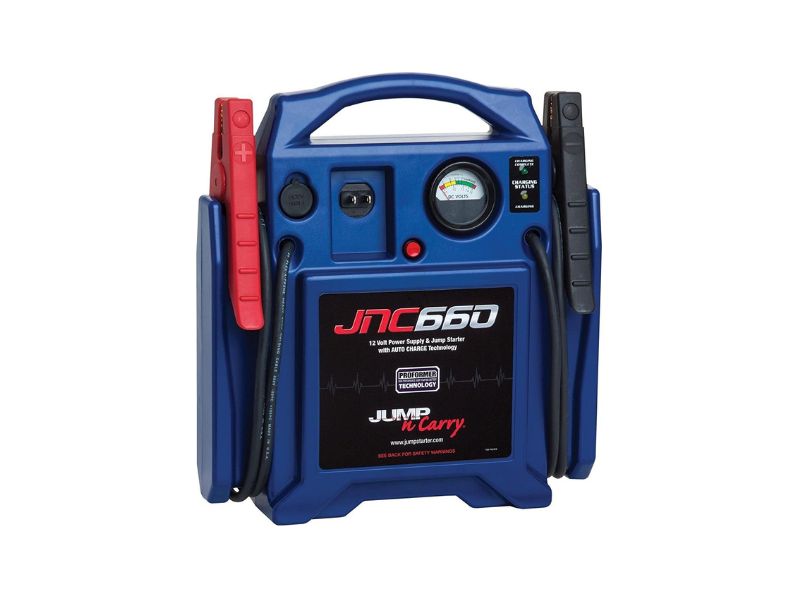
Key Features
- 1700 peak amps
- 425 cranking amps
- 22Ah sealed lead-acid battery
- 46-inch #2 AWG welding cables
- Built-in automatic charger, analog voltmeter, and 12V accessory outlet
The Clore Automotive Jump-N-Carry JNC660 takes a different approach from the four lithium models. It uses a substantial sealed lead-acid battery, long heavy-gauge cables, and industrial-style clamps. That construction makes it more appropriate for garages, service vehicles, farms, fleets, and repeated multi-vehicle use.
Its 1700 peak-amp figure is accompanied by a 425 cranking-amp rating. Cranking amps describe a more sustained output than a brief peak rating, making the specification useful when evaluating a professional-style jump box. The JNC660 is designed to deliver substantial current through its #2 AWG cables without depending on thin, short leads.
The 46-inch cables are a meaningful advantage when a battery is recessed, mounted away from the edge of the engine bay, or accessible only through remote jump posts. The longer reach also allows the heavy unit to remain on the ground or a stable surface rather than balancing near moving belts, fans, or hot components.
Its industrial clamps provide a large contact area, which can improve connection quality on conventional battery posts. However, their size may be excessive for motorcycles, powersports batteries, or tightly packaged modern vehicles. Users should confirm that the clamp jaws can reach the approved connection points without touching adjacent metal.
At approximately 18 pounds, the JNC660 is far heavier than a lithium jump starter. That weight is manageable in a workshop but inconvenient for a small trunk, compact emergency kit, or anyone with limited lifting ability.
The built-in automatic charger simplifies maintenance when the unit is stored near an electrical outlet. Sealed lead-acid batteries generally benefit from regular charging and should not remain deeply discharged. The internal battery will also age over time, although a serviceable, replaceable design can be advantageous for long-term ownership.
An analog voltmeter gives a quick indication of the unit’s charge condition. The 12V accessory outlet can power suitable equipment, but the JNC660 lacks the modern USB-C charging convenience found on the lithium alternatives.
What I Like
- Long 46-inch heavy-gauge cables
- Strong sustained cranking capability
- Industrial clamps with substantial contact area
- Automatic onboard charging
- Suitable for repeated garage and fleet use
What I Do Not Like
- Approximately 18-pound weight
- Requires more deliberate charging and storage maintenance
- Lacks fast USB-C charging and a digital percentage display
The JNC660 is the better tool when cable reach, sustained output, and repeated use matter more than portability. I would choose it for a workshop, farm, fleet, or multi-vehicle garage, but not for a driver who simply wants a compact pack for occasional roadside emergencies.
Automotive Battery Jump Starter Comparison
| Product | Chemistry | Starting rating | Gas engine limit | Diesel engine limit | Capacity | Approx. weight | Charging | Cable or clamp design | Safety or override | Extra functions | Main limitation |
| WOLFBOX MegaVolt24 4000A Jump Starter | Lithium | 4000A peak | 10.0L | 10.0L | 88.8Wh | Portable | 65W USB-C | Short, compact clamps | Automatic protections and boost mode | Power bank, display, light | Short clamp reach |
| NOCO Boost X GBX55 1750A Lithium Jump Starter | Lithium | 1750A peak | 7.5L | 5.0L | 46Wh | 2.58 lb | 60W USB-C | Compact detachable clamp assembly | Reverse polarity, spark resistance, manual override | Power bank, 200-lumen light | Fastest charging needs suitable charger |
| WOLFBOX MegaVolt16 Air 3000A Jump Starter With Air Compressor | Lithium | 3000A peak | 8.0L | 6.0L | 59.2Wh | Larger portable unit | 65W USB-C | Blocky clamps | Automatic protections and boost mode | 160 PSI compressor, light, power bank | Larger housing |
| GOOLOO GP2000 2000A Supersafe Jump Starter | Lithium | 2000A peak | 8.0L rated | 6.0L rated | Approx. 37Wh | Approx. 1.2 lb | Standard USB charging | Compact metal clamps | Multiple automatic protections | Dual USB, 400-lumen light | Less margin for demanding large engines |
| Clore Automotive Jump-N-Carry JNC660 | Sealed lead-acid | 1700 peak; 425 cranking | Not stated by displacement | Not stated by displacement | 22Ah | Approx. 18 lb | Automatic onboard charger | 46-inch #2 AWG cables and industrial clamps | Conventional manual connection | Voltmeter, 12V outlet | Heavy and less convenient to store |
The WOLFBOX MegaVolt24 provides the widest balance of battery capacity, engine coverage, charging speed, and portable storage. The NOCO GBX55 is easier to carry and has particularly refined safety and USB-C features, but it gives up some battery reserve and diesel-engine coverage.
The MegaVolt16 Air is the most versatile roadside device because it can address both starting and tire-pressure problems. The GOOLOO GP2000 is better matched to standard passenger vehicles than severe large-engine duty. The JNC660 is the least portable option, but its long heavy-gauge cables and sustained output make it more appropriate for frequent garage or fleet work.
How to Choose the Best Automotive Battery Jump Starter
Match the Jump Starter to Engine Size and Fuel Type
Begin with the vehicle’s engine displacement, measured in liters. A 2.0-liter four-cylinder engine generally requires less starting current than a 5.7-liter V8, especially when both vehicles are exposed to the same temperature.
Diesel engines usually need more starting energy than gasoline engines of similar displacement. Higher compression ratios, heavier rotating components, glow-plug operation, and cold oil can increase the electrical load. That is why jump-starter specifications commonly provide separate gasoline and diesel engine limits.
Treat the stated engine limit as an upper boundary rather than the ideal target. A unit rated for a 6.0-liter diesel may start that engine under favorable conditions, but an older battery, subfreezing weather, long cables, or poor clamp contact can reduce the available margin. Choosing additional capacity is sensible for large diesels, infrequently used vehicles, and winter climates.
Confirm 12V Compatibility
Most portable consumer jump starters are intended for 12V electrical systems. Passenger cars, light trucks, motorcycles, boats, and powersports equipment commonly use 12V starting batteries, but some commercial trucks, buses, construction equipment, and specialty vehicles use 24V systems.
Never connect a 12V-only jump starter to a 24V system. The mismatch can damage the jump starter, vehicle electronics, battery, or wiring. A vehicle that uses two visible 12V batteries is not automatically a 24V system; the batteries may be connected in parallel to remain at 12V. Check the vehicle manual or service information rather than guessing from battery count.
Understand Peak Amps and Cranking Amps
Peak amps represent a brief maximum current figure. The number can indicate the general capability class of a jump starter, but peak claims are not always measured under identical conditions across brands.
Cranking amps or start-assist amps describe a more sustained current output over a defined interval. When available, those figures can provide useful context, especially for professional lead-acid jump boxes.
Do not assume that a 4000A product will always deliver exactly twice the practical starting performance of a 2000A product. Internal resistance, battery temperature, cable thickness, clamp contact, voltage stability, protection circuitry, and test methodology all affect actual results.
The vehicle battery’s cold cranking amps, or CCA, is a separate specification. CCA describes how much current the installed battery can provide at 0°F under a defined test. It does not translate directly into the peak-amp number required from a portable jump starter.
Compare Lithium and Sealed Lead-Acid Designs
Lithium jump starters dominate portable roadside use because they provide a favorable power-to-weight ratio. They are small, easy to carry, and often include USB charging, digital displays, and automatic connection safeguards.
Their limitations include sensitivity to extreme temperature, gradual capacity loss with age, and short clamp cables on many models. They also depend on electronic protection systems that may refuse to activate when a vehicle battery is extremely depleted.
Sealed lead-acid jump boxes are larger and heavier, but they can provide sustained current and support long heavy-gauge cables. They are useful in workshops where the unit can remain on a charger between jobs. Their drawbacks are weight, greater self-discharge, and the need for regular charging.
For a commuter or family vehicle, I generally prefer lithium. For a garage, farm, fleet, or repeated service work, a professional lead-acid unit can be more appropriate.
Evaluate Capacity in Watt-Hours
Watt-hours, abbreviated Wh, describe stored energy more clearly than an isolated milliamp-hour number. A higher watt-hour capacity can provide more reserve for repeated jump attempts, cold-weather losses, lights, compressors, and USB device charging.
Capacity should not be confused with starting current. A large battery with inadequate high-current circuitry may store substantial energy without being effective at starting an engine. Conversely, a compact pack may deliver a powerful brief pulse but have less reserve for repeated attempts.
Avoid comparing milliamp-hour claims unless the underlying battery voltage is known. A 24,000mAh figure measured at an internal lithium-cell voltage is not equivalent to 24,000mAh at 12V. Watt-hours provide a more consistent basis for comparison.
Inspect Clamp Shape, Cable Length, and Cable Gauge
Clamps are easy to overlook until the vehicle will not start. Some vehicles have exposed top posts, while others use side terminals, remote jump posts, plastic covers, or recessed battery compartments.
A good clamp needs strong spring pressure and enough conductive contact area to grip the approved terminal securely. Thick insulation and flexible cable construction are also important, especially in cold weather.
Longer cables improve reach, but cable thickness must increase as length increases to limit voltage drop. American Wire Gauge, or AWG, works inversely: a smaller gauge number indicates a thicker conductor. The JNC660’s #2 AWG cables are substantially heavier than the short leads used on compact lithium packs.
Before buying, inspect the positive connection point and approved chassis-ground location in each vehicle the pack may serve.
Look for Appropriate Safety Controls
Useful protection features include:
- Reverse-polarity detection
- Spark-resistant connection
- Short-circuit protection
- Over-current protection
- Over-temperature protection
- Automatic shutoff
- Low-voltage detection
These features reduce common risks but cannot correct every mistake. A clamp placed across the wrong electrical points can still cause damage, and a damaged or frozen battery remains dangerous regardless of the jump starter’s circuitry.
A manual override or boost mode can energize the clamps when the vehicle battery voltage is too low for automatic detection. Because this mode may bypass polarity or voltage checks, it should be activated only after confirming every connection.
Check Charging Speed and Charger Requirements
A jump starter that takes many hours to recharge is more likely to remain partly discharged after an emergency. USB-C Power Delivery models can recharge quickly when paired with a compatible charger and cable.
The port’s maximum wattage does not guarantee that every charger will deliver that amount. A 65W-capable jump starter connected to a 10W phone charger will recharge at the lower supported rate. Some products include only a cable, while others include a compatible wall adapter.
Also consider whether the unit can charge from a vehicle while traveling. A vehicle USB-C port or compatible 12V adapter may be useful on a road trip, although the engine should be running when drawing substantial charging power to avoid further discharging the vehicle battery.
Consider Weight, Storage Space, and Carrying Protection
A powerful jump starter is not useful if it is too heavy or bulky to keep in the vehicle. Compact lithium models fit easily in trunk organizers and emergency bags, while combination compressor units require more space.
A protective case is valuable because it keeps the clamps separated, protects charging ports, and prevents accessories from becoming lost. The case should allow the unit to be stored without sharply bending the cables.
Do not place the jump starter beneath unsecured heavy cargo. Impact damage can compromise the housing or internal battery even when no damage is visible externally.
Account for Heat and Cold
Both vehicle batteries and jump-starter batteries lose performance in low temperatures. Cold engine oil increases cranking resistance at the same time that battery output falls, making winter starts especially demanding.
Extreme heat accelerates battery aging. A closed vehicle can become substantially hotter than the outside air, so year-round in-car storage should remain within the product’s stated storage-temperature range.
In severe cold, storing the pack indoors and bringing it to the vehicle when needed may preserve performance. Never attempt to jump-start a frozen vehicle battery. A frozen, swollen, cracked, or leaking battery requires professional handling.
Decide Whether an Air Compressor Adds Enough Value
An integrated compressor can eliminate the need to carry a separate inflator. It is useful for seasonal pressure adjustments, slow leaks, and low-pressure warnings.
The tradeoffs are greater size, more weight, additional controls, and shared battery capacity. Inflation can consume a meaningful portion of the pack’s stored energy, especially with large truck or SUV tires.
A combination unit makes sense for road trips and drivers with limited storage space. A dedicated jump starter and separate inflator may be preferable when each tool will be used frequently or maximum performance is required.
Consider Warranty, Replacement Parts, and Serviceability
Battery products degrade with age even when they are rarely used. Before buying, consider the warranty terms, availability of replacement cables or chargers, and whether the internal battery can be serviced.
Professional lead-acid units sometimes allow battery replacement, extending the usable life of the housing, charger, clamps, and cables. Many compact lithium packs are sealed and replaced as complete units when their battery capacity declines.
Keep the purchase record, operating manual, charging cable, and compatible charger together. A jump starter with impressive specifications is less useful when the correct cable or adapter cannot be found during an emergency.
Peak Amps, Cranking Amps, and Battery Capacity Explained
Peak current, sustained current, and battery capacity describe different aspects of a jump starter. None should be used alone to predict performance.
Peak amps refer to a brief maximum output. This figure helps communicate that the pack can supply a large surge, but it does not reveal how long the voltage remains stable or how the unit behaves at low temperature.
Cranking amps describe current delivered over a longer interval. A unit with a lower peak figure but strong sustained output, thick cables, and large clamps may perform better during a long crank than a compact product with a much larger advertised peak number.
Cold cranking amps usually refer to the vehicle’s installed battery, not the jump starter. CCA measures battery output at 0°F while maintaining a specified voltage. It is useful when replacing the vehicle battery but should not be compared directly with a portable pack’s peak rating.
Battery capacity is stored energy. Watt-hours can be calculated by multiplying voltage by amp-hours:
Watt-hours = volts × amp-hours
A nominal 12V, 22Ah lead-acid battery stores far more energy on paper than a small lithium pack, but the two products also differ in weight, discharge behavior, usable voltage range, and starting circuitry. Capacity therefore explains endurance, not the entire starting capability.
A jump starter also does not recharge the vehicle battery in the way a battery charger does. It temporarily supplements the electrical system so the starter motor can turn the engine. Once the engine is running, the charging system may replenish the vehicle battery, provided the battery and alternator are functioning correctly.
How to Use a Portable Jump Starter Safely
A jump starter can be used safely when the driver follows the vehicle instructions, the jump-starter manual, and correct connection order. Vehicle-specific guidance takes priority because some batteries are hidden and require remote jump posts.
- Move to a safe location.
Put the transmission in Park or Neutral as directed, apply the parking brake, turn off the ignition, and switch off lights, climate control, audio equipment, and accessories. Avoid standing in moving traffic. - Inspect the vehicle battery.
Do not proceed if the battery is frozen, cracked, swollen, leaking, smoking, or unusually hot. Stop if there is a strong sulfur odor or visible damage. - Confirm system voltage.
Verify that the jump starter and vehicle use the same voltage. A 12V-only pack must not be connected to a 24V system. - Locate the approved connection points.
Use the vehicle manual to identify the positive terminal and the recommended negative or chassis-ground point. Some vehicles instruct users not to connect directly to the negative battery post. - Connect the positive clamp first.
Attach the red clamp securely to the positive connection point marked with a plus symbol. Ensure the clamp does not contact nearby metal. - Connect the negative clamp.
Attach the black clamp to the approved ground location or negative terminal as directed by the vehicle manual. Keep cables away from belts, fans, pulleys, and hot exhaust components. - Check the jump starter’s indicators.
Confirm that the unit shows a correct connection. If it reports reverse polarity or another fault, disconnect the clamps and correct the problem before continuing. - Activate normal starting mode.
Turn on the jump starter when required by its instructions. Allow any specified waiting period so the system can stabilize. - Crank the engine briefly.
Do not hold the starter continuously for an extended period. Follow the maximum crank time and waiting interval stated in the product manual. Repeated long attempts can overheat the starter motor, cables, clamps, and jump pack. - Use manual override only when necessary.
If the vehicle battery voltage is too low for automatic detection, an override may be required. Verify polarity visually before activating it because normal safeguards may be reduced or disabled. - Disconnect after the engine starts.
Turn off the jump starter when instructed. Remove the negative clamp first, then the positive clamp, while keeping the jaws separated. - Recharge the jump starter.
Restore the pack to a full or recommended storage charge before returning it to the vehicle.
A successful jump does not prove that the battery is healthy. If the vehicle needs repeated assistance, stalls after starting, or displays charging-system warnings, the battery, alternator, starter, cables, or electrical system should be inspected.
Jump Starter Maintenance and Storage
Recharge the jump starter after every use. Even a brief start can consume more energy than the display suggests, particularly in cold weather or when the vehicle battery is severely discharged.
Check the charge level every few months and before winter, long trips, hurricane season, or periods of remote travel. There is no universal schedule because self-discharge and recommended storage practices vary by battery chemistry and product design.
Store the unit within its specified temperature range. Avoid prolonged exposure to direct sunlight, standing water, engine-bay heat, and unventilated areas that exceed the permitted temperature. Keep port covers closed when the product uses them for dust or water resistance.
Inspect the cables for cuts, hardened insulation, exposed conductor, or loose connections. Clamp springs should remain strong, and conductive surfaces should be clean enough to grip securely.
Keep the positive and negative clamps separated during storage. A fitted case is preferable to placing the unit loose among tools or metal objects.
Sealed lead-acid jump boxes require particular attention to charging. Leaving one deeply discharged can permanently reduce capacity. Lithium packs are lighter and usually hold a charge longer, but they also age and should be replaced if the housing swells, the battery overheats, or starting performance deteriorates substantially.
Common Jump Starter Buying and Usage Mistakes
Buying Only by Peak Amps
The largest advertised number is not automatically the best choice. Engine rating, battery capacity, cable quality, clamps, temperature performance, and sustained current all affect practical starting ability.
Ignoring Diesel Requirements
A model that comfortably starts a gasoline V6 may not provide enough margin for a similar-size diesel. Use the separate diesel rating and leave extra capacity for cold weather.
Confusing 12V and 24V Systems
A voltage mismatch can damage equipment and create a serious electrical hazard. Verify the system instead of assuming that every road vehicle uses 12V.
Failing to Check Terminal Access
Short cables and bulky clamps may not reach recessed batteries or remote ground points. Inspect the vehicle before selecting a pack.
Treating Manual Override as a Normal Mode
Override functions may bypass automatic protections. They should be used only when the battery is too depleted for normal detection and polarity has been confirmed.
Leaving the Pack Discharged
A jump starter that sits uncharged for months may be useless during an emergency. Recharge after use and check it periodically.
Attempting to Start a Damaged Battery
Frozen, swollen, cracked, leaking, smoking, or unusually hot batteries should not be jump-started. Move away from the vehicle and obtain professional assistance.
Cranking Continuously
Long, repeated starting attempts can overheat the jump starter, vehicle starter, clamps, and cables. Follow the specified crank and cooldown intervals.
Expecting the Pack to Repair the Vehicle
A jump starter supplies temporary starting assistance. It cannot repair a failed alternator, damaged starter, corroded cable, internal engine problem, or battery that can no longer hold a charge.
Choosing the Wrong Product Type
An 18-pound professional jump box is excessive for many commuters, while a tiny lithium pack may be inadequate for repeated fleet starts. Match the product to the actual frequency, engine size, and storage environment.
Frequently Asked Questions
What is the best automotive battery jump starter for most drivers?
For most drivers, the best automotive battery jump starter is the WOLFBOX MegaVolt24. It offers a strong combination of engine coverage, battery reserve, 65W USB-C charging, a digital display, and portable storage. Its main drawback is short clamp reach, so drivers with recessed terminals should inspect their connection points first. The NOCO GBX55 is preferable when compact size matters more, while the MegaVolt16 Air is more useful when an integrated tire inflator is needed.
How many amps should a car jump starter have?
Most passenger vehicles are well served by a reputable 1,000A to 2,000A lithium model. Small gasoline engines often need less, while V8 engines, diesels, cold climates, and deeply discharged batteries benefit from additional margin. Peak-amp figures are not standardized perfectly across brands, so engine-size ratings, battery capacity, cable construction, and sustained output should also be considered. A properly designed 1750A unit may be more dependable than a poorly built product with a larger advertised number.
What size jump starter do I need for a V6 or V8 engine?
Choose a model whose stated engine range exceeds your vehicle’s displacement. A V6 passenger vehicle is commonly covered by a quality midrange lithium pack, while a large V8 deserves greater capacity and starting-current margin. Check whether the engine is gasoline or diesel, since diesel starting loads are higher. For winter use, older vehicles, or infrequent driving, I would avoid selecting a product at the exact upper edge of its stated engine limit.
Do diesel engines require a more powerful jump starter?
Yes, diesel engines generally require more starting power than similar-size gasoline engines. Their higher compression, heavier components, glow-plug operation, and cold-weather demands increase the electrical load.
Use the manufacturer’s separate diesel displacement rating rather than the gasoline figure. A unit rated for an 8.0-liter gasoline engine may support a much smaller diesel. Owners of larger diesel pickups should prioritize extra capacity, strong clamps, thick cables, and proven cold-weather suitability.
What is the difference between peak amps and cranking amps?
Peak amps describe a brief maximum, while cranking amps indicate more sustained output. Peak current is useful for identifying a product’s general power class, but it does not reveal how long the pack maintains usable voltage. Cranking or start-assist ratings can be more informative when provided under a defined test. Cable resistance, battery temperature, clamp contact, and internal protection circuitry also affect performance, so the largest peak number should not be the sole selection criterion.
Is a lithium jump starter better than a lead-acid jump box?
Lithium is better for portability, while lead-acid can suit repeated professional use. Lithium packs are smaller, lighter, and more likely to include USB-C charging, digital displays, and automatic connection protections. Lead-acid jump boxes are heavier but can support long, thick cables and sustained cranking. I would choose lithium for a personal roadside kit and consider lead-acid for a garage, farm, fleet, or workshop where the unit can remain on a maintenance charger.
Can a portable jump starter start a completely dead battery?
Sometimes, but an extremely low-voltage battery may require a carefully used override mode. Automatic jump starters often look for a minimum battery voltage before energizing the clamps. When the battery falls below that threshold, the pack may report no connection. A manual boost function can bypass the detection process, but it may also reduce polarity protection. Confirm the positive and negative connections visually before using override, and do not attempt to start a frozen, leaking, or damaged battery.
What does the manual override or boost button do?
It energizes the clamps when normal low-voltage detection prevents automatic operation. This can help when a vehicle battery is so discharged that the jump starter cannot recognize it. The tradeoff is that reverse-polarity or spark protections may be limited during override. Connect the clamps first, verify polarity, keep the cables clear of moving parts, and activate the mode only as directed. Manual boost should not be used merely to speed up an ordinary starting attempt.
Can a jump starter recharge a dead car battery?
No, a jump starter provides brief starting assistance rather than a controlled full recharge. It supplies enough current to help the starter motor turn the engine. After the engine starts, the alternator may recharge the battery, but that depends on the battery’s condition and the charging system. A deeply discharged battery should be restored with an appropriate battery charger. If it repeatedly loses charge, have the battery, alternator, and parasitic electrical draw tested.
Can a portable jump starter damage vehicle electronics?
Correctly used compatible equipment should not damage a healthy vehicle electrical system. Risk increases when the clamps are reversed, the wrong system voltage is used, override mode is activated incorrectly, or the vehicle has special jump-start procedures. Follow the vehicle manual, use approved remote terminals when provided, and keep the ignition and accessories off during connection. Stop if the jump starter reports an error, the battery is visibly damaged, or the cables become unusually hot.
Can I use a 12V jump starter on a 24V vehicle?
No, a 12V jump starter must not be used on a 24V system. The voltage mismatch can damage the pack, vehicle electronics, cables, or battery system. Some 24V vehicles use two 12V batteries connected in series, while other vehicles use two 12V batteries in parallel and remain a 12V system. Do not identify system voltage by counting batteries. Check the owner’s manual, battery labels, or qualified service information before connecting any starting equipment.
Can I use a jump starter with AGM, EFB, gel, or flooded batteries?
Yes, most 12V jump starters support common lead-acid starting-battery types. AGM, EFB, gel, and flooded batteries can generally receive starting assistance when the jump starter matches the system voltage and the vehicle permits the procedure. The jump starter is supplying temporary cranking current rather than performing a chemistry-specific charging cycle. Battery type matters more when selecting a charger or maintainer. Never connect to a frozen, swollen, leaking, or physically damaged battery.
Can a jump starter be used with a hybrid or electric vehicle?
Only use it on the low-voltage battery when the vehicle manual permits. Hybrids and electric vehicles usually have a conventional low-voltage support battery in addition to the high-voltage traction battery. A portable jump starter must never be connected to high-voltage components. Connection points and startup procedures vary substantially by model, and some vehicles use remote terminals. Follow the exact manufacturer procedure and obtain qualified assistance when the approved low-voltage connection is unclear.
How often should I recharge a portable jump starter?
Recharge it after use and check the charge every few months. Also inspect it before winter, long trips, severe-weather season, or travel through remote areas. Self-discharge rates vary, so the product manual’s schedule should take priority. A unit used to charge phones, operate a compressor, or provide several starting attempts should be recharged promptly. Avoid returning a nearly empty pack to the trunk, since prolonged low charge can reduce battery life and leave it unprepared.
Can I leave a jump starter in a hot or cold car?
Only when the product’s stated storage-temperature range allows prolonged in-vehicle storage. Vehicle interiors can become much hotter or colder than the outside air. Excessive heat accelerates battery aging, while severe cold temporarily reduces starting output. In extreme climates, storing the pack indoors may preserve performance, provided it remains accessible when needed. Never charge a lithium pack when it is outside its permitted charging-temperature range, and inspect it for swelling or damage before use.
How many jump starts can one charge provide?
One charge may provide several starts, but no fixed number is guaranteed. The result depends on engine displacement, fuel type, temperature, vehicle-battery condition, crank duration, clamp contact, and the jump starter’s remaining capacity. Starting a small warm gasoline engine may use little energy, while assisting a cold diesel can consume far more. Treat advertised jump counts as favorable estimates rather than promises. Recharge the unit after any emergency instead of assuming substantial capacity remains.
Should the negative clamp connect to the battery or chassis ground?
Use the connection point specified in the vehicle owner’s manual. Many vehicles direct users to connect the negative clamp to an approved chassis or engine ground away from the battery, reducing the chance of a spark near battery gases. Other vehicles specify a dedicated remote negative post. Do not choose an arbitrary painted bracket or moving component. The ground point must be clean, solid, electrically conductive, and clear of belts, fans, fuel lines, and hot exhaust parts.
What should I do if the engine still will not start?
Stop repeated attempts and diagnose the battery, starter, fuel, or charging system. Recheck clamp contact, jump-starter charge, system voltage, and any error indicators. Allow the specified cooldown interval before one additional attempt. Clicking may indicate inadequate current or a starter problem, while normal cranking without ignition can point to fuel, ignition, immobilizer, or engine issues. If cables become hot, the battery is damaged, or the vehicle still fails to start, disconnect safely and obtain professional assistance.
Conclusion
The best automotive battery jump starter is not necessarily the model with the largest advertised peak-amp number. The right choice must fit the vehicle’s engine displacement, gasoline or diesel configuration, 12V electrical system, terminal layout, climate, storage space, and expected frequency of use.
The WOLFBOX MegaVolt24 remains my primary recommendation because it provides the strongest balance of engine coverage, 88.8Wh battery capacity, 65W USB-C charging, clear status information, and portable storage. It is particularly suitable for multi-vehicle households, SUVs, pickups, road trips, and drivers who want extra reserve.
The NOCO Boost X GBX55 is the stronger alternative when compact construction, refined connection safeguards, and fast USB-C charging are more important than maximum battery capacity. The WOLFBOX MegaVolt16 Air is more practical for drivers who want a tire inflator and jump starter in one roadside device.
The GOOLOO GP2000 makes sense for ordinary passenger cars, crossovers, and buyers who prioritize low weight. The Clore Automotive JNC660 is better suited to garages, farms, fleets, and repeated use because of its sustained cranking output and long heavy-gauge cables.
Before buying, confirm system voltage, engine-size coverage, clamp access, cable reach, charging requirements, and permitted storage temperatures. For the broadest range of everyday drivers, I would choose the WOLFBOX MegaVolt24, keep it charged, and verify its condition before every long trip or severe-weather season.