A dead battery can immobilize a compact car, family SUV, or full-size pickup without warning. The best jump starter for cars and trucks should cover the engines you actually own while remaining charged, accessible, and simple enough to use during a roadside emergency.
Battery trouble is a major U.S. roadside problem. AAA handled more than 30 million roadside events in 2025, with battery issues among the most common reasons drivers needed assistance.
My primary recommendation is the NOCO Boost GB40 1000A UltraSafe Lithium Jump Starter. I would choose it for most passenger cars, crossovers, smaller SUVs, and moderate gasoline trucks because it combines compact storage with support for gasoline engines up to 6.0L and diesel engines up to 3.0L.
I would choose the NOCO Boost GB70 2000A UltraSafe Lithium Jump Starter for full-size gasoline pickups, larger SUVs, RVs, boats, or moderate diesel trucks. Its 8.0L gasoline and 6.0L diesel ratings provide significantly more engine-size margin than the GB40.
The Clore Automotive Jump-N-Carry JNC660 1700 Peak Amp Jump Starter is more suitable for garages, work trucks, farms, fleets, and owners who value long heavy-duty cables and sustained cranking performance over compact lithium portability.
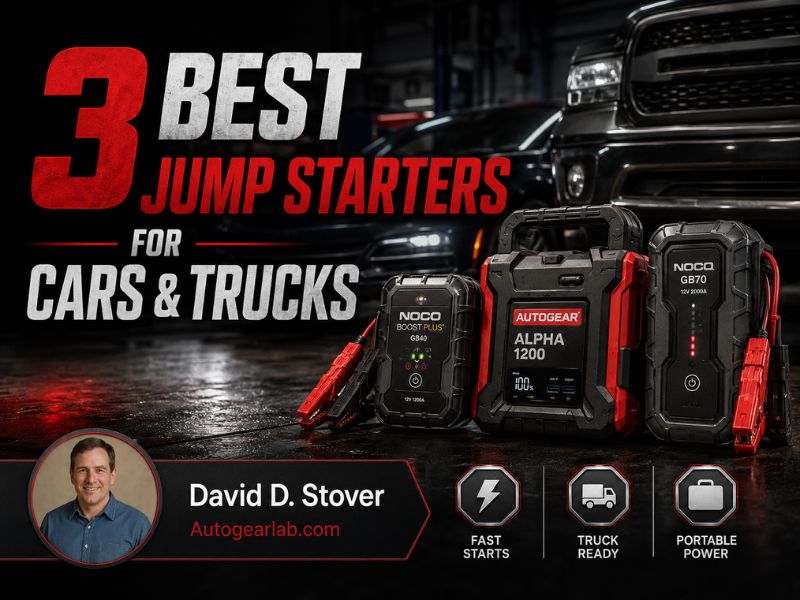
3 Jump Starters for Cars and Trucks Reviewed
| Image | Product Name | Check Price |
|---|---|---|
Best Choice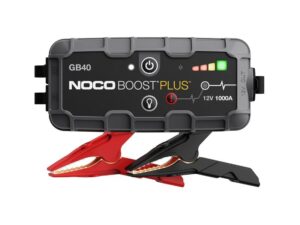 | NOCO Boost GB40 1000A UltraSafe Lithium Jump Starter | Check Price |
Second Best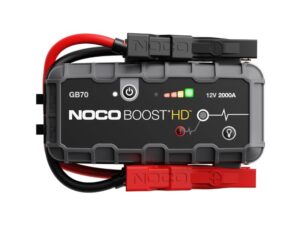 | NOCO Boost GB70 2000A UltraSafe Lithium Jump Starter | Check Price |
Third Choice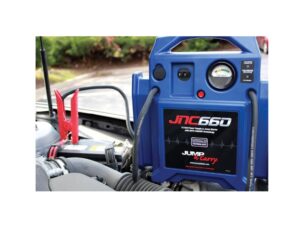 | Clore Automotive Jump-N-Carry JNC660 1700 Peak Amp Jump Starter | Check Price |
All three models operate with 12V vehicle starting systems, but they serve different buyers. The two NOCO models emphasize lightweight lithium portability, while the JNC660 uses a professional-style lead-acid design aimed at repeated starting work.
1. NOCO Boost GB40 1000A UltraSafe Lithium Jump Starter
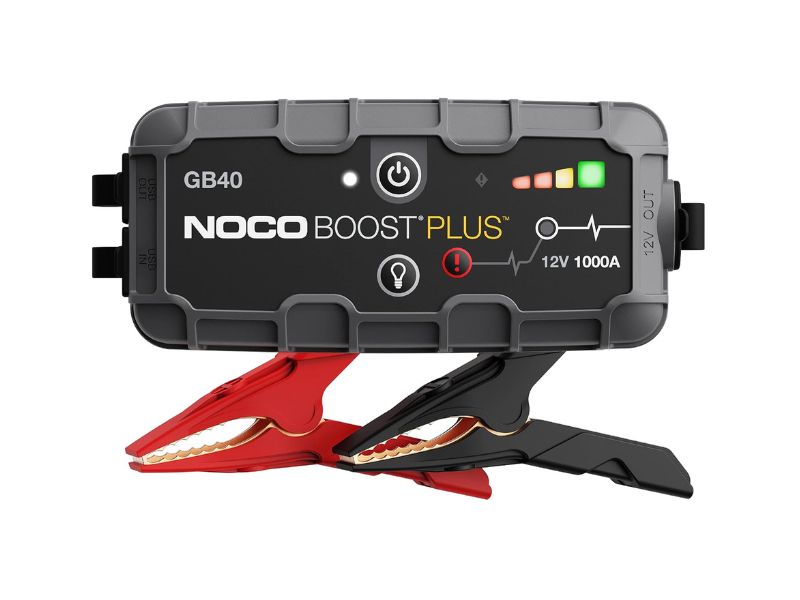
Key Features
- 1000A starting rating
- Gasoline engines up to 6.0L
- Diesel engines up to 3.0L
- Compact lithium-ion design
- Reverse-polarity protection
- Spark-resistant connection
- IP65 housing with ports closed
- USB charging and 100-lumen flashlight
The NOCO GB40 provides enough starting capability for a large portion of U.S. passenger vehicles without becoming cumbersome. NOCO rates it for 12V gasoline engines up to 6.0 liters and diesel engines up to 3.0 liters.
That range makes it appropriate for four-cylinder and six-cylinder cars, many V6 SUVs, crossovers, motorcycles, lawn equipment, boats, and numerous gasoline pickups.
Its diesel capability is more limited. A compact 2.0L or 3.0L diesel can fall within the stated range, but a 6.6L or 6.7L full-size diesel pickup requires a much larger unit.
Portability is one of the GB40’s strongest advantages. NOCO lists the unit at approximately 2.4 pounds, making it far easier to keep in a trunk, cargo organizer, or toolbox than a professional lead-acid jump box.
That matters in practice. An oversized jump starter left at home is less useful than a correctly sized unit that remains in the vehicle.
The normal operating mode includes reverse-polarity protection and spark-resistant connection. These safeguards help prevent two common mistakes when users attach battery clamps under stressful conditions.
They do not replace correct procedure. The driver should still identify the proper positive terminal and approved negative or chassis-ground point before connecting the booster.
NOCO also rates the enclosure IP65 with its ports closed. This provides useful resistance to dust and water jets, although the device should not be submerged or stored wet.
The integrated 100-lumen flashlight can illuminate battery terminals and includes emergency flashing functions.
USB functionality lets the GB40 provide emergency energy for phones and other small electronics. Device charging reduces the energy available for starting, so I would recharge the unit before relying on it again after substantial power-bank use.
The main drawback is that the GB40 is sized primarily for cars rather than large trucks. Pickup owners with large gasoline V8s, diesels, or frequent cold-weather starts will benefit from the GB70’s additional reserve.
What I Like
- Compact enough for everyday car storage
- Broad gasoline passenger-vehicle compatibility
- Reverse-polarity protection
- Spark-resistant normal operation
- IP65 housing with ports closed
What I Do Not Like
- Limited to 3.0L diesel engines
- Less reserve for large trucks
- Smaller internal battery than heavy-duty alternatives
The NOCO GB40 is my preferred choice for the broadest group of car owners. It also works for many lighter trucks, but owners of full-size pickups or large diesels should move to a stronger model.
2. NOCO Boost GB70 2000A UltraSafe Lithium Jump Starter
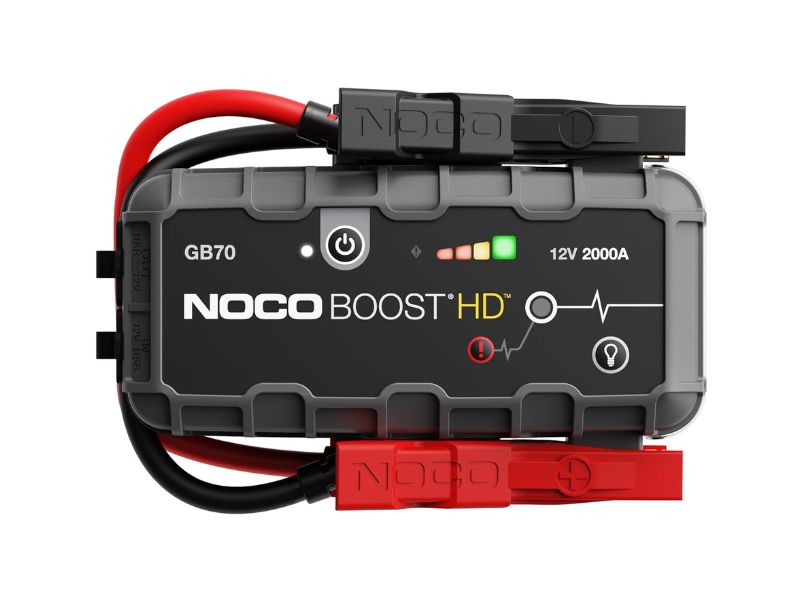
Key Features
- 2000A starting rating
- Gasoline engines up to 8.0L
- Diesel engines up to 6.0L
- Larger lithium-ion battery
- Reverse-polarity and spark protection
- 400-lumen flashlight
- 12V accessory output
- IP65 protection with ports closed
The GB70 is better matched to buyers who want one portable lithium starter for both cars and larger trucks. NOCO rates it for gasoline engines up to 8.0 liters and diesel engines up to 6.0 liters.
That gasoline range covers almost any normal passenger car while extending comfortably into full-size gasoline pickups, SUVs, RVs, boats, and work vehicles.
The 6.0L diesel rating covers many diesel vehicles but remains below common 6.6L and 6.7L heavy-duty pickup engines. Buyers with those trucks should select a jump starter whose manufacturer explicitly rates the unit above their engine displacement.
The GB70 offers roughly double the headline output of the GB40, but the larger battery reserve is just as meaningful.
NOCO states that the unit can provide up to 40 jump starts under favorable conditions. Actual results vary substantially with engine size, battery condition, temperature, and cranking time, so that figure should not be treated as a guaranteed number of starts.
The unit weighs approximately five pounds. That makes it noticeably larger than the GB40 but still much easier to transport than a conventional professional jump box.
For a pickup owner, the extra size is easier to justify because truck storage compartments and toolboxes generally provide more room.
The 400-lumen flashlight offers much better engine-bay illumination than the GB40’s smaller light. This is helpful around large pickup engine compartments or during nighttime roadside work.
The 12V accessory connection can run compatible tire inflators, power inverters, and other low-voltage equipment. NOCO also provides USB functionality for small electronics.
Normal operation provides reverse-polarity and spark protection. A manual-override function can start batteries whose voltage is too low for automatic detection, but NOCO warns that override disables those normal safeguards.
That means override should only be used after checking voltage and clamp polarity carefully.
What I Like
- Covers large gasoline engines
- Stronger truck capability than the GB40
- Good battery reserve
- Bright 400-lumen flashlight
- 12V accessory-power capability
- Still portable for a high-output unit
What I Do Not Like
- Larger than most car owners need
- 6.0L diesel ceiling excludes some HD pickups
- Manual override requires additional caution
The NOCO GB70 is the most versatile choice when one jump starter must cover both passenger cars and full-size gasoline trucks. I would choose it over the GB40 for a pickup, large SUV, RV, or multi-vehicle household.
3. Clore Automotive Jump-N-Carry JNC660 1700 Peak Amp Jump Starter
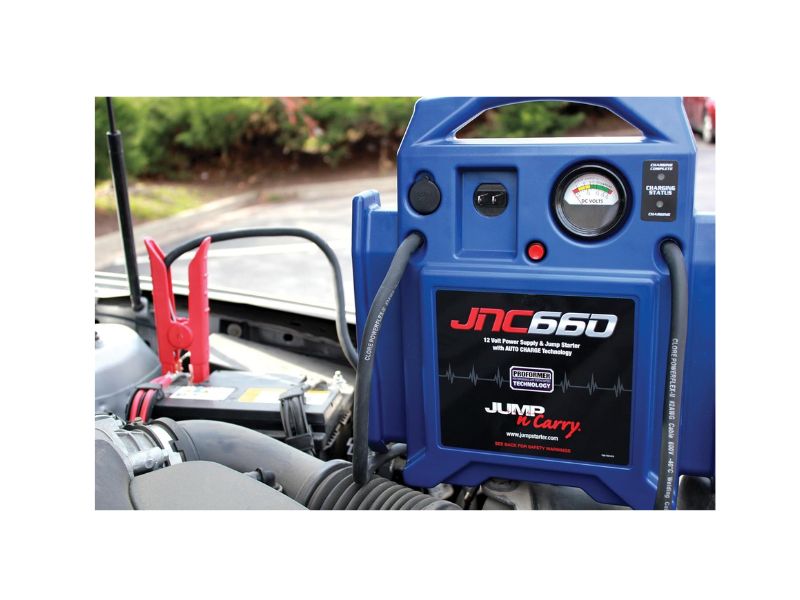
Key Features
- 1700 peak amps
- 425 cranking amps
- 22Ah Clore PROFORMER battery
- 46-inch #2 AWG welding cables
- Industrial-grade clamps
- Built-in automatic charger
- Voltmeter
- 12V accessory outlet
The JNC660 takes a fundamentally different approach from the compact NOCO products.
Instead of a small lithium battery and short leads, Clore uses a substantial lead-acid battery, long heavy-gauge cables, industrial clamps, and a built-in charger. The design is aimed at repeated vehicle starting in garages, fleets, farms, dealerships, marinas, and service environments.
Its 425 cranking amps are worth noting. Peak-current numbers describe only a brief maximum, while cranking amps provide more information about sustained starting output.
This makes the JNC660 especially useful when starting a vehicle that needs current for more than an instant.
Its 46-inch #2 AWG welding cables are one of its biggest advantages over pocket-size lithium packs.
Cars frequently have easily accessible battery terminals, but trucks can have batteries mounted farther inside the engine compartment or designated jump points that require greater cable reach. Long cables allow the JNC660 to remain on the ground while the clamps reach the vehicle safely.
The #2 AWG conductors are also substantially thicker than typical compact jump-pack leads. Thicker cables reduce electrical resistance and voltage drop when large starting current flows.
Industrial clamps provide strong spring pressure and a large contact area. They are well suited to conventional battery posts, truck batteries, and repeated workshop use.
The internal battery is designed specifically for high-current jump starting. Clore also includes an automatic built-in charger so the JNC660 can remain maintained and ready between jobs.
That charging approach makes particular sense in a garage. Instead of remembering to connect a USB cable every few months, the unit can return to a designated charging location after use.
The disadvantage is weight. The JNC660 is approximately 18 pounds, making it much less convenient for everyday passenger-car storage than the NOCO lithium alternatives.
It also lacks modern USB-C fast charging, a percentage-based digital battery display, and other convenience features.
What I Like
- Strong sustained cranking performance
- Long 46-inch cables
- Heavy #2 AWG conductors
- Industrial-grade clamps
- Automatic onboard charging
- Well suited to frequent starting work
What I Do Not Like
- Much heavier than lithium jump starters
- Requires more storage space
- Less convenient for occasional roadside use
The JNC660 is the best option here for a garage, farm, fleet, or truck owner who values heavy cables and repeat-use capability. For normal passenger-car roadside storage, the GB40 is much easier to live with.
Car and Truck Jump Starter Comparison
| Product | Battery Type | Starting Rating | Gas Engine Limit | Diesel Limit | Cable Style | Main Strength | Main Limitation |
| NOCO Boost GB40 | Lithium-ion | 1000A | 6.0L | 3.0L | Compact portable leads | Easy everyday car storage | Limited large-truck capability |
| NOCO Boost GB70 | Lithium-ion | 2000A | 8.0L | 6.0L | Larger portable leads | Strong balance for cars and pickups | Not rated for several HD diesels |
| Clore JNC660 | Sealed lead-acid | 1700 peak / 425 cranking | Not specified by displacement | Not specified by displacement | 46-in #2 AWG | Long cables and sustained output | Approx. 18-lb weight |
The GB40 makes the most sense for passenger cars because it is easy to keep in the vehicle while still covering gasoline engines up to 6.0L.
The GB70 expands that versatility into larger trucks, SUVs, boats, and RVs with its 8.0L gasoline and 6.0L diesel limits.
The JNC660 is less convenient to carry but gives garages and frequent users something neither lithium model offers: long #2 AWG cables and a published sustained cranking rating.
How to Choose the Best Jump Starter for Cars and Trucks
Start With Vehicle Voltage
All three recommended models are designed for 12V starting systems.
Most passenger cars, SUVs, light trucks, and pickups use 12V electrical systems.
Some heavy commercial trucks, buses, and industrial equipment use 24V systems. A 12V jump starter must not be connected across a true 24V system.
A truck having two batteries does not automatically mean it is 24V. Many diesel pickups use two 12V batteries connected in parallel while retaining a 12V electrical system.
Check the owner’s manual when uncertain.
Match the Starter to Gasoline Engine Size
Gasoline engine displacement is one of the easiest compatibility specifications to check.
The GB40 supports gasoline engines up to 6.0L, making it adequate for most passenger cars and many light trucks.
The GB70 increases that rating to 8.0L, giving it more flexibility for V8 pickups, large SUVs, and motorhomes.
I prefer leaving some margin above the actual engine displacement, especially for:
- Cold climates
- Older starting batteries
- Vehicles that sit unused
- Large V8 engines
- Multiple household vehicles
Use the Diesel Rating for Diesel Trucks
Diesel engines place greater demands on starting systems than similarly sized gasoline engines.
High compression, cold engine oil, glow plugs or grid heaters, and heavy starter motors can increase electrical demand.
Never use the gasoline rating when selecting a jump starter for a diesel.
The GB40 stops at 3.0L diesel, while the GB70 supports up to 6.0L.
A 6.6L or 6.7L diesel pickup therefore needs a different portable unit with a higher published diesel limit.
Do Not Choose by Peak Amps Alone
A 2000A label does not automatically mean exactly twice the practical starting performance of a 1000A product.
Peak amps describe a short maximum output.
Actual starting performance also depends on:
- Battery capacity
- Temperature
- Cable resistance
- Clamp contact
- Engine displacement
- Battery condition
- Starter condition
- Cranking duration
The JNC660 illustrates why additional specifications matter: its 1700A peak rating is accompanied by a 425A cranking rating, which provides more context about sustained output.
Compare Lithium and Lead-Acid Designs
Lithium jump starters are the practical choice for most drivers.
They are:
- Lightweight
- Compact
- Easy to store
- Low maintenance
- Often equipped with USB ports
- Usually equipped with electronic safety systems
Lead-acid jump boxes are heavier, but professional designs can provide:
- Longer cables
- Larger clamps
- Strong sustained output
- Built-in maintenance charging
- Better suitability for repeated shop use
For a daily-driven car, I would choose lithium.
For a repair garage or farm, the JNC660’s traditional design may be more useful.
Check Cable Reach
Cable reach becomes more important as vehicle size increases.
Compact lithium jump starters use short cables because short leads reduce resistance and make storage easier.
That arrangement usually works well for passenger cars with accessible terminals.
Large trucks may have:
- Wide engine compartments
- Recessed batteries
- Dual batteries
- Remote jump terminals
- Distant approved ground points
The JNC660’s 46-inch cables make it easier to position the unit safely when battery access is difficult.
Look for Reverse-Polarity Protection
Reverse polarity occurs when the positive and negative clamps are connected incorrectly.
NOCO’s GB40 and GB70 provide reverse-polarity protection and spark-resistant connection during normal operation.
That is particularly useful for someone who uses a jump starter only occasionally.
Always confirm the connection visually anyway.
Understand Manual Override
A nearly zero-voltage battery may not be detected by a smart lithium jump starter.
Manual override forces the output on.
NOCO states that using manual override on the GB70 disables both spark protection and reverse-polarity protection.
Use override only when:
- Normal mode cannot detect the battery
- The vehicle voltage has been confirmed
- Clamp polarity has been checked carefully
- The battery is not physically damaged
Consider Cold-Weather Reserve
Cold weather reduces battery performance while increasing engine-cranking resistance.
A jump starter selected near the minimum acceptable engine rating may have less margin in severe winter conditions.
For an ordinary passenger car, the GB40 still provides useful reserve.
For large trucks, V8 engines, or winter use, I would lean toward the GB70 or a higher-capacity truck-specific model.
Think About Where the Jump Starter Will Live
A car owner may want something that fits beneath a seat or inside a trunk organizer.
A pickup owner may have considerably more storage space.
The GB40 is the easiest unit here to keep inside almost any vehicle.
The GB70 is larger but still practical for SUVs and pickups.
The JNC660 is better stored in a garage, work truck, farm building, or service vehicle because its approximately 18-pound body is less convenient for ordinary trunk storage.
Jump Starter vs Jumper Cables
Traditional jumper cables require a second vehicle with a working battery.
A portable jump starter carries its own energy supply.
That gives a jump pack several practical advantages:
- No second vehicle is required
- Cars do not need to be positioned close together
- There is less dependence on strangers
- The booster can be used in parking garages or isolated locations
- Smart lithium models can provide connection safeguards
Traditional cables still have advantages. Quality heavy-gauge jumper cables do not contain an internal battery that needs charging or eventually wears out.
For maximum preparedness, some drivers keep both.
How to Jump-Start a Car or Truck Safely
1. Read the Vehicle Manual
Check whether the vehicle uses direct battery terminals or designated remote jump points.
2. Inspect the Battery
Do not attempt to jump-start a battery that is:
- Frozen
- Cracked
- Swollen
- Leaking
- Smoking
- Unusually hot
3. Confirm System Voltage
Verify that the vehicle uses a 12V starting system.
4. Turn Off Electrical Loads
Switch off the ignition, lights, climate control, audio system, and unnecessary accessories.
Apply the parking brake.
5. Connect Positive
Attach the red clamp to the approved positive terminal.
6. Connect Negative
Attach the black clamp to the recommended negative terminal or chassis-ground point.
Keep the cable away from belts, fans, pulleys, and hot components.
7. Check the Indicators
Do not proceed when the smart clamp system shows reverse polarity or another connection fault.
8. Activate the Jump Starter
Use normal protected mode first.
9. Crank Briefly
Attempt to start the engine only for the duration allowed by the jump-starter manual.
Do not hold the starter continuously.
10. Allow Cooling Between Attempts
Repeated cranking creates heat in the jump starter, cables, clamps, and vehicle starter motor.
11. Disconnect After Starting
Follow the vehicle and jump-starter instructions for removal.
The negative connection is commonly removed before the positive connection.
12. Recharge the Jump Starter
Restore the internal battery before returning the unit to storage.
Jump Starter Maintenance
Recharge a lithium jump starter after every use.
Check its charge every few months and before:
- Winter
- Long road trips
- Towing trips
- Camping
- Hurricane season
- Remote travel
Inspect the clamps, cable insulation, connectors, and housing.
Keep the positive and negative clamps separated while stored.
Avoid leaving lithium units where cabin temperatures exceed the manufacturer’s permitted storage limits.
The JNC660 requires a different maintenance approach because it contains a lead-acid battery. Clore provides an automatic onboard charger designed to keep the unit ready when properly connected during storage.
Common Jump Starter Buying Mistakes
Buying Only by Peak Amps
Engine ratings, battery capacity, clamps, cables, and temperature are equally important.
Ignoring Diesel Requirements
A jump starter that handles a large gasoline engine may support a significantly smaller diesel.
Assuming Every Truck Is 12V
Most pickups are 12V, but some commercial vehicles use 24V.
Buying Too Little Capacity
A small booster might work for a sedan but leave insufficient margin for a full-size truck.
Buying Too Much Capacity
A large professional jump box is unnecessary for many compact-car owners.
Ignoring Cable Reach
Large truck engine compartments can make short cables frustrating.
Using Manual Override Too Quickly
Protected normal mode should always be the first choice.
Leaving the Pack Discharged
An emergency booster is useless when its own battery is nearly empty.
Assuming a Successful Jump Fixed the Vehicle
Repeated battery problems can indicate a failing battery, alternator, starter, cable, or parasitic electrical drain.
Frequently Asked Questions
What is the best jump starter for cars and trucks?
The NOCO GB40 suits most cars, while the GB70 is better for larger trucks.
The GB40 supports gasoline engines up to 6.0L and is easier to store. The GB70 increases coverage to 8.0L gasoline and 6.0L diesel, making it more versatile when one unit needs to serve passenger cars and larger pickups.
How many amps should a jump starter have for a car?
A reputable 1000A-class jump starter is enough for many gasoline passenger cars.
Actual suitability depends on engine displacement, temperature, battery condition, and the manufacturer’s engine rating. Larger V8 vehicles can benefit from 1500A–2000A-class equipment.
How many amps should a jump starter have for a truck?
Around 1500A–2000A is a practical range for many gasoline pickups and light trucks.
Large diesel engines can require substantially more capability. Always check the manufacturer’s separate diesel displacement limit instead of relying only on peak amps.
Is a 1000A jump starter enough for a truck?
It can be enough for smaller gasoline trucks, but larger pickups benefit from more reserve.
The GB40 supports gasoline engines up to 6.0L, so some pickups fall within its stated range. A larger V8, diesel truck, or severe winter application is better matched to a stronger unit.
Is a 2000A jump starter enough for a full-size pickup?
Yes for many gasoline pickups, provided the engine falls within the stated rating.
The GB70 supports gasoline engines up to 8.0L and diesel engines up to 6.0L. Full-size diesels larger than 6.0L require another model with a higher published diesel rating.
Can one jump starter work for both my car and truck?
Yes, if its engine rating covers the larger vehicle.
Choose based on the truck because it normally places the greater demand on the jump starter. The same compatible 12V unit can then serve the smaller car.
Can a jump starter start a completely dead battery?
Sometimes, but a battery below the detection threshold may require manual override.
Smart jump starters may refuse to activate when battery voltage is extremely low. Override can help, but safety features may be disabled, so correct polarity becomes especially important.
What is the difference between peak amps and cranking amps?
Peak amps describe a brief maximum, while cranking amps describe more sustained output.
The distinction matters for difficult starts. The JNC660 publishes both 1700 peak amps and 425 cranking amps, providing additional context about its professional-style output.
Is lithium or lead-acid better for a jump starter?
Lithium is better for portability, while lead-acid can be better for repeated garage use.
Lithium models are far lighter and easier to carry. Professional lead-acid units can provide long heavy cables, large clamps, and sustained starting performance.
Can a jump starter be used on an AGM battery?
Yes, compatible 12V jump starters can generally assist AGM starting batteries.
A jump starter supplies temporary starting current rather than performing a full chemistry-specific charging cycle. Follow the vehicle and jump-starter instructions.
Can I use a 12V jump starter on a 24V truck?
No, a 12V jump starter must not be connected across a true 24V system.
The voltage mismatch can damage batteries, wiring, electronic modules, or the jump starter itself.
Do two batteries mean my truck is 24V?
No, many trucks use two 12V batteries while the electrical system remains 12V.
Parallel-connected batteries maintain 12V while increasing capacity and available current. Verify the system voltage rather than counting batteries.
How often should I recharge a portable jump starter?
Recharge it after every use and check its charge every few months.
Also inspect it before winter, long trips, towing, camping, or remote travel.
Can I leave a lithium jump starter in my vehicle?
Yes, but only within the manufacturer’s approved storage-temperature range.
Extreme summer heat accelerates lithium-battery aging, while severe cold temporarily reduces starting output.
How many times can a jump starter start a car?
A full charge may provide multiple starts, but the actual number varies widely.
Small gasoline engines use less stored energy than large cold truck engines. Temperature, crank duration, vehicle-battery condition, and internal booster capacity all affect the result.
Why will my vehicle not start even with a jump starter?
The problem may involve the starter, battery cables, fuel system, alternator, or engine.
Confirm clamp contact and jump-starter charge. If repeated permitted attempts fail, stop cranking and diagnose the underlying vehicle problem.
Conclusion
The best jump starter for cars and trucks should be selected according to the largest vehicle it needs to start. Engine displacement, gasoline or diesel configuration, 12V compatibility, battery capacity, clamp reach, and storage requirements matter more than simply choosing the highest advertised amp rating.
The NOCO Boost GB40 remains my primary recommendation for most passenger cars and smaller gasoline trucks. Its compact design, 6.0L gasoline rating, reverse-polarity protection, and straightforward operation make it practical to keep inside the vehicle.
The NOCO Boost GB70 is the stronger choice when one jump starter must cover both cars and full-size gasoline pickups. Its 8.0L gasoline and 6.0L diesel ratings provide significantly greater vehicle coverage.
The Clore Jump-N-Carry JNC660 suits a different buyer. Its 425 cranking amps, 46-inch #2 AWG cables, industrial clamps, and automatic onboard charger make it particularly useful for garages, farms, fleets, and repeated truck starting.
For a normal household with cars and a light truck, I would choose the NOCO GB40. If the household includes a large pickup, SUV, RV, or several bigger vehicles, I would move to the GB70 for the extra starting reserve.