A dead battery can leave an otherwise healthy vehicle completely immobilized, and waiting for another car or roadside assistance is not always practical. The best jump starter for dead battery situations should provide enough starting power for the engine, dependable clamp protection, and a safe way to handle batteries whose voltage has dropped below normal automatic-detection levels.
Deep discharge deserves special attention. Smart jump starters may refuse to activate when a battery voltage is extremely low, so a properly designed manual-override mode can be useful—but it also demands greater care because normal safety protections may be reduced or disabled.
My primary recommendation is the NOCO Boost GB40 1000A Lithium Jump Starter. I would choose it for most passenger vehicles because it delivers 1000A peak output, supports gasoline engines up to 6.0L and diesels up to 3.0L, uses reverse-polarity and spark-resistant protection during normal operation, and includes manual override for batteries too deeply discharged for normal detection.
I would choose the NOCO Boost GB70 2000A Lithium Jump Starter for larger SUVs, trucks, V8s, and diesels. It increases engine coverage to 8.0L gasoline and 6.0L diesel, provides a 56Wh-class battery system, IP65 protection with ports closed, and a 12V accessory output in addition to its 2000A starting capability.
The NOCO Boost GB50 1500A Lithium Jump Starter is the middle-ground choice. Its 1500A output, 7.0L gasoline/4.5L diesel rating, 35Wh battery, IP65 housing, 200-lumen flashlight, and low-voltage override capability provide more reserve than the GB40 without the size of the GB70.
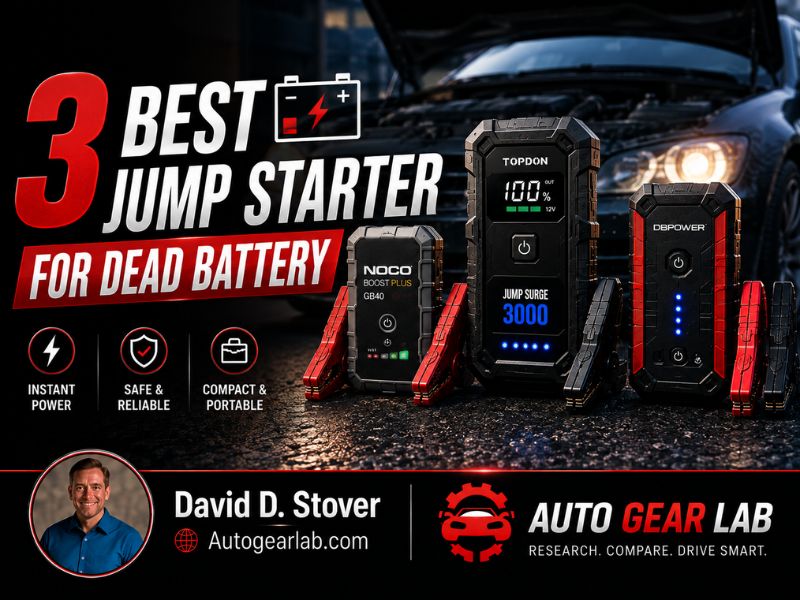
3 Best Jump Starters for a Dead Battery Reviewed
| Image | Product Name | Check Price |
|---|---|---|
Best Choice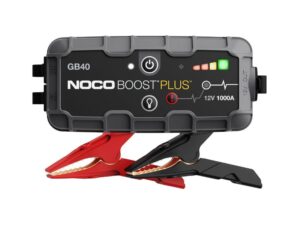 | NOCO Boost GB40 1000A Lithium Jump Starter | Check Price |
Second Best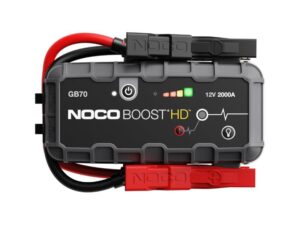 | NOCO Boost GB70 2000A Lithium Jump Starter | Check Price |
Third Choice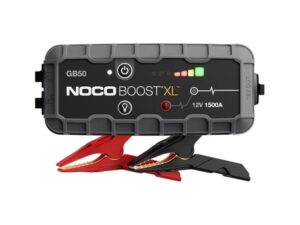 | NOCO Boost GB50 1500A Lithium Jump Starter | Check Price |
1. NOCO Boost GB40 1000A Lithium Jump Starter
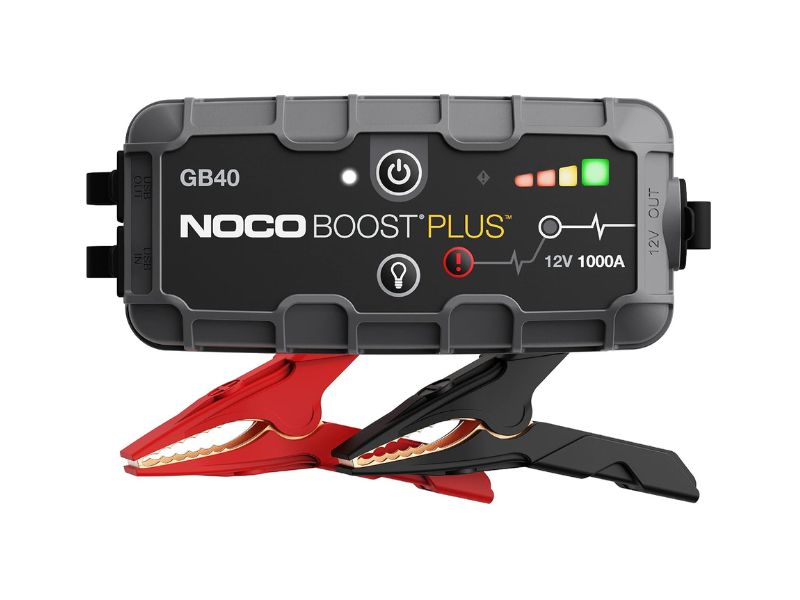
Key Features
- 1000A peak starting output
- 12V lithium-ion jump starter
- Gas engines up to 6.0L
- Diesel engines up to 3.0L
- Reverse-polarity protection
- Spark-resistant normal connection
- Manual override for extremely low-voltage batteries
- IP65 enclosure
- 100-lumen LED flashlight
- USB charging capability
- Approx. 2.4 lb
The GB40 is my primary recommendation because it is powerful enough for a large percentage of everyday passenger vehicles while remaining compact enough to keep in the car permanently.
NOCO explicitly markets the GB40 for starting dead batteries, with 1000A peak lithium power and engine compatibility up to 6.0L gasoline and 3.0L diesel.
That makes it suitable for many:
- Sedans
- Crossovers
- SUVs
- V6 vehicles
- Moderate V8 gasoline engines
- Small pickups
- Motorcycles
- Boats and powersports applications using compatible 12V starting batteries
Its strongest dead-battery feature is not simply the 1000A rating.
It is the combination of normal smart protection and an emergency manual override mode.
During ordinary use, the GB40 checks the connection and provides reverse-polarity protection. NOCO also describes the connection system as spark-resistant.
That is useful when the vehicle battery is weak but still has enough residual voltage for the booster to recognize it.
However, an extremely discharged battery can drop below the jump starter’s detection threshold.
NOCO’s current GB40 support documentation says the unit may fail to enter normal Boost mode when the connected battery is below approximately 2 volts. In that situation, manual override can force Boost output.
This is where careful use becomes critical.
NOCO explicitly warns that manual override disables safety protection and manually forces Boost on.
That means you should never treat override as the normal starting method.
Before using it, verify:
- The vehicle uses a compatible 12V starting system
- Red clamp is on positive
- Black clamp is on the approved negative/ground point
- The battery is not frozen
- The battery is not swollen
- The case is not cracked
- There is no leaking electrolyte
- There is no smoke or abnormal heat
A low-voltage battery and a physically failed battery are not the same problem.
The GB40 can assist a deeply discharged battery.
It cannot repair a battery with internal mechanical or chemical failure.
Portability is another major advantage.
NOCO lists the GB40 at about 2.4 pounds and gives the enclosure an IP65 rating.
That makes it easy to store under a seat, in a trunk organizer, or in a roadside emergency kit.
The 100-lumen flashlight also helps when connecting clamps after dark.
For most cars, I prefer carrying a jump starter that is small enough to remain in the vehicle every day rather than buying a very large booster that eventually gets left at home.
The main limitation is engine displacement.
A 6.2L or 6.4L gasoline engine exceeds the GB40’s published 6.0L rating.
Large diesels exceed its 3.0L diesel rating by an even larger margin.
For those vehicles, the GB50 or GB70 is the better choice.
What I Like
- Excellent portability
- Strong fit for everyday passenger vehicles
- Reverse-polarity protection
- Spark-resistant normal mode
- Manual override for extremely low battery voltage
- IP65 housing
- Simple roadside storage
What I Do Not Like
- 6.0L gasoline ceiling limits large V8 use
- 3.0L diesel rating excludes most full-size diesel trucks
- Manual override disables normal safety protections
- Less stored-energy reserve than GB50 or GB70
For an ordinary car, crossover, or moderate gasoline SUV, the GB40 is the jump starter I would keep in the vehicle. It is compact enough to actually carry every day while still including the low-voltage recovery feature that can matter when a battery is genuinely dead.
2. NOCO Boost GB70 2000A Lithium Jump Starter
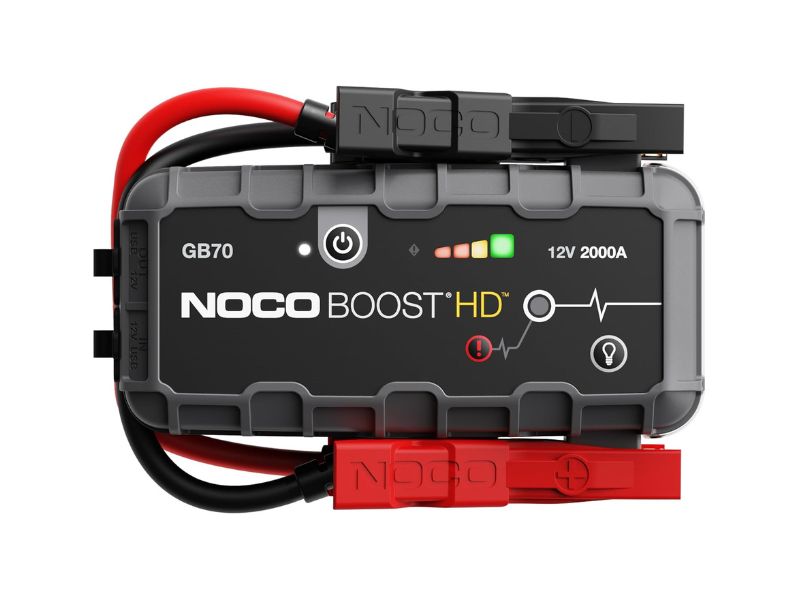
Key Features
- 2000A peak output
- 12V lithium-ion jump starter
- Gas engines up to 8.0L
- Diesel engines up to 6.0L
- Reverse-polarity protection
- Manual override for very low battery voltage
- IP65 housing with ports closed
- USB input/output
- 12V/15A accessory output
- Approx. 5 lb
The GB70 is the stronger choice when the dead battery belongs to a larger vehicle.
Amazon currently lists it at 2000A for gasoline engines up to 8.0L and diesel engines up to 6.0L.
That makes it a better fit for:
- Full-size SUVs
- V8 pickups
- Larger gasoline engines
- Some diesel pickups
- RVs
- Boats
- Multi-vehicle households
A jump starter used only on a compact car may never need this much engine coverage.
But dead-battery recovery becomes more demanding when engine displacement increases, temperatures drop, or the vehicle battery is severely depleted.
The GB70 provides more reserve for those situations.
NOCO’s current user guide lists the GB70 at 2000A, with operating temperatures from approximately -4°F to 122°F, IP65 housing protection with ports closed, USB charging, and a 12V/15A accessory output.
That 12V output can be useful for compatible roadside accessories.
However, I would preserve internal energy for starting when the vehicle battery is completely dead.
Phone charging, lighting, and accessory use can wait until the engine-starting problem is solved.
The GB70 also supports manual override for very low-voltage batteries.
Its troubleshooting documentation indicates that a connected battery below approximately 2V may not activate normal Boost detection.
The same safety principle applies here as with the GB40:
Use protected normal mode first.
Only consider manual override after you have positively identified the system voltage, battery terminals, and battery condition.
A heavily discharged battery can sometimes be recovered sufficiently for starting.
A damaged battery may be unsafe to boost.
Large-vehicle owners should also pay attention to system voltage.
Some diesel vehicles use two 12V batteries connected in parallel.
That arrangement remains a 12V system.
Other equipment may use a true 24V system.
A 12V booster must never be connected across a true 24V system unless the manufacturer explicitly designed it for that voltage.
The GB70’s larger physical size is the main tradeoff.
NOCO lists it at approximately 5 pounds.
That is still portable, but it occupies noticeably more storage space than the GB40.
For a truck or SUV, I think the additional bulk is reasonable.
For a compact sedan, the GB40 is usually easier to justify.
What I Like
- Strong 2000A output
- 8.0L gasoline capability
- 6.0L diesel compatibility
- Good fit for large V8s
- IP65 protection
- 12V accessory output
- More reserve for difficult starts
What I Do Not Like
- Heavier than GB40 and GB50
- More capacity than most small cars need
- 6.0L diesel ceiling still excludes some heavy-duty engines
- Low-voltage override requires careful use
The GB70 is my preferred option when the dead battery is in a large SUV, pickup, V8 vehicle, or moderate diesel. Its extra starting and energy reserve provides more useful margin than a compact booster.
3. NOCO Boost GB50 1500A Lithium Jump Starter
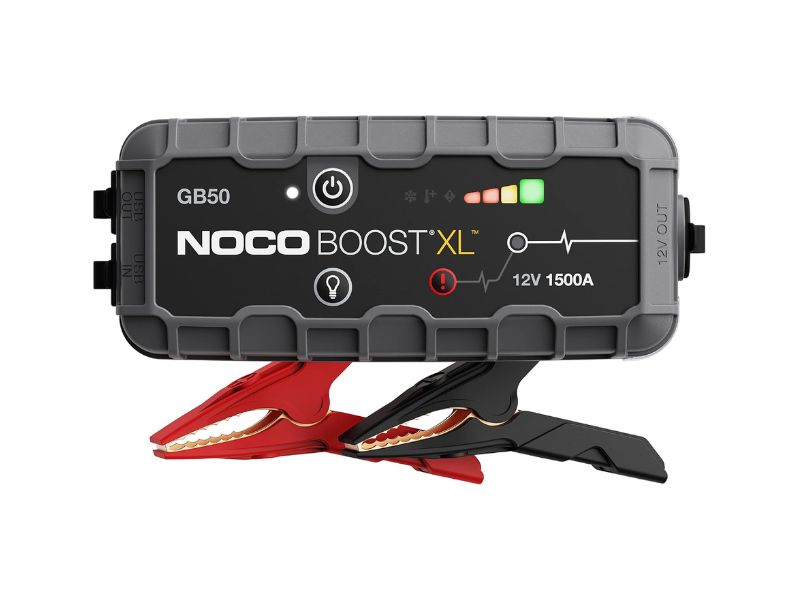
Key Features
- 1500A peak output
- Gas engines up to 7.0L
- Diesel engines up to 4.5L
- 35Wh lithium-ion battery
- Reverse-polarity protection
- Spark-resistant normal operation
- Manual override
- IP65 enclosure
- 200-lumen flashlight
- USB charging
- Approx. 2.7 lb
The GB50 fills the gap between the highly portable GB40 and larger GB70.
NOCO rates it at 1500A for gasoline engines up to 7.0L and diesels up to 4.5L.
That additional gasoline-engine capacity is particularly useful for large-displacement V8s.
A 6.2L or 6.4L engine is beyond the GB40’s 6.0L limit but remains comfortably within the GB50’s 7.0L specification.
NOCO’s data sheet specifies a 35Wh internal lithium-ion battery, IP65 housing with ports closed, a 200-lumen flashlight, and an operating range of approximately -4°F to 122°F.
The complete unit with clamps and accessories weighs approximately 2.71 pounds, keeping it considerably closer to the GB40 in portability than to the five-pound GB70.
That makes the GB50 particularly attractive for:
- Large gasoline SUVs
- V8 cars
- Full-size gasoline pickups
- Crossovers
- Multi-vehicle households
- Drivers wanting additional cold-weather margin
Its normal connection system provides spark-resistant technology and reverse-polarity protection.
The GB50 also provides a manual override mode for extremely low-voltage batteries.
Again, this is not a feature I would activate automatically.
Normal protected mode should be attempted first.
If the battery is too deeply discharged to be detected, verify the battery and connection carefully before considering override.
The 35Wh battery provides more stored energy than the smallest GB40 platform.
Stored energy and peak current describe different things.
Peak current indicates short-duration starting capability.
Watt-hours provide context about overall stored energy.
More stored energy can help when several starting attempts are required, but repeated failed attempts should not continue indefinitely.
If a vehicle still does not start after several correct attempts, possible causes include:
- Failed battery
- Loose battery terminal
- Corroded connection
- Failed starter
- Alternator problem
- Fuel or ignition issue
- Security/immobilizer problem
- Mechanical engine problem
A jump starter only solves inadequate cranking power.
It does not diagnose every no-start condition.
What I Like
- Strong 1500A output
- Useful 7.0L gasoline rating
- 35Wh internal battery
- Compact 2.7-pound package
- IP65 enclosure
- 200-lumen flashlight
- Good middle ground between GB40 and GB70
What I Do Not Like
- Less reserve than GB70
- 4.5L diesel rating excludes larger diesels
- Manual override requires extra caution
- Basic USB system compared with newer USB-C designs
The GB50 is the model I would choose when I want more dead-battery starting margin than the GB40 without carrying the larger GB70. It is especially well suited to V8 vehicles between 6.0L and 7.0L.
Jump Starter for Dead Battery Comparison
| Product | Peak Output | Gas Engine Limit | Diesel Limit | Battery Energy | Weight | Best Fit |
| NOCO GB40 | 1000A | 6.0L | 3.0L | Compact lithium pack | ~2.4 lb | Cars, crossovers, moderate V8s |
| NOCO GB70 | 2000A | 8.0L | 6.0L | Larger reserve | ~5 lb | Trucks, SUVs, larger engines |
| NOCO GB50 | 1500A | 7.0L | 4.5L | 35Wh | ~2.7 lb | Large V8s and middle-ground use |
All three can assist deeply discharged compatible 12V batteries, but engine size should determine which one you choose.
How to Choose the Best Jump Starter for Dead Battery Recovery
Match the Engine Size First
Do not buy by peak amps alone.
Manufacturer-published engine displacement provides a much more practical starting point.
For these three models:
GB40: up to 6.0L gasoline / 3.0L diesel
GB50: up to 7.0L gasoline / 4.5L diesel
GB70: up to 8.0L gasoline / 6.0L diesel
If your engine is near the maximum published limit and you regularly drive in severe winter conditions, additional margin can be worthwhile.
Dead vs Completely Discharged Battery
People often use “dead battery” to describe several different conditions.
A battery can be:
Partially discharged: enough voltage for electronics, but not enough cranking current.
Deeply discharged: voltage has fallen extremely low.
Failed: internal damage means it can no longer function normally.
A jump starter may help the first two situations.
It cannot repair the third.
What If the Battery Shows Almost Zero Volts?
Smart jump starters normally need to detect a battery before activating output.
NOCO’s GB40 support documentation says a battery below around 2 volts may not be detected automatically. Manual override is provided for that condition.
That does not mean every battery reading near zero should be force-started.
Check for physical damage first.
Manual Override Can Be Useful—but Risky
Manual override is one of the most important features for a severely dead battery.
It is also one of the easiest features to misuse.
NOCO explicitly warns that manual override disables safety protection and forces Boost on.
That means polarity errors can become much more serious.
Never use override casually.
Never Jump a Frozen Battery
A frozen battery can be dangerous.
NOCO’s safety documentation specifically warns against attempting to start a frozen battery.
Do not attempt a jump if the battery is:
- Frozen
- Cracked
- Swollen
- Leaking
- Smoking
- Unusually hot
- Giving off an abnormal odor
Replace or professionally inspect the battery instead.
Peak Amps Do Not Tell the Whole Story
Peak amps represent short-duration maximum capability.
They do not describe sustained cranking current in the same way standardized vehicle-battery ratings such as CCA do.
When comparing portable boosters, consider:
- Engine displacement
- Battery chemistry
- Stored Wh
- Clamp quality
- Cable resistance
- Safety electronics
- Cold-weather behavior
- Manufacturer compatibility limits
A reputable 1000A jump starter can be better suited to a particular vehicle than an obscure model advertising an enormous peak number.
Watt-Hours Matter
Stored energy is useful when evaluating repeated-start reserve.
The GB50 publishes a 35Wh internal battery, while the GB70 uses a larger lithium system.
Peak amps and Wh should not be confused.
A booster needs both sufficient short-duration current and enough stored energy to support the starting attempt.
Cold Weather Makes Dead Batteries More Difficult
Cold weather creates two simultaneous problems.
The vehicle battery provides less effective current.
The engine can require more cranking effort because lubricants become more viscous.
Lithium booster performance can also decrease when extremely cold.
If you live in a severe winter climate, additional jump-starter capacity is useful.
Keep the booster within its specified storage and operating limits.
Check Clamp Contact
Even a fully charged 2000A jump starter can perform poorly if the clamps make weak electrical contact.
Before starting:
- Remove obvious terminal corrosion if safe
- Ensure clamps grip clean metal
- Avoid plastic terminal covers
- Use the vehicle’s approved jump points
- Verify the ground connection
Resistance at the connection can prevent sufficient current from reaching the starter.
Some Vehicles Use Remote Jump Posts
The battery is not always located under the hood.
Some vehicles place it:
- In the trunk
- Under a rear seat
- Beneath interior panels
- In hard-to-access compartments
Manufacturers may provide designated under-hood jump terminals.
Follow the vehicle manual.
Do not dismantle the vehicle just to reach the physical battery if a designated jump point exists.
A Jump Starter Is Not a Battery Charger
This distinction matters.
A portable jump starter delivers a short burst of current to help crank the engine.
It does not normally recharge the installed vehicle battery fully.
After a successful jump, the battery may still require:
- Driving/alternator charging
- A proper battery charger
- Battery testing
- Replacement
If the battery repeatedly dies, diagnose the cause.
Why Does the Battery Keep Dying?
Repeated dead batteries may indicate:
- Aging battery
- Alternator fault
- Parasitic draw
- Interior light left on
- Accessory drain
- Corroded terminals
- Loose cable
- Extreme temperature
- Long-term vehicle storage
Repeatedly jump-starting the car treats the symptom rather than the cause.
How to Jump-Start a Dead Battery Safely
1. Confirm the Vehicle Uses 12V
These selected jump starters are designed for compatible 12V starting systems.
2. Inspect the Battery
Do not proceed if the battery appears damaged, frozen, swollen, or leaking.
3. Turn Off Electrical Loads
Switch off:
- Headlights
- HVAC
- Seat heaters
- Audio system
- Phone chargers
- Other accessories
4. Find the Approved Jump Points
Follow the vehicle owner’s manual.
5. Connect the Positive Clamp
Attach the red clamp to the designated positive point.
6. Connect the Negative Clamp
Attach the black clamp to the approved negative terminal or chassis ground.
7. Allow Normal Detection
Use protected normal mode first.
8. Attempt a Short Start
Avoid extended continuous cranking.
9. Allow a Pause Between Attempts
Repeated cranking can heat:
- Starter motor
- Battery
- Booster
- Clamps
- Cables
10. Consider Override Only When Appropriate
If battery voltage is too low for detection, follow the jump starter’s exact override instructions.
11. Stop After Repeated Failure
A different mechanical or electrical fault may be present.
12. Recharge the Jump Starter
Restore its charge before putting it back into emergency storage.
Common Dead-Battery Jump Starter Buying Mistakes
Buying Only by Peak Amps
Engine compatibility and design quality matter more.
Buying a Unit Too Small for the Engine
A 6.7L diesel needs different equipment from a small gasoline sedan.
Assuming Manual Override Is Automatically Better
Override reduces normal safety protection.
Jumping a Physically Damaged Battery
No portable booster makes that safe.
Ignoring System Voltage
Never connect a 12V-only booster across a true 24V system.
Storing the Booster Discharged
Emergency equipment needs periodic charging.
Assuming a Successful Jump Means the Battery Is Healthy
A battery may start once and still require replacement.
Frequently Asked Questions
What is the best jump starter for dead battery situations?
The NOCO GB40 is my primary recommendation for most everyday 12V passenger vehicles.
It combines 1000A output, 6.0L gasoline/3.0L diesel compatibility, normal connection protection, and manual override for extremely low-voltage batteries.
Can a jump starter start a completely dead battery?
Sometimes, if the battery is deeply discharged rather than physically failed or damaged.
A battery with extremely low voltage may require a manufacturer-approved manual-override mode when normal smart detection cannot recognize it.
Can the NOCO GB40 start a dead battery?
Yes, NOCO specifically designs the GB40 to jump-start discharged 12V starting batteries.
It delivers 1000A and supports gasoline engines up to 6.0L and diesels up to 3.0L.
What happens if the battery voltage is below 2V?
Normal automatic detection may fail, requiring an approved low-voltage override procedure.
NOCO’s GB40 support documentation specifically identifies below-2V battery conditions as a situation where manual override may be required.
Is manual override safe?
It requires extra caution because normal safety protections may be disabled.
NOCO explicitly warns that GB40 manual override forces Boost on and disables safety protection.
Should I use manual override every time?
No, normal protected mode should always be attempted first.
Override is for very low battery voltage that prevents automatic detection.
Is 1000 amps enough for a dead battery?
Yes for many vehicles when the engine falls within the manufacturer’s published compatibility range.
The GB40 is rated for gasoline engines up to 6.0L.
Is 1500 amps enough for a dead battery?
Yes, 1500A provides useful capability for larger gasoline engines and moderate diesels.
The GB50 supports up to 7.0L gasoline and 4.5L diesel engines.
Is 2000 amps enough for a dead truck battery?
Yes for many trucks within the GB70’s 8.0L gas and 6.0L diesel limits.
Larger heavy-duty diesels may require a more powerful manufacturer-rated unit.
Can a jump starter damage a battery?
Incorrect voltage, polarity, or unsafe override use can create serious electrical risks.
Use the correct system voltage, follow the vehicle procedure, and rely on normal protected mode whenever possible.
Can I jump a frozen battery?
No, never attempt to jump-start a frozen battery.
NOCO’s safety documentation specifically warns against starting frozen batteries.
Can I jump a swollen battery?
No, a swollen battery may be internally damaged and should not be boosted.
Disconnect from the situation and have the battery professionally inspected or replaced.
Why does my jump starter not recognize the battery?
The battery voltage may be below the smart detection threshold or clamp contact may be poor.
Check terminal contact first. If the voltage is extremely low, consult the manufacturer’s approved override procedure.
Why does the car still not start with a jump starter?
The problem may involve more than battery charge.
A failed starter, damaged cables, bad terminals, immobilizer issue, fuel problem, ignition fault, or mechanical failure can all produce a no-start condition.
Will a jump starter recharge my battery?
No, a jump starter primarily provides short-duration current for engine cranking.
A deeply discharged battery should be properly charged and tested afterward.
Should I replace my battery after using a jump starter?
Not necessarily, but repeated dead-battery events warrant battery and charging-system testing.
A healthy battery discharged by an accidentally left-on light may recover; an aging battery may fail again quickly.
How long should I crank the engine?
Use short attempts within the limits specified by the vehicle and jump-starter manufacturers.
Extended cranking can overheat the starter motor, battery, cables, and booster.
How often should I recharge a jump starter?
Recharge after use and check its charge periodically while it remains in emergency storage.
I would also inspect it before winter, long trips, or extended vehicle storage.
Which jump starter is best for a large V8 dead battery?
The NOCO GB70 offers the most engine-displacement headroom of these three selections.
Its 8.0L gasoline rating makes it a stronger choice for large 6.2L and 6.4L V8 applications.
Which jump starter is best for a normal car?
The NOCO GB40 provides the best balance of compact size and useful engine coverage.
Its 1000A output and 6.0L gasoline rating cover many ordinary passenger vehicles without requiring a large jump box.
Conclusion
The best jump starter for dead battery recovery should provide enough engine-starting capacity while giving you a safe, understandable way to deal with both ordinary discharge and unusually low battery voltage.
The NOCO GB40 remains my primary recommendation for most drivers. Its 1000A output, 6.0L gasoline/3.0L diesel compatibility, compact 2.4-pound design, IP65 enclosure, reverse-polarity protection, and low-voltage manual override make it a practical emergency tool for everyday cars, crossovers, and many SUVs.
For larger engines, I would choose the NOCO GB70. Its 2000A output and 8.0L gasoline/6.0L diesel compatibility provide more useful reserve for pickups, large SUVs, V8s, and difficult cold-weather starts.
The NOCO GB50 provides an excellent middle ground with 1500A output, 7.0L gasoline/4.5L diesel coverage, a 35Wh lithium battery, IP65 protection, and a compact 2.7-pound package.
For a normal passenger vehicle, I would choose the NOCO GB40. For a large V8 truck or SUV, I would step up to the GB70, while the GB50 is the better compromise when you need more engine capacity without carrying the largest pack.
Most importantly, treat manual override as an emergency low-voltage feature—not the default starting method. A jump starter can overcome discharge, but it cannot make a frozen, damaged, or internally failed battery safe.