A hybrid can have plenty of energy in its high-voltage traction battery and still refuse to start when its smaller 12V auxiliary battery is discharged. The best jump starter for hybrid cars should restore low-voltage power safely without adding unnecessary bulk or encouraging contact with high-voltage hybrid components.
Honda’s current CR-V Hybrid and Accord Hybrid manuals specifically provide procedures for a dead 12-volt battery and instruct owners to use a 12V booster source. That is separate from the high-voltage traction battery that powers the hybrid drive system.
My primary recommendation is the NOCO Boost GB40 1000A UltraSafe Lithium Jump Starter. For most hybrid owners, its strongest advantages are compact storage, 12V compatibility, reverse-polarity protection, and spark-resistant normal operation rather than sheer peak amperage. Its current U.S. Amazon listing shows 128,561 ratings, by far the largest rating history of these three products.
I would choose the NOCO Boost GB50 1500A UltraSafe Lithium Jump Starter when one booster must serve both a hybrid and larger conventional vehicles. It increases gasoline-engine coverage to 7.0L and diesel coverage to 4.5L while retaining the same general protected-connection approach. Its current Amazon listing shows 16,766 ratings.
The AstroAI S8 1500A Car Battery Jump Starter is the compact alternative for buyers who want straightforward emergency functionality. Its current Amazon listing shows 10,771 ratings, while AstroAI specifies 1500A peak output, 12V operation, a 10,000mAh NMC battery, smart clamps, and BOOST functionality.

3 Jump Starters for Hybrid Cars Reviewed
| Image | Product Name | Check Price |
|---|---|---|
Best Choice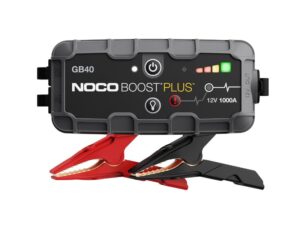 | NOCO Boost GB40 1000A UltraSafe Lithium Jump Starter | Check Price |
Second Best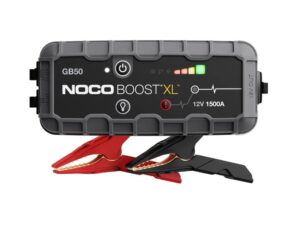 | NOCO Boost GB50 1500A UltraSafe Lithium Jump Starter | Check Price |
Third Choice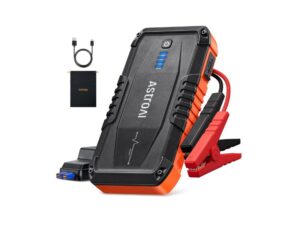 | AstroAI S8 1500A Car Battery Jump Starter | Check Price |
A portable jump starter should only be connected to the low-voltage points identified in the hybrid’s owner’s manual. Never attach one to orange high-voltage cables, traction-battery terminals, inverter hardware, electric-motor wiring, or other high-voltage hybrid components.
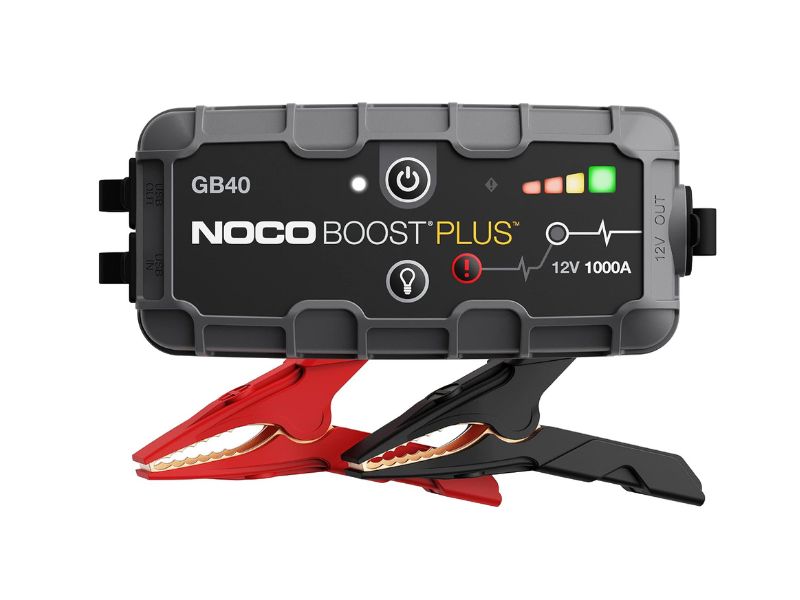
1. NOCO Boost GB40 1000A UltraSafe Lithium Jump Starter
Key Features
- 1000A peak output
- Designed for 12V lead-acid batteries
- Gasoline engines up to 6.0L
- Diesel engines up to 3.0L
- Reverse-polarity protection
- Spark-resistant normal operation
- IP65 housing with ports closed
- 100-lumen emergency flashlight
- Approx. 2.4-pound complete unit
The GB40 is my primary choice because most hybrid owners do not need an enormous truck-oriented jump starter. The key requirement is having a dependable 12V source available when the hybrid’s auxiliary battery cannot power its computers and startup systems.
NOCO specifies the GB40 for 12V lead-acid batteries, with 1000A output and conventional engine coverage up to 6.0L gasoline or 3.0L diesel. It also provides reverse-polarity protection, spark-resistant connection, IP65 protection with the ports closed, and an approximately 2.4-pound design.
For a hybrid, the large gasoline-engine rating is not the primary reason to buy it.
Hybrid vehicles often use the low-voltage battery to initialize control modules, relays, braking electronics, and other systems required before the vehicle becomes operational. Honda’s CR-V Hybrid manual, for example, provides a 12V battery jump procedure and instructs users to connect an approved 12V booster source to the specified positive terminal and ground point.
The GB40’s compact size is therefore particularly valuable. It can remain in a trunk or cargo organizer without consuming the space required by a large professional jump box.
Its reverse-polarity protection is another meaningful benefit. If the positive and negative connections are reversed during normal operation, the electronics can identify the problem instead of simply energizing the clamps.
Spark-resistant normal operation adds another protection layer, although neither feature replaces checking the hybrid’s manual.
Correct polarity and correct connection location are two different things. You can theoretically connect positive to positive and negative to ground yet still use points the manufacturer did not approve.
The GB40 also functions as a USB power bank and includes a 100-lumen flashlight. Those are useful when a low-voltage failure also disables the car’s USB ports or leaves you working around the vehicle after dark.
The principal limitation is that NOCO specifies the GB40 specifically for 12V lead-acid batteries. If a particular hybrid uses a different low-voltage battery chemistry or architecture, do not assume compatibility merely because the nominal voltage appears similar. Verify the vehicle manual first.
What I Like
- Excellent size for permanent hybrid-car storage
- Very large Amazon rating history
- Reverse-polarity protection
- Spark-resistant normal operation
- IP65 protection with ports closed
- Plenty of capability for conventional gasoline cars too
What I Do Not Like
- Intended specifically for 12V lead-acid batteries
- Lower reserve than larger boosters
- Peak engine-start capability is more than most hybrid low-voltage situations require
The GB40 offers the strongest balance for most hybrid owners. It is small enough to stay with the vehicle, simple enough for occasional emergency use, and capable of serving many conventional cars in the same household.
2. NOCO Boost GB50 1500A UltraSafe Lithium Jump Starter
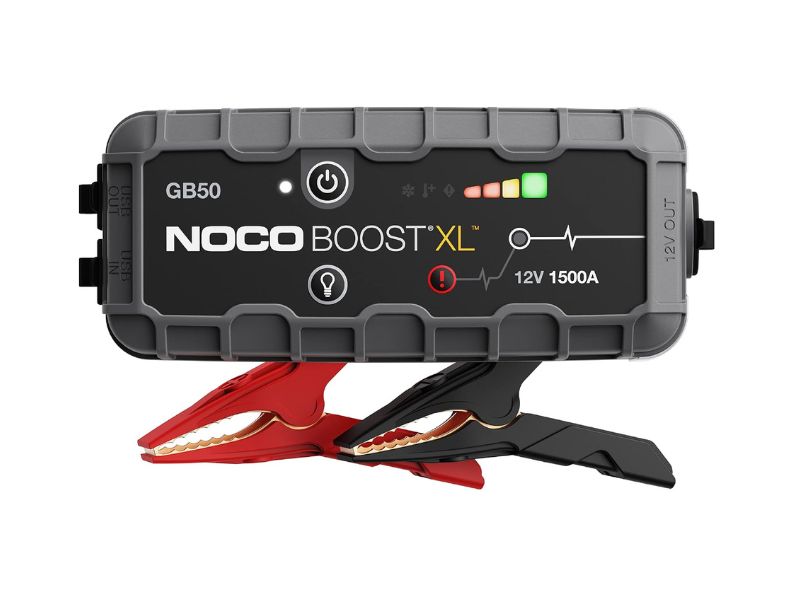
Key Features
- 1500A peak output
- Designed for 12V lead-acid starting batteries
- Gasoline engines up to 7.0L
- Diesel engines up to 4.5L
- Reverse-polarity protection
- Spark-resistant normal operation
- IP65 with ports closed
- 200-lumen flashlight
- More starting reserve than the GB40
The GB50 is the stronger choice when the hybrid shares a household with larger conventional vehicles.
NOCO’s current specification table places it at 1500A with 7.0L gasoline and 4.5L diesel capability, a 200-lumen flashlight, and closed-port IP65 protection.
For the hybrid itself, those extra engine-displacement numbers are not especially important.
The value is that the same booster can handle a hybrid low-voltage emergency while also offering more conventional cranking capability for an SUV, V8 car, light truck, boat, or other 12V vehicle.
The GB50’s current Amazon listing shows 16,766 reviews/ratings and a 4.6-star average at the latest crawl.
Its connection safeguards are useful around modern hybrids because these vehicles can contain substantial electronic equipment even on the low-voltage side.
Reverse-polarity protection helps with accidental clamp reversal, while spark-resistant operation makes ordinary connection less intimidating for someone who does not frequently handle automotive batteries.
As with the GB40, those protections do not make the high-voltage system safe to touch.
Hybrid vehicles commonly use clearly marked high-voltage components, frequently associated with orange wiring. Those are outside the scope of a consumer jump starter.
Honda’s 2025 Accord Hybrid instructions are a good example of the correct approach: use a 12V booster battery, connect to the specified 12V positive terminal, and make the final negative connection at the designated ground point.
The GB50 is larger than the GB40 but still compact enough for regular cargo storage.
I would consider the additional size worthwhile if the booster needs to cover several vehicles. If it is being purchased solely for a small hybrid sedan, the GB40 is more efficient.
What I Like
- More reserve than the GB40
- Better choice for mixed hybrid-and-ICE households
- 7.0L gasoline conventional vehicle capability
- Reverse-polarity and spark protection
- IP65 protection with ports closed
What I Do Not Like
- Extra peak output brings limited hybrid-specific benefit
- Larger than the GB40
- Still requires confirmation of low-voltage battery compatibility
The GB50 is the more versatile household booster. I would buy it when the emergency kit must cover both a hybrid and larger gasoline or diesel vehicles.
3. AstroAI S8 1500A Car Battery Jump Starter
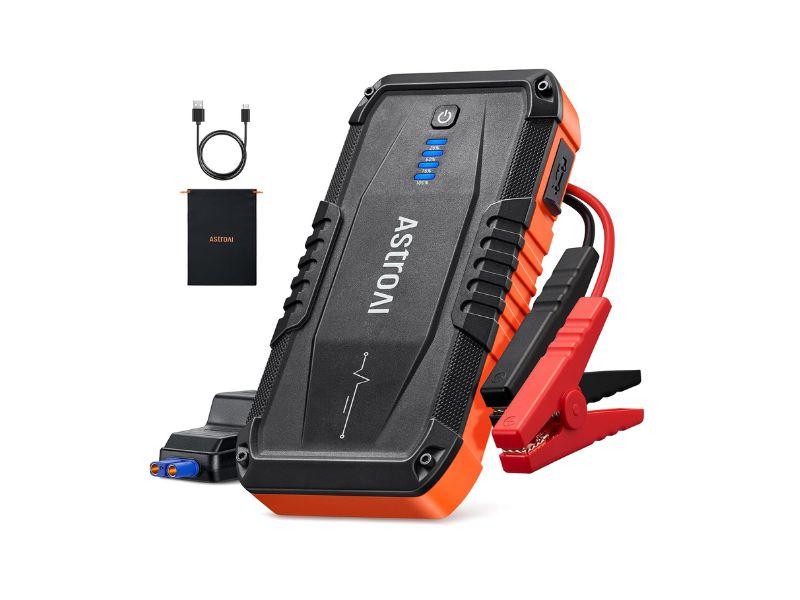
Key Features
- 1500A peak output
- 12V operating voltage
- Gasoline engines up to 6.0L
- Diesel engines up to 3.0L
- 10,000mAh NMC lithium battery
- BOOST mode
- Smart battery clamps
- Multiple electrical protections
- Three-mode flashlight
- Approx. 0.95-pound published product weight
AstroAI’s S8 is the lightweight alternative.
Its manufacturer specifies 1500A peak output, a 12V architecture, support for 6.0L gasoline and 3.0L diesel engines, a 10,000mAh NMC internal battery, and multiple protection functions.
Its current Amazon listing shows 10,771 ratings and describes a smart BOOST mode that becomes available when battery voltage drops below 9V.
That BOOST feature requires special attention with a hybrid.
It is useful on compatible conventional 12V starting batteries because a battery with extremely low voltage may not be detected normally.
However, I would not automatically press BOOST on a hybrid simply because the vehicle appears dead.
First confirm that the hybrid manufacturer permits portable 12V boosting, locate the specified terminals, identify the low-voltage battery chemistry, and attempt the recommended normal procedure.
Force-start modes can bypass part of the normal detection logic, making correct polarity and vehicle compatibility even more important.
The S8’s biggest advantage is portability. AstroAI lists it at approximately 0.95 pounds, considerably lighter than many large jump packs.
That makes it easy to store in a Prius, Corolla Hybrid, Accord Hybrid, CR-V Hybrid, RAV4 Hybrid, Escape Hybrid, or other vehicle where cargo space and emergency-kit size matter.
The USB power-bank capability and flashlight add useful roadside functions without requiring a much larger case.
AstroAI lists multiple protections including reverse polarity, reverse connection, overcurrent, overvoltage, overload, overcharge, over-discharge, and short-circuit protection.
What I Like
- Very lightweight and compact
- Strong current Amazon rating history
- Smart electrical protections
- BOOST capability for compatible very-low-voltage batteries
- Power-bank and emergency-light functions
What I Do Not Like
- BOOST requires additional caution on hybrids
- Less substantial reserve than larger jump packs
- No prominent IP weather-resistance rating in the main current specifications
The AstroAI S8 is a sensible option for buyers who prioritize compact storage and straightforward backup power. I prefer the GB40 overall, but the S8 provides strong portability and useful safety electronics.
Hybrid Jump Starter Comparison
| Product | Peak Output | Battery Compatibility | Gas Engine Limit | Diesel Limit | Main Hybrid Advantage | Current Amazon Rating Count |
| NOCO Boost GB40 | 1000A | 12V lead-acid | 6.0L | 3.0L | Compact protected connection | 128,561 |
| NOCO Boost GB50 | 1500A | 12V lead-acid | 7.0L | 4.5L | More reserve for mixed households | 16,766 |
| AstroAI S8 | 1500A | 12V compatible applications per manufacturer | 6.0L | 3.0L | Lightweight smart-clamp design | 10,771 |
The GB40 remains the most sensible dedicated hybrid emergency choice because huge engine-start output is rarely the central requirement.
The GB50 becomes more attractive when the same booster must also start conventional SUVs or trucks.
The AstroAI S8 prioritizes light weight and compact storage while retaining useful smart-clamp and low-voltage BOOST functionality.
What Does a Jump Starter Do on a Hybrid Car?
A hybrid typically contains two very different electrical systems.
The high-voltage traction battery stores energy for electric propulsion.
The smaller 12V auxiliary system powers many of the electronics required to initialize the vehicle.
If that low-voltage battery becomes discharged, the hybrid can fail to start even though substantial charge remains in the traction battery.
Honda’s hybrid owner documentation confirms that a dead 12V battery can require external 12V assistance before the vehicle’s power system can be started.
The portable jump starter therefore supplies temporary low-voltage support.
It does not directly recharge the high-voltage traction battery.
Why Hybrids Usually Do Not Need Huge Peak Amps
A conventional gasoline vehicle commonly uses its 12V battery to drive a high-current starter motor.
Many hybrids use their electrical architecture differently.
The 12V battery is particularly important for powering electronics and allowing the hybrid system to initialize. Once the system reaches its operational state, the high-voltage system can participate in normal vehicle operation.
This is why buying a 4000A or 6000A jump starter solely for a hybrid often provides little practical advantage.
For hybrid-specific use, I prioritize:
- Correct low-voltage compatibility
- Secure clamps
- Reverse-polarity protection
- Compact storage
- Clear charge indication
- Reliable state of charge
- Correct manufacturer-approved procedure
Peak amps matter more when the same unit must also start conventional engines.
Hybrid Traction Battery vs 12V Battery
The two batteries should never be confused.
The traction battery operates at much higher voltage and supplies propulsion energy.
The 12V battery supports conventional low-voltage electronics and startup functions.
A portable automotive booster is designed for compatible low-voltage systems.
It should never be connected to traction-battery terminals, electric-motor wiring, inverter connections, high-voltage service plugs, or orange high-voltage cables.
If the high-voltage hybrid system has a fault, ordinary jump-start equipment is not the correct repair tool.
Hybrid vs Plug-In Hybrid
A plug-in hybrid adds the ability to recharge its traction battery from an external EV charging source.
It still maintains a low-voltage electrical system for computers, controls, locks, and other vehicle electronics.
A portable jump starter can therefore be useful for an approved low-voltage battery emergency, but it cannot add meaningful driving range to an empty plug-in traction battery.
The same rule applies: follow the exact model’s owner manual.
Match the Jump Starter to the 12V Battery Chemistry
This point is easy to overlook.
NOCO specifies the GB40 for 12V lead-acid batteries and warns that it is not intended for other battery types.
Do not assume every modern hybrid uses the same auxiliary-battery chemistry.
Before buying, check the vehicle manual or battery label for:
- Nominal voltage
- Battery chemistry
- Approved jump procedure
- Specified positive jump point
- Approved chassis ground
If the low-voltage battery chemistry is not supported by the booster, choose equipment explicitly approved by the vehicle manufacturer.
Look for Reverse-Polarity Protection
Reverse polarity means accidentally connecting positive and negative incorrectly.
NOCO specifies spark-resistant technology and reverse-polarity protection on its Boost series.
AstroAI also lists reverse-polarity and reverse-connection protection among the S8’s safety functions.
Those features are particularly helpful for users who only handle battery equipment during rare emergencies.
They do not remove the need to visually confirm the connections.
Check Clamp Reach and Jump-Point Access
A hybrid’s actual 12V battery may not always be the point the manufacturer wants you to access during a jump.
Before an emergency, locate:
- The approved positive jump terminal
- The designated negative or chassis ground
- Any fuse-box terminal cover
- Battery-access panels
- Cable-routing restrictions
Honda, for example, specifies a positive 12V battery terminal and a dedicated ground location for its current CR-V Hybrid procedure.
Knowing these locations in advance is far easier than searching for them in a dark parking lot.
Use BOOST or Manual Override Carefully
Smart jump starters normally detect the connected battery before activating.
When voltage becomes extremely low, detection may fail.
Some units provide BOOST or manual override to force the output on.
That can be useful, but it also increases the importance of correct polarity and battery compatibility.
For a hybrid:
- Check the vehicle manual.
- Confirm the low-voltage battery type.
- Attach the clamps to the approved points.
- Try protected normal operation first.
- Only use BOOST if both the vehicle and jump-starter instructions support doing so.
Keep the Booster Charged
A jump starter is emergency equipment, so state of charge is critical.
Recharge it after use and check it periodically, particularly before:
- Winter
- Long road trips
- Extended airport parking
- Leaving the hybrid unused for weeks
- Severe-weather season
- Remote travel
A compact jump starter with moderate specifications but a full battery is more useful than an oversized booster left nearly discharged.
Storage Temperature Matters
Lithium jump starters should not be forgotten indefinitely in extreme heat or cold.
NOCO specifies an operating range for the GB40 from approximately -4°F to 122°F.
Extreme cold temporarily reduces battery output, while excessive heat accelerates lithium-cell aging.
Drivers in very hot or very cold U.S. climates should review the manufacturer’s operating and storage limits.
How to Jump-Start a Hybrid Car Safely
1. Read the Exact Hybrid Owner’s Manual
Do not assume every hybrid uses the same connection sequence.
Honda’s current CR-V Hybrid and Accord Hybrid manuals each provide explicit 12V jump-start instructions.
2. Confirm the Correct Low-Voltage System
Verify voltage and battery chemistry before connecting the booster.
3. Turn Off Electrical Loads
Switch off unnecessary:
- Lighting
- Climate control
- Audio
- Heated seats
- USB accessories
This reduces low-voltage demand.
4. Locate the Approved Positive Point
Attach the red clamp only to the positive terminal or remote jump point identified by the manufacturer.
5. Locate the Approved Ground
Attach the black clamp to the designated chassis or engine ground.
Honda specifically instructs users to make the final negative connection to a specified mounting or ground point rather than an arbitrary location.
6. Verify the Booster’s Indicators
Do not proceed if the jump starter reports reverse polarity, temperature problems, or another connection fault.
7. Use Protected Normal Mode First
Do not immediately press BOOST or force-start.
8. Start the Hybrid According to Its Manual
The required process may include pressing the brake pedal and POWER or START button.
Follow the vehicle-specific sequence.
9. Confirm the Vehicle Is Operational
Many hybrids use a READY indication rather than continuous engine sound as confirmation that the propulsion system is active.
The gasoline engine may remain off even though the hybrid is ready to drive.
10. Disconnect in the Correct Sequence
Follow the vehicle and jump-starter manuals.
Honda instructs users to disconnect from the vehicle ground first after the hybrid power system has started, followed by the remaining connections in reverse sequence.
11. Investigate Repeated Battery Failure
A hybrid that repeatedly needs external 12V assistance may have:
- An aging auxiliary battery
- A parasitic electrical drain
- A charging-system problem
- Loose or corroded connections
- Extended-storage issues
- Another electrical fault
A jump starter addresses the immediate problem, not its cause.
Common Hybrid Jump Starter Mistakes
Trying to Jump the High-Voltage Battery
A consumer jump starter is not a traction-battery charger.
Buying Only by Peak Amps
Hybrid low-voltage recovery often benefits more from correct compatibility and safe connections than massive engine-start numbers.
Connecting to the Wrong Electrical Point
Use only the manufacturer-specified 12V terminals or jump posts.
Assuming Every Hybrid Uses the Same Battery Chemistry
Verify the auxiliary battery before connecting a booster.
Touching Orange Cables
Orange cables commonly identify high-voltage hybrid circuits and should not be used as jump-start points.
Using BOOST Immediately
Protected normal mode should be attempted first.
Assuming the Hybrid Is Not Running Because the Gas Engine Is Quiet
A hybrid may be fully operational while the gasoline engine remains off.
Leaving the Jump Starter Discharged
Check the booster every few months and recharge it after every use.
Frequently Asked Questions
What is the best jump starter for hybrid cars?
The NOCO GB40 is the strongest overall choice for many compatible 12V lead-acid hybrid systems.
Its compact size, reverse-polarity protection, spark-resistant normal operation, and large Amazon rating history make it particularly practical for emergency storage. Always confirm the hybrid’s battery chemistry and approved connection points first.
Can you jump-start a hybrid car?
Yes, many hybrids allow external assistance to a discharged 12V auxiliary battery.
Honda provides dedicated 12V jump-start procedures for current CR-V Hybrid and Accord Hybrid models. The exact connection points and sequence vary by vehicle.
Does a hybrid need a special jump starter?
Usually it needs a compatible low-voltage source rather than unusually high peak amperage.
The important requirements are voltage, battery chemistry, safe clamps, and manufacturer-approved connection points.
Is a 1000A jump starter enough for a hybrid?
For many compatible hybrid 12V systems, 1000A provides far more conventional cranking output than necessary.
The GB40 is capable of starting conventional gasoline engines up to 6.0L, while hybrid low-voltage recovery generally focuses on restoring auxiliary-system power.
Is 1500A better for a hybrid?
Not necessarily; extra output matters more when the jump starter also serves conventional vehicles.
A GB50 can make sense when one household owns both a hybrid and a large gasoline SUV or truck.
Can a jump starter charge the hybrid traction battery?
No. A portable 12V jump starter is not a high-voltage traction-battery charger.
It is intended only for compatible low-voltage systems.
Why can my hybrid be dead when the traction battery has charge?
The 12V battery powers electronics needed to initialize the hybrid system.
If low-voltage power is unavailable, the vehicle may not activate its normal propulsion system even when high-voltage energy remains.
Can I jump-start a Honda CR-V Hybrid?
Yes, Honda provides a specific procedure for a discharged 12V battery.
Honda instructs owners to use a 12V booster source, connect the positive terminal correctly, and use the specified ground point.
Can I jump-start a Honda Accord Hybrid?
Yes, Honda provides a dedicated 12V jump-start procedure for the Accord Hybrid.
The current manual specifically says to use a 12V booster battery and identifies the required connection sequence.
Should I connect directly to the hybrid battery?
Only connect to the 12V battery or jump points specifically identified in the owner’s manual.
Never connect a consumer booster to the traction battery.
What do orange cables mean on a hybrid?
They commonly identify high-voltage hybrid circuits that should not be used for jump-starting.
Stay with the approved low-voltage connection points.
Can I use the NOCO GB40 on every hybrid?
No. The GB40 is specified for 12V lead-acid batteries, so compatibility must be checked first.
If the hybrid uses another low-voltage battery chemistry, follow the manufacturer’s instructions and use equipment explicitly approved for it.
Is the AstroAI S8 good for a hybrid?
It can be a compact option when the vehicle’s 12V system and jump procedure are compatible.
The S8 provides 1500A output, smart clamps, multiple protections, and low-voltage BOOST functionality. BOOST should only be used when appropriate for the specific vehicle.
Should I use BOOST mode on a hybrid?
Try protected normal operation first and use BOOST only when the manuals permit it.
BOOST can bypass low-voltage detection, so correct battery chemistry, polarity, and connection location become especially important.
Can I jump-start a plug-in hybrid?
Its approved low-voltage system may be externally supported, but its traction battery cannot be jumped this way.
Consult the exact PHEV owner’s manual because architectures and procedures differ.
Why does the gasoline engine stay off after I jump the hybrid?
That can be normal if the hybrid system has reached its operational READY state.
The control system decides when the gasoline engine needs to run. Engine noise alone is not always a reliable indication of whether the hybrid is operational.
How often should I recharge my hybrid jump starter?
Recharge it after use and check its battery level every few months.
Also inspect it before winter, long trips, extended parking, and severe-weather season.
Why does my hybrid 12V battery keep dying?
Repeated discharge can indicate battery aging, electrical drain, charging problems, or another fault.
The jump starter restores temporary power but does not diagnose or repair the underlying problem.
Conclusion
The best jump starter for hybrid cars should be chosen around the hybrid’s 12V auxiliary system, not the size of its high-voltage traction battery. Correct voltage, battery chemistry, safe connections, compact storage, and a manufacturer-approved jump procedure matter more than chasing the largest peak-amp rating.
The NOCO Boost GB40 remains my primary recommendation for hybrids using a compatible 12V lead-acid system. It is compact, carries strong connection safeguards, and has by far the largest current Amazon rating history among these three products.
The NOCO GB50 is better when one booster must also handle larger conventional vehicles. Its additional engine capability and reserve make it more versatile without moving into a large professional jump-box format.
The AstroAI S8 is the lightweight alternative, with smart clamps, multiple protections, a 10,000mAh battery, and a compact design that is easy to keep inside a hybrid.
For a dedicated hybrid emergency kit, I would choose the NOCO GB40, confirm that the vehicle uses a compatible 12V lead-acid auxiliary battery, learn the designated positive and ground points before an emergency, and keep the booster charged.