A good hand held tire inflator removes most of the inconvenience from maintaining proper tire pressure. Instead of finding an air station, dragging out a large compressor, or routing a 12V cable through your vehicle, you can carry a compact rechargeable pump directly to the tire, set the desired pressure, and start inflating.
That convenience is especially valuable when temperature changes trigger a TPMS warning, a motorcycle tire needs a quick pressure correction before a ride, or a bicycle needs air away from home. However, handheld inflators vary enormously in performance. Some are genuinely capable of topping off passenger-car tires, while others are better treated as lightweight bicycle and emergency pumps.
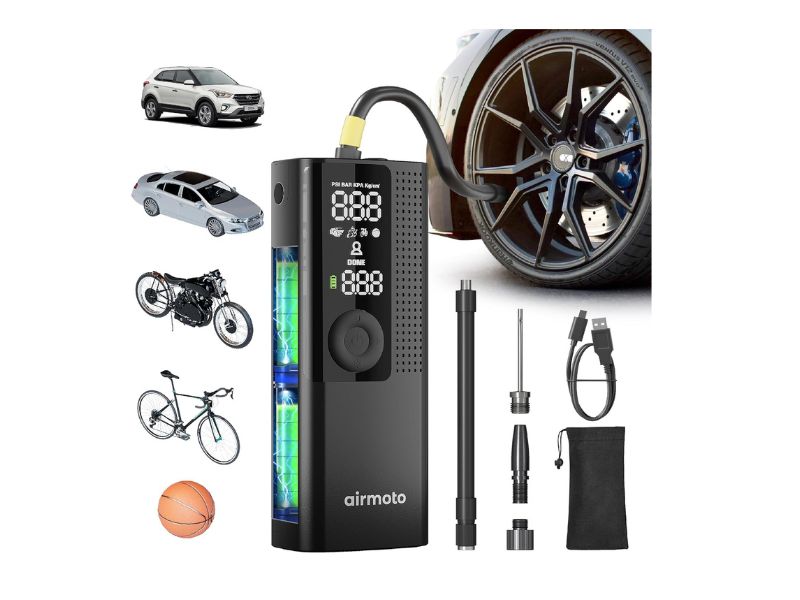
For most drivers, my first recommendation is the Airmoto Tire Inflator Portable Air Compressor. Its compact cordless body, 120 PSI capability, digital pressure gauge, automatic shutoff, multiple adapters, and glove-box-friendly size make it one of the easiest pumps to keep with a vehicle permanently.
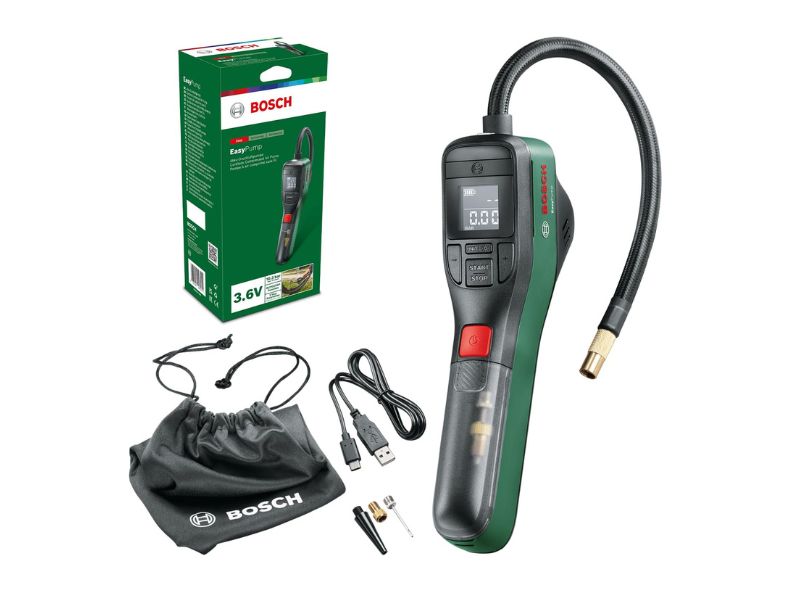
The Bosch EasyPump is my second choice if build quality, ergonomics, and straightforward operation are priorities. It is exceptionally compact, reaches 150 PSI, charges by USB-C, and includes an automatic stop function. Its relatively modest airflow makes it more suitable for routine top-offs than repeatedly filling large nearly-flat tires.
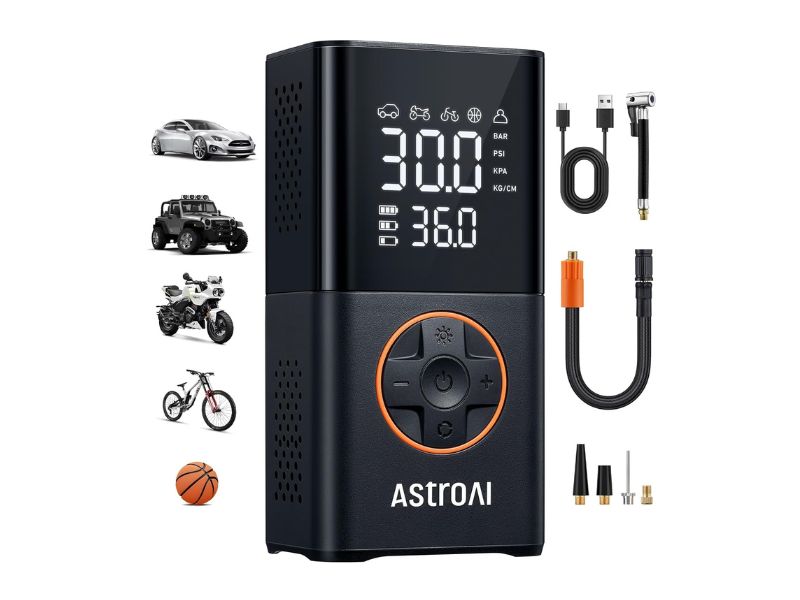
For buyers who want strong value and a larger internal battery, the AstroAI L7 Tire Inflator deserves serious consideration. It combines a 4000mAh battery, 150 PSI capability, digital auto-stop controls, LED lighting, and a remarkably small body that works well for cars, motorcycles, bikes, and sports equipment.
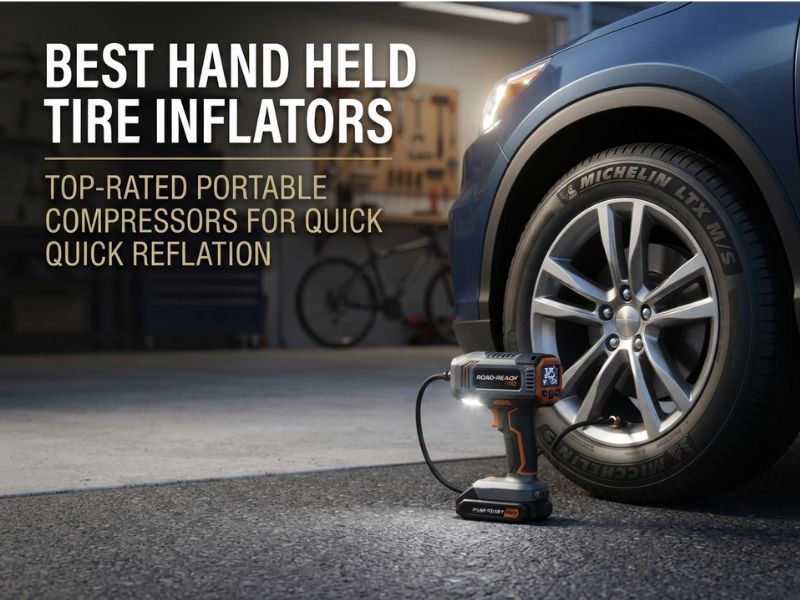
10 Best Hand Held Tire Inflator
| Image | Product Name | Check Price |
|---|---|---|
Best Choice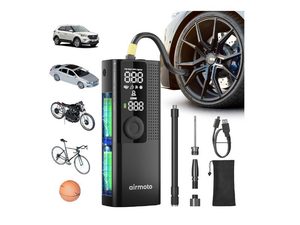 | Airmoto Tire Inflator Portable Air Compressor | Check Price |
Second Best | Bosch EasyPump Cordless Air Pump | Check Price |
Third Choice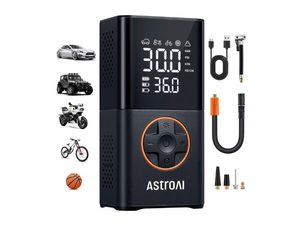 | AstroAI L7 Tire Inflator – Best Compact Value | Check Price |
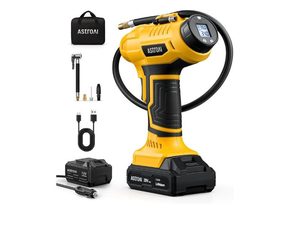 | AstroAI 20V Cordless Tire Inflator | Check Price |
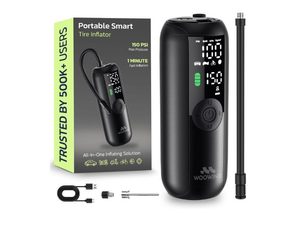 | WooWind LP1 Smart Air Pump | Check Price |
 | Xiaomi Portable Electric Air Compressor | Check Price |
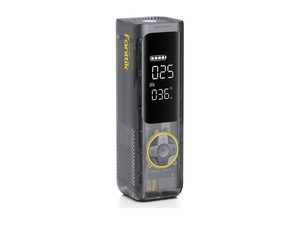 | Fanttik X8 APEX Tire Inflator | Check Price |
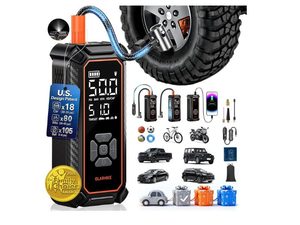 | OlarHike Tire Inflator Portable Air Compressor | Check Price |
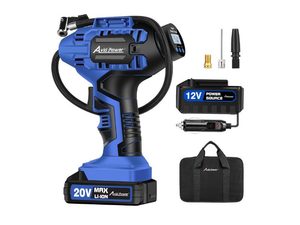 | AVID POWER 20V Cordless Tire Inflator | Check Price |
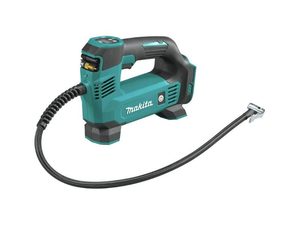 | Makita DMP180ZX 18V LXT Cordless Inflator | Check Price |
1. Airmoto Tire Inflator Portable Air Compressor – Best Overall Hand Held Tire Inflator
Key Features
- Maximum pressure: 120 PSI
- Approximate airflow: 20 L/min
- Rechargeable 2000mAh lithium-ion battery
- Digital pressure gauge
- Automatic shutoff
- PSI, BAR, kPa, and KG/CM² units
- Built-in LED light
- Schrader connection
- Presta adapter
- Ball needle and general nozzle
- Approximately 1.2 pounds
- Compact body around 6.1 inches long
Detailed Review
Airmoto earns the first position because it represents what many drivers actually mean when they search for a handheld tire inflator: something small enough to store almost anywhere but capable enough to perform routine vehicle-tire maintenance.
The body is roughly the size of a large handheld electronic device rather than a traditional compressor. That allows it to fit in a glove compartment, center-console storage area, backpack, motorcycle luggage, or roadside-emergency bag without taking over the available space.
Its rechargeable battery eliminates the electrical cord entirely. You can walk around the vehicle and inflate each tire without opening a door to reach the accessory socket.
Maximum pressure is rated at 120 PSI, while airflow is around 20 liters per minute. Those specifications make considerably more sense for passenger cars, motorcycles, bicycles, and sports equipment than for oversized truck tires.
The digital control system is one of Airmoto’s strongest features. You connect the hose, select the desired pressure, and start inflation. Once the target is reached, the compressor stops automatically. That eliminates the need to continuously watch a small analog needle while trying to decide when to shut the pump off.
Multiple pressure units also make it versatile. Car owners may prefer PSI, while BAR and kPa can be more convenient for motorcycles, bicycles, or specifications written for other markets.
Battery capacity is relatively modest at 2000mAh, so expectations should remain realistic. This is primarily a top-off and emergency inflator rather than a replacement for a high-output garage compressor.
Its small size is particularly useful when tire pressure falls because of seasonal temperature changes. Adding three to six PSI to several passenger-car tires is exactly the kind of workload for which a device like Airmoto makes sense.
A built-in LED adds some roadside usefulness, and the supplied adapters support bicycle valves, sports balls, and other smaller inflation jobs.
What I Like
The strongest feature is portability. A tire inflator only helps during an emergency if it is actually inside the vehicle, and Airmoto is small enough that leaving it permanently stored is easy.
I also like the automatic shutoff and simple digital interface. Someone who rarely performs automotive maintenance should be able to understand the basic operation quickly.
Its adapter selection adds versatility without requiring a separate accessory kit.
What I Do Not Like
The internal battery is considerably smaller than the batteries used in heavy-duty cordless compressors. Inflation of severely underinflated large tires can therefore consume charge quickly.
It also cannot accept a removable tool battery, so you cannot instantly swap in a second pack when the internal battery runs low.
Verdict
The Airmoto Tire Inflator is the best overall handheld option for typical passenger-car owners who prioritize compact storage, uncomplicated controls, and convenient cordless tire top-offs.
It is especially suitable for sedans, compact SUVs, motorcycles, bicycles, and everyday roadside preparedness.
2. Bosch EasyPump Cordless Air Pump – Best for Build Quality and Ergonomics
Key Features
- Maximum pressure: 150 PSI
- Approximate airflow: 10 L/min
- Integrated 3.0Ah lithium-ion battery
- USB-C charging
- Automatic pressure stop
- Digital pressure display
- Built-in LED light
- Approximate weight: 0.4 kg
- 24 cm hose
- Integrated accessory storage
- Presta adapter
- Ball needle
- Volume adapter
Detailed Review
The Bosch EasyPump stands out immediately because it looks and feels more like a thoughtfully designed handheld tool than a miniature box compressor.
Its long handle gives you a natural grip while keeping the display visible. At roughly 0.4 kg, it remains light enough for one-handed operation and easy vehicle storage.
Maximum pressure reaches 150 PSI, making the EasyPump suitable for normal passenger-car tires, motorcycles, bicycles, sports balls, and high-pressure bicycle applications.
Its airflow is more modest than some larger cordless models, which is an important consideration. Bosch prioritizes size, control, and portability rather than maximum tire-filling speed.
That means the EasyPump excels when correcting a tire by a handful of PSI. Filling a large vehicle tire from completely empty takes considerably longer.
The digital pressure system allows you to enter your desired target. Once that target is reached, the pump stops automatically.
USB-C charging is another major practical advantage. Rather than carrying a proprietary charging brick, you can use compatible modern USB charging equipment.
Accessory storage is integrated into the handle, reducing the possibility of losing the small bicycle and ball adapters in a glove compartment.
A built-in LED helps illuminate valve stems at night.
For anyone who values product ergonomics, the EasyPump is one of the more polished designs available. The compromise is speed: it simply is not intended to compete with large high-airflow compressors.
What I Like
The build quality and grip design are excellent.
USB-C charging is convenient, and I particularly like having the smaller adapters stored directly in the tool rather than loose in a bag.
The automatic shutoff system also makes pressure adjustments straightforward.
What I Do Not Like
Approximately 10 L/min airflow is relatively low.
A nearly flat car tire therefore requires patience, and the Bosch would not be my first choice for repeatedly filling large SUV or pickup tires.
Verdict
Choose the Bosch EasyPump if you primarily perform tire top-offs and want a lightweight, refined handheld pump from an established tool manufacturer.
For bikes, motorcycles, and routine car-pressure maintenance, it is particularly pleasant to use.
3. AstroAI L7 Tire Inflator – Best Compact Value
Key Features
- Maximum pressure: 150 PSI
- Approximately 17 L/min airflow
- 4000mAh rechargeable battery
- Automatic shutoff
- Digital dual-value display
- Multiple inflation modes
- LED lighting
- Approximately 1.17 pounds
- USB charging
- Schrader and Presta compatibility
- Ball and inflatable adapters
Detailed Review
The AstroAI L7 provides one of the strongest combinations of low weight, useful battery capacity, simple operation, and reasonable pricing in the mini-inflator category.
At just over one pound, it is easy to carry yet provides a 4000mAh internal battery, double the nominal capacity of several smaller pocket-style competitors.
Maximum pressure is rated at 150 PSI, while airflow is approximately 17 L/min.
That makes it useful across a broad range of applications including passenger-car tires, motorcycle tires, bicycles, sports balls, and similar equipment.
AstroAI’s digital display shows pressure information clearly, and the target pressure can be preset. Once the selected pressure is reached, the compressor shuts itself off.
The company states that the L7 can perform multiple passenger-tire top-offs on a charge under its specified test conditions, making it particularly appealing for drivers who want something tiny but still practical for checking an entire vehicle.
The tradeoff is that this remains a mini compressor. It should not be confused with a dual-cylinder truck inflator simply because the specification says 150 PSI.
For a normal sedan tire that has fallen from 35 to 30 PSI, the L7 is a highly convenient tool. For a large pickup tire at extremely low pressure, a larger compressor will be much more appropriate.
LED lighting adds roadside utility, and the compact rectangular design is easy to place in a small emergency bag.
What I Like
The 4000mAh battery is impressive for such a compact inflator.
I also like the dual-value digital display and straightforward preset controls.
Its small size makes it easy to justify keeping one permanently inside a vehicle.
What I Do Not Like
There is no 12V wired backup on the L7.
If the battery is discharged, you have to recharge it before using the compressor.
Its relatively small compressor is also better for routine top-offs than serious large-tire inflation.
Verdict
The AstroAI L7 is one of the best choices for buyers looking for maximum convenience per dollar.
It works especially well for cars, motorcycles, scooters, bikes, and compact emergency kits.
4. AstroAI 20V Cordless Tire Inflator – Best Dual-Power Handheld Pick
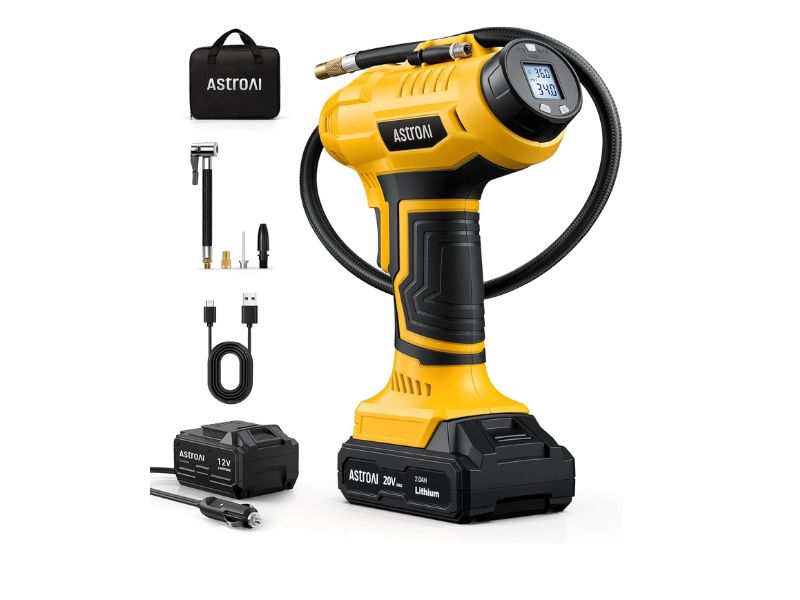
Key Features
- Rechargeable 20V battery
- 12V DC vehicle-power backup
- Maximum pressure up to 160 PSI
- Digital pressure gauge
- Automatic shutoff
- Backlit display
- LED light
- Pistol-grip design
- Multiple pressure units
- Carrying accessories
- Suitable for cars, motorcycles, bicycles, and sports equipment
Detailed Review
The AstroAI 20V model is substantially larger than pocket pumps such as the L7, but that size gives it several useful advantages.
The removable 20V battery provides cordless operation while the pistol-grip housing makes it comfortable to carry from tire to tire.
More importantly, AstroAI supplies 12V vehicle power as a backup.
This addresses one of the biggest weaknesses of rechargeable emergency equipment. If the inflator has been sitting untouched for months and you discover that the battery is low, you still have another way to power the compressor.
That makes the AstroAI especially appealing for road-trip use.
Its rated maximum pressure reaches 160 PSI. Passenger cars will never need anything close to that under normal circumstances, but the pressure range adds flexibility for bicycles and other applications.
Preset pressure and automatic shutoff allow you to select a target and let the inflator manage the final cutoff.
The pistol-grip shape is convenient around motorcycles and bicycles because the compressor can easily be repositioned without dragging a box-shaped unit along the ground.
It is larger than mini inflators, however, and requires space for the battery and accessories.
What I Like
The combination of cordless battery power and 12V backup is excellent.
It offers more emergency reassurance than a built-in-battery pump that becomes unusable once discharged.
I also like the removable battery and comfortable drill-style shape.
What I Do Not Like
It occupies considerably more storage space than Airmoto, Bosch, or the AstroAI L7.
The compressor is still intended primarily for passenger vehicles rather than repeated large-truck tire inflation.
Verdict
The AstroAI 20V Cordless Tire Inflator is the strongest option for buyers who want a true handheld design but do not want to rely exclusively on battery charge.
That dual-power capability makes it an excellent road-trip companion.
5. WooWind LP1 Smart Air Pump – Best Simple Smart Pump
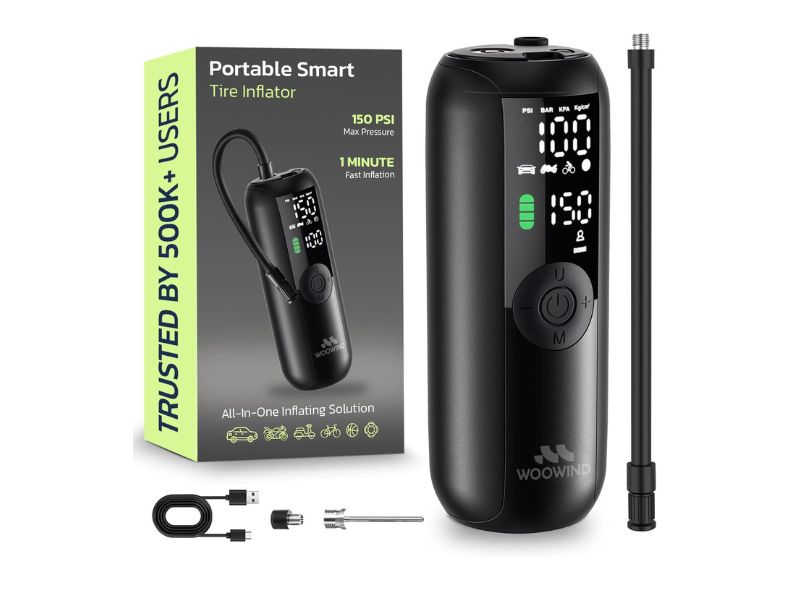
Key Features
- Maximum pressure: 150 PSI
- Approximately 15–18 L/min airflow
- 4000mAh battery
- 7.4V / 14.8Wh battery system
- Automatic shutoff
- Digital display
- Built-in LED light
- USB-C charging
- Approximately 446 grams
- Multiple adapters
- Car, motorcycle, bicycle, and ball compatibility
Detailed Review
The WooWind LP1 is a straightforward compact inflator that avoids unnecessary complexity.
Its approximately 446-gram body is small enough for regular travel and provides a 4000mAh battery, giving it useful capacity for moderate top-off work.
The 150 PSI ceiling provides plenty of pressure for passenger cars and bicycles.
WooWind lists airflow around 15–18 L/min. That puts the LP1 in the mini-compressor category rather than the high-output category, but it is entirely appropriate for the kinds of jobs most owners perform regularly.
You select the desired pressure, start the compressor, and its auto-stop system shuts the pump down when the target is reached.
The integrated LED makes nighttime use easier, while USB-C charging simplifies keeping the battery ready.
WooWind also includes attachments for cars, motorcycles, bicycles, sports equipment, and compatible inflatables.
The LP1 is a particularly good choice for someone who wants a simple general-purpose inflator rather than a tool-platform device with separate batteries and chargers.
What I Like
The LP1 offers a good balance of battery size and compact dimensions.
USB-C charging is convenient, and the auto-stop controls are easy to understand.
It is also versatile enough to move between car, bicycle, and recreational use.
What I Do Not Like
Its 15–18 L/min airflow is not designed for large tires.
Like other small cordless inflators, it can also become warm during extended operation.
Verdict
The WooWind LP1 is an excellent straightforward handheld pump for buyers who mainly perform routine top-offs.
It is compact, easy to operate, and well suited to mixed car-and-bike households.
6. Xiaomi Portable Electric Air Compressor 2 – Best Compact Pump for Bikes and Cars
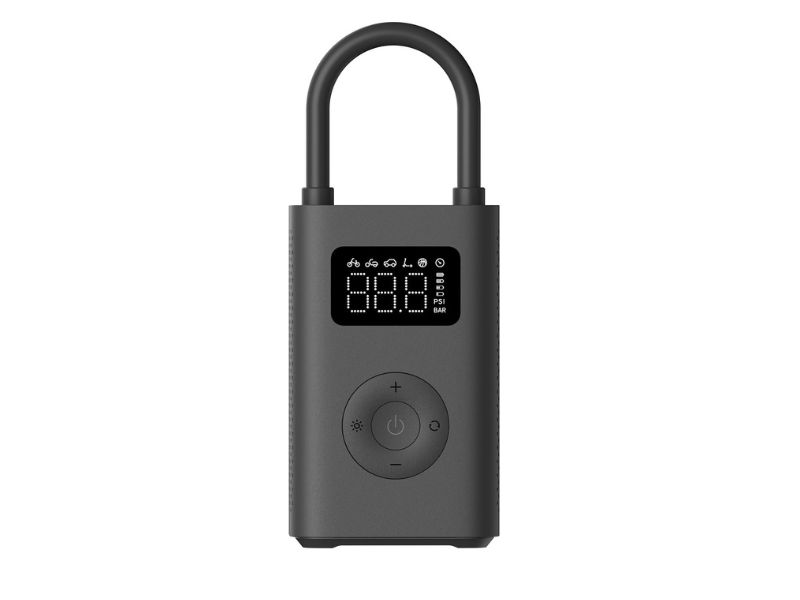
Key Features
- Maximum pressure: 150 PSI
- 2000mAh / 14.4Wh battery
- Approximately 490 grams
- Six inflation modes
- Automatic pressure cutoff
- Digital pressure detection
- Accuracy up to approximately ±1 PSI
- USB charging
- Improved inflation speed over previous generation
- LED light
- Quick-connect adapter
- Car, motorcycle, bicycle, scooter, and ball modes
Detailed Review
Xiaomi’s Portable Electric Air Compressor 2 is one of the most polished compact inflators in this group.
Its squared-off design makes it easy to store, and at roughly 490 grams it remains genuinely portable.
Xiaomi redesigned the internal system compared with its previous-generation compressor and claims an approximately 25% increase in inflation speed.
The company rates pressure up to 150 PSI and provides several preset modes designed for cars, motorcycles, bicycles, electric scooters, balls, and manual use.
The automatic stop system is particularly convenient.
Choose the mode or manually enter the required pressure and the compressor stops once the selected value has been reached.
Pressure detection accuracy is rated up to approximately ±1 PSI under specified conditions, which is appropriate for normal automotive maintenance.
Xiaomi states that a full charge can perform multiple routine tire top-offs, although actual battery life depends heavily on tire volume, starting pressure, ambient temperature, and target pressure.
The Air Compressor 2 is particularly strong for motorcycle, scooter, and bicycle owners because high pressure is available without needing a bulky compressor.
For a completely empty passenger-car tire, Xiaomi’s own testing indicates inflation can still take several minutes. That is normal for a pump of this size and demonstrates why maximum PSI alone should never be mistaken for airflow.
What I Like
The controls and preset modes are very intuitive.
I also like the ±1 PSI claimed pressure accuracy and compact, self-contained design.
It is one of the easiest choices for people who own a car plus bikes or an electric scooter.
What I Do Not Like
The internal battery cannot be swapped.
The hose is also relatively short, which can make positioning more awkward when a valve stem is near the top of a large wheel.
Verdict
The Xiaomi Portable Electric Air Compressor 2 is a particularly good choice for drivers and cyclists who want a polished mini inflator with useful presets and accurate digital pressure control.
7. Fanttik X8 APEX Tire Inflator – Best Premium Compact Performer
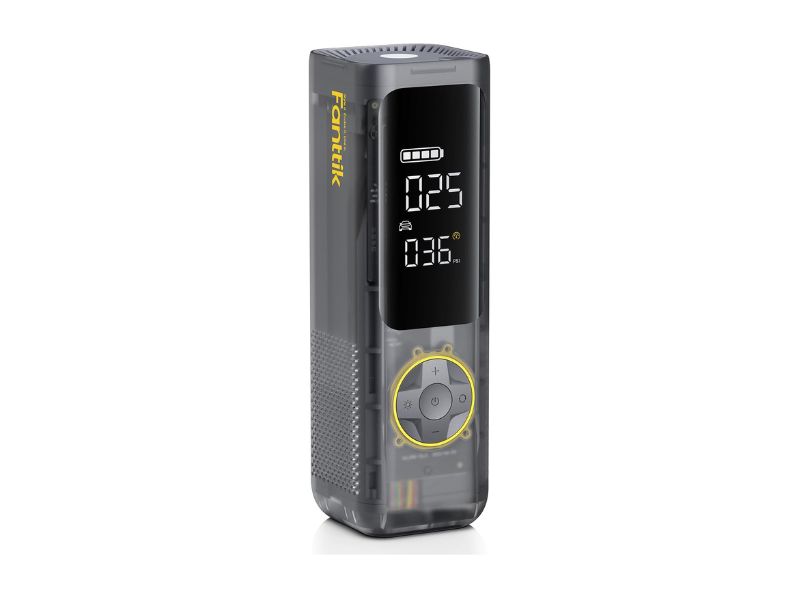
Key Features
- Maximum pressure: 150 PSI
- Approximate 28.8Wh battery
- Fast passenger-tire top-off performance
- Digital dual-screen interface
- Pressure accuracy around ±1 PSI
- Automatic shutoff
- Multiple preset modes
- Up to around 40 minutes of operation under specified conditions
- USB-C charging
- Power-bank capability
- LED light
- Approximately 1.8-pound class
- Car, SUV, motorcycle, and bike compatibility
Detailed Review
The Fanttik X8 APEX is one of the more performance-oriented inflators that still qualifies as truly handheld.
Rather than minimizing the battery and compressor to create the smallest possible pump, Fanttik gives the X8 APEX more battery capacity and airflow while keeping the unit small enough for easy vehicle storage.
The company rates it at 150 PSI and claims it can add several PSI to a common passenger-car tire in around a minute under its specified test conditions.
That makes the X8 APEX much more pleasant for routine four-tire maintenance than some slower pocket pumps.
Pressure accuracy is rated around ±1 PSI, and the digital interface lets you select among preset applications or enter a custom pressure.
Automatic shutoff stops the compressor at the chosen target.
The internal battery can also function as a power bank, adding usefulness during roadside emergencies.
USB-C charging simplifies travel, and an integrated LED provides illumination after dark.
The X8 APEX costs more than several generic mini pumps, but the additional battery capability and faster inflation performance help justify the premium for frequent users.
Fanttik also specifically positions the model for sedans, SUVs, motorcycles, and bicycles within reasonable tire-size limits.
What I Like
Inflation performance is strong relative to the physical size.
The larger internal battery, accurate pressure control, power-bank function, and USB-C charging make it a particularly complete travel tool.
What I Do Not Like
It is more expensive than many basic handheld pumps.
The internal battery also means you cannot install a fresh battery instantly after exhausting the first one.
Verdict
The Fanttik X8 APEX is my premium compact recommendation.
It makes sense for drivers who use their inflator frequently and are willing to spend more for faster tire top-offs and a better overall feature set.
8. OlarHike Tire Inflator Portable Air Compressor – Best Dual-Power Mini Inflator
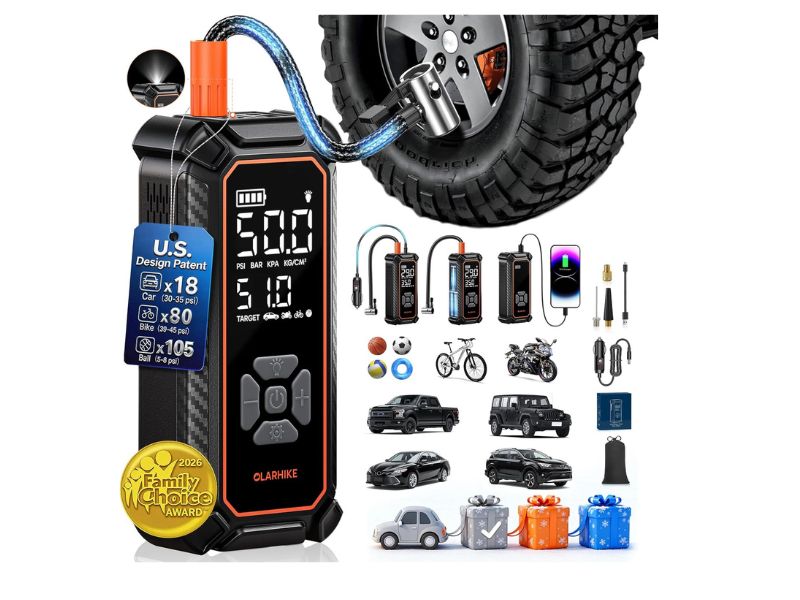
Key Features
- Maximum pressure: 160 PSI
- Approximate airflow: 24 L/min
- Rechargeable battery operation
- 12V DC backup power
- Automatic shutoff
- Digital pressure gauge
- Approximately 23.6-inch hose
- LED lighting
- Carrying bag
- Multiple adapters
- Car, motorcycle, bicycle, and ball compatibility
Detailed Review
OlarHike combines the compact body style of a rechargeable mini inflator with one feature that greatly improves emergency reliability: 12V backup power.
Cordless operation handles normal maintenance.
If the internal battery becomes depleted, the wired vehicle connection provides another way to run the compressor.
That combination is particularly useful for people who intend to store the inflator in a vehicle for long periods.
The compressor is rated up to 160 PSI with approximately 24 L/min airflow.
That airflow places it ahead of several smaller pocket pumps and makes routine passenger-car top-offs relatively practical.
A 23.6-inch hose also provides better positioning flexibility than ultra-short hoses integrated into some mini inflators.
Automatic shutoff and digital pressure controls simplify operation.
The supplied bag keeps the compressor, power cable, hose accessories, and inflation adapters together.
Although the pressure ceiling is 160 PSI, OlarHike should still be viewed primarily as a passenger-car and light-duty compressor. Large off-road and commercial tires require substantially greater sustained airflow.
What I Like
Dual power is the standout feature.
I also like the relatively long hose and 24 L/min rated airflow for a compact rechargeable design.
What I Do Not Like
The additional 12V equipment creates more cables and accessories to store.
The unit is larger than ultra-minimal options such as the AstroAI L7.
Verdict
Choose the OlarHike Tire Inflator if you want handheld cordless convenience but consider wired backup power important for emergency reliability.
9. AVID POWER 20V Cordless Tire Inflator – Best Pistol-Grip Alternative
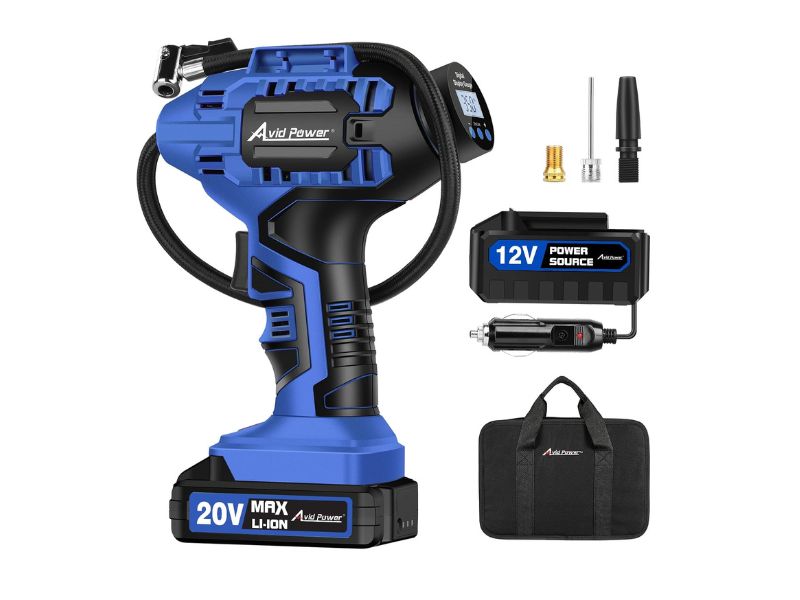
Key Features
- Rechargeable 20V battery
- 12V DC vehicle adapter
- Approximate airflow up to 28 L/min
- Digital pressure gauge
- Automatic shutoff
- Pressure accuracy around ±2 PSI
- Self-locking safety switch
- Ergonomic pistol grip
- Multiple adapters
- Passenger-car, motorcycle, bicycle, and recreational use
Detailed Review
AVID POWER uses a drill-like design that feels familiar to anyone who regularly handles cordless power tools.
The large removable battery provides more energy than the tiny internal cells used in pocket pumps, while the pistol grip makes the inflator easy to carry from wheel to wheel.
The company rates airflow up to approximately 28 L/min.
Under its specified testing, the compressor can inflate common passenger-car tire sizes from very low pressure to normal operating pressure in several minutes.
As with AstroAI’s larger handheld model, 12V vehicle power is supplied as a backup.
That is valuable because an inflator kept primarily for emergencies may sit unused long enough for its battery charge to fall.
Preset pressure and automatic shutoff simplify tire maintenance.
AVID POWER states that the pressure indication has a tolerance around ±2 PSI, so owners who require very precise pressure may want to verify the final result occasionally with a quality standalone gauge.
The manufacturer specifically warns that this model is not intended for commercial vehicles or very large truck tires.
That limitation is worth respecting. The compressor is powerful for its size, but a handheld piston pump is still different from a dedicated high-flow off-road compressor.
What I Like
The removable battery and 12V backup system provide excellent flexibility.
Its 28 L/min rated airflow is also relatively strong for a handheld pistol-style compressor.
What I Do Not Like
It is noticeably bulkier than self-contained pocket inflators.
Pressure accuracy is rated less tightly than on some ±1 PSI compact competitors.
Verdict
The AVID POWER 20V Cordless Tire Inflator is an excellent alternative for buyers who prefer a substantial pistol-grip tool and want both cordless operation and 12V backup power.
10. Makita DMP180ZX 18V LXT Cordless Inflator – Best for Makita LXT Owners
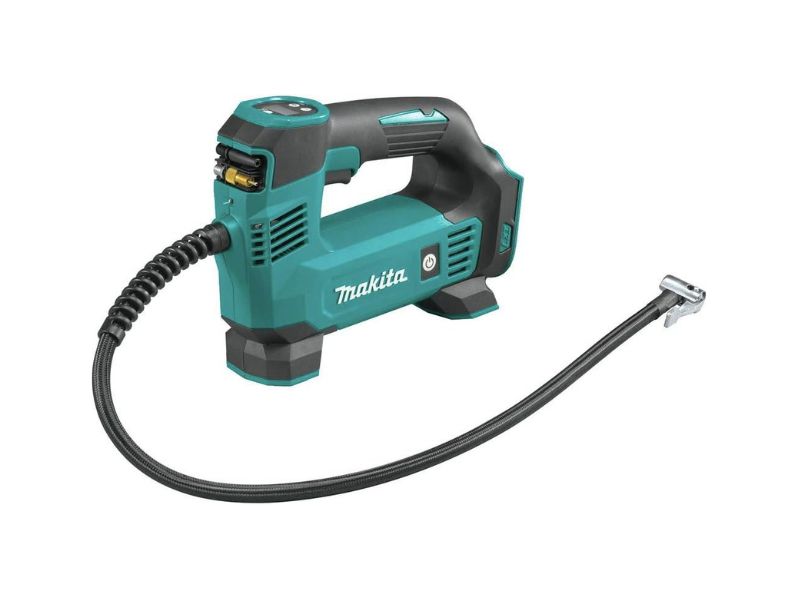
Key Features
- 18V LXT lithium-ion battery system
- Maximum pressure: 120 PSI
- Automatic stop function
- Backlit digital pressure display
- Built-in LED work light
- Approximately 25.5-inch hose
- Compact pistol-grip design
- Approximately 2.3 pounds without battery
- Presta valve adapter
- Sports-ball needle
- Tapered adapter
Detailed Review
The Makita DMP180ZX is the most obvious choice on this list for anyone who already owns Makita 18V LXT tools.
Instead of maintaining a separate internal battery and charger exclusively for a tire pump, the DMP180ZX accepts the same battery packs used throughout Makita’s enormous cordless-tool system.
That can make the inflator extremely practical for an established LXT owner.
The Makita-built motor produces up to 120 PSI, sufficient for passenger cars, light-truck top-offs, bicycles, motorcycles, and sports equipment.
Pressure can be preset using the digital controls. The auto-stop function shuts down inflation after reaching that target.
The approximately 25.5-inch hose is another practical advantage. Longer hoses allow the tool to rest or be held at a comfortable angle regardless of where the valve stem has stopped on the wheel.
Makita includes an LED work light and a backlit display for nighttime use.
The primary disadvantage is cost for new users.
The DMP180ZX is commonly treated as a tool-only product, meaning someone who does not already own a compatible LXT battery and charger may need to buy them separately.
For existing Makita users, that is hardly a drawback. For everyone else, a complete standalone inflator may be more economical.
What I Like
Battery sharing is a major advantage for existing Makita owners.
The long hose, auto-stop system, LED light, and ergonomic grip also make the tool pleasant to use.
What I Do Not Like
Value drops considerably if you have to purchase a battery and charger specifically for the inflator.
It is also larger than pocket-size models and is intended primarily for topping off car and light-truck tires rather than high-volume off-road use.
Verdict
The Makita DMP180ZX is the best handheld tire inflator for drivers already invested in the Makita LXT battery platform.
Its strong construction and replaceable battery make it particularly appealing for long-term ownership.
Hand Held Tire Inflator Comparison
| Product | Max PSI | Power | Approx. Airflow | Auto Stop | Backup Power | Best For |
| Airmoto Tire Inflator | 120 PSI | Built-in battery | 20 L/min | Yes | No | Best overall compact car inflator |
| Bosch EasyPump | 150 PSI | Built-in battery | 10 L/min | Yes | No | Build quality and routine top-offs |
| AstroAI L7 | 150 PSI | 4000mAh battery | 17 L/min | Yes | No | Best compact value |
| AstroAI 20V | 160 PSI | Removable 20V battery | Handheld-duty | Yes | 12V DC | Road trips and dual-power reliability |
| WooWind LP1 | 150 PSI | 4000mAh battery | 15–18 L/min | Yes | No | Simple everyday use |
| Xiaomi Air Compressor 2 | 150 PSI | 2000mAh battery | Compact-duty | Yes | No | Cars, motorcycles, scooters, bikes |
| Fanttik X8 APEX | 150 PSI | Built-in 28.8Wh battery | Fast compact-duty | Yes | No | Premium portable performance |
| OlarHike Tire Inflator | 160 PSI | Rechargeable battery | 24 L/min | Yes | 12V DC | Dual-power mini inflator |
| AVID POWER 20V | Passenger-car focused | Removable 20V battery | 28 L/min | Yes | 12V DC | Pistol-grip performance |
| Makita DMP180ZX | 120 PSI | 18V LXT battery | Tool-duty | Yes | No | Makita battery owners |
How to Choose the Best Hand Held Tire Inflator
Buying a handheld inflator based only on its maximum PSI number is one of the easiest ways to end up with the wrong product.
The specifications that matter most depend on the tire you are inflating and how far below the target pressure it normally gets.
Choose According to Tire Size
A bicycle tire can require high pressure but contains relatively little air.
A pickup tire may require lower pressure yet contain many times more air.
That means a tiny pump capable of 150 PSI can be brilliant for a bicycle but frustratingly slow on a large SUV tire.
For compact cars and sedans, most of the inflators in this guide are well suited to routine top-offs.
For midsize SUVs, favor models with stronger airflow and larger batteries.
For full-size pickups or oversized off-road tires, consider moving beyond the handheld category entirely and buying a dedicated high-output compressor.
Maximum PSI Does Not Equal Inflation Speed
This deserves emphasis because PSI dominates product marketing.
A 160 PSI pump is not automatically faster or more powerful than a 120 PSI pump.
Pressure describes how much force the compressor can generate.
Airflow describes how quickly it moves air.
Most passenger-car tires operate somewhere around 30–40 PSI, depending on the vehicle.
Therefore, both a 120 PSI compressor and a 150 PSI compressor already provide far more pressure capability than the typical car requires.
When choosing between them for car use, airflow and battery capacity may matter more.
Consider Airflow
Airflow may be listed in liters per minute or cubic feet per minute.
A tiny 10 L/min compressor and a 28 L/min handheld compressor can both reach 35 PSI.
The difference is how long they take to get there.
However, manufacturer airflow specifications are not always measured at the same pressure.
Compressor output typically falls as pressure rises.
For this reason, real tire-inflation tests are often more useful than comparing theoretical zero-pressure airflow alone.
Decide Between Pocket and Pistol-Grip Designs
Handheld inflators generally fall into two groups.
Pocket-Style Inflators
Examples include:
- Airmoto
- AstroAI L7
- WooWind LP1
- Xiaomi Air Compressor 2
- Fanttik X8 APEX
These maximize portability.
They are ideal for glove compartments, motorcycles, bicycles, scooters, and compact emergency kits.
The compromise is battery and cooling capacity.
Pistol-Grip Inflators
Examples include:
- AstroAI 20V
- AVID POWER 20V
- Makita DMP180ZX
These are larger but can accept bigger batteries and provide comfortable one-handed operation.
They work particularly well for households that regularly maintain several vehicle tires.
Built-In vs. Removable Batteries
A built-in battery keeps the product compact and self-contained.
There is no separate battery pack to lose, and USB charging is often available.
However, lithium-ion batteries gradually lose capacity with age.
When a permanently installed battery deteriorates, replacing it can be difficult.
A removable tool battery has the opposite characteristics.
The inflator becomes larger, but you can:
- Replace an aging battery
- Install a higher-capacity battery
- Swap depleted batteries
- Share packs with other tools
Makita is particularly attractive if you already use LXT equipment.
Look for 12V Backup Power
A rechargeable inflator can be fully charged when placed in the trunk and partially discharged months later when you actually need it.
Models such as the AstroAI 20V, OlarHike, and AVID POWER reduce this risk by providing a vehicle-power option.
Cordless mode gives you convenience.
12V mode gives you emergency redundancy.
That combination is excellent for long-distance road trips.
Automatic Shutoff Is Worth Having
Almost every inflator on this list provides automatic shutoff because it dramatically improves usability.
The basic process becomes:
- Connect the hose.
- Read the current pressure.
- Set the desired pressure.
- Start the compressor.
- Let it stop automatically.
You do not need to watch the display every second.
Auto-stop also reduces the possibility of accidentally continuing well beyond the desired pressure.
Pressure Accuracy Matters
A sophisticated compressor is not particularly useful if its gauge is consistently wrong.
Some manufacturers publish accuracy figures around ±1 PSI, while others allow a wider tolerance.
For ordinary car maintenance, a small difference is manageable.
Still, keeping a quality standalone tire gauge provides a useful reference.
Periodically compare your inflator against that gauge.
If both readings agree consistently, you can have greater confidence in the automatic cutoff.
Check Battery Capacity
Battery capacity affects how many tires you can service before recharging.
However, comparing mAh numbers directly can be misleading when battery voltages differ.
A better energy measurement is watt-hours.
Even then, actual runtime depends on:
- Tire size
- Starting pressure
- Target pressure
- Ambient temperature
- Battery age
- Compressor efficiency
- Cooling conditions
A device that performs eight minor top-offs may not be capable of completely filling eight empty tires.
Those are entirely different workloads.
USB-C Charging Is Convenient
USB-C has become particularly valuable for portable tools.
Instead of packing a proprietary charger, you may be able to use equipment already carried for phones, tablets, or power banks.
Bosch, WooWind, Fanttik, Xiaomi, and similar rechargeable designs benefit from simpler charging arrangements.
Consider Hose Length
Very short hoses keep a product compact but can create awkward positioning.
Imagine the tire valve stops at the twelve-o’clock position.
A tiny inflator with a short hose may have to hang from the valve or rest against the wheel.
A longer hose allows you to place the compressor safely on the ground.
This is one advantage of the Makita and OlarHike designs.
Do You Need a Presta Adapter?
If you own a road bike, gravel bike, or many modern mountain bikes, check the valve type.
Cars and many bicycles use Schrader valves.
Many performance bicycles use Presta valves.
A supplied Presta adapter saves you from carrying another component separately.
Think About LED Lighting
An LED may sound like a marketing extra until you have to locate a black valve stem beside a dark wheel at night.
Built-in illumination is genuinely useful for roadside emergencies.
It can also help you avoid losing valve caps in dark parking areas.
Pay Attention to Heat
Tiny compressors create a surprising amount of heat.
The cylinder repeatedly compresses air inside a very small enclosure.
As runtime increases, the hose connection, cylinder, and surrounding housing may become extremely warm.
Follow the manufacturer’s operating-time limits and cooling recommendations.
Do not assume that a pump capable of running for several minutes should necessarily be operated continuously for half an hour.
Handheld Tire Inflators Are Primarily for Top-Offs
This is perhaps the most important expectation to set.
A good handheld inflator is outstanding for:
- 28 PSI to 35 PSI
- 31 PSI to 36 PSI
- Motorcycle pressure adjustment
- Bicycle inflation
- Seasonal pressure changes
- TPMS warnings
- Slow leaks before professional repair
Completely filling a large tire from zero pressure creates a much heavier workload.
It may still be possible, but it consumes more battery, takes longer, and generates significantly more heat.
Hand Held Tire Inflator vs. 12V Corded Inflator
Neither design is universally better.
Advantages of Handheld Cordless Inflators
A handheld cordless pump provides:
- No power cable
- Easy movement between tires
- Easy motorcycle use
- Easy bicycle use
- Better portability
- Compact storage
- Convenience away from a vehicle
For frequent tire-pressure maintenance, cordless operation can make the difference between checking tires regularly and postponing the job.
Advantages of 12V Corded Inflators
A 12V inflator does not depend on a charged internal battery.
As long as the vehicle’s electrical system and accessory circuit are available, the pump has a power source.
Corded inflators can therefore be excellent emergency equipment.
They also often cost less because there is no large lithium battery included.
Which Is Better?
For maximum convenience, choose cordless.
For maximum long-term emergency readiness, choose 12V.
For both, choose a handheld model that supports battery power plus 12V backup.
Which Hand Held Tire Inflator Is Best for Cars?
For ordinary sedans and compact crossovers, I would narrow the choices to:
Airmoto for maximum portability.
AstroAI L7 for value and battery capacity.
Fanttik X8 APEX for stronger premium performance.
AstroAI 20V for removable-battery operation with 12V backup.
The right choice depends on how often you expect to use the tool.
Occasional emergency users may prioritize size.
Drivers who check pressure monthly may appreciate greater airflow and battery capacity.
Which Hand Held Tire Inflator Is Best for Motorcycles?
Motorcycles are an excellent application for handheld pumps.
Tires contain less air than automotive tires, meaning even small compressors can make pressure adjustments relatively quickly.
Storage space matters enormously on a motorcycle, however.
For that reason, the:
- Airmoto
- AstroAI L7
- WooWind LP1
- Xiaomi Air Compressor 2
- Fanttik X8 APEX
are particularly attractive motorcycle options.
Which Is Best for Bicycle Tires?
Bicycle use requires a slightly different set of priorities.
Look for:
- High maximum pressure
- Presta adapter
- Accurate gauge
- Small pressure adjustment increments
- Compact storage
- Low weight
Bosch EasyPump and Xiaomi Air Compressor 2 are particularly attractive here.
Road-bike owners should verify that the maximum pressure comfortably exceeds their tire requirement.
Can a Hand Held Tire Inflator Handle SUV Tires?
Yes, within reason.
Compact and midsize SUV tires are usually manageable for routine top-offs.
A large SUV tire that has fallen only 4 PSI is very different from an oversized off-road tire that has been intentionally aired down from 40 PSI to 15 PSI.
The first job is ideal for many handheld pumps.
The second is better handled by a high-output compressor.
Where Do I Find the Correct Tire Pressure?
The correct pressure for most passenger vehicles appears on the driver’s door-jamb placard.
It may also appear in the owner’s manual.
Do not inflate your tires to the maximum pressure printed on the tire sidewall unless that is specifically what the vehicle manufacturer requires.
The sidewall figure represents tire information and limits, not necessarily the ideal pressure for your particular vehicle.
Front and rear recommendations can also differ.
Frequently Asked Questions
What is the best hand held tire inflator?
The Airmoto Tire Inflator is my best overall choice for most drivers because it combines a genuinely compact body, cordless operation, automatic shutoff, a digital gauge, useful adapters, and enough performance for routine passenger-car tire maintenance.
For faster premium performance, consider the Fanttik X8 APEX.
What is the best small handheld tire inflator?
The AstroAI L7 is one of the strongest small options.
It weighs just over a pound, includes a 4000mAh battery, reaches 150 PSI, and offers digital automatic pressure control.
Are handheld tire inflators powerful enough for cars?
Yes, quality models work well for passenger-car tire top-offs.
They are most efficient when adding several PSI rather than filling a completely empty large tire.
Can a small tire inflator fill a flat tire?
Some can, but it will take considerably longer than a normal top-off.
Before inflating a completely flat tire, inspect it for obvious damage. A compressor cannot repair a puncture, sidewall cut, bead problem, or damaged tire structure.
Is 150 PSI enough?
Yes.
Most passenger-car tires operate far below 150 PSI.
Even 120 PSI is already more than sufficient for ordinary car tire pressures.
Is 160 PSI better than 120 PSI?
Not automatically.
A 120 PSI compressor with higher airflow may inflate a normal car tire faster than a 160 PSI compressor with low airflow.
Maximum pressure and airflow measure different things.
How fast should a handheld inflator work?
For a routine passenger-car top-off, one to several minutes per tire is typical depending on compressor output and the pressure increase required.
Completely filling an empty tire can take much longer.
Are cordless tire inflators reliable?
Good-quality models can be very reliable when properly charged and stored.
Battery readiness is the biggest difference compared with corded compressors.
Check the charge periodically, particularly before a long road trip.
How often should I charge my tire inflator?
Follow the manufacturer’s storage instructions, but periodically checking charge is sensible.
A convenient habit is to check the inflator whenever you perform your monthly tire-pressure inspection.
Can I leave a rechargeable tire inflator in my car?
Many drivers do, but vehicle interiors can experience extreme heat and cold.
Lithium-ion batteries generally perform best when protected from extreme temperatures.
Follow the manufacturer’s storage-temperature guidance.
Are digital gauges accurate?
Quality digital gauges are generally appropriate for routine vehicle maintenance.
Some manufacturers claim approximately ±1 PSI accuracy.
Periodically compare the inflator with a trusted standalone gauge if precise pressure matters.
Does auto shutoff prevent overinflation?
Automatic shutoff stops the compressor when the selected target is reached.
It greatly reduces accidental overinflation, but you still need to enter the correct target pressure.
Can I use a handheld tire inflator for bike tires?
Yes.
Check maximum pressure and valve compatibility.
If the bike uses a Presta valve, make sure the required adapter is supplied or purchase one separately.
Can I use one for motorcycle tires?
Yes.
Handheld inflators are particularly convenient for motorcycles because the tires require less air volume than large automotive tires and storage space is limited.
Which is better: built-in battery or removable battery?
A built-in battery provides maximum compactness.
A removable battery provides easier replacement, higher-capacity options, and the ability to swap batteries immediately.
The better option depends on whether portability or long-term flexibility matters more to you.
What is the advantage of 12V backup power?
It allows the compressor to continue operating even if its rechargeable battery is depleted.
This makes dual-power models particularly useful as vehicle emergency equipment.
Why does my handheld tire inflator get hot?
Compressing air generates heat.
Compact compressors have small cylinders and limited cooling area, so heat builds quickly during extended operation.
Follow the recommended maximum runtime and cooling interval.
Can I use a handheld inflator on truck tires?
Small passenger-truck top-offs may be possible with stronger models, but handheld inflators are generally not ideal for oversized truck, commercial, or off-road tires.
A dedicated high-flow compressor is better for those applications.
Can a tire inflator repair a puncture?
No.
A tire inflator only replaces lost air.
A leaking or damaged tire still requires inspection and proper repair or replacement.
Should I check tire pressure when the tires are hot or cold?
Vehicle manufacturers generally specify cold tire pressure.
Checking before significant driving provides the most consistent measurement because driving heats the tires and increases pressure temporarily.
Final Thoughts
The Airmoto Tire Inflator Portable Air Compressor is my first recommendation for most buyers searching for the best hand held tire inflator. Its combination of portability, automatic shutoff, digital pressure monitoring, rechargeable operation, and broad adapter compatibility makes it an excellent everyday car and motorcycle tool.
The Bosch EasyPump is an outstanding alternative when build quality and ergonomics matter more than maximum inflation speed.
For budget-conscious buyers, the AstroAI L7 offers an impressive combination of a 4000mAh battery, 150 PSI capability, compact dimensions, and automatic pressure control.
The larger AstroAI 20V is better for drivers who want a removable battery and the security of 12V backup power.
The WooWind LP1 and Xiaomi Portable Electric Air Compressor 2 are excellent multi-purpose choices for cars, motorcycles, scooters, and bicycles.
If you want stronger compact performance and do not mind paying more, the Fanttik X8 APEX is one of the most complete premium handheld options.
The OlarHike and AVID POWER stand out when dual power is important, while the Makita DMP180ZX is a natural choice for anyone who already owns Makita 18V LXT batteries.
Whichever model you choose, focus less on the biggest PSI number and more on airflow, battery capacity, auto-stop accuracy, tire size, hose design, charging convenience, and realistic inflation workload.
For routine passenger-car tire maintenance, a well-designed handheld inflator can eliminate trips to public air pumps and make maintaining correct tire pressure dramatically easier.