Truck tires hold significantly more air than typical passenger-car tires, so choosing the best 12V tire inflator for trucks requires more than looking at maximum PSI. Airflow, duty cycle, power connection, hose reach, heat management, and the size of tire the compressor can realistically handle all matter.
My primary recommendation is the GSPSCN 12V Heavy Duty Dual Cylinder Tire Inflator. Its dual-cylinder design produces approximately 70 liters per minute of airflow, while the 150 PSI maximum pressure, direct battery connection, extension hose, and compact metal body make it particularly useful for pickups, SUVs, vans, RVs, and everyday truck emergencies. It also has the largest owner-feedback history among the three models selected here.
For truck owners who prioritize established build quality and independent inflation performance, I would choose the VIAIR 88P Portable 12V Air Compressor. It is specifically designed for tires up to approximately 33 inches and combines a direct battery connection with a long air hose, brass tire chuck, 120 PSI pressure capability, and excellent inflation speed for its compact size.
If you regularly run oversized truck or off-road tires, the Smittybilt 2781 High Performance 12V Air Compressor provides substantially greater airflow. Its heavy-duty motor, long coiled air hose, thermal protection, and high-volume output make it especially attractive for large truck, Jeep, and off-road tires that would make a small inflator work for an uncomfortably long time.
Best 12V Tire Inflator for Trucks
1. GSPSCN 12V Heavy Duty Dual Cylinder Tire Inflator – Best Overall
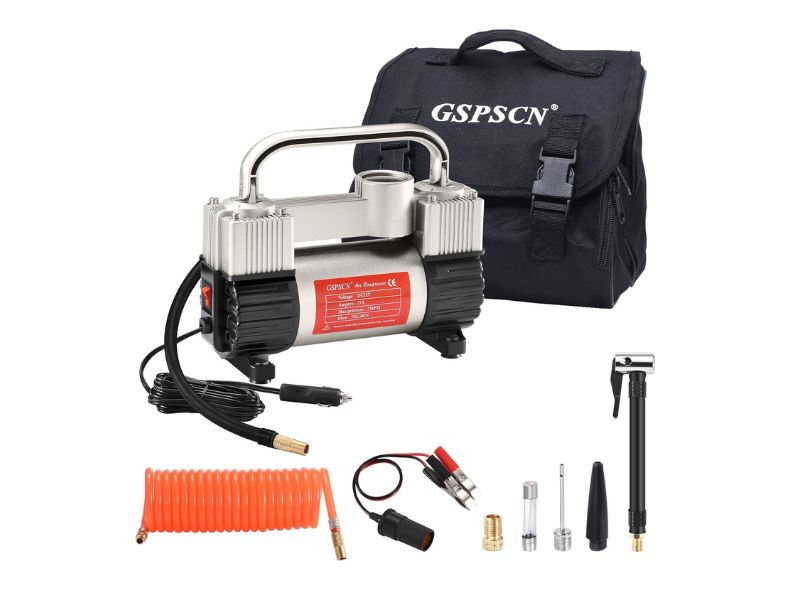
Key Features
- 12V direct-current operation
- Dual-cylinder compressor design
- Approximately 70 L/min airflow
- Up to 150 PSI maximum pressure
- Direct battery-clamp connection
- Approximately 20A maximum current
- Long extension air hose
- Multiple inflation adapters
- Metal and reinforced housing
- Carrying bag included
- Suitable for pickups, SUVs, vans, RVs, and cars
The GSPSCN takes my first position because it combines high airflow, strong review volume, truck-friendly accessories, and a relatively affordable portable design.
Truck owners should pay particular attention to the dual-cylinder compressor.
A small single-cylinder inflator can have enough pressure to reach 35, 50, or even 80 PSI, but maximum pressure does not tell you how quickly it can fill a large tire. Truck tires contain much more air volume than compact-car tires, which is why airflow matters so much.
At approximately 70 liters per minute, the GSPSCN has enough volume to make normal pickup-tire top-offs much more reasonable than a tiny cigarette-lighter inflator.
Dual Cylinders Make Sense for Truck Tires
The compressor uses two cylinders working together.
That gives the pump greater air-delivery capability than many miniature 12V units.
This is particularly useful if your truck has:
- Large all-terrain tires
- LT-rated tires
- Higher recommended inflation pressure
- Large 17-, 18-, or 20-inch wheels
- Tires that are regularly aired down
- A trailer that also needs inflation
A truck tire that only needs to move from 33 PSI to 36 PSI is relatively easy for almost any decent compressor.
The real difference appears when you need to recover a significantly underinflated tire or inflate several large tires consecutively.
Direct Battery Power Is a Major Advantage
The GSPSCN can connect directly to the vehicle battery.
This is preferable for a relatively powerful compressor because a normal 12V accessory socket may have a limited fuse rating.
High-output compressors can require substantially more current than small dashboard-socket inflators.
Connecting directly to the battery reduces the need to push high electrical current through the truck’s interior accessory wiring.
You should keep the vehicle running when instructed by the compressor manufacturer so the alternator helps maintain system voltage during inflation.
150 PSI Gives Plenty of Pressure Headroom
The compressor is rated up to 150 PSI.
Most pickup tires operate nowhere near that maximum, but additional pressure capability means the compressor is not working at its absolute limit during ordinary inflation.
Remember that you should inflate a truck tire to the vehicle manufacturer’s recommended pressure, usually shown on the driver’s door-jamb placard.
Do not inflate a tire to 150 PSI simply because the compressor can theoretically produce it.
Long Hose Improves Truck Usability
Full-size pickups can be surprisingly long.
A compressor may sit near the front battery while you need to reach a rear tire several feet away.
The supplied extension hose makes this much easier.
Long reach also helps with:
- Crew-cab pickups
- Long-bed trucks
- Vans
- RVs
- Trailers
- Dual-axle utility trailers
This is one area where many compact inflators become frustrating.
Portable Enough for Permanent Truck Storage
Despite its dual-cylinder arrangement, the GSPSCN remains relatively compact.
It can fit inside:
- Under-seat storage
- A truck toolbox
- Behind the rear seat
- An emergency equipment tote
- An RV storage compartment
The included storage bag also helps keep the compressor, hose, adapters, and battery clamps together.
That may sound minor, but small inflation adapters are easy to lose when they are stored loose in a truck toolbox.
Suitable for More Than Truck Tires
The additional inflation adapters extend usefulness beyond pickup tires.
You can also use an appropriate attachment for things such as:
- Passenger-car tires
- SUV tires
- Motorcycle tires
- Bicycle tires with compatible valves/adapters
- Trailer tires
- Sports balls
- Certain inflatables
For a truck emergency kit, versatility is always useful.
What I Like
- Strong owner-feedback history
- Dual-cylinder design
- Approximately 70 L/min airflow
- 150 PSI maximum capability
- Direct battery connection
- Good truck-tire performance
- Long extension hose
- Metal construction
- Carrying bag included
- Useful for pickups, RVs, SUVs, and trailers
- Strong value for the output
What I Do Not Like
- Heavier than compact car inflators
- Analog operation is less convenient than premium digital auto-stop systems
- Compressor and hose components can become hot during extended operation
- Not intended to replace a full-size shop compressor
Verdict
The GSPSCN is my best overall 12V tire inflator for trucks because its dual-cylinder 70 L/min design delivers the kind of airflow larger tires need while remaining compact enough to permanently store in a pickup.
2. VIAIR 88P Portable 12V Air Compressor – Best Proven Truck Inflator
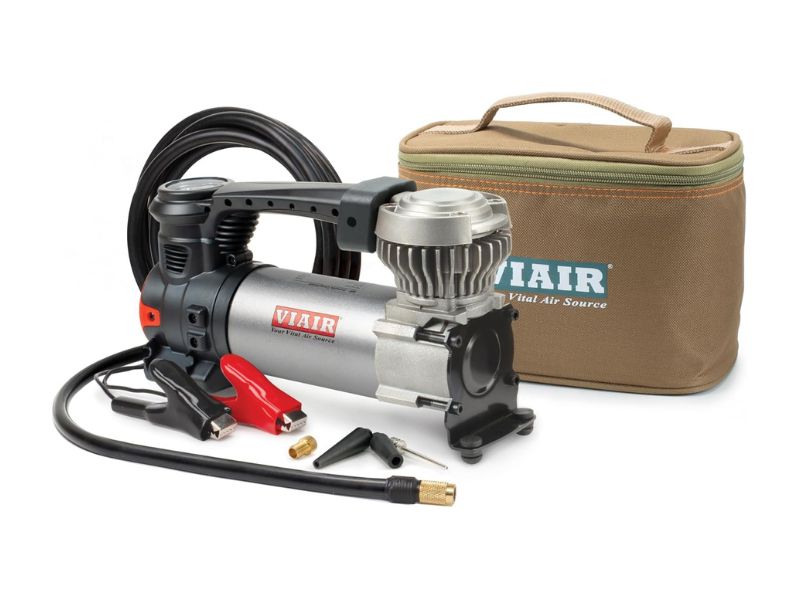
Key Features
- 12V direct battery operation
- 120 PSI maximum pressure
- Approximately 1.47 CFM free-flow rating
- Designed for tires up to about 33 inches
- Approximately 20A maximum current
- Long air hose
- Direct battery clamps
- Solid brass twist-on tire chuck
- LED power indicator
- Multiple inflation tips
- Carrying bag included
- Compact metal housing
The VIAIR 88P is the product I would choose if proven truck performance is more important to you than having the largest specification numbers.
It has been available for years and has accumulated a large body of user experience with pickup trucks, SUVs, 4x4s, and off-road vehicles.
More importantly, it performs well in actual inflation testing.
Designed Around Larger Tires
The 88P is intended for tires up to approximately 33 inches.
That makes it suitable for many:
- Half-ton pickups
- Midsize pickups
- SUVs
- Jeeps
- 4x4s
- Stock or moderately upgraded off-road vehicles
If your truck has factory-size tires or modest all-terrain upgrades, 33-inch capability covers a broad range of configurations.
People running 35-, 37-, or 40-inch off-road tires should look toward a higher-flow compressor instead.
Excellent Real-World Inflation Speed
The VIAIR may advertise lower airflow than some dual-cylinder competitors, but the compressor has demonstrated strong real-world truck-tire performance.
This is an important reminder that specifications do not tell the entire story.
Motor design, cylinder efficiency, electrical connections, heat management, hose restriction, and pressure level all influence actual inflation time.
For a normal pickup owner who occasionally needs to:
- Correct low tire pressure
- Inflate after a slow leak
- Air up after mild off-road driving
- Adjust pressures before towing
the 88P is a very capable tool.
Direct Battery Clamps
Like the GSPSCN, the VIAIR connects directly to the vehicle’s battery.
This helps the compressor draw the current it needs without relying on a low-amperage accessory socket.
The process is slightly less convenient than plugging into a dashboard outlet because you need to open the hood.
However, I prefer direct battery power for a serious truck compressor.
The additional electrical capacity is more important than saving thirty seconds during setup.
Long Combined Reach
The power cord and air hose provide enough combined reach to work around many full-size vehicles.
You can position the compressor near the battery while taking the hose toward the rear tires.
This is especially important with:
- Extended cabs
- Crew cabs
- Long beds
- SUVs
- Trailers
Short hoses become annoying very quickly on larger vehicles.
Brass Twist-On Chuck
VIAIR uses a solid brass twist-on tire chuck.
The threaded connection takes slightly longer to attach than a lever-style chuck, but it creates a secure seal around the valve stem.
Air leakage around the connection wastes compressor output and makes pressure readings less reliable.
A solid tire connection therefore matters more than it may initially appear.
Simple Analog Operation
The 88P is intentionally uncomplicated.
There is no elaborate touchscreen, battery, wireless connection, or menu system.
Connect power, attach the hose, and run the compressor.
That simplicity can be a major advantage in an emergency.
However, it also means you do not get automatic pressure shutoff.
You need to monitor tire pressure yourself and stop inflation when the desired PSI is reached.
Strong Choice for Off-Road Use
Truck and SUV owners who air down tires for sand, trails, snow, or rocky terrain create a much more demanding workload than drivers who simply add two PSI every few months.
Imagine four large tires reduced from approximately 35 PSI to 18 PSI for off-road traction.
After leaving the trail, all four need significant reinflation.
A small portable inflator may eventually complete the job, but it may take a very long time and accumulate substantial heat.
The VIAIR 88P is much better suited to this type of moderate off-road use than the average low-cost 12V car inflator.
What I Like
- Excellent independent truck/SUV inflation performance
- Large owner-feedback history
- Purpose-built for tires up to approximately 33 inches
- Direct battery connection
- Strong brass tire chuck
- Good hose reach
- Compact construction
- Easy controls
- Established brand in portable compressors
- Excellent for pickups and 4x4s
What I Do Not Like
- 120 PSI maximum is lower than several competitors
- No automatic shutoff
- Analog gauge requires manual monitoring
- Must connect directly to the battery
- Not ideal for very large 35-inch-plus tires
Verdict
The VIAIR 88P is my favorite choice for truck owners who want a proven, straightforward 12V compressor with excellent real-world performance on normal pickup and SUV tires.
3. Smittybilt 2781 High Performance 12V Air Compressor – Best for Oversized Truck Tires
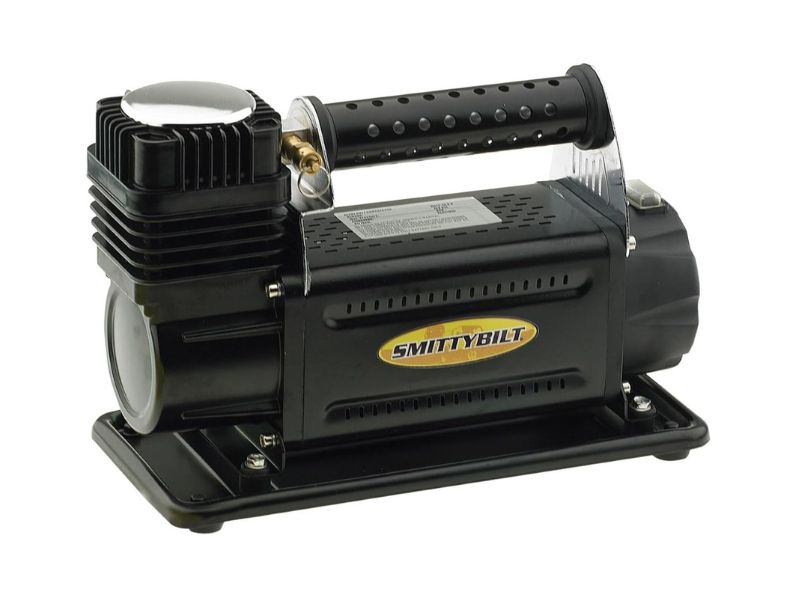
Key Features
- Heavy-duty 12V compressor
- High-volume airflow
- Up to 150 PSI pressure capability
- Direct battery connection
- Approximately 45A maximum current
- Long 24-foot coiled air hose
- Approximately 10-foot power cable
- Automatic thermal cutoff
- Heavy-duty battery clamps
- Brass inflation fitting
- Carrying bag included
- Designed for large off-road tires
The Smittybilt 2781 is in a different performance class from a normal compact emergency inflator.
Its major advantage is high airflow.
Large off-road and truck tires contain a tremendous volume of air. This makes airflow much more important than simply advertising 150 PSI.
Better Choice for 35-Inch and Larger Tires
If your truck runs factory highway tires, this much compressor may be unnecessary.
But if your vehicle uses:
- 35-inch tires
- Oversized all-terrain tires
- Mud-terrain tires
- Lifted truck configurations
- Large Jeep tires
- Off-road tire setups
the additional compressor output begins to make a lot of sense.
A high-flow compressor can reduce the amount of time you spend standing beside the vehicle after airing down.
That is particularly valuable when all four tires need 15–25 PSI added after every trail trip.
Substantial Airflow
The 2781 is built around a powerful 12V motor and high-volume compressor.
This means it draws substantially more current than a small inflator.
That is why it connects directly to the battery rather than relying on an interior accessory socket.
The higher current demand is a reasonable tradeoff for serious inflation capability.
For truck use, I would rather have a compressor connected properly to the battery than an underpowered pump limited by a small accessory fuse.
24-Foot Coiled Hose
The 24-foot air hose is one of the biggest practical advantages.
You can position the compressor near the truck battery and still comfortably move around a large vehicle.
This is particularly convenient on:
- Crew-cab pickups
- Long-bed pickups
- Full-size SUVs
- Lifted trucks
- Trailers
You should not need to move the compressor every time you switch tires.
Thermal Protection
High-output compressors generate considerable heat.
Smittybilt uses an automatic thermal cutoff designed to protect the compressor when operating temperature becomes excessive.
This is important during repeated tire inflation.
Even with thermal protection, you should follow the specified duty cycle and avoid touching hot compressor components immediately after operation.
Better for Off-Road Air-Up Cycles
Suppose you regularly drop four 35-inch tires from highway pressure to approximately 15–18 PSI on the trail.
At the end of the day, you need to restore all four tires before highway driving.
That workload is much more demanding than topping a tire from 32 to 35 PSI.
A compressor like the Smittybilt makes sense because it is built to move a much larger volume of air.
Bigger and Heavier
There is no avoiding the biggest disadvantage.
The Smittybilt is substantially larger and heavier than either of the first two inflators.
It belongs in:
- A pickup toolbox
- Off-road recovery kit
- SUV cargo compartment
- Garage
- Overlanding storage system
rather than a small glove compartment.
For an off-road truck, the weight is reasonable.
For a daily-driven midsize pickup with standard tires, the VIAIR or GSPSCN is easier to justify.
What I Like
- Excellent airflow for large tires
- Strong owner-feedback history
- Suitable for oversized truck/off-road tires
- 150 PSI capability
- Long 24-foot air hose
- Direct battery connection
- Automatic thermal protection
- Strong clamps
- Heavy-duty construction
- Good for repeated air-down/air-up use
What I Do Not Like
- Significantly heavier than compact inflators
- High current draw
- Requires substantial storage space
- Compressor becomes hot during use
- More capability than normal stock truck tires require
Verdict
The Smittybilt 2781 is the strongest choice here for oversized truck tires and regular off-road inflation, where high airflow matters much more than minimum size.
12V Truck Tire Inflator Comparison
| Product | Max Pressure | Airflow | Power Connection | Tire Size Focus | Hose Reach | Best For |
| GSPSCN Dual Cylinder | 150 PSI | ~70 L/min | Battery clamps | Standard/large truck tires | Long extension hose | Best overall |
| VIAIR 88P | 120 PSI | 1.47 CFM | Battery clamps | Up to ~33 in | Long hose + cord | Proven truck use |
| Smittybilt 2781 | 150 PSI | High-volume | Battery clamps | 35 in+ class | 24-ft coil hose | Oversized/off-road tires |
Quick Comparison Summary
The GSPSCN 12V Heavy Duty Dual Cylinder Tire Inflator is my overall recommendation because it combines strong airflow, 150 PSI pressure capability, long reach, a compact design, and the largest customer-feedback history of the three.
The VIAIR 88P is the model I prefer for a stock or moderately modified pickup where long-term reputation and proven real-world inflation performance are priorities.
The Smittybilt 2781 becomes the better investment when large off-road tires are involved. Its high airflow and long hose are particularly useful when four oversized tires need significant pressure added after trail driving.
How I Chose the Best 12V Tire Inflators for Trucks
A truck inflator has a harder job than a normal compact-car tire pump.
I therefore gave additional weight to:
- Airflow
- Maximum working pressure
- Direct battery connection
- Truck-tire compatibility
- Hose length
- Current draw
- Duty cycle
- Thermal protection
- Clamp construction
- Tire-chuck quality
- Portability
- Storage
- Established owner feedback
- Real-world inflation testing
I did not simply choose the three compressors advertising the highest PSI.
That specification alone can be extremely misleading.
Why Airflow Matters More Than Maximum PSI
This is the most important concept when buying a truck tire inflator.
You may see two compressors:
Compressor A: 150 PSI, 20 L/min
Compressor B: 120 PSI, 45 L/min
A buyer looking only at maximum pressure may assume Compressor A is stronger.
For a truck tire that needs 35–45 PSI, however, Compressor B may inflate dramatically faster because it moves much more air.
Most pickup tires do not need anything close to 120 PSI, let alone 150 PSI.
They need air volume.
That makes liters per minute or cubic feet per minute one of the most useful specifications.
LPM vs. CFM Explained
Inflator airflow can be listed in either:
- LPM — liters per minute
- CFM — cubic feet per minute
They measure essentially the same concept using different units.
Higher airflow generally means faster inflation, particularly on large-volume tires.
However, compare figures carefully.
Some manufacturers state free-flow airflow, meaning airflow with almost no resistance.
Actual airflow decreases as tire pressure rises.
Therefore, real-world inflation testing remains valuable.
Why Truck Tires Need More Powerful Inflators
A truck tire can be significantly:
- Wider
- Taller
- Higher volume
- Higher pressure
than a normal passenger-car tire.
Consider the difference between a small sedan tire and a 35-inch all-terrain tire.
Even if both eventually need 35 PSI, the larger tire contains much more air.
A tiny pump may technically be able to reach the required pressure but take an unreasonable amount of time to do so.
During that extended operation, heat can also become a problem.
This is why truck owners should prioritize airflow and duty cycle.
What PSI Should a Truck Tire Inflator Have?
For normal pickups, a compressor capable of 100–150 PSI provides plenty of pressure range.
Do not confuse compressor maximum PSI with the correct tire pressure.
Your truck may require:
- 32 PSI
- 35 PSI
- 40 PSI
- 50 PSI
- 65 PSI
- 80 PSI
depending on tire type, vehicle load, and manufacturer requirements.
Check the driver’s door-jamb placard and tire/load requirements.
Do not simply use the maximum pressure written on the tire sidewall.
Best Airflow for a Truck Tire Inflator
For occasional emergency top-offs, moderate airflow can be adequate.
For regular truck use, I prefer approximately 40 L/min or more.
Around 60–70 L/min becomes much more attractive for large tires.
Off-road owners regularly reinflating 35-inch or larger tires can benefit from even greater airflow.
The ideal output depends on how you use the compressor.
Occasional Highway Top-Offs
You usually do not need extreme airflow.
A quality VIAIR 88P-style compressor is plenty for many applications.
Large Pickup Tires
A dual-cylinder compressor around 70 L/min can reduce waiting significantly.
Regular Off-Road Use
High-volume units such as the Smittybilt make more sense because you may need to add substantial air to all four tires in one session.
Battery Clamps vs. 12V Cigarette-Lighter Plug
Many small inflators plug into a vehicle’s 12V accessory socket.
This is convenient but limits how much electrical current the compressor can safely draw.
An accessory socket might be protected by:
- 10A fuse
- 15A fuse
- 20A fuse
depending on the vehicle.
A heavy-duty compressor can draw more current than that.
This is why most serious truck compressors connect directly to the battery using alligator clamps.
Direct battery connection provides a higher-current electrical path and reduces the risk of repeatedly blowing an accessory-socket fuse.
Why You May Need to Run the Truck During Inflation
A strong 12V compressor can draw 20, 30, or even 40+ amps.
Running the truck lets the alternator help supply electrical power.
Without the engine operating, the compressor draws entirely from the battery and could significantly discharge it.
Follow the compressor manufacturer’s instructions.
Also operate the vehicle only in a safe, appropriately ventilated environment.
Never leave an engine running inside a closed garage.
What Is Compressor Duty Cycle?
The duty cycle describes how long a compressor can run within a specified period before needing to cool.
For example, a compressor might be designed to run:
- 10 minutes continuously
- 20 minutes continuously
- 40 minutes at a specified pressure
before requiring a cooling period.
Truck owners should care about duty cycle because large tires demand longer operating times.
If you regularly inflate four oversized tires, a small compressor with a short duty cycle can become frustrating.
Why Compressors Get Hot
Compressing air creates heat.
Portable 12V compressors can become extremely hot during operation.
Hot areas may include:
- Compressor head
- Cylinder
- Metal hose fitting
- Air hose near compressor
- Heat sink
Do not immediately grab metal parts after a long inflation session.
Use handles and designated touch points.
Allow the compressor to cool according to the instructions before storing it.
Best 12V Inflator for a Half-Ton Truck
For a typical half-ton pickup running factory-size tires, either the GSPSCN or VIAIR 88P is a sensible choice.
The VIAIR is particularly attractive when your tire diameter is within its intended range.
The GSPSCN offers additional airflow and pressure headroom while remaining relatively compact.
Examples of half-ton trucks include common configurations of:
- Ford F-150
- Chevrolet Silverado 1500
- GMC Sierra 1500
- Ram 1500
- Toyota Tundra
Actual tire size matters more than the truck badge.
Best Tire Inflator for a 3/4-Ton Truck
Three-quarter-ton pickups frequently use LT tires with higher operating pressure.
A compressor with 150 PSI capability and strong airflow is therefore attractive.
I would give the GSPSCN serious consideration for normal emergency use.
For trucks equipped with large aftermarket tires, the Smittybilt may be worth its additional size.
Best Tire Inflator for a 1-Ton Truck
One-ton pickups can use larger, higher-pressure tires, particularly under towing or payload conditions.
For this application, prioritize:
- High airflow
- 150 PSI capability
- Direct battery connection
- Long hose
- Good duty cycle
A compressor like the Smittybilt becomes more attractive when the vehicle uses particularly large tires.
Always verify that the compressor is suitable for the actual tire size and pressure range rather than buying solely based on the truck’s weight classification.
Best 12V Tire Inflator for Diesel Trucks
The fact that the truck has a diesel engine does not directly change tire inflation requirements.
What matters is that diesel trucks are often:
- Larger
- Heavier
- Equipped with LT tires
- Used for towing
- Equipped with higher-pressure tires
This tends to push owners toward more capable compressors.
A 150 PSI heavy-duty unit provides useful pressure headroom for many diesel pickup applications.
Best Inflator for 33-Inch Truck Tires
The VIAIR 88P is especially well suited to approximately 33-inch tires.
That is the tire size range around which the model is designed.
It makes a good choice for stock and moderately modified trucks, Jeeps, and SUVs.
Best Inflator for 35-Inch Truck Tires
For 35-inch tires, I prefer more airflow.
The Smittybilt 2781 makes more sense because large off-road tires contain substantially more air.
A smaller compressor can still work, but the inflation process may take considerably longer.
Best Inflator for Off-Road Trucks
Off-road use is much more demanding than correcting ordinary seasonal pressure loss.
Drivers often deliberately lower tire pressure to improve:
- Traction
- Ride comfort
- Tire footprint
- Performance on sand
- Performance on rocks
Before returning to highway speeds, those tires need to be reinflated.
A high-flow compressor is therefore one of the most important pieces of equipment in an off-road truck.
For frequent air-down/air-up cycles, I would choose the Smittybilt among these three.
Analog vs. Digital Tire Inflators
Analog Inflators
Advantages:
- Simple
- Reliable
- No complicated menus
- Easy to operate
Disadvantages:
- Gauge may be less precise
- No automatic shutoff
- Must monitor pressure manually
Digital Inflators
Advantages:
- Easy pressure reading
- Preset PSI
- Automatic shutoff
- More convenient for routine top-offs
Disadvantages:
- More electronics
- Displays can fail
- Often found on lower-airflow consumer inflators
For truck tires, I prioritize compressor performance first.
I would rather have a fast analog compressor than a very slow digital model simply because it has a nicer display.
Is Automatic Shutoff Important?
Automatic shutoff is convenient but not essential.
With an auto-stop inflator, you can select a target such as 38 PSI and let the compressor stop automatically.
The heavy-duty models in this guide emphasize airflow and rugged operation more than automation.
When using a manual inflator, monitor pressure carefully.
A separate quality tire-pressure gauge is useful even if the compressor includes its own gauge.
Why Hose Length Matters on Trucks
Pickup trucks are long.
A crew-cab long-bed truck can be far longer than the typical compact car used to design inexpensive inflators.
If the compressor needs to remain near the front battery, the air hose must still reach the rear tires.
For this reason, I strongly prefer truck inflators with:
- Long air hoses
- Extension hoses
- Long power cables
The Smittybilt’s 24-foot coiled hose is particularly useful in this respect.
Tire Chuck Types
The tire chuck connects the air hose to the valve stem.
Common designs include:
Screw-On Chuck
Provides a secure connection with relatively little leakage.
The VIAIR 88P uses this general approach.
Lever Chuck
Quick to connect and remove.
Quality varies considerably.
Quick-Connect Hose System
Useful on higher-output compressors because hoses and accessories can be changed quickly.
Whichever system you choose, a solid airtight connection is essential.
Do You Need a 150 PSI Inflator for a Truck?
Not necessarily.
Many truck tires operate well below 100 PSI.
A 120 PSI compressor can therefore be perfectly adequate.
The reason 150 PSI units are attractive is pressure headroom, especially for LT tires, trailers, and other higher-pressure applications.
Do not automatically choose a slower 150 PSI compressor over a much faster 120 PSI unit.
Again, airflow matters.
Tire Pressure for Towing
Towing changes vehicle load, but you should not arbitrarily increase tire pressure beyond approved limits.
Follow:
- Truck manufacturer recommendations
- Tire load tables where appropriate
- Tire manufacturer’s guidance
- Trailer tire requirements
Maintaining correct pressure is especially important while towing because tires experience greater heat and load.
A portable compressor is valuable for correcting pressure before starting a long towing trip.
Can These Inflators Handle Trailer Tires?
Yes, provided the compressor’s pressure capability and duty cycle match the trailer tire.
Truck owners frequently need to inflate:
- Travel-trailer tires
- Boat-trailer tires
- Utility-trailer tires
- Car-hauler tires
Trailer tires may require relatively high pressure.
Always check the pressure rating and required cold inflation PSI.
Can a 12V Tire Inflator Inflate a Completely Flat Truck Tire?
A capable compressor can inflate a completely deflated tire if the tire and wheel are otherwise functional and the bead remains properly seated.
An inflator cannot fix:
- Punctures
- Torn sidewalls
- Damaged valve stems
- Bent wheels
- Unseated beads in many situations
- Internal tire failure
If the tire lost all pressure unexpectedly, determine why before relying on inflation alone.
Tire Repair Kit and Inflator Combination
For remote travel, I recommend carrying a tire-plug kit alongside the compressor if you know how to use one safely and the tire damage is appropriate for a temporary repair.
A common tread puncture may sometimes be temporarily addressed enough to reach professional service.
Sidewall damage should not be repaired with a typical plug.
A compressor cannot overcome a major leak.
Should You Carry a Spare Tire Too?
Yes.
A compressor solves low pressure.
It does not solve every tire failure.
A spare remains critical when the tire experiences:
- Large puncture
- Sidewall tear
- Blowout
- Wheel damage
- Bead failure
The ideal truck roadside setup includes both a spare and a capable inflator.
How to Use a 12V Truck Tire Inflator
Park the truck on a safe, stable surface.
Check the recommended tire pressure.
Position the compressor where it has ventilation and will not contact moving engine components.
Connect the positive and negative battery clamps according to the compressor instructions.
Start the truck if instructed and safe to do so.
Attach the air hose securely to the tire valve.
Turn the compressor on.
Monitor pressure.
Stop at the vehicle’s recommended PSI.
Remove the hose carefully because nearby fittings may be hot.
Disconnect electrical power.
Allow the compressor to cool before placing it back in the storage bag.
How Often Should You Check Truck Tire Pressure?
Check pressure at least monthly and before:
- Long trips
- Towing
- Hauling heavy loads
- Off-road trips
- Significant temperature changes
Measure tire pressure when the tires are cold whenever possible.
Pressure naturally increases as tires warm during driving.
Why Tire Pressure Drops in Cold Weather
Air contracts as temperature decreases.
As a general rule, tire pressure can change roughly 1 PSI for every 10°F change in temperature, although actual results vary.
That is why tire-pressure warning lights commonly appear on the first cold mornings of fall or winter.
A 12V inflator kept in the truck makes seasonal corrections easy.
Truck Tire Inflator Maintenance
Portable compressors require relatively little maintenance.
Still, you should occasionally inspect:
- Power cable
- Battery clamps
- Fuse
- Air hose
- Tire chuck
- Hose fittings
- Compressor filter
- Carrying case
Clean dust from ventilation openings.
Replace damaged hoses or electrical cables rather than continuing to use them.
Keep the compressor dry during storage.
Common Buying Mistakes
Buying Based Only on PSI
A tiny 150 PSI compressor can be much slower than a larger 120 PSI unit.
Look at airflow.
Choosing a Small Accessory-Socket Inflator
These can be fine for cars but may take too long on large truck tires.
Ignoring Duty Cycle
A compressor that overheats after one large tire is inconvenient if you need to inflate four.
Buying Too Little Hose
Make sure the compressor can reach every tire from its power connection.
Expecting a Compressor to Repair a Tire
It only adds air.
It does not repair physical damage.
Using Tire Sidewall Maximum Pressure
Use the vehicle’s recommended inflation pressure, not automatically the maximum molded into the tire.
Storing the Compressor Without Testing It
Test a new inflator at home.
Learn how the connections work before you need it beside a dark highway.
Frequently Asked Questions
What is the best 12V tire inflator for trucks?
The GSPSCN dual-cylinder 12V inflator is my best overall choice for most truck owners.
Its approximately 70 L/min airflow, 150 PSI capability, direct battery connection, long extension hose, and compact storage design make it suitable for pickups, SUVs, vans, RVs, and trailers. The VIAIR 88P is a strong alternative for tires up to approximately 33 inches, while the Smittybilt is better for oversized off-road tires.
Which 12V truck tire inflator has the most reviews?
The GSPSCN dual-cylinder model has the largest current feedback history among these three selections.
It has accumulated more than eleven thousand ratings in current listing snapshots, followed by the VIAIR 88P with roughly eight thousand and the Smittybilt 2781 with around three thousand.
Is 150 PSI enough for truck tires?
Yes, 150 PSI provides more than enough pressure capability for most pickup tires.
The correct tire pressure will normally be much lower. Check the driver’s door placard and applicable tire/load information rather than using the compressor’s maximum PSI.
Is 120 PSI enough for a truck tire inflator?
Yes, 120 PSI is sufficient for many pickup and SUV tires.
The VIAIR 88P is a good example. Although rated to 120 PSI, it performs very well on appropriately sized truck and SUV tires because airflow and compressor efficiency matter as much as maximum pressure.
How many CFM do I need for truck tires?
Higher airflow significantly reduces inflation time on large truck tires.
Around 1.5 CFM can be sufficient for normal pickup use, while 2 CFM and above becomes increasingly useful for larger tires and off-road air-up cycles. Very large tires benefit from even more airflow.
Is a dual-cylinder tire inflator better?
Dual-cylinder compressors can provide excellent airflow for their size.
They are particularly useful when larger tires require substantial amounts of air. However, cylinder count alone does not guarantee performance; overall airflow, motor quality, current supply, cooling, and duty cycle also matter.
Should I connect a truck inflator directly to the battery?
Direct battery connection is preferable for many high-output 12V compressors.
It provides access to more electrical current than a typical accessory outlet. Follow the compressor’s connection instructions and observe correct polarity.
Can I plug a heavy-duty compressor into the cigarette lighter?
Only if the compressor is specifically designed for that socket and stays within its current limit.
A high-output truck compressor may blow the accessory-circuit fuse or overheat wiring if it draws more current than the circuit supports.
Should the truck be running while using the compressor?
Follow the compressor manufacturer’s instructions, but many high-output 12V models are intended to operate with the engine running.
This allows the alternator to support the compressor and reduces battery discharge. Never run the engine in an enclosed area.
What tire inflator is best for 33-inch tires?
The VIAIR 88P is particularly well suited to tires up to approximately 33 inches.
Its combination of portability, direct battery connection, long hose, and proven inflation performance makes it a strong pickup and SUV option.
What tire inflator is best for 35-inch tires?
A higher-flow compressor such as the Smittybilt 2781 is more appropriate for frequent 35-inch tire inflation.
A smaller pump may eventually reach the same pressure but take significantly longer, especially when reinflating all four tires after off-road use.
Can a portable inflator handle 80 PSI truck tires?
Some heavy-duty 12V compressors can, provided their working pressure and duty cycle support the application.
High-pressure LT and trailer tires can take considerably longer to inflate than ordinary passenger tires. Verify the exact compressor specifications before relying on it.
Why does my tire inflator get so hot?
Air compression generates substantial heat, especially during prolonged high-pressure operation.
Portable compressor heads, hose fittings, and cylinders can become hot enough to cause burns. Use designated handles and allow the unit to cool before storage.
Can I inflate RV tires with a 12V truck inflator?
Yes, if the compressor supports the tire’s required pressure and volume.
RV tires can be large and may operate at relatively high pressures, so high airflow, a long duty cycle, and substantial pressure capability are important.
Can I use a truck tire inflator on a car?
Yes. A heavy-duty 12V truck inflator can also inflate normal passenger-car tires.
Simply stop at the correct recommended tire pressure. The additional airflow generally makes inflation faster.
Is a digital tire inflator better than an analog one?
Digital controls are more convenient, but compressor performance matters more for large truck tires.
Automatic shutoff and preset PSI are helpful, but they should not come at the expense of adequate airflow and duty cycle.
How long should a truck tire inflator take?
Inflation time varies dramatically with tire size, starting pressure, target pressure, and compressor airflow.
Adding three PSI to a warm half-ton pickup tire may take less than a minute with a capable unit, while inflating a large off-road tire from a low trail pressure can take several minutes.
Can an inflator reseat a tire bead?
Some high-flow compressors may help in certain situations, but portable inflators should not be assumed capable of safely reseating every tire bead.
Bead seating can require extremely high instantaneous airflow and specialized procedures. Seek professional assistance when necessary.
Do I need a separate tire-pressure gauge?
I recommend carrying one even when the compressor includes a gauge.
A dedicated quality pressure gauge allows you to verify the final pressure independently and can be quicker to use for routine tire checks.
What should I keep with my truck tire inflator?
A tire gauge, repair kit, gloves, flashlight, and properly inflated spare make a strong roadside tire kit.
For off-road travel, additional recovery equipment may also be appropriate.
Conclusion
Choosing the best 12V tire inflator for trucks should start with airflow rather than maximum PSI.
My primary recommendation is the GSPSCN 12V Heavy Duty Dual Cylinder Tire Inflator. Its approximately 70 L/min airflow, 150 PSI capability, direct battery connection, long hose, compact metal design, and substantial owner-feedback history make it the strongest all-around choice for typical truck owners.
The VIAIR 88P Portable 12V Air Compressor is my preferred alternative for stock and moderately modified pickups with tires up to approximately 33 inches. Its real-world performance, brass tire chuck, direct battery connection, and compact construction make it especially dependable as a permanent roadside tool.
For larger off-road tires, the Smittybilt 2781 High Performance 12V Air Compressor is the more appropriate investment. Its high airflow, long coiled hose, heavy-duty battery connection, and thermal protection make repeated inflation of oversized tires considerably less frustrating.
For a normal pickup, I would choose the GSPSCN or VIAIR. If you regularly air down 35-inch or larger tires for off-road driving, I would step up to the Smittybilt.