Truck tires demand more from an inflator than ordinary passenger-car tires. Their larger internal volume, higher load ratings, and—in many cases—higher recommended pressure mean a tiny emergency pump can take a frustratingly long time or overheat before the job is finished. The best air inflator for truck tires should therefore be chosen by airflow, duty cycle, tire-size capability, power source, hose reach, and thermal management rather than maximum PSI alone.
My first recommendation is the VIAIR 88P Portable Compressor Kit. It is one of the most established portable truck-tire compressors in this size class and is designed for tires up to 33 inches. Its direct-to-battery power connection, 1.47 CFM airflow, sturdy metal compressor construction, and long history of use make it an excellent match for everyday pickups, SUVs, and moderate off-road tires.
If you prefer cordless operation, the ETENWOLF Vortex S6 Heavy-Duty Tire Inflator is the model I would consider next. Its 19,200mAh rechargeable battery, dual-cylinder architecture, approximately 42 L/min airflow, 160 PSI pressure ceiling, automatic shutoff, and 100% duty-cycle design provide an unusual combination of portability and sustained performance.
The AstroAI T2 Heavy-Duty Tire Inflator is another strong option if you want a 12V dual-cylinder compressor with automatic pressure control. Its long hose and power-cable setup works particularly well around pickups, SUVs, RVs, and other larger vehicles where reaching every tire can be difficult with a short compact inflator.
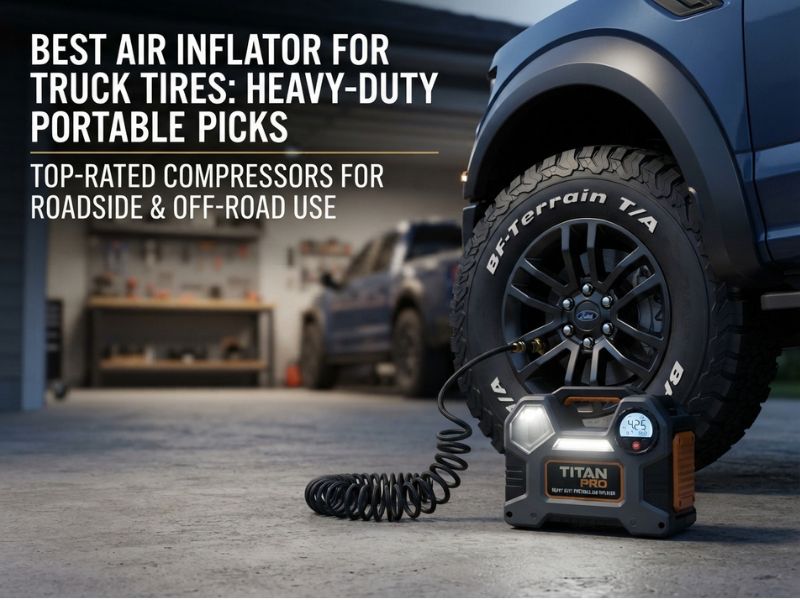
3. Best Air Inflator for Truck Tires
| Image | Product Name | Check Price |
|---|---|---|
Best Choice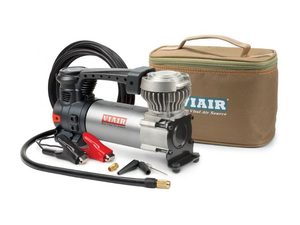 | VIAIR 88P Portable Compressor Kit | Check Price |
Second Best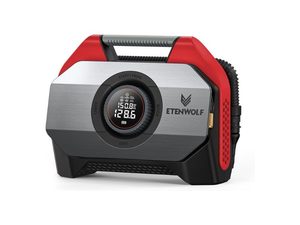 | ETENWOLF Vortex S6 Heavy-Duty Tire Inflator | Check Price |
Third Choice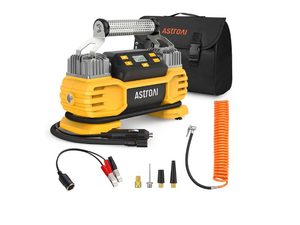 | AstroAI T2 Heavy-Duty Tire Inflator | Check Price |
1. VIAIR 88P Portable Compressor Kit – Best Overall
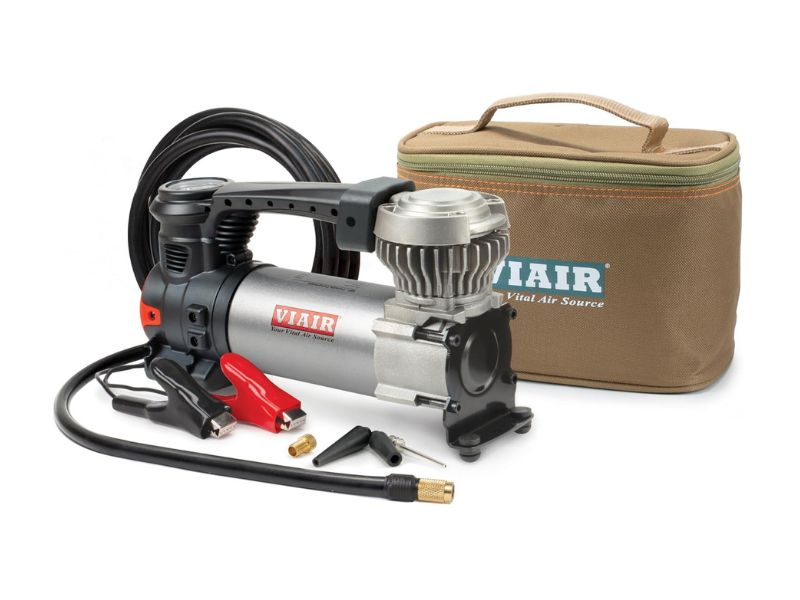
Key Features
Maximum pressure: 120 PSI
Airflow: approximately 1.47 CFM
Recommended tire size: up to 33 inches
Power: 12V direct battery connection
Maximum current draw: about 20A
Duty rating: up to 25 minutes at 30 PSI
Hose length: approximately 16 feet
Construction: compact metal compressor with brass tire chuck
Pressure gauge: integrated analog gauge
Best use: pickups, SUVs, off-road vehicles, and everyday truck tire maintenance
Detailed Review
The VIAIR 88P takes my first position because it focuses on the things that actually matter when you need to put air into a large tire.
Its maximum pressure is only 120 PSI, which may look less impressive than inexpensive inflators advertising 150 or 160 PSI. But maximum pressure alone tells you very little about how useful an inflator will be on a truck.
A compressor needs to move enough air volume while tolerating the heat generated during longer inflation cycles.
The 88P delivers approximately 1.47 CFM and is intended for tires up to 33 inches. That makes it particularly suitable for common half-ton pickups, SUVs, Jeeps, and moderate off-road builds.
Another major advantage is how it receives power.
Instead of relying on a low-current cigarette-lighter socket, the 88P connects directly to the vehicle battery with alligator clamps. This gives the compressor access to the electrical current it needs without asking a small accessory socket to support the load.
That connection method is particularly appropriate for truck-tire inflation because large tires often require longer compressor runtime than passenger-car tires.
The approximately 16-foot hose also gives you useful reach around a pickup. Anyone who has tried to use a short inflator cable on a long-wheelbase truck knows how quickly insufficient reach becomes annoying.
At the tire end, VIAIR uses a solid brass twist-on chuck. It takes slightly longer to attach than a basic lever chuck, but it creates a secure seal on the valve stem. Preventing air leakage matters when inflation already takes several minutes.
The compressor’s relatively simple construction is another reason I like it.
There is no large touchscreen, internal rechargeable battery, Bluetooth connection, or complicated electronics package. You connect the compressor, attach the chuck, turn it on, and monitor pressure.
For a tool that may live in a truck for years, simplicity can be valuable.
The 88P is also compact enough to remain practical as emergency equipment. At under five pounds, it is considerably easier to transport than a garage compressor while delivering substantially more serious performance than many pocket-size inflators.
Its limitation is heavy off-road use.
If you routinely air four 35-inch or 37-inch tires down into the teens and then need to reinflate all of them at the end of every trail day, I would move to a larger compressor with more airflow and a higher duty cycle.
The 88P is best understood as a high-quality medium-duty portable truck inflator, not a substitute for a large onboard air system.
What I Like
The 88P has an excellent balance of airflow, size, durability, direct battery power, hose reach, and proven reliability. It is powerful enough to make sense for real pickup tires without becoming unnecessarily large.
I also prefer its direct-to-battery connection for demanding inflation because it avoids the limitations of many 12V accessory sockets.
What I Do Not Like
There is no automatic shutoff. You need to monitor pressure manually.
Its 33-inch recommended tire limit also means serious off-road owners running larger tires should step up to something like a VIAIR 400P, 440P, or another higher-output compressor.
Verdict
The VIAIR 88P is my best air inflator for truck tires overall for normal pickups, SUVs, and vehicles running tires up to approximately 33 inches.
It combines proven durability with enough airflow for truck use while staying small enough to keep behind a seat or in a truck emergency kit.
2. ETENWOLF Vortex S6 Heavy-Duty Tire Inflator – Best Cordless Pick
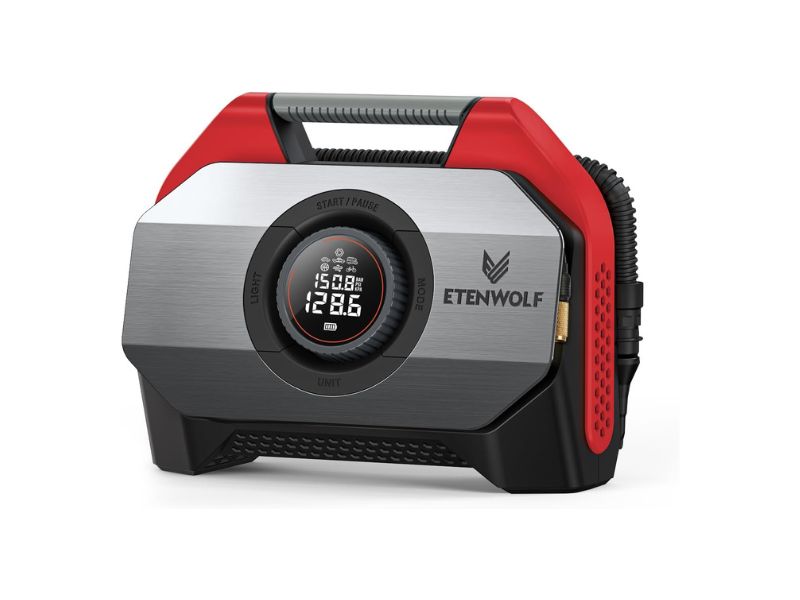
Key Features
Maximum pressure: 160 PSI
Airflow: approximately 42 L/min or 1.5 CFM at zero pressure
Battery: 19,200mAh rechargeable lithium battery
Duty cycle: designed for continuous inflation
Compressor design: dual-cylinder system
Automatic shutoff: yes
Pressure presets: multiple preset modes
Charging: 45W USB-C fast charging
Lighting: high-output integrated LED
Power-bank function: yes
Best use: pickups, SUVs, off-road vehicles, and drivers prioritizing cordless convenience
Detailed Review
The ETENWOLF Vortex S6 takes a completely different approach from the VIAIR.
Instead of requiring a physical connection to your truck battery while inflating, it carries a large 19,200mAh rechargeable battery inside the compressor.
That makes walking around a pickup significantly easier.
You do not have to route electrical cable through doors, around bumpers, or across the vehicle while moving from one tire to another.
For routine tire-pressure corrections, that convenience is substantial.
The S6 is also much more serious than the tiny handheld cordless pumps designed mainly for bicycles and passenger cars.
Its dual-cylinder system delivers approximately 42 liters per minute, equivalent to around 1.5 CFM at zero pressure.
More importantly, it is designed around sustained operation. Truck owners should pay close attention to duty cycle, because a compressor that produces good airflow for only a few minutes may shut down from heat before four high-volume tires are finished.
The Vortex S6 is built to handle repeated inflation without the frequent cooling breaks associated with many compact pumps.
Its digital interface is also considerably more convenient than the analog VIAIR design.
Set the desired target pressure, begin inflation, and the S6 can automatically stop when the preset PSI is reached.
That is useful when correcting all four truck tires to the same cold pressure. You can concentrate on moving equipment and attaching the hose rather than staring constantly at a pressure gauge.
The 160 PSI maximum pressure gives the S6 enough theoretical pressure range for many light-truck applications.
Still, 160 PSI should not be the primary reason you buy it. Most pickup tires operate far below that figure. What matters more is that the compressor can sustain useful airflow at normal truck-tire pressures.
The large integrated battery also doubles as a power bank.
USB-C fast charging makes the S6 more convenient to recharge than older portable equipment, and the integrated emergency light adds value when tire problems happen at night.
There is one important drawback to cordless power: battery dependency.
The VIAIR 88P can operate whenever the vehicle battery can supply sufficient electrical energy. The ETENWOLF needs its internal pack to be charged.
That means the owner must develop the habit of checking the inflator before long trips, winter driving, towing, or off-road outings.
Battery aging is another long-term consideration. Rechargeable lithium packs gradually lose capacity over years of use and exposure to temperature extremes.
What I Like
Cordless convenience is the biggest advantage.
The 42 L/min airflow, dual cylinders, large rechargeable battery, automatic shutoff, digital pressure setting, USB-C charging, and extended duty capability make this one of the most complete portable inflators for light-truck owners.
What I Do Not Like
It is larger and heavier than small cordless inflators, and its usefulness depends on keeping the internal battery adequately charged.
I would also choose a purpose-built high-flow compressor for repeated airing-up of very large 35- to 40-inch off-road tires.
Verdict
The ETENWOLF Vortex S6 is my preferred cordless truck tire inflator.
It makes particular sense for drivers who frequently check or correct pressure around multiple vehicles and do not want to connect an electrical cable to the truck every time.
3. AstroAI T2 Heavy-Duty Tire Inflator – Best Dual-Cylinder Value Pick
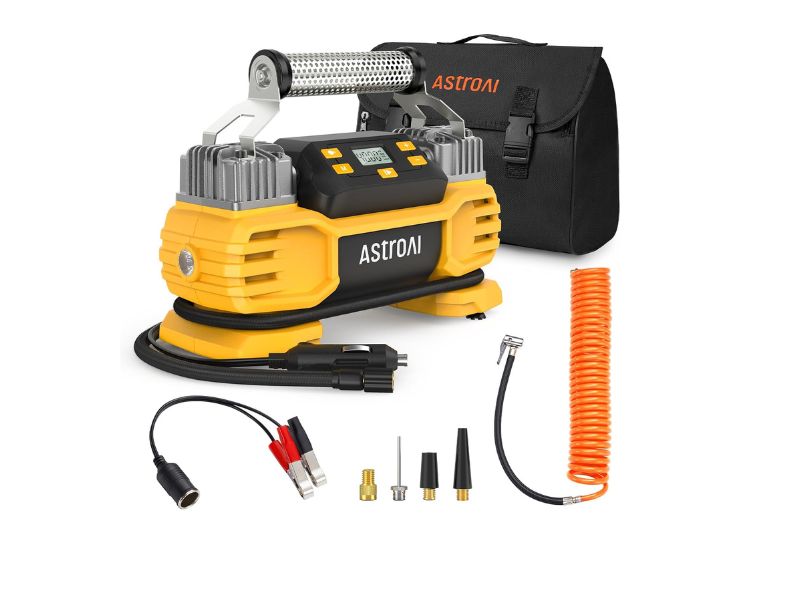
Key Features
Maximum pressure: 160 PSI
Airflow: approximately 23 L/min
Power: 12V DC
Rated power: approximately 205W
Compressor design: dual motors and dual metal cylinders
Continuous operating time: up to 40 minutes
Air hose: long coiled extension hose
Power cord: approximately 11.5 feet
Automatic shutoff: yes
Display: digital pressure display
Power options: 12V plug and battery clamps depending on pressure/load
Best use: pickups, SUVs, RVs, and general heavy-duty tire maintenance
Detailed Review
The AstroAI T2 is the most traditional heavy-duty-looking inflator of these three products.
Its architecture uses two metal cylinders and dual motors, giving the unit additional stability and runtime compared with many single-cylinder emergency inflators.
The compressor is rated for up to 40 minutes of continuous operation before its recommended cooling period.
That long runtime is important with truck tires.
Inflating one passenger-car tire from 31 PSI to 35 PSI is not particularly demanding. Restoring four large LT tires after they have been aired down is a completely different workload.
The T2’s biggest practical advantage may actually be its reach.
The coiled extension hose is approximately 16.4 feet long, while the DC power cord adds roughly another 11.5 feet of electrical reach.
That combination makes it easier to work around long-wheelbase pickups, larger SUVs, trailers, and RV applications.
The compressor can be powered through a 12V connection, and battery clamps provide additional capability for higher-pressure operation.
AstroAI specifically recommends using the direct battery connection for tire pressures above certain loads rather than relying solely on the accessory socket.
The digital pressure display and automatic shutoff are also convenient.
Set your desired pressure and allow the unit to stop automatically.
This is a significant usability advantage over compressors that require constant pressure-gauge monitoring.
The 160 PSI maximum rating gives it plenty of pressure headroom, but again, PSI alone should not determine whether an inflator is appropriate for your truck.
The T2’s approximate 23 L/min airflow is lower than the airflow of the VIAIR 88P or ETENWOLF S6.
That means it may take longer on very large-volume tires despite its high maximum-pressure rating.
Its strength is the combination of long runtime, automatic control, dual-cylinder stability, extensive reach, and relatively accessible cost.
For common pickup tires that need routine topping off rather than rapid off-road air-up cycles, that combination can work very well.
What I Like
The T2’s 40-minute rated runtime and long combined hose/cable reach stand out.
I also like the digital preset system because it makes maintaining consistent pressure across four tires easier.
What I Do Not Like
Its airflow is not especially high compared with more serious off-road compressors.
The unit is also heavier and bulkier than basic emergency inflators, and a long cooling period is required after the maximum continuous operating cycle.
Verdict
The AstroAI T2 is my best value-oriented dual-cylinder pick for pickup owners who prioritize long operating time, pressure presets, and enough hose reach to comfortably work around a larger vehicle.
Truck Tire Inflator Comparison
| Product | Max Pressure | Airflow | Recommended Tire/Application | Power Source | Duty Capability | Auto Shutoff | Approx. Weight | Best For |
| VIAIR 88P | 120 PSI | 1.47 CFM | Tires up to 33 in. | 12V battery clamps | 25 min at 30 PSI | No | 4.75 lb | Best overall |
| ETENWOLF Vortex S6 | 160 PSI | 42 L/min / ~1.5 CFM | Pickups, SUVs, off-road | Rechargeable battery | Continuous-duty design | Yes | About 6 lb | Cordless truck use |
| AstroAI T2 | 160 PSI | 23 L/min | Trucks, SUVs, RVs | 12V DC/battery clamps | 40 min continuous | Yes | About 7.3 lb | Long-runtime value |
The VIAIR 88P is my preferred choice for ordinary pickup owners because its combination of direct battery power, useful airflow, moderate weight, and 33-inch tire capability matches real light-truck use particularly well.
The ETENWOLF Vortex S6 is easier to use when mobility matters. Cordless operation makes moving between four tires effortless, while its dual-cylinder architecture and strong airflow distinguish it from small handheld rechargeable pumps.
The AstroAI T2 is the more affordable heavy-duty-style option when automatic shutoff and long hose reach are priorities. Its airflow is lower, but its 40-minute continuous operating specification makes it well suited to steady tire-pressure maintenance.
How to Choose the Best Air Inflator for Truck Tires
Truck owners should ignore much of the marketing used for ordinary portable inflators.
A unit can advertise 150 PSI and still perform poorly with a large truck tire.
The specifications that matter most are airflow, operating time, tire-size compatibility, electrical input, and how much heat the compressor can tolerate.
Airflow Is More Important Than Maximum PSI
Airflow is usually expressed as CFM—cubic feet per minute—or L/min—liters per minute.
Higher airflow generally means the compressor can move more air into a tire during a given period.
Truck tires contain much more air volume than many passenger-car tires.
That means an inflator producing 10 to 15 L/min can technically reach the correct PSI yet take an inconveniently long time.
For serious truck use, I prefer to see airflow closer to the 1.5 CFM range or higher whenever size and budget allow.
Understand Maximum PSI
Maximum PSI tells you the highest pressure the compressor is designed to produce.
It does not tell you how quickly it can inflate a tire.
Most light-duty pickups run tire pressures far below the 120-160 PSI ceiling advertised by these compressors.
A higher maximum-pressure specification becomes more relevant for certain heavy-duty and commercial applications, but airflow and duty cycle remain critical.
Know Your Tire Size
Tire diameter is one of the easiest ways to estimate compressor workload.
A stock midsize pickup may use a tire around 30 to 32 inches tall.
Full-size pickups frequently fall into a similar range depending on trim.
Modified trucks may run:
- 33-inch tires
- 35-inch tires
- 37-inch tires
- 40-inch tires
Every increase in tire size adds substantial air volume.
The VIAIR 88P is specifically designed around tires up to approximately 33 inches.
If your truck runs 35-inch or larger off-road tires and you routinely air them down, I would move into a higher-output compressor category.
Check Your Truck’s Recommended Pressure
Use the tire-pressure specification provided by the vehicle manufacturer, normally shown on the driver’s door-jamb placard.
Do not automatically inflate the tires to the maximum PSI printed on the sidewall.
The sidewall figure describes tire capability under defined conditions; it is not necessarily the correct operating pressure for your truck.
Correct pressure affects:
- Load carrying
- Tire temperature
- Braking
- Steering
- Ride quality
- Tread wear
- Fuel economy
Measure pressure when the tires are cold whenever possible.
Light-Truck Tires vs. Passenger Tires
LT-rated tires can place greater demands on a portable compressor.
They may use stronger construction and operate at higher pressure than typical passenger tires.
A compact inflator that works wonderfully on a sedan can become slow and hot when asked to inflate four LT tires.
This becomes particularly important on:
- 3/4-ton pickups
- 1-ton pickups
- Tow vehicles
- Work trucks
- Heavy-duty vans
Choose the compressor based on your actual tire specification rather than simply whether the product description includes the word “truck.”
What Is Duty Cycle?
Duty cycle describes how long a compressor can operate before it needs time to cool.
This is one of the most important truck-inflator specifications.
Small compressors generate significant heat.
A pump might inflate one tire perfectly but shut down halfway through the second tire if its motor and cylinder cannot dissipate heat quickly enough.
For routine pressure corrections, a moderate duty cycle is usually sufficient.
For off-road drivers who intentionally lower pressure in all four tires, sustained operation becomes far more important.
The ETENWOLF’s continuous-duty approach is particularly attractive here, while AstroAI’s 40-minute rating also provides useful working time.
Why Battery-Clamp Power Is Useful
A truck-tire compressor can draw substantial current.
Many vehicle accessory sockets are limited by relatively small fuses.
Direct battery clamps allow the inflator to pull power from the battery without routing the full load through the truck’s accessory circuit.
This is why compressors such as the VIAIR 88P use battery clamps rather than a basic cigarette-lighter plug.
Always connect the clamps according to the manufacturer’s instructions and verify polarity first.
Corded vs. Cordless Truck Tire Inflators
Corded Compressor
A corded 12V compressor has one important advantage: runtime is not limited by a small internal battery.
As long as the vehicle’s electrical system can supply the necessary current, the compressor can operate according to its rated duty cycle.
This makes corded designs attractive for off-road trips and long-distance travel.
Cordless Compressor
A cordless inflator is dramatically easier to move around the vehicle.
There is no cable to route beneath doors or around bumpers.
The disadvantage is that you must keep its battery charged.
For routine truck-tire maintenance, cordless convenience is excellent.
For remote expedition travel, I prefer a compressor that can still run from the truck’s electrical system or carrying appropriate backup power.
Automatic Shutoff vs. Manual Inflation
Automatic shutoff allows you to preset a target PSI.
The compressor stops when that pressure is reached.
This is convenient when adjusting all four tires.
Manual compressors such as the VIAIR 88P require you to watch the gauge and stop inflation yourself.
The manual method is less convenient but also mechanically straightforward.
Neither approach is inherently better.
Choose based on whether you prioritize simplicity or automation.
How Fast Should a Truck Tire Inflator Be?
There is no single ideal inflation time because truck tires vary enormously.
Adding 3 PSI to a warm half-ton pickup tire is easy.
Inflating a large LT tire from almost flat is much more demanding.
Airing four 35-inch tires from trail pressure back to highway pressure is harder again.
When comparing products, ask what workload you actually expect:
Emergency top-offs: Moderate airflow is usually fine.
Routine pickup maintenance: Look for higher airflow and decent runtime.
Off-road airing up: Prioritize CFM and duty cycle.
Commercial truck work: Use equipment specifically designed for commercial tire volume and pressure requirements.
Are Small Cordless Inflators Good for Trucks?
Some are, but many are not.
Handheld inflators originally designed around bicycles and passenger cars may advertise impressive pressure ratings while moving very little air.
They can be useful for adding several PSI to a pickup tire.
They are much less attractive when a large tire is nearly empty.
For truck use, prioritize a larger compressor architecture rather than the smallest possible physical size.
Inflating Off-Road Tires
Off-road drivers commonly reduce tire pressure to improve traction and ride comfort on sand, rock, or trails.
Returning to pavement means restoring highway pressure.
That repeated air-up process is one of the most demanding jobs for a portable compressor.
If this is your main use case, look beyond maximum PSI and prioritize:
- High airflow
- Long duty cycle
- Heat management
- Durable hose
- Battery-clamp power
- Easy valve attachment
For frequent 35-inch and larger off-road tires, a higher-output compressor than the VIAIR 88P is usually justified.
What About Dually Truck Tires?
Dual rear wheels create additional challenges.
Valve stems may be difficult to access, and the compressor needs sufficient hose reach to work around the rear axle.
A suitable dual-head chuck or valve extension may be necessary.
Heavy-duty dually tires can also operate at relatively high pressure.
If you own a 3/4-ton or 1-ton dually, verify the compressor’s airflow, maximum working pressure, runtime, and chuck compatibility carefully.
A purpose-built heavy-duty compressor can be more appropriate than a general light-truck inflator.
Commercial Truck Tires
A pickup truck and a commercial truck are not the same inflation application.
Medium- and heavy-duty commercial tires may demand substantially greater pressure, airflow, runtime, and equipment durability.
The products reviewed here are primarily aimed at pickups, SUVs, recreational vehicles, and similar portable applications.
For commercial fleet tire service, use a compressor system specifically rated for that workload.
Tire Inflator Accuracy
Do not assume the built-in gauge is perfect.
Even good digital inflators can differ slightly from a calibrated reference gauge.
A smart practice is to keep a separate quality tire pressure gauge in your truck.
After inflation, verify all tires consistently.
A difference of one PSI is rarely an emergency on a normal light-duty pickup, but consistent pressure across an axle matters for predictable handling and tire wear.
When to Check Truck Tire Pressure
Check pressure when the tires are cold, meaning the truck has been parked long enough for the tires to return near ambient temperature.
Driving heats the tire and the air inside it.
Pressure naturally rises as temperature increases.
If you adjust a hot tire down to its cold-pressure specification, it may become underinflated after cooling.
A monthly pressure check is a good baseline, with additional checks before:
- Long road trips
- Heavy towing
- Large payloads
- Off-road trips
- Seasonal temperature changes
Follow the truck and tire manufacturer’s recommendations.
Tire Pressure Changes With Temperature
Tire pressure changes as ambient temperature changes.
A substantial overnight temperature drop can make a correctly inflated tire appear several PSI low the next morning.
That is one reason portable compressors are particularly useful during fall and winter.
The tire may not have a puncture at all; the pressure may simply have fallen with temperature.
Repeated pressure loss in one tire, however, should be investigated for a puncture, valve leak, wheel damage, or bead-sealing problem.
Safety Tips for Inflating Truck Tires
Never inflate a visibly damaged tire simply because the gauge shows low pressure.
Inspect for:
- Sidewall bulges
- Exposed cords
- Deep cuts
- Severe cracking
- Wheel damage
- Objects penetrating the tread
- Bead separation
A tire that has been driven while severely underinflated may have internal damage that is not immediately visible.
For high-pressure or commercial tire service, professional inspection may be necessary.
Common Truck Tire Inflator Buying Mistakes
Choosing Only by PSI
A 160 PSI specification looks impressive but says nothing about how quickly the compressor moves air.
Always check airflow.
Ignoring Duty Cycle
A fast compressor that overheats after five minutes may be frustrating when you have four large tires.
Using a Tiny Passenger-Car Inflator
Small pumps are excellent emergency tools for cars but can be painfully slow on high-volume truck tires.
Buying Too Little Hose
Long-wheelbase trucks need more reach.
Check the complete distance provided by both the electrical cable and air hose.
Ignoring Power Requirements
Do not plug a high-current compressor into an accessory socket unless the manufacturer specifically permits it.
Inflating to Sidewall Maximum
Use the truck manufacturer’s recommended cold tire pressure unless your specific tire/load application requires an approved alternative.
Frequently Asked Questions
What is the best air inflator for truck tires?
The VIAIR 88P is my best overall choice for typical pickup tires up to about 33 inches.
It provides 1.47 CFM airflow, direct battery power, a useful duty rating, long hose reach, and a durable portable design without becoming excessively large.
How much PSI should a truck tire inflator have?
Maximum PSI should exceed your required tire pressure, but airflow matters more for inflation speed.
Most light-truck tires do not need anything close to a 150 or 160 PSI compressor ceiling. Check your door-jamb tire-pressure specification and focus on CFM, duty cycle, and tire volume.
What is a good CFM for truck tires?
Around 1.5 CFM is a useful starting point for portable light-truck inflation.
Higher airflow becomes increasingly valuable with larger tires, especially 35-inch and larger off-road setups.
Can a portable inflator handle pickup tires?
Yes, provided it is designed for the tire size and workload.
The VIAIR 88P is rated around 33-inch tires, while heavier off-road applications benefit from larger compressors.
Is 150 PSI enough for truck tires?
It is more than enough maximum pressure for many light-truck applications.
The more important question is whether the compressor can maintain useful airflow at your required pressure without overheating.
What is the best cordless inflator for truck tires?
The ETENWOLF Vortex S6 is my preferred cordless option among these picks.
Its large rechargeable battery, dual-cylinder design, approximately 42 L/min airflow, automatic shutoff, and sustained-duty capability make it far more truck-friendly than tiny handheld pumps.
Can I inflate a 35-inch tire with a portable compressor?
Yes, but choose a compressor specifically suited to larger tire volume.
The VIAIR 88P is optimized around tires up to approximately 33 inches, so regular 35-inch tire use is a good reason to move to a larger high-flow model.
Do I need a dual-cylinder inflator?
Not for every truck, but dual cylinders can help with sustained high-volume inflation.
They are particularly useful when multiple large tires need significant pressure increases.
Is a cordless or 12V inflator better for a truck?
Cordless is more convenient; direct 12V power is better for unlimited energy availability.
For emergency and off-road use, a direct-powered compressor provides confidence that the internal battery will not run flat.
Can I use my truck’s cigarette-lighter socket?
Only if the inflator is specifically designed for that circuit.
High-output compressors can exceed accessory-socket current limits and therefore use battery clamps instead.
How long can a truck tire inflator run?
It depends on the compressor’s duty-cycle specification.
Some require cooling after 10 or 20 minutes. Others are designed for much longer continuous operation. Check the manual before inflating several tires consecutively.
Why does my tire inflator get hot?
Compressing air generates substantial heat.
Motor friction and electrical resistance add more heat. This is normal within limits, but exceeding the rated duty cycle can trigger thermal protection or damage the compressor.
Can I use a truck tire inflator for car tires?
Yes.
A compressor powerful enough for pickup tires normally handles passenger-car tires easily, provided the pressure range and chuck are compatible.
Can I use one for an RV?
Some models can handle certain RV tires, but verify pressure, tire volume, and duty requirements carefully.
Large motorhome tires can require considerably more compressor capability than ordinary pickup tires.
Should I carry a separate tire pressure gauge?
Yes, especially if accurate pressure matters for towing or heavy loads.
A separate quality gauge gives you a useful independent check of the inflator’s built-in reading.
Final Thoughts
The best air inflator for truck tires needs more than a large PSI number. Truck owners should prioritize airflow, duty cycle, tire-size compatibility, electrical power, hose reach, heat management, and pressure accuracy.
The VIAIR 88P is my overall recommendation for typical pickup trucks and SUVs running tires up to approximately 33 inches. Its 1.47 CFM output, direct battery connection, durable compressor body, and straightforward operation make it a particularly dependable tool for both routine tire maintenance and roadside emergencies.
The ETENWOLF Vortex S6 is the better choice when cordless convenience matters most. Its large rechargeable battery, strong airflow, dual-cylinder architecture, automatic shutoff, and sustained operating capability make moving around a truck much easier.
The AstroAI T2 provides a useful middle ground for buyers who want dual-cylinder construction, a digital pressure display, automatic shutoff, and exceptionally long hose and power-cable reach without moving into a more expensive off-road compressor system.
For a stock or moderately modified light-duty pickup, I would start with the VIAIR 88P. For repeated off-road air-ups on 35-inch or larger tires, step up to a higher-CFM heavy-duty compressor rather than expecting a small emergency inflator to perform like an onboard air system.