Finding the best tire inflator for pickup trucks requires more than choosing a compact pump with an impressive maximum PSI number. Pickup tires hold substantially more air than typical passenger-car tires, and many trucks use larger LT tires, higher load ratings, taller sidewalls, or aftermarket all-terrain tires.
A small inflator that works fine for a sedan may overheat or take frustratingly long when asked to bring a truck tire from 25 PSI back to 40 or 50 PSI. For this reason, I prioritize airflow, duty cycle, direct battery power, hose reach, heat management, and large-tire compatibility over headline pressure alone.
My first recommendation is the GSPSCN Heavy Duty Double Cylinder 12V Tire Inflator. Its dual-cylinder design delivers strong airflow, while the 150 PSI capability, long extension hose, direct 12V power, and metal construction make it particularly useful for pickups, SUVs, vans, RVs, and other larger vehicles. I also like that it gives truck owners strong inflation performance without requiring a rechargeable internal battery that must be remembered and maintained.
For a more proven enthusiast-oriented compressor, I would strongly consider the VIAIR 88P Portable Compressor Kit. It connects directly to the truck battery, has enough capability for tires up to 33 inches, provides a long air hose, and is particularly well suited to pickups that occasionally air down for trails, sand, snow, or off-road driving. Its simple analog design lacks automatic shutoff, but the compressor itself is exceptionally well matched to pickup-size tires.
If cordless convenience matters most, the ETENWOLF VORTEX S6 Heavy Duty Tire Inflator is my third choice. Its large rechargeable battery, dual-cylinder architecture, 100% duty cycle, automatic pressure shutoff, digital display, and high-volume inflation capability create one of the most convenient solutions for a pickup owner who does not want to open the hood or route long power cables every time tire pressure needs adjustment.
Best Tire Inflator for Pickup Trucks: Fast Heavy-Duty Picks
| Image | Product Name | Check Price |
|---|---|---|
Best Choice | GSPSCN Heavy Duty Double Cylinder 12V Tire Inflator – Best Overall | Check Price |
Second Best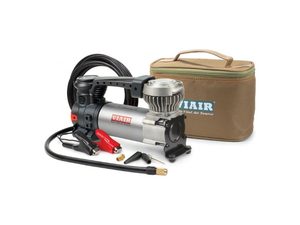 | VIAIR 88P Portable Compressor Kit – Best Proven Truck Inflator | Check Price |
Third Choice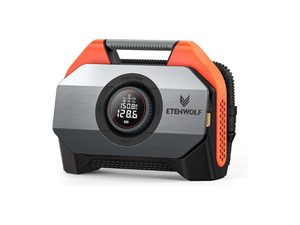 | ETENWOLF VORTEX S6 Heavy Duty Tire Inflator – Best Cordless Pick | Check Price |
Best Tire Inflator for Pickup Trucks
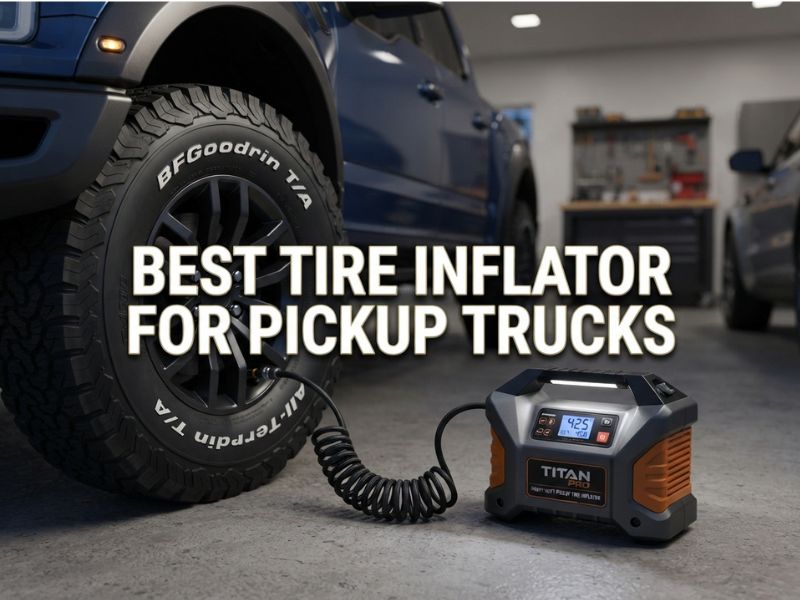
Pickup tires create a very different workload from bicycle tires or compact-car tires.
A higher maximum PSI does not necessarily mean a compressor can move enough air to inflate a large tire quickly. CFM or liters per minute, duty cycle, electrical power, hose length, and thermal capacity are often more useful specifications.
The three models below represent three distinct approaches: an affordable high-airflow dual-cylinder compressor, a proven direct-battery truck compressor, and a premium cordless heavy-duty inflator.
1. GSPSCN Heavy Duty Double Cylinder 12V Tire Inflator – Best Overall
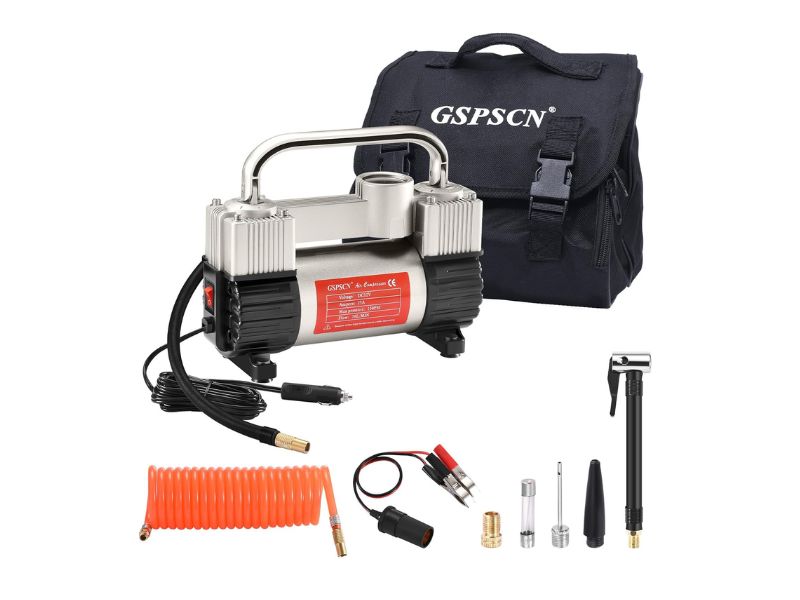
Key Features
- 70 L/min airflow
- Dual-cylinder compressor design
- Maximum pressure up to 150 PSI
- 12V DC power
- Direct battery-clamp connection available
- Approximately 240W maximum power
- Around 20A maximum current draw
- Long extension air hose
- Metal and ABS construction
- Pressure gauge
- Carrying bag included
- Multiple inflation adapters
- Suitable for pickups, SUVs, vans, RVs, and cars
Detailed Review
The GSPSCN earns my first position because it delivers the kind of high-volume airflow that makes sense for pickup tires without moving into the size or expense of a full workshop compressor.
The defining feature is the dual-cylinder pump.
A larger truck tire contains substantially more air volume than the tire on a compact sedan. Moving that volume quickly requires airflow. GSPSCN’s approximately 70 L/min rating is significantly more relevant to truck owners than simply advertising a 150 PSI maximum.
A pickup tire may only require 35, 40, 50, or 65 PSI depending on the vehicle, tire, load, and manufacturer’s specification. The real challenge is getting enough air into that large tire without waiting forever.
The dual-cylinder design helps address that issue.
I also prefer its direct vehicle-powered approach for emergency use. You do not need to wonder whether an internal lithium battery still has enough charge after sitting in the truck for several months. As long as the vehicle electrical system is available and the compressor is connected correctly, power is there.
The system uses substantial current, so this is not the type of compressor I would casually plug into any unknown 12V accessory outlet. Direct battery clamps make much more sense for a roughly 20A compressor.
Another major advantage is reach.
Truck wheelbases are longer than those of many cars, and a short power cable plus short hose can make reaching the rear tire surprisingly frustrating. The included extension hose gives you considerably more flexibility around crew-cab pickups, full-size trucks, vans, trailers, and larger SUVs.
The compressor’s metal construction also feels appropriate for the intended application. Truck equipment often gets thrown behind a seat, moved around a truck bed, exposed to dust, and used on uneven roadside surfaces. A substantial compressor body is preferable to an ultralight plastic housing for this kind of use.
The pressure gauge is functional, although I would still keep a quality standalone tire gauge in the truck.
This is particularly important for pickups because tire pressure can vary considerably depending on load and tire type. Accurate pressure matters for tire wear, braking, handling, fuel economy, towing stability, and load capacity.
The biggest limitation is convenience.
There is no sophisticated preset-and-walk-away experience like you get with the ETENWOLF. You connect the compressor, monitor pressure, and shut it down manually.
It also weighs more than tiny emergency inflators.
For me, those drawbacks are acceptable because the product’s primary job is moving enough air for larger tires.
What I Like
- Excellent airflow for pickup-size tires.
- Dual-cylinder construction.
- 150 PSI maximum capability.
- Direct 12V operation eliminates battery-charge anxiety.
- Long hose helps reach rear truck tires.
- Strong choice for SUVs and vans as well.
- Durable metal-oriented design.
- Good balance between performance and portability.
- Carrying bag keeps the system organized.
- Useful for road trips and towing.
What I Do Not Like
- Heavier than pocket-size inflators.
- No automatic pressure shutoff.
- Analog gauge is less convenient than a digital preset system.
- Direct power connection requires more setup than a cordless inflator.
- Compressor and hose components can become hot during extended operation.
Verdict
The GSPSCN is my best overall tire inflator for pickup trucks if strong airflow and value are your primary concerns.
It is especially attractive for F-150, Silverado 1500, Ram 1500, Tacoma, Frontier, Ranger, Colorado, and similar pickup owners who want substantially more capability than a small passenger-car compressor.
2. VIAIR 88P Portable Compressor Kit – Best Proven Truck Inflator
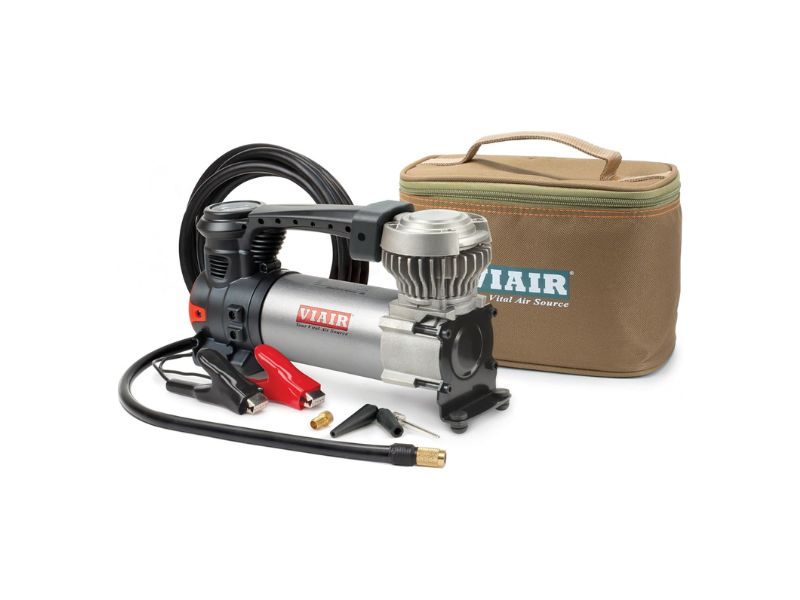
Key Features
- Designed for tires up to approximately 33 inches
- 12V operation
- Direct battery clamps
- 120 PSI maximum working pressure
- Approximately 1.47 CFM airflow at 0 PSI
- 20A maximum current draw
- 25-minute duty cycle at 30 PSI
- 16-foot air hose
- 10-foot power cord
- Solid brass twist-on chuck
- LED work light
- IP53-rated housing
- Carry bag included
- Approximately 4.75-pound weight
Detailed Review
The VIAIR 88P is the product I would choose when long-term reputation and proven truck-tire performance matter more than automatic convenience.
VIAIR has built much of its reputation around portable 12V compressors for automotive, off-road, RV, and mobile-air applications, and the 88P is positioned specifically between small passenger-car inflators and the company’s larger 300P, 400P, and 450P systems.
The key specification for pickup owners is its support for tires up to approximately 33 inches.
That covers many stock and mildly upgraded half-ton pickup configurations, including numerous F-150, Silverado, Sierra, Ram, Tacoma, Tundra, Ranger, Frontier, Colorado, and Canyon applications.
The compressor connects directly to the battery with clamps.
Some buyers may initially see that as less convenient than plugging into an accessory socket, but there is an important technical reason for the design.
The 88P can draw approximately 20 amps. Many vehicle accessory outlets are protected by 10A or 15A fuses.
Trying to pull substantially more current through that outlet could overload the circuit.
Direct battery connection bypasses that limitation and allows the compressor to receive the current it needs through an appropriately designed connection.
For a truck inflator, I actually consider that an advantage.
The 16-foot air hose and 10-foot power lead give the system excellent reach. This becomes particularly useful around long-wheelbase pickups and trailers.
The brass twist-on chuck provides a secure connection to the valve stem. I prefer solid threaded fittings for off-road and truck equipment because they are less likely to accidentally release while the compressor is running.
The compressor’s 25-minute duty cycle at 30 PSI is also more meaningful than an unrealistic marketing claim that says only “heavy duty.”
Duty cycle describes how long the compressor can operate under specified conditions before needing a cool-down period.
Pickup owners should care about this because filling four large tires after airing down creates much more heat than adding 2 PSI to one sedan tire.
The VIAIR is especially good for drivers who intentionally lower tire pressure for:
- Sand
- Off-road trails
- Rocky terrain
- Snow
- Beach driving
When you return to pavement, you need enough compressor capacity to bring all four tires back toward highway pressure.
A tiny cordless inflator can make that process painfully slow.
The 88P is much better suited to the workload.
There are two limitations I would emphasize.
First, the traditional 88P does not automatically stop when your target pressure is reached. You need to monitor the gauge and control inflation yourself.
Second, if you run oversized 35-, 37-, or 40-inch off-road tires, I would move up to a larger compressor rather than expecting the 88P to be ideal.
VIAIR’s larger 300P, 400P, 440P, and 450P families are more appropriate as tire size and repeated workload increase.
What I Like
- Specifically suited to larger automotive tires.
- Excellent reputation among truck and off-road users.
- Handles tires up to approximately 33 inches.
- Direct battery power provides reliable current.
- 16-foot hose offers excellent wheel-to-wheel reach.
- Solid brass tire chuck.
- Strong airflow compared with small emergency pumps.
- Defined duty-cycle specification.
- Integrated LED work light.
- Durable carrying bag.
- Compact enough to keep behind a pickup seat.
What I Do Not Like
- Manual pressure monitoring.
- No automatic shutoff on the traditional version.
- Requires opening the hood to access the battery.
- Not the ideal choice for tires significantly larger than 33 inches.
- Compressor components can become hot after extended inflation.
Verdict
The VIAIR 88P is my preferred proven direct-battery inflator for stock and mildly modified pickups.
If you regularly air down a pickup for off-road use and want a compressor with a long history in that environment, it is difficult to ignore.
3. ETENWOLF VORTEX S6 Heavy Duty Tire Inflator – Best Cordless Pick
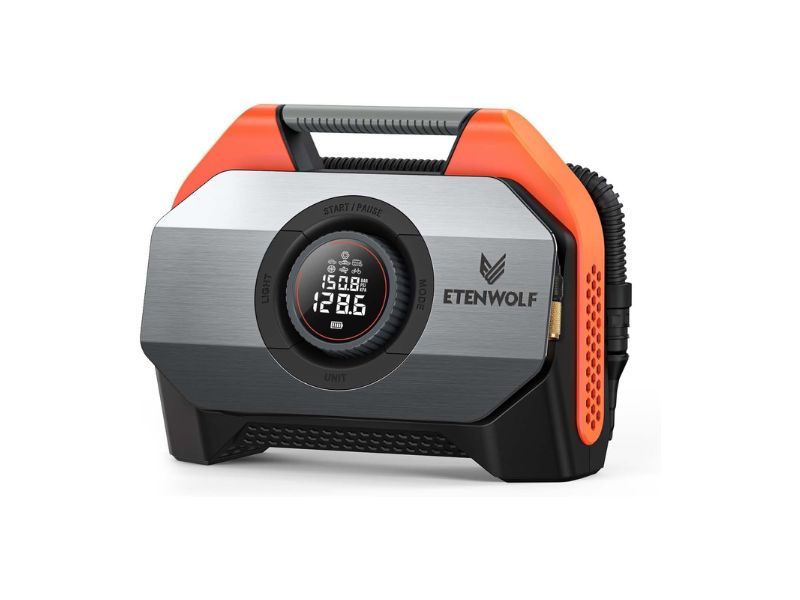
Key Features
- Designed for SUVs and light-duty pickups
- Dual-cylinder compressor
- 100% duty cycle
- 19,200mAh rechargeable battery
- Maximum pressure up to 160 PSI
- Approximately 1.5 CFM airflow
- Digital pressure display
- Automatic pressure shutoff
- Multiple preset inflation modes
- USB-C charging
- 45W fast charging support
- 1,000-lumen LED light
- Power-bank functionality
- High-pressure and high-volume inflation modes
Detailed Review
The ETENWOLF VORTEX S6 solves the biggest inconvenience associated with the first two products: cables.
Instead of connecting to the truck’s battery and routing a lead around the vehicle, you carry the compressor directly to whichever tire needs air.
For quick pressure corrections, this is extremely convenient.
The S6 is not simply a small handheld inflator with “truck” added to the product description. It uses a dual-cylinder design and is specifically intended for SUVs and light-duty pickup trucks.
Its 100% duty-cycle specification is especially notable.
Small inflators often require a cooling interval after 10 or 15 minutes of operation. That limitation matters when inflating four pickup tires consecutively.
A compressor designed for continuous operation is better suited to multi-tire workloads.
The large 19,200mAh internal battery gives the S6 another advantage over the usual compact cordless pump.
Battery-powered tire inflators are convenient only if their batteries have enough energy to finish the job. Larger tires consume substantially more energy because the compressor needs to run longer.
The S6’s large battery helps make cordless operation realistic for truck use rather than merely convenient for topping off one small tire.
Automatic shutoff is another feature I appreciate.
Enter the target pressure, begin inflation, and the compressor stops once that setting is reached.
This is considerably easier than watching an analog gauge continuously.
A digital preset is especially useful when seasonal temperature changes cause all four pickup tires to lose several PSI simultaneously.
You can move systematically from tire to tire without repeatedly guessing how long to run the compressor.
The 160 PSI maximum provides more than enough pressure range for normal light-duty pickup applications.
However, remember that maximum PSI is not your recommended tire pressure.
Always use the pressure specified by the vehicle manufacturer for your tire/load configuration unless an approved alternative setup requires different pressure.
The S6 also incorporates a powerful LED light, USB-C charging, and power-bank capability.
Those functions do not improve inflation performance directly, but they make the compressor a more useful roadside-emergency device.
I particularly like the LED light because tire problems frequently happen at inconvenient times. Illuminating the valve stem, tire sidewall, or roadside working area makes nighttime inflation safer and easier.
The main disadvantage is long-term battery dependence.
A 12V compressor such as the VIAIR or GSPSCN can sit in the truck without needing its own battery maintained.
A rechargeable cordless inflator needs periodic charging.
If you buy the S6, build checking its charge into your normal vehicle-maintenance routine.
What I Like
- True cordless convenience.
- Designed around light-duty pickups and SUVs.
- Powerful dual-cylinder system.
- 100% duty cycle.
- Large 19,200mAh battery.
- Automatic pressure shutoff.
- Digital gauge.
- 160 PSI maximum.
- USB-C charging.
- Strong built-in emergency light.
- Power-bank capability.
- Excellent choice for routine tire-pressure maintenance.
What I Do Not Like
- More expensive than basic corded compressors.
- Internal battery requires periodic charging.
- Heavier than compact passenger-car cordless inflators.
- Not intended for every oversized off-road tire or dual-rear-wheel truck.
- Long-term battery aging is unavoidable.
Verdict
The ETENWOLF VORTEX S6 is the best cordless tire inflator for light-duty pickup trucks in this group.
If you want digital controls, automatic shutoff, high airflow, and no battery clamps or long power cables, its convenience is hard to beat.
Best Tire Inflator for Pickup Trucks Comparison
| Product | Power Source | Max Pressure | Airflow | Duty Cycle | Truck Tire Focus | Auto Shutoff | Main Advantage |
| GSPSCN Double Cylinder | 12V direct power | 150 PSI | 70 L/min | Heavy-duty intermittent | Pickups, SUVs, vans, RVs | No | High airflow and value |
| VIAIR 88P | 12V battery clamps | 120 PSI | 1.47 CFM | 25 min @ 30 PSI | Tires up to 33 in. | No | Proven truck/off-road reliability |
| ETENWOLF VORTEX S6 | Rechargeable battery | 160 PSI | Approx. 1.5 CFM | 100% | Light-duty pickups and SUVs | Yes | Cordless convenience |
Quick Comparison
The GSPSCN Double Cylinder is my first choice when you want maximum practical airflow for the money. Its dual-cylinder configuration and 70 L/min rating make it particularly useful for larger pickup tires.
The VIAIR 88P is the model I prefer for proven long-term truck and off-road use. Its direct-battery design, defined duty cycle, long hose, and 33-inch tire capability create an excellent match for stock and moderately upgraded pickups.
The ETENWOLF VORTEX S6 is the convenience winner. Its cordless architecture, digital display, auto shutoff, large battery, and continuous-duty design eliminate much of the setup required by traditional compressors.
Why Pickup Trucks Need a More Powerful Tire Inflator
The difference comes down primarily to air volume.
Imagine two tires:
A compact-car tire might be approximately 205/55R16.
A pickup tire could be 275/65R18.
The truck tire contains much more internal air volume.
Even if both tires require approximately the same pressure, the compressor has to move considerably more air to raise the pressure in the larger tire.
This is why a tiny pump can advertise 150 PSI yet still take an extremely long time to inflate a pickup tire.
Maximum pressure tells you how high the compressor can theoretically push pressure.
Airflow tells you how quickly it can move air.
For pickup trucks, airflow is often the more useful specification.
What CFM Means on a Tire Inflator
CFM means cubic feet per minute.
It measures airflow volume.
Some manufacturers use liters per minute instead.
A rough conversion is:
1 CFM ≈ 28.3 liters per minute.
Higher airflow generally means faster inflation, although actual performance changes as tire pressure increases.
Compressors move air most easily at low pressure.
As tire pressure rises, the compressor works harder and airflow usually decreases.
That is why comparing only a free-air CFM number does not tell the entire story.
Still, for truck tires, higher airflow is normally desirable.
Why Maximum PSI Can Be Misleading
Many inexpensive inflators advertise:
150 PSI
or even:
160 PSI
That sounds impressive.
But your pickup probably does not need anything close to 150 PSI.
A typical light-duty truck tire might run in the 30–45 PSI range.
Certain LT tires and heavier-duty applications can require substantially more.
The correct pressure depends on:
- Vehicle
- Tire size
- Load rating
- Axle load
- Towing load
- Manufacturer recommendation
A compressor capable of 150 PSI may still be very slow at 40 PSI if its airflow is poor.
For pickup use, ask:
How quickly can it move air into a large tire at realistic pressure?
That question is more useful than simply asking for maximum PSI.
What Size Tire Inflator Do I Need for a Pickup Truck?
For an ordinary half-ton pickup with factory-size tires, I look for approximately:
- 1.3 CFM or more
- Direct 12V or substantial cordless power
- 15–20A-class electrical capability for corded units
- Enough hose/cable reach for all four wheels
- Appropriate duty cycle
- Strong thermal protection
For 33-inch tires, a compressor such as the VIAIR 88P is a practical minimum for drivers who inflate regularly.
For 35-inch or larger tires, particularly after airing down, I would consider moving to a more powerful off-road compressor.
Tire Inflator for Ford F-150
The Ford F-150 is available with numerous wheel and tire packages, so no single compressor is ideal for every configuration.
For normal street use and factory-size tires, all three products in this guide are strong options.
I particularly like:
GSPSCN for economical high airflow.
VIAIR 88P for direct-battery reliability.
ETENWOLF VORTEX S6 for cordless convenience.
If your F-150 runs large aftermarket off-road tires, verify actual tire diameter before choosing.
Tire Inflator for Chevy Silverado 1500 and GMC Sierra 1500
Silverado and Sierra owners should prioritize airflow rather than pocket-size portability.
These trucks commonly use larger tire sizes than passenger cars, and long wheelbases make hose reach important.
A 12V direct-battery compressor with a long hose is especially practical.
For that reason, the GSPSCN and VIAIR 88P are both strong choices.
Tire Inflator for Ram 1500
A Ram 1500 with factory highway tires is comfortably within the general light-duty pickup category.
For routine pressure adjustments, the ETENWOLF’s cordless system is extremely convenient.
For repeated airing up from lower pressure, I prefer a direct-powered compressor so battery capacity is not part of the equation.
Tire Inflator for Toyota Tacoma
The Tacoma is a popular platform for overlanding and off-road modifications.
A stock Tacoma can be handled easily by a quality heavy-duty portable compressor.
If you have upgraded to larger 32- or 33-inch all-terrain tires and frequently air down, the VIAIR 88P becomes especially attractive.
For larger aftermarket configurations, consider stepping up to a more powerful off-road compressor.
Tire Inflator for Toyota Tundra
The Tundra’s larger tires and overall vehicle size justify selecting a genuine truck-capable inflator rather than a compact sedan pump.
The GSPSCN’s 70 L/min airflow makes it particularly attractive for routine use.
ETENWOLF is a better choice if you value cordless convenience and mainly need pressure top-offs rather than repeated trail air-ups.
Corded vs. Cordless Tire Inflator for Pickup Trucks
Both have advantages.
Corded 12V Compressor
Advantages include:
- No internal battery to charge
- Continuous access to vehicle power
- Often higher sustained output
- Better for repeated tire inflation
- Excellent long-term emergency storage
Disadvantages:
- Requires routing wires
- Battery clamps may require opening the hood
- Less convenient for quick pressure checks
Cordless Inflator
Advantages:
- Extremely easy to use
- No power cable
- Easy wheel-to-wheel movement
- Automatic controls are common
- Can double as a power bank
Disadvantages:
- Battery must remain charged
- Battery capacity degrades with age
- Extreme temperatures can affect performance
- Large tires consume substantial battery energy
For frequent off-road use, I usually prefer direct 12V power.
For everyday street-driven pickups, a powerful cordless inflator can be more convenient.
Why Battery-Clamp Power Is Good for Truck Compressors
Small tire inflators commonly use a cigarette-lighter-style accessory plug.
That works because they draw relatively little current.
Heavy-duty compressors can require more.
Many truck accessory outlets are protected by:
- 10A fuse
- 15A fuse
- Sometimes higher-rated circuits
A compressor drawing 20A may exceed the safe capacity of a smaller outlet circuit.
Direct battery clamps allow the compressor to receive high current through its dedicated wiring.
This is one reason heavy-duty inflators frequently use alligator clamps.
Why Duty Cycle Matters
A compressor creates heat.
The longer it runs, the hotter the motor, cylinder, piston, valves, and hose can become.
Duty cycle describes the amount of time the compressor can run within a particular period and at specified pressure/temperature conditions.
For example, a compressor rated for 25 minutes at 30 PSI should not automatically be assumed capable of running continuously forever.
Truck owners need to pay attention because four large tires can create a lengthy workload.
If you regularly air all four tires from approximately 20 PSI to 35 PSI, choose a compressor with a strong duty cycle.
100% Duty Cycle Explained
A compressor advertised with a 100% duty cycle is designed to operate continuously under its specified rating conditions rather than requiring frequent cooling intervals.
That makes the ETENWOLF particularly appealing for multiple-tire use.
Even so, always follow the manufacturer’s operating-temperature and safety instructions.
Hoses, connectors, and compressor surfaces may still become hot.
How Fast Should a Truck Tire Inflator Be?
For routine pressure corrections, I want a quality truck inflator to add several PSI without making me wait ten or fifteen minutes per tire.
Inflation speed depends on:
- Tire volume
- Starting PSI
- Target PSI
- Compressor airflow
- Temperature
- Battery voltage
- Electrical connection
- Compressor temperature
A flat 33-inch tire creates a completely different workload from a tire that simply needs to go from 32 to 36 PSI.
Do not judge every inflator using one universal time claim.
Pickup Tire Pressure: Use the Door Placard
One of the most important tire-inflation rules is simple:
Use your vehicle manufacturer’s recommended cold tire pressure as the primary reference for stock applications.
You can usually find the specification on the tire-information placard inside the driver’s door area.
Do not automatically use the maximum pressure molded onto the tire sidewall.
The sidewall number generally represents the tire’s maximum rated cold pressure associated with its load rating, not necessarily the correct everyday pressure for your pickup.
Does Towing Require More Tire Pressure?
Sometimes.
Towing and heavy payloads increase axle load.
Certain vehicle and tire combinations may require higher pressure under load.
However, do not simply add an arbitrary 10 or 20 PSI.
Refer to:
- Vehicle owner’s manual
- Tire-loading information
- Tire manufacturer load tables
- Truck manufacturer guidance
Correct inflation becomes especially important when towing because tire heat and load increase during highway driving.
Can These Inflators Handle LT Tires?
Generally, they are much better suited to LT-size applications than tiny car inflators.
However, LT tires vary enormously.
A light-duty pickup running modest LT tires at around 40–50 PSI creates a manageable workload.
A one-ton pickup running high-pressure commercial tires is different.
Check:
- Required pressure
- Tire size
- Inflation volume
- Compressor maximum working pressure
- Duty cycle
For heavy-duty 2500/3500 trucks, especially dual-rear-wheel configurations, I would often choose a larger dedicated compressor than the three products here.
Best Tire Inflator for a 2500 or 3500 Pickup
Heavy-duty pickups deserve extra attention.
A Ram 2500, Silverado 2500HD, Sierra HD, or F-250 may use large LT tires requiring significantly greater pressure than half-ton trucks.
For occasional top-offs, a strong portable compressor can work.
For repeated heavy-duty use, I would move toward a higher-end VIAIR 300P, 400P, or 450P-class compressor or another purpose-built high-volume heavy-truck solution.
Dually trucks also require additional hose reach and appropriate valve access.
Best Tire Inflator for 33-Inch Truck Tires
The VIAIR 88P is particularly relevant because it is specifically designed around tires up to approximately 33 inches.
That makes it well matched to many mild off-road pickup builds.
GSPSCN is another strong option because its high airflow can make large-tire inflation considerably quicker than compact emergency pumps.
What About 35-Inch Tires?
Thirty-five-inch tires represent a meaningful increase in air volume.
If you occasionally add 2–3 PSI, one of these compressors may be adequate depending on the specific setup.
If you routinely air four 35-inch tires down to trail pressure and then restore highway pressure, I would invest in a larger off-road compressor.
That workload rewards higher airflow and stronger thermal capacity.
How to Use a Portable Tire Inflator on a Pickup
Check Pressure When Tires Are Cold
Tire pressure rises as the tire heats during driving.
For normal pressure adjustment, measure when the tires have been parked long enough to cool.
Find the Recommended PSI
Read the driver’s-door tire placard or owner’s manual.
Position the Compressor Safely
Place it on a stable surface away from moving vehicle components.
Connect Power
For battery-clamp compressors:
Connect according to the manufacturer’s instructions and verify polarity.
For cordless compressors:
Check battery charge before beginning.
Attach the Air Hose
Connect securely to the valve stem.
A loose connection wastes airflow and produces inaccurate pressure readings.
Set or Monitor Pressure
If the compressor has auto shutoff, enter the required PSI.
If it uses a manual gauge, watch pressure carefully.
Stop at the Correct Pressure
Do not inflate to the maximum PSI simply because the compressor or tire can tolerate it.
Check With a Separate Gauge
For important towing or heavy-load use, I recommend verifying pressure with a dependable standalone tire gauge.
Why Truck Tire Pressure Drops in Winter
Air pressure changes with temperature.
As outdoor temperature falls, tire pressure generally decreases.
A commonly used rule of thumb is approximately 1 PSI for each 10°F change in temperature, although real behavior varies.
This is why TPMS lights frequently appear during the first cold mornings of fall or winter.
Having a truck-capable inflator at home lets you correct all four tires without repeatedly visiting a service station.
Why Pickup Tires Need Regular Pressure Checks
Correct pressure affects:
Tire Wear
Underinflation can cause excessive shoulder wear.
Overinflation can alter the contact patch and wear pattern.
Fuel Economy
Low pressure increases rolling resistance.
Handling
A heavily underinflated truck tire can feel vague and unstable.
Braking
Correct tire condition and pressure help maintain predictable contact with the road.
Towing Stability
Tire pressure becomes especially important when the pickup is loaded or towing.
Heat
Underinflated tires flex excessively, generating additional heat.
For loaded trucks, that can become a significant safety concern.
Auto Shutoff vs. Manual Inflation
Auto Shutoff
Advantages:
- Enter target PSI.
- Start compressor.
- Unit stops automatically.
- Convenient for four-tire top-offs.
- Reduces accidental overinflation.
ETENWOLF provides this convenience.
Manual Inflation
Advantages:
- Simpler design.
- Fewer electronics.
- Common on high-output compressors.
- User retains direct control.
GSPSCN and the traditional VIAIR 88P require more active monitoring.
Neither system is inherently better.
For casual use, auto shutoff is convenient.
For off-road users who frequently adjust pressure manually, simple controls are often perfectly acceptable.
How to Keep a Pickup Tire Inflator in Good Condition
Keep It Dry
Avoid storing the compressor where water can collect.
Protect the Hose
Do not sharply bend or crush the air hose.
Inspect Electrical Cables
Look for damaged insulation, loose clamps, and broken strain relief.
Keep Air Vents Clear
Compressors require cooling airflow.
Dust, fabric, or cargo should not block ventilation.
Allow Hot Components to Cool
Air hoses and cylinder heads can become very hot.
Do not immediately pack a hot compressor tightly into its case.
Charge Cordless Models Regularly
Check a battery-powered inflator every few months and before major road trips.
Common Mistakes When Buying a Truck Tire Inflator
Buying by Maximum PSI Alone
A 150 PSI label means little if the compressor moves air very slowly.
Choosing a Tiny Sedan Pump
Small pumps can work, but truck tires may expose their thermal and airflow limitations quickly.
Ignoring Duty Cycle
Four truck tires create a substantially larger workload than one low car tire.
Buying a Cordless Pump With a Tiny Battery
Large tires consume energy.
A small battery can run flat before you finish.
Ignoring Hose Reach
Pickup wheelbases are long.
Measure whether the compressor can actually reach your rear wheels from the power source.
Plugging a High-Amp Compressor Into an Underrated Outlet
Always verify electrical requirements.
A 20A compressor should not be connected blindly to a 10A accessory circuit.
Ignoring Tire Size
A compressor ideal for stock Tacoma tires may not be the right choice for 37-inch mud-terrain tires.
Frequently Asked Questions
1. What is the best tire inflator for pickup trucks?
The GSPSCN Double Cylinder is my best overall pick for strong airflow and practical truck use.
Its 70 L/min airflow, dual-cylinder construction, long extension hose, 150 PSI maximum, and direct 12V operation make it well suited to light-duty pickups. VIAIR 88P is an excellent alternative when proven off-road performance matters, while ETENWOLF VORTEX S6 is the better choice for cordless convenience.
2. What PSI air compressor do I need for truck tires?
Choose a compressor whose working-pressure capability comfortably exceeds your truck’s required tire pressure.
For most light-duty pickups, a 120–150 PSI-capable inflator provides plenty of pressure range. However, airflow and duty cycle are usually more important than maximum PSI when judging inflation speed.
3. Is a 150 PSI tire inflator enough for a pickup truck?
Yes, 150 PSI provides more than enough pressure range for most light-duty pickup tires.
The important question is how quickly the compressor can deliver air at the pressure your tire actually uses. High airflow and an appropriate duty cycle matter more than simply having a 150 PSI label.
4. What CFM is good for a truck tire inflator?
Around 1.5 CFM or more is a useful starting point for portable light-truck inflation.
Higher airflow generally reduces inflation time, especially on large tires. Serious off-roaders running oversized tires may benefit from compressors delivering 2 CFM, 3 CFM, or considerably more.
5. Can a portable tire inflator fill an F-150 tire?
Yes, a genuine truck-capable portable compressor can easily handle normal F-150 tire maintenance.
GSPSCN, VIAIR 88P, and ETENWOLF VORTEX S6 are all substantially better suited to the job than a small pump intended primarily for compact cars.
6. Can VIAIR 88P inflate truck tires?
Yes, the 88P is designed for automotive tires up to approximately 33 inches.
That makes it appropriate for many stock and mildly modified light-duty pickups. Larger off-road tires may justify a higher-capacity compressor.
7. Is a cordless tire inflator good for pickup trucks?
Yes, provided it has enough airflow, battery capacity, and duty cycle for larger tires.
ETENWOLF VORTEX S6 is a good example because it uses a large battery, dual-cylinder compression, and a continuous-duty design rather than the small motor found in many pocket inflators.
8. Is a dual-cylinder air compressor better for truck tires?
Dual cylinders can provide greater airflow, which is particularly useful for large-volume pickup tires.
However, overall design quality, motor power, cooling, electrical capacity, and duty cycle also matter. Cylinder count by itself does not guarantee better performance.
9. How long should it take to inflate a pickup tire?
Inflation time depends heavily on tire size and how much pressure is missing.
Adding 3 PSI to a stock tire may take less than a minute with a powerful compressor, while filling a large tire from nearly flat can require several minutes. Compare inflators using similar tire sizes and starting pressures.
10. What tire inflator should I use for 33-inch tires?
VIAIR 88P is a particularly strong choice because it is designed around tires up to approximately 33 inches.
It is well suited to stock and mild off-road pickup builds and provides enough duty cycle for normal airing-up tasks.
11. What tire inflator is best for 35-inch tires?
For frequent 35-inch tire inflation, I would step up to a higher-capacity off-road compressor.
Small truck inflators may handle occasional pressure corrections, but regularly restoring four aired-down 35-inch tires demands significantly more airflow and thermal capacity.
12. Can I run a tire inflator from my truck’s cigarette lighter?
Only if the compressor’s current requirement is within the outlet’s rated capacity.
High-output truck compressors can draw around 20 amps or more, while many accessory circuits are rated at only 10 or 15 amps. Direct battery clamps are safer when the compressor is designed for high current.
13. Should the engine be running while using a 12V tire compressor?
Follow the compressor manufacturer’s instructions.
Many higher-output 12V compressors are intended to operate with the vehicle running so the charging system supports electrical demand and battery voltage remains higher. Always work in a well-ventilated location and observe vehicle safety requirements.
14. What is a good duty cycle for a truck tire inflator?
The longer the duty cycle, the better for repeatedly inflating large tires.
A 20–30-minute rating can be adequate for ordinary light-truck use. A 100% duty-cycle compressor becomes particularly valuable when inflating several tires consecutively.
15. Do I need an air tank with a pickup tire inflator?
No, a tankless portable compressor is sufficient for normal tire inflation.
An air tank can provide a brief burst of high airflow for pneumatic tools or bead seating, but it adds considerable size and weight. For routine roadside tire inflation, a direct compressor is simpler.
Conclusion
Choosing the best tire inflator for pickup trucks comes down to airflow, electrical power, duty cycle, tire size, and how you actually use your truck.
My first recommendation is the GSPSCN Heavy Duty Double Cylinder Tire Inflator. Its strong 70 L/min airflow, dual-cylinder design, direct 12V power, long hose reach, and 150 PSI capability give it an excellent balance for everyday light-duty pickup owners who want faster inflation without carrying a large shop compressor.
The VIAIR 88P is my preferred alternative for drivers who prioritize established truck and off-road performance. Its direct battery connection, 16-foot hose, 25-minute duty cycle, brass chuck, and support for tires up to approximately 33 inches make it particularly useful for pickups that spend time away from pavement.
The ETENWOLF VORTEX S6 is the best choice when cordless convenience matters most. Its large battery, automatic shutoff, digital gauge, dual-cylinder design, and 100% duty cycle make routine pressure maintenance remarkably easy.
For a stock pickup and general roadside use, I would choose GSPSCN first. For regular trail use with tires up to 33 inches, I would lean toward VIAIR 88P. For a street-driven pickup where convenience and automatic operation matter more than direct 12V power, the ETENWOLF VORTEX S6 is the strongest cordless option.