Finding the best air chuck tire inflator can make routine tire maintenance considerably faster, especially if you already own an air compressor. Unlike a portable electric inflator, this type of tool connects to a compressor air line and combines an air chuck, pressure gauge, inflation trigger, and usually a bleed valve in one handheld unit. The right model lets you attach securely to a Schrader valve, add air, check pressure, and release excess pressure without repeatedly switching tools.
My primary recommendation is the JACO FlowPro Digital Tire Inflator with Pressure Gauge 200 PSI. Its digital display, high-pressure range, lock-on air chuck, durable braided hose, and professional-style accuracy make it particularly useful for home garages, automotive enthusiasts, SUVs, trucks, and drivers who want precise pressure adjustments.
For buyers who prefer a simple analog gauge without depending on batteries, I would choose the AstroAI Tire Pressure Gauge with Inflator 100 PSI. Its large glow dial, integrated air chuck, quick-connect fitting, and practical 100 PSI range make it a strong value choice for normal passenger cars and light trucks.
My third recommendation is the Milton S-506 Original Dual Head Chuck Tire Inflator Gauge. Its traditional service-station design, 10–160 PSI range, dual-head chuck, 15-inch hose, and replaceable internal components make it especially appealing for workshops, trucks, trailers, and users who value proven mechanical simplicity.
Best Air Chuck Tire Inflator: Accurate Garage Picks
| Image | Product Name | Check Price |
|---|---|---|
Best Choice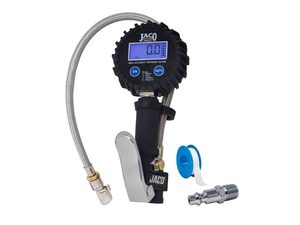 | JACO FlowPro Digital Tire Inflator with Pressure Gauge 200 PSI | Check Price |
Second Best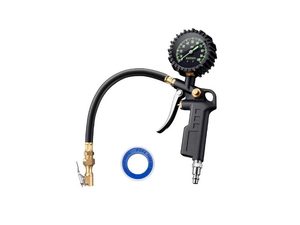 | AstroAI Tire Pressure Gauge with Inflator 100 PSI | Check Price |
Third Choice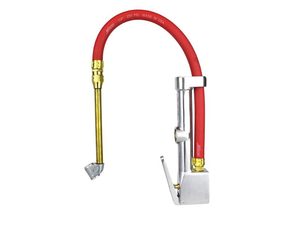 | Milton S-506 Original Dual Head Chuck Tire Inflator Gauge | Check Price |
Best Air Chuck Tire Inflator
1. JACO FlowPro Digital Tire Inflator with Pressure Gauge 200 PSI – Best Overall
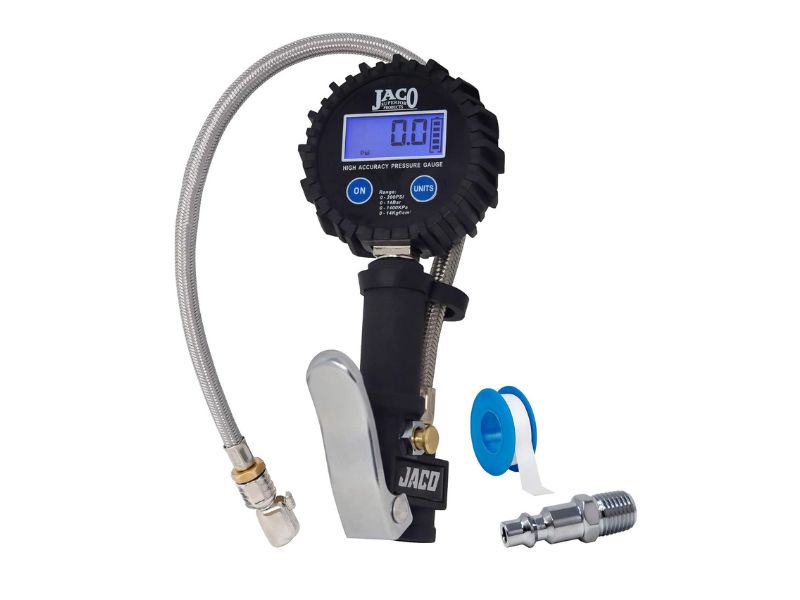
Key Features
- 5–200 PSI pressure range
- Digital pressure display
- Approximately ±1% full-scale accuracy
- Lock-on air chuck
- Quick-release chuck mechanism
- Push-to-inflate trigger
- Built-in air bleeder
- Braided air hose
- 1/4-inch NPT connections
- Multiple pressure units
- Replaceable AAA batteries
- Compatible with conventional air compressor lines
Detailed Review
The JACO FlowPro earns my top position because it combines accurate pressure measurement with one of the most useful air-chuck designs in this category.
Its digital gauge covers pressures up to 200 PSI, giving it considerably more range than typical 100 PSI passenger-car inflators. That extra capacity is useful if you maintain pickups, trailers, RVs, utility vehicles, or higher-pressure tires in addition to normal passenger cars.
For ordinary automotive work, though, pressure range is less important than accuracy and control.
The FlowPro gives you a digital readout that makes small adjustments easier to see than an analog gauge with broad markings. When a tire specification calls for 33, 35, or 38 PSI, being able to monitor smaller pressure changes helps avoid unnecessary overinflation.
Its air chuck is another major advantage.
A poor chuck forces you to hold the connector against the valve stem while simultaneously operating the inflator. If the chuck sits at an awkward angle, air can leak around the valve and make the pressure reading inconsistent.
The JACO uses a locking chuck that grips the Schrader valve after being pushed into position. A release mechanism allows quick removal once inflation is complete.
That hands-free connection is especially useful when checking all four tires in a garage.
The inflator trigger adds air, while a separate bleeder lets you reduce pressure if you overshoot your target. This creates a simple workflow:
connect the chuck, read pressure, add air, bleed excess air if needed, and disconnect.
The braided hose also feels more appropriate for frequent garage use than a very thin rubber tube.
One limitation is that this is not a standalone compressor. You still need an external air compressor with a suitable air line and fitting.
For someone who already owns a shop compressor, however, that is exactly what makes this type of inflator appealing.
What I Like
The lock-on air chuck is my favorite feature because it makes repeated tire checks much easier.
I also like the 200 PSI digital gauge and precise pressure readout.
The built-in bleeder is useful when fine-tuning tire pressure after adding slightly too much air.
What I Do Not Like
The digital gauge requires batteries.
It also costs more than basic analog inflator gauges.
Owners who only check normal passenger-car tires occasionally may not need its 200 PSI range.
Verdict
The JACO FlowPro is the strongest overall choice for buyers who want accurate digital readings, a secure air-chuck connection, and professional-style inflation control.
Best for: Home garages, automotive enthusiasts, cars, SUVs, trucks, trailers, and frequent tire maintenance.
2. AstroAI Tire Pressure Gauge with Inflator 100 PSI – Best Value Analog Pick
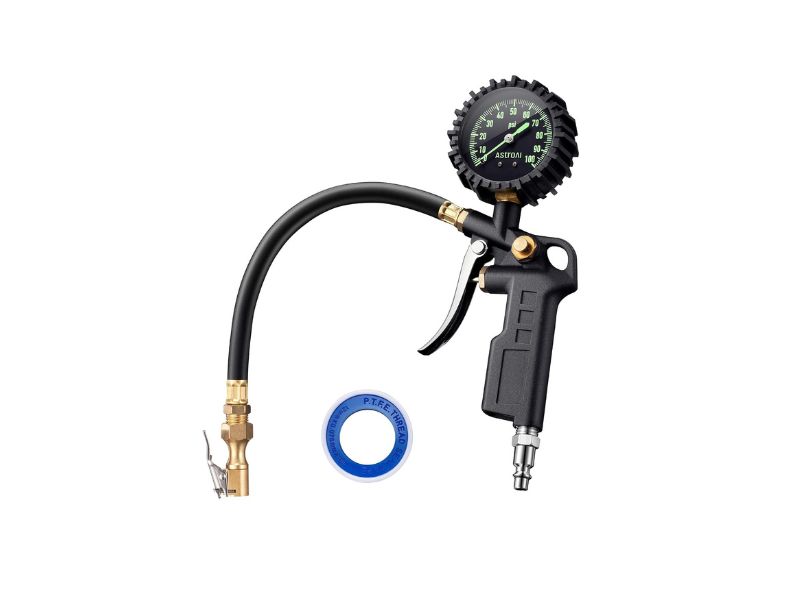
Key Features
- 0–100 PSI range
- Large analog dial
- Glow-in-the-dark gauge face
- Integrated air chuck
- Inflation trigger
- Air-release function
- Rubber air hose
- Quick-connect coupler
- Battery-free operation
- Designed for standard Schrader valves
- Suitable for most passenger vehicles
Detailed Review
The AstroAI 100 PSI inflator is a strong alternative for anyone who prefers an analog gauge and wants to avoid keeping batteries inside another garage tool.
Its 100 PSI maximum range is more than enough for most passenger cars, SUVs, crossovers, motorcycles, lawn equipment, and many light-truck tires.
One benefit of choosing a lower-range gauge is readability.
When nearly all of your tires operate around 30–45 PSI, a gauge designed around 100 PSI can provide a more useful visual scale than an instrument designed primarily around extremely high-pressure applications.
The large dial makes pressure easy to see while inflating.
Its glow-style face is also useful inside dim garages or during nighttime maintenance.
Operation is straightforward.
Connect the air chuck to the tire valve, observe the current pressure, squeeze the trigger to add air, and use the release function if the tire becomes overinflated.
Because the gauge is mechanical, there are no batteries to replace and no electronic display to fail because it sat unused for a long period.
That simplicity is one reason analog tire inflators remain popular.
The included quick-connect hardware also reduces the amount of setup required when connecting the inflator to a compatible compressor line.
I would primarily recommend the AstroAI for passenger-vehicle owners rather than commercial users.
Its 100 PSI range is appropriate for ordinary automotive work but less versatile than 160–200 PSI inflators when higher-pressure truck or specialty tires enter the picture.
What I Like
The large battery-free analog gauge is easy to understand and convenient for occasional use.
Its 100 PSI range is well matched to ordinary car tires.
I also like having inflation, pressure checking, and deflation combined into one tool.
What I Do Not Like
The chuck is not as refined as the locking connection on the JACO.
A 100 PSI maximum range also makes it less suitable for some commercial and specialty applications.
Analog readings require you to interpret dial markings rather than reading an exact digital number.
Verdict
The AstroAI is my preferred value pick for ordinary passenger-car owners who want a straightforward compressor-powered tire inflator without electronic complexity.
Best for: Cars, crossovers, motorcycles, lawn equipment, light trucks, and home garages.
3. Milton S-506 Original Dual Head Chuck Tire Inflator Gauge – Best Heavy-Duty Dual Head Pick
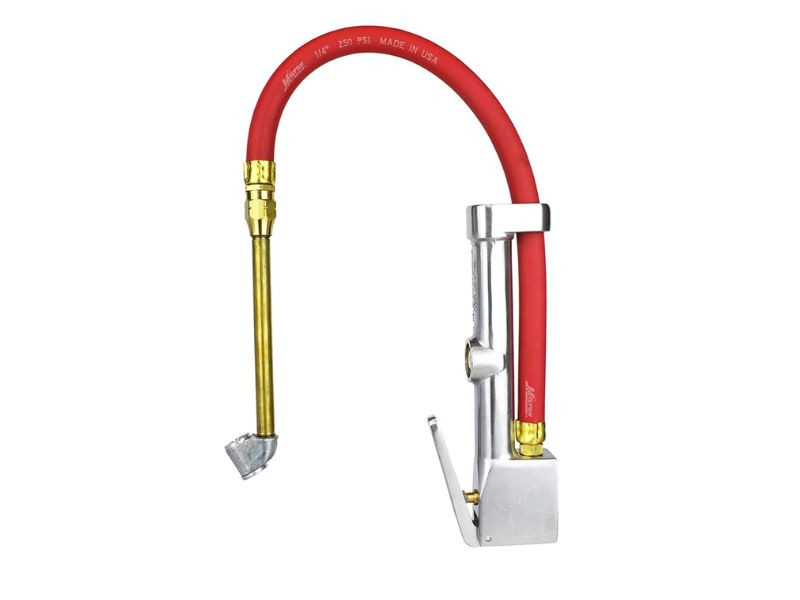
Key Features
- 10–160 PSI range
- Traditional mechanical gauge
- Dual-head air chuck
- 15-inch hose
- Full-swivel chuck design
- 1/4-inch NPT air inlet
- Heavy-duty construction
- Magnifying gauge window
- Replaceable gauge cartridge
- Replaceable valve cartridge
- Suitable for cars, trucks, trailers, RVs, and shop use
Detailed Review
The Milton S-506 takes a more traditional approach than the JACO or AstroAI.
Its design resembles the tire inflator gauges that have been used in service stations and automotive shops for decades.
The biggest practical difference is its dual-head chuck.
One end of the chuck points relatively straight while the second head approaches the valve from a different direction. This is especially useful when valve stems are recessed, angled awkwardly, or positioned on dual-wheel assemblies.
That gives the Milton a clear advantage for trucks and trailers.
Its pressure scale covers 10–160 PSI, providing substantially more range than a typical passenger-car-only analog inflator.
The 15-inch flexible hose gives you enough separation between the gauge body and valve chuck to work comfortably around larger wheels.
Milton also uses replaceable gauge and valve cartridges.
That serviceability is important.
Many inexpensive tire inflators become disposable once their internal valve begins leaking or the gauge becomes unreliable. A tool with replaceable components has greater potential for long-term workshop use.
The mechanical gauge does not need batteries, another advantage for a tool that may remain in a toolbox for months between uses.
The tradeoff is convenience.
The dual-head chuck is designed to be pressed onto the valve rather than automatically locking on like the JACO chuck.
For normal passenger-car wheels, I prefer a good locking chuck because it leaves both hands freer.
For dual wheels and harder-to-reach stems, however, Milton’s design can be much more useful.
What I Like
The dual-head chuck and 160 PSI range make the Milton extremely versatile around trucks and trailers.
I also like that the gauge and valve cartridges are replaceable.
Its simple mechanical construction is ideal for users who dislike battery-powered shop tools.
What I Do Not Like
The chuck does not provide the same hands-free locking convenience as the JACO.
The traditional gauge style is also less precise to read at a glance than a modern digital display.
For ordinary passenger-car owners, the dual-head design may provide little benefit.
Verdict
The Milton S-506 is the strongest choice for buyers who want a durable, serviceable, old-school tire inflator that can handle awkward valve stems and higher tire pressures.
Best for: Workshops, pickups, trailers, RVs, dual wheels, and users who prioritize mechanical durability.
Air Chuck Tire Inflator Comparison
| Product | Pressure Range | Gauge Type | Chuck Style | Hose | Bleeder | Power Needed | Best For |
| JACO FlowPro Digital | 5–200 PSI | Digital | Lock-on | Braided flexible hose | Yes | AAA batteries + air compressor | Best overall precision |
| AstroAI 100 PSI Inflator Gauge | 0–100 PSI | Analog | Standard air chuck | Rubber hose | Yes | Air compressor only | Passenger cars and value |
| Milton S-506 | 10–160 PSI | Mechanical | Dual-head chuck | 15-inch hose | Integrated inflator control | Air compressor only | Trucks and shop use |
For most home-garage users, the JACO FlowPro Digital provides the most complete setup. Its locking chuck, digital display, bleeder control, and broad pressure range are particularly convenient when maintaining several vehicles.
The AstroAI is simpler and usually better suited to buyers who primarily work on normal passenger-car tires. The Milton S-506 becomes especially attractive when dual wheels, trucks, trailers, and hard-to-reach valve stems are part of your regular maintenance routine.
How I Chose These Air Chuck Tire Inflators
My first priority was air-chuck performance.
A tire inflator can have an excellent pressure gauge but still be frustrating if its chuck constantly leaks around the Schrader valve.
I therefore considered how each chuck attaches, how easily it reaches the valve stem, and whether its design is appropriate for the intended vehicle.
Pressure accuracy was the second priority.
Correct tire pressure affects:
- Tire wear
- Steering response
- Braking behavior
- Ride quality
- Fuel efficiency
- Tire temperature
- Load-carrying performance
Being off by several PSI may be more significant than many drivers realize, particularly when one tire differs substantially from the others.
I also considered pressure range, gauge visibility, hose construction, inflation control, bleed valves, compressor fittings, repairability, and whether batteries were required.
Finally, I selected three different designs rather than three nearly identical digital tools.
That gives buyers a meaningful choice between digital precision, analog value, and heavy-duty dual-head access.
Buying Guide: How to Choose the Best Air Chuck Tire Inflator
Understand What This Tool Actually Does
An air chuck tire inflator is normally not an air compressor.
It is an attachment that connects between your compressed-air supply and tire.
You typically need:
- Air compressor
- Compressor hose
- Appropriate coupler
- Tire inflator gauge
- Air chuck
Many inflator gauges include the chuck and quick-connect plug, reducing the number of separate pieces required.
If you do not own an air compressor and need a completely portable device, a 12V or cordless tire inflator may make more sense.
Choose the Right Air Chuck
The chuck is one of the most important parts of the entire tool.
Lock-On Chuck
A lock-on chuck grips the valve stem and remains connected while you inflate.
Advantages include:
- Hands-free connection
- Less air leakage
- Easier gauge reading
- Convenient repeated inflation
- Better usability in tight areas
The JACO is particularly strong here.
Standard Push-On Chuck
A basic chuck must be held firmly against the valve.
It is simple and inexpensive but can leak if the angle is imperfect.
Dual-Head Chuck
A dual-head chuck provides two access angles.
This is particularly useful for:
- Dually pickups
- Commercial trucks
- RVs
- Trailers
- Deep wheels
- Hard-to-reach valve stems
The Milton S-506 uses this traditional design.
Digital vs. Analog Tire Inflator Gauge
Both can work extremely well.
Digital Gauge Advantages
A digital screen provides a specific number such as:
35.2 PSI
instead of requiring you to estimate between dial markings.
Digital displays are particularly useful when fine adjustments matter.
Other advantages may include:
- Multiple pressure units
- Backlighting
- Easy nighttime reading
- Fine measurement resolution
The disadvantage is battery dependence.
Analog Gauge Advantages
Analog gauges require no batteries.
That makes them excellent for toolboxes, shops, and emergency kits where the gauge may sit unused for long periods.
They are also easy to operate and can be extremely durable.
The main disadvantage is reading precision. Small dial markings can be harder to interpret quickly.
How Much PSI Range Do You Need?
More pressure range is not automatically better.
Up to 100 PSI
Ideal for:
- Passenger cars
- Crossovers
- Motorcycles
- Lawn equipment
- Many light trucks
Most car tires operate well below 50 PSI.
Up to 160 PSI
Useful for:
- Pickups
- Trailers
- RVs
- Some commercial tires
- Shop environments
Up to 200 PSI
Provides the greatest flexibility for:
- High-pressure truck applications
- Shop use
- Multiple vehicle types
- Buyers who want one gauge for nearly everything
However, a gauge designed for very high pressure should still provide enough resolution to accurately read normal passenger-car pressures.
Check Gauge Accuracy
Pressure range tells you how high a gauge can measure.
Accuracy tells you how close that measurement should be to the actual pressure.
For normal automotive use, consistency within approximately 1–2 PSI is generally much more important than having a maximum range of hundreds of PSI.
A high-quality digital gauge with a stated accuracy specification is attractive when tire setup needs to be repeatable.
Performance enthusiasts, towing users, and drivers who frequently adjust pressure may particularly appreciate better accuracy.
Why a Bleeder Valve Is Useful
It is easy to overinflate a tire slightly.
Without a bleeder, you have to disconnect the chuck, press the valve stem separately, reconnect the gauge, and check again.
An integrated bleed valve makes the process much faster.
If you overshoot from 35 PSI to 37 PSI, simply release a little air while watching the gauge.
This is one of the most useful features on a combined inflator gauge.
Hose Length Matters
A longer hose separates your hand and gauge from the valve stem.
That can make inflation easier around:
- Large wheels
- Deep rims
- Trucks
- Trailers
- Valve stems positioned near suspension components
However, an excessively long hose adds bulk.
For most passenger vehicles, approximately 15–21 inches provides a useful balance.
Look at Hose Construction
Rubber hoses are flexible and inexpensive.
Braided hoses provide additional abrasion protection and can feel more substantial in a workshop environment.
Regardless of material, look closely at:
- Crimp quality
- Chuck connection
- Gauge connection
- Swivel points
- Hose flexibility
Air leaks frequently develop at connections rather than through the middle of the hose.
Check the Air Inlet Size
Many compressor tire inflators use 1/4-inch NPT connections.
This is a common pneumatic-tool standard.
However, the quick-connect plug profile on your air compressor system also matters.
Common coupler styles are not always interchangeable.
Before purchasing, verify that the supplied plug matches your compressor coupler or plan to replace the plug with the fitting your shop uses.
Air Chuck Tire Inflator vs. Portable Tire Inflator
These tools are designed for different situations.
Air Chuck Tire Inflator
Requires an external compressor.
Advantages:
- Fast airflow with a good compressor
- Excellent shop usability
- Accurate integrated pressure gauge
- Durable
- No motor inside the handheld tool
- Good for repeated tire maintenance
Portable Electric Inflator
Contains its own compressor.
Advantages:
- Can travel in the vehicle
- Does not require a shop compressor
- Useful during roadside emergencies
- Often includes automatic shutoff
If you already have a garage compressor, I prefer an air-chuck inflator gauge for routine tire maintenance.
For emergency roadside use, a portable electric compressor is more practical.
Why Correct Tire Pressure Matters
Proper tire inflation is not simply about avoiding a warning light.
Underinflation
An underinflated tire flexes more as it rolls.
Potential consequences include:
- Excess heat
- Increased rolling resistance
- Reduced fuel economy
- Poor steering response
- Accelerated shoulder wear
- Reduced load capability
Overinflation
Excessive pressure can also create problems.
Possible effects include:
- Harsher ride
- Reduced compliance
- Increased sensitivity to road impacts
- Different tread wear characteristics
- Reduced traction under certain conditions
The correct target is generally the vehicle manufacturer’s specified cold tire pressure, not the maximum pressure printed on the tire sidewall.
Where to Find Your Car’s Correct Tire Pressure
Look for the vehicle’s tire-information placard.
It is commonly located:
- Inside the driver’s door jamb
- On the door edge
- Inside the fuel door on some vehicles
- In the owner’s manual
The placard normally lists recommended front and rear cold tire pressures.
Do not automatically inflate the tire to the maximum PSI shown on its sidewall.
The sidewall number represents a tire specification, not necessarily the correct operating pressure for your vehicle.
What Does Cold Tire Pressure Mean?
“Cold” does not necessarily mean the tire feels cold to your hand.
Cold tire pressure generally means the vehicle has been parked long enough for tire temperature to stabilize, or has only been driven a very short distance.
Driving heats the tire.
As temperature rises, internal pressure rises as well.
That is why pressure measured immediately after a highway trip may be several PSI higher than the cold specification.
Whenever possible, make routine pressure adjustments before driving.
How to Use an Air Chuck Tire Inflator
Connect your compressor and allow it to reach appropriate operating pressure.
Attach the inflator to the compressor air hose.
Remove the tire valve cap.
Push or lock the air chuck onto the Schrader valve.
Check the current pressure.
If the tire needs additional air, squeeze the inflation trigger in short bursts.
Watch the gauge as pressure rises.
If you add too much air, use the bleeder valve to reduce pressure.
Once the correct PSI is reached, disconnect the chuck and reinstall the valve cap.
Repeat for the remaining tires.
How Often Should You Check Tire Pressure?
Checking approximately once a month is a practical routine for most drivers.
You should also check pressure:
- Before long road trips
- Before towing
- Before carrying heavy loads
- After major temperature changes
- When the TPMS warning appears
- If handling suddenly feels different
- After tire service
- Before extended highway driving
Tires naturally lose small amounts of pressure over time.
Outdoor temperature also affects tire pressure significantly.
Why Tire Pressure Changes With Temperature
Air pressure changes as temperature changes.
A commonly used rule of thumb is roughly 1 PSI for every 10°F change in temperature, although the exact relationship varies.
This is why TPMS warnings often appear on the first cold morning of the season.
The tire may not suddenly have developed a leak.
Its pressure may simply have fallen enough with temperature to cross the warning threshold.
Still, never assume temperature is the cause without checking the actual pressure.
Can an Air Chuck Damage a Valve Stem?
A properly used chuck should not damage a healthy Schrader valve.
Problems can occur when you:
- Push the chuck sideways
- Bend the valve aggressively
- Use excessive force
- Leave heavy equipment hanging from the stem
- Use a damaged chuck
- Work with badly aged rubber valve stems
A flexible hose between the gauge and chuck reduces leverage on the valve stem compared with attaching a heavy gauge body directly to it.
Why Does My Air Chuck Leak?
Several things can cause leakage.
Incorrect Angle
A push-on chuck must sit squarely on the valve stem.
Worn Chuck Seal
The internal rubber seal can deteriorate over time.
Damaged Schrader Valve
The valve core may be loose, bent, or contaminated.
Worn Valve Stem
Old rubber stems can crack around the base.
Loose Hose Fitting
Air may be escaping from the threaded connection rather than the tire valve.
Use appropriate pneumatic thread sealant or PTFE tape where specified.
Why Does the Gauge Read Differently From My TPMS?
Your dashboard TPMS and handheld gauge may not display exactly the same number.
Possible reasons include:
- Gauge accuracy tolerance
- TPMS sensor tolerance
- Rounding
- Temperature change
- Measurement timing
- Sensor calibration
- Tire heating after driving
A difference of a small amount does not automatically indicate that either device is defective.
For consistent maintenance, use one accurate gauge under similar cold-tire conditions.
Do You Need a Digital Gauge for Accurate Inflation?
No.
A quality analog gauge can be extremely accurate.
Digital primarily improves readability and resolution.
A professional mechanical gauge can outperform a poor digital gauge.
The important factors are calibration quality, construction, consistency, and appropriate pressure range.
Best Air Chuck Tire Inflator for Cars
For a normal passenger car, I would choose either the JACO or AstroAI.
The JACO FlowPro Digital is preferable if you value precise readings and a locking chuck.
The AstroAI makes more sense if you want simplicity and battery-free operation.
Most passenger-car tires operate well within both tools’ pressure ranges.
Best Air Chuck Tire Inflator for Trucks
Truck requirements vary.
For a gasoline pickup with standard single rear wheels, the JACO is extremely versatile.
For trucks with dual rear wheels, the Milton S-506’s dual-head chuck can make valve access considerably easier.
For heavy-duty trucks with higher tire pressure, confirm that the gauge range comfortably exceeds the required operating PSI.
Best Air Chuck for Dually Tires
Dual rear wheels create a specific problem: the inner valve stem may be difficult to access with a normal straight chuck.
This is where a dual-head air chuck becomes especially valuable.
One side can reach stems facing outward while the angled or reverse head reaches valves positioned deeper between wheels.
Among these three choices, the Milton S-506 is the natural dually-oriented option.
Best Air Chuck Tire Inflator for a Home Garage
For a typical home compressor setup, I would choose the JACO FlowPro.
It gives you:
- Secure chuck connection
- Accurate gauge
- Easy inflation
- Easy deflation
- High pressure range
- Flexible hose
- Common pneumatic connection
For occasional use where budget matters more than premium features, the AstroAI remains an excellent alternative.
Air Compressor Size for Inflating Car Tires
You do not need a huge shop compressor just to inflate passenger-car tires.
Tire inflation typically requires relatively modest airflow compared with tools such as sanders, grinders, or impact tools used continuously.
A small portable compressor with a tank can usually handle normal tire topping-off.
Larger compressor tanks improve convenience because you can add air to multiple tires before the compressor motor cycles heavily.
The inflator gauge itself does not determine compressor capacity.
What Compressor Pressure Should You Use?
Your compressor tank pressure must be higher than the tire pressure you are trying to achieve.
For example, you cannot effectively inflate a tire to 80 PSI if the compressor line is only supplying 60 PSI.
However, you do not need to send the compressor’s absolute maximum pressure through every tool without regulation.
Use the compressor regulator and stay within the inflator’s pressure rating.
Can You Use These Inflators on Bicycle Tires?
It depends on the valve.
Most automotive air chucks are designed for Schrader valves.
Many mountain bikes, children’s bikes, cruisers, and some e-bikes use Schrader valves and can connect directly.
Many road bikes and performance bicycles use Presta valves.
A Presta-to-Schrader adapter or dedicated Presta chuck is required.
Also pay attention to pressure range. High-pressure road bicycle tires may operate near or above the maximum of some automotive gauges.
Can You Use an Air Chuck on Motorcycle Tires?
Yes, if the motorcycle uses a standard Schrader valve and the chuck can physically reach it.
Motorcycle wheels sometimes place valve stems in tight spaces between brake discs and spokes.
A compact 90-degree or flexible lock-on chuck can be easier to use than a large straight dual-head design.
Always use the motorcycle manufacturer’s specified cold pressure.
Maintaining an Air Chuck Tire Inflator
Pneumatic tire inflators require very little maintenance, but a few steps improve reliability.
Keep the chuck clean.
Dirt around the chuck seal can create leaks.
Inspect the air hose periodically for:
- Cracks
- Abrasion
- Bulges
- Loose crimps
- Leaking fittings
Check threaded connections if you hear hissing.
Digital models should have batteries replaced before leakage or corrosion occurs.
Avoid dropping the gauge.
Impact can affect calibration even if the outside of the tool appears undamaged.
Common Mistakes to Avoid
Inflating to the Sidewall Maximum
Use the vehicle placard for normal operating pressure.
Checking Tires After a Long Drive
Hot pressure can be several PSI higher than cold pressure.
Buying the Wrong Chuck
A standard car chuck may be frustrating on dually wheels.
Ignoring Gauge Range
Choose a range appropriate for the tires you actually maintain.
Assuming Digital Automatically Means More Accurate
Build quality and calibration matter more than display type.
Using a Portable 12V Inflator Attachment Incorrectly
These compressor-line inflator gauges are intended for pneumatic air systems, not necessarily the short hose coming from a standalone 12V mini compressor.
Ignoring Small Air Leaks
Leaks waste compressor air and can create misleading pressure readings.
Never Checking Gauge Accuracy
Periodically compare your inflator against another known-quality gauge.
Frequently Asked Questions
What is the best air chuck tire inflator?
The JACO FlowPro Digital is my best overall choice for most compressor-equipped garages.
It combines a secure lock-on air chuck with a digital 200 PSI gauge, fine pressure resolution, an inflation trigger, and an integrated bleeder. That combination makes it easy to connect to a tire, add air, release excess pressure, and verify the final PSI without switching between separate tools.
What is an air chuck tire inflator?
It is a compressor-powered tool that connects an air line to a tire valve while measuring pressure.
Most models combine an air chuck, pressure gauge, trigger, hose, and pressure-release valve. They require an external air compressor rather than producing compressed air themselves.
Does an air chuck tire inflator need a compressor?
Yes, the models in this guide require an external compressed-air source.
They connect to an air compressor through a pneumatic hose and quick-connect fitting. If you need an inflator that works without a shop compressor, choose a portable electric or cordless tire inflator instead.
Is a locking air chuck better?
A locking chuck is generally more convenient for ordinary car and SUV tires.
It grips the Schrader valve and stays attached while you read the gauge or operate the trigger. This can reduce air leakage and free your hands. Dual-head chucks are often preferable for dually tires and difficult valve locations.
What PSI air chuck do I need for a car?
A 100 PSI gauge is more than sufficient for most passenger-car tires.
Normal cold tire pressures are usually much lower than 100 PSI. Higher-range 160–200 PSI gauges become useful when you also maintain trucks, trailers, RVs, or specialty tires.
Is a 200 PSI tire inflator better than a 100 PSI one?
Not automatically; choose the range that matches the tires you maintain.
A 200 PSI unit provides greater versatility, while a 100 PSI analog gauge can offer an easy-to-read scale for typical passenger-car pressures. Accuracy and resolution matter just as much as maximum range.
Which is better, digital or analog?
Digital is easier to read precisely, while analog eliminates battery dependence.
Digital gauges are excellent when you want fine numerical readings and backlighting. Mechanical gauges are simple, durable, and ready even after sitting unused for months.
What is the best air chuck for trucks?
For standard truck wheels, a locking chuck works well; for dual wheels, a dual-head chuck is usually better.
The Milton S-506 is particularly useful for dually trucks because its two chuck heads provide different approaches to difficult valve stems.
Why won’t my air chuck stay on the valve?
The chuck seal may be worn, the valve angle may be poor, or the chuck may not be a locking design.
Push-on chucks need constant pressure against the valve. A quality lock-on chuck can provide a more secure hands-free connection.
Why does air leak when I connect the chuck?
The chuck may not be seated squarely or its internal seal may be worn.
Check the valve stem for damage and inspect threaded hose connections as well. A small leak at the chuck can make both inflation and pressure readings inconsistent.
How accurate should a tire inflator gauge be?
For routine automotive use, consistency within roughly 1–2 PSI is generally desirable.
Higher-quality professional gauges can provide tighter stated tolerances. Accurate tire pressure is especially important when towing, carrying heavy loads, or making performance-oriented adjustments.
Can I use the PSI printed on my tire?
Use the vehicle manufacturer’s recommended cold pressure for normal operation, not automatically the tire’s maximum sidewall PSI.
The correct pressure is normally shown on the driver’s door-jamb placard and in the owner’s manual.
Should I check tires hot or cold?
Check and adjust routine tire pressure when the tires are cold whenever possible.
Driving heats the tire and raises internal pressure, making a hot reading higher than the normal cold specification.
How often should tire pressure be checked?
Checking approximately once per month is a good routine for most drivers.
Also check before road trips, towing, heavy loads, and after major seasonal temperature changes.
Can I use an air chuck inflator on motorcycle tires?
Yes, if the chuck fits the motorcycle’s Schrader valve and can reach it safely.
Wheel design sometimes makes motorcycle valve stems difficult to access, so a compact flexible chuck can be particularly useful.
Can an air chuck inflator work on Presta valves?
Not directly unless the chuck specifically supports Presta valves.
Most automotive air chucks fit Schrader valves. Use an appropriate adapter or Presta-specific chuck for road bicycles and other equipment using Presta valves.
Do I need a bleeder valve?
It is not essential, but it makes precise pressure adjustment much easier.
A bleeder lets you reduce pressure without removing the chuck and manually pressing the valve core.
Why does my digital inflator show a different pressure from my dashboard?
Small differences can result from calibration, temperature, sensor tolerance, and rounding.
Measure cold pressure consistently and compare the tool against another trusted gauge if the difference seems unusually large.
Can I use a 150 PSI compressor with a 100 PSI inflator gauge?
You must keep pressure within the inflator’s rated limits and use appropriate regulation.
Do not expose a gauge or hose to pressure beyond its specified maximum. Your compressor regulator should be set appropriately for the pneumatic tool and task.
What fitting does an air chuck tire inflator use?
Many common models use 1/4-inch NPT pneumatic connections.
The quick-connect plug profile must also match your compressor hose coupler. Check both thread size and coupler style before use.
Is Milton S-506 good for dually tires?
Yes, its dual-head chuck is one of its biggest advantages for dual-wheel applications.
The two chuck orientations make it easier to reach valve stems that are awkward or recessed between wheels.
Conclusion
Choosing the best air chuck tire inflator depends primarily on the type of tires you maintain, how much pressure range you need, and whether you prefer a locking, push-on, or dual-head air chuck.
My primary recommendation is the JACO FlowPro Digital Tire Inflator with Pressure Gauge 200 PSI. Its accurate digital display, locking air chuck, broad pressure range, inflation trigger, and bleeder provide the most complete package for a compressor-equipped home garage.
The AstroAI 100 PSI Tire Pressure Gauge with Inflator is the better choice when you want an affordable, battery-free analog setup for normal passenger vehicles. Its lower pressure range is still more than sufficient for most car tires and keeps everyday operation straightforward.
For workshops, trucks, trailers, and dual-wheel vehicles, the Milton S-506 Original Dual Head Chuck Tire Inflator Gauge stands out. Its 160 PSI range, serviceable mechanical construction, long hose, and dual-head chuck are particularly useful when valve access is more important than digital convenience.
For most drivers who already own an air compressor, I would choose the JACO FlowPro because its secure lock-on chuck and easy pressure adjustment remove much of the frustration from routine tire maintenance.