Keeping your tires at the correct pressure affects handling, braking, tread wear, fuel economy, and overall driving safety, but relying on a gas-station air pump is not always convenient. A portable tire inflator with a built-in gauge lets you check pressure and add air at home, on a road trip, or during a roadside emergency without carrying a separate pressure gauge. The best models should provide an easy-to-read display, reliable pressure measurement, enough airflow for passenger-car tires, a long enough power cord to reach all four wheels, and an automatic shutoff system that reduces the risk of accidental overinflation.
My primary recommendation is the AstroAI Tire Inflator Portable Air Compressor B07QR4Q42L. It combines a digital pressure gauge, preset automatic shutoff, 100 PSI maximum pressure, 35 L/min airflow, a long 12V power cord, and an integrated LED light in a compact package. Its large established feedback base also makes it one of the most proven choices for ordinary sedans, hatchbacks, crossovers, motorcycles, bicycles, and everyday tire-pressure maintenance.
For buyers who prefer a slightly larger traditional compressor design, I would consider the EPAuto 12V DC Portable Air Compressor Pump. Its digital gauge, automatic shutoff, approximately 1.06 CFM airflow, and straightforward 12V operation make it particularly convenient for drivers who want a dependable inflator that can stay in the trunk and be ready whenever tire pressure drops.
My third choice is the VacLife ATJ-1166 12V Tire Inflator. It provides a digital pressure display, preset auto shutoff, LED illumination, compact storage, and several nozzle accessories. It is particularly useful for standard passenger-car tires and lighter inflation work, although it is not the model I would choose for oversized truck tires or other high-volume applications.
Best Car Tire Inflator with Gauge
1. AstroAI Tire Inflator Portable Air Compressor – Best Overall
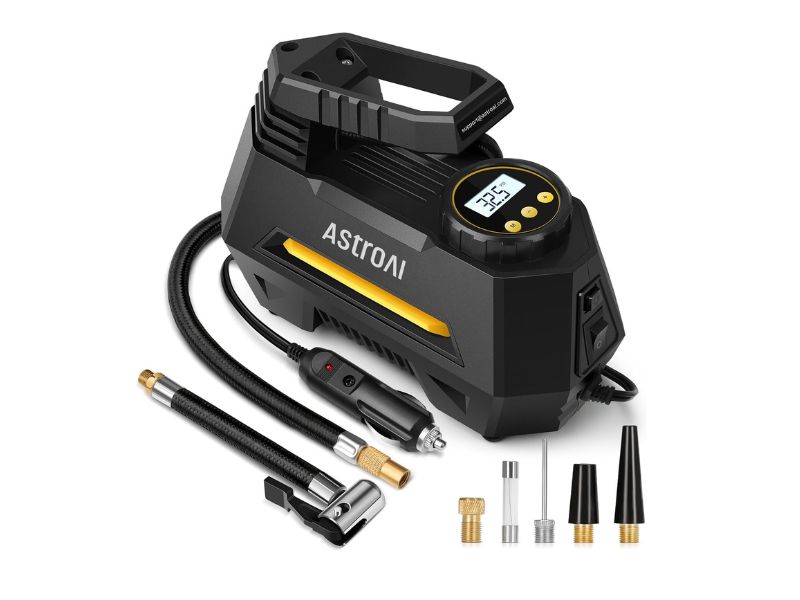
Key Features
- 12V DC power
- 100 PSI maximum working pressure
- Approximately 35 L/min or 1.23 CFM airflow
- Built-in digital pressure gauge
- PSI, kPa, bar, and kg/cm² pressure units
- Preset automatic shutoff
- Approximately 9.84-foot power cable
- Integrated LED work light
- Up to 15 minutes recommended continuous operation
- 120W power rating
- Compact portable design
- Additional inflation adapters
Detailed Review
The AstroAI earns my first position because it combines the features most drivers actually need in a portable car inflator without turning the unit into something unnecessarily bulky.
Its integrated digital pressure gauge allows you to connect the hose, read current tire pressure, set the desired target, and let the compressor handle the remaining inflation.
That is considerably more convenient than using an older compressor with a small analog gauge that requires repeated stopping and checking.
The automatic shutoff system is especially useful for normal tire maintenance.
Suppose your vehicle recommends 35 PSI when the tires are cold. You can select the target pressure, begin inflation, and the compressor stops automatically once that pressure is reached.
This does not eliminate the value of periodically checking the reading with a known accurate gauge, but it makes routine adjustments much easier.
The unit delivers approximately 35 liters per minute, or about 1.23 CFM.
That is appropriate for passenger-car tires, crossovers, motorcycles, bicycles, and similar applications.
It is not intended to compete with a large shop compressor or heavy-duty off-road inflation system. If you routinely air large truck tires from very low pressures, a higher-volume compressor would be more appropriate.
A 100 PSI maximum working pressure is more than sufficient for ordinary passenger-car tires, which commonly operate somewhere around the 30–40 PSI range.
Maximum compressor pressure should not be confused with your tire’s recommended pressure.
Always inflate according to the vehicle manufacturer’s specification—usually found on the driver’s door-jamb placard—not simply to the maximum number molded into the tire sidewall.
The long power cord is another practical advantage.
The approximately 9.84-foot cable helps the compressor reach different wheels when connected to a vehicle’s 12V socket.
Cord length seems like a minor detail until you discover that a short cable cannot comfortably reach the rear tire of a larger sedan or crossover.
The built-in LED light is useful during roadside inflation after dark. It can illuminate the valve stem, hose connection, and surrounding work area without requiring you to balance a separate flashlight.
AstroAI specifies a maximum continuous operating period of roughly 15 minutes.
That is important because small portable compressors generate significant heat. Repeatedly operating them beyond their duty cycle can shorten motor and compressor life.
For normal pressure corrections—such as raising four tires from 29 PSI to 35 PSI—the duty cycle should rarely be a major issue.
It becomes more important when inflating a completely flat tire.
Another advantage is the unit’s compact size. A tire inflator only provides roadside value if it is actually inside the vehicle when you need it.
This model can remain in a trunk storage compartment alongside a tire plug kit, gloves, portable jump starter, and other emergency equipment without consuming excessive cargo space.
What I Like
I like the combination of digital pressure measurement and automatic shutoff because it simplifies regular pressure adjustment considerably.
The 35 L/min airflow is appropriate for normal automotive use, while the long power cable and built-in light improve real-world roadside usability.
The four selectable pressure units also make the display versatile for users who encounter PSI, bar, or kPa specifications.
What I Do Not Like
The inflator depends on the vehicle’s 12V electrical outlet, so it is not cordless.
It also needs cooling periods during demanding use, making it less suitable for repeatedly inflating large off-road or truck tires.
The screw-on hose connection can take slightly longer to attach and remove than a quality locking chuck.
Verdict
The AstroAI is my best car tire inflator with gauge for most drivers. It provides accurate-enough everyday pressure monitoring, automatic shutoff, useful airflow, good cable reach, and compact storage without unnecessary complexity.
2. EPAuto 12V DC Portable Air Compressor Pump – Best Easy-to-Use Digital Inflator
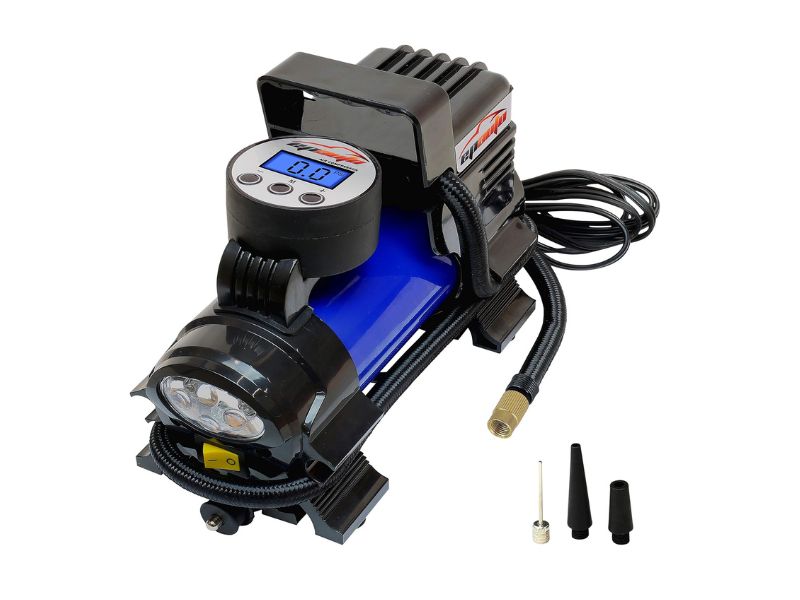
Key Features
- 12V DC operation
- Built-in digital tire-pressure gauge
- Automatic shutoff at preset pressure
- Approximately 1.06 CFM airflow
- 70 PSI maximum pressure specification
- Approximately 180W maximum power
- Roughly 3-foot air hose
- LED flashlight
- Multiple display units
- Portable trunk-friendly construction
- Inflation adapters for smaller inflatables
- Suitable for many compact and midsize passenger vehicles
Detailed Review
The EPAuto is another highly established portable inflator and has a straightforward design that works particularly well for ordinary passenger vehicles.
Like the AstroAI, it uses the vehicle’s 12V accessory outlet as its power source.
This has several advantages.
There is no internal lithium battery to recharge before a road trip, no battery pack gradually losing capacity after years of hot-car storage, and no proprietary battery platform required.
As long as the vehicle can supply appropriate 12V power, the compressor is available.
Its integrated digital gauge provides current pressure information and allows you to select a target pressure.
Once the preset pressure is reached, the compressor automatically switches off.
For routine tire maintenance, this is one of the features I consider most important.
People commonly overinflate tires when using a compressor without an automatic stopping point. They add air, disconnect the hose, check pressure, reconnect, and repeat.
A preset system reduces that back-and-forth.
EPAuto’s airflow is approximately 1.06 cubic feet per minute, which is adequate for passenger-car tires and routine top-offs.
It works especially well when correcting normal seasonal pressure changes.
For example, tire pressure often decreases when outside temperatures fall. If all four tires lose three or four PSI during the first cold weather of the season, a portable compressor lets you correct the problem at home rather than making a special trip to an air station.
The 70 PSI maximum pressure is lower than the headline ratings found on some competing products, but that is not a disadvantage for ordinary passenger-car use.
Your sedan may only require around 32–38 PSI.
Having a 150 PSI maximum rating does not make a compressor inflate a 35 PSI car tire more accurately.
Airflow, duty cycle, gauge quality, hose connection, and compressor performance matter more for typical use.
The included LED light adds roadside utility.
If a low-pressure warning appears after dark, you can illuminate the valve area while connecting the inflator.
The compressor is relatively compact and can stay inside the trunk without becoming an inconvenience.
Its traditional box-style construction also gives it a stable base when placed on pavement.
One thing to consider is noise.
Small piston compressors are not quiet, and the EPAuto is no exception. This is normal for the category, but it is something to keep in mind if you are inflating multiple tires early in the morning or late at night.
The unit is also better suited to passenger vehicles than large commercial tires.
If you own a heavy-duty pickup with large LT tires that require high pressure and substantial air volume, choose a compressor designed specifically for truck tires.
What I Like
The automatic shutoff and digital pressure gauge make the EPAuto simple enough for occasional users.
I also like the straightforward 12V power design. There is no internal battery whose charge status you need to remember before an emergency.
The compressor’s established design and compact storage size make it practical as permanent trunk equipment.
What I Do Not Like
It is relatively loud during operation.
Its 70 PSI maximum and passenger-car-oriented airflow also mean that it is not my preferred solution for large truck, RV, or off-road tires.
The unit requires a 12V vehicle outlet and therefore does not provide cordless operation.
Verdict
The EPAuto is a strong choice for drivers who want a simple digital inflator with automatic pressure shutoff for regular car-tire maintenance and emergency top-offs.
3. VacLife ATJ-1166 12V Tire Inflator – Best Compact Value Pick
Key Features
- 12V DC power
- Digital pressure gauge
- Preset pressure control
- Automatic shutoff
- Integrated LED illumination
- Compact portable body
- 120W power rating
- Multiple nozzle accessories
- Suitable for car tires, motorcycles, bicycles, and balls
- Lightweight approximately 2.33-pound construction
- Easy trunk storage
- Designed primarily for standard passenger-car tire sizes
Detailed Review
The VacLife ATJ-1166 is my third recommendation for buyers who want a straightforward tire inflator with the core features that matter most: digital pressure measurement, preset inflation, automatic shutoff, and roadside lighting.
Its operating principle is simple.
Connect the inflator to the vehicle’s 12V power outlet, attach the air hose to the tire valve, check the current pressure reading, select your desired target, and start the compressor.
When the target is reached, the unit automatically stops.
That makes it suitable for drivers who may not be particularly comfortable working with tire-pressure equipment.
There is no need to manually estimate how long the compressor should run.
The integrated digital display allows you to monitor tire pressure during the process.
For normal passenger-car maintenance, that is considerably easier than trying to read a tiny mechanical gauge while the compressor vibrates on the ground.
VacLife also incorporates an LED light, which improves usability when checking tire pressure at night.
Many tire-pressure warnings happen at inconvenient times. A vehicle may sit in an office parking lot all day and only display a low-pressure warning when you leave after dark.
Having illumination built directly into the inflator means there is one less tool to locate.
The included adapters expand its usefulness beyond cars.
Depending on the accessory, the compressor can help inflate items such as bicycles, sports balls, and other compatible inflatables.
That makes a portable inflator useful even if you rarely experience a completely flat car tire.
Like the other models here, however, this is a small 12V automotive compressor rather than a heavy-duty continuous-use air system.
The model is intended primarily for ordinary passenger tires rather than large high-pressure truck tires.
If your vehicle uses wide LT tires, oversized off-road tires, or unusually high inflation pressures, a larger compressor with heavier wiring and greater airflow is the better tool.
The VacLife’s approximately 2.33-pound weight keeps it easy to move and store.
It fits well in a trunk emergency kit, and the compact housing is less intrusive than carrying a tank-style compressor.
What I Like
The digital gauge, preset pressure, and automatic shutoff make the VacLife simple to operate.
Its LED light and multiple nozzle accessories also increase its usefulness as a general-purpose inflator.
I particularly like it for drivers who want an inexpensive compressor for pressure maintenance rather than extreme off-road inflation.
What I Do Not Like
It is not designed for large trucks, commercial tires, or other applications requiring high airflow and extended continuous operation.
Like the other 12V models here, it also relies on the vehicle’s electrical system rather than an internal rechargeable battery.
Verdict
The VacLife ATJ-1166 is a practical compact-value tire inflator with a digital gauge for standard passenger cars, motorcycles, bicycles, and occasional emergency use.
Car Tire Inflator with Gauge Comparison Table
| Product | Power | Max Pressure | Airflow | Gauge | Auto Shutoff | LED Light | Best For |
| AstroAI B07QR4Q42L | 12V DC | 100 PSI | 35 L/min | Digital | Yes | Yes | Best overall |
| EPAuto B01L9WSTEG | 12V DC | 70 PSI | 1.06 CFM | Digital | Yes | Yes | Easy everyday use |
| VacLife ATJ-1166 | 12V DC | Passenger-car class | Standard portable output | Digital | Yes | Yes | Compact value |
Quick Comparison
The AstroAI Tire Inflator is my overall favorite because its 35 L/min airflow, 100 PSI working range, long power cable, digital gauge, auto-stop function, and LED light create the strongest all-around package for normal car owners.
The EPAuto is an excellent alternative if you value a simple, established compressor for ordinary passenger-car pressure corrections. Its 70 PSI maximum is completely adequate for typical car tires, while the automatic shutoff makes inflation straightforward.
The VacLife ATJ-1166 provides many of the same convenience features in a compact design and is particularly suitable for buyers who want basic tire maintenance plus occasional bicycle or sports-equipment inflation.
How I Chose These Car Tire Inflators
The first requirement was a built-in gauge.
A tire inflator without a usable pressure reading does not fully match the buying intent because you would still need to carry a separate tire gauge.
I also prioritized:
- Established buyer-feedback history
- Digital pressure measurement
- Automatic shutoff
- 12V automotive compatibility
- Passenger-car tire suitability
- Airflow
- Maximum operating pressure
- Cord length
- Hose length
- LED lighting
- Ease of storage
- Inflation adapters
- Duty cycle
- Ease of setting target PSI
- Straightforward controls
I did not rank inflators simply by the highest maximum PSI.
For a passenger car that requires 35 PSI, a well-made 70 PSI compressor can be more useful than a poorly designed unit advertising 150 PSI.
Why a Built-In Gauge Matters
Correct tire pressure is important for more than avoiding a warning light.
Underinflation can affect:
- Steering response
- Braking behavior
- Tire temperature
- Shoulder wear
- Fuel consumption
- Tire life
Overinflation can also create problems, including:
- Reduced ride comfort
- Increased center tread wear
- Reduced compliance over rough surfaces
- Greater sensitivity to impacts
A built-in gauge allows you to monitor pressure while adding air rather than continuously removing the hose and checking with another tool.
For the most accurate maintenance, I still recommend owning a separate quality tire-pressure gauge as a reference.
Portable compressor gauges can vary slightly, and occasionally comparing readings helps you identify calibration drift.
Digital Gauge vs Analog Gauge
Both can work well.
Digital Gauge Advantages
Digital displays are typically easier to read in:
- Low light
- Tight wheel areas
- Cold weather
- Roadside emergencies
They can also show multiple units such as:
- PSI
- kPa
- bar
- kg/cm²
Many digital inflators also support preset automatic shutoff.
Analog Gauge Advantages
Analog gauges:
- Do not need a display battery
- Can be quick to read
- Have fewer electronic components
- Often work well in workshop environments
For a self-contained portable car inflator, however, I generally prefer digital because preset control is so convenient.
What Is the Correct Tire Pressure for Your Car?
Do not simply inflate to the PSI printed in large numbers on the tire sidewall.
The correct starting point is the vehicle manufacturer’s recommended cold tire pressure.
Look for the placard commonly found:
- Inside the driver’s door opening
- On the door jamb
- Inside the fuel door on some vehicles
- In the owner’s manual
The placard may specify different pressures for:
- Front tires
- Rear tires
- Full-load driving
- Spare tire
The number on the tire sidewall generally identifies maximum load/pressure information for the tire, not the everyday inflation target selected by the vehicle manufacturer.
Check Tire Pressure When Cold
For routine adjustment, tire pressure should generally be checked when the tires are cold.
Driving creates heat.
As tire temperature increases, internal air pressure rises.
If you drive for an hour and then reduce pressure to the cold specification, the tire may become underinflated after cooling.
A cold tire generally means the vehicle has been parked long enough for the tire temperature to stabilize near ambient conditions.
If you must add air while the tire is hot, follow appropriate vehicle guidance and recheck it cold later.
Why Tire Pressure Changes With Temperature
Air pressure changes as temperature changes.
This is why the tire-pressure monitoring system may activate on the first cold morning of fall even when no tire has a puncture.
A commonly used approximation is that tire pressure changes by roughly 1 PSI for every 10°F change in temperature, although actual behavior depends on conditions.
That makes a portable inflator particularly useful in regions with large seasonal temperature swings.
Instead of waiting in line at an air station during the first cold week of the year, you can adjust all four tires at home.
How Much PSI Does a Car Tire Need?
Many passenger vehicles operate somewhere in the 30–40 PSI range, but there is no universal number.
Some cars require less.
Some performance vehicles, heavily loaded vehicles, and specific tire sizes require more.
Always use the manufacturer’s placard specification for your exact vehicle and tire configuration.
The inflator’s maximum PSI rating is simply the maximum pressure the compressor is designed to produce.
It does not determine what pressure should go into your tires.
Is 100 PSI Enough for a Tire Inflator?
For most passenger cars, 100 PSI is more than enough.
If your tires require only 35 PSI, the difference between a compressor rated for 100 PSI and one rated for 150 PSI may have little practical significance.
Airflow is often more important.
A compressor capable of moving more air can inflate a large tire more quickly even if its maximum pressure rating is lower.
Airflow Matters More Than Many Buyers Realize
Airflow tells you how much air the compressor moves over time.
It may be expressed as:
- CFM
- L/min
A higher airflow generally means faster inflation when other variables are comparable.
The AstroAI’s approximately 35 L/min rating is useful for ordinary passenger-car applications.
Large truck and off-road tires contain far more air volume, which is why they benefit from higher-flow compressors.
Corded vs Cordless Tire Inflator
12V Corded Inflator
Advantages:
- No internal battery to recharge
- Ready whenever vehicle power is available
- Usually affordable
- Good for permanent trunk storage
- Runtime not limited by a small lithium battery
Disadvantages:
- Power cord must reach the wheel
- Vehicle electrical outlet must function
- Less convenient away from a vehicle
Cordless Inflator
Advantages:
- No cord around the vehicle
- Convenient for bikes and equipment
- Easy to carry
- Can work when the vehicle electrical system is unavailable
Disadvantages:
- Internal battery requires charging
- Battery capacity decreases with age
- Extreme temperatures affect lithium batteries
- May run out of charge during multiple tire inflations
For long-term trunk storage, a 12V corded inflator is still a very dependable solution.
Auto Shutoff Is Worth Having
Automatic shutoff is one of the features I would actively look for.
Without it, you must:
- Start the compressor.
- Watch the gauge continuously.
- Stop near the target.
- Check pressure.
- Add or release air if necessary.
With auto shutoff, you preset the desired pressure and allow the compressor to stop by itself.
This is especially convenient when checking all four tires.
It also reduces the chance of accidentally leaving the compressor running too long.
How Accurate Are Built-In Tire Inflator Gauges?
Accuracy varies by model.
A built-in digital gauge is generally sufficient for everyday tire maintenance when it is functioning correctly.
However, no inexpensive automotive gauge should be assumed perfectly calibrated forever.
I recommend occasionally comparing it with a quality standalone gauge.
If your inflator consistently reads:
- Inflator: 35 PSI
- Reference gauge: 33 PSI
you know there may be a systematic difference.
For ordinary road vehicles, consistency within a small reasonable range is normally more important than chasing laboratory-level precision.
How to Use a Car Tire Inflator with Gauge
1. Park Safely
Use a level location away from traffic.
Apply the parking brake.
2. Find the Recommended PSI
Check the driver’s door-jamb placard.
Do not guess.
3. Check the Tire When Cold
Cold pressure gives you the proper baseline.
4. Connect the Inflator to Power
For the models reviewed here, use the vehicle’s 12V socket.
Follow the manufacturer’s instructions regarding whether the engine should be running.
5. Remove the Valve Cap
Keep it somewhere safe.
6. Attach the Air Hose
Make sure the connection is secure and not leaking excessively.
7. Read Current Pressure
Allow the gauge to stabilize.
8. Set the Target
Choose the recommended PSI.
9. Start Inflation
The compressor should begin adding air.
10. Let Auto Shutoff Work
Once the selected pressure is reached, the compressor stops.
11. Disconnect the Hose
Some air loss during disconnection is normal.
12. Verify Pressure
Check the final reading.
13. Replace the Valve Cap
This helps keep dirt and moisture away from the valve core.
Should the Car Be Running While Using a 12V Inflator?
Follow the manufacturer’s instructions for the exact inflator and your vehicle.
Some 12V compressors work best with the engine running because the alternator maintains electrical-system voltage.
However, never run a vehicle in an enclosed garage or poorly ventilated area.
Carbon monoxide can accumulate rapidly and can be fatal.
If engine operation is required, move the vehicle to a properly ventilated outdoor location.
Do Portable Tire Inflators Drain the Car Battery?
They consume electrical current.
If the vehicle engine is off, that energy comes from the starting battery.
A short tire top-off should normally consume far less energy than starting the engine, but prolonged compressor operation can still discharge a weak battery.
This is another reason to follow the inflator manufacturer’s power instructions.
If your car battery is already failing, repeatedly operating an inflator with the engine off may leave insufficient power for restarting.
Understanding Duty Cycle
Small compressors generate heat.
Manufacturers therefore limit how long they should run continuously.
The AstroAI model, for example, specifies roughly 15 minutes of maximum continuous operation before cooling is necessary.
Ignoring duty-cycle limits can lead to:
- Excessive motor heat
- Compressor wear
- Melted components
- Reduced service life
- Thermal shutdown
For ordinary pressure corrections, 15 minutes is usually sufficient.
A completely flat large tire can be a different matter.
Tire Inflator for a Completely Flat Tire
First determine why the tire is flat.
If it simply lost pressure slowly and remains seated on the rim, a portable inflator may restore enough air to inspect it or reach a repair facility.
Do not simply inflate and drive if the tire has:
- Visible sidewall damage
- Exposed cords
- Large puncture
- Tire separated from rim
- Bulge
- Severe cracking
- Damage from being driven while flat
Inflation does not repair structural tire damage.
Tire Inflator vs Tire Repair Kit
An inflator adds air.
A tire repair kit may temporarily seal certain tread-area punctures.
The ideal roadside setup often includes both:
Inflator + tire-pressure gauge + appropriate tire repair kit.
A nail puncture can continue leaking after inflation.
If you have a slow leak, the inflator may provide enough pressure to reach professional service, but the underlying problem still requires inspection.
Never plug sidewall damage.
Can a Tire Inflator Fix a TPMS Warning?
It can fix the warning if low pressure is the cause.
The tire-pressure monitoring system may activate when:
- Temperature drops
- A tire slowly leaks
- Pressure was set incorrectly
- A tire has a puncture
After correcting pressure, some vehicles reset automatically after driving.
Others require a relearn or reset procedure.
If the warning remains with correct pressure, a TPMS sensor or system fault may need diagnosis.
How Often Should You Check Tire Pressure?
Checking approximately once a month is a practical routine for many drivers.
Also check:
- Before long road trips
- Before towing
- Before carrying heavy loads
- After major temperature changes
- When TPMS warns
- After tire service
Do not rely entirely on TPMS.
Many systems only warn after pressure has already dropped significantly below the recommended level.
Why Proper Tire Pressure Saves Money
Correct pressure helps tires maintain their intended shape and contact patch.
Chronic underinflation can increase rolling resistance and accelerate shoulder wear.
That means proper inflation can contribute to:
- Better fuel efficiency
- More even tread wear
- Longer tire life
- Predictable handling
A portable inflator makes routine pressure maintenance easy enough that you are more likely to actually do it.
Tire Pressure for Highway Trips
Before a long highway drive, check all tires when cold.
Also inspect:
- Tread depth
- Sidewalls
- Spare tire
- Valve stems
- Visible damage
Do not intentionally overinflate tires simply because you will be traveling at highway speed unless the vehicle manufacturer specifies a different setting for your load.
Do Not Forget the Spare Tire
Temporary spare tires can require significantly higher pressure than normal road tires.
Some compact spares require around 60 PSI, although the exact value should always be confirmed on the vehicle placard or spare-tire information.
A portable compressor capable of reaching that pressure can be very useful.
Spare tires are often ignored for years, so they may be underinflated precisely when needed.
Using a Tire Inflator on SUVs
Most compact and midsize SUV tires are within the capabilities of ordinary portable 12V inflators.
The difference is inflation time.
A larger tire contains more air than a small sedan tire, so the same compressor may take longer to raise pressure.
The AstroAI is my preferred model among these three for this kind of use because of its published 35 L/min airflow.
Using a Tire Inflator on Trucks
Truck tires require more consideration.
A light-duty pickup with standard road tires may be manageable.
Large LT tires, heavy-duty pickups, commercial vehicles, and off-road tires can require:
- Higher pressure
- Greater air volume
- Longer compressor runtime
A small passenger-car compressor may overheat before completing the task.
For frequent truck use, choose a heavy-duty inflator specifically rated for your tire size and required pressure.
Common Mistakes to Avoid
Inflating to the Sidewall Maximum
Use the vehicle placard pressure, not the maximum tire rating.
Checking Immediately After a Long Drive
Hot tires naturally show higher pressure.
Ignoring the Duty Cycle
Portable compressors need cooling.
Using the Wrong Power Source
Follow voltage and amperage requirements.
Leaving the Inflator Loose in the Trunk
Secure the compressor so cargo does not damage the hose, display, or power plug.
Assuming Inflation Repairs a Puncture
Air only restores pressure temporarily if a leak remains.
Never Checking Gauge Accuracy
Compare the built-in gauge occasionally with a trusted reference gauge.
Frequently Asked Questions
What is the best car tire inflator with gauge?
The AstroAI B07QR4Q42L is my top overall choice for most passenger-car owners.
Its digital gauge, preset automatic shutoff, 100 PSI maximum working pressure, approximately 35 L/min airflow, long 12V power cable, and LED light create an effective balance of portability and everyday performance.
Is a digital tire inflator better than an analog one?
Digital inflators are generally easier for everyday drivers because they support preset pressure and clear readings.
Analog gauges can be reliable and do not depend on an electronic display, but digital models are particularly convenient for automatic shutoff.
How accurate should a tire inflator gauge be?
It should be accurate enough to keep pressure close to the vehicle manufacturer’s specification.
For extra confidence, compare the inflator periodically with a quality standalone gauge. Consistent readings matter more than assuming every low-cost digital display is perfectly calibrated.
Is 100 PSI enough for car tires?
Yes, 100 PSI is far above the normal operating pressure of most passenger-car tires.
Most cars operate somewhere around the 30–40 PSI range, although the exact specification varies.
Is 70 PSI enough for a tire inflator?
Yes, for most passenger cars and many normal SUVs.
EPAuto’s 70 PSI capability comfortably exceeds the pressure required by typical car tires. Check your vehicle requirements if you need to inflate high-pressure truck or spare tires.
How fast should a portable tire inflator work?
Inflation speed depends on tire volume, starting pressure, compressor airflow, and target PSI.
A small sedan tire can be topped off quickly, while a large SUV tire requires more air and therefore more time.
Can I inflate all four tires at once?
You inflate them individually, but a portable compressor can normally top off all four during one maintenance session.
Respect the compressor’s duty-cycle limit and allow cooling if operation becomes prolonged.
Does an inflator automatically stop?
Models with preset automatic shutoff stop when the selected pressure is reached.
All three recommendations in this guide provide this convenience.
Can a tire inflator overinflate a tire?
Yes, particularly if automatic shutoff is not used or the selected target pressure is wrong.
Always verify the manufacturer’s recommended cold tire pressure before setting the compressor.
Should I use the PSI on the tire sidewall?
No, use the vehicle manufacturer’s recommended cold tire pressure for routine inflation.
The sidewall figure generally represents maximum tire-related pressure/load information rather than the normal operating target for your vehicle.
Where do I find my car’s tire pressure?
Look at the tire-information placard inside the driver’s door opening or check the owner’s manual.
It normally lists front and rear cold tire pressures.
Can I use a tire inflator with the engine off?
Follow the inflator and vehicle manufacturer’s instructions.
A 12V compressor draws current from the vehicle battery when the engine is off. Never run an engine inside a closed garage simply to power an inflator.
Can a portable compressor inflate a completely flat tire?
Often yes if the tire remains structurally sound and seated on the rim.
Do not reinflate a tire with serious sidewall damage, visible structural failure, or damage caused by driving while flat without proper inspection.
Can I use these inflators for bicycles?
Yes, when the correct valve adapter and pressure range are compatible.
Some bicycle tires require adapters or pressures outside the ideal range for automotive compressors, so check the bicycle tire specification first.
Can I use one for balls and inflatables?
Yes, compatible needle and nozzle adapters allow many portable compressors to inflate sports and recreational equipment.
Be careful with low-pressure inflatables because a car compressor can add air quickly.
Why does my tire keep losing pressure?
A continuing pressure loss can indicate a puncture, leaking valve, bead leak, wheel damage, or temperature change.
If one tire repeatedly loses substantially more pressure than the others, have it inspected rather than continually adding air.
Why does my TPMS light stay on after inflation?
The system may require driving, recalibration, or sensor diagnosis.
First verify all tires are set correctly when cold. Consult the vehicle manual for the TPMS reset procedure.
How often should I check tire pressure?
Checking approximately monthly and before long trips is a good habit.
Also inspect pressure after major seasonal temperature changes.
Should I keep an inflator in my car all year?
Yes, provided it is stored securely and within the manufacturer’s temperature limits.
A compact 12V inflator is particularly useful because it does not depend on an internal rechargeable battery.
Is a cordless inflator better than a 12V inflator?
Cordless models are more convenient, while 12V inflators eliminate the need to maintain another battery.
For permanent trunk storage, I like the reliability of a corded 12V model. For frequent use around bikes and equipment, cordless convenience can be more valuable.
Conclusion
Choosing the best car tire inflator with gauge is mainly about balancing pressure accuracy, airflow, portability, power source, automatic shutoff, and suitability for your actual tire size.
The AstroAI B07QR4Q42L remains my primary recommendation. Its 100 PSI maximum working pressure, approximately 35 L/min airflow, digital gauge, automatic shutoff, multiple pressure units, long power cable, and built-in LED light make it a particularly well-rounded option for ordinary passenger vehicles.
The EPAuto 12V DC Portable Air Compressor Pump is another strong choice for drivers who value simple controls, an integrated digital gauge, automatic shutoff, and a stable traditional compressor design. Its 70 PSI maximum pressure is more than adequate for most passenger-car tires.
The VacLife ATJ-1166 rounds out the list as a compact value option with digital pressure monitoring, preset auto-stop functionality, LED lighting, and useful inflation accessories.
For most sedans, hatchbacks, and crossovers, I would start with the AstroAI Tire Inflator. It offers the strongest overall combination of established use, practical airflow, gauge convenience, and roadside portability.