Checking tire pressure with one tool and then repeatedly reconnecting an air chuck to add air is unnecessarily slow. The best digital tire inflator with LED pressure gauge combines an air-compressor inflator, pressure gauge, tire chuck, and usually a bleed valve into one handheld tool. Connect it to your compressor, attach it to the valve stem, and you can monitor pressure while adding or releasing air without constantly swapping tools.
For everyday cars, SUVs, pickups, motorcycles, RVs, and trailers, I pay particular attention to gauge accuracy, PSI range, backlit display visibility, hose quality, valve-stem connection, trigger control, pressure resolution, and quick-connect compatibility.
A high maximum PSI is useful, but accurate readings around normal automotive tire pressures are more important than simply having the largest number on the specification sheet. It is also worth noting that most products in this category use an LCD screen with LED backlighting, rather than an LED-only numerical display.
My primary recommendation is the AstroAI Digital Tire Pressure Gauge with Inflator 3–250 PSI. Its huge user base, 0.1 PSI display resolution, backlit digital screen, inflate-and-bleed controls, standard compressor connection, and broad 250 PSI range make it the strongest all-around choice for a home garage.
The JACO FlowPro Digital Tire Inflator with Pressure Gauge 200 PSI is my preferred upgrade if you care about a particularly secure valve-stem connection and a more premium workshop feel. Its locking chuck, rugged construction, illuminated screen, integrated bleed control, and strong accuracy specification make tire-pressure adjustments extremely convenient.
For buyers who want a rugged metal-bodied alternative, the AZUNO Digital Tire Inflator with Pressure Gauge 200 PSI is also worth considering. It offers a bright digital display, fine pressure resolution, durable hose and fittings, an air-release control, and the standard connection needed for most home air-compressor setups.
Best Digital Tire Inflator with LED Pressure Gauge
| Image | Product Name | Check Price |
|---|---|---|
Best Choice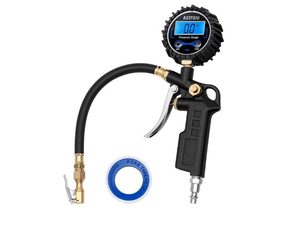 | AstroAI Digital Tire Pressure Gauge with Inflator – Best Overall | Check Price |
Second Best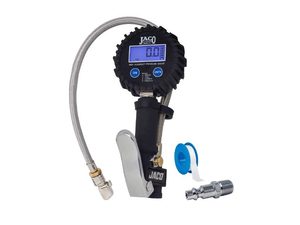 | JACO FlowPro Digital Tire Inflator with Pressure Gauge 200 PSI | Check Price |
Third Choice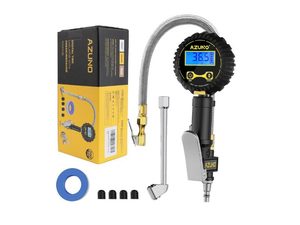 | AZUNO Digital Tire Inflator with Pressure Gauge 200 PSI | Check Price |
 | Rhino USA Digital Tire Pressure Gauge with Inflator 200 PSI | Check Price |
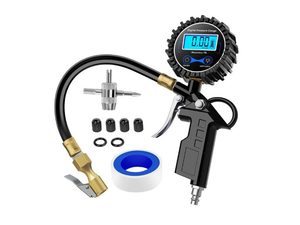 | Nilight 50026R Digital Tire Inflator Pressure Gauge | Check Price |
Best Digital Tire Inflator with LED Pressure Gauge
1. AstroAI Digital Tire Pressure Gauge with Inflator – Best Overall
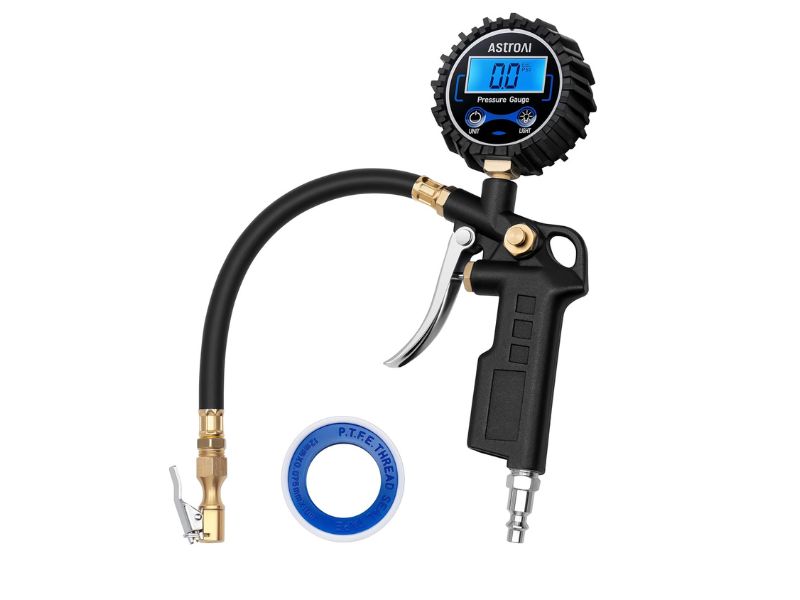
Key Features
- 3–250 PSI measurement range
- 0.1 PSI display resolution
- LED-backlit digital screen
- PSI, BAR, kPa, and kg/cm² units
- Integrated inflation trigger
- Built-in air-bleed valve
- Locking air chuck
- 1/4-inch NPT compressor compatibility
- Heavy-duty steel and brass components
- Automatic display shutoff
- Suitable for cars, SUVs, trucks, motorcycles, and RVs
Detailed Review
The AstroAI digital inflator earns the top position because it combines the features most home mechanics actually need with one of the largest user histories in the category.
The first benefit is convenience. Instead of attaching an air chuck, adding air, removing it, checking pressure with a separate gauge, and repeating the process, the AstroAI keeps the pressure reading directly in front of you during inflation.
Its digital gauge covers a wide 3–250 PSI range. That is far more than a normal passenger-car tire needs, but the additional range makes the tool versatile for higher-pressure applications.
More important for normal car use is its 0.1 PSI display resolution. Passenger tires are commonly adjusted within a fairly narrow pressure range, so being able to see tenths of a PSI makes fine adjustments much easier than estimating between marks on a small analog dial.
The backlit display is another practical advantage. Garage lighting is not always ideal, and valve stems often end up positioned close to the floor or inside a wheel where reading a conventional gauge becomes awkward. A bright digital display reduces that frustration.
The inflator also includes a bleed valve. If you overshoot the desired pressure, you do not have to remove the tool and manually depress the valve core. Press the release control, let a small amount of air escape, and watch the gauge until the desired pressure is reached.
Construction is suitable for regular DIY use, with metal components in the pressure-handling areas and a flexible hose connecting the body to the air chuck.
The standard quick-connect arrangement is designed for connection to an external air compressor. This point is important: the AstroAI does not contain its own compressor. You need a shop compressor, pancake compressor, portable compressor with a compatible air hose, or another suitable compressed-air source.
That distinction sometimes causes confusion because “tire inflator” can also describe portable electric pumps. This model is an inflator-gauge attachment for an existing compressor.
What I Like
- Very large user history
- Wide 250 PSI range
- Fine 0.1 PSI display resolution
- Bright backlit screen
- Easy inflation and deflation
- Multiple measurement units
- Useful locking chuck
- Standard compressor connection
- Good balance of price and durability
- Easy to read in a dim garage
What I Do Not Like
- Requires a separate air compressor.
- The standard hose is not especially long.
- The locking chuck may require careful positioning on some recessed valve stems.
- Maximum PSI is far more than most passenger-car users need.
Verdict
The AstroAI is the best digital tire inflator with LED pressure gauge for most home garages.
It delivers accurate, easy-to-read pressure information while allowing you to inflate and bleed air from the same tool. For routine tire maintenance on cars, SUVs, motorcycles, and light trucks, it offers an excellent combination of simplicity and useful features.
2. JACO FlowPro Digital Tire Inflator with Pressure Gauge 200 PSI – Best Premium Pick
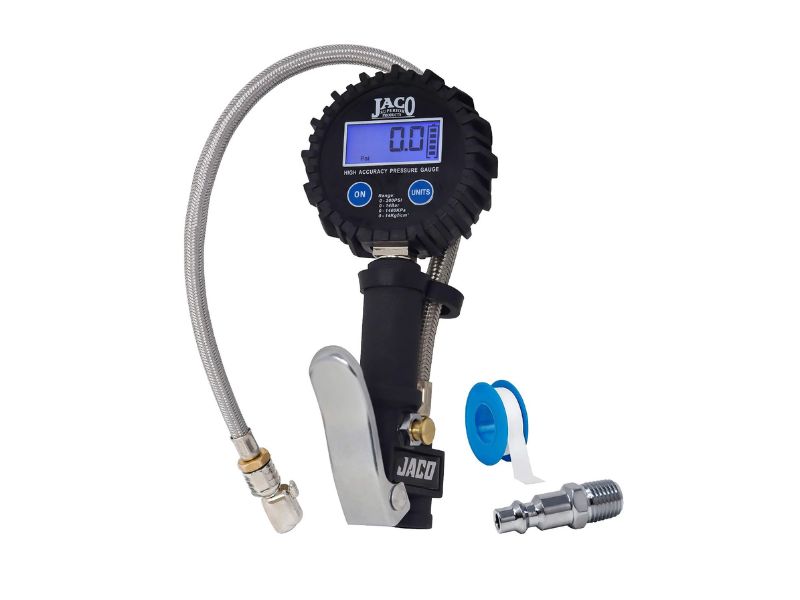
Key Features
- Up to 200 PSI
- Backlit digital pressure display
- Multiple pressure units
- Precision pressure measurement
- Integrated inflation trigger
- Built-in air-bleed function
- Locking tire chuck
- Heavy-duty body construction
- Flexible air hose
- Standard compressor connection
- Automatic display shutoff
- Suitable for automotive and higher-pressure tires
Detailed Review
The JACO FlowPro is my second recommendation and the model I would consider if the air chuck itself is one of your biggest priorities.
A tire inflator can have an excellent gauge yet still be annoying if the chuck does not seal securely on the valve stem. Air leakage during connection makes readings unstable and wastes compressor air.
JACO’s locking chuck is designed to grip the Schrader valve firmly so you can concentrate on the gauge and trigger rather than holding the chuck against the valve with one hand.
That becomes particularly useful when maintaining several vehicles. If you check four tires on two cars, you may make eight valve connections in a single session. Small improvements in chuck usability become noticeable very quickly.
The FlowPro also integrates inflation and pressure adjustment into a handheld design. Add air with the trigger, monitor pressure on the illuminated screen, and use the bleed function when you need to remove a small amount.
Its 200 PSI range covers normal passenger tires, pickup tires, many RV applications, motorcycles, trailers, and numerous workshop jobs without making the gauge excessively specialized.
I also like the rugged feel. The JACO is aimed more toward enthusiasts and frequent garage users than someone who checks a single car twice a year.
A backlit digital readout makes pressure easy to see in low-light conditions, and common pressure units allow you to switch formats when working with vehicles or equipment whose specifications are not listed in PSI.
Compared with a very inexpensive inflator attachment, the main reason to pay more is the overall user experience—particularly the chuck, hose, trigger, and construction.
What I Like
- Excellent locking air chuck
- Strong overall build quality
- Clear illuminated display
- 200 PSI working range
- Convenient inflation control
- Built-in deflation capability
- Good for repeated garage use
- Easy one-tool pressure adjustment
- Useful for cars, motorcycles, and trucks
What I Do Not Like
- Costs more than many basic digital inflators.
- Requires an external compressor.
- May be more tool than an occasional user needs.
- Some buyers may prefer 0.1 PSI resolution across every operating condition.
Verdict
The JACO FlowPro is my premium recommendation for drivers who want an especially convenient valve-stem connection and a rugged garage tool.
It makes the most sense for enthusiasts, home mechanics, motorcycle owners, and anyone who checks tire pressure frequently enough to appreciate better ergonomics.
3. AZUNO Digital Tire Inflator with Pressure Gauge 200 PSI – Best Heavy-Duty Value
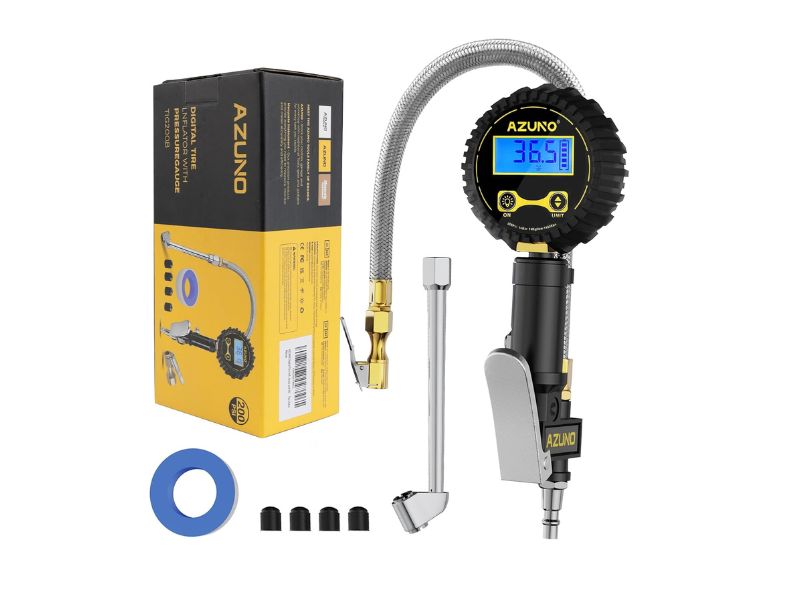
Key Features
- Up to 200 PSI
- Digital backlit gauge
- Fine pressure resolution
- Multiple measurement units
- Aluminum/metal body construction
- Flexible air hose
- Lock-on air chuck
- Integrated bleed valve
- Quick-connect compressor coupler
- Automatic power-saving function
- Suitable for cars, trucks, motorcycles, and RVs
Detailed Review
The AZUNO is a strong alternative for buyers who want a substantial inflator without moving into premium-tool pricing.
Its body has a reassuringly solid feel, while the combination of metal fittings and flexible hose gives it the durability needed for normal garage use.
The digital display is large and illuminated, making pressure information much easier to interpret than a small dial when the valve stem is near the bottom of the wheel.
Pressure can be displayed in several common units, which is particularly helpful for people who work on vehicles from different markets or switch between automotive, motorcycle, bicycle, and recreational applications.
The integrated inflator configuration is straightforward. Connect the tool to the compressor, attach the chuck to the tire valve, read the existing pressure, squeeze the control to add air, and release excess pressure through the bleed function if needed.
The ability to make all those adjustments without removing the tool is one of the primary advantages of this entire product category.
AZUNO’s 200 PSI range is more than enough for ordinary automotive work. Passenger vehicles generally operate far below the maximum capability of the gauge, leaving plenty of operating headroom.
I also like the hose and lock-on chuck configuration for wheels where the valve stem is positioned awkwardly. A flexible connection is easier to maneuver than a rigid inflator body attached directly to the valve.
One consideration is air-fitting compatibility. Most U.S. home compressor systems use familiar 1/4-inch quick-connect hardware, but there are different coupler profiles. Verify the fitting style used on your compressor rather than assuming every connector that looks similar will mate correctly.
What I Like
- Strong value
- Rugged body construction
- Bright digital display
- 200 PSI range
- Fine pressure adjustment
- Locking tire chuck
- Integrated air bleeder
- Flexible hose
- Standard-style quick connection
- Useful across several vehicle types
What I Do Not Like
- Air-fitting profile should be checked before use.
- Requires an existing compressor.
- The included hose may still feel short around unusual wheels.
- Not as refined as the JACO chuck system.
Verdict
The AZUNO is an excellent heavy-duty value choice for a home compressor setup.
It combines an easy-to-read digital gauge, solid construction, inflation control, and pressure bleeding without making the tool unnecessarily complicated.
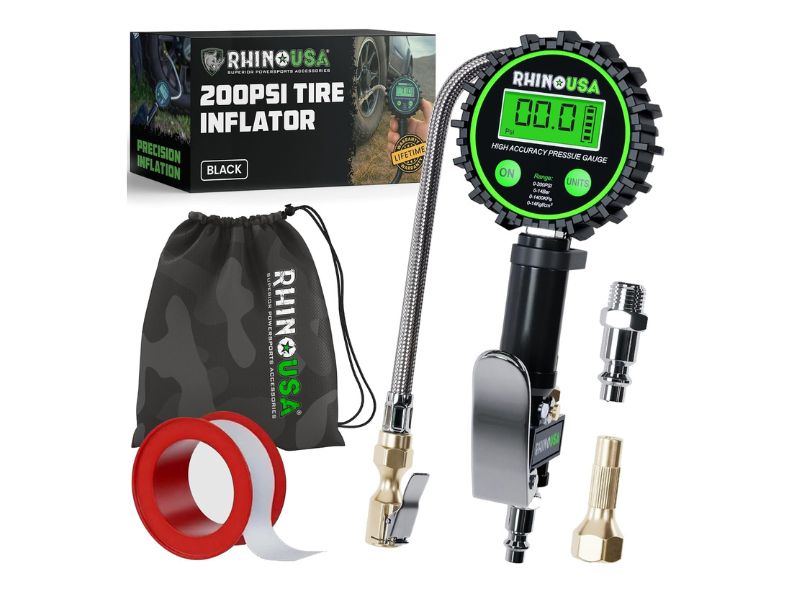
4. Rhino USA Digital Tire Pressure Gauge with Inflator 200 PSI – Best for Garage Durability
Key Features
- Digital pressure gauge
- Up to 200 PSI range
- Illuminated display
- Inflate, measure, and deflate functions
- Flexible hose
- Locking air chuck
- Metal and reinforced construction
- Quick-connect compressor compatibility
- Multiple pressure units
- Protective body design
- Suitable for passenger vehicles, trucks, and RVs
Detailed Review
The Rhino USA digital inflator is another highly popular compressor accessory that combines the three functions I want in this category: inflate, measure, and bleed pressure.
Its rugged exterior is one of the first things that stands out. Garage tools get dropped, dragged across workbenches, exposed to dust, and occasionally knocked into concrete. A pressure gauge used regularly should therefore have more physical protection than a delicate handheld electronic gauge.
The large digital display makes checking tire pressure straightforward, particularly when your eyesight or garage lighting makes a small analog scale frustrating.
A flexible hose helps position the inflator away from the wheel while the chuck remains connected. This is useful on trucks, RVs, aftermarket wheels, and motorcycles where valve-stem orientation can make a rigid gauge awkward.
The ability to release excess air without disconnecting the tool is another feature I consider essential.
Suppose the recommended cold pressure is 35 PSI and you accidentally inflate the tire to 37 PSI. Instead of disconnecting the air chuck, finding another tool, releasing air, and checking again, you can simply bleed the pressure downward while watching the screen.
The Rhino USA is suitable for people who value a rugged garage-tool feel and straightforward operation more than advanced electronics.
Like every compressor attachment in this guide, it relies on an external compressed-air source. If you need something for roadside emergencies where no compressor is available, choose a self-powered portable tire inflator instead.
What I Like
- Rugged garage-friendly design
- 200 PSI range
- Clear digital pressure reading
- Useful illuminated display
- Inflation and bleed controls
- Flexible hose
- Locking chuck
- Appropriate for larger vehicles
- Easy one-tool pressure adjustment
What I Do Not Like
- A separate compressor is mandatory.
- Bulkier than a simple handheld gauge.
- Chuck fit can vary depending on valve-stem geometry.
- More expensive than basic gauge-only tools.
Verdict
The Rhino USA is a good choice for drivers who want a durable digital inflator that will live permanently beside a garage compressor.
Its combination of straightforward controls, sturdy construction, and broad pressure range makes it useful for mixed vehicle maintenance.
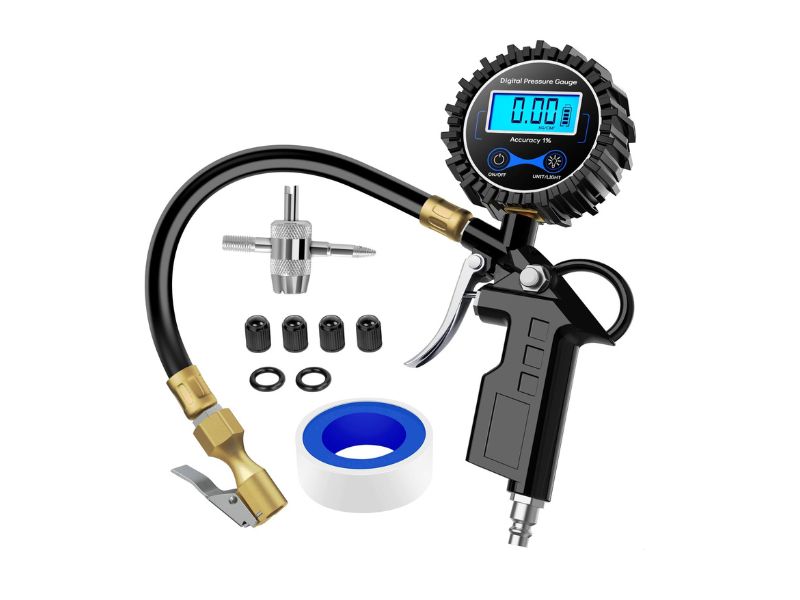
5. Nilight 50026R Digital Tire Inflator Pressure Gauge – Best Budget LED Display Pick
Key Features
- Up to 250 PSI gauge range
- 0.1 PSI display resolution
- LED-backlit LCD screen
- PSI, BAR, kPa, and kg/cm²
- Integrated inflation gun
- Tire-pressure gauge
- Air-bleed valve
- Lock-on air chuck
- Rubber hose
- Quick-connect coupler
- Heavy-duty steel and brass components
- Automatic screen shutoff
Detailed Review
The Nilight 50026R rounds out my list as a value-focused digital inflator with the core functionality needed for routine tire-pressure maintenance.
Its backlit digital screen is a key advantage over inexpensive mechanical inflator gauges. The large numbers are much easier to read while kneeling beside a wheel or working in a dimly lit garage.
The displayed pressure resolution reaches 0.1 PSI, providing enough detail for precise passenger-car adjustments.
You can also switch between PSI, kPa, BAR, and kg/cm². Most U.S. passenger vehicles use PSI, but multiple units are useful when working with international specifications, bicycles, motorcycles, or equipment manuals.
The pressure-handling components use steel and brass, while a protective section around the display helps make the tool more suitable for garage conditions.
Inflation is controlled from the gun-style body. An integrated air-bleed valve allows you to lower pressure after accidentally overfilling the tire.
I particularly like this approach for setting four tires evenly. Rather than deliberately stopping below the target and slowly creeping upward, you can add a little extra pressure and then bleed each tire precisely to the desired cold specification.
The included quick-connect coupler means installation into a typical compressor system is simple, assuming your compressor hose uses a compatible fitting profile.
Nilight also bundles small accessories such as valve caps and basic service components with many versions of the kit, which can be handy around the garage.
What I Like
- Strong value
- Wide 250 PSI range
- 0.1 PSI display resolution
- Backlit LCD
- Four measurement units
- Integrated bleed valve
- Lock-on chuck
- Metal pressure components
- Quick-connect setup
- Easy to read at night
What I Do Not Like
- Chuck quality is not as refined as premium options.
- Display housing should still be protected from severe drops.
- Requires an external compressor.
- Check quick-coupler compatibility with your existing air-hose system.
Verdict
The Nilight 50026R is a good budget-oriented choice for drivers who specifically want an illuminated digital pressure display without paying for a premium inflator.
It covers the main garage requirements—pressure reading, inflation, deflation, and quick compressor connection—in one convenient tool.
Best Digital Tire Inflator with LED Pressure Gauge Comparison
| Product | Pressure Range | Display Resolution | Backlit Display | Bleed Valve | Locking Chuck | Best For |
| AstroAI Digital Tire Pressure Gauge with Inflator | 3–250 PSI | 0.1 PSI | Yes | Yes | Yes | Best overall |
| JACO FlowPro Digital Tire Inflator | Up to 200 PSI | Fine digital reading | Yes | Yes | Yes | Premium chuck and build |
| AZUNO Digital Tire Inflator | Up to 200 PSI | 0.1 PSI class | Yes | Yes | Yes | Heavy-duty value |
| Rhino USA Digital Tire Inflator | Up to 200 PSI | Digital | Yes | Yes | Yes | Garage durability |
| Nilight 50026R | Up to 250 PSI | 0.1 PSI | Yes | Yes | Yes | Budget digital option |
The AstroAI remains my primary recommendation because it offers the strongest combination of popularity, pressure range, readable backlighting, fine resolution, and everyday usability.
JACO is my upgrade pick when chuck quality and overall ergonomics matter most. AZUNO and Rhino USA are strong garage alternatives, while Nilight delivers the essential digital features at the value end of the category.
How I Selected These Digital Tire Inflators
I focused on products that actually combine a compressor-powered inflator and pressure gauge rather than standalone digital gauges.
The most important factors were pressure accuracy, customer history, backlit display visibility, pressure range, resolution, hose construction, chuck security, inflate/deflate control, and compressor compatibility.
I also prioritized different brands rather than filling the list with several nearly identical models from one manufacturer.
What Is a Digital Tire Inflator with Pressure Gauge?
This type of tool connects between an air compressor hose and a tire valve stem.
It usually combines four components:
- Air chuck
- Inflation trigger
- Digital pressure gauge
- Air-bleed control
This allows you to handle the entire adjustment process without disconnecting the tire.
It is important not to confuse this tool with a portable electric tire inflator.
A portable inflator contains its own compressor motor.
The products reviewed here are primarily air-compressor accessories, meaning you need an existing compressed-air source.
Why Use a Digital Inflator Instead of a Separate Gauge?
The main advantage is workflow.
With separate tools, tire adjustment might look like this:
Connect air chuck, add air, remove it, connect pressure gauge, check pressure, remove gauge, reconnect air chuck, add more air, then check again.
With an inflator gauge, you connect once.
The pressure reading remains available while you inflate or bleed air.
When maintaining four tires on several vehicles, this can save substantial time and reduce repeated valve-stem handling.
Digital vs. Analog Tire Inflator Gauge
Both can work well.
Digital Advantages
A digital gauge provides:
- Large numerical readings
- Backlighting
- Fine pressure resolution
- Multiple measurement units
- Easier low-light visibility
For many users, reading “35.2 PSI” is easier than interpreting a needle position.
Analog Advantages
Analog gauges offer:
- No batteries
- Straightforward operation
- Good durability in quality models
- Easy visual pressure trends
A high-quality mechanical gauge can remain extremely accurate.
My preference for this keyword is digital because the illuminated screen makes garage use especially convenient.
LED vs. LCD Tire Pressure Gauge
This terminology causes some confusion.
Many products described as having an “LED pressure gauge” actually use an LCD numerical screen illuminated by LED backlighting.
That is what most products in this guide use.
The important buyer benefit is not the technical display category—it is being able to clearly read the pressure in low light.
Look for:
- Strong contrast
- Large digits
- Backlighting
- Automatic shutoff
- Common measurement units
How Accurate Should a Tire Inflator Gauge Be?
For normal automotive work, I prefer a tool specified to approximately ±1 PSI or around 1% within its intended range, provided the manufacturer gives a meaningful accuracy specification.
Resolution and accuracy are not the same.
A screen displaying increments of 0.1 PSI does not automatically mean the gauge is accurate to ±0.1 PSI.
Resolution simply describes the smallest change shown on the screen.
Accuracy describes how close the displayed result is to actual pressure.
This distinction matters when comparing digital gauges.
Is 250 PSI Better Than 200 PSI?
Not necessarily.
A normal passenger-car tire might be specified around 30–40 PSI cold.
Whether your inflator has a 200 PSI or 250 PSI maximum does not materially improve normal car-tire inflation.
Higher ranges become relevant when working with:
- High-pressure truck tires
- Certain RV tires
- Trailer tires
- Specialized equipment
- Some bicycle tires
For an ordinary sedan, accuracy around 30–40 PSI matters more than the maximum reading.
What Does 0.1 PSI Resolution Mean?
A gauge with 0.1 PSI resolution can display readings such as:
32.1 PSI, 32.2 PSI, 32.3 PSI, and so on.
That makes fine adjustments easier.
However, you usually do not need to obsess over every tenth of a PSI for normal road driving.
Tire temperature alone can change pressure enough to overwhelm tiny differences.
Use the recommended cold pressure as your target and aim for consistent readings across the axle.
What PSI Should Car Tires Be Inflated To?
Use the pressure recommended by the vehicle manufacturer, normally found on the tire-information placard inside the driver’s door area or in the owner’s manual.
Do not automatically inflate tires to the maximum PSI molded into the tire sidewall.
The sidewall figure describes tire limits under specified conditions; it is not necessarily the correct everyday pressure for your particular vehicle.
Different vehicles using the same tire size may require different pressures because vehicle weight, suspension tuning, load distribution, and manufacturer specifications differ.
Why Check Tire Pressure When Tires Are Cold?
Vehicle-recommended tire pressures are generally based on cold tires.
Tire pressure increases as the tire heats during driving.
If you check immediately after a long highway drive, the measured pressure may be several PSI higher than the normal cold reading.
For the most consistent results, check tires before driving or after they have had enough time to cool.
How Often Should You Check Tire Pressure?
A practical routine is to check tire pressure roughly once a month and before long trips, while also responding to any TPMS warning.
More frequent checks can be useful when:
- Weather changes dramatically
- A tire has a known slow leak
- The vehicle tows
- You carry heavy loads
- The car sits for extended periods
- You drive significant mileage
A digital inflator attached to your garage compressor makes this routine much easier.
Why Tire Pressure Changes with Temperature
Air pressure changes as temperature changes.
When outdoor temperatures drop, tire pressure usually falls.
When temperatures rise, pressure increases.
A commonly used automotive rule of thumb is roughly 1 PSI change for every 10°F temperature change, though real-world behavior varies somewhat.
This is why a TPMS light may suddenly appear during the first cold morning of fall even when no tire has developed a puncture.
TPMS and Digital Tire Inflators
Modern vehicles use a Tire Pressure Monitoring System (TPMS) to warn drivers when tire pressure becomes significantly low.
TPMS is valuable, but it does not eliminate the need for a physical gauge.
The system is designed mainly as a warning system rather than a replacement for routine pressure maintenance.
A digital inflator lets you set the tires to the manufacturer’s recommended pressure before the warning threshold is reached.
Why Correct Tire Pressure Matters
Incorrect pressure affects more than comfort.
Underinflation
An underinflated tire can:
- Generate more heat
- Increase rolling resistance
- Wear the shoulder areas more rapidly
- Reduce steering response
- Reduce fuel efficiency
- Increase stress on the tire structure
Overinflation
Excessive pressure can:
- Reduce ride comfort
- Alter the contact patch
- Increase center tread wear in some conditions
- Make the tire more sensitive to impacts
- Reduce traction under certain conditions
Proper pressure helps the tire operate as the vehicle and tire manufacturers intended.
Choosing the Right Air Chuck
The chuck is the point where the inflator connects to the valve stem.
Lock-On Chuck
A locking chuck clips onto the valve stem and remains attached.
This is my preferred style for most automotive work because it allows hands-free pressure monitoring.
Push-On Chuck
A push-on chuck must often be held against the valve.
It is quick but can become tiring when adjusting several tires.
Screw-On Chuck
A threaded connector creates an extremely secure seal but takes longer to connect and disconnect.
The best choice depends on your wheels and how frequently you use the tool.
Why Hose Length Matters
A flexible hose allows the inflator body to remain in a comfortable position while the chuck connects to the tire.
Short hoses are compact but can be awkward on:
- Deep wheels
- Dual rear wheels
- Large brake assemblies
- Motorcycles
- RVs
- Valve stems positioned behind wheel spokes
For ordinary passenger cars, a moderate hose is usually sufficient.
Truck and RV owners may want an extended-reach model.
Check Your Air Compressor Coupler
Many tire inflator gauges use 1/4-inch NPT fittings, but that does not automatically mean every quick-connect plug fits every compressor coupler.
Several common quick-connect profiles exist.
If your inflator will not connect to your air hose, you may simply need a compatible plug rather than a different inflator.
Before ordering, check:
- Compressor coupler style
- Inflator inlet thread
- Existing air-tool plugs
- Required sealing method
This can prevent a frustrating installation problem.
How to Use a Digital Tire Inflator Gauge
Connect the inflator to your air-compressor hose.
Turn the compressor on and allow its tank to reach normal operating pressure.
Check the vehicle’s recommended cold tire pressure.
Remove the tire valve cap.
Attach the inflator chuck securely to the Schrader valve.
The digital display should show the existing tire pressure.
If pressure is low, squeeze the inflation trigger in short bursts.
Pause and allow the displayed pressure to stabilize.
If you add too much, press the bleed valve briefly.
Continue until the desired cold pressure is reached.
Disconnect the chuck and reinstall the valve cap.
Repeat the process on the remaining tires.
Why Compressor Tank Pressure Matters
Your air compressor needs to supply pressure higher than the pressure you are trying to put into the tire.
If a truck tire needs 80 PSI but your compressor is regulated to 70 PSI, air cannot effectively flow into the tire once the pressures approach equilibrium.
For normal passenger tires around 30–40 PSI, even relatively small compressors normally have plenty of pressure capability.
Airflow and tank capacity primarily influence how often the compressor motor needs to run.
Do You Need a Large Air Compressor?
No.
Tire inflation consumes relatively little air compared with pneumatic impact tools, grinders, or spray equipment.
A small pancake or portable compressor can work very well for ordinary car tires.
Larger tanks simply provide:
- Longer periods between motor cycles
- Faster recovery for repeated tire filling
- More capability for trucks and larger tires
For checking and topping off four passenger tires, a modest home compressor is generally sufficient.
Can These Inflators Be Used on Trucks?
Yes, provided the pressure range, hose, chuck, and compressor supply match the truck’s requirements.
A 200–250 PSI digital gauge provides more than enough measurement range for many light-truck tires.
Heavy-duty commercial vehicles may benefit from:
- Longer hoses
- Dual-head chucks
- Higher airflow
- Extended-reach tools
- More rugged shop-grade inflators
For a pickup truck, the models in this guide are generally much more practical.
Can You Use Them on RV Tires?
Yes.
The main challenge with RVs is often valve access rather than pressure range.
Dual rear wheels can have valve stems facing difficult directions.
A longer hose or dual-foot chuck may be necessary.
The digital gauge itself typically has more than enough pressure capacity.
Can You Use a Digital Inflator on Motorcycle Tires?
Yes, and the precise digital display can be particularly useful for motorcycles.
However, motorcycle wheels sometimes provide limited space around the valve stem due to:
- Brake rotors
- Spokes
- Drive components
- Small wheel diameter
A compact locking or angled chuck can make connection easier.
Can You Use It on Bicycle Tires?
These inflators normally connect directly to Schrader valves.
Many mountain bikes, children’s bikes, and recreational bicycles use Schrader valves.
Road bikes frequently use Presta valves, which require an appropriate adapter or compatible chuck.
Also verify the gauge range and compressor regulation before inflating small-volume, high-pressure bicycle tires.
Digital Gauge Battery Life
Digital pressure gauges use a small battery supply for the display and sensor electronics.
Battery life improves significantly when the tool includes automatic shutoff.
Good habits include:
- Turn it off after use if required.
- Do not store it in extreme heat.
- Replace batteries when the display becomes weak.
- Remove leaking or corroded batteries immediately.
- Keep spare batteries in the garage.
AAA-powered models can be particularly convenient because replacement batteries are widely available.
How to Check Gauge Accuracy
You can compare your digital inflator against another known accurate tire-pressure gauge.
Set a stable tire pressure and measure it with both tools.
If several quality gauges agree closely, you gain confidence that the inflator is reading correctly.
For professional environments requiring certified accuracy, follow the shop’s calibration procedures rather than relying on informal comparison.
Why Pressure Readings Sometimes Fluctuate
Pressure can fluctuate when:
- The chuck is not fully seated.
- Air is leaking around the valve.
- The trigger is partially open.
- Compressor pulses are entering the hose.
- The valve stem is damaged.
- The digital sensor has not stabilized.
Release the inflation trigger and allow pressure to settle before taking your final reading.
How to Prevent Air Leaks
Make sure the chuck is pushed fully onto the valve stem.
Inspect the valve stem for damage.
Check the inflator hose and fittings.
Use appropriate thread sealing methods on NPT connections when required.
Do not use thread tape where a fitting is designed to seal using a gasket or O-ring instead.
If the chuck repeatedly leaks on several vehicles, inspect or replace the chuck seal.
Maintenance Tips
Digital inflator gauges require relatively little maintenance.
Keep the tool:
- Dry
- Clean
- Protected from severe impacts
- Away from corrosive chemicals
- Stored without tension on the hose
- Equipped with healthy batteries
Inspect the air chuck and hose periodically.
If the tool is dropped hard, compare its readings with another accurate gauge before relying on it again.
Common Buying Mistakes
Buying a Gauge Without Realizing It Needs a Compressor
These are not usually self-powered air pumps.
Make sure you already own a compatible compressor.
Choosing by Maximum PSI Alone
A 300 PSI specification is meaningless if the gauge is inaccurate at 35 PSI.
Ignoring the Air Chuck
A poor chuck can make an otherwise good gauge frustrating.
Confusing Resolution with Accuracy
A 0.1 PSI display does not automatically guarantee ±0.1 PSI accuracy.
Forgetting Coupler Compatibility
Check your compressor’s quick-connect standard before buying.
Using Tire Sidewall Maximum Pressure as the Target
Always use the vehicle manufacturer’s recommended cold pressure unless a specific application requires otherwise.
Frequently Asked Questions
What is the best digital tire inflator with LED pressure gauge?
The AstroAI 3–250 PSI Digital Tire Pressure Gauge with Inflator is my best overall choice.
Its combination of an illuminated display, fine resolution, broad pressure range, inflate-and-bleed controls, locking air chuck, compressor compatibility, and very large user history makes it particularly well suited to home garages.
Does a digital tire inflator include an air compressor?
Not necessarily, and the products in this guide primarily require an external compressor.
They attach to an existing compressed-air hose and allow you to control inflation while reading pressure. If you need a self-contained roadside pump, look for a portable electric tire inflator instead.
What does LED pressure gauge mean?
Most digital inflator gauges use an LCD screen with LED backlighting.
The LED illumination makes the numerical pressure reading easier to see at night or in dim garages.
Is 200 PSI enough for a tire inflator gauge?
Yes, 200 PSI is more than enough for normal passenger-car and light-truck tire maintenance.
Most cars operate around a fraction of that pressure. Higher ranges mainly add flexibility for specialized tires and equipment.
Is 250 PSI better than 200 PSI?
Not for ordinary passenger cars.
Gauge accuracy, chuck quality, and ease of reading around your normal operating pressure are more important than the maximum rating.
Which is more accurate, digital or analog?
Either can be highly accurate when properly designed and calibrated.
Digital models are easier to read precisely, while quality analog gauges eliminate battery dependence.
Is 0.1 PSI resolution useful?
Yes, it makes fine pressure adjustments easier, although normal driving does not require obsessing over every tenth of a PSI.
Temperature changes can cause larger pressure variations during normal use.
What tire pressure should I use?
Use the cold tire pressure specified by the vehicle manufacturer.
The information is commonly printed on the driver’s-door placard and listed in the owner’s manual.
Should I inflate tires to the PSI shown on the tire?
Not automatically.
The tire sidewall normally lists maximum load and pressure information, not necessarily the correct everyday pressure for your vehicle.
Should tire pressure be checked cold?
Yes, manufacturer-recommended tire pressures are normally cold-pressure specifications.
Checking before driving produces the most consistent results.
How often should I check tire pressure?
Checking approximately once a month and before long trips is a sensible routine.
Also inspect pressure whenever the TPMS warning appears or outside temperatures change substantially.
Why is my tire pressure higher after driving?
Driving heats the tire and the air inside it, which increases pressure.
Do not automatically release air from a warm tire simply because its pressure exceeds the cold specification.
Can I use a digital tire inflator on a motorcycle?
Yes, provided the chuck can access the valve stem and the tire uses a compatible valve.
Motorcycles often benefit from the precise, easy-to-read digital display.
Can I use one on an RV?
Yes, but valve access and hose reach can be more important than maximum PSI.
Dual-wheel RVs may require an extended or dual-head chuck.
Does the AstroAI need an air compressor?
Yes, the inflator-gauge model reviewed here is designed to connect to an external compressed-air source.
It is not a standalone electric pump.
Is JACO better than AstroAI?
JACO is particularly attractive for its chuck and premium ergonomics, while AstroAI offers outstanding overall value and popularity.
For most DIY users I would choose AstroAI; frequent users may appreciate JACO’s connection system.
Is a bleed valve important?
Yes, it makes precise pressure adjustment considerably easier.
If you overinflate the tire slightly, you can release air without removing the inflator.
Why won’t my inflator connect to my compressor?
Your quick-connect plug and compressor coupler may use different profiles.
Confirm both the NPT thread size and quick-connect standard before replacing the tool.
Can a digital inflator gauge lose calibration?
Yes, any pressure gauge can become inaccurate after wear, contamination, or significant impact.
If you suspect a problem, compare it with another trusted gauge.
Can I leave the batteries inside the gauge?
Yes during normal use, but inspect them periodically for leakage or corrosion.
If the tool will be stored unused for a very long period, follow the manufacturer’s battery-storage recommendations.
Conclusion
The best digital tire inflator with LED pressure gauge should make tire maintenance faster without sacrificing pressure accuracy or connection quality. A good tool lets you connect to the valve once, see the tire pressure clearly, add air from your compressor, and bleed excess pressure without reaching for a second gauge.
My primary recommendation is the AstroAI Digital Tire Pressure Gauge with Inflator 3–250 PSI. Its broad pressure range, 0.1 PSI display resolution, illuminated digital screen, integrated bleed valve, locking chuck, and huge user history make it the most balanced choice for the average home garage.
The JACO FlowPro Digital Tire Inflator is my preferred upgrade for buyers who value a premium locking chuck and rugged construction. It is particularly appealing for enthusiasts who check multiple vehicles frequently.
The AZUNO Digital Tire Inflator provides a strong balance between heavy-duty construction and value, while the Rhino USA Digital Tire Inflator is a solid choice for garage users who prioritize a rugged tool body.
The Nilight 50026R rounds out the group with a useful 250 PSI range, fine digital resolution, illuminated display, pressure-release control, and straightforward compressor connection.
For most drivers who already own an air compressor, I would start with the AstroAI. It turns the repetitive inflate-check-adjust process into a much simpler one-tool job and offers the features that matter most for regular car-tire maintenance.