Keeping tires properly inflated is much easier when you have a dependable inflator permanently available in the garage. Instead of driving to a gas station whenever a tire loses a few PSI, a good garage tire inflator lets you check and correct pressure before commuting, road trips, seasonal temperature changes, or routine vehicle maintenance.
For garage use, I particularly value household AC power, an accurate pressure display, automatic shutoff, adequate hose and cord reach, reasonable inflation speed, and a duty cycle that can handle several tires without constant overheating.
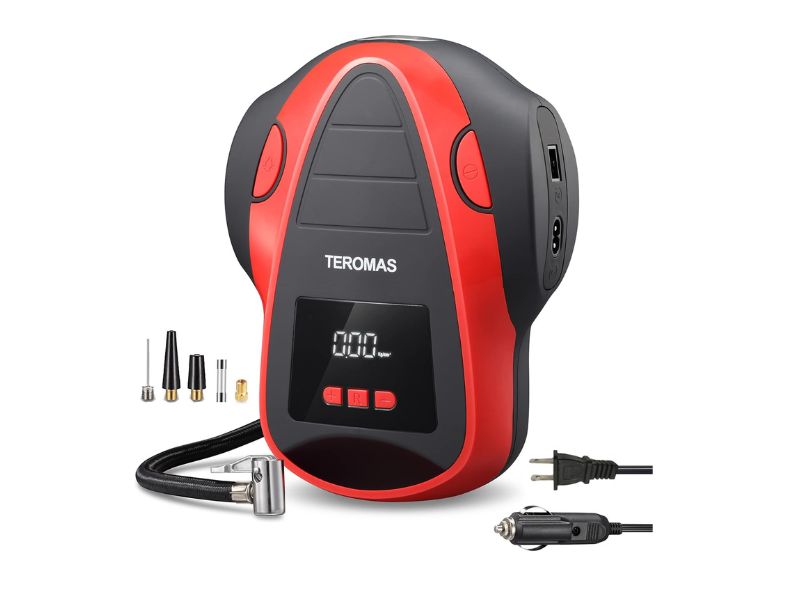
My primary recommendation is the TEROMAS TMS-3015 AC/DC Tire Inflator. It combines a standard 110V wall connection with a 12V vehicle plug, a programmable digital gauge, automatic shutoff, and a compact body. That dual-power arrangement makes it useful as a dedicated garage pump while still giving you the option to carry it in the vehicle.
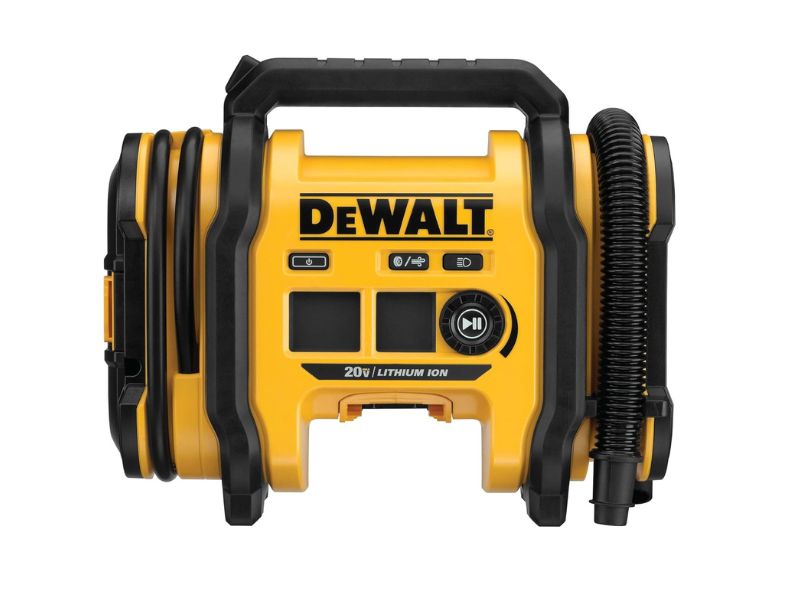
For buyers who want a more rugged tool-platform design, I recommend the DEWALT DCC020IB 20V MAX Tire Inflator. It can operate from a 20V MAX battery or 12V vehicle power, with an optional AC adapter available for household outlets. Its high-pressure and high-volume modes, threaded tire chuck, automatic shutoff, and durable construction make it particularly attractive for a busy home garage.
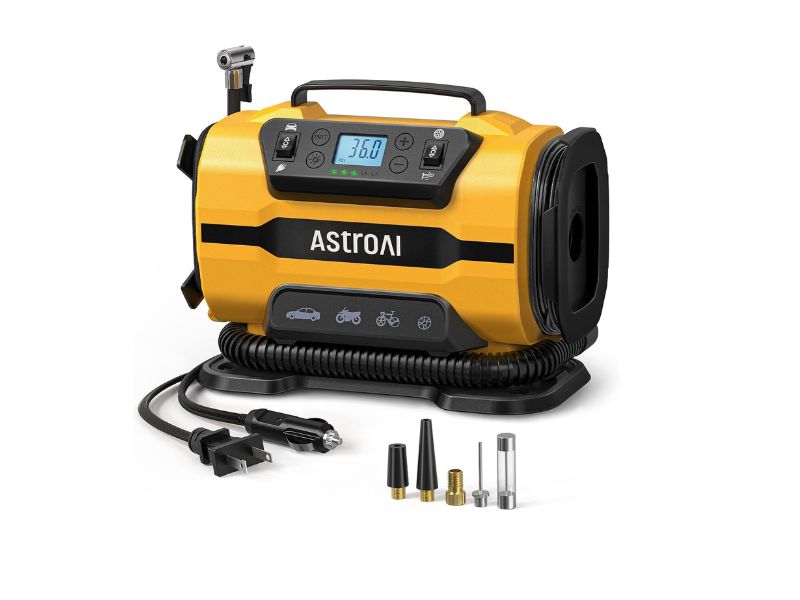
The AstroAI 150 PSI AC/DC Dual-Motor Tire Inflator is my third pick and arguably the most garage-focused of the three if direct household power is your priority. It plugs into either 120V AC or 12V DC, uses separate motors for high-pressure and high-volume inflation, and is designed for up to 15 minutes of continuous operation.
3 Best Garage Tire Inflator: Reliable Picks for Home Garages
| Image | Product Name | Check Price |
|---|---|---|
Best Choice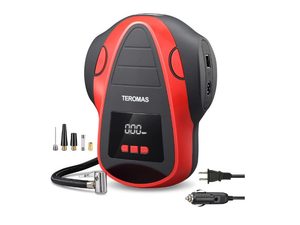 | TEROMAS TMS-3015 AC/DC Tire Inflator – Best Overall | Check Price |
Second Best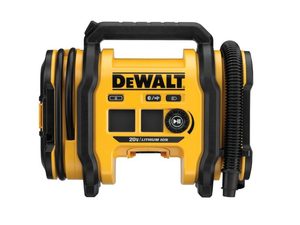 | DEWALT DCC020IB 20V MAX Tire Inflator – Best Premium Pick | Check Price |
Third Choice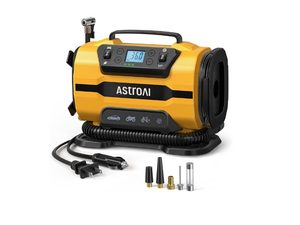 | AstroAI 150 PSI AC/DC Dual-Motor Tire Inflator | Check Price |
3 Best Garage Tire Inflator: Reliable Picks for Home Garages
1. TEROMAS TMS-3015 AC/DC Tire Inflator – Best Overall
Key Features
- 110V/120V AC household power
- 12V DC vehicle power
- Maximum pressure up to 150 PSI
- Digital pressure display
- Programmable target pressure
- Automatic shutoff
- Approximately 17 L/min airflow
- LED work light
- Multiple pressure units
- Compact corded design
Detailed Review
The TEROMAS TMS-3015 earns my top position because it matches the garage-use requirement particularly well while remaining portable enough for occasional roadside use.
Its biggest advantage is straightforward AC/DC dual power.
When the inflator lives in your garage, you can plug it directly into a normal wall outlet. You do not need to start the car, depend on a charged tool battery, or run a 12V cable through the vehicle every time you want to correct tire pressure.
If you want to take the unit on a trip, the included 12V connection lets you power it from a compatible vehicle accessory outlet.
That combination is more useful than it might initially sound. Dedicated AC inflators are convenient at home but useless away from an outlet. Basic 12V pumps work on the road but are slightly inconvenient when you simply want to top off four tires in your garage. TEROMAS gives you both options in one compact unit.
The digital pressure controls are also useful for routine tire maintenance.
You set the desired pressure, start the compressor, and the unit automatically stops when it reaches the selected value. This reduces the need to continually switch the compressor off, check pressure manually, and restart it.
Its maximum pressure rating is 150 PSI, although maximum PSI should never be confused with actual inflation speed or suitability for huge high-volume truck tires.
For normal passenger cars, motorcycles, bicycles, and light automotive applications, the output is much more appropriate.
A standard passenger tire can be brought up from low pressure relatively quickly, making this more than a tiny emergency-only pump.
The compact design is another reason I like it for a home garage. A large tank compressor is much more versatile, but it also occupies floor space, requires a hose, creates more noise, and may be excessive if your main task is simply maintaining tire pressure.
TEROMAS can sit on a shelf and be ready whenever tire pressure drops.
The LED light is more relevant on the roadside than inside a well-lit garage, but it can still help when working in a dim garage corner or checking a tire before sunrise.
One limitation is duty cycle. This is still a compact inflator rather than a commercial continuous-duty compressor.
For extended inflation work, give the unit the cooling periods specified by the manufacturer.
I would also avoid buying it specifically for large heavy-duty truck or tractor tires. Those applications demand substantially greater airflow and usually justify a more powerful compressor.
What I Like
- Direct household AC connection
- 12V backup power for travel
- Strong review history
- Compact enough for shelf storage
- Programmable pressure
- Automatic shutoff
- Easy digital controls
- 150 PSI maximum rating
- Works well for routine car tire top-offs
- No rechargeable battery to maintain
What I Do Not Like
- Limited duty cycle compared with shop compressors
- Relatively short air hose
- Not intended for large commercial truck or tractor tires
- Louder than larger low-RPM shop compressors
Verdict
The TEROMAS TMS-3015 is my best garage tire inflator for most homeowners. Its AC/DC versatility, auto shutoff, compact footprint, and straightforward digital controls cover routine garage tire maintenance without requiring a full-size air compressor.
2. DEWALT DCC020IB 20V MAX Tire Inflator – Best Premium Pick
Key Features
- 20V MAX battery compatibility
- Included 12V DC power cord
- 110V AC capability with optional adapter
- Maximum pressure up to 160 PSI
- Digital pressure gauge
- Automatic shutoff
- High-pressure tire mode
- High-volume inflation mode
- High-volume deflation mode
- Threaded tire chuck
- LED work light
- Heavy-duty rubber feet
- Integrated accessory storage
Detailed Review
The DEWALT DCC020IB is the model I would choose for a garage where tools get used regularly rather than occasionally.
Its biggest strength is versatility.
For high-pressure applications such as car, truck, motorcycle, bicycle, and trailer tires, the digital high-pressure mode lets you set a target PSI and allow the inflator to stop automatically.
For high-volume items, DEWALT includes a separate large hose. That makes the tool useful for air mattresses and other large inflatables where a small tire hose would move air too slowly.
You can even connect the high-volume hose to a dedicated deflation port when you need to remove air quickly.
Power options are another major strength.
If you already own DEWALT 20V MAX tools, inserting one of your batteries makes the inflator completely cordless. That is extremely convenient in a garage because you can walk from one vehicle to another without moving extension cords.
A built-in 12V cord provides a backup when a tool battery is unavailable.
For permanent garage use, the unit can also accept a 110V AC power adapter, although this adapter is typically a separate accessory. That is the main detail buyers need to understand before choosing the DCC020IB specifically as an AC garage inflator.
I would not describe that as a deal breaker, especially for someone already invested in the 20V MAX battery system. But if you want to take a new inflator out of the box and immediately plug it into a garage wall outlet, TEROMAS or AstroAI is simpler.
The threaded tire chuck is one of my favorite details.
Lever-style chucks are fast, but inexpensive ones can leak if they do not sit perfectly on the valve stem. DEWALT’s threaded connection takes a little longer to attach, but it creates a secure seal.
The digital gauge and automatic shutoff also make routine pressure checks straightforward.
Suppose your vehicle specifies 35 PSI and all four tires have dropped to 31 PSI after a cold front. Set 35 PSI, attach the chuck, and allow the compressor to finish each tire.
Heavy rubber feet reduce movement while the compressor runs, and the integrated accessory storage keeps adapters from disappearing into a garage drawer.
The DCC020IB also feels more substantial than inexpensive plastic emergency inflators.
That does not make it an industrial air compressor, but I would be more comfortable using it regularly on several vehicles.
What I Like
- Excellent long-term buyer history
- Strong tool-quality construction
- Up to 160 PSI
- Automatic pressure shutoff
- Accurate, readable digital controls
- Cordless operation with compatible battery
- 12V DC backup power
- Optional household AC capability
- High-pressure and high-volume modes
- Deflation function
- Secure threaded tire chuck
- Excellent choice for an existing DEWALT tool setup
What I Do Not Like
- Battery is normally sold separately
- Household AC adapter is normally sold separately
- Larger than ultra-compact emergency pumps
- More expensive than basic AC/DC inflators
Verdict
The DEWALT DCC020IB is my premium garage choice, particularly for anyone who already owns compatible batteries. It delivers excellent versatility, solid construction, and useful high-pressure/high-volume functionality that goes beyond basic tire inflation.
3. AstroAI 150 PSI AC/DC Dual-Motor Tire Inflator – Best Dual-Motor Garage Pick
Key Features
- 120V AC household power
- 12V DC vehicle power
- Dual-motor design
- Metal motor components
- Maximum pressure up to 150 PSI
- Digital pressure display
- Automatic shutoff
- High-pressure inflation mode
- High-volume inflation mode
- Up to 15-minute continuous operation
- OmniVent heat-dissipation system
- LED light
- Integrated storage
Detailed Review
The AstroAI AC/DC Dual-Motor inflator is a particularly good match for a homeowner who wants a tire inflator that will spend most of its life in the garage but still wants the flexibility to use it away from home.
Like TEROMAS, it provides both a household AC plug and 12V vehicle connection.
That means there is no battery pack to charge and no separate AC adapter needed for normal garage operation.
Where AstroAI distinguishes itself is its dual-motor system.
One motor handles high-pressure inflation for tires and similar applications, while another high-volume system is intended for objects such as air mattresses.
Separating these jobs makes sense because tire inflation and mattress inflation require very different airflow characteristics.
A tire needs relatively high pressure but limited total air volume.
An air mattress needs much greater airflow but comparatively little pressure.
Trying to optimize one tiny pump for both jobs can produce mediocre performance in one of those areas.
The AstroAI design instead provides separate operating modes.
For normal car tires, you select the pressure mode, enter the target PSI, attach the hose, and allow automatic shutoff to end the process.
The inflator is rated to 150 PSI, which is more than enough for ordinary passenger vehicles.
AstroAI also emphasizes heat management with its OmniVent cooling design.
Compact compressors create substantial heat because a small piston and motor work rapidly inside a confined housing. Improved heat dissipation helps the compressor maintain performance and can reduce thermal stress during repeated inflation.
The published continuous-use time of up to approximately 15 minutes is useful if you need to adjust several tires in one session.
Still, I would give any compact compressor time to cool if its housing becomes extremely hot.
Another advantage is integrated storage. An inflator becomes much less convenient when the power cable, air hose, and nozzle accessories turn into a tangled pile on a garage shelf.
Keeping accessories organized within or around the housing makes the unit easier to grab and use.
At approximately four pounds, it remains portable enough to move between garage shelves, vehicles, bicycles, and household inflatables without feeling like a shop compressor.
What I Like
- Direct 120V AC operation
- 12V vehicle power option
- Dual independent motors
- High-pressure and high-volume modes
- Automatic shutoff
- Digital pressure setting
- Strong current buyer feedback
- 150 PSI maximum
- Improved heat-management design
- Longer continuous-use capability than many compact pumps
- Useful for tires and household inflatables
What I Do Not Like
- Bulkier than basic single-cylinder emergency pumps
- Still not a replacement for a tank compressor
- Large truck tires may require a heavier-duty inflator
- Corded design lacks the convenience of battery-powered operation
Verdict
The AstroAI dual-motor AC/DC inflator is an excellent dedicated home-garage choice for buyers who want direct household power and more versatility than a basic tire-only pump.
Best Garage Tire Inflator Comparison
| Product | Max Pressure | Garage Power | Vehicle Power | Auto Shutoff | High-Volume Mode | Best For |
| TEROMAS TMS-3015 | 150 PSI | 110V/120V AC | 12V DC | Yes | Basic adapters | Best overall |
| DEWALT DCC020IB | 160 PSI | 110V with optional adapter | 12V DC / 20V battery | Yes | Yes + deflation | Premium garage use |
| AstroAI Dual-Motor | 150 PSI | 120V AC | 12V DC | Yes | Dedicated mode | Multi-purpose garage use |
Which Garage Tire Inflator Should You Buy?
For most households, I would choose the TEROMAS TMS-3015.
It plugs directly into a garage outlet, does not require a rechargeable battery, includes automatic shutoff, and can still operate from a vehicle’s 12V outlet if you decide to carry it on a trip.
The DEWALT DCC020IB is the better choice if durability and power flexibility matter more than having AC power included out of the box. Existing 20V MAX tool owners benefit the most because they can use batteries they already own.
The AstroAI AC/DC Dual-Motor makes sense when your garage inflator will also be used for air mattresses, sports equipment, bicycles, and other inflatables. Its separate high-pressure and high-volume systems provide better multi-purpose versatility.
Why Keep a Tire Inflator in the Garage?
Tire pressure changes more often than many drivers realize.
A tire can lose pressure from:
- Normal air permeation
- Falling outdoor temperatures
- Slow valve leaks
- Small punctures
- Bead leaks
- Seasonal storage
- Long periods without driving
Having an inflator at home makes it easy to correct small pressure changes before they become larger problems.
You can check tire pressure when the tires are cold, inflate them to the vehicle manufacturer’s recommended value, and leave home with the correct pressure instead of driving several miles to find public compressed air.
That convenience encourages more frequent tire checks.
Why Correct Tire Pressure Matters
Proper inflation affects several parts of vehicle performance.
Tire Wear
Underinflation can cause excessive wear toward the outer shoulders of a tire.
Overinflation may increase wear toward the center.
Correct pressure helps the tread contact the road more evenly.
Handling
A significantly underinflated tire can feel soft and less responsive during steering.
Heat
Underinflated tires flex more as they roll.
That additional flex generates heat.
Fuel Economy
Low tire pressure increases rolling resistance, forcing the vehicle to use more energy.
Load Capacity
Tire load capability is related to inflation pressure.
Vehicles carrying passengers, cargo, or towing loads should be maintained according to the vehicle and tire manufacturer’s requirements.
AC vs 12V vs Cordless Garage Tire Inflators
120V AC
For a permanent garage inflator, household AC power is extremely convenient.
Advantages include:
- No battery charging
- Consistent power
- Easy use with extension cords
- Good for repeated home maintenance
The main disadvantage is portability away from electrical outlets.
12V DC
A 12V inflator connects to the vehicle.
Advantages include:
- Excellent roadside availability
- No internal battery to charge
- Compact equipment
The disadvantage is that you generally need access to the vehicle’s accessory socket.
Rechargeable Battery
Battery-powered inflators provide the easiest mobility.
They are particularly attractive when you already own tools from the same battery ecosystem.
The downside is battery maintenance.
A cordless inflator is only cordless and convenient while the battery contains enough charge.
Multi-Power Inflators
For maximum flexibility, I prefer multi-power models.
TEROMAS and AstroAI combine AC and 12V DC.
DEWALT provides battery and 12V power, with AC available through the compatible adapter.
Garage Tire Inflator vs Full-Size Air Compressor
A dedicated tire inflator and shop air compressor overlap, but they are not the same tool.
Tire Inflator Advantages
A tire inflator is:
- Compact
- Easy to store
- Simple to operate
- Usually equipped with a pressure gauge
- Often equipped with auto shutoff
- Much quieter and easier to set up than a large compressor
- Ideal for routine tire maintenance
Air Compressor Advantages
A tank compressor is better for:
- Pneumatic tools
- Impact wrenches
- Blow guns
- Paint spraying
- High-volume inflation
- Seating tire beads
- Frequent shop work
- Continuous air demand
If you already need compressed air for tools, a quality tank compressor makes sense.
If you primarily need to add 2–10 PSI to car tires every few weeks, a dedicated inflator is simpler.
How Much PSI Does a Garage Tire Inflator Need?
Do not select an inflator simply because it has the largest maximum PSI.
Most passenger-car tires operate somewhere around the 30–40 PSI range, although the correct specification varies by vehicle.
Light-truck and trailer tires can require considerably higher pressures.
A 150 PSI inflator therefore provides more than enough maximum pressure for most common home automotive uses.
What matters more is airflow at the pressure you actually use.
A tiny compressor may technically reach 150 PSI while taking a long time to move enough air into a large tire.
This is why inflation speed and duty cycle are just as important as maximum pressure.
How to Find the Correct Tire Pressure
Do not automatically inflate tires to the maximum pressure molded into the tire sidewall.
For normal operation, use the vehicle manufacturer’s recommended cold tire pressure.
Common locations for this information include:
- Driver-side door jamb
- Fuel-door area on some vehicles
- Owner’s manual
- Manufacturer tire-pressure placard
The sidewall maximum is related to the tire itself and should not replace the vehicle’s recommended operating pressure.
Why Check Tires When Cold?
Tire pressure rises as the air inside warms.
Driving creates heat through tire flex and road contact.
As a result, a tire measured immediately after highway driving may show a higher PSI than it would after sitting overnight.
Vehicle recommended pressures generally refer to cold tires.
For the most consistent readings, check tires before driving or after they have been parked long enough to return near ambient temperature.
Keeping an inflator in the garage makes cold-pressure checks especially convenient.
How Temperature Affects Tire Pressure
Air pressure changes with temperature.
A commonly used practical rule is that tire pressure can change by roughly 1 PSI for every 10°F change in ambient temperature, although actual behavior varies.
This is why low-pressure warning lights frequently appear during the first cold mornings of fall or winter.
The tire may not suddenly have developed a major leak.
The colder air simply occupies less volume and produces less pressure.
That does not mean the warning should be ignored.
Measure all four tires and inflate them according to the cold-pressure specification.
Digital vs Analog Tire Inflator Gauge
Digital Gauge
Digital displays make it easy to:
- Read exact PSI
- Set a target pressure
- Use automatic shutoff
- Switch pressure units
- Work in low light
For a typical homeowner, I prefer digital.
Analog Gauge
Analog gauges:
- Do not require complex displays
- Can be easy to read at a glance
- Often appear on simple garage compressors
- May be more durable in certain environments
The main issue is accuracy rather than display type.
It is worth occasionally comparing your inflator against a known-good handheld tire gauge.
Why Auto Shutoff Is Worth Having
Auto shutoff is one of the most convenient features in a home tire inflator.
Without it, the process often looks like this:
Inflate.
Stop.
Read pressure.
Inflate again.
Stop.
Check again.
With auto shutoff, you enter the target PSI and let the compressor finish.
This is especially convenient when correcting all four tires because you can repeat the same target pressure without constantly guessing.
Still, I recommend occasionally confirming pressure with a quality independent gauge, particularly when using a new inflator for the first time.
Inflation Speed Matters More Than Maximum PSI
A compressor capable of 160 PSI is not automatically faster than one rated at 120 PSI.
Maximum pressure tells you how much pressure the pump can theoretically create.
Airflow tells you how quickly it moves air.
Large tires require substantial air volume.
This is why a tiny bicycle-oriented compressor may technically produce high PSI but take a long time to fill an SUV tire.
For routine top-offs, almost any competent automotive inflator is quick enough.
For recovering a completely flat truck tire, higher airflow becomes much more important.
Understanding Duty Cycle
Compact inflators generate heat.
A piston repeatedly compresses air while an electric motor runs under substantial load.
Manufacturers therefore specify a maximum continuous operating period.
For example, a compact inflator may be designed to operate for approximately 10 or 15 minutes before requiring a cooling period.
Ignoring that limit can:
- Trigger thermal protection
- Reduce motor life
- Damage seals
- Overheat wiring
- Shorten compressor life
Garage users who maintain several large vehicles should pay particular attention to duty cycle.
Hose Length and Power-Cord Reach
Garage convenience depends heavily on reach.
A short air hose may require moving the entire inflator beside each tire.
A long power cord helps, but household AC models often still benefit from a quality extension cord.
Before buying, think about:
- Outlet location
- Vehicle size
- Garage width
- Driveway use
- Whether the inflator will remain wall-mounted or portable
If you frequently inflate tires outside the garage, dual AC/DC or cordless power becomes more useful.
Screw-On Chuck vs Lever Chuck
Screw-On Chuck
A threaded chuck twists onto the valve stem.
Advantages:
- Strong seal
- Low risk of popping off
- Consistent connection
Disadvantage:
- Slightly slower to attach and remove
Lever Chuck
A lever chuck pushes over the valve and locks in place.
Advantages:
- Very fast
- Convenient for frequent use
Disadvantages:
- Cheap versions can leak
- Internal seals can wear
Neither system is inherently wrong.
I generally appreciate the secure threaded connection on the DEWALT for occasional home use.
Garage Inflator for SUVs
SUV tires contain more air than small sedan tires, so inflation speed matters more.
For normal 2–5 PSI pressure corrections, all three models in this guide are practical.
If you regularly inflate large off-road tires from very low trail pressure back to highway pressure, however, I would choose a dedicated heavy-duty compressor with significantly higher airflow.
That is a different workload from occasional garage maintenance.
Garage Inflator for Pickup Trucks
A compact inflator can work perfectly well for a pickup when tire pressure only needs topping off.
Pay attention to the required pressure.
Certain light-truck tires operate at much higher pressures than ordinary passenger tires.
Make sure the compressor is rated comfortably above your required PSI and does not take excessively long at that pressure.
For frequent large-truck use, a heavy-duty compressor is generally a better investment.
Can You Inflate a Completely Flat Tire?
Yes, provided the tire is still correctly seated on its rim and there is no major structural damage.
A compact garage inflator can add air to a fully deflated passenger tire, although it will take substantially longer than a routine top-off.
If the tire bead has separated from the rim, a small inflator may not move air quickly enough to reseat it.
A tire that went completely flat while driving should also be inspected for sidewall and internal damage before being returned to service.
Adding air does not make a damaged tire safe.
Tire Inflator Safety Tips
Inspect the Tire First
Do not blindly inflate a tire that is:
- Bulging
- Cracked
- Severely damaged
- Showing exposed cords
- Separated from the rim
- Damaged from being driven while flat
Use the Vehicle-Specified Pressure
Do not inflate to the tire sidewall maximum unless that is specifically required for the application.
Keep the Inflator Dry
Electrical compressors and water are a poor combination.
Follow the Duty Cycle
Allow the compressor to cool when required.
Avoid Touching Hot Components
Air hoses and compressor fittings can become hot during operation.
Use a Proper Extension Cord
For AC inflators, an undersized or damaged extension cord can create voltage drop and heat.
Follow the manufacturer’s electrical requirements.
How to Maintain a Garage Tire Inflator
A compact inflator requires little maintenance, but a few habits improve service life.
Keep the unit clean and dry.
Do not wrap the air hose around the housing so tightly that it develops sharp bends.
Inspect the power cable periodically.
Keep adapters organized.
Avoid pulling the unit by its electrical cord.
Let the compressor cool before putting it inside an enclosed cabinet.
Keep the threaded chuck clean.
Periodically compare the digital gauge with a trusted pressure gauge.
If the manufacturer provides a replaceable 12V fuse, keep a spare with the unit.
Common Garage Tire Inflator Buying Mistakes
Buying Only by Maximum PSI
A 200 PSI rating means little if airflow is poor.
Ignoring Power Source
An inflator that only uses 12V vehicle power may become annoying if its permanent home is your garage.
Assuming Cordless Means Battery Included
Many tool-brand inflators are sold as bare tools.
Check what is included.
Ignoring the AC Adapter Requirement
Some multi-power inflators support AC but require a separately purchased power supply.
Buying Too Small for Truck Tires
Small compressors are excellent for sedans but can be frustrating with large LT tires.
Ignoring Duty Cycle
Repeatedly overheating a compressor is an easy way to shorten its life.
Trusting One Gauge Forever
Pressure sensors can drift.
Verify accuracy occasionally.
Frequently Asked Questions
What is the best garage tire inflator?
The TEROMAS TMS-3015 is my preferred all-around garage tire inflator for most homeowners.
It plugs directly into household AC power, includes 12V DC capability for travel, provides a programmable digital pressure setting, and automatically shuts off at the selected PSI. Its compact size also makes it easier to store than a traditional tank compressor while remaining suitable for routine car, motorcycle, and bicycle tire maintenance.
Is an AC tire inflator better for garage use?
AC power is usually the most convenient option when the inflator will primarily stay at home.
You can plug the pump into a household outlet without depending on a charged battery or the vehicle’s accessory socket. Dual-power models provide the best flexibility because they can also operate from 12V power away from the garage.
Is 150 PSI enough for a garage tire inflator?
Yes, 150 PSI exceeds the pressure requirements of most passenger cars and many light-truck applications.
Inflation speed and airflow are generally more important than maximum pressure for normal automotive use. Always verify the required cold tire pressure for your specific vehicle.
What PSI should I put in my car tires?
Use the vehicle manufacturer’s recommended cold tire pressure, not automatically the number molded into the tire sidewall.
Look for the tire-information placard in the driver’s door jamb or consult the owner’s manual. Front and rear pressure recommendations may differ on some vehicles.
Do tire inflators automatically stop?
Many digital inflators allow you to preset a target PSI and shut off automatically when it is reached.
TEROMAS, DEWALT, and AstroAI all offer automatic pressure-control functions in the models reviewed here. Auto shutoff makes correcting several tires much easier.
Can I use a garage tire inflator on an SUV?
Yes, these inflators are suitable for routine SUV tire top-offs.
Completely filling a large SUV tire from zero PSI takes longer than adding several PSI to a normal car tire. Frequent large-tire inflation may justify a higher-airflow compressor.
Can I use one on a truck tire?
Yes for many light-duty pickup tires, provided the inflator supports the required pressure.
Large heavy-duty truck, commercial, and high-volume off-road tires are better served by a dedicated heavy-duty compressor.
Is DEWALT DCC020IB good for a garage?
Yes, particularly if you already own DEWALT 20V MAX batteries.
It can also operate from 12V vehicle power and supports household AC through the compatible optional adapter. Automatic shutoff, high-volume inflation, deflation, and a threaded chuck make it highly versatile around a garage.
Does the DEWALT tire inflator include a battery?
The DCC020IB is commonly sold as a bare tool, so a battery and charger are normally separate.
It does include a 12V DC power option. Buyers specifically wanting household AC operation should also account for the compatible AC power adapter.
Is AstroAI good for garage tire inflation?
The dual-motor AC/DC AstroAI is particularly well suited to home use.
It plugs directly into a standard wall outlet, provides 12V backup power, includes auto shutoff, and has separate high-pressure and high-volume modes. It is a useful choice for households inflating both vehicle tires and recreational inflatables.
Can I leave a tire inflator plugged in?
Disconnect a portable inflator when you finish using it unless its manufacturer explicitly specifies otherwise.
These pumps are not battery maintainers or permanently installed air systems. Coil the cables safely and store the unit after it has cooled.
How accurate are digital tire inflators?
Good digital inflators can provide very useful pressure readings, but an independent gauge is still worth keeping.
Compare the inflator reading with a trusted tire-pressure gauge periodically. A difference of a small amount may result from gauge tolerance or pressure lost while disconnecting the chuck.
How often should I check tire pressure?
Checking at least monthly and before long trips is a practical routine.
Also check pressure after major seasonal temperature changes or whenever the tire-pressure monitoring system illuminates.
Can cold weather lower tire pressure?
Yes, tire pressure typically falls as ambient temperature drops.
This is why low-pressure warnings commonly appear during the first cold weather of the season. Measure and correct pressure when the tires are cold instead of simply resetting the warning.
Can a tire inflator fix a slow leak?
No. It can replace lost air temporarily but cannot repair the source of the leak.
If the same tire repeatedly loses pressure, inspect it for punctures, valve problems, bead leaks, or wheel damage.
Do I need a full-size compressor for a home garage?
Not if tire inflation is your main compressed-air task.
A compact inflator is easier to store, quicker to set up, and generally sufficient for routine tire maintenance. A tank compressor becomes worthwhile when you also want to power pneumatic tools, blow guns, sprayers, or other high-airflow equipment.
Conclusion
The best garage tire inflator should be easy enough to use that checking tire pressure becomes part of normal vehicle maintenance rather than a task you continually postpone. For most homeowners, direct household power, automatic shutoff, a clear pressure gauge, and enough output for routine car and SUV tire top-offs matter more than extreme maximum-PSI claims.
My primary recommendation is the TEROMAS TMS-3015. Its direct AC connection, 12V backup power, compact footprint, digital pressure control, and automatic shutoff give it the most useful overall balance for an ordinary home garage.
The DEWALT DCC020IB is the better premium option, especially for people already using the 20V MAX battery platform. Its high-pressure and high-volume functions, secure threaded chuck, robust construction, and three possible power sources make it extremely versatile.
The AstroAI AC/DC Dual-Motor Tire Inflator is another excellent garage-focused option. Its direct wall connection, dual-motor layout, 150 PSI maximum pressure, heat-management design, and separate high-volume function make it particularly useful for a household that inflates more than vehicle tires.
If I were setting up a simple garage tire-maintenance station and wanted a compact inflator that could also travel in the car when necessary, I would start with the TEROMAS TMS-3015.