The best pneumatic tire inflator with gauge should make tire maintenance faster by combining three jobs in one tool: checking pressure, adding compressed air, and bleeding excess pressure. Unlike a portable electric inflator, these tools connect to an existing air compressor, which makes them especially useful in home garages, workshops, tire shops, and anywhere several tires need to be serviced quickly.
My first recommendation is the AstroAI Digital Tire Inflator with Pressure Gauge ATG250. Its wide 0–250 PSI range, digital display, 0.1 PSI resolution, built-in bleed valve, compressor-ready connection, and broad vehicle compatibility make it the most practical all-around option. It also has the largest customer-review history among the three pneumatic inflator gauges selected for this guide.
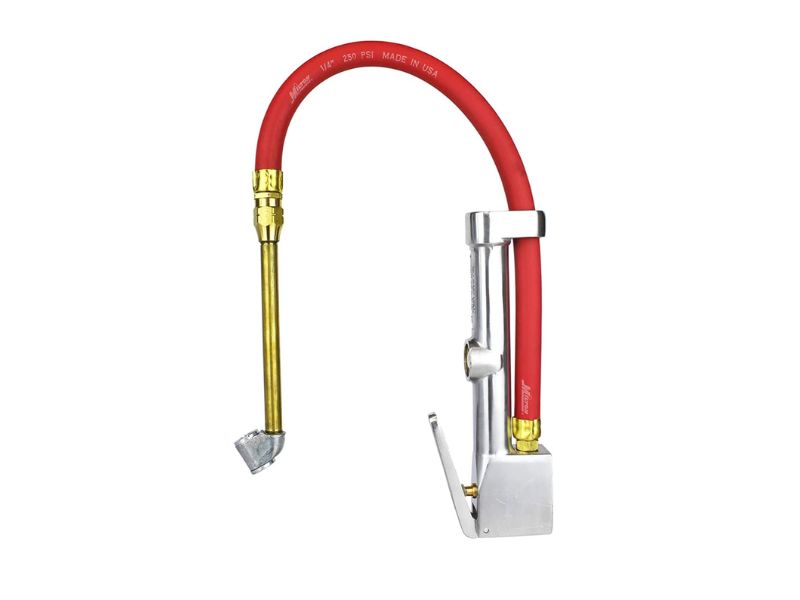
For buyers who prefer a traditional shop-style tool without batteries, I would choose the Milton S-506 Original Dual Head Chuck Tire Inflator Gauge. Its 10–160 PSI range, dual-head chuck, replaceable internal components, and long-established service-station design make it particularly appealing for trucks, trailers, RVs, and frequent garage use.
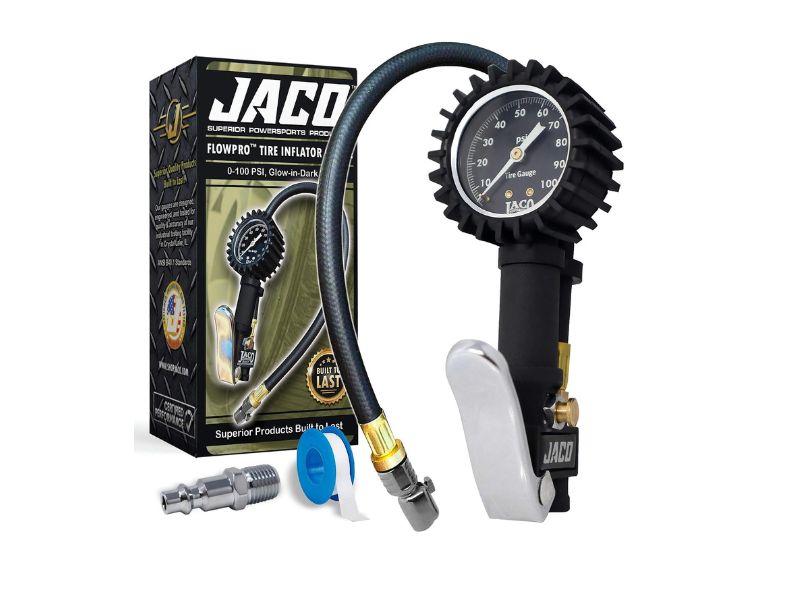
My third recommendation is the JACO FlowPro Tire Inflator with Pressure Gauge. It gives up some maximum pressure range compared with the other two, but the locking air chuck, glow-in-the-dark analog dial, 21-inch hose, built-in bleeder valve, and battery-free operation create an excellent setup for passenger cars, SUVs, motorcycles, and other normal road vehicles.
3 Best Pneumatic Tire Inflator With Gauge
| Image | Product Name | Check Price |
|---|---|---|
Best Choice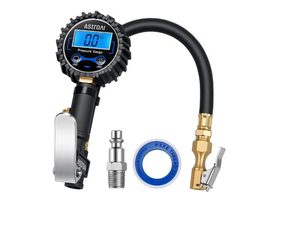 | AstroAI Digital Tire Inflator with Pressure Gauge – Best Overall | Check Price |
Second Best | Milton S-506 Original Dual Head Chuck Tire Inflator Gauge | Check Price |
Third Choice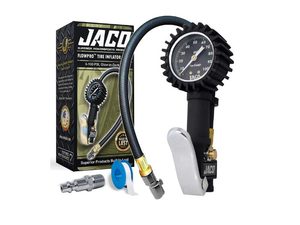 | JACO FlowPro Tire Inflator with Pressure Gauge | Check Price |
Best Pneumatic Tire Inflator With Gauge
1. AstroAI Digital Tire Inflator with Pressure Gauge – Best Overall
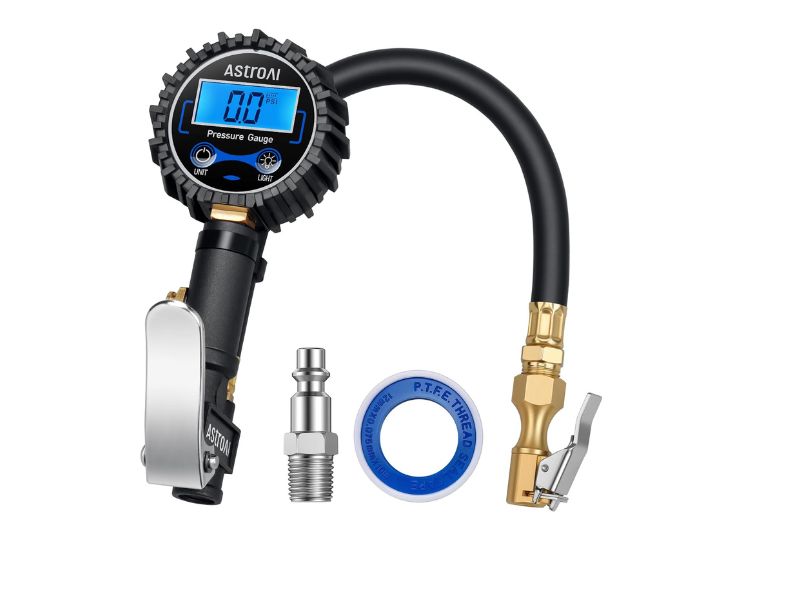
Key Features
- Digital tire inflator and pressure gauge
- 0–250 PSI measurement range
- 0.1 PSI display resolution
- Approximately ±1% stated accuracy
- PSI, bar, kPa, and kg/cm² units
- Backlit digital display
- Inflation trigger
- Built-in pressure-release valve
- Flexible air hose
- Locking air chuck
- Quick-connect compressor fitting
- Heavy-duty steel and brass components
- Two AAA batteries
- Suitable for cars, SUVs, trucks, motorcycles, and bicycles
Detailed Review
The AstroAI ATG250 is my top choice because it offers the easiest combination of pressure measurement, inflation control, readability, and wide pressure range.
The most noticeable advantage is its digital display.
Instead of trying to interpret a small analog needle between markings, you get pressure displayed to a resolution of 0.1 PSI. That makes it especially convenient when you are trying to set four tires to exactly the same target pressure.
Its operating range extends to 250 PSI, which is far beyond what an ordinary passenger-car tire needs. The extra range makes the tool more versatile for higher-pressure applications, although you should always stay within the rated limits of the tire, compressor system, fittings, and connected equipment.
AstroAI combines the pressure gauge and inflator trigger into a single handheld assembly.
Connect it to your compressor hose, attach the chuck to the valve stem, and the gauge displays tire pressure. Pulling the trigger adds air.
If you go a little too far, the built-in bleed valve lets you release air without removing the tool.
That workflow is much faster than using a separate air chuck and then repeatedly disconnecting it to check pressure with another gauge.
The digital display can also switch between multiple measurement units.
Most U.S. passenger vehicles list tire pressures in PSI, but bar and kPa support is useful when working with vehicles or equipment labeled in metric units.
The wide range makes this model attractive for a mixed garage.
It can handle ordinary car tires in the 30–40 PSI range but still has substantial pressure headroom for compatible truck, RV, bicycle, and specialty applications.
I also like the construction.
Steel and brass are used in important portions of the inflator, giving it a more substantial feel than inexpensive all-plastic compressor accessories.
A flexible hose allows the gauge body to remain in a comfortable position while the chuck is attached to the valve stem.
That matters more than it sounds.
Valve stems are often positioned awkwardly near the ground or partially obstructed by wheel designs. A flexible hose is considerably easier to manipulate than attaching a large rigid gauge directly to the stem.
The tool requires two AAA batteries for the digital display.
Battery dependence is the main reason some professional users may still prefer Milton’s mechanical design. However, AAA cells are inexpensive and easy to keep in a toolbox.
For the typical home garage, I think the improved readability outweighs that disadvantage.
The AstroAI is especially useful when you already own a compressor.
This point needs to be clear: the tool itself does not contain an air compressor. It measures and controls compressed air supplied by your existing compressor system.
Once connected to a compressor, though, it provides a substantially faster workflow than checking and inflating each tire with separate tools.
What I Like
The digital display is extremely easy to read, particularly in a garage where lighting around the wheel may not be ideal.
The 250 PSI maximum range also provides much more versatility than a basic 60- or 100-PSI gauge.
I especially like having the inflation trigger, gauge, and bleed valve together. Tire pressure can be increased or decreased while watching the reading rather than disconnecting multiple tools.
The high customer-review volume also gives this model a much longer real-world track record than many newer pneumatic inflator gauges.
What I Do Not Like
The gauge depends on batteries.
If the batteries are dead, the convenience of the digital system disappears until they are replaced.
The included air chuck is adequate for normal use, but users doing frequent professional tire work may eventually prefer upgrading to a premium lock-on chuck.
Its 250 PSI specification is also more capacity than ordinary passenger-car owners genuinely need.
Verdict
The AstroAI ATG250 is the best pneumatic tire inflator with gauge for most buyers. It combines an easy-to-read digital display, excellent pressure range, simple inflation and deflation controls, and broad compatibility at a level that works equally well in a home garage or occasional workshop environment.
2. Milton S-506 Original Dual Head Chuck Tire Inflator Gauge – Best Professional Analog Pick
Key Features
- Pneumatic tire inflator and gauge
- 10–160 PSI operating range
- Analog pressure display
- Dual-head air chuck
- 15-inch rubber/EPDM hose
- Full-swivel chuck design
- 1/4-inch NPT air connection
- Heavy-duty construction
- Magnifying gauge lens
- Replaceable gauge cartridge
- Replaceable valve cartridge
- No batteries required
- Suitable for cars, trucks, RVs, trailers, motorcycles, and equipment
Detailed Review
The Milton S-506 is one of the most traditional tools in this category.
Its design is based on the classic service-station tire inflator gauge, and that simplicity is exactly why it remains relevant.
There is no LCD display.
There are no batteries.
There is no complicated control interface.
You connect the inflator to a compressed-air line, push the chuck onto the valve, add air as necessary, and read pressure mechanically.
The gauge covers approximately 10–160 PSI, which is enough for a wide range of passenger vehicles, pickups, trailers, motor homes, and other pneumatic tires.
For a conventional car tire, you will normally operate near the lower end of that range.
The major advantage over many consumer inflators is the dual-head chuck.
A standard straight chuck works well when the valve stem is easily accessible from the outside of a wheel.
Dual-head designs become particularly useful when servicing:
- Dual rear wheels
- Trucks
- RVs
- Trailers
- Commercial-style wheels
- Difficult recessed valve stems
One end of the chuck can access valves from one direction while the angled head handles positions that would be difficult to reach with a normal straight chuck.
The 15-inch hose also helps keep the gauge body away from the wheel.
This gives you more freedom to position the inflator comfortably while maintaining a connection to the tire.
Durability is one of the strongest reasons to choose Milton.
A digital gauge may eventually encounter an electronic failure, damaged screen, or battery-contact issue.
The S-506 is fundamentally mechanical.
Even more importantly, the gauge and valve cartridges are replaceable.
That makes the tool repairable in a way many inexpensive consumer inflators are not.
If a wear component eventually develops a problem, you may be able to replace the internal cartridge instead of throwing away the entire tool.
For frequent garage and shop work, that repairability adds real long-term value.
The gauge uses a magnifying lens to help the operator read the scale.
It is still not as instantly precise-looking as a digital 0.1 PSI readout, but analog gauges have an important advantage: they are always ready.
There is no battery level to check before starting work.
Another reason I like this model is its pressure range.
Some analog tire inflators stop at 60 or 100 PSI. A 160 PSI maximum gives the Milton much more flexibility for higher-pressure truck and trailer applications.
This versatility is particularly useful for someone maintaining a mixed fleet rather than one passenger car.
The trade-off is precision of reading.
The analog scale uses larger increments than a digital display, so someone who wants to set a tire to an exact tenth of a PSI will prefer AstroAI.
For ordinary automotive tire inflation, however, such tiny increments are usually unnecessary.
Correct cold tire pressure according to the vehicle manufacturer’s placard is far more important than chasing insignificant decimal differences.
What I Like
The biggest advantage is durability.
The Milton feels like a true shop tool rather than an electronic gadget.
I also like the dual-head chuck for trucks, RVs, trailers, and difficult valve locations.
Replaceable cartridges are another major strength because they extend the useful life of the tool.
Finally, battery-free operation means the gauge can stay connected to the shop air system and remain ready whenever you need it.
What I Do Not Like
The analog display is not as easy to read with fine precision as AstroAI’s digital screen.
The long service-station form factor is also less compact than some modern pistol-grip inflators.
For a home user who services only passenger cars, the dual-head chuck may provide little additional benefit.
Verdict
The Milton S-506 is the pneumatic tire inflator gauge I would choose for a traditional shop environment, especially when trucks, trailers, RVs, or other difficult valve positions are involved.
3. JACO FlowPro Tire Inflator with Pressure Gauge – Best Locking-Chuck Pick
Key Features
- Pneumatic analog tire inflator
- Up to 100 PSI
- Approximately ±2% stated accuracy
- Glow-in-the-dark analog dial
- Lock-on Lightning air chuck
- 21-inch flexible hose
- Push-to-inflate trigger
- Built-in pressure bleeder
- 1/4-inch NPT compressor connection
- Battery-free operation
- Rugged steel construction
- Suitable for cars, SUVs, light trucks, motorcycles, and bikes
Detailed Review
The JACO FlowPro takes a different approach from the Milton.
It remains battery-free and analog, but the design feels much more like a modern enthusiast garage tool.
Its biggest advantage is the locking air chuck.
A poor air chuck can turn tire inflation into an annoying job.
If the chuck does not seal properly, compressed air escapes around the valve stem while you are trying to read pressure. You may end up holding the chuck firmly against the valve throughout the entire process.
JACO’s locking system is designed to secure itself to the valve stem and maintain a seal.
That allows you to concentrate on the gauge and trigger instead of constantly pushing the chuck into place.
For repeated tire maintenance, that convenience can make a meaningful difference.
The FlowPro also uses a relatively long 21-inch flexible hose.
The additional length is helpful when working around large wheels, motorcycles, or valve stems positioned close to the ground.
You can hold the gauge at a comfortable viewing angle while the chuck stays attached.
Pressure range is approximately 0–100 PSI.
That is more than enough for most:
- Passenger cars
- Crossovers
- SUVs
- Light trucks
- Motorcycles
- ATVs
- Many bicycle applications
However, this is also its primary limitation.
A 100 PSI gauge does not have the pressure range of the AstroAI’s 250 PSI digital unit or Milton’s 160 PSI professional gauge.
If your work regularly involves high-pressure truck, trailer, or specialty tires, I would choose one of those models instead.
For typical road vehicles, the lower range can actually make the analog scale easier to use because the dial is devoted to pressures you are more likely to encounter.
The gauge is designed for roughly ±2% accuracy.
That is suitable for normal vehicle maintenance when the gauge is in good condition and used properly.
The analog face is designed to remain visible in low light, which helps inside darker garages.
Inflating the tire is straightforward.
Pull the trigger to introduce compressed air.
If pressure exceeds the target, press the built-in bleeder valve to let air escape.
This allows you to gradually approach the desired pressure without removing the chuck.
The battery-free design is another advantage.
For a tool that may hang beside an air compressor for years, eliminating electronic batteries reduces one maintenance item.
It also means the gauge does not become temporarily useless because batteries leaked or went flat.
Construction feels more substantial than inexpensive plastic inflator guns.
JACO uses a steel-bodied design aimed at garage and workshop users.
For someone who values the mechanical simplicity of Milton but wants a more modern lock-on chuck and pistol-style handling, the FlowPro is an excellent compromise.
What I Like
The locking chuck is my favorite feature.
It simplifies connecting the inflator and helps reduce frustrating leaks at the valve stem.
The 21-inch hose is also longer than many alternatives and makes awkward wheel positions easier to handle.
I also like the battery-free glow dial for a tool that may spend years hanging beside a compressor.
What I Do Not Like
The 100 PSI maximum limits its usefulness with certain high-pressure truck, trailer, and commercial applications.
An analog dial also cannot provide the same fine numerical resolution as AstroAI’s digital display.
Its customer-review volume is strong but lower than AstroAI and Milton.
Verdict
Choose the JACO FlowPro if your main vehicles operate below 100 PSI and you value an excellent locking chuck, long hose, straightforward controls, and battery-free operation.
Pneumatic Tire Inflator With Gauge Comparison
| Product | Gauge Type | Pressure Range | Accuracy | Hose | Chuck Style | Bleeder | Batteries | Best For |
| AstroAI ATG250 | Digital | 0–250 PSI | ±1% stated | Flexible | Locking chuck | Yes | 2 AAA | Best overall |
| Milton S-506 | Analog | 10–160 PSI | Calibrated mechanical gauge | 15 in | Dual head | Yes/current version | No | Shops, trucks, RVs |
| JACO FlowPro | Analog | 0–100 PSI | ±2% stated | 21 in | Lock-on chuck | Yes | No | Cars and home garages |
Which One Should You Choose?
For most home garages, I recommend the AstroAI ATG250.
Its digital screen is easier to interpret, the wide pressure range works across more applications, and its integrated inflation and bleeding controls make routine tire maintenance straightforward.
Choose the Milton S-506 if durability and professional-style construction matter more than digital precision. Its dual-head chuck is especially valuable for trucks, trailers, RVs, and dual-wheel configurations.
The JACO FlowPro is my favorite option for users who want a battery-free gauge with an easy lock-on chuck. Its 100 PSI range is sufficient for typical passenger vehicles and motorcycles.
What Is a Pneumatic Tire Inflator With Gauge?
A pneumatic tire inflator with gauge is a handheld tool that connects an air compressor to a tire valve while simultaneously displaying tire pressure.
A typical unit combines:
- Air inlet
- Inflation trigger
- Pressure gauge
- Flexible hose
- Tire chuck
- Pressure-release valve
The key difference from an electric tire inflator is that the pneumatic tool does not generate compressed air.
It relies on an external air compressor.
The inflator simply controls that compressed air and shows tire pressure.
This setup is extremely common in professional automotive shops because a shop compressor can deliver much more air than a small portable electric pump.
Pneumatic Inflator vs Portable Electric Inflator
Both tools inflate tires, but they are designed around different environments.
Pneumatic Tire Inflator
A pneumatic inflator:
- Requires an air compressor
- Usually inflates quickly
- Can service many tires continuously
- Is ideal for garages
- Often has professional-grade chucks
- Can offer excellent pressure control
Portable Electric Inflator
A portable inflator:
- Has its own compressor
- Can operate from a battery or vehicle power
- Is useful during roadside emergencies
- Requires no shop compressor
- Usually inflates more slowly
- Can become hot during extended operation
For a garage where compressed air is already available, I strongly prefer a quality pneumatic inflator gauge.
For roadside emergencies, a portable electric inflator is more useful because no separate compressor is required.
Why Buy an Inflator With a Built-In Gauge?
You could use a separate air chuck and tire-pressure gauge.
But an integrated tool is considerably faster.
Without an integrated gauge, the workflow looks like this:
Add air.
Remove the chuck.
Connect the gauge.
Check pressure.
Remove the gauge.
Reconnect the chuck.
Add more air.
Check again.
With a combination inflator gauge, pressure can be monitored while the tool remains attached.
If pressure is too low, pull the inflation trigger.
If pressure is too high, press the bleed valve.
That can reduce tire-service time substantially when checking four or more tires.
Digital vs Analog Tire Inflator Gauge
Both types can work very well.
The better choice depends on your priorities.
Digital Gauge Advantages
Digital gauges provide:
- Easy numerical readings
- Fine resolution
- Multiple measurement units
- Backlighting
- Simple interpretation
They are excellent for home users who want an exact pressure number without interpreting dial markings.
Digital Gauge Disadvantages
They require batteries.
Electronics can also be more sensitive to moisture, impacts, and long-term storage problems than a simple mechanical gauge.
Analog Gauge Advantages
Analog gauges provide:
- No batteries
- Simple operation
- Long-term reliability
- Easy shop storage
- Mechanical durability
A high-quality analog gauge can remain useful for many years.
Analog Gauge Disadvantages
Fine readings require interpreting the needle and scale.
Visibility can also be worse in low light unless the gauge uses illuminated or glow markings.
What PSI Range Should You Choose?
Do not automatically buy the gauge with the highest pressure range.
Choose a range that matches your equipment.
Passenger Cars
Most passenger-car tire pressures fall approximately in the 30–40 PSI area.
A 100 PSI gauge provides more than enough range.
SUVs and Light Trucks
Many SUVs and light trucks also fall comfortably within a 100 PSI range, although specific truck tires can require considerably more.
Always use the vehicle’s recommended pressure.
Heavy Trucks and RVs
Higher-pressure tires make a 160 PSI or 250 PSI gauge more useful.
Milton and AstroAI therefore have an advantage for mixed heavy-vehicle use.
Bicycles
Pressure requirements differ dramatically by bicycle type.
Wide mountain-bike tires may use very low pressure, while certain road-bike setups can use much higher pressures.
Use a gauge appropriate to the actual tire system and valve type.
How Accurate Should a Tire Inflator Gauge Be?
For ordinary automotive work, consistency and calibration matter more than having excessive decimal places.
A gauge with approximately ±1% accuracy can provide excellent automotive results.
But keep this distinction in mind:
Resolution is not the same as accuracy.
A digital gauge might display 35.7 PSI, but the extra decimal does not automatically mean the actual pressure is exactly 35.7 PSI.
Resolution describes how finely the display changes.
Accuracy describes how close that reading should be to the true pressure.
When evaluating gauges, accuracy specifications are more meaningful than the number of displayed digits.
Why Correct Tire Pressure Matters
Proper tire pressure affects several aspects of vehicle performance.
Tire Wear
Underinflation tends to increase shoulder loading and heat generation.
Overinflation can reduce the size and shape of the tire’s normal contact patch and change wear characteristics.
Fuel Economy
An underinflated tire creates additional rolling resistance.
Keeping pressure at the vehicle manufacturer’s recommendation helps the tire operate as intended.
Handling
Incorrect tire pressure can alter steering response, braking behavior, and vehicle stability.
Tire Temperature
Excessive flex from severe underinflation creates additional heat.
Heat is one of the major enemies of tire durability.
Load Carrying
Tire pressure is directly related to the tire’s ability to support load.
This becomes especially important with trucks, trailers, and RVs.
Where Do You Find the Correct Tire Pressure?
For a passenger vehicle, use the tire-information placard specified by the vehicle manufacturer.
It is commonly located:
- Inside the driver’s door jamb
- On the door pillar
- Inside the fuel door on some vehicles
- In the owner’s manual
Do not simply inflate to the maximum PSI printed on the tire sidewall.
The sidewall marking relates to tire limitations and load-rating information.
It is not automatically the correct everyday inflation pressure for your vehicle.
Check Tire Pressure When Tires Are Cold
Vehicle manufacturers normally specify cold tire pressure.
A tire heats up while driving.
As temperature rises, internal air pressure also rises.
If you adjust a hot tire down to the cold specification immediately after a highway drive, the tire may become underinflated after cooling.
For the most consistent results, measure pressure before driving or after the vehicle has been sitting long enough for the tires to return close to ambient temperature.
Understanding Temperature and Tire Pressure
Air pressure changes with temperature.
A commonly used practical estimate is approximately 1 PSI for every 10°F change in temperature, although actual behavior varies.
This explains why tire-pressure warning lights frequently appear during the first major cold spell of the season.
The tire may not suddenly have developed a leak.
Ambient temperature may simply have reduced pressure enough to trigger the vehicle’s TPMS threshold.
Still, always inspect for actual leaks rather than assuming temperature is the only cause.
What Compressor Do You Need?
A pneumatic tire inflator requires an external compressor, but tire inflation does not normally demand an enormous shop compressor.
Even smaller garage compressors can inflate passenger-car tires effectively.
The important factors include:
- Maximum compressor pressure
- Tank capacity
- Airflow
- Hose size
- Fittings
- Duty cycle
For basic tire inflation, airflow demand is much lower than that of tools such as impact wrenches, grinders, or sanders.
This means a modest compressor can often serve tire-maintenance needs perfectly well.
Air Compressor PSI vs Tire PSI
The compressor needs to provide higher pressure than the tire’s target pressure.
If you are trying to inflate a tire to 35 PSI, a compressor regulated below that pressure cannot complete the job.
Most normal garage compressors easily exceed passenger-car tire pressures.
For high-pressure truck, RV, or bicycle applications, verify the compressor can supply appropriate pressure.
Never exceed the working-pressure limits of:
- Compressor
- Air hose
- Couplers
- Inflator
- Gauge
- Tire
Why the Air Chuck Matters
An excellent pressure gauge can still be frustrating if the chuck leaks.
The chuck is the part that creates the seal against the tire’s Schrader valve.
Common designs include:
Clip-On Chuck
A lever or clip holds the chuck against the valve.
These are common and inexpensive.
Lock-On Chuck
A locking mechanism grips the valve stem and maintains the seal.
JACO’s FlowPro is particularly attractive for this reason.
Dual-Head Chuck
Two openings point in different directions.
These are valuable for dual wheels and difficult valve positions.
Milton’s S-506 uses this arrangement.
Straight Chuck
Simple and compact.
It works well on easily accessible passenger-car valve stems.
Why Hose Length Matters
A longer inflator hose gives you more flexibility around the wheel.
Very short hoses can force you to hold the gauge at an awkward angle.
A longer hose allows the chuck to stay attached while the gauge remains where you can comfortably read it.
JACO’s 21-inch hose is particularly good in this regard.
Milton’s 15-inch hose also provides enough flexibility for many automotive applications.
Quick-Connect Fittings
Most pneumatic tire inflators use an NPT threaded air inlet, commonly 1/4 inch.
A quick-connect plug can then be installed to match your compressor hose coupler.
There are several quick-connect standards and profiles.
Before buying fittings, confirm what your compressor system already uses.
Mixing incompatible plug and coupler profiles can cause:
- Air leakage
- Poor connections
- Restricted airflow
- Unexpected disconnection
Using one standardized fitting system throughout your garage makes switching air tools much easier.
How to Use a Pneumatic Tire Inflator With Gauge
First, identify the vehicle’s recommended cold tire pressure.
Connect the inflator to your compressor hose.
Set the compressor regulator to an appropriate working pressure.
Remove the tire valve cap.
Attach the air chuck securely to the valve stem.
Check the gauge reading.
If pressure is low, squeeze or press the inflation control briefly.
Release the trigger and allow the gauge reading to stabilize.
Repeat until the correct pressure is reached.
If you add too much air, use the bleed valve to release pressure gradually.
Check the final pressure.
Remove the chuck and reinstall the valve cap.
Repeat for all tires.
Why You Should Check All Four Tires
Tires do not necessarily lose pressure at exactly the same rate.
One tire may have:
- Small tread puncture
- Valve-core leak
- Bead leak
- Wheel corrosion
- Temperature-related variation
Checking all four tires reveals differences that could indicate a problem.
Do not forget the spare tire.
Full-size and compact spare tires often sit ignored for years.
A spare with insufficient air will not be very helpful during an emergency.
How Often Should Tire Pressure Be Checked?
A practical approach is to check tire pressure about once per month and before long-distance travel.
Check more frequently when:
- Temperatures change dramatically
- The TPMS light comes on
- A tire looks low
- Carrying heavy loads
- Towing
- Preparing an RV
- A tire recently had a puncture repaired
Regular pressure checks also give you an opportunity to inspect tread and sidewalls.
Tire Inflator Gauge vs TPMS
A tire-pressure monitoring system is valuable, but it does not eliminate the need for a physical gauge.
TPMS is primarily a warning system.
Depending on vehicle design, it may alert you only after pressure has already fallen significantly below the recommended level.
A pneumatic gauge lets you proactively set all tires to the correct cold pressure.
Some vehicles display individual tire pressures digitally, but periodic verification with a known good gauge is still useful.
Maintaining a Pneumatic Tire Inflator Gauge
A good inflator gauge can last for years with basic care.
Keep It Clean
Avoid dropping the chuck and hose into sand, water, or grinding debris.
Contamination can damage seals and valve components.
Store It Indoors
Protect digital gauges from moisture and extreme temperature.
Remove Batteries During Very Long Storage
If a digital gauge will remain unused for an extended period, removing batteries can reduce the risk of leakage.
Inspect the Hose
Replace hoses that become:
- Cracked
- Swollen
- Abraded
- Brittle
- Leaky
Check the Air Chuck
A chuck that continually leaks may have a damaged internal seal.
Verify Accuracy Occasionally
Compare the gauge against another trusted gauge.
If readings suddenly differ substantially, investigate before continuing to rely on it.
Common Mistakes to Avoid
Assuming the Inflator Contains a Compressor
A pneumatic inflator gauge requires compressed air from another source.
Inflating to the Sidewall Maximum
Use the vehicle manufacturer’s recommended cold pressure for normal operation.
Checking Only One Tire
Pressure can differ significantly between tires.
Checking Immediately After Highway Driving
Hot tire pressure will normally be higher than cold pressure.
Ignoring Gauge Accuracy
A damaged or poorly calibrated gauge can cause all four tires to be set incorrectly.
Buying Too Narrow a Pressure Range
If you regularly work on trucks or RVs, a 100 PSI maximum may not be enough.
Using the Wrong Quick Coupler
Confirm compressor-fitting compatibility.
Ignoring Air Leaks at the Chuck
A leaking connection makes accurate inflation slower and more frustrating.
Forgetting the Spare Tire
Spare tires frequently lose pressure while sitting unused.
Frequently Asked Questions
What is the best pneumatic tire inflator with gauge?
The AstroAI ATG250 is my top overall choice for most home garages.
Its digital display, wide 250 PSI range, approximately ±1% stated accuracy, integrated trigger, bleed valve, compressor connection, and flexible hose make it versatile and easy to use. Milton S-506 is the stronger traditional shop option, while JACO FlowPro is particularly appealing if you prioritize a locking chuck and battery-free operation.
Does a pneumatic tire inflator need an air compressor?
Yes, a pneumatic tire inflator requires an external source of compressed air.
The inflator itself controls airflow and measures tire pressure. It does not contain a motor or compressor pump. You normally connect it to a garage air compressor through an appropriate pneumatic hose and quick-connect fitting.
What is the difference between a tire inflator and an air chuck?
An air chuck connects compressed air to the valve; an inflator gauge adds pressure measurement and controls.
A basic chuck simply transfers air. A combination inflator normally includes a trigger, gauge, hose, and pressure-release valve, allowing you to add, measure, and remove air with one tool.
Is a digital or analog pneumatic tire inflator better?
Digital is easier to read precisely, while analog offers simpler battery-free operation.
For most homeowners, I prefer digital because the numerical display eliminates interpretation of dial markings. Professional users may prefer analog because it does not depend on batteries and can offer excellent long-term durability.
Is 100 PSI enough for a tire inflator gauge?
Yes for most passenger vehicles, but not necessarily for every truck or specialty tire.
Normal car and SUV pressures are far below 100 PSI. However, some truck, RV, trailer, and specialty applications may require a higher gauge range. Check your equipment before choosing.
Is a 250 PSI gauge better than a 100 PSI gauge?
It is more versatile, but the extra range is unnecessary for most passenger cars.
A 100 PSI gauge can dedicate more of its analog scale to common automotive pressures, while a 250 PSI digital model provides broader application coverage. Choose based on the highest pressure you realistically need.
How accurate should a tire inflator gauge be?
Around ±1% to ±2% is a useful target for quality automotive tire inflation.
Calibration quality matters more than an unnecessarily fine display resolution. Periodically compare your gauge with another reliable gauge if accuracy becomes questionable.
What PSI should I put in my car tires?
Use the cold tire pressure specified by the vehicle manufacturer.
Look for the tire-information placard in the driver’s door area or consult the owner’s manual. Do not automatically use the maximum pressure printed on the tire sidewall.
Should I check tire pressure when the tires are hot or cold?
Check and adjust pressure when the tires are cold whenever possible.
Driving heats the tires and raises internal pressure. Manufacturers generally specify recommended pressures based on cold tires.
Can I use a pneumatic tire inflator on motorcycle tires?
Yes, provided the chuck fits the valve and the gauge covers the required pressure range.
Motorcycle tires often benefit from a flexible hose and locking chuck because valve stems can be difficult to access around brake rotors and wheel designs.
Can I use one on bicycle tires?
Yes when pressure range, valve type, and adapters are compatible.
Most automotive pneumatic inflators are designed primarily for Schrader valves. Presta bicycle valves generally require an appropriate adapter or bicycle-specific chuck.
What is a bleed valve on a tire inflator?
A bleed valve lets you release small amounts of air while the inflator remains attached.
This is useful if you slightly overinflate the tire. Press the valve briefly, watch the gauge, and stop when pressure reaches the target.
Why does my tire inflator leak air at the valve?
The air chuck may not be seated correctly or its internal seal may be worn.
Push or lock the chuck squarely onto the valve stem. Also inspect the valve stem itself. A quality lock-on chuck can reduce connection leakage significantly.
Does hose length affect accuracy?
Normal inflator hose length has little practical effect on a properly designed gauge reading.
Hose length mainly affects convenience. Longer hoses make difficult valve positions easier to reach and let you hold the gauge at a better viewing angle.
Can I use a pneumatic inflator with a small pancake compressor?
Yes, most small compressors can handle normal passenger-tire inflation.
Tire inflation usually requires relatively modest airflow compared with continuous pneumatic tools. The compressor must still be capable of producing pressure above the tire’s target PSI.
What compressor pressure should I use to inflate car tires?
Set the compressor high enough to exceed the desired tire pressure without exceeding tool limits.
The compressor needs a pressure difference to move air into the tire. Follow your compressor, hose, fitting, and inflator working-pressure specifications.
Can I use a tire inflator gauge on truck tires?
Yes, but choose a gauge with sufficient pressure range and an appropriate chuck.
Milton S-506 is especially useful for truck applications because its 160 PSI range and dual-head chuck improve access to many truck and dual-wheel valve stems.
Why does tire pressure change in winter?
Air pressure falls as temperature decreases.
This is why tires that were correctly inflated during warmer weather may trigger a low-pressure warning after a major temperature drop. Check and adjust cold pressure instead of ignoring the warning.
Do I still need a gauge if my car has TPMS?
Yes, a quality gauge lets you accurately set tire pressure before the TPMS reaches its warning threshold.
TPMS is primarily intended to warn about significantly low pressure, not replace routine pressure maintenance.
Can I leave the pneumatic tire inflator connected to my compressor?
It can remain part of a shop setup when the equipment permits it, but depressurizing the system after use is generally good practice.
Follow the compressor manufacturer’s instructions and inspect air hoses, couplers, and inflator seals periodically for leakage or damage.
Conclusion
Choosing the best pneumatic tire inflator with gauge mainly comes down to four factors: gauge accuracy, pressure range, air-chuck design, and how frequently you plan to use the tool.
For most home garages, my first recommendation is the AstroAI ATG250 Digital Tire Inflator with Pressure Gauge. The digital 0.1 PSI display is easy to interpret, the 250 PSI range covers far more than ordinary passenger-car requirements, and having inflation, pressure measurement, and air bleeding integrated into one tool makes routine tire maintenance fast and straightforward.
The Milton S-506 is my preferred alternative for traditional professional-style use. Its analog battery-free operation, 160 PSI range, dual-head chuck, replaceable components, and durable service-station design make it especially useful for trucks, RVs, trailers, and garage environments where equipment is used frequently.
The JACO FlowPro takes third place but may actually be the best choice for some home mechanics. Its locking air chuck, 21-inch hose, built-in bleeder, glow dial, and battery-free operation create an extremely convenient tool for cars, SUVs, motorcycles, and other applications below 100 PSI.
If I were equipping a typical home air-compressor setup today, I would start with the AstroAI ATG250. If I expected frequent heavy-duty or commercial-style use, I would choose the Milton S-506 instead.