A jump starter is one of the most useful emergency tools to keep in a vehicle, but it is only helpful when its internal battery has enough charge. One of the most common questions people have after buying one is, how long does a jump starter take to charge?
In general, a portable jump starter can take anywhere from a few hours to more than 10 hours to reach a full charge. The exact time depends on the jump starter’s battery capacity, charging method, charger output, battery condition, and the technology used by the device.
A small jump starter with USB-C fast charging may reach a full charge considerably faster than an older high-capacity model using a low-power USB connection. Some larger units can require many hours, particularly when they are charged from a standard USB port or a vehicle’s 12-volt outlet.
Knowing the expected charging time helps you determine whether your jump starter is charging normally and whether it will be ready when you need it.
Read More: how to charge jump starter without charger
How Long Does a Jump Starter Take to Charge?
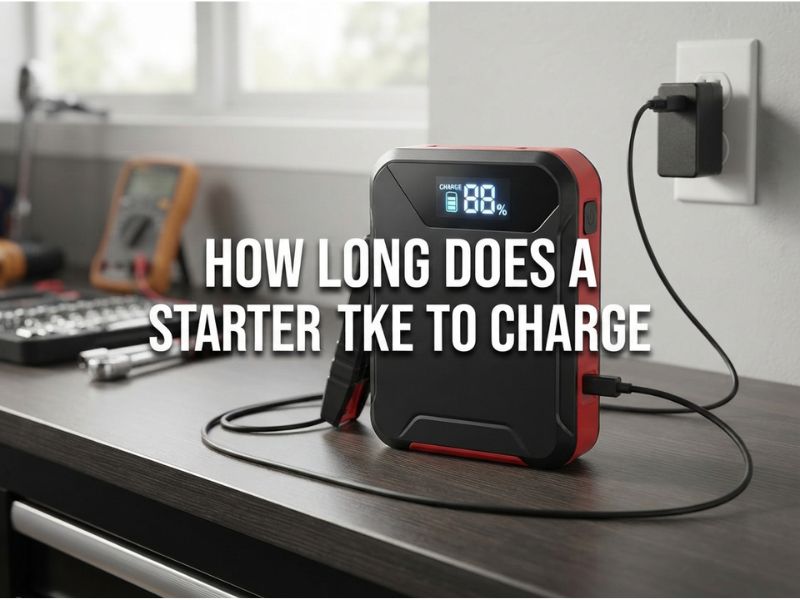
Most portable jump starters take approximately 3 to 8 hours to fully charge under normal conditions, although charging times can vary significantly between models.
Smaller lithium-ion jump starters with modern fast-charging systems may take around 2 to 4 hours. Larger units or models using older charging technology may require 6 to 12 hours or more.
The manufacturer’s charging specification is always the best reference because two jump starters with similar-looking designs can have very different internal batteries and charging circuits.
A general estimate looks like this:
| Jump Starter Type | Approximate Full Charging Time |
| Small compact model | 2–4 hours |
| Medium portable model | 3–6 hours |
| High-capacity model | 5–10+ hours |
| Older USB-charged model | 6–12+ hours |
| USB-C fast-charge model | Often 2–4 hours |
| 12V vehicle charging | Often several hours |
These are general ranges rather than guaranteed charging times. Always check the specifications for your particular model.
What Determines How Long a Jump Starter Takes to Charge?
Several factors determine the charging time of a portable jump starter.
The most important factors are battery capacity, charger output, charging technology, and the jump starter’s current battery level.
Battery Capacity
The larger the internal battery, the more energy it has to store.
A compact jump starter might have a relatively small lithium-ion battery, while a heavy-duty unit designed for trucks and larger engines may have a much larger battery.
A larger battery generally requires more time to recharge when using the same charging power.
For example, a small emergency jump starter might recharge relatively quickly from a USB-C charger, while a high-capacity jump starter could require several additional hours.
Charger Output
The charger determines how much electrical power is available for charging.
A low-power USB charger may take much longer than a compatible higher-output charger.
However, simply using a charger with a higher wattage rating does not automatically make the jump starter charge faster. The jump starter has an internal charging circuit that determines how much power it can safely accept.
Charging Method
The charging method can have a major effect on charging time.
Common methods include:
- AC wall adapter
- USB-A
- Micro-USB
- USB-C
- 12V vehicle outlet
Modern USB-C charging can be considerably faster on compatible models, while older USB systems may require much longer.
Battery Level
A jump starter that is almost completely empty naturally requires more time to reach full charge than one that is already 50% charged.
If you used the jump starter for several starting attempts, its battery may have been significantly depleted.
Battery Age
A new jump starter and an older jump starter may not charge in exactly the same way.
Over time, lithium-ion battery capacity can decline. An aging battery may also show unusual charging behavior, such as reaching 100% unusually quickly while providing less runtime.
Temperature
Temperature can also influence battery charging.
Extreme heat and extreme cold can affect the charging behavior of lithium-ion batteries. Many devices include temperature protection that reduces or stops charging when the battery is outside its safe operating range.
How Long Does a New Jump Starter Take to Charge?
A new jump starter may require several hours to reach a full charge before its first use.
Some manufacturers recommend charging the device completely before using it for the first time.
If the jump starter arrives partially charged, you may technically be able to use it immediately, depending on the battery level and manufacturer’s instructions. However, fully charging it first ensures that you have the maximum available energy reserve.
For a new device, use the included charging cable or adapter whenever possible.
Check the instruction manual for the manufacturer’s recommended initial charging procedure.
How Long Does It Take to Charge a Jump Starter With USB?
USB charging time depends heavily on the type of USB connection and charger.
Older Micro-USB jump starters can take many hours to reach full capacity, particularly when connected to a low-output adapter.
A compact jump starter might take around 4–8 hours through a suitable USB charger, while some older or larger models can take considerably longer.
Charging through a computer’s USB port can take even longer because computer ports may provide less power than a dedicated wall adapter.
For faster charging, use a compatible power adapter that meets the jump starter manufacturer’s specifications.
How Long Does It Take to Charge a Jump Starter With USB-C?
USB-C jump starters can often charge faster than older USB models.
Some newer devices support higher charging power and may reach full capacity in approximately 2 to 4 hours, depending on the battery size and charging system.
However, not every USB-C jump starter supports fast charging.
USB-C describes the connector type, not necessarily the charging speed.
Two devices can both use USB-C while having very different charging capabilities.
If fast charging is important to you, check the manufacturer’s specifications for the actual input power and estimated charging time.
How Long Does a Jump Starter Take to Charge From a Wall Outlet?
Charging from a wall outlet using the manufacturer’s AC adapter can often be one of the most convenient methods.
Many portable jump starters take approximately 3 to 8 hours when charged using their recommended AC adapter.
The exact time depends on the model.
A small unit with a high-efficiency charging circuit may finish considerably faster, while a large heavy-duty jump starter can take longer.
If the manufacturer provides an estimated charging time, use that figure rather than relying on a generic charging estimate.
How Long Does a Jump Starter Take to Charge in a Car?
Some portable jump starters can be charged through a vehicle’s 12V accessory outlet.
This can be convenient when you are traveling and don’t have access to a wall outlet.
However, 12V vehicle charging can be relatively slow depending on the jump starter and charging cable.
It may take several hours to recharge the device.
There is also an important consideration: if you charge the jump starter while the vehicle is turned off, the energy comes from the vehicle’s battery.
A long charging session could drain the car battery.
If you need to recharge the jump starter from a vehicle, follow the manufacturer’s instructions and consider whether the vehicle should be running.
How Long Should You Charge a Jump Starter After Using It?
After using a jump starter to start a vehicle, it is a good idea to recharge the device as soon as practical.
The required charging time depends on how much energy was consumed.
If you used the jump starter only once, it may not be completely depleted. Nevertheless, recharging it restores its emergency capacity.
If you made several starting attempts, the battery may require considerably more charging.
For maximum reliability, charge the jump starter until its battery indicator shows the recommended full-charge state.
Do not assume that a few minutes of charging is enough simply because the jump starter still displays some battery capacity.
Does a Jump Starter Charge Faster When It Is Half Full?
Yes, a jump starter that is already partially charged will generally require less time to reach 100% than one that is almost completely empty.
However, the charging rate is not necessarily constant throughout the entire charging cycle.
Modern battery management systems can adjust charging current as the battery approaches full capacity.
The device may charge relatively quickly at lower battery levels and then reduce charging power near the end of the cycle.
This is one reason why the final portion of a charging cycle can sometimes appear slower.
Why Does My Jump Starter Take So Long to Charge?
If your jump starter takes significantly longer than the manufacturer’s estimated charging time, several things could be responsible.
Low-Power Charger
A charger that provides limited power can significantly increase charging time.
Poor-Quality Cable
A damaged or low-quality charging cable can restrict charging performance.
Wrong Charging Port
Many jump starters have several ports. Some are outputs for charging phones, while another is the actual battery charging input.
Make sure you are using the correct input.
Large Battery
A high-capacity jump starter naturally requires more energy to recharge.
Extreme Temperature
Very hot or cold conditions can cause the charging system to reduce charging speed.
Aging Battery
An older battery may have reduced capacity or abnormal charging behavior.
Faulty Charging Circuit
If the device suddenly takes much longer to charge than it used to, the charging circuit or battery could have developed a fault.
How Can I Make My Jump Starter Charge Faster?
There is no safe way to force a jump starter to charge faster than its internal charging system allows.
However, you can optimize the charging process.
Use the manufacturer-recommended charger and cable.
Charge from a reliable power source rather than a low-power computer USB port.
If the jump starter supports USB-C fast charging, use a compatible USB-C power adapter that meets its specifications.
Charge the device at a suitable temperature.
Also make sure that the charging port and connector are clean and undamaged.
Do not use an incompatible high-voltage adapter simply because you want faster charging. The charging system is designed for a specific input range.
Does a Higher-Watt Charger Make a Jump Starter Charge Faster?
Not necessarily.
A jump starter can only accept the amount of power supported by its internal charging circuit.
For example, if a jump starter is designed to accept a certain maximum charging power, connecting it to a much more powerful adapter will not necessarily reduce charging time.
The charger and jump starter need to be compatible.
With USB-C devices, charging speed can also depend on the USB Power Delivery (USB PD) capabilities supported by both the charger and the jump starter.
Therefore, check the manufacturer’s specifications rather than choosing a charger solely based on its maximum wattage.
How Do You Know When a Jump Starter Is Fully Charged?
Most jump starters have a battery level indicator.
Depending on the design, the indicator might consist of four LED lights, a digital percentage display, or a battery icon.
Common signs of a full charge include:
- 100% displayed on the screen
- All battery LEDs illuminated
- A solid battery icon
- A charging indicator that stops flashing
However, indicator behavior differs between models.
Read the owner’s manual to determine exactly what the charging lights mean.
If the manufacturer says that all four LEDs represent a full battery, for example, you should not assume that one or two LEDs indicate a full charge.
Can You Leave a Jump Starter Charging Overnight?
Whether you can leave a jump starter charging overnight depends on the manufacturer’s instructions.
Many modern portable jump starters contain overcharge protection and a battery management system that controls the charging process.
However, manufacturers may still recommend disconnecting the device once it reaches full charge.
For routine charging, there is generally little benefit to leaving the device connected longer than necessary.
If you need to charge it overnight, check the owner’s manual first.
Do not leave a damaged or unusually hot jump starter unattended while charging.
Can You Overcharge a Portable Jump Starter?
Modern lithium-ion jump starters are normally equipped with charging protection.
The internal electronics can monitor battery voltage, temperature, and charging current.
Safety features may include:
- Overcharge protection
- Over-voltage protection
- Over-current protection
- Short-circuit protection
- Over-temperature protection
These systems are designed to reduce the risk of battery damage.
Nevertheless, you should always use a compatible charger and follow the manufacturer’s charging instructions.
If the jump starter becomes extremely hot, begins swelling, produces smoke, or develops an unusual odor, stop charging and discontinue use.
Does a Jump Starter Lose Charge While Sitting?
Yes.
Like other rechargeable battery-powered devices, a portable jump starter can gradually lose charge during storage.
This happens because of self-discharge and the small amount of power consumed by internal electronics.
The rate varies from model to model.
Some jump starters can retain a useful charge for many months, while others may require more frequent recharging.
If you keep a jump starter in your car for emergencies, periodically check its battery level.
A jump starter that has been sitting unused for six months may not have the same charge level it had when you stored it.
How Often Should You Recharge a Jump Starter?
The best recharge schedule depends on the manufacturer’s recommendations.
If you use the jump starter, recharge it afterward.
If it remains unused, periodically check its battery level.
Many users choose to inspect their emergency jump starter every few months.
The important goal is to avoid discovering that the battery is nearly empty when you actually need it.
For long-term storage, follow the manufacturer’s recommended storage charge level.
Some devices may recommend storing the battery at a particular percentage rather than keeping it at 100% indefinitely.
Does Cold Weather Make a Jump Starter Take Longer to Charge?
Cold temperatures can affect lithium-ion battery charging.
A very cold battery may have reduced charging performance, and some battery management systems can prevent or limit charging when temperatures fall outside the safe operating range.
If your jump starter has been stored in a cold vehicle, allow it to reach the recommended operating temperature before charging.
Do not attempt to artificially heat the battery with a heater, hair dryer, or other external heat source.
Follow the manufacturer’s temperature recommendations.
Does Heat Make a Jump Starter Charge Faster?
No.
Although heat can sometimes affect battery chemistry and charging behavior, intentionally heating a jump starter is unsafe.
Excessive heat can accelerate battery degradation and potentially create a dangerous condition.
A jump starter should be charged within the temperature range specified by the manufacturer.
Do not place it in direct sunlight or near a heater to try to speed up charging.
How Long Does a Jump Starter Battery Last?
The useful life of a portable jump starter depends on the battery chemistry, charging habits, storage conditions, usage frequency, and overall build quality.
Most modern portable jump starters use lithium-ion or lithium-polymer battery technology.
Rechargeable lithium batteries gradually lose capacity as they age and go through charging cycles.
A jump starter that was once capable of several jump starts may eventually provide fewer attempts between charges.
Proper storage and avoiding extreme temperatures can help extend battery life.
Can You Use a Jump Starter While It Is Charging?
In most cases, you should not assume that a jump starter can be used while it is charging.
Some manufacturers may support specific forms of pass-through charging, but many devices are not designed for simultaneous charging and high-current jump-start operation.
Unless the manufacturer specifically states that this function is supported, charge the jump starter first and disconnect the charger before using it.
This is especially important because jump-starting requires very high current compared with normal USB charging.
Can a Jump Starter Charge a Car Battery?
A jump starter’s primary purpose is to provide enough electrical power to help start an engine.
It is not normally designed to function as a full battery charger.
After the vehicle starts, the alternator can replenish some energy in the vehicle’s battery.
However, if the car battery is deeply discharged, a dedicated automotive battery charger may be required to restore it fully.
This distinction is important.
A jump starter can help you get the engine running, but it should not be considered a replacement for a battery charger.
Why Does My Jump Starter Show 100% but Die Quickly?
If a jump starter reaches 100% very quickly but then loses its charge rapidly, the internal battery may have lost capacity.
This can happen as a rechargeable battery ages.
Another possibility is an inaccurate battery indicator.
If the device is relatively new and this behavior appears suddenly, there could be an issue with the battery management system or charging circuit.
Check the manufacturer’s troubleshooting instructions before attempting any repair.
Do not open a lithium-ion jump starter unless it is specifically designed to be serviced by the user.
Why Is My Jump Starter Not Charging at All?
If the jump starter does not charge, check the following:
Power source: Make sure the outlet, USB port, or adapter is working.
Charging cable: Inspect the cable for damage.
Charging port: Make sure you are using the correct input port.
Adapter compatibility: Verify that the charger meets the manufacturer’s specifications.
Temperature: Make sure the device is within its recommended charging temperature range.
Battery condition: A severely damaged or aged battery may not accept a normal charge.
If these checks do not solve the problem, consult the manufacturer.
Avoid attempting to bypass the charging system or connect the internal battery directly to another power source.
Best Practices for Charging a Jump Starter
Following a few simple practices can help keep your jump starter reliable.
Use the Correct Charger
Use the supplied charger whenever possible.
If you need a replacement, make sure it meets the manufacturer’s electrical specifications.
Keep the Battery Charged
Do not store the jump starter completely empty for long periods.
Avoid Extreme Temperatures
Store and charge the unit within its recommended temperature range.
Inspect the Charging Cable
Replace damaged charging cables instead of continuing to use them.
Keep the Charging Port Clean
Dust and debris can interfere with the connection.
Recharge After Emergency Use
After using the jump starter, recharge it before storing it again.
Check It Periodically
A quick battery-level check every few months can help ensure that the device is ready for an emergency.
Jump Starter Charging Time by Charging Method
Different charging methods can produce different results.
AC Wall Charger
An AC adapter is often one of the fastest and most reliable charging methods for compatible models.
Typical charging time can range from approximately 3 to 8 hours, depending on the device.
USB-C
USB-C can offer fast charging on supported models.
Some modern jump starters can reach full charge in approximately 2 to 4 hours, although this varies widely.
USB-A or Micro-USB
Older USB charging systems can take around 4 to 12 hours or longer, depending on the charger and battery capacity.
12V Vehicle Outlet
Charging through a vehicle’s accessory outlet may take several hours and can be slower than dedicated AC or USB-C charging.
These ranges are only general estimates.
Jump Starter Charging Time vs. Battery Capacity
Battery capacity is one of the most useful specifications when estimating charging time.
A jump starter with a larger internal capacity stores more energy.
For example, a compact emergency jump starter designed for a small gasoline engine may charge relatively quickly.
A high-capacity jump starter designed for large engines, trucks, or commercial vehicles can require substantially more time.
However, battery capacity alone does not determine charging time.
A larger battery paired with a high-power charging system could potentially charge faster than a smaller battery using a very low-power charger.
This is why both battery capacity and charging input power need to be considered.
How to Keep a Jump Starter Ready for Emergencies
The main purpose of a portable jump starter is emergency preparedness.
You do not want to discover that it is empty when your car battery dies.
Keep the jump starter in a suitable protective case if one is provided.
Check its battery indicator periodically.
Recharge it after use.
Avoid leaving it exposed to extreme heat for long periods.
If you frequently take long road trips, check the jump starter before leaving.
It can also be useful to keep the charging cable in the same storage case so that you do not have a charged jump starter but no way to recharge it afterward.
Frequently Asked Questions
How long does a jump starter take to charge fully?
Most portable jump starters take approximately 3 to 8 hours to reach a full charge, but some compact fast-charging models can take less time while larger units can require 10 hours or more.
How long does a jump starter take to charge for the first time?
A new jump starter may require several hours for its initial full charge. Follow the charging time specified by the manufacturer and fully charge the device before relying on it for emergencies.
Can a jump starter charge in 2 hours?
Some modern compact jump starters with USB-C fast charging can reach a high or full charge in around two hours, but not every model supports this speed.
How long does a 1000 amp jump starter take to charge?
The advertised peak current, such as 1000 amps, does not directly determine charging time. Charging time depends more on the internal battery capacity and charging input.
How long does a 2000 amp jump starter take to charge?
A 2000-amp jump starter may take several hours to fully charge. The exact time depends on its battery capacity and charger. Peak starting current is not the same thing as charging speed.
Does a jump starter charge faster when the car is running?
If the jump starter supports 12V vehicle charging, the vehicle’s charging system may provide power while the engine is running. However, the actual charging rate depends on the jump starter and charging cable.
Can I charge my jump starter with a phone charger?
You may be able to if the jump starter supports the same charging standard and the phone charger provides compatible voltage and current. Check the jump starter’s specifications first.
Can I leave my jump starter plugged in overnight?
Check the manufacturer’s instructions. Many modern models have charging protection, but manufacturers may still recommend disconnecting the device after it reaches full charge.
How often should I charge my portable jump starter?
Recharge it after use and periodically check its battery level while it is stored. The exact maintenance schedule should follow the manufacturer’s recommendations.
Why is my jump starter charging so slowly?
A low-power charger, unsuitable cable, large battery capacity, extreme temperature, aging battery, or charging-circuit issue can cause slow charging.
Can I use a fast charger on my jump starter?
Only if the jump starter supports the charger’s charging standard and power specifications. A higher-wattage charger does not automatically make an incompatible device charge faster.
Does a jump starter need to be fully charged to start a car?
Not always. Some jump starters can start a vehicle when partially charged. However, keeping the battery well charged provides a larger energy reserve for emergency use.
Does charging a jump starter recharge my car battery?
No. Charging the jump starter only charges the jump starter’s internal battery. The vehicle battery must be recharged separately through the vehicle’s charging system or a dedicated battery charger.
Final Thoughts on How Long Does a Jump Starter Take to Charge?
So, how long does a jump starter take to charge? For many portable models, a full charge takes roughly 3 to 8 hours, but the actual charging time can range from around two hours for some fast-charging compact units to more than 10 hours for larger or slower-charging models.
The biggest factors are battery capacity, charging input power, charger type, charging technology, battery condition, and temperature. USB-C models with fast-charging support can generally recharge more quickly than older Micro-USB models, while charging from a vehicle’s 12V outlet may take several hours.
For the most reliable results, use the manufacturer’s recommended charger and cable, charge the device within its recommended temperature range, and recharge it after using it to start a vehicle.
Most importantly, do not wait until an emergency to discover that your jump starter is empty. Periodically checking and maintaining its charge ensures that this important piece of emergency car equipment is ready when your vehicle battery needs help.