The best tire inflator for home use should make routine tire-pressure maintenance simple without requiring a bulky shop compressor. For most households, a model with household AC power, automatic pressure control, a readable gauge, and enough hose reach for driveway use offers the best balance of convenience and performance.
If I were buying one for routine garage use, my first choice would be the TEROMAS Tire Inflator Air Compressor 12V DC/110V AC. Its biggest advantage is straightforward dual-power operation: it can plug into a household outlet at home or a vehicle’s 12V outlet when needed on the road.
My second choice would be the DEWALT DCC020IB 20V MAX Corded/Cordless Inflator. It is the more versatile and rugged option, particularly for homeowners who already use DEWALT 20V MAX batteries and want one machine for tires, sports equipment, mattresses, and other inflatables.
I also like the AstroAI ATJ-8366 12V DC/120V AC Tire Inflator for households that want a dedicated plug-in inflator with both high-pressure and high-volume capabilities. It works especially well when one machine needs to handle vehicle tires as well as air mattresses and larger household inflatables.
5 Best Tire Inflator for Home Use
| Image | Product Name | Check Price |
|---|---|---|
Best Choice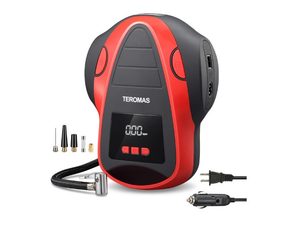 | TEROMAS Tire Inflator Air Compressor 12V DC/110V AC | Check Price |
Second Best | DEWALT DCC020IB 20V MAX Corded/Cordless Inflator | Check Price |
Third Choice | AstroAI ATJ-8366 12V DC/120V AC Tire Inflator | Check Price |
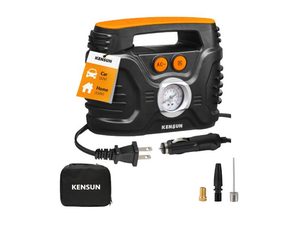 | Kensun AC/DC Portable Air Compressor Pump | Check Price |
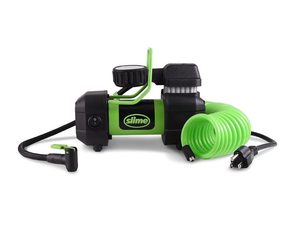 | Slime 40045 120V Pro Power Tire Inflator | Check Price |
What Makes a Tire Inflator Good for Home Use?
A home tire inflator has slightly different priorities than an emergency compressor kept permanently in a trunk. Portability still matters, but convenient household outlet compatibility, an accurate pressure gauge, reasonable inflation speed, and simple storage become more important.
For normal car maintenance, you usually are not trying to inflate a completely flat tire every week. The typical job is correcting seasonal pressure changes, topping a tire from perhaps 29 PSI to 35 PSI, checking several family vehicles, or inflating bicycles and recreational equipment.
That makes an inflator with a preset pressure function and automatic shutoff especially convenient. Connect the hose, enter the pressure recommended on the vehicle’s door-jamb placard, and allow the inflator to stop when it reaches the target.
Power supply also deserves careful consideration. A 110V or 120V AC tire inflator plugs directly into a household garage outlet. AC/DC models add a 12V vehicle connection, which lets the same compressor serve as both a garage tool and roadside equipment.
Cordless models eliminate cords entirely, although they introduce battery management. They make the most sense when you already own batteries in the same power-tool ecosystem.
The 5 Best Tire Inflators for Home Use
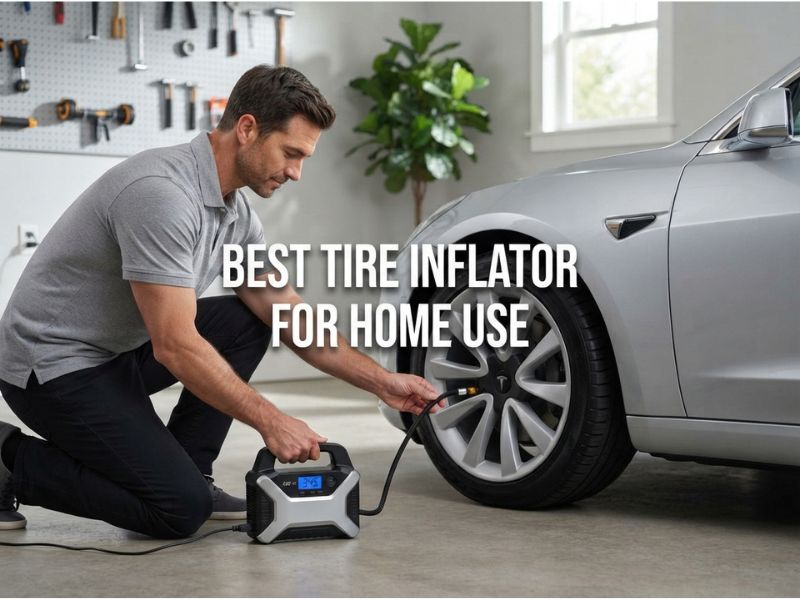
1. TEROMAS Tire Inflator Air Compressor 12V DC/110V AC – Best Overall
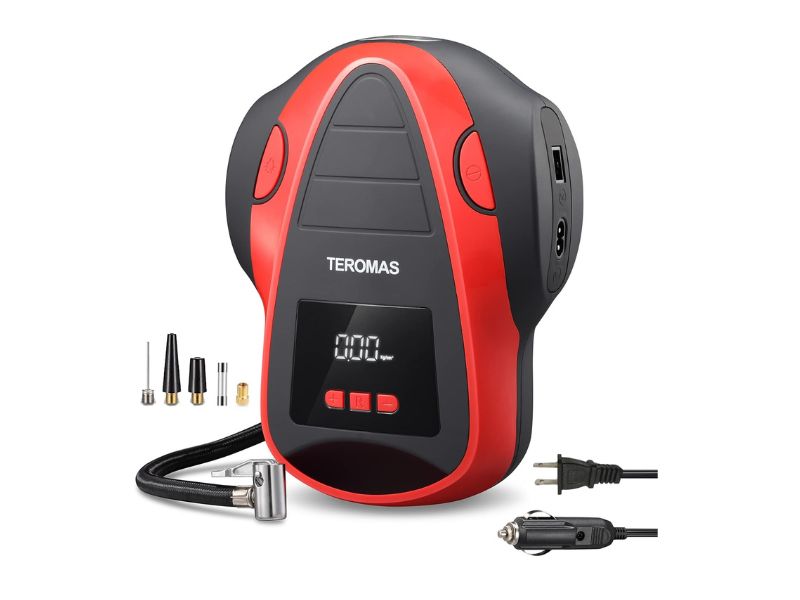
The TEROMAS TMS-3015 earns the top position because its design closely matches what most homeowners actually need. It combines AC household power with 12V vehicle power, a digital pressure display, preset inflation, and automatic shutoff in a relatively compact package.
Key Features: 110V AC and 12V DC operation; digital pressure gauge; pressure preset; automatic shutoff; up to 150 PSI rated pressure; approximately 17 LPM airflow; compact body; adapters for several inflation tasks.
Detailed Review
The defining feature is the dual-power system. At home, you can plug it into a regular wall outlet rather than running a vehicle simply to top off its tires. When traveling, the 12V DC connection gives you a second source of power.
That arrangement is one of the most practical configurations for a household tire compressor because it eliminates dependence on a rechargeable battery. You do not have to remember whether the battery was charged six months ago, and you can still carry the inflator in a vehicle.
The digital pressure control also makes routine maintenance easier. Instead of continuously watching an analog needle, you select the target pressure and let the machine stop automatically when it reaches the preset level.
This is useful when maintaining several tires. You can check the driver’s door-jamb tire-pressure label, set the appropriate PSI, and move systematically from tire to tire.
Its 150 PSI rating sounds impressive, although maximum pressure alone should never determine which inflator you buy. Airflow, motor duty cycle, tire volume, and heat management affect real-world performance just as much. For ordinary passenger cars, crossovers, motorcycles, bicycles, and many smaller SUVs, the TEROMAS is better suited to routine pressure correction than demanding commercial tire work.
Another reason I prefer it for home use is simplicity. There is no separate battery platform to invest in and no special AC adapter required before it becomes useful around the garage.
Its compact construction also makes storage fairly easy. A full-size tank compressor can provide dramatically more airflow, but it requires considerably more floor space. The TEROMAS can sit on a garage shelf and come out only when tire pressure needs attention.
The primary compromise is that it is still a small portable compressor. It creates noticeable noise and heat, and repeatedly filling large tires from extremely low pressure can push it harder than ordinary top-off work.
What I Like
I like the combination of included household AC power and vehicle DC power most. Automatic shutoff also reduces the need to watch the gauge constantly, and the digital controls are straightforward enough for occasional users.
What I Do Not Like
The air hose could offer more reach for some large vehicles, and this class of small compressor is not intended to replace a high-CFM shop compressor for continuous work.
Verdict
For most households wanting one compact machine for the garage and vehicle, the TEROMAS provides the most useful mixture of plug-in convenience, portability, digital pressure control, and dual-power flexibility. It is my primary recommendation for the best tire inflator for home use.
2. DEWALT DCC020IB 20V MAX Corded/Cordless Inflator – Best Heavy-Duty Versatility
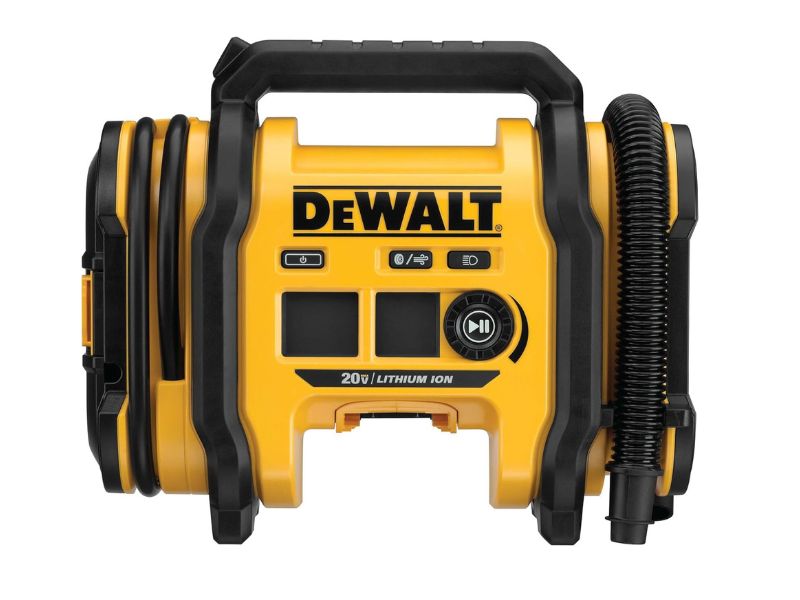
The DEWALT DCC020IB takes a more versatile approach. It supports high-pressure tire inflation, high-volume inflation and deflation, automatic shutoff, an LED work light, and multiple potential power sources.
Key Features: 20V MAX battery compatibility; included 12V DC power cord; optional 110V AC operation; digital pressure setting; automatic shutoff; separate high-pressure and high-volume functions; deflation mode; threaded tire chuck; onboard accessory storage.
Detailed Review
The DCC020IB is particularly appealing to homeowners who already use DEWALT 20V MAX batteries. Install a charged battery, carry the inflator into the driveway, and there is no extension cord or vehicle cable to manage.
That convenience becomes more noticeable in a multi-vehicle household. Moving between two or three vehicles is easier when the inflator is completely cordless.
If the battery is unavailable, the supplied 12V DC cord gives you another way to run the compressor from a vehicle. The machine is also designed to support household AC power, but there is an important purchasing detail: the standard tool-only package does not include the battery, charger, or AC power adapter. Those items are sold separately.
That means this model offers excellent power flexibility, but buyers starting from scratch should calculate what equipment they actually need before choosing it specifically for home use.
Performance versatility is where the DEWALT separates itself from simpler tire pumps. The high-pressure mode is designed for tires and uses a digital pressure setting with automatic shutoff. Set the desired PSI and the unit stops when the target is reached.
There is also a high-volume hose for items such as air mattresses and other large inflatables. Moving the hose to the deflation side lets the machine remove air as well. That can be surprisingly useful for camping equipment, pool accessories, and household storage.
The threaded chuck creates a secure connection to a tire valve stem. Some people prefer a quick clamp because it attaches faster, while others appreciate the secure seal provided by a threaded connection.
A built-in LED light and onboard accessory storage improve usability, while substantial rubber feet help keep the compressor from moving around excessively during operation.
The machine is larger and more expensive than a simple plug-in tire pump, but it also handles a broader set of tasks.
What I Like
The combination of cordless operation, 12V backup, auto shutoff, high-volume inflation, and deflation makes the DCC020IB exceptionally versatile. It is especially attractive when compatible batteries are already in your garage.
What I Do Not Like
The standard package is a bare tool. A battery, charger, and household AC adapter are not included, so the total investment can be considerably higher for someone who does not already own compatible equipment.
Verdict
Choose the DEWALT DCC020IB if you value versatility more than minimum cost. Existing 20V MAX owners will get the most value because they can immediately take advantage of cordless operation without purchasing another battery system.
3. AstroAI ATJ-8366 12V DC/120V AC Tire Inflator – Best for Tires and Inflatables
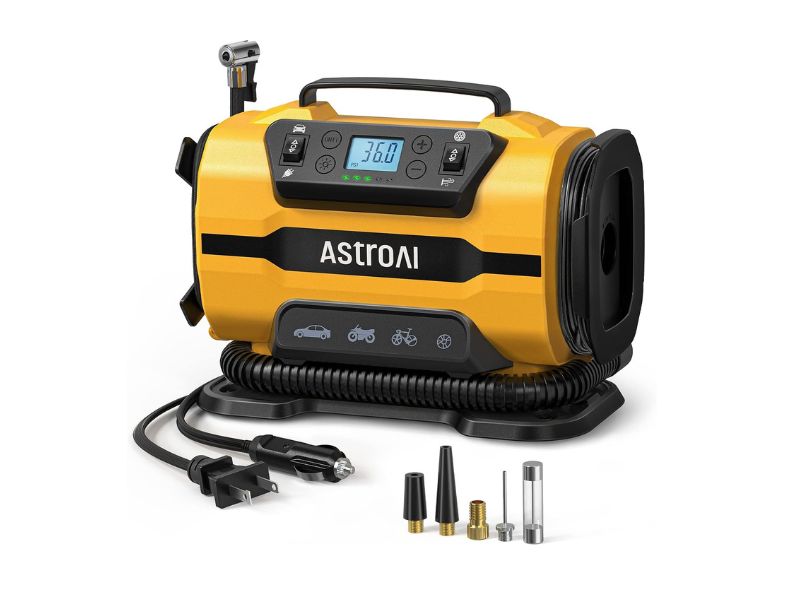
The AstroAI ATJ-8366 is a particularly useful household option because it combines two power sources with separate inflation modes. It can handle high-pressure objects such as vehicle tires and higher-volume items such as air mattresses.
Key Features: 120V AC household input; 12V DC vehicle input; 150 PSI maximum pressure rating; digital gauge; automatic shutoff; dual metal motors; high-pressure mode; high-volume mode; adapters for tires, bicycles, balls, and inflatables.
Detailed Review
A common problem with buying a tire inflator for the house is discovering that it is good at only one type of inflation.
A compressor optimized for 35 PSI automotive tires might take too long to fill a large air mattress. A high-volume blower, meanwhile, may move plenty of air but lack the pressure needed for vehicle tires.
The AstroAI addresses that problem with separate high-pressure and high-volume operation.
High-pressure mode is intended for car tires, motorcycle tires, bicycles, and similar items. High-volume operation is better suited to objects requiring a larger quantity of air at lower pressure.
That flexibility makes it useful in households where the compressor will spend more time in the garage than in a car trunk.
The AC/DC configuration is another major advantage. Plugging directly into a household outlet eliminates reliance on a car’s electrical system when you are working at home. The 12V connection remains available when traveling.
The digital gauge and automatic shutoff are also convenient for routine vehicle maintenance. Enter the desired pressure and allow the compressor to stop at the preset figure rather than repeatedly disconnecting a separate tire gauge.
AstroAI rates this model up to 150 PSI and uses dual metal motors with a metal cylinder. The manufacturer also specifies a limited continuous operating period, so users should still follow cooldown instructions rather than assuming a compact compressor can run indefinitely.
That distinction matters. Small inflators compress air inside a compact housing and inevitably generate heat. Ignoring a manufacturer’s duty-cycle guidance can shorten the useful life of almost any portable tire compressor.
Storage is reasonable for a unit with this degree of versatility, although it is understandably larger than an ultra-compact emergency inflator.
What I Like
The two inflation modes make this one of the most useful choices for a household with cars, bicycles, sports equipment, and air mattresses. I also like that both household and vehicle power are supported without needing a battery.
What I Do Not Like
It is larger than basic tire-only compressors, and users still need to respect the specified operating and cooling intervals during demanding inflation jobs.
Verdict
The AstroAI ATJ-8366 is an excellent choice when your definition of home use goes beyond car tires. Its combination of AC/DC power and high-pressure/high-volume operation gives it broader household usefulness than many conventional portable compressors.
4. Kensun AC/DC Portable Air Compressor Pump – Best Simple Dual-Power Pick
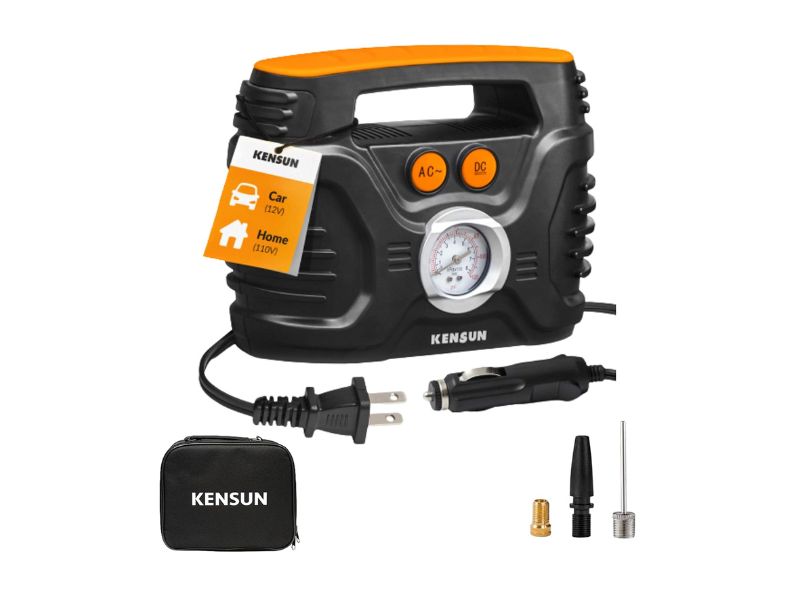
The Kensun AC/DC Portable Air Compressor is a relatively traditional alternative for buyers who value straightforward operation over numerous electronic features.
Key Features: household AC and vehicle DC power; compact carrying design; analog pressure gauge; approximately 18 LPM airflow; tire-inflation accessories; compact storage dimensions.
Detailed Review
Not everyone wants another rechargeable device or a compressor packed with digital controls. The Kensun takes a simpler route.
Its main advantage for homeowners is AC/DC power compatibility. You can use household electricity while working in the garage and switch to vehicle power when away from home.
That gives it many of the practical advantages of the TEROMAS without making battery charging part of routine maintenance.
The analog gauge is also worth considering. Digital pressure displays are easier to read precisely and make automatic shutoff possible, but an analog gauge has a basic simplicity some homeowners prefer.
There are fewer menus, presets, or electronic controls involved. Attach the hose, watch the gauge, and shut the compressor off at the appropriate pressure.
That does mean the operator must pay more attention. A digital auto-stop inflator is easier when you frequently maintain several vehicles because you can preset the pressure instead of continuously monitoring inflation.
The Kensun’s approximately 18 LPM airflow places it comfortably in compact portable-inflator territory. It is suitable for ordinary pressure maintenance but should not be confused with a large tank compressor designed to operate pneumatic tools or deliver continuous high airflow.
The body is still compact enough to store on a shelf, inside a cabinet, or in a vehicle.
What I Like
I like the uncomplicated AC/DC design. It works from the power sources homeowners commonly have available without requiring another rechargeable battery ecosystem.
What I Do Not Like
The more traditional control arrangement lacks the convenience of the best digital auto-shutoff systems. Users who simply want to select 35 PSI and walk away will likely prefer the TEROMAS or AstroAI.
Verdict
The Kensun is a good fit for someone who wants a straightforward dual-power tire compressor and does not consider automatic digital pressure control essential.
5. Slime 40045 120V Pro Power Tire Inflator – Best Wall-Powered Garage Pick
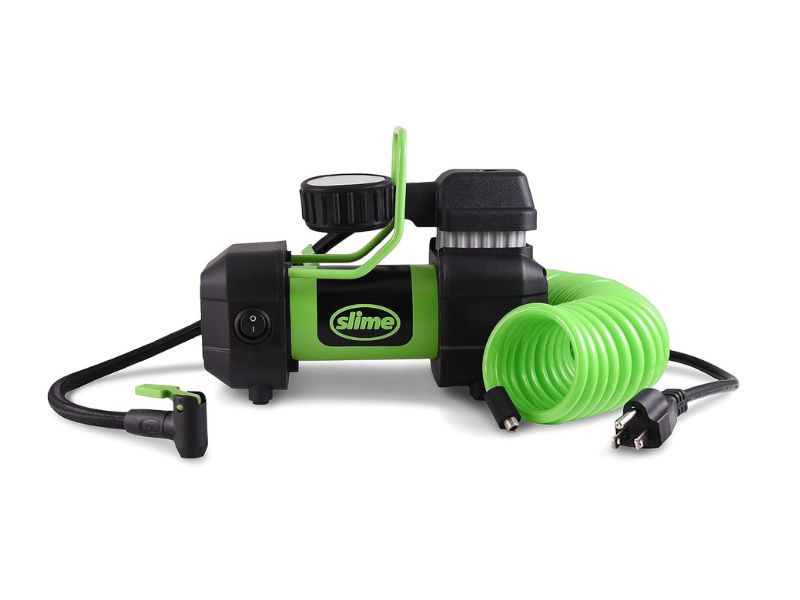
The Slime 40045 Pro Power is the most garage-specific model in this group. Rather than trying to be a battery-powered roadside tool, it is built around a standard 120V household outlet and includes a long coiled air hose and wall-mounting capability.
Key Features: 120V household power; direct-drive motor; wall-mount bracket; approximately 15-foot air-hose extension; mounted analog gauge; thermal protection; accessories for tires and recreational inflatables.
Detailed Review
For a tire inflator that will remain in the garage almost permanently, the Slime 40045 has an appealingly simple concept.
Mount it in a convenient location, connect it to household power, and use the long hose to reach the vehicle. This can feel more like a miniature garage inflation station than an emergency compressor.
That arrangement eliminates one of the annoyances common to portable compressors: carrying the machine around each wheel.
Slime specifies an approximately 15-foot air-hose extension, giving the user considerably more working reach than many small portable inflators.
The direct-drive motor is designed around routine tire inflation, and Slime advertises a roughly four-minute inflation time for a standard tire under its defined test conditions. Actual inflation time naturally changes with tire size, starting pressure, ambient temperature, hose restriction, and electrical conditions.
The 120V-only approach is both its advantage and limitation.
For dedicated home use, a household outlet is exactly what many buyers want. You do not need to maintain a rechargeable battery or run a vehicle to power a 12V socket.
On the other hand, it is considerably less useful as an emergency roadside inflator because you need access to AC power.
The analog gauge also means inflation remains more hands-on than with digital preset models. Many owners may prefer to confirm final pressure with a separate quality tire-pressure gauge, particularly when precise pressure is important.
The included thermal protection is another sensible feature for a compact direct-drive compressor because heat is one of the primary limitations of small inflation equipment.
What I Like
The long hose, wall-mount capability, and 120V power source make the Slime particularly convenient for a permanent home-garage setup.
What I Do Not Like
It lacks the travel flexibility of AC/DC models and does not provide the set-and-forget convenience of a digital automatic shutoff system.
Verdict
If the inflator will stay in your garage and you value hose reach over portability, the Slime 40045 is one of the most purpose-built choices in this group.
Tire Inflator Comparison
| Product | Power Source | Gauge | Auto Shutoff | High-Volume Mode | Hose/Reach Focus | Portability | Best For |
| TEROMAS TMS-3015 | 110V AC / 12V DC | Digital | Yes | No dedicated mode | Standard portable reach | High | Most households |
| DEWALT DCC020IB | 20V battery / 12V DC / optional 110V AC | Digital | Yes | Yes | Multiple onboard hoses | Medium | Tool-system owners |
| AstroAI ATJ-8366 | 120V AC / 12V DC | Digital | Yes | Yes | Standard portable reach | Medium | Tires and inflatables |
| Kensun AC/DC | AC / 12V DC | Analog | No | No | Standard portable reach | High | Simple operation |
| Slime 40045 | 120V AC | Analog | No | No | Long garage hose | Low | Dedicated garage station |
The TEROMAS TMS-3015 provides the best overall balance for ordinary homeowners because household and vehicle power are included and digital auto shutoff simplifies routine tire maintenance.
The DEWALT DCC020IB offers the broadest operating flexibility, particularly if you already have compatible batteries. The AstroAI ATJ-8366 is the better choice when large household inflatables matter almost as much as tires.
Kensun keeps things simpler with an analog AC/DC configuration, while the Slime 40045 prioritizes garage convenience with household power and extended hose reach.
Buying Guide: How to Choose the Best Tire Inflator for Home Use
Choose the Right Power Source First
For home use, I would usually start with 110V or 120V AC capability. A wall-powered inflator can stay ready indefinitely without relying on battery charge.
Dual AC/DC inflators are even more versatile. They run from household electricity in your garage but can travel in a vehicle and operate from its 12V accessory socket.
Cordless machines offer maximum convenience while moving between vehicles. However, they make the most financial sense when you already use batteries from the same tool ecosystem.
Look for Automatic Shutoff
Automatic shutoff is one of the most useful features on a home tire inflator.
Rather than staring at a gauge, you enter the manufacturer’s recommended tire pressure and start the compressor. The unit stops automatically at the preset value.
This becomes particularly convenient when seasonal temperature changes require all four tires on two or three vehicles to be adjusted.
Do Not Choose by Maximum PSI Alone
A 150 PSI or 160 PSI specification looks powerful, but it does not tell you how quickly a compressor can inflate a tire.
Airflow, motor design, tire volume, duty cycle, and starting pressure all influence inflation time.
Most passenger vehicles operate far below a portable inflator’s maximum advertised pressure. For routine maintenance, fast airflow at normal automotive pressures is generally more important than an extremely high maximum PSI figure.
Understand the Difference Between Pressure and Air Volume
Vehicle tires need relatively high pressure. Air mattresses and pool floats need far more air volume but operate at low pressure.
A dedicated high-volume mode can therefore make a home inflator substantially more versatile.
If you only maintain tires and bicycles, it may not matter. If you also inflate mattresses, rafts, pool equipment, or camping gear, models such as the DEWALT DCC020IB and AstroAI ATJ-8366 have an advantage.
Consider Hose and Cord Reach
Homeowners frequently underestimate how much reach they need.
Imagine where your garage outlet is located, where the vehicle normally parks, and whether the hose can conveniently reach the tires on the opposite side.
An extension cord can solve some AC-power limitations when permitted by the manufacturer’s instructions, but a longer air hose often creates a cleaner garage setup.
For that reason, the long coiled hose on a garage-oriented model such as the Slime 40045 can be valuable.
Digital Versus Analog Gauges
A digital gauge is easier for preset inflation because the compressor can stop automatically at a chosen pressure.
Analog gauges are simpler and can still work well, but the user must monitor pressure manually.
Regardless of gauge type, periodically comparing the compressor’s reading with a separate accurate tire-pressure gauge is a reasonable maintenance practice.
Pay Attention to Duty Cycle and Heat
Portable tire inflators generate heat rapidly.
A compact compressor may be rated for only a certain amount of continuous operation before requiring a cooldown period. That does not make the machine defective; it is a normal limitation of compact compressor design.
Follow the operating instructions for your specific model. If you routinely inflate multiple large tires from very low pressure, a larger compressor may be more appropriate than a portable tire inflator.
Match the Compressor to Your Vehicle
Passenger cars are comparatively easy work for most quality portable inflators. SUVs and crossovers contain more air volume, so inflation can take longer.
Large pickup tires, LT tires, RV tires, and commercial applications place considerably greater demands on a compressor.
Before buying, compare the manufacturer’s recommended applications with your actual tire size and required pressure rather than assuming a high maximum PSI rating means the compressor is optimized for every tire.
Why Keeping a Tire Inflator at Home Makes Sense
Tire pressure naturally changes over time. Temperature changes are particularly noticeable because colder weather typically reduces measured pressure while warmer conditions raise it.
A home inflator allows you to correct those changes immediately instead of waiting until you find a public air pump.
Correct tire pressure also supports predictable handling, proper tire contact with the road, even tread wear, and efficient vehicle operation.
Modern TPMS systems are helpful, but the warning lamp is not a substitute for routine pressure checks. In many vehicles, the warning appears only after pressure has already fallen significantly below the recommended figure.
The vehicle manufacturer’s recommended cold-tire pressure is normally listed on the driver’s door-jamb placard or in the owner’s manual.
Do not automatically inflate the tires to the maximum pressure molded onto the tire sidewall. That sidewall figure serves a different purpose and is not normally the vehicle manufacturer’s recommended everyday inflation pressure.
Home Tire Inflator Maintenance Tips
Keep the inflator somewhere dry and relatively clean. Excessive moisture, dirt, and extreme temperatures are not ideal for electrical equipment, hoses, connectors, or rechargeable batteries.
Inspect the air hose periodically for cracking or damage, particularly around the fitting and valve connector.
If the model has a removable or replaceable fuse, make sure you know its location before you actually need the compressor.
Cordless units should have their batteries checked periodically rather than being left discharged for months.
For 12V models, follow the manufacturer’s instructions regarding whether the vehicle should be running during operation. Electrical requirements vary by model.
Finally, let a compact compressor cool when required. Repeatedly ignoring thermal limits is an easy way to shorten motor and seal life.
Who Should Buy a Home Tire Inflator?
A portable home tire inflator makes sense for almost any household with one or more vehicles.
It becomes particularly useful for families maintaining several cars, homeowners who regularly adjust tire pressure as seasons change, cyclists, motorcyclists, RV or trailer owners with appropriately sized equipment, and anyone who would rather handle basic pressure maintenance in the driveway.
A tire inflator is less appropriate when you need compressed air for pneumatic tools, painting, continuous blowing, or other high-CFM shop work. Those applications call for a conventional air compressor with a storage tank and suitable airflow rating.
Frequently Asked Questions
What is the best tire inflator for home use?
The TEROMAS TMS-3015 is the best all-around choice for most homes.
Its combination of household AC power, 12V vehicle power, digital pressure control, and automatic shutoff covers the features most people need for routine garage tire maintenance. Unlike a battery-only unit, it does not depend on maintaining a rechargeable battery, yet it can still travel in a vehicle when needed.
Is a 120V tire inflator better for home use?
A 120V inflator is usually more convenient when the compressor stays in your garage.
Household AC power lets you operate the compressor directly from a wall outlet instead of running a vehicle or maintaining a rechargeable battery. An AC/DC model adds even more flexibility because it can use household power at home and 12V vehicle power on the road.
Is a cordless or corded tire inflator better?
Cordless models provide convenience, while corded models provide dependable continuous access to power.
A cordless inflator is excellent when you already own compatible tool batteries and frequently move between vehicles. Corded AC models are better for homeowners who want something that can remain on a garage shelf for months and be immediately ready when connected to an outlet.
How much PSI should a home tire inflator have?
Most passenger-car owners do not need an extremely high maximum PSI rating.
Many portable inflators advertise 100 to 160 PSI, while normal passenger-vehicle tire pressures are generally much lower. Instead of concentrating solely on maximum PSI, look at airflow, tire compatibility, duty cycle, gauge accuracy, and inflation speed at normal automotive pressures.
Can a portable tire inflator fill a completely flat tire?
Many can, provided the tire and inflator are otherwise suitable for the job.
A small portable compressor may take considerably longer to inflate a completely deflated tire than it takes to perform a normal pressure top-off. If the tire is flat because of a puncture, damaged valve, sidewall failure, or an unseated bead, adding air alone will not solve the underlying problem.
Can I use a home tire inflator on an SUV?
Yes, many portable inflators are suitable for standard SUVs and crossovers.
Larger tires contain more air than typical passenger-car tires, so inflation may take longer. Check the compressor manufacturer’s vehicle and tire recommendations, particularly for large SUVs, heavy-duty pickups, LT tires, RVs, and tires requiring unusually high operating pressure.
Do I need automatic shutoff?
It is not essential, but it makes routine tire maintenance much easier.
With automatic shutoff, you enter the desired PSI and allow the compressor to stop at the preset pressure. This is especially useful for households with several vehicles because you do not need to monitor the pressure gauge continuously while topping off every tire.
Should I use the PSI printed on my tire sidewall?
Use the vehicle manufacturer’s recommended cold-tire pressure for normal driving.
That figure is normally found on the driver’s door-jamb label or in the vehicle owner’s manual. The pressure molded onto a tire sidewall generally represents tire-related limits rather than the recommended everyday pressure for your particular vehicle.
Can a tire inflator replace a garage air compressor?
A tire inflator can replace a large compressor for inflation tasks, but not for every air-powered job.
Portable tire inflators are designed primarily for tires and small inflatables. They generally cannot provide the sustained airflow needed for impact wrenches, pneumatic nailers, spray equipment, air blow guns, or other demanding tools. For those applications, use a properly sized tank compressor.
How often should I check tire pressure at home?
Checking tire pressure about once a month is a practical routine for most drivers.
You should also check before long trips and when temperatures change substantially. Measure pressure when the tires are cold whenever practical, and compare the result with the vehicle manufacturer’s specified cold-tire pressure.
Final Thoughts
The TEROMAS TMS-3015 Tire Inflator is my first choice for most homeowners because it combines the two most useful power options with digital pressure control and automatic shutoff.
The DEWALT DCC020IB 20V MAX Inflator is the stronger choice for homeowners already invested in the DEWALT battery platform or anyone who wants high-pressure inflation, high-volume inflation, and deflation in one machine.
The AstroAI ATJ-8366 Tire Inflator is particularly versatile for a household that regularly handles both tires and large inflatables. The Kensun AC/DC Portable Air Compressor provides a simpler dual-power alternative, while the Slime 40045 Pro Power Tire Inflator is well suited to a permanent garage setup where wall power and extended hose reach matter most.
For the average driver who wants a compact, dependable tool for routine pressure adjustments, seasonal tire maintenance, bicycles, and occasional roadside use, a dual AC/DC inflator with automatic shutoff offers the most practical combination of features.