A 12V portable tire inflator is one of the simplest tools to keep in a vehicle because it lets you correct low tire pressure almost anywhere a 12V outlet is available. The best models combine useful airflow, an accurate digital gauge, automatic shutoff, enough cable reach, and a compact design that stays out of the way until you need it.
For most drivers, I recommend the AstroAI AIRUN H Tire Inflator Portable Air Compressor. It has the combination I want for routine tire maintenance: straightforward controls, preset pressure, automatic shutoff, a digital display, useful airflow, and enough portability for permanent trunk storage.
My second choice is the EPAuto 12V DC Portable Air Compressor Pump. I like it for drivers who want a well-established, conventional 12V inflator with an easy interface, automatic pressure control, an LED work light, and overheating protection.
For a smaller, inexpensive everyday option, I would also consider the VacLife VL701 12V DC Tire Inflator. Its compact body, digital controls, preset inflation, and integrated light make it particularly convenient for topping off passenger-car tires.
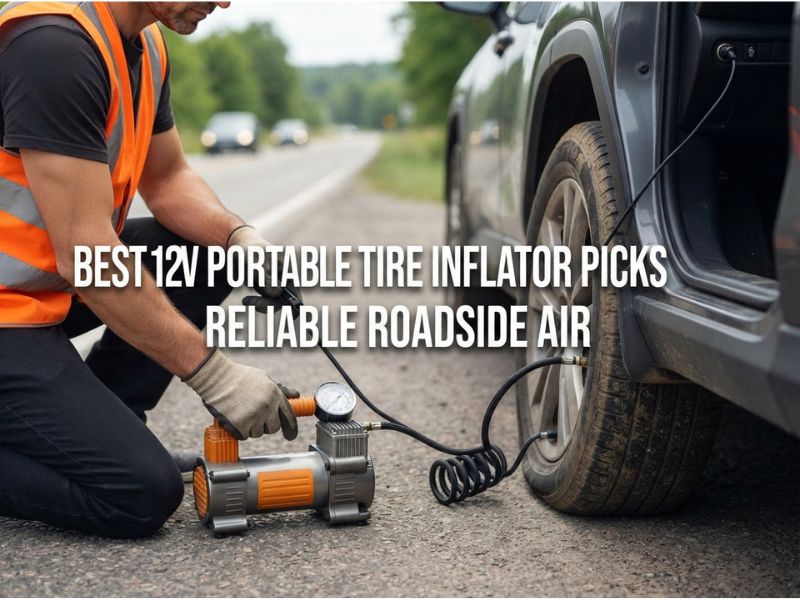
Best 12V Portable Tire Inflators at a Glance
| Image | Product Name | Check Price |
|---|---|---|
Best Choice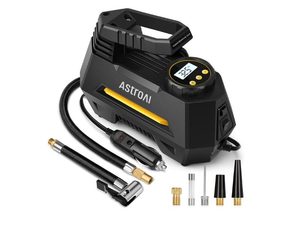 | AstroAI AIRUN H Tire Inflator Portable Air Compressor | Check Price |
Second Best | EPAuto 12V DC Portable Air Compressor Pump AT-010-1Z | Check Price |
Third Choice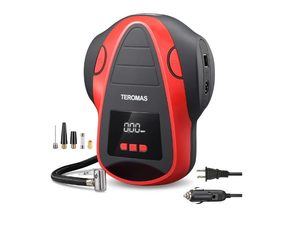 | TEROMAS TMS-3015 Tire Inflator Portable Air Compressor | Check Price |
 | CARSUN CAP-001 Digital 12V Tire Inflator | Check Price |
The five models below were selected for their relevance to ordinary vehicle tire maintenance, established buyer history, useful features, portability, and overall practicality. They are listed with the strongest review-volume products first while still considering performance and intended vehicle type.
1. AstroAI AIRUN H Tire Inflator Portable Air Compressor – Overall Best Pick
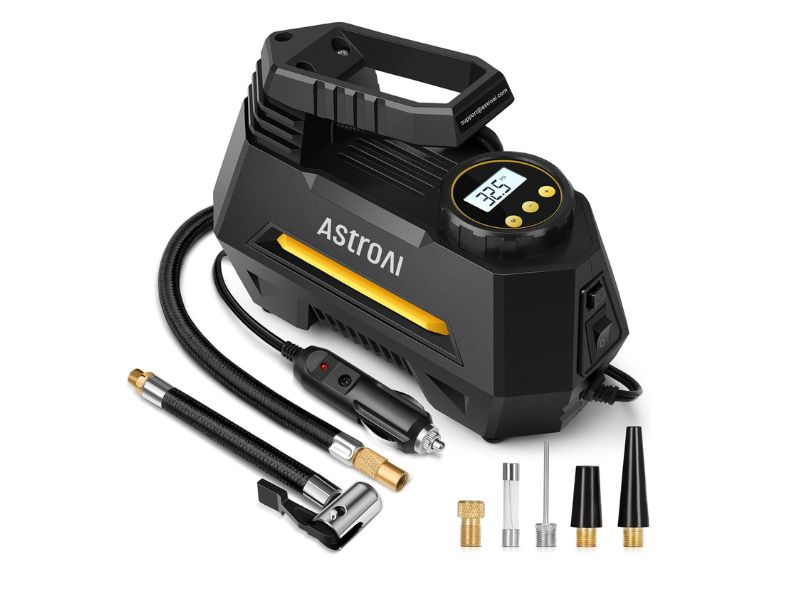
Key Features
- 12V DC corded power
- Up to 100 PSI
- Approximately 35 L/min airflow
- Digital pressure display
- Preset pressure with automatic shutoff
- Built-in LED light
- Long power cable for reaching vehicle tires
- Multiple inflation adapters
The AstroAI AIRUN H is the model I would choose for the widest range of normal passenger-car owners. It does not try to be a heavy-duty shop compressor. Instead, it concentrates on the features that make a compact car tire inflator genuinely useful: simple controls, reasonable airflow, a clear gauge, preset pressure, and convenient storage.
One of its biggest strengths is the digital pressure system. Rather than connecting the hose, repeatedly stopping the compressor, and checking pressure with a separate gauge, you can select your desired PSI and let the unit handle the final cutoff. That is particularly convenient when correcting a tire that is only 5–10 PSI below specification.
The roughly 35 L/min airflow also gives it a useful performance advantage over many very small emergency pumps. You should still think of it as a top-off and roadside inflation tool rather than a compressor intended to fill oversized off-road tires repeatedly, but it is well matched to compact cars, sedans, crossovers, motorcycles, bicycles, and similar applications.
Cable reach matters more than many shoppers initially realize. A powerful inflator is frustrating if its 12V cord cannot comfortably reach the rear tire on a longer vehicle. The AstroAI provides enough reach for typical passenger vehicles, helping make tire-to-tire movement easier.
The integrated LED work light is another sensible addition. A tire that needs air does not always become noticeable during daylight, so having illumination built directly into the inflator reduces the number of separate tools needed during a roadside stop.
I also like the compact form factor. Unlike a tank compressor, it can remain in a trunk or cargo compartment permanently. That makes it useful not only for emergencies but also for checking pressure before long highway drives, seasonal temperature changes, or road trips.
What I Like
The biggest advantage is balance. It is compact without feeling excessively limited and provides the digital features most drivers actually use. The preset function reduces the chance of accidentally continuing well beyond the desired pressure, while the display removes much of the guesswork involved with inexpensive analog gauges.
Its airflow is also respectable for this size of inflator, making routine pressure corrections relatively painless.
What I Do Not Like
This is still a compact 12V compressor. It should not be treated like a high-duty-cycle compressor for repeatedly filling very large truck or off-road tires from extremely low pressure.
Like most small compressors, it can also become hot during extended operation. Giving the pump appropriate cooling time is important.
Verdict
The AstroAI AIRUN H is my primary recommendation because it combines portability, automatic pressure control, a clear digital interface, useful airflow, and strong everyday usability. For typical car owners searching for the best 12V portable tire inflator, this is the most balanced place to start.
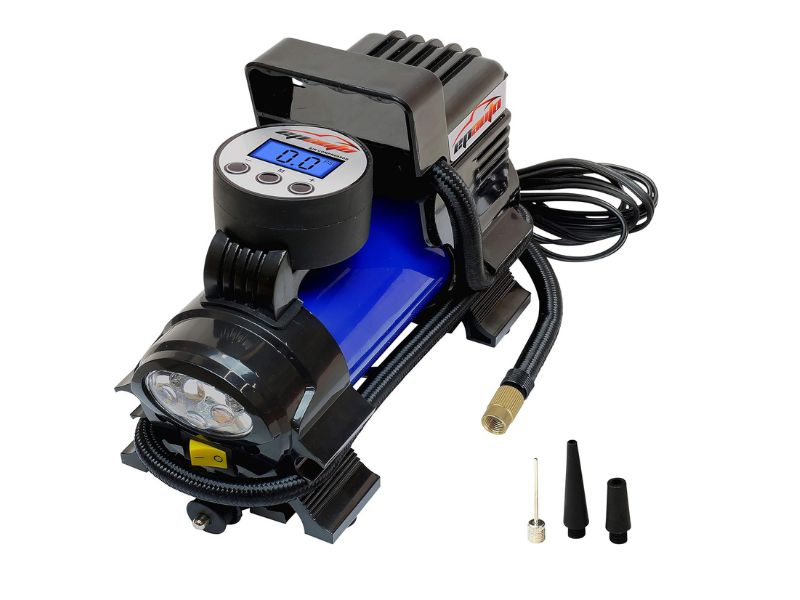
2. EPAuto 12V DC Portable Air Compressor Pump AT-010-1Z – Best Proven 12V Value
Key Features
- 12V DC vehicle outlet connection
- Up to approximately 100 PSI
- Around 1.06 CFM free-air capacity
- Digital pressure gauge
- Automatic shutoff
- Multiple pressure units
- LED flashlight
- Overheat protection
- Inflation adapters
The EPAuto AT-010-1Z has been around long enough to become one of the recognizable designs in the portable inflator category. Its appeal is straightforward: plug it into a vehicle’s 12V outlet, connect the hose, choose a pressure, and let the compressor run until the target is reached.
For routine maintenance, that simplicity is valuable. Tire inflation equipment does not need an elaborate interface. You want controls that remain easy to understand even if the inflator has been sitting untouched in the trunk for six months.
The digital gauge supports common pressure units, which makes it practical whether your tire-pressure specification is expressed in PSI, BAR, or kPa. Most U.S. drivers will leave it on PSI, but the additional options make the tool more versatile.
EPAuto also incorporates an automatic cutoff. This is one of the features I consider most useful on a modern portable compressor because it allows the user to preset a reasonable target rather than watching the display continuously.
Another notable feature is overheat protection. Small compressors naturally generate heat, particularly when increasing pressure substantially. The protection system does not turn the inflator into a continuous-duty compressor, but it adds another layer of protection during demanding use.
The supplied adapters extend its usefulness beyond car tires. You can handle common recreational inflatables, sports balls, and compatible bicycle valves when using the appropriate adapter.
However, vehicle compatibility needs to remain realistic. This particular EPAuto unit is primarily designed for standard passenger vehicles rather than large LT tires or heavy trucks. Maximum PSI alone does not determine whether an inflator is appropriate for a large tire; airflow, motor load, heat generation, and duty cycle are equally important.
What I Like
The EPAuto feels purpose-built for routine automotive ownership. Its controls are uncomplicated, the automatic shutoff is convenient, and the integrated light is genuinely useful.
I particularly like it for someone who wants a traditional plug-in compressor rather than another rechargeable device that must be kept charged.
What I Do Not Like
Its design is bulkier than some newer handheld inflators, and it is not the right choice for serious truck-tire inflation.
The compressor can also become noisy and hot, which is normal for this class but worth considering if you expect long inflation sessions.
Verdict
The EPAuto AT-010-1Z remains an excellent choice for passenger cars and midsize vehicles. I would choose it when proven simplicity, automatic pressure control, and dependable 12V operation are more important than having the smallest possible compressor.
3. VacLife VL701 12V DC Tire Inflator – Best Compact Everyday Pick
Key Features
- 12V DC power
- Up to 150 PSI rated maximum pressure
- Digital display
- Preset inflation
- Automatic shutoff
- Integrated LED light
- Compact housing
- Multiple inflation accessories
The VacLife VL701 is aimed squarely at drivers who want a small compressor that can remain in the vehicle without consuming much storage space.
Its digital controls follow the familiar modern tire-inflator layout. Connect the unit to vehicle power, attach the hose to the valve stem, select the required pressure, and start the pump. Once the target is reached, the automatic shutoff feature removes the need to stand over the compressor making constant adjustments.
That is particularly useful when maintaining tire pressure seasonally. Tire pressure commonly drops as ambient temperature falls, so many drivers need relatively small corrections across all four tires rather than emergency inflation from zero.
The compact housing also makes the VacLife easy to position beside a tire. This may sound minor, but awkward compressor shapes and poorly positioned cords can make a simple maintenance job unnecessarily annoying.
Its 150 PSI rating gives the product a high pressure ceiling, although shoppers should not confuse that number with heavy-duty capability. A compact compressor being capable of producing high pressure does not necessarily mean it can move the large volume of air required by oversized truck tires efficiently.
The built-in LED light improves usefulness in darker garages, parking lots, and roadside situations. Additional adapters also make the unit suitable for smaller recreational inflation jobs.
What I Like
I like how approachable the VacLife is. Someone who does not normally work on cars can understand the basic operation quickly.
It also offers the features most everyday drivers are likely to value: digital pressure information, automatic stopping, compact storage, and a direct 12V connection that eliminates battery-charging concerns.
What I Do Not Like
Its compact size comes with limitations. I would not buy it primarily for oversized tires or frequent high-volume inflation.
Extended operating sessions can also create significant heat, so following the recommended duty cycle is important.
Verdict
The VacLife VL701 is a practical choice for compact cars, sedans, motorcycles, bicycles, and routine pressure corrections. It is especially attractive if storage space and easy operation are higher priorities than heavy-duty performance.
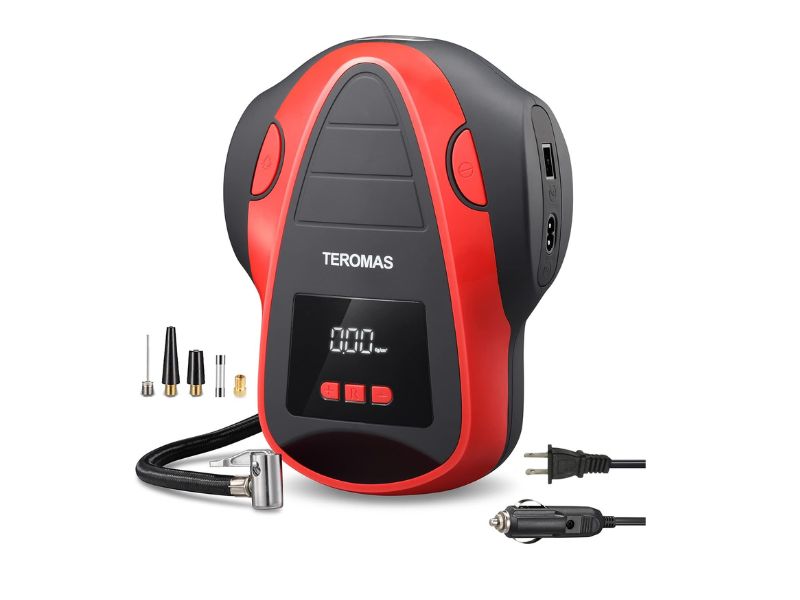
4. TEROMAS TMS-3015 Tire Inflator Portable Air Compressor – Best AC/DC Versatility
Key Features
- 12V DC vehicle operation
- 110V AC household operation
- Up to 150 PSI
- Digital pressure gauge
- Preset inflation
- Automatic shutoff
- LED illumination
- Multiple adapters
The TEROMAS TMS-3015 takes a somewhat different approach from the first three inflators. Its biggest advantage is dual AC/DC power, allowing it to operate from a vehicle’s 12V supply while traveling or a household outlet when working in the garage.
That flexibility can be surprisingly useful. Many drivers primarily check tire pressure at home but still want an inflator they can carry on road trips. A dual-power system avoids the need to run a cord through an open car door or rely exclusively on the vehicle’s accessory outlet when working in the driveway.
The digital system lets you choose your required pressure and provides automatic stopping at the preset level. For routine maintenance, this is far more convenient than an old-fashioned compressor that requires continuous gauge monitoring.
Its pressure rating reaches 150 PSI, but its realistic sweet spot is still passenger vehicles, motorcycles, bicycles, and common inflatables. Drivers needing rapid inflation of large off-road or LT tires should step up to a higher-airflow compressor specifically designed for those applications.
The TEROMAS is slightly less compact than the simplest 12V-only pumps because it contains the hardware and cables required for dual-power operation. That is a reasonable tradeoff if you actually plan to use both power sources.
What I Like
The AC/DC design is the obvious advantage. It can serve as both a garage inflator and a vehicle emergency compressor without requiring a separate adapter.
The digital interface and automatic shutoff also keep operation simple.
What I Do Not Like
Dual-power versatility adds bulk, so it is not my first choice for a driver whose only goal is the smallest trunk inflator possible.
It is also better suited to pressure maintenance and moderate inflation jobs than repeated filling of large-volume truck tires.
Verdict
Choose the TEROMAS TMS-3015 if you want one compact inflator that can operate both at home and on the road. Its versatility makes it particularly useful for households that regularly inflate car tires, bicycle tires, sports equipment, and other items from different locations.
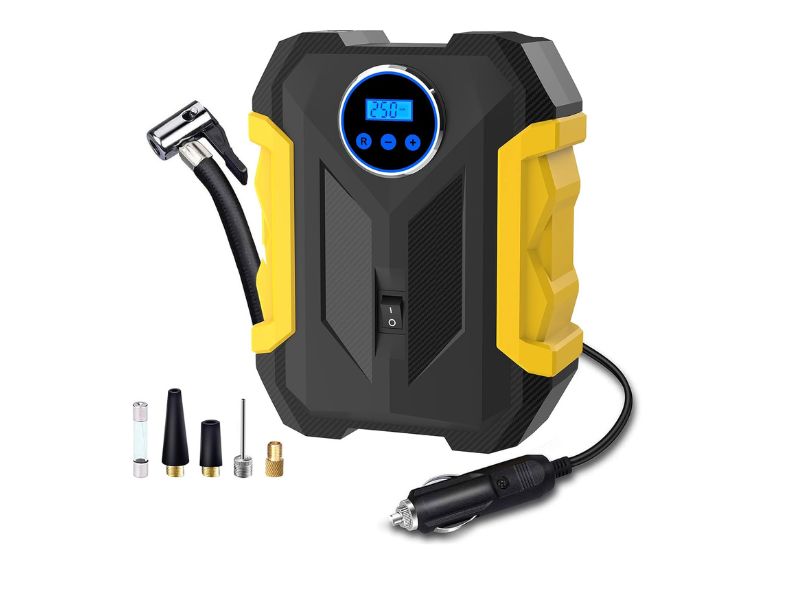
5. CARSUN CAP-001 Digital 12V Tire Inflator – Best Budget 150 PSI Pick
Key Features
- 12V DC corded operation
- Up to 150 PSI
- Approximately 35 L/min airflow
- Digital pressure display
- Automatic shutoff
- Built-in LED light
- Approximately 10-foot power cord
- Multiple inflation nozzles
The CARSUN CAP-001 offers many of the features buyers now expect from a digital 12V compressor without making the design overly complicated.
Its approximately 35 L/min airflow is useful for ordinary passenger-car tire maintenance, while its long power cord gives drivers enough flexibility to move between wheels without constantly repositioning the compressor.
The digital display provides both the current pressure reading and preset controls. Once you select the target pressure, the automatic shutoff system stops inflation when that target is reached.
The integrated light is useful for nighttime roadside stops, and the included nozzles expand the compressor’s usefulness beyond vehicle tires.
CARSUN rates the pump up to 150 PSI, although again, the maximum pressure number should not be treated as a measurement of heavy-duty capability. Tire volume is what makes large truck and off-road tires demanding. A compressor can potentially generate high pressure while still taking a long time to move enough air into a large tire.
For ordinary sedans and crossovers, however, the combination of airflow, preset inflation, and a compact design covers the basic needs well.
What I Like
The CARSUN offers a useful feature set for straightforward tire maintenance. I particularly like the combination of digital controls, automatic shutoff, decent cable reach, and integrated lighting.
Its adapters also increase its usefulness as a general-purpose inflator.
What I Do Not Like
I would keep expectations realistic regarding durability and continuous heavy-duty operation.
This is also not the model I would select for large truck tires, frequent off-road airing up, or other applications where high sustained airflow is essential.
Verdict
The CARSUN CAP-001 makes sense for drivers looking for an affordable digital 12V compressor for ordinary cars, motorcycles, bicycles, and occasional inflatables. It provides the core convenience features without requiring a large compressor.
12V Portable Tire Inflator Comparison
| Product | Power Source | Max Pressure | Approx. Airflow | Digital Gauge | Auto Shutoff | LED Light | Best Use |
| AstroAI AIRUN H | 12V DC | 100 PSI | 35 L/min | Yes | Yes | Yes | Best all-around passenger-car use |
| EPAuto AT-010-1Z | 12V DC | 100 PSI | 1.06 CFM | Yes | Yes | Yes | Routine car and midsize SUV maintenance |
| VacLife VL701 | 12V DC | 150 PSI | Compact-duty | Yes | Yes | Yes | Small cars and convenient trunk storage |
| TEROMAS TMS-3015 | 12V DC / 110V AC | 150 PSI | Compact-duty | Yes | Yes | Yes | Home and roadside versatility |
| CARSUN CAP-001 | 12V DC | 150 PSI | 35 L/min | Yes | Yes | Yes | Budget everyday tire inflation |
The AstroAI AIRUN H provides the strongest overall balance for most passenger-car owners. EPAuto is an excellent alternative if you prefer a well-established traditional design, while VacLife emphasizes compact convenience.
TEROMAS stands apart because of its dual AC/DC capability. CARSUN is worth considering when you want the essential digital features and useful airflow in an inexpensive conventional package.
How to Choose the Best 12V Portable Tire Inflator
A tire inflator looks like a simple product, but several specifications determine whether it will actually be convenient when you need it.
Match the Inflator to Your Tire Size
Start with the vehicle rather than the compressor.
A compact sedan with tires that normally operate near 32–36 PSI places relatively little demand on an inflator. A large pickup with high-volume tires is an entirely different situation.
The amount of air a tire contains is critical. Two compressors may both claim a 150 PSI maximum, yet one may fill a large tire considerably faster because it moves more air per minute.
For standard cars, crossovers, and many midsize SUVs, compact 12V inflators generally work well for routine top-offs.
For large trucks, LT tires, oversized off-road tires, or frequent airing-down and airing-up, look for a dedicated high-flow 12V compressor with battery clamps and a stronger continuous-duty specification.
Do Not Choose Based on Maximum PSI Alone
Maximum PSI is one of the most heavily advertised specifications, but it is often misunderstood.
Most passenger-car tires are nowhere near 100 or 150 PSI during normal use. A typical recommendation may fall somewhere around the 30–40 PSI range, depending on the vehicle.
Because of this, an inflator rated at 150 PSI is not automatically better than one rated at 100 PSI.
For normal automotive use, airflow and duty cycle often matter more.
Pay Attention to Airflow
Airflow may be listed in liters per minute (L/min) or cubic feet per minute (CFM).
Higher airflow generally means the compressor can add a given amount of air more quickly.
However, numbers from different manufacturers may be measured under different conditions. Treat them as useful guidance rather than assuming every published airflow figure is perfectly comparable.
For ordinary tire top-offs, extremely high airflow is unnecessary. The difference becomes much more noticeable when a tire is severely underinflated.
Look for Automatic Shutoff
An automatic shutoff tire inflator is significantly more convenient than a basic compressor.
With an auto-stop system, you select the target pressure before inflation. The compressor measures pressure as it operates and shuts itself off when the selected level is reached.
This reduces constant monitoring and can help prevent accidental overinflation.
You should still verify tire pressure with a good gauge periodically, particularly if precise pressure matters.
Digital Gauge vs. Analog Gauge
Most of the products in this guide use a digital pressure gauge, and I generally prefer digital displays for compact roadside compressors.
A backlit digital display is easier to read at night and often allows you to change between PSI, BAR, and kPa.
Analog gauges have fewer electronics and can be perfectly functional, but tiny analog dials can be difficult to read accurately in poor lighting.
Check the Power Cord Length
A 12V compressor cannot help much if its cord will not reach the tire.
This is particularly relevant for:
- Large sedans
- Crossovers
- SUVs
- Minivans
- Vehicles with only one 12V outlet
Consider where the accessory socket is located and how far the cable must travel to reach each wheel.
A long electrical cord combined with a practical air hose usually provides the easiest setup.
Consider the 12V Outlet’s Fuse Rating
Portable compressors can draw a significant amount of electrical current.
Before plugging in an inflator, check the manufacturer’s current requirements and confirm that your vehicle’s accessory circuit can support the load.
Some inflators may recommend operating with the vehicle engine running. Follow the instructions supplied with the compressor and your vehicle.
A compressor designed for a 12V socket should never be connected to an incompatible power source simply because the plug appears similar.
Understand Duty Cycle and Heat
Small air compressors generate substantial heat.
The duty cycle indicates how long a compressor can safely operate before it requires a cooling period. This specification becomes especially important when inflating multiple tires or starting from very low pressure.
Ignoring the recommended operating time can shorten motor life or activate thermal protection.
If a compressor becomes extremely hot, follow its operating instructions and allow it to cool before continuing.
Decide Whether You Need AC/DC Power
Most drivers only need a 12V connection because the inflator will live inside the vehicle.
However, an AC/DC tire inflator such as the TEROMAS can be useful if you routinely perform pressure checks in a garage.
The household-power option also makes the compressor convenient for bicycle tires, sports balls, and other inflatables without requiring the vehicle to be nearby.
Consider Hose Connection Style
Inflators generally use either a screw-on connector or a lever-style chuck.
A screw-on connector can provide a secure seal and is unlikely to pop off during inflation. The downside is that threading and unthreading it takes slightly longer and can release a small amount of air during removal.
A lever chuck is faster to connect but must fit securely to prevent leakage.
Neither design is automatically superior. Choose whichever is easier for you to use.
Look for Useful Cable Storage
Compactness is not just about the compressor’s dimensions.
Poorly organized cords can turn a small inflator into an awkward bundle inside the trunk. Integrated channels or compartments for storing the power cable, hose, and adapters make a noticeable difference in everyday convenience.
An LED Light Is More Useful Than It Sounds
An emergency tire-pressure problem can occur at night, during rain, or in a poorly lit parking area.
A built-in LED work light helps locate the valve stem and monitor the equipment while keeping both hands available.
It should not replace proper roadside safety equipment, but it is a useful secondary feature.
Why Keep a 12V Tire Inflator in Your Vehicle?
Modern vehicles commonly include a tire pressure monitoring system (TPMS), but TPMS does not put air back into a tire.
A portable compressor lets you respond immediately when a warning appears because of changing temperature or a slow leak.
Correct tire pressure matters for several reasons.
Underinflated tires can produce excess heat, increase rolling resistance, affect steering response, and cause uneven tread wear.
Overinflation can also negatively affect ride quality and tire contact with the road.
A small compressor makes it easier to maintain the pressure specified by the vehicle manufacturer instead of waiting until you find a service station with a working air machine.
12V Corded vs. Cordless Tire Inflators
Cordless inflators have become increasingly popular, but a conventional 12V corded tire inflator still has an important advantage: it does not depend on a small rechargeable battery being charged.
A battery-powered inflator may be more convenient for a quick bicycle or car-tire top-off. However, a device stored in a vehicle for months can lose charge.
A 12V compressor receives power directly from the vehicle, so it can remain ready for long-term emergency storage.
For this reason, I still like corded 12V models as dedicated roadside equipment.
The tradeoff is cable management. Cordless units provide freedom of movement, whereas 12V units require sufficient cord length to reach every wheel.
Can a 12V Tire Inflator Fix a Flat Tire?
A compressor can add air, but it cannot repair most tire damage.
If a tire is simply low because of seasonal temperature changes or a very slow leak, an inflator may restore the correct pressure.
If a nail or other puncture is causing a significant leak, the compressor may provide enough temporary air to reach a safer location only if the tire is still structurally safe and can retain pressure.
A tire with a damaged sidewall, exposed internal structure, severe bead damage, or other serious failure should not simply be reinflated and driven on.
The compressor is a maintenance and emergency-support tool—not a substitute for proper tire repair.
Where to Find the Correct Tire Pressure
Do not use the maximum PSI molded into the tire sidewall as your normal inflation target.
For most passenger vehicles, the recommended cold tire pressure is listed on the driver’s door jamb placard. It may also appear in the owner’s manual.
Front and rear recommendations can differ.
Tires should generally be checked when cold because driving heats the tire and raises internal pressure.
Using the vehicle manufacturer’s recommended pressure gives you a much more useful target than simply inflating every tire to the same arbitrary number.
Safety Tips for Using a Portable Tire Inflator
Park in a secure location away from moving traffic whenever possible.
Check the tire visually before inflation. If you see serious sidewall damage, cords, major cuts, or deformation, simply adding air may not be safe.
Keep the compressor on a stable surface while it operates. Small compressors vibrate and can become hot.
Do not cover ventilation openings.
Avoid touching hot metal components immediately after extended use.
Finally, follow the manufacturer’s recommended maximum continuous operating time. Heat is one of the primary stresses affecting compact compressor motors.
Frequently Asked Questions
What is the best 12V portable tire inflator?
The AstroAI AIRUN H is my best overall choice for most passenger vehicles.
It combines good airflow for its size, a digital pressure gauge, preset inflation, automatic shutoff, an LED light, and compact storage. EPAuto is another strong option for drivers who prefer a proven traditional compressor design.
Is a 12V tire inflator powerful enough for car tires?
Yes, a quality 12V inflator is usually sufficient for normal passenger-car tires.
These compressors are especially effective for topping off tires that are a few PSI below specification. Completely filling a large tire from zero pressure takes much longer and places significantly more thermal load on the compressor.
Can I use a 12V tire inflator on an SUV?
Many compact and midsize SUVs can use a 12V portable inflator effectively.
The important factor is tire size rather than the SUV label itself. Large truck-based SUVs with oversized or LT tires may require a higher-airflow compressor.
Can I use one on truck tires?
Small 12V inflators are generally not ideal for large truck tires.
Some may technically reach the required PSI, but the large air volume can result in extremely long inflation times and excessive heat. A heavy-duty battery-clamp compressor is usually more appropriate.
Is 150 PSI better than 100 PSI?
Not necessarily; maximum pressure does not determine inflation speed.
Most passenger tires operate well below either figure. Airflow, motor strength, cooling, and duty cycle are generally more important for real-world automotive inflation.
How long does a portable tire inflator take?
A routine 5–10 PSI top-off commonly takes only a few minutes with a suitable compressor.
Actual inflation time depends on tire volume, starting pressure, target pressure, airflow, temperature, and the compressor itself. Filling a nearly empty tire takes considerably longer.
Should the car be running while using a 12V inflator?
Follow the inflator and vehicle manufacturer’s instructions for the specific setup.
Many 12V compressors draw substantial current and are intended to operate with adequate vehicle electrical power available. Make sure the accessory circuit can support the compressor’s current requirement.
Are digital tire inflators accurate?
Good digital inflators are accurate enough for routine maintenance, but periodic verification is sensible.
A separate quality tire-pressure gauge can be used to confirm readings occasionally. Even a small gauge difference matters less than consistently driving with severely underinflated tires.
Will an automatic tire inflator stop by itself?
Models with preset automatic shutoff stop when the selected pressure is reached.
You normally enter your desired PSI before starting the compressor. Once the sensor detects the preset pressure, the motor stops automatically.
Can I leave a tire inflator in my car year-round?
Yes, a corded 12V inflator is well suited to permanent vehicle storage.
Store it securely in its case or trunk compartment and protect the cables and hose from damage. Extreme temperatures can affect materials over time, so inspect the unit periodically.
Can a portable inflator inflate bicycle tires?
Yes, provided the valve is compatible directly or through an included adapter.
Always check the bicycle tire’s pressure requirement because road-bike tires can require substantially higher pressure than many car tires.
Why does my tire inflator get hot?
Compression generates heat, and compact pumps have limited cooling capacity.
Heat during operation is normal to a point. Respect the manufacturer’s maximum continuous run time and required cooling interval rather than running the compressor indefinitely.
Should I buy a corded or rechargeable tire inflator?
Choose corded 12V power for dependable vehicle storage and cordless power for maximum convenience.
A corded unit does not rely on remembering to recharge a battery, making it excellent for emergency kits. Cordless inflators are easier to move around but require battery maintenance.
Final Thoughts
For most drivers, the AstroAI AIRUN H Tire Inflator Portable Air Compressor is the strongest all-around choice. It combines the features that matter most in everyday use: manageable size, useful airflow, a clear digital gauge, preset pressure, automatic shutoff, and practical cable reach.
The EPAuto 12V DC Portable Air Compressor Pump is my second choice for drivers who value a proven, straightforward 12V design. The VacLife VL701 is particularly appealing when compact storage is important.
If you want to use the same compressor both beside your car and inside a garage, the TEROMAS TMS-3015 provides useful AC/DC flexibility. The CARSUN CAP-001 rounds out the list as a practical digital option with a strong basic feature set.
Whichever model you choose, match the inflator to your actual tire size rather than focusing exclusively on maximum PSI. For normal passenger cars and routine top-offs, a compact 12V portable tire inflator can be one of the most useful and inexpensive pieces of emergency equipment you keep in the vehicle.