If I wanted one compact rechargeable inflator to keep in a car, I would start with the Airmoto Tire Inflator Portable Air Compressor. Its USB-C charging, digital pressure control, automatic shutoff, and compact handheld design make it particularly convenient for routine tire top-offs and roadside use.
The AstroAI L7 Tire Inflator Portable Air Compressor is my next choice for buyers who want a smaller 150 PSI unit with a clear digital interface, several preset modes, and a rechargeable battery.
I also like the Woowind LP1 Tire Inflator Portable Air Compressor for drivers and cyclists who want a straightforward USB-C rechargeable pump with automatic pressure control and broad valve compatibility.
A USB tire inflator eliminates one of the biggest inconveniences of traditional portable air compressors: having to route a 12V power cable through your vehicle every time a tire needs a few extra PSI. Charge the pump beforehand, place it near the tire, set the pressure, and start inflation.
The tradeoff is battery capacity. Small rechargeable pumps are excellent for pressure corrections, bicycles, motorcycles, sports balls, and emergency car-tire top-offs, but they are not substitutes for high-output compressors designed for repeatedly filling large truck or off-road tires from completely flat.
The five models below stand out for their combination of portable size, rechargeable operation, automatic shutoff, useful pressure ranges, digital gauges, and established buyer feedback.
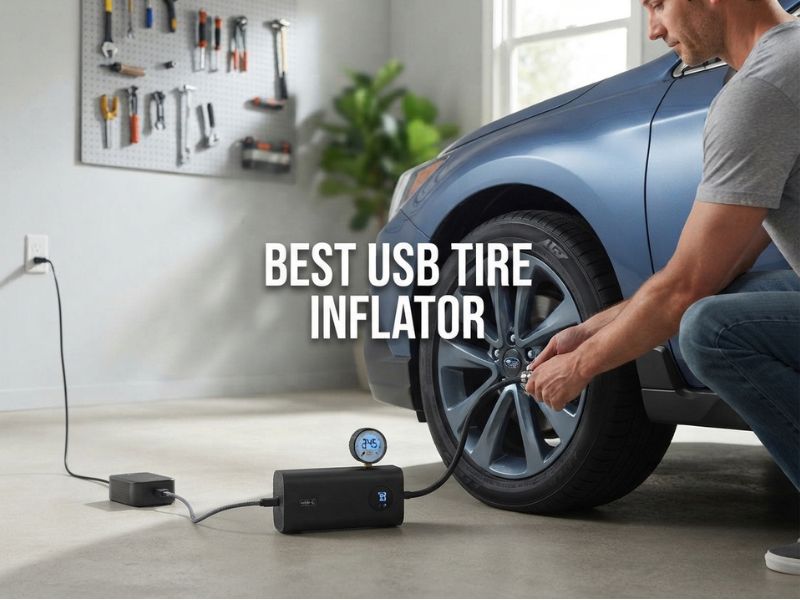
5 Best USB Tire Inflator: Cordless Picks for Roadside Use
| Image | Product Name | Check Price |
|---|---|---|
Best Choice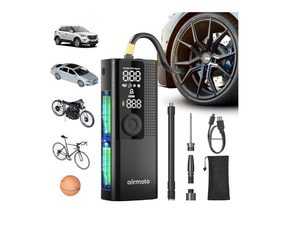 | Airmoto Tire Inflator Portable Air Compressor – Best Overall | Check Price |
Second Best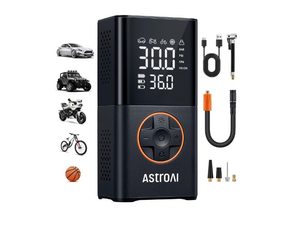 | AstroAI L7 Tire Inflator Portable Air Compressor | Check Price |
Third Choice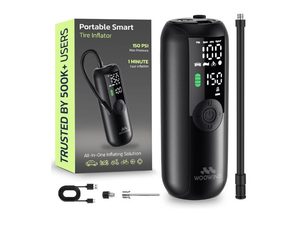 | Woowind LP1 Tire Inflator Portable Air Compressor | Check Price |
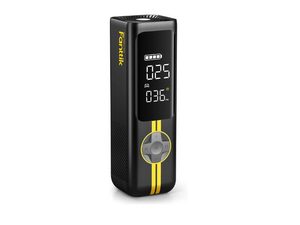 | Fanttik X8 APEX Tire Inflator Portable Air Compressor | Check Price |
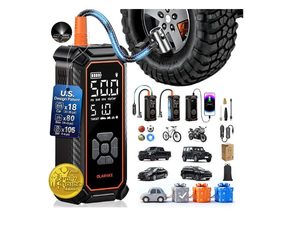 | OlarHike Tire Inflator Portable Air Compressor 6000mAh | Check Price |
1. Airmoto Tire Inflator Portable Air Compressor – Best Overall
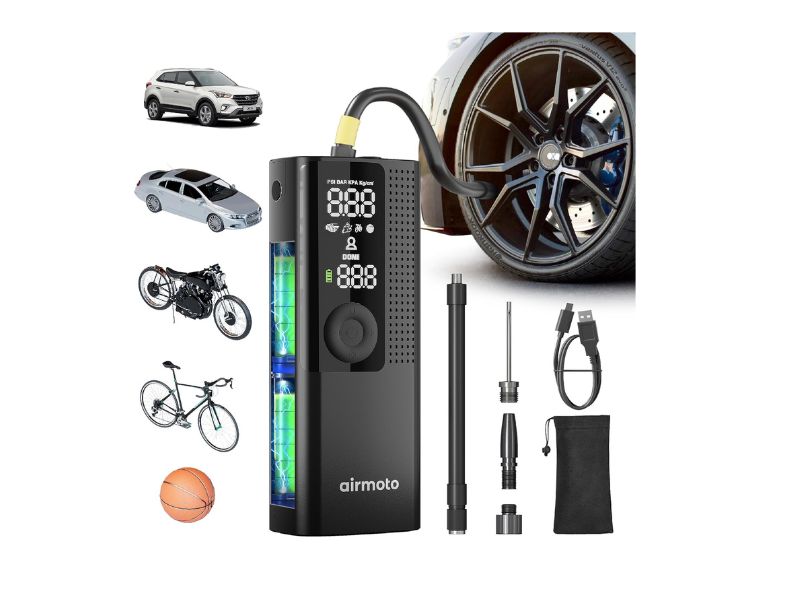
Key Features
- USB-C rechargeable battery
- Up to 120 PSI
- Digital pressure gauge
- Automatic shutoff
- Multiple pressure units
- Built-in LED light
- Schrader, Presta, needle, and general-purpose adapters
- Compact handheld design
- Storage pouch included
Detailed Review
The Airmoto is my top recommendation because it focuses on exactly what most people want from a USB tire pump: small size, cordless operation, simple controls, and enough pressure capability for common car and bicycle tires.
Its rechargeable battery means there is no electrical cable running from the dashboard to the wheel. Charge the unit through USB-C, store it in the vehicle, and take it directly to whichever tire needs attention. Airmoto specifies up to 120 PSI, a 2000mAh battery, automatic shutoff, a digital interface, LED lighting, and several adapters.
Operation is straightforward. Attach the hose, select the appropriate mode or pressure unit, set your target PSI, and start the pump. Once the preset pressure is reached, it stops automatically.
That feature is especially useful for routine maintenance. If a tire that normally requires 35 PSI has fallen to 30 or 31 PSI, you can program the desired pressure rather than repeatedly stopping to check it with another gauge.
Portability is another major advantage. At roughly the size of a large handheld device, the Airmoto can fit into a glove compartment, center-console storage area, emergency bag, or motorcycle luggage more easily than a conventional rectangular compressor.
The integrated LED light is useful when locating a valve stem beside the road after dark. Multiple included valve adapters also make the unit useful for motorcycles, bicycles, sports balls, and several other inflatables.
Its limitation is airflow. Small battery-powered compressors prioritize portability rather than high-volume performance. Filling a severely deflated large SUV tire will take considerably longer and consume much more battery than adding several PSI to a normal passenger-car tire.
What I Like
I like the compact USB-C design most. It is easy to charge using equipment many drivers already carry and small enough to keep in a vehicle permanently.
Automatic shutoff and digital pressure selection also make it approachable for someone who does not regularly use air compressors.
What I Do Not Like
The 120 PSI rating is adequate for most intended applications but lower than the 150 PSI maximum offered by several competing models.
Its small battery and compact compressor are also better suited to pressure corrections than repeated full-tire inflation.
Verdict
The Airmoto is the best USB tire inflator for most everyday drivers in this lineup. It is particularly attractive if portability, uncomplicated controls, and USB-C charging matter more than maximum compressor output.
2. AstroAI L7 Tire Inflator Portable Air Compressor – Best Compact Value
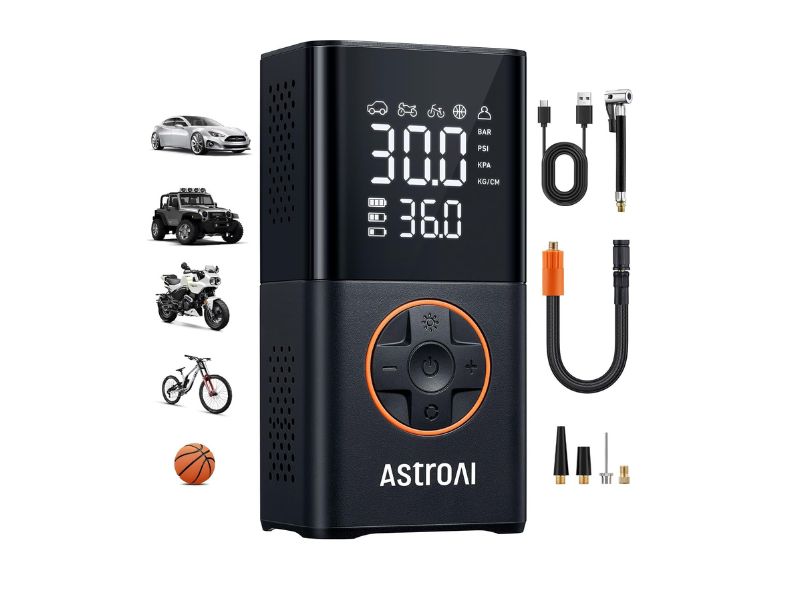
Key Features
- Rechargeable cordless operation
- USB charging
- 150 PSI maximum pressure
- Digital dual-value display
- Automatic shutoff
- Multiple inflation modes
- Multiple pressure units
- LED emergency light
- Compact handheld housing
- Multiple nozzle adapters
Detailed Review
The AstroAI L7 is one of the strongest alternatives if you want a small rechargeable compressor with a higher advertised pressure ceiling.
Its maximum pressure is 150 PSI, and the pump incorporates a digital pressure display, preset pressure control, automatic shutoff, LED lighting, and several adapters. AstroAI also positions the L7 primarily for cars, motorcycles, bicycles, and sports equipment rather than heavy-duty truck tires.
The dual-value display is useful because you can see current pressure and your preset target without repeatedly switching screens.
That becomes helpful when adjusting multiple tires. You can quickly see that a tire currently sits at, for example, 29 PSI while your programmed target remains at 35 PSI.
It supports common measurement units including PSI, BAR, KPA, and kg/cm², giving it flexibility for equipment marked using different standards.
I particularly like the size-to-function balance. Some cordless compressors become surprisingly bulky after manufacturers add large batteries and cooling systems. The L7 remains more suitable for glove-box or backpack storage.
The built-in light provides additional utility during roadside stops, while its nozzle accessories extend use to bicycles and sports equipment.
AstroAI’s design is still a compact battery-powered compressor, however. A 150 PSI maximum does not mean it can fill a large-volume tire as quickly as a larger compressor. Maximum pressure and airflow are different specifications.
What I Like
The L7 combines 150 PSI capability, automatic shutoff, compact dimensions, digital pressure monitoring, and cordless operation without becoming unnecessarily complicated.
I also like the clear separation between current and target pressure.
What I Do Not Like
It is not designed for heavy-duty off-road, trailer, or commercial truck tires.
Long inflation sessions will also generate heat, as they do with most miniature compressors.
Verdict
The AstroAI L7 is the best choice here for buyers seeking a compact USB rechargeable tire inflator at a practical size while still getting 150 PSI capability and modern digital controls.
3. Woowind LP1 Tire Inflator Portable Air Compressor – Best for Cars and Bikes
Key Features
- USB-C rechargeable
- 4000mAh battery
- Up to 150 PSI
- Approximately 15–18 L/min rated airflow
- Automatic shutoff
- Digital pressure gauge
- LED light
- Schrader adapter
- Presta adapter
- Dunlop adapter
- Sports-ball and inflatable accessories
Detailed Review
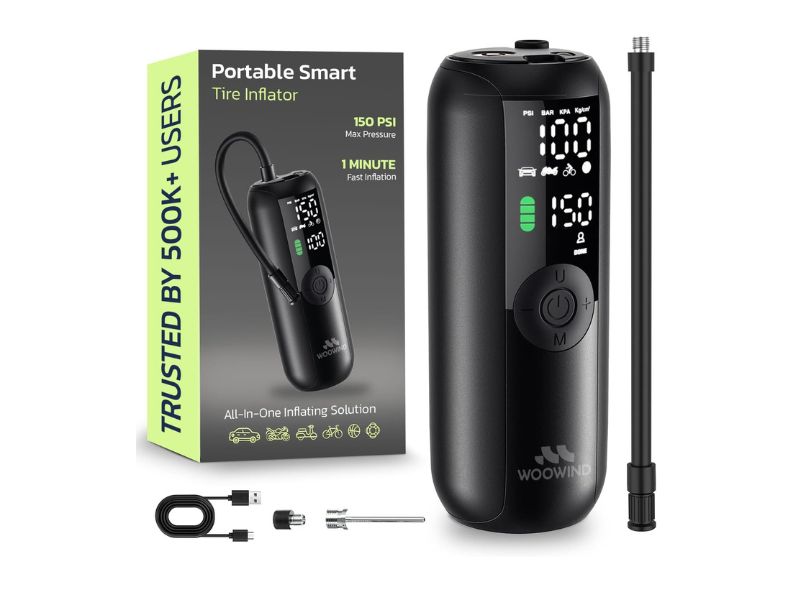
The Woowind LP1 is particularly appealing if one rechargeable pump needs to serve both your car and bicycles.
Woowind specifies a 4000mAh battery, USB-C recharging, 150 PSI maximum pressure, automatic shutoff, an integrated light, and approximately 15–18 L/min inflation performance. It also provides several valve adapters, including support for Schrader, Presta, and Dunlop applications.
That valve support matters for cyclists. Most passenger vehicles in the United States use Schrader valves, while many road and performance bicycles use Presta valves.
With the appropriate adapter already stored with the pump, you do not need separate equipment for each type.
Automatic pressure control operates much like the other smart pumps in this guide. Enter the required pressure and let the compressor stop when that target is achieved.
This makes the LP1 considerably easier to use than basic portable compressors equipped only with analog gauges.
The 4000mAh battery is also a useful compromise. It gives the LP1 more battery capacity than several ultra-small designs without turning it into an especially bulky power-tool-style compressor.
For cyclists, e-bike owners, motorcycle riders, and passenger-car drivers who regularly switch between different inflation tasks, this versatility is the strongest selling point.
What I Like
I like the LP1’s broad valve compatibility and USB-C charging.
The combination of 150 PSI capability, automatic shutoff, digital pressure monitoring, and several included adapters makes it particularly versatile.
What I Do Not Like
The compact compressor is not intended to compete with a high-flow shop compressor or dedicated heavy-duty truck inflator.
The pump and hose can also become warm during extended operation, so normal compressor cooling precautions still apply.
Verdict
Choose the Woowind LP1 if you regularly maintain car, motorcycle, and bicycle tires and want one portable rechargeable pump that can move easily between them.
4. Fanttik X8 APEX Tire Inflator Portable Air Compressor – Best Premium Pick
Key Features
- USB-C input
- 150 PSI maximum pressure
- Large dual digital display
- Automatic shutoff
- Four preset inflation modes
- Approximately 28.86Wh battery
- Long flexible air hose
- Built-in LED light
- USB-A output for emergency device charging
- Storage accessories
Detailed Review
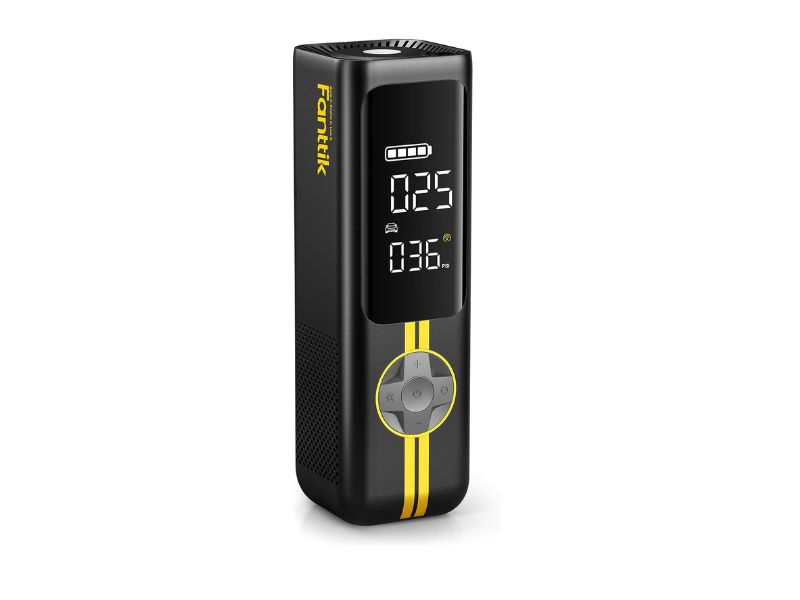
The Fanttik X8 APEX feels more premium than most small cordless pumps. Its rectangular handheld housing, larger digital display, long hose, and substantial internal battery make it better suited to buyers who expect to use their inflator regularly rather than only during emergencies.
Fanttik specifies 150 PSI maximum pressure, USB-C input, automatic pressure shutoff, multiple preset modes, an 18.11-inch hose, LED lighting, and USB-A power output. The latter allows the internal battery to serve as an emergency power source for compatible devices.
Its large display is one of my favorite features. Small low-cost pumps sometimes squeeze pressure information, battery status, and settings onto a tiny screen. The X8 APEX provides more visual space for current and target pressure values.
Its longer hose also makes positioning the compressor easier. You can place the unit securely beside the wheel rather than forcing the body of the pump into an awkward position near the valve stem.
USB-C charging fits perfectly with the purpose of this guide. You can recharge it using a compatible USB-C power source rather than carrying a proprietary charger.
The power-bank function adds extra emergency value. I would not purchase an inflator solely to charge a phone, but having the option can be useful during a roadside situation.
The main tradeoff is size and weight. The Fanttik is portable, but it is not as minimal as the smallest handheld alternatives.
What I Like
The larger battery, long hose, dual display, USB-C input, and power-bank function make the X8 APEX feel well developed for frequent use.
I also like its combination of automatic shutoff and clearly presented inflation modes.
What I Do Not Like
It occupies more storage space than ultra-compact pumps.
Buyers who only occasionally add two or three PSI to a car tire may not need all of its additional features.
Verdict
The Fanttik X8 APEX is my premium USB tire inflator recommendation. It makes the most sense when display quality, hose length, battery capacity, and overall convenience matter more than minimizing size.
5. OlarHike Tire Inflator Portable Air Compressor 6000mAh – Best Dual-Power Pick
Key Features
- USB-C rechargeable
- 6000mAh internal battery
- Backup 12V DC vehicle power
- Up to 150 PSI
- Digital pressure display
- Automatic shutoff
- Four preset modes
- Multiple pressure units
- Built-in LED light
- Long air hose
- Storage bag and adapters
Detailed Review
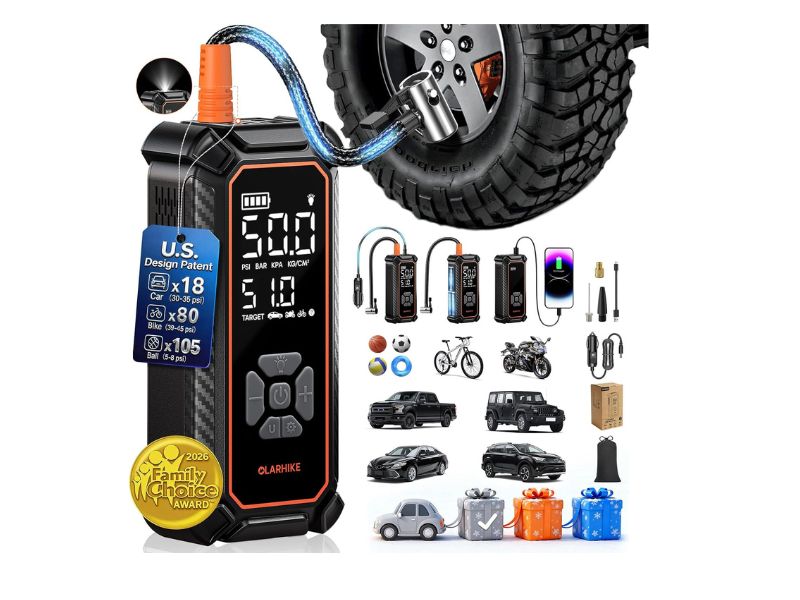
The OlarHike earns its place because it solves one of the most important weaknesses of cordless tire inflators: what happens when the battery is empty?
The 6000mAh version combines rechargeable cordless operation with the ability to connect to a 12V vehicle outlet. OlarHike specifies USB-C charging, automatic shutoff, multiple preset modes, digital pressure monitoring, an LED light, and both battery and vehicle-powered operation.
That dual-power configuration provides useful redundancy.
For everyday maintenance, use it cordlessly. If you forgot to recharge it before a road trip and need air urgently, the 12V cable gives you another way to operate the compressor.
That makes the OlarHike especially interesting as a permanent road-trip emergency inflator.
The 6000mAh battery is also considerably larger than the cells found in several tiny handheld models. Battery capacity alone does not determine how many tires a compressor can service—motor load, pressure, tire size, temperature, and efficiency all matter—but additional capacity is valuable for repeated top-offs.
Its digital display lets you monitor current and target pressure, while preset modes simplify common inflation tasks.
The drawback is predictable: battery capacity and dual-power hardware add bulk. This is more of a compact trunk tool than a minimalist glove-box pump.
What I Like
The combination of USB-C charging and 12V backup power is its strongest advantage.
I also like the larger rechargeable battery, preset modes, automatic shutoff, LED light, and travel-oriented accessory package.
What I Do Not Like
It is larger than the Airmoto and AstroAI L7.
If maximum compactness is the goal, one of the smaller battery-only pumps is easier to store.
Verdict
The OlarHike is the best option in this group for buyers who want cordless convenience without depending completely on the internal battery.
Best USB Tire Inflator Comparison
| Product | Max Pressure | Recharge Method | Battery | Auto Shutoff | Digital Gauge | Backup 12V Power | LED Light | Best For |
| Airmoto Tire Inflator | 120 PSI | USB-C | 2000mAh | Yes | Yes | No | Yes | Compact everyday car use |
| AstroAI L7 | 150 PSI | USB | Rechargeable | Yes | Yes | No | Yes | Small size and value |
| Woowind LP1 | 150 PSI | USB-C | 4000mAh | Yes | Yes | No | Yes | Cars and bicycles |
| Fanttik X8 APEX | 150 PSI | USB-C | 28.86Wh | Yes | Yes | No | Yes | Premium frequent use |
| OlarHike 6000mAh | 150 PSI | USB-C | 6000mAh | Yes | Yes | Yes | Yes | Road trips and backup power |
The Airmoto is the easiest overall recommendation when compact storage is the priority. AstroAI provides a strong value-oriented alternative with a higher maximum pressure rating, while Woowind offers particularly good versatility for car and bicycle owners.
Fanttik is the more premium choice, especially if you value a larger display, long hose, and power-bank capability.
OlarHike has the most useful power redundancy because it can operate from its rechargeable battery or a vehicle’s 12V electrical outlet.
How to Choose the Best USB Tire Inflator
USB-C Charging Is Usually the Better Choice
If you are buying a rechargeable inflator today, USB-C is preferable to older proprietary charging systems.
It allows you to share cables and compatible charging equipment with phones, tablets, laptops, power banks, and other electronics.
That becomes particularly useful during travel because you have fewer dedicated accessories to remember.
USB-C does not automatically mean fast charging, however. The inflator’s charging circuitry determines how much power it can accept.
Consider Battery Capacity
Battery capacity affects how much inflation work the compressor can perform before needing another charge.
Small batteries help keep an inflator lightweight and compact.
Larger batteries improve operating endurance but add size and weight.
If you mainly correct tire pressure by three to five PSI, a small pump can be perfectly adequate.
If you maintain several vehicles or frequently inflate larger tires, choosing a larger battery or dual-power inflator is more sensible.
Maximum PSI Is Not Inflation Speed
A common mistake is assuming that a 150 PSI compressor must inflate car tires faster than a 120 PSI compressor.
That is not necessarily true.
Maximum pressure measures pressure capability, while airflow indicates how quickly air can be moved.
Most passenger vehicles operate at pressures far below 120 PSI anyway.
For ordinary car tires, usable airflow, cooling capability, battery capacity, and hose design often matter more than the maximum PSI printed on the specification sheet.
Automatic Shutoff Is Extremely Useful
A preset pressure system lets you enter your desired PSI before inflation begins.
The pump monitors pressure and shuts itself off at the target.
This makes tire maintenance easier and reduces the likelihood of accidentally adding excessive pressure.
You still need to enter the correct target pressure.
Check Your Vehicle’s Correct Tire Pressure
The appropriate pressure for your car is normally listed on a placard inside the driver’s door area.
It may also appear in the owner’s manual.
Do not automatically use the maximum pressure molded onto the tire sidewall as your target.
The vehicle manufacturer’s recommended cold tire pressure is generally the correct reference for normal driving.
Consider Hose Length
Hose length affects how comfortably you can position the compressor.
A very short hose can force a larger pump to hang awkwardly beside the valve.
Longer flexible hoses let you place the compressor on stable ground while it operates.
This becomes more important with larger and heavier portable inflators.
Check Valve Compatibility
Most cars use Schrader valves, but bicycles vary.
Road bikes commonly use Presta valves, while other bicycles may use Schrader or Dunlop systems.
If you plan to use one pump for several types of tires, choose a model that includes the appropriate adapters.
Look for a Clear Pressure Display
A good digital display should make two pieces of information easy to identify:
Current tire pressure and target pressure.
A bright screen becomes especially valuable at night or in bright sunlight where tiny displays can be difficult to read.
Multiple selectable pressure units are also convenient.
PSI is common in the United States, while BAR and KPA are frequently used elsewhere.
Think About Emergency Lighting
An integrated LED light is not the most important compressor feature, but it is genuinely useful during roadside inflation.
A tire may lose pressure at night, in a parking garage, or on an unlit road.
Having illumination directed near the tire can make locating and connecting the valve much easier.
I would still keep a dedicated flashlight in a roadside emergency kit, but built-in lighting is worthwhile.
USB Tire Inflator vs. 12V Tire Inflator
A USB rechargeable inflator wins on convenience.
There is no long power cord to route around your car, and you can use the compressor away from the vehicle. This makes rechargeable pumps particularly suitable for bicycles, motorcycles, and home use.
A traditional 12V inflator wins on continuous access to power.
As long as the vehicle’s electrical system and outlet are functioning, there is no small internal battery that needs to be charged before use.
For emergency-only storage, this is an important advantage.
The ideal compromise is a dual-power design such as the OlarHike, which provides battery operation for convenience and 12V capability as a backup.
USB Tire Inflator vs. Cordless Tool-Battery Inflator
Larger cordless inflators frequently use removable batteries from power-tool ecosystems.
These compressors can offer greater output and longer working times, making them attractive for garages, large SUVs, trucks, and users who already own compatible batteries.
USB inflators emphasize portability instead.
They require no bulky external battery pack and are easier to store in a glove box, backpack, motorcycle case, or small emergency kit.
For ordinary passenger-car pressure adjustments, a USB rechargeable pump is often more convenient.
For repeated high-volume inflation, a larger tool-battery compressor can be the better choice.
When a Small USB Inflator Is Not Enough
Compact rechargeable pumps have practical limits.
If you regularly inflate oversized off-road tires, large pickup tires, RV tires, commercial vehicle tires, or several completely flat tires consecutively, consider a more powerful compressor.
Large tires contain substantially more air.
A miniature compressor may eventually reach the required pressure, but doing so can require long operating periods that generate excessive heat and drain the battery.
USB inflators are at their best as portable pressure-maintenance and emergency tools.
Tire Inflator Safety and Maintenance Tips
Check pressure when the tires are cold whenever practical. Tire pressure increases as tires heat during driving.
Allow a compact compressor to cool if it becomes excessively hot during prolonged operation.
Keep the hose away from hot vehicle components and moving parts.
Recharge a battery-powered inflator periodically instead of leaving it completely discharged for months.
Inspect the hose and valve connector occasionally for cracks, wear, or damaged threads.
If a tire repeatedly loses pressure, have the tire inspected. An inflator can restore air pressure, but it cannot repair a puncture, damaged valve, leaking wheel, or structural tire problem.
Frequently Asked Questions
What is the best USB tire inflator?
The Airmoto Tire Inflator is my top USB rechargeable pick for most drivers.
It combines USB-C charging, automatic shutoff, digital pressure monitoring, LED lighting, and a compact handheld body that is particularly easy to keep inside a passenger vehicle.
AstroAI L7 is another strong choice if you want 150 PSI capability in a compact format.
Can a USB tire inflator inflate a car tire?
Yes, a suitable USB rechargeable inflator can inflate and top off normal passenger-car tires.
Performance depends on tire volume, starting pressure, target pressure, compressor airflow, and remaining battery charge.
These pumps are particularly effective when correcting moderate pressure loss rather than repeatedly filling large tires from zero PSI.
Can I inflate a completely flat tire with a USB air pump?
It may be possible, but a completely flat tire creates a much more demanding inflation job.
The compressor has to move considerably more air, increasing inflation time, battery consumption, and heat.
If the tire is damaged, has separated from the rim, or cannot hold pressure, inflating it will not solve the underlying problem.
Is 120 PSI enough for car tires?
Yes, 120 PSI is comfortably above the normal operating pressure of most passenger-car tires.
Most cars require far less pressure than 120 PSI.
Always follow the vehicle manufacturer’s recommended cold pressure rather than selecting an inflator solely because it advertises the highest maximum PSI.
Is 150 PSI better than 120 PSI?
Not necessarily for normal car-tire inflation.
Both pressure ratings exceed the normal requirements of typical passenger cars.
A compressor with better airflow and thermal management can inflate a car tire faster even if its maximum pressure rating is lower.
How often should I charge a USB tire inflator?
Check and recharge it periodically, especially before long trips.
Lithium-ion batteries gradually lose charge during storage.
If the inflator remains in your vehicle for emergency use, checking its battery every few months helps ensure it is ready when needed.
Can I leave a rechargeable tire inflator in my car?
Generally yes, but avoid prolonged exposure to extreme temperatures whenever possible.
Lithium-ion batteries perform best when they are not repeatedly exposed to excessive heat or extreme cold.
Follow the manufacturer’s storage guidance and periodically inspect the battery condition.
Will a USB tire inflator work on an SUV?
Many will work for ordinary crossover and SUV tire top-offs.
Larger tires contain more air, however, so inflation takes longer and consumes more battery power.
Full-size SUVs, heavy-duty pickups, and oversized off-road tires may be better served by a higher-output compressor.
Can USB tire inflators charge a phone?
Some models provide USB power output, but not all do.
The Fanttik X8 APEX, for example, includes power-output capability in addition to its charging input.
Treat this mainly as an emergency feature because using the inflator’s battery to charge other devices leaves less stored energy available for tire inflation.
Do rechargeable tire inflators automatically stop?
Many modern models include automatic shutoff, including all five picks in this guide.
You enter the desired pressure before starting.
The compressor monitors the tire and stops when the selected pressure is reached.
Are digital tire inflator gauges accurate?
Quality digital gauges are generally suitable for routine tire-pressure maintenance.
Minor differences can occur between gauges.
If pressure accuracy is especially important, compare the inflator’s reading occasionally with a reliable standalone tire-pressure gauge.
Can a USB inflator fix a tire puncture?
No. A tire inflator only restores air pressure.
A puncture, leaking valve stem, damaged wheel, or compromised tire still requires proper repair or replacement.
Continuously adding air to a leaking tire should not be treated as a permanent solution.
Final Thoughts
The Airmoto Tire Inflator Portable Air Compressor is my first choice for most people looking for the best USB tire inflator. Its compact dimensions, USB-C charging, automatic shutoff, straightforward pressure controls, and convenient storage make it particularly suitable for everyday passenger vehicles.
The AstroAI L7 Tire Inflator Portable Air Compressor is the next model I would consider if you want an exceptionally compact 150 PSI cordless pump.
The Woowind LP1 Tire Inflator is a particularly useful choice for households that need to maintain cars and bicycles with the same device.
The Fanttik X8 APEX provides the most premium overall experience here, with a larger battery system, long hose, clear display, and emergency power-output capability.
Finally, the OlarHike 6000mAh Tire Inflator is the smartest choice for power redundancy because it combines cordless USB-C rechargeable operation with a 12V vehicle-power backup.
For a typical driver who wants something small enough to keep close at hand and simple enough to use whenever the TPMS light appears, I would choose the Airmoto Tire Inflator Portable Air Compressor first.