A portable jump starter is designed to provide emergency starting power when your car battery does not have enough energy to crank the engine. However, the jump starter itself needs to be charged before you can depend on it during a roadside emergency.
Understanding how to charge a portable jump starter is important because different models use different charging methods. Some can be charged through a wall outlet with an AC adapter, while others use USB-C, a traditional USB cable, or a vehicle’s 12-volt power outlet. Charging time can also vary considerably depending on the battery capacity, charger output, and condition of the jump starter.
The good news is that charging a portable jump starter is usually straightforward. You connect the correct charging cable or adapter to the designated input port, plug it into an appropriate power source, and allow the internal battery to charge until the indicator shows that it is full.
This guide explains the different ways to charge a portable jump starter, how long charging usually takes, how to know when it is fully charged, whether you can charge it from your car, and how to store and maintain it so it is ready when you need it.
How to Charge a Portable Jump Starter
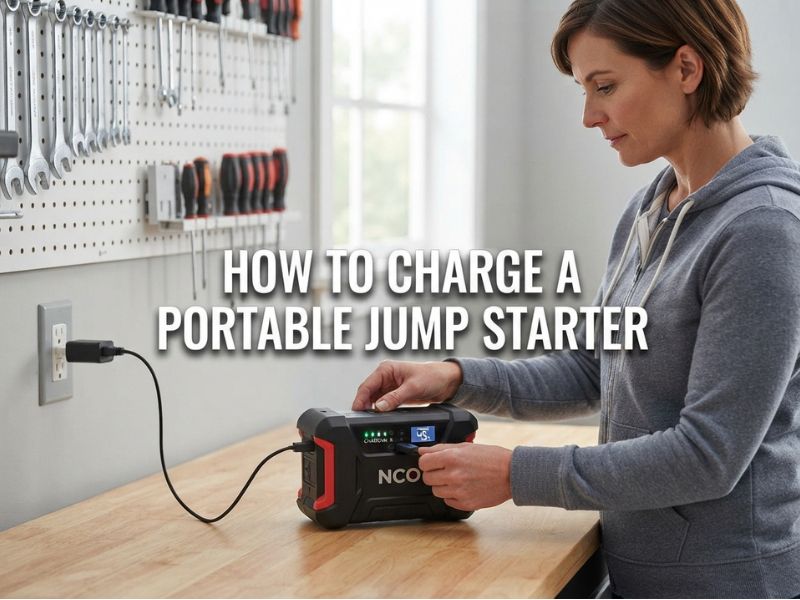
The exact charging procedure depends on the model, but the general process is similar for most modern portable jump starters.
First, locate the jump starter’s charging input port. Do not confuse the input port with USB output ports that are designed to charge phones and other devices.
Connect the supplied charging cable or compatible charger to the input port. Then connect the other end to the appropriate power source.
Turn on the power source if necessary and check the jump starter’s charging indicator.
Many devices display the charging level using LED lights, while newer models may have a digital display showing a percentage.
Allow the jump starter to charge until it reaches the manufacturer’s recommended full-charge level.
Once charging is complete, disconnect the charger from the power source and then disconnect the cable from the jump starter.
The basic process is:
- Locate the correct charging input.
- Use the recommended charging cable or adapter.
- Connect the charger to a suitable power source.
- Check the charging indicator.
- Allow the battery to reach full charge.
- Disconnect the charger when charging is complete.
- Store the jump starter in a suitable location.
Always check the owner’s manual because the charging method, voltage, and recommended charging time can vary between models.
What Type of Charger Does a Portable Jump Starter Use?
Portable jump starters can use several different charging systems.
The most common options include AC wall charging, USB charging, USB-C charging, and 12-volt vehicle charging.
The charging method depends on the design of the jump starter.
Older or higher-capacity models may include a dedicated AC charging adapter. Newer compact jump starters increasingly use USB-C because it is convenient and widely available.
Some jump starters can also be charged from a vehicle’s 12V accessory socket, although this may be slower than charging from a wall outlet.
Before using any charger, verify the manufacturer’s specifications. A charging cable may physically fit a port without being electrically appropriate for the device.
Charging a Portable Jump Starter With an AC Adapter
An AC wall adapter is one of the most straightforward ways to charge a portable jump starter.
If your jump starter came with an AC charger, connect the charging connector to the designated input port on the device.
Plug the adapter into a standard wall outlet.
The jump starter should indicate that charging has started.
Depending on the model, you may see:
- Flashing LED indicators
- A percentage display
- A battery icon
- A charging symbol
- A changing battery-level indicator
Leave the jump starter connected until the manufacturer indicates that the battery is fully charged.
Once it reaches full capacity, disconnect the charger.
Do not substitute an unknown power adapter simply because the connector appears to fit. The adapter’s output voltage, current, and connector specifications need to be compatible with the jump starter.
Charging a Portable Jump Starter With USB
Many compact jump starters can be charged through a standard USB connection.
The jump starter may have a Micro-USB, USB-A, or USB-C charging input depending on its age and design.
Connect the appropriate cable to the charging input and connect the other end to a compatible USB power source.
Possible USB power sources include:
- USB wall charger
- Computer USB port
- USB power adapter
- Vehicle USB port
- Power bank
However, the available charging power can differ significantly between these sources.
A computer USB port may provide less power than a dedicated wall charger, which means charging can take substantially longer.
For the fastest compatible charging method, use the charger and cable recommended by the manufacturer.
Charging a Portable Jump Starter With USB-C
USB-C charging has become increasingly common in modern portable jump starters.
USB-C offers several advantages because it is widely available and can support higher power levels than older USB charging standards.
If your jump starter supports USB-C input, connect a compatible USB-C cable to the charging port.
Then connect the cable to a suitable USB-C power adapter.
The charging speed depends on the capabilities of both the jump starter and the power adapter.
A high-wattage USB-C charger does not necessarily mean the jump starter will charge at that same wattage. The jump starter’s internal charging circuit determines how much power it can accept.
Therefore, using a very powerful USB-C charger does not automatically make the device charge faster.
Can You Charge a Portable Jump Starter in a Car?
Yes, some portable jump starters can be charged from a vehicle.
A jump starter may include a 12V charging cable designed to connect to the vehicle’s cigarette lighter or accessory power outlet.
This can be useful when traveling because you can recharge the device after using it without needing access to a wall outlet.
However, charging from a vehicle can be slower than charging from an appropriate AC or USB-C power adapter.
There is another important consideration: if you are charging the jump starter from the vehicle’s 12V outlet while the engine is off, you are drawing energy from the vehicle’s battery.
If the jump starter requires a long charging period, this could unnecessarily discharge the vehicle battery.
For this reason, if the vehicle is running and the manufacturer’s instructions permit it, charging from the vehicle’s charging system may be more practical.
Always follow the jump starter manufacturer’s instructions for 12V charging.
How Long Does It Take to Charge a Portable Jump Starter?
Charging time varies from one portable jump starter to another.
A small compact jump starter may charge in several hours, while a larger high-capacity unit can require considerably longer.
The main factors affecting charging time include:
- Battery capacity
- Battery state of charge
- Charger output
- Charging technology
- USB versus AC charging
- Ambient temperature
- Battery age
- Internal charging circuitry
For example, a jump starter with a large lithium-ion battery may require more energy to reach full charge than a smaller emergency starter.
Likewise, charging a jump starter through a low-power USB port may take significantly longer than using its recommended wall charger.
The manufacturer’s specified charging time is the best reference for your particular device.
How Do You Know When a Portable Jump Starter Is Fully Charged?
Most portable jump starters have some type of battery indicator.
On simpler models, several LED lights may represent different battery levels.
For example, the indicators may progressively illuminate as the battery charges.
Some newer devices use an LCD screen that displays the battery percentage.
A fully charged jump starter may show:
- 100% battery level
- All battery indicator lights illuminated
- A solid full-battery icon
- A charging indicator that stops flashing
The exact meaning varies between manufacturers.
Do not assume that every jump starter uses the same indicator system. Check the manual to understand what the lights or display mean.
Should You Charge a Portable Jump Starter Before First Use?
Yes.
If you purchase a new portable jump starter, it is generally a good idea to fully charge it before relying on it.
Although some manufacturers ship devices with a partial charge, that does not mean the jump starter is ready for maximum emergency performance.
Charging it fully gives you the greatest available energy reserve.
After the initial charge, follow the manufacturer’s recommendations for maintaining the battery during storage.
Should a Portable Jump Starter Be Fully Charged?
For emergency preparedness, keeping a portable jump starter adequately charged is important.
A jump starter with a low battery may not have enough energy to provide multiple starting attempts.
If you keep the device in your vehicle as an emergency battery booster, periodically check its charge level.
This is especially important if the jump starter has not been used for several months.
Some models have relatively low standby power consumption, while others may gradually lose charge over time.
A quick battery check every few months can help ensure that the device is ready when needed.
Can You Overcharge a Portable Jump Starter?
Modern portable jump starters generally contain an internal battery management system (BMS) and charging circuitry designed to control the charging process.
These systems can provide protections such as:
- Overcharge protection
- Over-current protection
- Short-circuit protection
- Over-temperature protection
- Over-voltage protection
However, this does not mean you should ignore the manufacturer’s charging instructions.
Use the recommended charger or a charger that meets the specifications stated by the manufacturer.
Avoid using damaged chargers or cables.
If the jump starter becomes unusually hot, produces an unusual smell, swells, or behaves abnormally during charging, disconnect it from the power source and stop using it.
Can You Leave a Portable Jump Starter Plugged In Overnight?
Whether you can leave a jump starter charging overnight depends on the manufacturer’s instructions.
Many modern devices are designed to regulate charging automatically, but manufacturers may still recommend disconnecting the device once it reaches full charge.
If the manual specifies a maximum charging time, follow it.
For routine charging, there is little reason to leave the device connected longer than necessary.
A good practice is to charge the jump starter when you can monitor it and disconnect it once it reaches the recommended full-charge state.
Can You Charge a Jump Starter With a Phone Charger?
Sometimes, but it depends on the jump starter.
If the jump starter supports USB-C charging or another USB charging standard, a compatible phone charger may work.
However, compatibility is determined by the charging specifications rather than simply the fact that both devices use USB.
Check:
- Required input voltage
- Required charging current
- USB charging standard
- Connector type
- Manufacturer recommendations
A modern USB-C charger may support multiple power levels, but the jump starter must be designed to negotiate and accept the available power.
If the manufacturer supplies a specific charging adapter, using that adapter is generally the safest choice.
Can You Charge a Jump Starter With a Power Bank?
A power bank can charge a portable jump starter if the jump starter supports the required USB input and the power bank can provide compatible output.
This can be useful while traveling or camping when you do not have access to a wall outlet.
However, charging efficiency can vary.
The power bank itself must have enough stored energy to provide meaningful charging capacity.
If the jump starter has a significantly larger battery than the power bank, the power bank may only partially recharge it.
Can You Charge a Jump Starter With a Laptop?
If the jump starter accepts USB charging, you may be able to charge it from a laptop’s USB port.
However, this is usually not the fastest method.
A laptop’s USB port may provide less charging power than a dedicated wall adapter.
As a result, the jump starter may take considerably longer to reach full capacity.
It is generally better to use the manufacturer’s recommended charger when you want a faster and more reliable charge.
Why Is My Portable Jump Starter Not Charging?
A portable jump starter that refuses to charge can have several possible causes.
The problem may involve the charging cable, power source, adapter, charging port, battery, or internal electronics.
Start with the simplest possibilities.
Check whether the wall outlet or USB power source is working.
Then inspect the charging cable for visible damage.
Try the manufacturer’s recommended cable and charger if available.
Check whether the charging indicator responds when the cable is connected.
Also inspect the charging port for dirt or physical damage.
If the jump starter has been completely discharged for a long period, its internal battery may require a specific recovery process.
Do not attempt to open the device or bypass its charging circuitry.
If the device remains unable to charge, contact the manufacturer or a qualified service professional.
Why Is My Jump Starter Charging Slowly?
Slow charging does not necessarily mean that the jump starter is defective.
Several factors can reduce charging speed.
Low-Power Charger
A low-output charger may take longer to charge a high-capacity jump starter.
Computer USB Port
Computer USB ports may provide less power than dedicated charging adapters.
Large Battery Capacity
A jump starter with a larger internal battery naturally requires more energy and time to reach full charge.
Older Battery
As a lithium-ion battery ages, its performance and charging characteristics can change.
Temperature
Extreme temperatures can affect battery charging behavior.
If the jump starter becomes unusually hot or cold, allow it to return to a suitable operating temperature before charging, following the manufacturer’s guidance.
Can You Charge a Portable Jump Starter While Using It?
Some jump starters may support simultaneous charging and output, but you should not assume that every model does.
Using a jump starter while it is charging can create additional electrical demands and may not be supported by the internal charging system.
Unless the manufacturer explicitly states that pass-through charging or simultaneous operation is supported, avoid using the device while it is charging.
This is particularly important when the device is being charged and used for high-current applications.
What Happens If You Use a Jump Starter Before It Is Fully Charged?
A partially charged jump starter may still be capable of starting a vehicle.
However, its available starting current and number of jump-start attempts can be reduced depending on the device and battery condition.
For maximum reliability, fully charge the device before storing it for emergency use.
If you have just used the jump starter to start a car, recharge it afterward.
How Often Should You Charge a Portable Jump Starter?
There is no universal charging schedule for every jump starter.
The correct interval depends on the device’s battery chemistry, standby power consumption, storage conditions, and manufacturer’s recommendations.
If you use the jump starter frequently, recharge it after use.
If it remains stored for emergencies, check the battery level periodically.
A practical approach is to inspect the charge every few months and recharge it whenever the battery level drops significantly.
Always prioritize the manufacturer’s maintenance recommendations over a generic schedule.
How to Store a Portable Jump Starter
Proper battery storage is just as important as charging.
A jump starter should generally be stored in a dry, protected environment within the temperature range specified by its manufacturer.
Avoid prolonged exposure to:
- Extreme heat
- Extreme cold
- Direct sunlight
- Moisture
- Water
- Excessive humidity
Keeping a lithium-ion jump starter inside a vehicle can expose it to substantial temperature fluctuations.
Very high temperatures can accelerate battery degradation, while very low temperatures can temporarily reduce battery performance.
If the manufacturer recommends storing the device outside the vehicle during extreme temperatures, follow that recommendation.
Does Heat Affect Portable Jump Starter Charging?
Yes.
Temperature can influence the performance and charging behavior of lithium-ion batteries.
High temperatures can accelerate battery aging and may cause charging protection systems to reduce or stop charging.
Very low temperatures can also affect lithium-ion battery charging.
If your jump starter has been sitting in a very hot or cold vehicle, allow it to return to the manufacturer’s recommended operating temperature before charging.
Never intentionally heat or cool the jump starter to speed up charging.
How to Maintain a Portable Jump Starter Battery
Good maintenance can extend the useful life of your jump starter.
Keep the battery adequately charged, store the device in suitable conditions, and inspect the cables and clamps periodically.
Keep the battery clamps clean and dry.
Do not allow the jump starter to remain completely discharged for extended periods.
If the unit has not been used for a long time, check its charge before depending on it during an emergency.
Also inspect the housing for swelling, cracks, or other physical damage.
If the lithium-ion battery appears swollen or damaged, discontinue use.
What Is the Best Charging Method for a Portable Jump Starter?
For most users, the best charging method is the one specifically recommended by the manufacturer.
If the device includes a dedicated AC charger, that may provide a convenient and relatively fast charging method.
If it supports USB-C fast charging, a compatible USB-C power adapter may be more convenient.
If you are traveling, 12V charging from a vehicle can provide an additional option.
The important point is not simply to choose the charger with the highest advertised wattage. The jump starter’s internal charging system determines how much power it can safely accept.
Portable Jump Starter Charging Safety Tips
Charging a high-capacity lithium-ion battery requires basic safety precautions.
Use the correct charging cable and compatible power adapter.
Do not use a charger with damaged insulation, exposed wires, bent connectors, or signs of overheating.
Do not charge a jump starter that has been physically damaged.
Avoid covering the device while it is charging. Adequate ventilation helps prevent excessive heat buildup.
Keep the device away from water and flammable materials.
Do not attempt to modify the charging circuitry.
If the device becomes extremely hot, begins swelling, emits smoke, produces a strong unusual odor, or behaves unexpectedly, disconnect it from power if it is safe to do so and stop using it.
A damaged lithium-ion battery should not be treated as a normal battery that simply needs another charging attempt.
Can You Charge a Jump Starter in Extreme Cold?
Extreme cold can affect lithium-ion battery performance.
A cold jump starter may temporarily have reduced available capacity and may not perform as expected.
Charging lithium-ion batteries at temperatures below the manufacturer’s permitted range can also be unsafe or damaging.
If the device has been stored in freezing conditions, allow it to reach the recommended temperature before charging.
Always follow the manufacturer’s temperature specifications.
Can You Charge a Jump Starter in a Hot Car?
It is generally better to avoid charging a lithium-ion jump starter inside an extremely hot vehicle.
Vehicle interiors can become much hotter than the surrounding outdoor temperature, especially when parked in direct sunlight.
Excessive heat can negatively affect battery life and charging behavior.
If possible, charge the jump starter in a controlled environment within the manufacturer’s recommended temperature range.
Does a Portable Jump Starter Lose Charge When Not Used?
Yes.
A portable jump starter can gradually lose charge during storage because of self-discharge and small amounts of power consumed by internal electronics.
The rate varies significantly between models.
Some devices can retain charge for many months, while others may require more frequent checks.
Additional features such as displays, wireless systems, or monitoring electronics can influence standby power consumption.
This is why it is important to periodically check the battery level instead of assuming a jump starter stored in your trunk is always ready.
How Long Can a Portable Jump Starter Hold a Charge?
There is no single answer because battery retention depends on the model, battery chemistry, capacity, age, temperature, and standby power consumption.
A good-quality jump starter can retain useful charge for an extended period when stored correctly, but it should still be checked periodically.
Manufacturers often provide specific storage and recharge recommendations.
If you want maximum emergency reliability, make checking the jump starter’s charge part of your vehicle maintenance routine.
Should You Recharge a Jump Starter After Jump-Starting a Car?
Yes.
If you use a jump starter to start a vehicle, recharge it afterward.
Starting an engine can consume a significant amount of the device’s stored energy, particularly if multiple attempts were required.
The jump starter may still show a substantial battery level after one successful start, but you should not assume it is fully prepared for another emergency.
Recharge it according to the manufacturer’s instructions before returning it to storage.
Portable Jump Starter vs. Car Battery Charger
A portable jump starter and a battery charger perform different primary functions.
A jump starter provides a high amount of current for a short period to help crank an engine.
A battery charger is designed to replenish the battery’s stored electrical energy over a longer period.
For example, if your car battery is too weak to start the engine, a jump starter can provide temporary starting power.
Once the engine is running, the alternator can replenish some battery energy, although a deeply discharged battery may require a proper charger.
A battery charger is therefore the better tool when the goal is to fully recharge and maintain a car battery.
Does Charging a Jump Starter Recharge the Car Battery?
No.
Charging the portable jump starter only replenishes energy stored inside the jump starter itself.
It does not recharge the vehicle battery.
When you use the jump starter, it temporarily supplies electrical power to help start the engine.
After the engine starts, the vehicle’s alternator becomes the primary source of electrical power and can recharge the vehicle battery while the engine runs.
However, a severely discharged or damaged car battery may require a dedicated battery charger or replacement.
Common Mistakes When Charging a Portable Jump Starter
Several simple mistakes can reduce battery life or prevent the jump starter from being ready when needed.
Using the Wrong Charger
A charger with incompatible voltage or specifications can damage the device.
Charging Through the Wrong Port
Some jump starters have several USB ports, but not all are charging inputs.
Make sure you identify the port labeled INPUT, CHARGE, or something similar.
Ignoring the Battery Indicator
A device may appear charged while actually having a low battery.
Check the manufacturer’s instructions to understand the indicator system.
Leaving the Device in Extreme Heat
Long-term exposure to high temperatures can accelerate battery degradation.
Storing It Completely Discharged
Allowing the battery to remain at zero for a long time can negatively affect some rechargeable battery systems.
Using Damaged Accessories
Damaged cables or adapters can create charging problems and safety risks.
Frequently Asked Questions
How do I charge a portable jump starter?
Connect the manufacturer’s recommended charging cable or adapter to the jump starter’s designated input port. Connect the other end to a compatible AC outlet, USB power source, USB-C adapter, or 12V vehicle outlet, depending on the model. Allow it to charge until the battery indicator shows that it is full.
How long should I charge a portable jump starter?
Charging time depends on the battery capacity and charger output. Some compact models can charge in a few hours, while larger models may take longer. The manufacturer’s specified charging time is the most accurate reference.
Can I charge a portable jump starter with a USB cable?
Yes, if the jump starter is designed for USB charging. Check whether it uses Micro-USB, USB-A, USB-C, or another connector and use a compatible power source.
Can I charge a portable jump starter with a USB-C charger?
Yes, if the jump starter supports USB-C charging. Use a compatible USB-C cable and power adapter that meet the manufacturer’s specifications.
Can I charge my jump starter from my car?
Some portable jump starters can be charged through a vehicle’s 12V accessory outlet. This can be convenient when traveling, but charging may be slower than using a wall charger.
Can I use my phone charger to charge a jump starter?
You may be able to use a phone charger if its output and charging standard are compatible with the jump starter. Always verify the required specifications before connecting a third-party charger.
Should I leave my portable jump starter plugged in overnight?
Follow the manufacturer’s instructions. Although many modern jump starters have charging protection, it is generally better to disconnect the device once it reaches the recommended full charge unless the manufacturer specifically states otherwise.
How often should I recharge my jump starter?
Recharge it after using it for a jump start and periodically check the charge level during storage. Follow the manufacturer’s maintenance recommendations for long-term storage.
Why is my portable jump starter not charging?
Possible causes include a faulty cable, incompatible charger, damaged charging port, unsuitable power source, extremely low battery voltage, excessive temperature, or an internal battery problem. Try the recommended charger and cable first.
Can a jump starter be charged while starting a car?
Do not assume that it can. Unless the manufacturer specifically supports simultaneous charging and jump-start operation, avoid using the jump starter while it is connected to a charger.
Can a portable jump starter overheat while charging?
It can become warm during charging, but excessive heat is not normal. If the device becomes extremely hot, swells, smells unusual, smokes, or behaves abnormally, stop charging and discontinue use.
How do I know when my jump starter is fully charged?
Depending on the model, a fully charged jump starter may display 100%, illuminate all battery-level LEDs, or show a solid full-battery indicator. Check the owner’s manual for the exact meaning of the indicators.
Does a portable jump starter need to be fully charged to start a car?
Not necessarily. Some jump starters can start a vehicle while partially charged. However, maintaining a high charge level provides a better emergency reserve and increases the likelihood of successful starting.
Final Thoughts on How to Charge a Portable Jump Starter
Learning how to charge a portable jump starter is essential if you want the device to be dependable during a dead-battery emergency. The basic process is simple: identify the correct charging input, use a compatible charger or cable, connect it to an appropriate power source, monitor the charging indicator, and allow the battery to reach the manufacturer’s recommended charge level.
The best charging method depends on your particular jump starter. Some models use an AC wall adapter, while others support USB-C, USB, or 12V vehicle charging. Charging speed depends on factors such as battery capacity, charger output, charging technology, temperature, and battery condition.
For long-term reliability, recharge the jump starter after using it, periodically check its charge while stored, and protect it from extreme temperatures and physical damage. Most importantly, use only compatible charging equipment and follow the manufacturer’s instructions.
A portable jump starter is an emergency tool, not a replacement for a battery charger. Keeping both your vehicle’s battery and your jump starter properly maintained gives you a much better chance of avoiding problems when your car refuses to start.