If your car battery is too weak to start the engine, a jump starter can provide the electrical power needed to get the vehicle running again. But how does a jump starter work, and how can such a relatively small device deliver enough power to start a car?
A portable jump starter works by storing electrical energy in an internal rechargeable battery and then releasing a large amount of current through heavy-duty cables and clamps. When connected correctly to a vehicle’s battery, the jump starter temporarily supplies the high current required by the starter motor. The starter motor then turns the engine’s crankshaft, allowing the engine to start.
Modern jump starters are usually built around lithium-ion or lithium-polymer batteries. They also contain electronic circuits that control charging, monitor voltage, and provide safety features such as reverse-polarity protection, short-circuit protection, and over-temperature protection.
Understanding how a jump starter works can help you choose the right model, connect it safely, and understand its limitations.
How Does a Jump Starter Work?
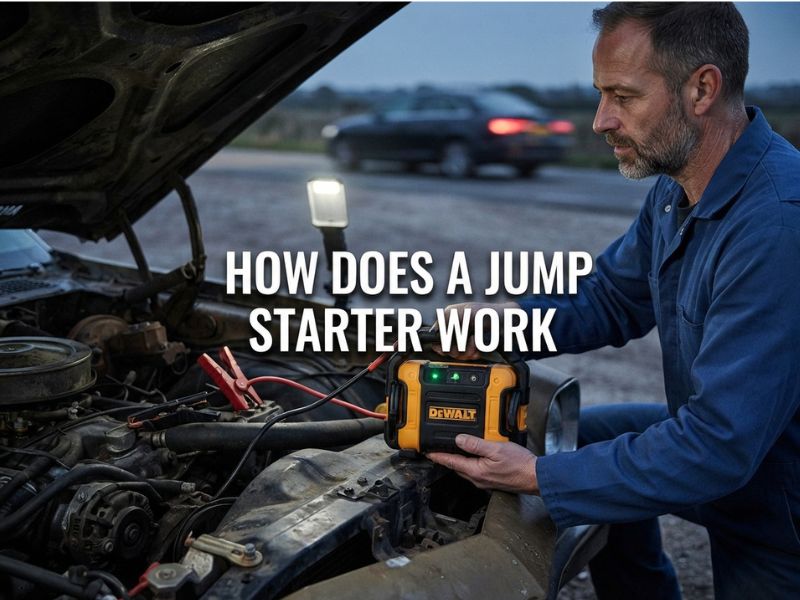
A jump starter works by storing electrical energy in an internal battery and releasing that energy as high-current electrical power when a vehicle needs assistance starting.
The basic process is:
- The jump starter is charged from an external power source.
- Its internal battery stores the electrical energy.
- The vehicle’s battery is connected to the jump starter using jumper clamps.
- The jump starter supplies current to the vehicle’s electrical system and starter circuit.
- The starter motor uses that current to turn the engine.
- Once the engine starts, the vehicle’s charging system takes over.
Unlike a conventional battery charger, a jump starter is not primarily designed to slowly recharge a vehicle battery. Its main purpose is to provide a short burst of high current to help start the engine.
This is why a relatively small portable jump starter can be useful even though it does not have the same overall energy capacity as a large automotive battery.
What Is Inside a Jump Starter?
A portable jump starter contains several important components that work together.
The main components typically include:
- Rechargeable battery pack
- Battery management system
- Charging circuit
- Power electronics
- Jumper cables
- Battery clamps
- Safety protection circuitry
- LED indicators or digital display
- USB or other charging ports
- Flashlight or emergency light on many models
The internal battery is the energy-storage component. The electronic circuitry manages how that battery is charged and how power is delivered to the vehicle.
The clamps provide the physical electrical connection between the jump starter and the vehicle’s battery.
The Internal Battery
Most modern portable jump starters use lithium-ion or related lithium battery technology.
Lithium batteries are useful because they can store significant amounts of energy without requiring the large physical size associated with many traditional lead-acid batteries.
They can also deliver substantial current for their size, making them suitable for portable engine-starting devices.
Battery Management System
A battery management system (BMS) helps monitor and protect the internal battery.
Depending on the design, it may monitor:
- Battery voltage
- Charging current
- Temperature
- Overcharge conditions
- Over-discharge conditions
- Short circuits
- Other abnormal operating conditions
This electronic protection is particularly important for lithium-based battery packs.
Jumper Cables and Clamps
The jumper cables transfer electrical current between the jump starter and the vehicle.
The clamps normally have a positive and negative connection:
- Red clamp = positive (+)
- Black clamp = negative (-)
The clamps need to make a strong electrical connection with the appropriate battery terminals or manufacturer-approved connection points.
How Does a Jump Starter Store Energy?
A jump starter stores energy in its internal rechargeable battery.
When you plug the jump starter into an appropriate power source, electrical energy flows into the internal battery through its charging circuit.
The charging electronics regulate the process so that the battery receives the appropriate voltage and current.
Once charged, the jump starter is essentially carrying a stored supply of electrical energy that can be released when needed.
This is different from connecting a car directly to another running vehicle.
With traditional jumper cables, the donor vehicle’s alternator and battery provide the electrical assistance. With a portable jump starter, the device’s own internal battery provides the energy.
How Does a Jump Starter Deliver High Current?
One of the most interesting characteristics of a jump starter is its ability to provide a very high current for a short period.
Starting an engine requires significantly more current than powering something like a phone or LED light.
The jump starter is designed with:
- High-current battery cells
- Low-resistance electrical connections
- Heavy-duty cables
- Suitable clamps
- Power-control electronics
When the starter motor engages, it can draw a large amount of current.
The jump starter provides this current through the clamps and cables to the vehicle’s starting circuit.
The exact current required varies depending on the engine, temperature, battery condition, oil viscosity, starter motor, and other factors.
What Happens When You Connect a Jump Starter to a Car?
When you connect a portable jump starter to a vehicle, several electrical events occur.
First, the positive and negative connections establish an electrical path between the jump starter and the vehicle.
Depending on the design of the jump starter, its electronics may detect the vehicle battery’s voltage and determine whether the connection appears correct.
Many modern models include reverse-polarity protection. If the clamps are connected incorrectly, the unit can warn the user or prevent current from being delivered.
Once the connection is correct and the jump starter is activated, it can provide the additional current needed by the vehicle’s starting system.
When you turn the ignition key or press the engine-start button, the vehicle’s starter circuit activates the starter motor.
The jump starter supplies electrical assistance while the starter motor turns the engine.
How Does a Jump Starter Start an Engine?
The jump starter does not directly turn the engine mechanically.
Instead, it supplies electrical power to the vehicle’s electrical system and starter motor.
The process looks like this:
Jump starter → battery connection → vehicle electrical system → starter circuit → starter motor → engine rotation → combustion → engine starts
When you attempt to start the engine, the starter motor engages with the engine’s flywheel or flexplate.
The motor rotates the engine’s crankshaft.
As the crankshaft rotates, the engine’s pistons move, air and fuel are introduced into the cylinders, and the ignition or compression process begins.
Once combustion becomes self-sustaining, the engine starts running under its own power.
The jump starter’s job is primarily to provide the electrical energy necessary to overcome the starting system’s demand.
Does a Jump Starter Charge the Car Battery?
Not necessarily.
This is one of the most common misunderstandings about portable jump starters.
A jump starter is primarily designed to start an engine, not fully recharge the vehicle’s battery.
When the vehicle starts, its alternator normally begins producing electrical power. The alternator then supplies electricity to the vehicle’s electrical systems and replenishes some of the energy used from the battery.
However, the amount of charging depends on the vehicle and operating conditions.
If the car battery is old, damaged, or deeply discharged, simply starting the vehicle with a jump starter does not repair the battery.
A separate battery charger may be needed to properly recharge the battery.
Jump Starter vs. Battery Charger
Although both devices can be associated with vehicle batteries, they perform different functions.
| Feature | Jump Starter | Battery Charger |
| Primary purpose | Start a vehicle | Recharge a battery |
| Energy source | Internal battery | External electrical outlet |
| Current delivery | Very high for a short period | Controlled over longer periods |
| Portable | Usually yes | Depends on model |
| Starts a vehicle | Yes | Some can, but not their primary function |
| Fully recharges car battery | Usually no | Yes, when properly sized |
| Stores energy internally | Yes | Usually no |
A jump starter is essentially an emergency power source for engine starting.
A battery charger is a battery-recharging device.
You should not automatically use the two devices interchangeably.
What Is Peak Amps on a Jump Starter?
Jump starters are often advertised using a peak amperage rating.
For example, a manufacturer may advertise a unit as:
- 1,000 peak amps
- 1,500 peak amps
- 2,000 peak amps
- 3,000 peak amps
- 4,000 peak amps
Peak amps describe a maximum current capability under particular conditions.
However, peak amperage should not be the only factor you consider when comparing jump starters.
A high advertised peak number does not automatically mean the device is better.
Other factors include:
- Engine compatibility
- Battery capacity
- Starting current
- Battery-cell quality
- Cable resistance
- Clamp quality
- Temperature performance
- Safety electronics
- Manufacturer specifications
A reputable jump starter with a realistic rating can be more useful than an inexpensive product with an exaggerated peak-current claim.
What Are Cranking Amps?
Cranking amps (CA) describe the current a battery can deliver under a defined test condition.
You may also encounter cold cranking amps (CCA) when discussing automotive batteries.
CCA is particularly relevant because starting an engine in cold temperatures can require substantial current.
Oil becomes more viscous at low temperatures, while battery performance can also decrease.
Jump starter manufacturers may use different rating systems, so compare products according to the manufacturer’s actual vehicle and engine-size recommendations rather than relying on one number alone.
How Does a Lithium Jump Starter Work?
A lithium jump starter uses a lithium-based rechargeable battery pack to store energy.
When the unit is charged, electrical energy is stored chemically inside the battery cells.
When you connect it to a vehicle and activate the starting function, the stored energy is converted into electrical current that flows through the output circuit and jumper cables.
Lithium technology allows manufacturers to build relatively small devices capable of delivering substantial current.
This is why modern portable jump starters can be small enough to store in a glove compartment or emergency kit while still being capable of starting many passenger vehicles.
Why Can a Small Jump Starter Start a Large Engine?
At first, this can seem surprising.
A portable jump starter may be physically much smaller than a car battery, yet it can sometimes provide enough current to help start an engine.
The explanation is that engine starting requires high power for a relatively short time.
A jump starter does not need to operate the starter motor continuously.
It only needs to provide sufficient electrical power during the brief starting attempt.
Its internal battery and high-current design allow it to release a substantial amount of energy quickly.
However, there are limits.
A small jump starter should not be assumed to start every engine simply because it can produce high current.
Large diesel engines, commercial vehicles, and vehicles in extremely cold conditions may require a substantially more powerful jump starter.
How Does Reverse-Polarity Protection Work?
Reverse-polarity protection is an important safety feature in many modern jump starters.
A vehicle battery has positive and negative terminals.
If the positive and negative clamps are accidentally reversed, electricity could potentially flow through the wrong circuit.
A jump starter with reverse-polarity protection can detect an incorrect connection and prevent or limit the high-current output.
Some devices produce an audible warning, while others use indicator lights or a digital display.
This feature is particularly useful for inexperienced users.
However, it should never be treated as permission to connect the clamps carelessly. Always follow the manufacturer’s connection procedure.
How Does a Jump Starter Know the Battery Is Connected?
Many modern jump starters contain electronic circuits capable of detecting electrical conditions at the clamps.
The device may monitor the voltage present at the connection and determine whether the vehicle battery appears to be connected correctly.
Some models automatically activate when the clamps are attached properly.
Others require you to press a power or boost button.
The exact behavior varies by model.
Some units also have special manual override or force-start modes for extremely low-voltage batteries.
These modes can bypass some automatic detection features, so they should only be used according to the manufacturer’s instructions.
What Happens If the Car Battery Is Completely Dead?
A completely discharged battery can create a problem because some automatic jump starters require a minimum voltage before they activate their normal output.
If the vehicle battery voltage is extremely low, the jump starter may not detect it as a valid battery.
Some models solve this problem with a manual boost mode.
When activated, the jump starter can provide starting current despite the low detected voltage.
However, this does not mean the jump starter can overcome every battery problem.
If the battery has a physical defect, internal short circuit, severe corrosion, or other failure, the vehicle may still fail to start.
Can a Jump Starter Work Without a Car Battery?
This depends on the jump starter and vehicle.
Some advanced jump starters can provide enough starting current even when a vehicle battery is extremely discharged, while others require a battery connection for their normal operating mode.
Certain models have a manual override function that allows them to supply output to a very low-voltage battery.
However, removing the vehicle battery and attempting to start the vehicle directly from a jump starter is generally not recommended unless the vehicle and jump starter manufacturer explicitly allow it.
Modern vehicles contain sensitive electronic systems that depend on stable electrical power.
How Does a Jump Starter Affect the Alternator?
A jump starter does not normally replace the alternator.
Its job is to provide temporary assistance during the starting process.
Once the engine is running, the vehicle’s alternator supplies electrical power and begins maintaining the battery.
If the alternator is defective, however, the vehicle may stop running after the battery’s available energy is depleted.
This is why a jump starter should not be considered a solution for an alternator problem.
If a car repeatedly needs a jump start, the battery and charging system should be tested.
How Long Can a Jump Starter Run a Car?
A jump starter is not designed to continuously power a vehicle.
Its primary function is to assist with engine starting.
After the engine starts, the vehicle’s alternator should take over the electrical supply.
Trying to use a portable jump starter as a continuous replacement for the vehicle’s battery or alternator is not an appropriate use.
The exact amount of energy available from a jump starter depends on its battery capacity, efficiency, temperature, and condition.
How Many Times Can a Jump Starter Start a Car?
The number of jump starts available from a fully charged jump starter varies by model.
A manufacturer may provide an estimated number of starts under particular test conditions.
Real-world performance can vary because of:
- Engine size
- Battery condition
- Ambient temperature
- Number of starting attempts
- Jump starter battery condition
- Cable and clamp connection
- Starter motor condition
A larger jump starter with greater usable battery capacity may provide more starting attempts than a smaller unit.
However, you should recharge the device after using it rather than assuming it will always have enough energy for another emergency.
Does Temperature Affect a Jump Starter?
Yes.
Temperature can affect both the vehicle battery and the jump starter’s internal battery.
Cold temperatures can reduce battery performance and increase the difficulty of starting an engine.
The engine itself may also require more starting power because lubricating oil becomes thicker.
High temperatures can accelerate battery aging and may affect the safety and performance of lithium battery systems.
Always follow the manufacturer’s recommended operating and storage temperature range.
Avoid leaving a lithium jump starter exposed to extreme heat for long periods, such as inside a vehicle under intense summer sunlight.
How Do You Use a Jump Starter?
Although specific procedures vary, a typical process looks like this.
Step 1: Check the Jump Starter
Make sure the jump starter has sufficient charge.
Inspect the cables and clamps for visible damage.
Step 2: Turn Off the Vehicle
Switch off the ignition and electrical accessories.
Step 3: Connect the Positive Clamp
Attach the red positive clamp to the vehicle’s positive battery terminal or the manufacturer’s designated positive connection point.
Step 4: Connect the Negative Clamp
Attach the black negative clamp to the negative battery terminal or an approved grounding point, following the vehicle and jump starter instructions.
Step 5: Activate the Jump Starter
Turn on the jump starter if required.
Confirm that the device indicates a proper connection.
Step 6: Start the Engine
Attempt to start the vehicle.
Do not continuously crank the engine for an extended period. Follow the vehicle and jump starter manufacturer’s recommendations.
Step 7: Disconnect the Jump Starter
Once the engine is running, disconnect the clamps in the recommended order.
Step 8: Recharge the Unit
Recharge the jump starter after use so it is ready for the next emergency.
Why Won’t a Jump Starter Start the Car?
A jump starter can fail to start a vehicle for several reasons.
The jump starter may not have enough power for the engine.
The internal jump starter battery may be discharged.
The clamps may not have a good electrical connection.
The vehicle battery may be severely damaged.
The starter motor may be faulty.
There may also be a problem with the fuel system, ignition system, immobilizer, engine electronics, or another component unrelated to the battery.
A jump starter only addresses the electrical power requirement associated with starting.
It cannot repair a mechanical or electronic failure elsewhere in the vehicle.
What Safety Features Should a Jump Starter Have?
A quality jump starter should include several important protection systems.
Reverse-Polarity Protection
Helps prevent problems caused by connecting the positive and negative clamps incorrectly.
Short-Circuit Protection
Helps protect the device when the output terminals are accidentally shorted.
Over-Current Protection
Helps control excessive current flow.
Over-Temperature Protection
Helps protect internal components if the device becomes too hot.
Overcharge Protection
Helps prevent excessive charging of the internal battery.
Spark Protection
Some jump starters use electronics designed to reduce or prevent sparks when the clamps are connected incorrectly or in certain conditions.
These features can improve safety, but correct operation remains essential.
Can a Jump Starter Damage a Car?
A properly designed and correctly used jump starter should not damage a compatible vehicle.
However, incorrect use can create problems.
Potential risks include:
- Reverse connection
- Short circuits
- Using incompatible equipment
- Connecting to the wrong electrical terminals
- Ignoring manufacturer instructions
- Using a damaged jump starter
Modern vehicles contain numerous electronic control modules, sensors, and electrical components, so following the correct procedure is important.
Always consult the vehicle owner’s manual and jump starter instructions when in doubt.
How Does a Jump Starter Recharge?
After using a jump starter, you need to recharge its internal battery.
Depending on the model, charging may be possible through:
- USB-C
- Micro-USB
- AC wall adapter
- 12V vehicle outlet
- Manufacturer-specific charging adapter
Newer models increasingly use USB-C charging because it provides a convenient standardized connection.
Charging time varies depending on battery capacity, charger output, battery state, and charging technology.
Never use an incompatible charger simply because the connector physically fits.
How Long Does a Jump Starter Last?
The lifespan of a jump starter depends primarily on its battery chemistry, usage, storage conditions, charging habits, and build quality.
Lithium batteries gradually lose capacity as they age and go through charge cycles.
A jump starter that spends years in extreme heat may deteriorate faster than one stored under suitable conditions.
To maximize its useful life:
- Keep it charged according to the manufacturer’s recommendations.
- Avoid extreme temperatures.
- Don’t store it while completely discharged.
- Use the supplied or approved charger.
- Keep the unit dry.
- Inspect it periodically.
Is a Jump Starter Better Than Jumper Cables?
A portable jump starter offers several advantages over traditional jumper cables.
With jumper cables, you normally need another vehicle with a functioning battery.
A portable jump starter stores its own energy, so you don’t need another vehicle.
| Jump Starter | Traditional Jumper Cables |
| Contains its own battery | Requires another vehicle |
| Can be used alone | Requires donor vehicle |
| Easy to store | Very compact |
| Built-in safety electronics | Depends on user |
| Can include USB ports | Usually no |
| Often includes flashlight | Usually no |
Traditional jumper cables are still useful, particularly when another vehicle is available.
A portable jump starter simply provides greater independence.
Can You Use a Jump Starter on Different Vehicles?
Yes, provided the jump starter is appropriately rated for the vehicle.
The same jump starter may be capable of assisting multiple vehicles, but engine size and fuel type remain important.
For example, a unit suitable for a small gasoline sedan may not be suitable for a large diesel truck.
Before using the device, verify the manufacturer’s stated vehicle compatibility.
How Does a Jump Starter Compare With a Portable Power Bank?
A jump starter may look like a large power bank, but the two devices are fundamentally different.
A standard power bank is designed to provide relatively low-current power to electronic devices such as smartphones.
A jump starter is designed to deliver very high current for a short duration.
This requires specialized battery cells, electrical connections, cables, clamps, and protection circuitry.
Some jump starters include USB outputs, allowing them to function as emergency power banks as well.
However, their primary purpose remains vehicle starting.
Common Mistakes When Using a Jump Starter
Several mistakes can reduce the chance of a successful jump start or create safety risks.
Using an Undersized Jump Starter
A unit designed for a small four-cylinder engine may not have enough capability for a large diesel engine.
Ignoring the Battery Indicator
A jump starter with a low charge may not provide sufficient energy.
Poor Clamp Connection
Dirty, loose, or poorly positioned clamps can prevent sufficient current flow.
Connecting the Polarity Incorrectly
Always identify the positive and negative terminals before connecting.
Repeatedly Cranking the Engine
Multiple long starting attempts can drain the jump starter quickly.
Storing It in Extreme Heat
High temperatures can accelerate degradation of the internal battery.
Forgetting to Recharge It
A jump starter is useless during an emergency if its internal battery is empty.
Frequently Asked Questions
How does a jump starter work?
A jump starter stores electrical energy in an internal rechargeable battery and releases high electrical current through jumper cables and clamps to help power a vehicle’s starter motor.
Does a jump starter charge the car battery?
Usually, no. Its primary purpose is to provide temporary starting power. The vehicle’s alternator normally recharges the battery after the engine starts.
Can a jump starter start a car with a dead battery?
It can often start a vehicle with a severely discharged battery, provided the jump starter is properly rated and the vehicle’s battery and starting system are otherwise functional. Some models have a manual boost mode for very low-voltage batteries.
How many amps does a jump starter need?
The required power depends on the engine size, fuel type, vehicle, and conditions. Always use the manufacturer’s recommended engine-size rating instead of choosing based solely on peak amps.
Can a jump starter be used on a diesel engine?
Yes, if it is specifically rated for the diesel engine’s size. Diesel engines can require substantial starting power, particularly in cold conditions.
Can you leave a jump starter connected to a car?
A jump starter should only remain connected for the period specified in its operating instructions. Once the vehicle starts, disconnect it according to the manufacturer’s recommended procedure.
Can a jump starter replace a car battery?
No. A jump starter is an emergency starting device. It is not a permanent replacement for the vehicle’s battery.
Can a jump starter damage electronics?
A properly designed jump starter used according to the manufacturer’s instructions should be suitable for compatible vehicles. Incorrect connections or improper use can create electrical risks.
Why does a jump starter have a flashlight?
The flashlight provides emergency illumination when connecting the jump starter at night or in low-light conditions. Some models also include flashing or emergency signaling modes.
Final Answer: How Does a Jump Starter Work?
So, how does a jump starter work? A portable jump starter works by storing electrical energy inside an internal rechargeable battery and releasing a large amount of current through its jumper cables and clamps when a vehicle needs help starting.
When connected correctly, the jump starter provides electrical assistance to the vehicle’s starting system. That power allows the starter motor to turn the engine until combustion begins and the engine starts running.
Modern jump starters combine high-output lithium batteries, battery management systems, heavy-duty cables, clamps, and safety electronics to deliver substantial starting current from a relatively small package.
The key thing to remember is that a jump starter is primarily an emergency starting device, not a replacement for a battery charger. It can help start a vehicle with a weak battery, but it cannot repair a damaged battery, defective starter motor, failed alternator, or other mechanical problem.
Choosing the right jump starter means matching its starting capability, engine compatibility, battery capacity, safety features, and build quality to your vehicle. When properly selected, charged, stored, and used, a portable jump starter can be one of the most useful items in a vehicle emergency kit.