A digital tire inflator gauge is one of the easiest ways to make an existing air compressor more useful. Instead of inflating a tire, disconnecting the hose, checking pressure with another gauge, and reconnecting everything again, the right tool lets you check, inflate, and bleed pressure from one handheld unit.
My first recommendation is the AstroAI Digital Tire Pressure Gauge with Inflator 250 PSI. It has an exceptionally large owner-feedback history, a wide pressure range, 0.1 PSI display resolution, a backlit digital screen, and a straightforward 3-in-1 design that works well for home garages.
My second choice is the Rhino USA 200 PSI Digital Tire Inflator Gauge. I like its heavy-duty feel, backlit display, 17-inch hose, interchangeable chuck setup, and 200 PSI range for cars, trucks, SUVs, motorcycles, and RV tires.
For buyers who prioritize refined chuck design and shop-oriented construction, the JACO FlowPro 2.0 Digital Tire Inflator Gauge is another excellent option. Its 200 PSI range, 0.1 PSI resolution, calibrated digital gauge, flexible hose, and quick-lock chuck make it especially appealing for frequent garage use.
5 Best Digital Tire Inflator Gauge
| Image | Product Name | Check Price |
|---|---|---|
Best Choice | AstroAI Digital Tire Pressure Gauge with Inflator 250 PSI | Check Price |
Second Best | Rhino USA 200 PSI Digital Tire Inflator Gauge | Check Price |
Third Choice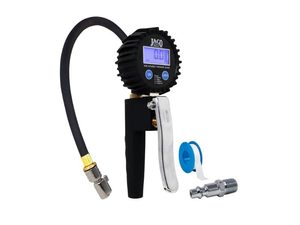 | JACO FlowPro 2.0 Digital Tire Inflator Gauge | Check Price |
 | AZUNO Digital Tire Inflator with Pressure Gauge 200 PSI | Check Price |
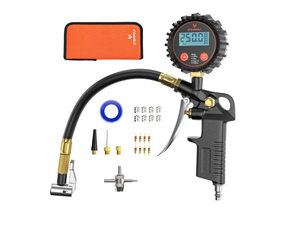 | ETENWOLF T500 Digital Tire Pressure Gauge with Inflator | Check Price |
What Is a Digital Tire Inflator Gauge?
A digital tire inflator gauge is an air-compressor accessory that combines three common tire-maintenance functions in one tool.
It measures tire pressure through a digital sensor, allows compressed air to enter the tire when the inflation trigger is pressed, and lets you release excess pressure through a bleed valve.
Unlike a cordless or 12V portable tire inflator, these products normally contain no compressor motor of their own. They need to be connected to a suitable air compressor or compressed-air system.
That distinction matters when shopping.
If you want something that can inflate a tire directly from a battery, wall outlet, or vehicle outlet, you need a portable tire inflator. If you already have an air compressor in your garage and want an easier, more accurate way to control tire pressure, a digital inflator gauge is the better tool.
5 Best Digital Tire Inflator Gauge
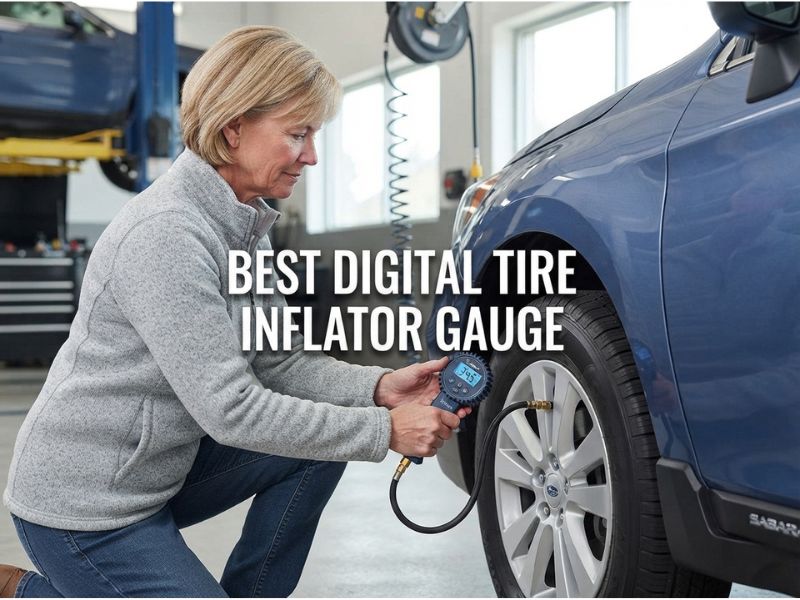
1. AstroAI Digital Tire Pressure Gauge with Inflator 250 PSI – Best Overall
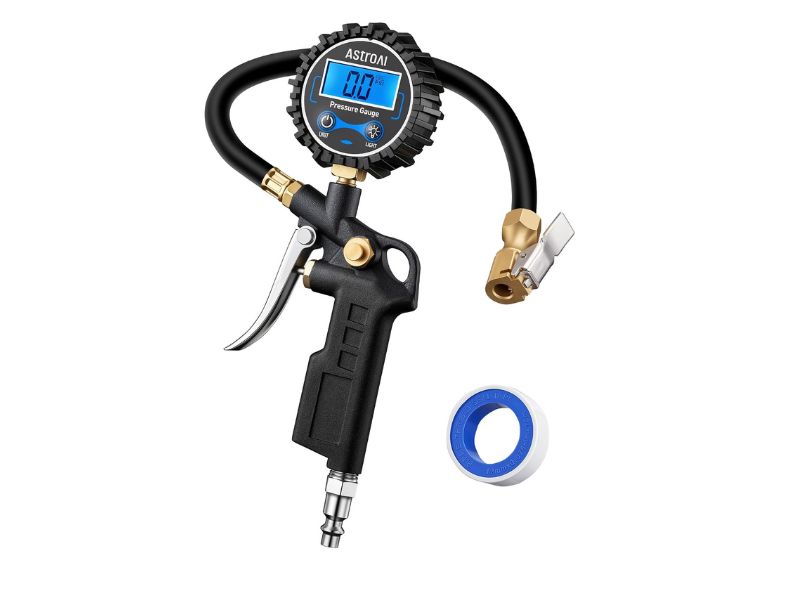
The AstroAI 250PSI-M earns my first position because it combines a huge long-term owner-feedback base with a practical feature set and a wide pressure range.
Key Features
- 3–250 PSI measuring range
- 0.1 PSI digital resolution
- Backlit digital display
- Inflate, check, and deflate functions
- Quick-connect air fitting
- Rubber air hose
- Multiple pressure units
- Replaceable AAA batteries
- Heavy-duty metal components
- Suitable for cars, trucks, SUVs, RVs, and motorcycles
Detailed Review
The AstroAI is designed to replace the repetitive process of using an air chuck and separate pressure gauge.
Connect the tool to your compressor, attach the chuck to the tire valve, and the digital screen immediately gives you a pressure reading. If the pressure is low, squeeze the inflation control. If you overshoot the target, use the bleed function to release a small amount of air.
That seemingly simple combination can make a major difference when maintaining several vehicles.
Suppose you need all four tires at 35 PSI. With a conventional chuck, you may inflate the first tire, disconnect the air hose, check it with another gauge, discover that it is at 37 PSI, release some air, and check it again.
With the AstroAI, those steps happen through the same tool.
Its 3–250 PSI range is considerably broader than most passenger vehicles require, but that extra capacity improves versatility. It can cover normal cars and motorcycles while also being suitable for many higher-pressure truck and RV applications.
The digital screen resolves pressure in 0.1 PSI increments, making small differences easy to see. That does not mean your vehicle needs pressure adjusted to one-tenth of a PSI under every condition, but the finer display makes it easier to match tires consistently.
The illuminated display is also much easier to read than a small analog dial when working in a dim garage.
Construction is another reason this model has remained popular. The inflator combines metal components with a flexible hose and quick-connect fitting designed to integrate with common compressed-air equipment.
It is still important to check fitting compatibility with your compressor setup. Air systems can use different coupler standards, and an adapter may occasionally be needed.
The AstroAI runs its display from replaceable AAA batteries rather than a proprietary rechargeable pack. For a garage tool, I consider that a sensible choice. Batteries are inexpensive, easy to replace, and the inflator does not depend on a charging cable.
The main limitation has nothing to do with inflation speed because the external compressor determines how quickly air is supplied.
Instead, convenience depends heavily on the chuck connection and hose arrangement. Users who frequently deal with difficult valve positions, dual rear wheels, or deep rims may prefer a longer specialty chuck.
For ordinary cars, SUVs, pickup trucks, motorcycles, and home-garage work, however, the supplied setup is much easier to manage.
What I Like
I like the combination of a wide 250 PSI range, bright digital reading, 0.1 PSI resolution, and 3-in-1 operation.
It also has a very large long-term owner base compared with most digital inflator gauges, which gives the design a stronger real-world track record.
What I Do Not Like
The included chuck configuration is good for normal valve stems but is not as specialized as a long dual-head chuck for dually or commercial-truck applications.
As with any compressor accessory, fitting compatibility should also be checked before assuming it will connect directly to every air-hose system.
Verdict
The AstroAI 250PSI-M is my best digital tire inflator gauge overall. It provides the accuracy, range, readability, and basic durability most DIY users need without making routine tire-pressure adjustment complicated.
2. Rhino USA 200 PSI Digital Tire Inflator Gauge – Best Heavy-Duty Home Garage Pick

The Rhino USA 200 PSI Tire Inflator Gauge is a strong choice for buyers who want something that feels more like a dedicated garage tool than a compact pressure tester.
Key Features
- Up to 200 PSI
- Digital backlit pressure display
- Multiple pressure measurement units
- 17-inch inflator hose
- Interchangeable chuck configuration
- 360-degree swivel design
- Quick-connect fitting
- Air bleed control
- Two AAA batteries
- Storage bag included
Detailed Review
Rhino USA builds this inflator around a straightforward garage workflow.
The unit connects to an external compressed-air source through its quick fitting. Attach the chuck to the tire, read pressure directly on the illuminated display, squeeze the inflation control to add air, or use the bleed function when pressure needs to come down.
The 200 PSI range is more than sufficient for standard passenger vehicles and provides useful headroom for pickup trucks, RVs, trailers, and other higher-pressure applications.
More pressure range is not automatically better, though.
For a tire inflator gauge, I care more about readable measurements, reliable valve connection, comfortable controls, and the ability to make small adjustments without repeatedly removing the chuck.
The Rhino does well in those areas.
One feature I particularly like is the approximately 17-inch hose. A little extra hose flexibility can make a considerable difference when the valve stem ends up near the bottom or back side of a large wheel.
A rigid gauge connected directly at the valve can force your hand into awkward positions. A hose lets the chuck remain attached while you move the digital display to a more comfortable viewing angle.
The backlit screen is useful in garages where the wheel well blocks overhead lighting. It also simplifies nighttime use.
Multiple pressure units are available, which is helpful if you work with equipment whose specifications are expressed in PSI, BAR, kPa, or another common unit.
The Rhino also uses replaceable AAA batteries. There is no need to remember to recharge another garage gadget before checking tires.
Another benefit is its included chuck and accessory arrangement. Different wheel and valve-stem layouts can make a single chuck design frustrating, particularly when moving between motorcycles, cars, trucks, and RVs.
The ability to configure the air connection gives the Rhino greater usefulness across a mixed garage.
As with every product in this guide, it is important to remember that the Rhino is not a standalone air compressor. It controls and measures air supplied by a separate compressor.
If you do not already own an air compressor, purchasing this gauge alone will not inflate a tire.
What I Like
The 200 PSI capacity, digital backlight, flexible hose, bleed function, and garage-oriented build create a good balance for frequent vehicle maintenance.
I also like the included storage solution because inflator accessories and small fittings are remarkably easy to misplace.
What I Do Not Like
It is more substantial than minimalist gauges, so buyers looking for something extremely compact may find it bulky.
The broad 200 PSI range is also more than a passenger-car-only household really needs.
Verdict
The Rhino USA is one of the best options for a home garage with several vehicle types. It is especially attractive for owners of cars, trucks, motorcycles, trailers, and RVs who want one digital compressor accessory capable of handling all of them.
3. JACO FlowPro 2.0 Digital Tire Inflator Gauge – Best Premium Chuck Design
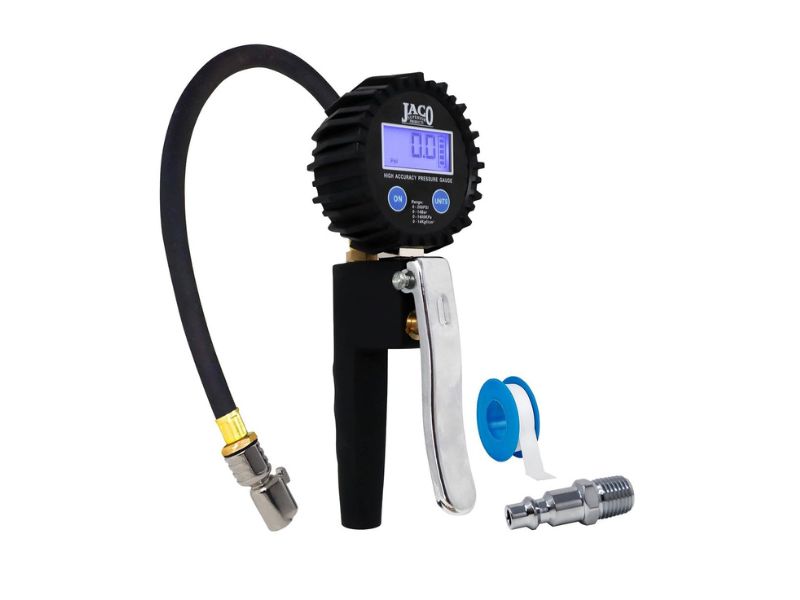
The JACO FlowPro 2.0 takes a more refined approach to the parts that mechanics interact with most: the gauge, hose, chuck, and pressure controls.
Key Features
- 5–200 PSI gauge range
- 0.1 PSI resolution
- ±1% full-scale stated accuracy
- ASME Grade 1A calibration
- Backlit digital display
- 21-inch flexible air hose
- Lightning quick-lock chuck
- Quick-release valve connection
- Four pressure units
- Two replaceable AAA batteries
- 1/4-inch NPT compatibility
Detailed Review
A digital pressure gauge can have excellent electronics and still be annoying to use if its chuck constantly leaks.
That is why the JACO Lightning chuck is probably the most important feature here.
Instead of repeatedly adjusting a conventional clip-on chuck until it seals correctly, the JACO design is intended to push onto the valve stem and lock in position.
When finished, the release mechanism lets you disconnect it without spending several seconds twisting a threaded chuck from the valve.
That can save noticeable time when working through four tires.
JACO specifies a 5–200 PSI pressure range with 0.1 PSI resolution. The company also states Grade 1A calibration and ±1% full-scale accuracy.
For normal car and light-truck work, the 200 PSI ceiling gives far more range than necessary while leaving enough flexibility for higher-pressure equipment.
Another advantage is the 21-inch HybridFlex hose.
The longer hose gives you more freedom to hold the display where it is easy to read while the chuck remains firmly connected to the valve.
That is particularly useful with large truck wheels, awkward wheel designs, or vehicles where you cannot comfortably hold the entire inflator close to the valve.
Pressure can be displayed in PSI and several alternative units.
The digital screen runs from two AAA batteries, which are easy to source and replace.
JACO positions the FlowPro as a garage and shop tool rather than simply an emergency pressure checker. That emphasis shows in its hose length, chuck design, and calibration specification.
The downside is that buyers who only inflate four passenger-car tires every month may not need the extra refinement.
A simpler inflator gauge can perform the same essential check, inflate, and deflate functions.
For someone who uses an air compressor frequently, though, convenience at the chuck can justify choosing a more polished design.
What I Like
The quick-lock chuck and 21-inch hose are the standout features.
I also appreciate that JACO clearly specifies the gauge’s pressure range, resolution, and calibration standard rather than focusing only on a maximum PSI number.
What I Do Not Like
The additional refinement may be unnecessary for occasional users who simply need an inexpensive gauge for monthly tire checks.
The supplied chuck is excellent for conventional valve stems, but owners of dual-rear-wheel trucks may still want a specialized dually chuck.
Verdict
Choose the JACO FlowPro 2.0 if chuck quality, hose flexibility, and frequent garage use matter more than simply finding the least expensive digital inflator gauge.
4. AZUNO Digital Tire Inflator with Pressure Gauge 200 PSI – Best Complete Value Kit
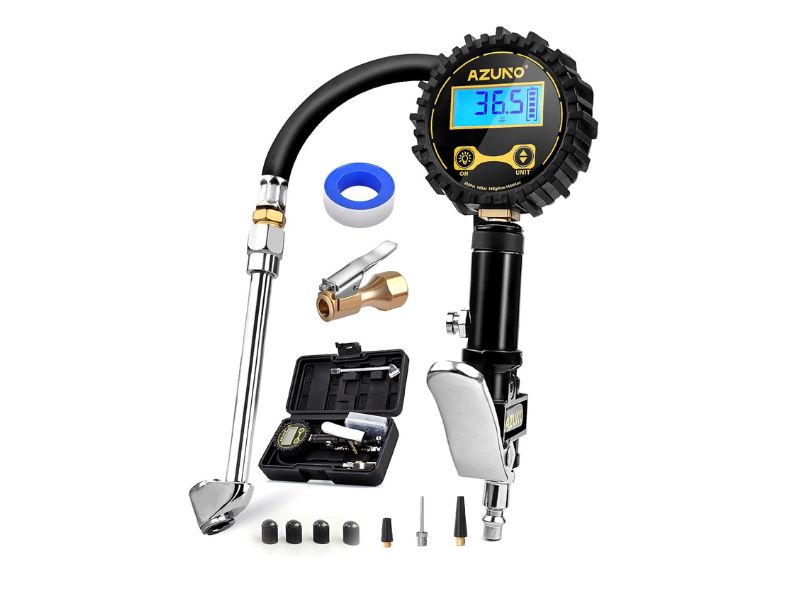
The AZUNO TIG200D combines a digital inflator gauge, hose, lock-on chuck, quick-connect hardware, and storage case in a package aimed at home mechanics.
Key Features
- Up to 200 PSI
- 0.1 PSI digital resolution
- Bright backlit LCD
- Four measurement units
- Inflation trigger
- Air bleed function
- Lock-on air chuck
- Quick-connect compressor fitting
- Heavy-duty hose
- Carrying case included
Detailed Review
The AZUNO’s appeal is easy to understand: it provides most of the functionality people look for in a digital inflator gauge without requiring a complicated setup.
Connect it to an air compressor, lock the chuck onto the tire valve, and the screen provides a live pressure reading.
The inflation trigger adds air while the bleed control allows excess pressure to escape.
Having both controls on the same tool makes it easy to approach your target pressure from either direction.
For example, if a tire reads 29.8 PSI and needs 35 PSI, you can add air while watching the display. If you reach 35.8 PSI, the bleed valve lets you reduce the pressure slightly without disconnecting anything.
The 200 PSI range and 0.1 PSI resolution cover a wide variety of passenger and light-commercial applications.
The illuminated screen supports several measurement units, giving the tool broader usefulness for equipment that may not specify pressure in PSI.
One-handed operation is another important advantage.
A properly attached lock-on chuck remains connected to the valve, leaving you free to hold the gauge naturally rather than pressing the chuck against the valve stem throughout inflation.
That becomes more valuable when checking several tires in succession.
AZUNO also packages this model with a carrying case.
A case may seem like a minor accessory, but it helps protect the digital display and keeps the small compressor fittings together when the tool is stored in a crowded garage cabinet.
Build quality is appropriate for regular DIY use, with metal and brass components in the working areas and protective material around the gauge.
The biggest consideration is the hose and fitting arrangement.
Air compressor couplers are not completely standardized across every garage. Check the connection used by your compressor before purchase, particularly if your system has been set up with a specific industrial or automotive fitting standard.
What I Like
The 0.1 PSI display, lock-on chuck, straightforward pressure controls, and storage case provide strong practical value.
It is particularly attractive for someone assembling a home compressor setup from scratch and wanting most of the small accessories together.
What I Do Not Like
The body and case take up more storage room than a minimalist inflator gauge.
Users with specialized air fittings may also need to swap or adapt the supplied compressor connection.
Verdict
The AZUNO is a strong value-oriented choice for home garages. It provides the essential advantages of a digital inflator gauge while including a useful organization case and practical compressor accessories.
5. ETENWOLF T500 Digital Tire Pressure Gauge with Inflator – Best Newer High-Pressure Option

The ETENWOLF T500 is a newer alternative with a 250 PSI range, digital display, robust construction, and an all-in-one check, inflate, and deflate layout.
Key Features
- Up to 250 PSI
- Backlit digital LCD
- Inflate, measure, and deflate functions
- 1/4-inch NPT compressor connection
- Heavy-duty air chuck
- Replaceable AAA batteries
- Metal and rubber construction
- Multiple pressure units
- Additional inflation accessories
- Storage bag included
Detailed Review
ETENWOLF has designed the T500 around the same fundamental workflow as the AstroAI: one tool should handle the three tasks normally performed by a separate chuck, pressure gauge, and deflator.
The 250 PSI range makes the T500 appropriate for a broad mix of vehicles.
That pressure capacity goes far beyond typical passenger-car requirements, but it can be useful for people maintaining trucks, RVs, trailers, motorcycles, and bicycles alongside ordinary vehicles.
The large digital display is backlit, helping you see pressure clearly in a dark garage or wheel well.
Pressure can also be changed among multiple units depending on the specification you are following.
ETENWOLF uses a standard 1/4-inch NPT compressor-oriented connection, making the tool suitable for common garage air systems once the correct coupler is installed.
The inflator combines an air chuck and pressure controls into one ergonomic assembly. Add air when the tire is low and use the release control when pressure is high.
The supplied accessories increase versatility beyond vehicle tires. A Presta adapter, for example, can be useful for certain bicycle tires, while a ball needle expands the tool’s usefulness around the garage.
The T500 also includes a storage bag.
One reason this model sits fifth rather than higher is simply track record. It is a newer product and has accumulated substantially less long-term owner feedback than the AstroAI.
That does not make it an inferior tool. In fact, the specifications are competitive.
It simply means the first few choices provide more years of real-world use from a larger group of owners.
What I Like
I like the 250 PSI range, clear display, robust body, and complete accessory kit.
The combination works well for households maintaining several types of tires rather than only one passenger car.
What I Do Not Like
It does not yet have the same long-term track record as the older AstroAI and Rhino USA designs.
Its wider pressure range is also unnecessary if you only maintain standard car tires around 30–40 PSI.
Verdict
The ETENWOLF T500 is a promising high-pressure digital inflator gauge for mixed garages, particularly when you want a complete accessory set and plan to work with cars, trucks, bicycles, trailers, or RVs.
Digital Tire Inflator Gauge Comparison
| Product | Pressure Range | Resolution | Display | Hose/Chuck | Inflate & Bleed | Compressor Connection | Best For |
| AstroAI 250PSI-M | 3–250 PSI | 0.1 PSI | Backlit digital | Flexible hose/chuck | Yes | Quick-connect/NPT setup | Best overall |
| Rhino USA 200 PSI | Up to 200 PSI | Digital | Backlit digital | 17-in hose, interchangeable chuck | Yes | Quick-connect | Heavy-duty home use |
| JACO FlowPro 2.0 | 5–200 PSI | 0.1 PSI | Backlit digital | 21-in hose, Lightning chuck | Yes | 1/4-in NPT | Frequent garage use |
| AZUNO TIG200D | Up to 200 PSI | 0.1 PSI | Backlit digital | Lock-on chuck | Yes | Quick-connect | Complete value kit |
| ETENWOLF T500 | Up to 250 PSI | Digital | Backlit digital | Heavy-duty chuck | Yes | 1/4-in NPT | Mixed vehicle types |
Comparison Summary
The AstroAI 250PSI-M remains the best choice for most buyers because it combines an exceptionally established track record with a useful 250 PSI range, fine digital resolution, and simple 3-in-1 controls.
The Rhino USA is a particularly good garage option when durable construction, hose flexibility, and interchangeable chuck capability are priorities.
The JACO FlowPro 2.0 stands out for buyers who use their compressor frequently. Its longer hose and quick-lock Lightning chuck reduce some of the small frustrations associated with repetitive tire work.
The AZUNO TIG200D offers an appealing complete kit for DIY users, while the ETENWOLF T500 is worth considering when a broad 250 PSI range and included accessories matter.
Buying Guide: How to Choose the Best Digital Tire Inflator Gauge
Make Sure You Already Have an Air Compressor
This is the single most important purchasing consideration.
A digital tire inflator gauge does not normally produce compressed air.
It measures and controls air supplied by another source.
If you already have a pancake compressor, portable garage compressor, upright shop compressor, or compatible compressed-air system, one of these gauges can make tire inflation dramatically more convenient.
If you do not have an air compressor and want a self-contained device, choose a portable electric tire inflator instead.
Choose a Useful Pressure Range
Standard passenger cars typically require nowhere near 200 or 250 PSI.
However, a wide measuring range gives the gauge additional flexibility for trucks, trailers, bicycles, and other equipment.
For a household containing only passenger cars and motorcycles, almost every gauge in this article provides far more range than necessary.
Truck, RV, and commercial users should pay closer attention to maximum supported pressure.
More important than maximum PSI is whether the gauge remains appropriately accurate throughout the pressure range you actually use.
Look at Accuracy and Resolution Separately
Accuracy and resolution are not the same thing.
A display that shows 35.1 PSI has 0.1 PSI resolution, but that does not automatically mean the true pressure is exactly 35.1 PSI.
Resolution describes how finely the display presents its reading.
Accuracy describes how close that reading should be to the actual pressure.
For normal automotive maintenance, consistency and reasonable accuracy matter more than chasing tiny decimal differences.
The JACO FlowPro 2.0 is particularly transparent about its calibration specification, while several other models advertise approximately one-percent-class accuracy.
A Backlit Display Is Worth Having
A tire valve is often located in one of the least illuminated parts of a garage.
Even during the day, the vehicle itself can cast a shadow across the gauge.
A backlit LCD makes pressure readings much easier to see.
This is one of the biggest practical advantages digital gauges have over inexpensive analog tire inflators.
Pay Attention to the Air Chuck
The chuck is the component that actually seals against the tire valve.
A poor chuck can make even an accurate gauge frustrating because air leaks while you are trying to take a measurement.
Basic clip-on chucks work well when properly attached.
Lock-on designs make hands-free operation easier.
Push-to-lock chucks such as JACO’s Lightning system prioritize quick attachment and removal.
Threaded chucks can create excellent seals but take longer to connect.
There is no universally perfect design; the best one depends on the valve stems you work with.
Consider Dually and Truck Tires Separately
Dual rear wheels can hide valve stems behind adjacent wheels.
A short conventional chuck may be inconvenient or impossible to use in that situation.
If you regularly maintain a dually pickup, motorhome, commercial truck, or trailer, look for a long dual-head chuck or compatible dually attachment.
Do not assume a high 200 or 250 PSI rating automatically means the included chuck is ideal for dual wheels.
Pressure range and valve accessibility are separate considerations.
Hose Length Matters
A longer hose gives you freedom to position the display while the chuck remains connected to the valve.
This makes the gauge easier to read and reduces strain on the valve stem.
The JACO’s approximately 21-inch hose is particularly attractive for this reason, while the Rhino USA also provides useful reach.
For compact cars, almost any normal hose works.
Large wheels and awkward valve positions benefit more from extra length.
Check Your Compressor Fitting
Most garage air systems use common 1/4-inch fittings, but coupler profiles can differ.
Industrial, automotive, ARO, and other fitting styles are not always directly interchangeable.
Before buying, inspect the coupler on your existing air hose.
If necessary, the fitting on many inflator gauges can be replaced or adapted relatively inexpensively.
Apply thread sealant or PTFE tape correctly when installing threaded pneumatic fittings, following the instructions for the tool.
Look for an Easy Bleed Valve
Inflation is only half of pressure adjustment.
A good inflator gauge should make it equally easy to release small amounts of excess air.
A dedicated bleed button or valve allows you to slightly overinflate a tire and then reduce it precisely to the desired pressure.
This is often easier than trying to stop an air compressor at the exact target every time.
Replaceable Batteries Are Convenient
Digital gauges need electricity for their sensor and display.
AAA batteries are common in this category because they are inexpensive and easily replaced.
Auto-off functionality is valuable because it prevents the display from draining the batteries after you put the tool away.
I prefer replaceable batteries for this type of garage equipment over a sealed proprietary rechargeable battery because a pressure gauge may sit unused for weeks between tire checks.
Digital vs. Analog Tire Inflator Gauges
Both types can work well.
A quality analog inflator does not require batteries and can be exceptionally durable. It is also easy to glance at while working.
Digital gauges provide a more precise-looking numerical display and eliminate the need to judge the position of a needle between printed markings.
For example, an analog dial may place the needle somewhere between 34 and 36 PSI.
A digital gauge can simply display 35.2 PSI.
Digital displays are also easier to illuminate for nighttime use.
However, digital electronics introduce batteries and additional components that analog gauges do not require.
For most home users, I prefer digital because readability and pressure adjustment are easier, particularly when matching the four tires on a vehicle.
Why Tire Pressure Accuracy Matters
Tire pressure affects several aspects of vehicle operation.
An underinflated tire flexes more as it rolls. That additional movement creates heat and increases rolling resistance.
Overinflation can alter the tire’s contact with the road and affect ride quality and wear characteristics.
Correct pressure helps the tire operate as the vehicle manufacturer intended.
That is why a reliable digital inflator gauge can be more than a convenience tool.
It encourages drivers to check tires more frequently because the process becomes faster.
Use the Vehicle’s Recommended Pressure
The correct everyday tire pressure usually comes from the vehicle manufacturer, not the maximum pressure printed on the tire sidewall.
Look at the driver’s door jamb, door frame, fuel door on some vehicles, or owner’s manual for the recommended cold-tire pressure.
Front and rear pressures may differ.
A tire’s sidewall maximum is not normally the target pressure you should use for routine driving.
Check Tires When Cold
For the most consistent result, tire pressure should normally be checked when the tires are cold.
Driving generates heat, and heat raises internal tire pressure.
If you check immediately after a long highway trip, you may see a higher number than you would after the vehicle has been parked.
Adjusting a hot tire down to its cold-pressure recommendation can leave it underinflated after it cools.
Follow the vehicle manufacturer’s instructions whenever they specify a particular checking procedure.
Digital Gauge vs. TPMS Reading
Many modern cars display individual tire pressures through their tire pressure monitoring system.
That feature is useful, but it does not make a physical gauge unnecessary.
The TPMS is primarily designed as a safety-monitoring system. Depending on the vehicle, the displayed reading may update slowly, round pressure values differently, or not appear until the vehicle begins moving.
A digital inflator gauge gives you an immediate reading directly at the tire while you are adding or removing air.
The two systems can complement each other.
How Much Compressor Pressure Do You Need?
Your compressor must be capable of supplying pressure higher than the pressure you want inside the tire.
For a typical passenger tire requiring 35 PSI, most garage compressors have no difficulty.
Higher-pressure truck, trailer, or specialty tires require an air system capable of delivering enough pressure and airflow for the job.
The fact that an inflator gauge measures to 250 PSI does not mean your compressor can produce 250 PSI.
The gauge and compressor have separate ratings.
Always remain within the safe working pressure limits of the compressor, hose, fittings, gauge, and tire.
Who Should Buy a Digital Tire Inflator Gauge?
This type of tool makes the most sense for someone who already has compressed air available.
A DIY mechanic with a pancake compressor can use it for routine car maintenance.
An enthusiast with several vehicles can quickly move from tire to tire.
Pickup and trailer owners can use a higher-range gauge for mixed pressure requirements.
Motorcycle owners benefit from the ability to make small adjustments while watching an easy-to-read digital display.
Professional garages can also benefit, although high-volume commercial environments may justify more expensive calibrated equipment and specialized chucks.
Frequently Asked Questions
What is the best digital tire inflator gauge?
The AstroAI 250PSI-M is the best overall choice for most home users.
It combines a broad 3–250 PSI range, 0.1 PSI display resolution, illuminated digital readout, inflate/deflate controls, and a long-established owner-feedback history. It is suitable for common cars, SUVs, trucks, motorcycles, and many RV applications when connected to an appropriate air compressor.
Does a digital tire inflator gauge inflate tires by itself?
No, most digital inflator gauges require a separate compressed-air source.
The gauge controls air from an external compressor. It measures existing tire pressure, lets you add compressed air through its trigger, and allows excess pressure to be released through a bleed valve. If you need an all-in-one motorized unit, look for an electric portable tire inflator instead.
What PSI range should I choose?
A 100–200 PSI range is already sufficient for the majority of automotive applications.
Passenger-car tires generally operate at much lower pressures. A 200 or 250 PSI gauge provides extra versatility for trucks, RVs, trailers, bicycles, and other equipment. Choose according to the highest working pressure you realistically expect to measure.
Is a digital tire gauge more accurate than an analog gauge?
Digital does not automatically mean more accurate, but it is usually easier to read precisely.
Quality and calibration determine actual accuracy. Digital displays remove the need to estimate a needle position between markings, and models with 0.1 PSI resolution make small pressure differences easier to identify.
Do digital tire inflator gauges need batteries?
Most digital models use batteries to operate the pressure sensor and LCD.
The products in this guide generally rely on replaceable AAA batteries. The compressed air itself still comes from your air compressor, so the batteries only power the electronic gauge and display.
Can I use one on truck tires?
Yes, provided the gauge and compressor are rated for the pressure required by the truck tire.
A 200 or 250 PSI inflator gauge offers plenty of measuring range for many truck applications. However, dual rear wheels may require a long dual-head or specialty chuck to reach the valve stems conveniently.
Can I use a digital inflator gauge on motorcycle tires?
Yes, these gauges work well for motorcycles with compatible Schrader valves.
The digital display is particularly useful because motorcycle pressures may be adjusted carefully within a relatively narrow range. Make sure the chuck can fit comfortably between the wheel, brake components, and valve stem.
What does 0.1 PSI resolution mean?
It means the display changes in increments as small as one-tenth of a PSI.
For example, the screen may show 33.4 rather than simply 33 or 34 PSI. Resolution describes the display’s level of detail; it should not be confused with the gauge’s stated measurement accuracy.
Do I need a bleed valve?
A bleed valve makes precise pressure adjustment much easier.
If you add too much air, press the bleed control to release a small amount without disconnecting the gauge. This lets you move back toward your target pressure while watching the digital reading.
Can I connect the gauge to any air compressor?
Usually, but the pneumatic fittings must be compatible.
Many digital tire inflator gauges use 1/4-inch NPT threaded connections and common quick-connect plugs. Your compressor hose may use a different coupler profile, so sometimes the supplied plug must be replaced or an adapter added.
Is 250 PSI better than 200 PSI?
Not necessarily for normal automotive use.
Both ranges greatly exceed the typical pressure of passenger-car tires. A 250 PSI model is useful when you need the extra range for specialized equipment, but build quality, calibration, chuck design, hose length, and ease of use are more important for most buyers.
Can I compare the gauge reading with my vehicle’s TPMS?
Yes, but small differences between the two readings are normal.
TPMS sensors and handheld gauges may use different tolerances, update intervals, and rounding methods. If you notice a large or persistent difference, compare both against another known-quality gauge.
How often should I check tire pressure?
Checking about once a month and before long trips is a sensible routine.
You should also check after significant seasonal temperature changes. Tire pressure changes with temperature, so colder weather commonly produces lower readings even when there is no puncture.
Final Thoughts
The AstroAI 250PSI-M Digital Tire Inflator Gauge is my primary recommendation for most garages. Its huge established owner base, wide pressure range, 0.1 PSI display resolution, illuminated screen, and simple inflate/check/deflate operation make it the most balanced option in this group.
The Rhino USA 200 PSI Digital Tire Inflator Gauge is an excellent alternative for buyers who prioritize a substantial garage-oriented design, hose flexibility, and broad vehicle compatibility.
The JACO FlowPro 2.0 stands out when you use your compressor frequently and appreciate a refined locking chuck and longer flexible hose.
The AZUNO TIG200D is a strong complete-kit option for DIY mechanics, while the ETENWOLF T500 offers a newer 250 PSI alternative with a useful collection of accessories.
For the average home mechanic, I would prioritize accurate digital readings, a secure air chuck, a flexible hose, a convenient bleed valve, and compatibility with the existing compressor fittings before worrying about which product advertises the highest maximum PSI.
Those features have a much greater effect on how easy the gauge is to use every time you check your tires.