Choosing the best 12 volt car battery charger is not simply about buying the model with the highest amperage. A good charger should match your battery chemistry, provide an appropriate charging rate, protect against incorrect connections, and safely maintain the battery once it reaches full charge. The right choice also depends on whether you are maintaining a stored vehicle or trying to recharge a significantly discharged car battery.
My primary recommendation is the NOCO GENIUS1 1A Smart Battery Charger. It has an exceptionally strong buyer history and combines 12V lead-acid, AGM, EFB, Gel, and compatible lithium charging with automatic maintenance, temperature compensation, low-voltage recovery, and a compact design. Its 1A output is slow for a large discharged car battery, but it is excellent for preventive battery care.
For long-term vehicle storage, I also like the Battery Tender Junior 12V 750mA Charger and Maintainer. Its low-current automatic charging is particularly appropriate for keeping a healthy lead-acid battery topped up when a car, motorcycle, lawn tractor, or seasonal vehicle sits for extended periods.
If you need significantly faster charging, the NOCO GENIUS10 10A Smart Battery Charger is the more practical choice for a substantially discharged automotive battery. Its higher output, broad battery compatibility, automatic maintenance, and temperature-aware charging make it one of the most versatile options for a home garage.
The five chargers below are ranked primarily by established buyer-review volume, from higher to lower, while keeping every selection directly relevant to 12-volt automotive charging or battery maintenance.
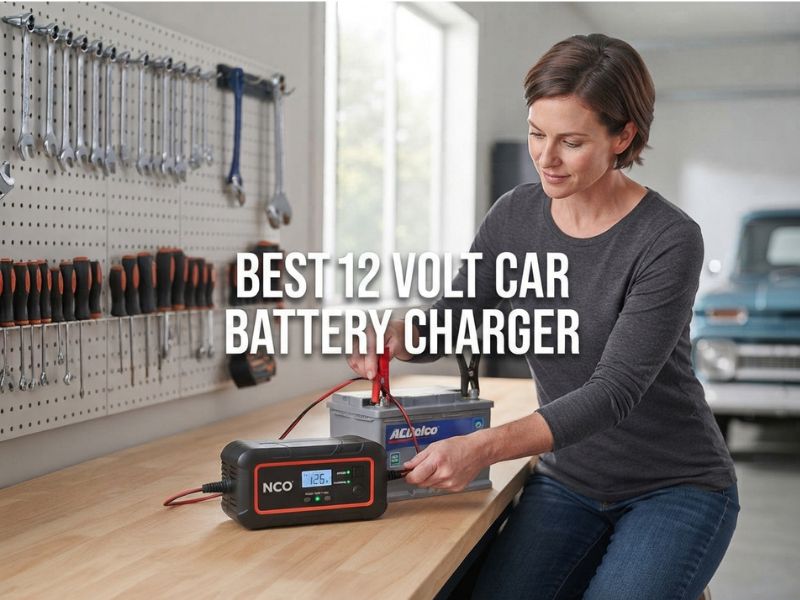
Best 12 Volt Car Battery Charger
| Image | Product Name | Check Price |
|---|---|---|
Best Choice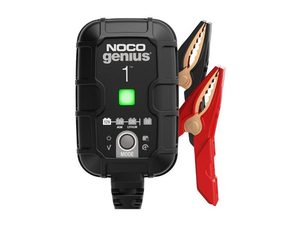 | NOCO GENIUS1 1A Smart Battery Charger | Check Price |
Second Best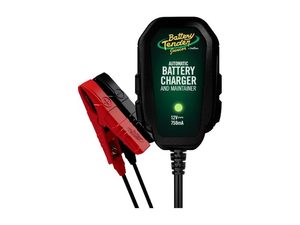 | Battery Tender Junior 12V 750mA Charger and Maintainer | Check Price |
Third Choice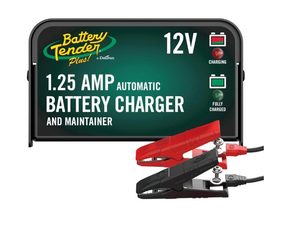 | Battery Tender Plus 12V 1.25A Battery Charger and Maintainer | Check Price |
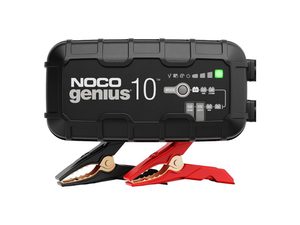 | NOCO GENIUS10 10A Smart Battery Charger | Check Price |
 | NOCO GENIUS5 5A Smart Battery Charger | Check Price |
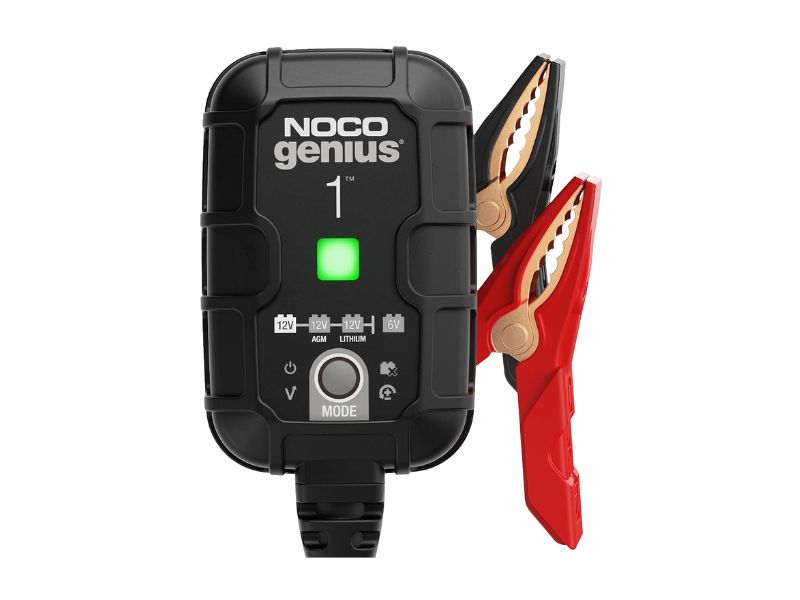
1. NOCO GENIUS1 1A Smart Battery Charger – Best Overall Maintenance Pick
Key Features
- 1A charging output
- 6V and 12V compatibility
- Dedicated 12V charging mode
- AGM battery mode
- EFB compatibility
- Wet/flooded battery compatibility
- Gel battery compatibility
- Compatible lithium battery mode
- Automatic battery maintenance
- Integrated temperature compensation
- Force Mode for extremely low-voltage batteries
- Reverse-polarity protection
- Spark-proof connection protection
- Overcharge and overheating protection
- Compact 0.77-pound design
The NOCO GENIUS1 takes my first position because it combines broad battery compatibility, sophisticated automatic charging, a compact design, and one of the strongest ownership histories in the category.
The most important specification to understand is its 1-amp charging output.
One amp is excellent for battery maintenance and smaller batteries, but it is not fast for a full-size automotive starting battery.
For example, an 80Ah battery that is around 50 percent discharged may require roughly 60 hours to reach full charge under the manufacturer’s approximate charging-time guidance.
That makes GENIUS1 particularly useful for vehicles that are parked frequently rather than cars that regularly need rapid recovery from a deeply discharged state.
Its battery compatibility is one of its greatest advantages.
The charger supports common 12V wet/flooded, maintenance-free, calcium, EFB, AGM, Gel, and compatible lithium batteries. That makes it considerably more versatile than an old-fashioned charger designed only for conventional flooded batteries.
The dedicated AGM mode is important because AGM batteries have different charging characteristics from standard flooded batteries.
Likewise, lithium mode is specifically intended for compatible lithium-ion batteries, including LiFePO4 batteries equipped with an appropriate battery-management system.
Another feature I value is temperature compensation.
Lead-acid battery charging requirements change with temperature. A battery in a freezing garage does not behave exactly like one sitting in summer heat.
GENIUS1’s integrated temperature sensing allows the charger to adjust automatically, reducing the chances of undercharging in cold weather or excessive charging voltage during hot conditions.
Low-voltage recovery is another advantage.
Smart chargers normally need to detect battery voltage before beginning an automatic charge. GENIUS1 can recognize batteries down to approximately 1 volt. For batteries below that threshold, Force Mode allows manual charging initiation.
Force Mode should be used carefully because the charger cannot apply all of its normal automatic detection logic when the battery voltage is extremely low.
Once charging is complete, GENIUS1 transitions into maintenance operation rather than continuing to push maximum charging current into a full battery.
That makes it especially suitable for winter storage, classic cars, weekend vehicles, convertibles, motorcycles, ATVs, lawn equipment, and cars that are driven only occasionally.
What I Like
Its biggest advantage is versatility. One compact charger can handle several common lead-acid chemistries as well as compatible lithium batteries.
The temperature-compensation feature makes it more appropriate for garages exposed to seasonal temperature changes.
Automatic maintenance is ideal for stored vehicles.
The housing is small enough to fit easily inside a garage cabinet or toolbox.
Its integrated eyelet connections also make semi-permanent installation convenient.
What I Do Not Like
The 1A output is slow for a large discharged car battery.
If your primary goal is recovering 60Ah to 100Ah automotive batteries in several hours, GENIUS5 or GENIUS10 is considerably more appropriate.
The LED interface is straightforward but does not provide the numerical voltage and charging-current information available on some LCD chargers.
Verdict
NOCO GENIUS1 is my first choice for 12V battery maintenance, smaller batteries, seasonal vehicles, and owners who prioritize safe automatic battery care over charging speed.
2. Battery Tender Junior 12V 750mA Charger and Maintainer – Best for Long-Term Storage

Key Features
- 12V charging
- 750mA output
- Fully automatic operation
- AGM compatibility
- Gel battery compatibility
- Standard flooded lead-acid support
- Sealed lead-acid compatibility
- Automatic float maintenance
- Alligator-clip connection
- Ring-terminal connection
- Approximately 12-foot total reach
- Compact lightweight design
- Automatic charge monitoring
The Battery Tender Junior is one of the most recognizable low-current maintainers for a reason: it performs a very specific job without unnecessary complexity.
Its output is 750 milliamps, or 0.75 amp.
That number immediately tells you how the product should be used.
This is primarily a maintenance-oriented charger, not a rapid automotive battery recovery machine.
Suppose a typical car battery needs 30Ah of energy replaced.
Even under ideal conditions, charging at 0.75A would require roughly 40 hours before accounting for charging losses and the slower final charging stage.
If your battery is substantially discharged on Friday afternoon and you need the vehicle Friday evening, this is the wrong type of charger.
If your sports car sits for three months every winter, it can be exactly the right charger.
Modern cars consume small amounts of electricity even when switched off.
Security systems, keyless-entry receivers, control modules, clocks, telematics systems, aftermarket electronics, and memory circuits can slowly drain a battery.
The problem becomes more noticeable when the vehicle is rarely driven.
A maintainer compensates for these small losses and keeps the battery near full charge.
The Junior supports AGM, Gel, standard flooded, sealed, and maintenance-free lead-acid batteries within its intended capacity range.
Once the battery is charged, the charger transitions into float maintenance rather than continuously applying uncontrolled current.
That distinguishes it from primitive trickle chargers.
Battery Tender includes both alligator clips and ring-terminal wiring.
Clamps are convenient when you move the charger between batteries.
Ring terminals are better when one vehicle stays connected regularly because the harness can remain attached to the battery.
What I Like
It is extremely simple to operate.
The low charge rate is well suited to long-term storage.
Automatic float maintenance reduces the risk of continuously overcharging a healthy battery.
Ring terminals make regular connection easy.
The compact charger takes very little garage space.
What I Do Not Like
A 750mA charger is very slow for a full-size discharged automotive battery.
It is 12V only, so owners of 6V classic vehicles need another charger.
This version is primarily designed around lead-acid batteries rather than lithium automotive batteries.
Verdict
Battery Tender Junior is one of the strongest choices for a car that sits for weeks or months and primarily needs its battery maintained rather than rapidly recharged.
3. Battery Tender Plus 12V 1.25A Battery Charger and Maintainer – Best Proven 12V Maintainer

Key Features
- 12V charging system
- 1.25A charging output
- Automatic charging
- Float maintenance
- AGM support
- Gel support
- Standard sealed or flooded lead-acid support
- Quick-disconnect connection system
- Alligator clips
- Ring-terminal cable
- Approximately 12 feet of total reach
- Automatic monitoring
- Compact garage-friendly construction
Battery Tender Plus gives you the same maintenance-focused philosophy as Battery Tender Junior but increases charging output to 1.25 amps.
That still makes it a relatively slow charger compared with 5A or 10A products, but it is more practical for normal automotive batteries than a sub-1A maintainer.
The charger is intended for 12V lead-acid battery types including AGM, Gel, standard flooded, and sealed batteries.
Its automatic charging behavior is more important than the simple amperage specification.
A smart battery charger should not treat an empty battery and a nearly full battery identically.
During the main charging phase, the charger provides energy required to restore capacity.
As the battery approaches full charge, current requirements change.
Once fully charged, Battery Tender Plus transitions into maintenance behavior so the battery can remain connected during storage without being subjected to continuous full-rate charging.
This makes it especially attractive for collector cars and second vehicles.
A classic muscle car may only leave the garage twice a month. A convertible might spend most of winter parked. A vacation-home vehicle might remain unused for months.
Those vehicles do not necessarily need a 25A fast charger.
They need a dependable system that prevents the battery from spending long periods partially discharged.
Maintaining a healthy state of charge is important because chronic undercharging encourages sulfation in lead-acid batteries.
That does not mean a maintainer makes the battery immortal. Heat, age, corrosion, plate deterioration, electrolyte loss, vibration, and cycling still contribute to battery aging.
However, preventing extended low-state-of-charge storage removes one common source of premature deterioration.
What I Like
The 1.25A output is more useful for automotive batteries than extremely low-current maintainers.
Its fully automatic operation makes long-term storage simple.
The included ring-terminal cable is convenient for regularly maintained vehicles.
Its straightforward design avoids unnecessary controls.
What I Do Not Like
It remains slow compared with modern 5A and 10A chargers.
It does not provide the multi-chemistry flexibility of chargers with dedicated lithium and EFB modes.
Drivers who frequently recharge discharged batteries should choose something stronger.
Verdict
Battery Tender Plus is an excellent traditional 12V automotive charger-maintainer for stored cars and owners who prioritize proven long-term maintenance behavior.
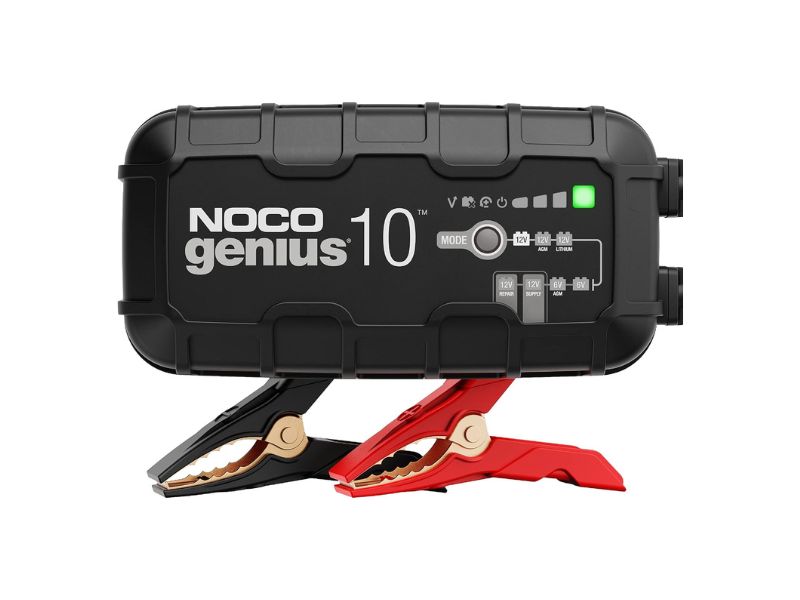
4. NOCO GENIUS10 10A Smart Battery Charger – Best for Fast 12V Charging
Key Features
- 10A charging output
- 6V and 12V operation
- 12V wet/flooded battery mode
- AGM compatibility
- EFB compatibility
- Gel compatibility
- Maintenance-free battery support
- Compatible lithium charging
- Up to approximately 230Ah charging capacity
- Maintenance for batteries beyond normal charging range
- Temperature compensation
- Low-voltage recovery
- Force Mode
- Battery repair mode
- Spark-proof protection
- Reverse-polarity protection
- IP65-rated housing
Although GENIUS10 appears fourth because this list prioritizes established buyer-feedback volume, it may actually be the most practical charger here for a full-size car battery that genuinely needs recharging.
Its output is 10 amps—ten times the charging current of GENIUS1.
That difference is significant.
According to approximate manufacturer charging guidance, an 80Ah automotive battery at about 50 percent depth of discharge may take around six hours with GENIUS10, compared with roughly 60 hours using GENIUS1.
That illustrates why you should never select a charger based on popularity alone.
A maintenance charger and a recovery charger perform related but different jobs.
GENIUS10 is rated for charging batteries up to approximately 230Ah, making it suitable not only for ordinary cars but also many trucks, SUVs, marine batteries, RV batteries, and deep-cycle applications.
Its chemistry support is equally impressive.
You get charging modes for common flooded lead-acid batteries, AGM, EFB, Gel, maintenance-free batteries, and compatible lithium batteries.
That makes it particularly useful in a garage containing several different vehicles.
Temperature compensation automatically changes charging behavior according to ambient conditions.
This becomes especially important during winter.
A cold lead-acid battery may require a different target charging voltage than the same battery during summer heat.
The charger also includes low-voltage detection and Force Mode for batteries whose voltage has fallen below normal smart-charger detection thresholds.
Repair mode is intended to address certain sulfation or acid-stratification conditions in lead-acid batteries.
Repair should not be interpreted as a guarantee that a failed battery can be restored.
A battery with a damaged cell, internal short, cracked case, severe grid corrosion, or extensive active-material loss must be replaced.
What I Like
Ten amps is a genuinely useful automotive charging rate.
The large battery-capacity range gives it excellent versatility.
Its chemistry support covers most common 12V automotive battery designs.
Temperature compensation is valuable in both cold and hot climates.
Low-voltage recovery, repair, and maintenance functions give it considerably more capability than a basic charger.
What I Do Not Like
It costs more and occupies more space than low-current maintainers.
Ten amps is unnecessary if you only maintain a motorcycle or small lawn-equipment battery.
You need to identify the battery chemistry correctly before selecting specialized modes.
Verdict
If your priority is actually recharging discharged car, SUV, or truck batteries within a useful time frame, GENIUS10 is my strongest performer among these five.
5. NOCO GENIUS5 5A Smart Battery Charger – Best Balanced 12V Charger

Key Features
- 5A charging current
- 6V and 12V operation
- Flooded lead-acid support
- AGM charging mode
- EFB compatibility
- Gel compatibility
- Maintenance-free battery support
- Compatible lithium charging mode
- Charging capacity up to approximately 120Ah
- Maintenance mode
- Temperature compensation
- Low-voltage battery recovery
- Force Mode
- Battery repair functionality
- Reverse-polarity protection
- Spark-proof protection
- IP65-rated construction
NOCO GENIUS5 is arguably the most balanced charger in this entire comparison.
Its 5A output occupies an ideal middle ground between low-current maintainers and higher-output recovery chargers.
Five amps is substantially faster than 0.75A, 1A, or 1.25A maintenance chargers but generates less output than GENIUS10.
For many households, that balance is exactly right.
It is rated for normal charging of batteries up to approximately 120Ah, which comfortably covers a large percentage of passenger-car batteries and many SUV, pickup, marine, and recreational batteries.
Consider an 80Ah battery at roughly 50 percent depth of discharge.
Manufacturer guidance indicates an approximate charging time around 12 hours.
That is slow enough for an overnight session but dramatically faster than using a 1A maintainer.
The battery-chemistry support mirrors the broader Genius family.
You can use appropriate modes for wet/flooded, AGM, EFB, Gel, maintenance-free, and compatible lithium batteries.
This flexibility matters increasingly as newer cars adopt AGM and EFB batteries for start-stop systems and greater electrical demands.
Its thermal sensor automatically compensates for temperature changes.
That feature is especially useful when the charger lives in an unconditioned garage.
Another strength is its physical size.
GENIUS5 weighs around 1.5 pounds and has an IP65-rated housing, so it remains easy to store and reasonably resistant to typical garage environmental exposure.
For most homeowners, I would choose this charging rate over 1A if the battery ever needs meaningful recharging.
At the same time, automatic maintenance allows GENIUS5 to remain useful after the battery reaches full state of charge.
What I Like
Five amps is an excellent everyday automotive charging rate.
The 120Ah capacity range covers most passenger vehicles.
AGM, EFB, Gel, flooded, and compatible lithium modes make it versatile.
Its compact housing is easy to store.
Temperature compensation and automatic maintenance make it appropriate for year-round use.
What I Do Not Like
GENIUS10 is faster for large or deeply discharged batteries.
Its LED indicators provide less numerical information than a full LCD charger.
It may be more charger than necessary if your only need is maintaining one small seasonal battery.
Verdict
NOCO GENIUS5 is my best balanced 12V car battery charger for an average home garage, combining useful charging speed with maintenance capability and broad battery compatibility.
12 Volt Car Battery Charger Comparison
| Product | Charge Rate | Voltage | Main Battery Types | Maintainer | Low-Voltage Recovery | Best For |
| NOCO GENIUS1 | 1A | 6V/12V | Wet, AGM, EFB, Gel, Lithium | Yes | Yes | Storage and maintenance |
| Battery Tender Junior | 0.75A | 12V | Flooded, AGM, Gel, sealed | Yes | Standard automatic operation | Long-term storage |
| Battery Tender Plus | 1.25A | 12V | Flooded, AGM, Gel | Yes | Standard automatic operation | Stored cars |
| NOCO GENIUS10 | 10A | 6V/12V | Wet, AGM, EFB, Gel, Lithium | Yes | Yes | Fast automotive charging |
| NOCO GENIUS5 | 5A | 6V/12V | Wet, AGM, EFB, Gel, Lithium | Yes | Yes | Everyday garage use |
The comparison highlights why charger amperage matters.
The NOCO GENIUS1, Battery Tender Junior, and Battery Tender Plus make the most sense when your battery is already reasonably healthy and your primary objective is keeping it charged during storage.
The NOCO GENIUS5 is better when you want both maintenance and practical overnight charging.
The NOCO GENIUS10 is the strongest option when charging speed matters and you regularly deal with partially or deeply discharged full-size automotive batteries.
How to Choose the Best 12 Volt Car Battery Charger
Choosing a charger begins with identifying the battery rather than studying charger marketing.
Look at the battery label or vehicle owner’s manual and determine:
Voltage, battery chemistry, battery capacity, and recommended charging rate.
Once those four details are known, most of the buying decision becomes straightforward.
Confirm That Your Vehicle Uses a 12V Battery
Most modern passenger cars, SUVs, pickups, vans, and light-duty vehicles use a 12-volt starting battery.
However, exceptions exist.
Some classic vehicles use 6V electrical systems.
Commercial equipment can use 24V systems.
Hybrid and electric vehicles may contain a conventional 12V auxiliary battery alongside a completely separate high-voltage traction battery.
Never connect an ordinary automotive charger to a high-voltage hybrid or EV traction battery.
This guide refers only to compatible low-voltage automotive batteries.
Identify Your Battery Chemistry
The chemistry determines which charging profile should be used.
Common types include:
- Flooded lead-acid
- Maintenance-free lead-acid
- AGM
- EFB
- Gel
- LiFePO4
A charger that works perfectly on a standard flooded battery is not automatically correct for every lithium or Gel battery.
Choose the Correct Charging Amperage
Amperage is one of the biggest practical differences between chargers.
A 0.75A to 1.25A charger is ideal when maintenance matters more than speed.
A 5A charger is an excellent general-purpose automotive option.
A 10A charger is better when you frequently recharge significantly discharged batteries.
Higher-current chargers are available, but they should be matched carefully to battery capacity and condition.
1 Amp vs 5 Amp vs 10 Amp Battery Charger
1 Amp Charger
A 1A charger is gentle and compact.
It works particularly well for:
Seasonal cars, classic vehicles, motorcycles, small batteries, lawn equipment, long-term maintenance, and batteries that are only slightly discharged.
Its disadvantage is time.
Recharging a large battery can require one or more days.
5 Amp Charger
Five amps is the best general-purpose rate for many home garages.
It is useful for:
Passenger cars, SUVs, pickups, AGM batteries, overnight charging, preventive maintenance, and households with several vehicle types.
Five amps offers enough current to make meaningful progress without requiring a large charger.
10 Amp Charger
Ten amps is the better option for drivers who frequently encounter low automotive batteries.
It is particularly useful for:
Large car batteries, truck batteries, deeply discharged batteries, larger AGM batteries, marine batteries, deep-cycle batteries, and quicker garage charging.
The charger should still regulate current automatically as the battery approaches full charge.
How Long Does a 12V Car Battery Take to Charge?
Charging time depends primarily on battery capacity, depth of discharge, charging rate, temperature, battery age, and charger efficiency.
A simple estimate is:
Missing battery capacity ÷ charging current = approximate bulk charging time
Suppose a 60Ah battery is around 50 percent charged.
Approximately 30Ah must be replaced.
At 1A, the theoretical bulk phase is around 30 hours.
At 5A, it is around 6 hours.
At 10A, around 3 hours.
Actual full-charge time will be longer because battery charging is not perfectly efficient and current decreases during later stages.
What Is a Smart 12V Battery Charger?
A smart charger uses electronic control to change its output according to battery condition.
Older manual chargers often supplied relatively fixed current until the owner disconnected them.
A modern automatic charger may progress through several stages, including:
Battery detection, soft start, bulk charging, absorption, optimization, analysis, and maintenance.
Different manufacturers use different stage names.
The exact number of advertised stages is less important than whether the charger properly controls voltage and current for the battery chemistry.
Battery Charger vs Battery Maintainer
A charger primarily restores missing energy.
A maintainer primarily preserves a battery that is already charged.
Modern smart devices often perform both jobs.
GENIUS5 and GENIUS10 can charge at useful automotive rates and then maintain the battery after reaching full charge.
Battery Tender Junior is much more maintenance-oriented because of its low 750mA output.
Neither approach is inherently better.
The correct product depends on your vehicle use.
Battery Maintainer vs Trickle Charger
These terms are often mixed together.
A traditional trickle charger provides a small continuous current.
An automatic battery maintainer monitors battery condition and changes output when the battery reaches full charge.
For long-term vehicle storage, a fully automatic maintainer is preferable to a primitive unregulated trickle charger.
Continuous overcharging can damage a lead-acid battery.
AGM Car Battery Charging
AGM batteries are increasingly common in modern vehicles.
AGM stands for Absorbent Glass Mat.
Instead of liquid electrolyte freely moving around inside the case, AGM batteries hold electrolyte in fiberglass mats between the plates.
They tolerate vibration and cycling well and are common in:
Start-stop vehicles, luxury cars, performance vehicles, trucks, SUVs, and vehicles with significant electrical loads.
Choose a charger with a specific AGM charging mode or explicit AGM compatibility.
GENIUS1, GENIUS5, GENIUS10, Battery Tender Junior, and Battery Tender Plus all provide relevant AGM support.
What Is an EFB Battery?
EFB means Enhanced Flooded Battery.
EFB technology improves on conventional flooded lead-acid construction and is commonly used in some start-stop vehicles.
An EFB battery should be charged using a profile that its manufacturer approves.
NOCO GENIUS1, GENIUS5, and GENIUS10 provide explicit EFB compatibility.
Do not assume every old 12V charger automatically provides an ideal EFB charging profile.
Charging a Gel Battery
Gel batteries are sealed lead-acid batteries containing a thickened electrolyte.
They can be sensitive to excessive charging voltage.
Use a charger explicitly compatible with Gel batteries.
Do not assume AGM and Gel charging requirements are identical simply because both are sealed lead-acid technologies.
Charging a Lithium 12V Battery
Some specialty vehicles use LiFePO4 lithium batteries.
Lithium batteries require a compatible charging profile and an appropriate battery-management system.
NOCO Genius chargers in this comparison provide compatible lithium modes.
Never apply a lead-acid desulfation or repair mode to a lithium battery unless the battery and charger manufacturers explicitly approve that procedure.
What Does Temperature Compensation Do?
Battery chemistry changes with temperature.
A cold lead-acid battery may need different charging voltage than a hot battery.
A fixed charging voltage can therefore result in:
Undercharging during very cold conditions or excessive charging voltage during hot conditions.
Automatic temperature compensation allows the charger to adjust its charging behavior according to ambient temperature.
This feature is especially useful in an unheated or uncooled garage.
What Is Battery Repair Mode?
Certain smart chargers provide a battery-repair or desulfation function.
Lead sulfate develops naturally on the plates when a lead-acid battery discharges.
Normal charging converts much of it back into active battery material.
If the battery remains partially discharged for long periods, sulfate can harden.
Repair modes use specialized charging behavior intended to improve certain recoverable sulfation or stratification conditions.
They cannot repair every failed battery.
Can a Charger Bring a Dead Battery Back to Life?
Sometimes.
A battery that is simply deeply discharged may recover after controlled charging.
A battery that is physically or chemically failed may not.
A charger cannot reliably fix:
- A shorted cell
- Broken internal connections
- Severe grid corrosion
- Cracked battery cases
- Extreme active-material shedding
- Frozen-battery damage
- Irreversible sulfation
If a fully charged battery still cannot provide adequate cranking power, it should be properly tested.
Why Smart Chargers Sometimes Do Not Detect Dead Batteries
Automatic chargers perform voltage checks before enabling normal output.
If battery voltage is extremely low, the charger may interpret the situation as no battery being connected.
Certain models provide a manual Force Mode that allows charging to begin below the normal detection threshold.
This function requires extra care because some automatic detection protections are temporarily bypassed.
Can I Leave a Smart Battery Charger Connected Overnight?
A compatible automatic charger is generally designed to manage the battery after it becomes fully charged.
This makes overnight charging normal for many smart chargers.
However, inspect the battery before charging.
Do not charge a battery that is:
Cracked, leaking, swollen, frozen, unusually hot, physically damaged, or producing a strong abnormal odor.
Automatic electronics cannot make a physically unsafe battery safe.
Can I Leave a Battery Maintainer Connected All Winter?
Many smart maintainers are specifically designed for long-term storage.
Once the battery becomes fully charged, the charger transitions into a maintenance strategy that supplies energy only as required.
Battery Tender Junior, Battery Tender Plus, and the NOCO models in this guide can all serve maintenance-oriented applications.
The charger and battery should still be inspected periodically.
Should I Disconnect My Car Battery Before Charging?
Not always.
Many modern smart chargers are designed for charging batteries while they remain installed in the vehicle.
However, some vehicles specify dedicated charging posts or grounding points.
Vehicles with intelligent battery-monitoring systems may require charging current to pass through a specific sensor.
Always follow the vehicle owner’s manual.
Never make assumptions based solely on how an older vehicle was charged.
Safe 12V Battery Charging Basics
Before charging, determine the battery voltage and chemistry.
Inspect the battery for physical damage.
Keep flames, cigarettes, grinding equipment, and spark-producing tools away from lead-acid batteries.
Place the charger where it receives adequate ventilation.
Make connections according to the charger and vehicle instructions.
Select the correct charging mode.
Keep cables clear of fans, belts, pulleys, and hot engine components.
Allow the automatic charging cycle to complete.
Disconnect the charger using the recommended sequence.
Why You Should Never Charge a Frozen Battery
A deeply discharged lead-acid battery can freeze at a much higher temperature than a fully charged battery.
Frozen electrolyte may expand and damage internal structures or the battery case.
Attempting to charge a frozen battery can create a serious safety hazard.
Allow the battery to reach a safe temperature and inspect it before considering charging.
A cracked or distorted battery should be replaced.
Best 12V Charger for a Stored Car
For a vehicle that spends weeks or months parked, charging speed is less important than reliable maintenance.
My strongest options are:
NOCO GENIUS1, Battery Tender Junior, and Battery Tender Plus.
If the battery is normally healthy before storage, these lower-output devices provide all the current needed to compensate for self-discharge and parasitic loads.
Best 12V Charger for a Dead Car Battery
For a significantly discharged full-size car battery, I prefer NOCO GENIUS10.
Its 10A output is much more practical than waiting one or two days with a low-current maintainer.
GENIUS5 is another excellent option when overnight charging is acceptable.
If a battery is extremely low, check whether the charger detects it automatically before using any manual low-voltage recovery function.
Best 12V Charger for AGM Batteries
All five chargers have relevant AGM capability, but I particularly like NOCO GENIUS5 and GENIUS10 for automotive AGM batteries.
Their charging rates are better suited to normal full-size automotive capacities while still providing dedicated AGM charging behavior and maintenance functionality.
Best 12V Charger for Start-Stop Cars
Start-stop cars often use AGM or EFB batteries.
The charger therefore needs explicit compatibility with the battery installed in your vehicle.
NOCO GENIUS1, GENIUS5, and GENIUS10 support both AGM and EFB battery types.
GENIUS5 is my favorite general-purpose option because its 5A output provides useful charging speed without requiring a particularly large charger.
Best Charger for Cold Weather
Cold conditions reduce battery output and increase the amount of energy required to crank an engine.
Temperature-compensated chargers provide an advantage because they can adjust charging according to environmental conditions.
GENIUS1, GENIUS5, and GENIUS10 all incorporate automatic thermal compensation.
Keeping the battery fully charged before winter is also important because a low-state-of-charge lead-acid battery is more vulnerable to freezing.
Best Charger for Hot Weather
High temperatures accelerate battery aging.
Charging voltage that is appropriate in a cold garage may be excessive when the battery is hot.
Temperature compensation therefore matters in hot climates as well.
If your vehicle lives in a warm garage or experiences long summers, prioritize a charger with thermal management rather than simply choosing the highest current rating.
Common 12V Battery Charger Mistakes
Buying Too Little Charging Power
A 0.75A maintainer can charge a car battery, but it may take days.
Choose 5A or 10A if you regularly need actual battery recovery.
Buying More Power Than You Need
A stored classic car does not necessarily need a large fast charger.
A small automatic maintainer may be more appropriate.
Selecting the Wrong Battery Mode
Do not use lithium mode on a lead-acid battery or vice versa.
Identify the battery before charging.
Ignoring AGM and EFB Requirements
Modern start-stop systems frequently use specialized batteries.
Use the correct charging profile.
Assuming Repair Mode Makes Batteries New
Repair functions can help certain neglected batteries but cannot reverse physical aging.
Leaving a Damaged Battery Charging
Never rely on smart electronics to compensate for a cracked, leaking, swollen, frozen, or overheating battery.
Confusing a Charger With a Jump Starter
A charger gradually restores battery capacity.
A portable jump starter supplies immediate high current to crank the engine.
For roadside emergencies, a jump starter is more useful.
For home battery care, a charger is better.
Frequently Asked Questions
What is the best 12 volt car battery charger?
NOCO GENIUS1 is my primary maintenance-focused recommendation, while GENIUS5 offers the best everyday charging balance.
GENIUS1 is extremely compact and works well for long-term maintenance, but its 1A output is slow for large discharged batteries. For an average car owner who needs practical overnight charging as well as maintenance, the 5A GENIUS5 may be more useful. GENIUS10 is preferable when faster charging is the priority.
Is a 12V charger suitable for all cars?
Most conventional passenger vehicles use a 12V battery, but you should always verify the vehicle first.
Some classic cars use 6V systems, commercial equipment can use 24V systems, and hybrids or EVs contain electrical systems beyond the conventional 12V auxiliary battery. Never connect an ordinary charger to a high-voltage traction battery.
How many amps should a 12V car battery charger have?
Five to ten amps is an excellent range for most full-size automotive batteries.
Lower-output chargers around 0.75A to 2A work extremely well for maintenance but require far longer to restore substantial capacity. A 5A charger offers a strong balance, while 10A is better for faster recovery.
Is a 1 amp charger good for a car battery?
Yes for maintenance and slow charging, but not when fast recovery is required.
A 1A charger can take dozens of hours to restore a significantly discharged automotive battery. It is better for stored cars, motorcycles, smaller batteries, and maintaining an already-charged vehicle.
Is a 5 amp charger enough for a car?
Yes. Five amps is one of the most practical charging rates for passenger cars.
It provides meaningful charging speed without the size or heat generation of a much larger charger. Many normal automotive batteries can be recharged overnight with a quality 5A smart charger, depending on capacity and depth of discharge.
Is a 10 amp charger too strong for a car battery?
No, a proper automatic 10A automotive charger is appropriate for many full-size car batteries.
Smart chargers regulate their current according to battery condition and reduce output as the battery approaches full charge. Always confirm that the battery capacity and chemistry are compatible with the charger.
How long does a 12 volt battery take to charge?
Charging can take several hours to several days depending on amperage and battery condition.
A 1A charger may require a day or more for a large battery, while a 5A or 10A charger can complete much of the charging process in several hours. Battery capacity, starting state of charge, temperature, age, and charger algorithm all influence actual time.
Can I leave a 12V battery charger connected overnight?
Yes, when using a compatible fully automatic smart charger on a healthy battery.
Automatic chargers reduce or change their output when the battery reaches full charge. Do not leave a damaged, leaking, swollen, frozen, or overheating battery charging unattended.
Can I leave a battery maintainer connected for months?
Many smart maintainers are designed specifically for long-term vehicle storage.
They monitor the battery after full charge and supply additional energy only when necessary. Periodically inspect the battery, terminals, wiring, and charger even when the system is automatic.
What is the difference between a charger and a maintainer?
A charger restores missing energy, while a maintainer primarily keeps a charged battery full during storage.
Many modern products perform both functions. Higher-output 5A and 10A devices are more practical for charging, while sub-2A models often excel at maintenance.
Can I use a 12V charger on an AGM car battery?
Yes, provided the charger explicitly supports AGM batteries.
AGM batteries have charging requirements that can differ from standard flooded batteries. Using a dedicated AGM mode is the safer and more effective approach.
Can I use a normal 12V charger on an EFB battery?
Use a charger or mode that specifically supports EFB batteries whenever possible.
EFB batteries are common in some start-stop vehicles and differ from ordinary flooded batteries. NOCO Genius chargers in this guide provide explicit EFB compatibility.
Can a 12V charger charge a lithium car battery?
Only when the charger and lithium battery are explicitly compatible.
Lithium iron phosphate batteries need their own charging profile and appropriate battery-management electronics. Do not use lead-acid repair or desulfation modes on lithium batteries.
Can a battery charger fix a dead battery?
It can recover some deeply discharged batteries but cannot repair every failed battery.
A battery with healthy internal components may recover after controlled charging. A battery with a shorted cell, damaged plates, internal corrosion, frozen damage, or severe irreversible sulfation will normally require replacement.
Why won’t my charger recognize the battery?
Battery voltage may be too low for automatic detection, or the electrical connection may be poor.
Check clamp contact, terminal corrosion, polarity, battery voltage, and charger mode. Certain chargers provide manual low-voltage recovery for extremely discharged batteries.
Should I use repair mode every time I charge?
No. Repair mode is intended for specific lead-acid battery problems, not routine charging.
Normal charging and maintenance modes should be used for healthy batteries. Repair modes can involve specialized voltage behavior and should only be selected when appropriate.
Can I charge my car battery without removing it?
Many smart chargers support in-vehicle charging, but your vehicle’s instructions should determine the connection procedure.
Modern cars may have designated charging posts or battery-monitoring sensors. Connecting at the specified locations helps ensure that the vehicle electronics correctly recognize battery charging.
Does a battery charger help during winter?
Yes, keeping the battery fully charged can significantly improve cold-weather starting reliability.
Cold temperatures reduce available battery power while the engine requires more effort to crank. A temperature-compensated charger is particularly useful in an unheated garage.
Is Battery Tender Junior strong enough for a car?
It can maintain many car batteries, but its 750mA output is slow for substantial recharging.
It is most useful on a healthy battery during storage. If a normal car battery is deeply discharged, a 5A or 10A charger will be considerably more practical.
Is NOCO GENIUS1 strong enough for a car battery?
It is excellent for maintenance but slow for charging a large automotive battery.
Its 1A output can recharge a car battery eventually, but a significantly discharged 80Ah battery may require multiple days. GENIUS5 or GENIUS10 is better when time matters.
Final Verdict
The best 12 volt car battery charger depends primarily on whether you want to maintain a healthy battery or recover a discharged one.
My primary recommendation, the NOCO GENIUS1, is particularly strong for battery maintenance, stored vehicles, smaller batteries, and owners who want broad chemistry support in an extremely compact charger. Its automatic maintenance, AGM/EFB/Gel/lithium compatibility, temperature compensation, and low-voltage recovery make it unusually versatile despite the modest 1A output.
The Battery Tender Junior is even more focused on long-term maintenance. Its 750mA output makes it an excellent choice for seasonal vehicles but a poor option when you need a discharged full-size battery recharged quickly.
The Battery Tender Plus increases output to 1.25A and remains an excellent traditional choice for maintaining stored 12V lead-acid automotive batteries.
When charging speed becomes important, the NOCO GENIUS10 is the strongest performer in this lineup. Its 10A output and roughly 230Ah charging range make it much more appropriate for full-size batteries that have lost substantial capacity.
For the average home garage, I consider the NOCO GENIUS5 the most balanced alternative. Five amps provides practical overnight charging while retaining the automatic maintenance, broad battery compatibility, temperature compensation, and safety protections expected from a modern smart charger.
If your car normally sits in storage, choose a low-current maintainer. If you occasionally need to restore a discharged battery, choose around 5A. If charging time is important or you own larger batteries, 10A is the more practical choice.
Most importantly, identify the battery’s voltage, chemistry, capacity, and recommended charging rate before connecting any charger. Matching the charger correctly is far more important than simply choosing the model with the largest number on the label.